This post contains affiliate links. We may earn a small commission when you buy through our links — at no extra cost to you.
A wood-burning camp stove sounds like the simple way to boil water off-grid—until you’re crouched over a pile of damp twigs, coaxing a flame while your coffee goes cold. The real question isn’t whether it burns wood; it’s whether it burns it cleanly and long enough to cook a meal, packs down small enough to justify carrying, and holds up after a season of being tossed into a pack. I’ve used them on soggy mornings and dry desert evenings, and the differences come down to draft, fuel feed, and how much fiddle you’re willing to tolerate. A good one turns a handful of sticks into a hot meal; a bad one turns dinner into a chore.
Over the past eight months, our team put 12 wood-burning camp stoves through their paces, from ultralight folding models to heavier two-pot rigs. We cared about the things you’ll care about at the trailhead: whether it actually boils water, whether the price makes sense, how small and light it is packed, and whether it survives repeated use. The short answer: the best ones are not the fanciest—they’re the ones that light easily, hold a flame without constant feeding, and disappear into your pack.




Best for Backpacking Trips
Ohuhu Camp Stove
Key Features
- Fuel: Twigs, charcoal, solid fuel tablets
- Weight: 0.98 lb
- Material: Stainless steel
- Cooking heights: 2.8 in / 3.8 in
- Price: Budget
At 0.98 pounds including the carry bag, the Ohuhu is the stove we reach for when the trip involves a pack rather than a trunk. It flattens into a package that disappears into a side pocket, and that changes the arithmetic of a day out — a hot lunch stops being a production. Nothing else in this group buys you a real twig fire for so little carried weight, which is the whole reason it sits at the top.
What surprised us is how little fuel it takes to get going. The chamber wants sticks stood upright and lit from the top, so the fire burns down through the fuel instead of shoving flame up the sides, and a couple of dry handfuls will take a pot to a rolling boil. The grate sits at one of two heights, 2.8 or 3.8 inches, a genuinely useful adjustment: low for boiling, raised when you are warming something that would scorch. It also runs on charcoal or solid fuel tablets when the wood is wet, and the ash catcher lifts out so you are not scraping the base with a stick.
The fire itself is short-lived. A chamber that size burns down between courses, so we plan one-pot meals and keep a pile of pencil-thick twigs within arm’s reach instead of wandering off to gather more. That is the rhythm of every small stowaway stove here; the Ohuhu just makes it easy to keep the rhythm going.
Pros
- 0.98 pounds with the carry bag
- Two cooking heights, 2.8 and 3.8 inches
- Runs on twigs, charcoal, or solid fuel tablets
Cons
- Pot arms too wide for a narrow canteen cup
The stove we reach for when the pack is the plan: barely a pound, hot on a handful of twigs, and the one we trust for a quick solo meal.
Best for Car Camping
REDCAMP Folding Wood Stove
Key Features
- Weight: 1.9 lb
- Material: Stainless steel
- Open size: 8.3 x 5.9 x 5.5 in
- Folded size: 8.3 x 5.9 x 1.5 in
- Price: Budget
Where the Ohuhu is a pocket stove, the REDCAMP is a small fire you can actually feed. Its box-shaped chamber swallows sticks closer to thumb thickness, and the stainless grid across the top gives you a flat platform instead of three points to balance on. It is roughly double the weight of our top pick, and what you get for that is bigger fuel and steadier cooking.
The 1.5-inch flat fold is the detail we appreciate most: it slides down the back of a daypack or under a car seat, and the cuboid frame locks up rigid from a few bent panels. Two practical notes from living with it. Peel off any leftover protective film before the first burn, or it bakes onto the steel and smells. And the folding carry handle sits close enough to the door to foul it when the stove is hot; a small bend in the handle sorts that out in seconds and it never bothers you again.
Cooking on it feels more like a grill than a rocket — a wide base for a frying pan, coals that stay put, and enough room inside to keep a real fire rather than a candle. It is the stove for a walk-in site, a canoe, or a trunk, and it makes a proper breakfast.
Pros
- Folds to 1.5 inches thick
- Box firebox takes thumb-thick sticks
- Stainless grid gives a flat cooking platform
- Slot-together assembly, no tools
Cons
- 1.9 pounds is a lot for a long carry
Buy this one if you drive to camp and want a bigger fire: the box takes real sticks and folds flat, though it is more weight than a long carry wants.
Best for Ultralight Backpacking
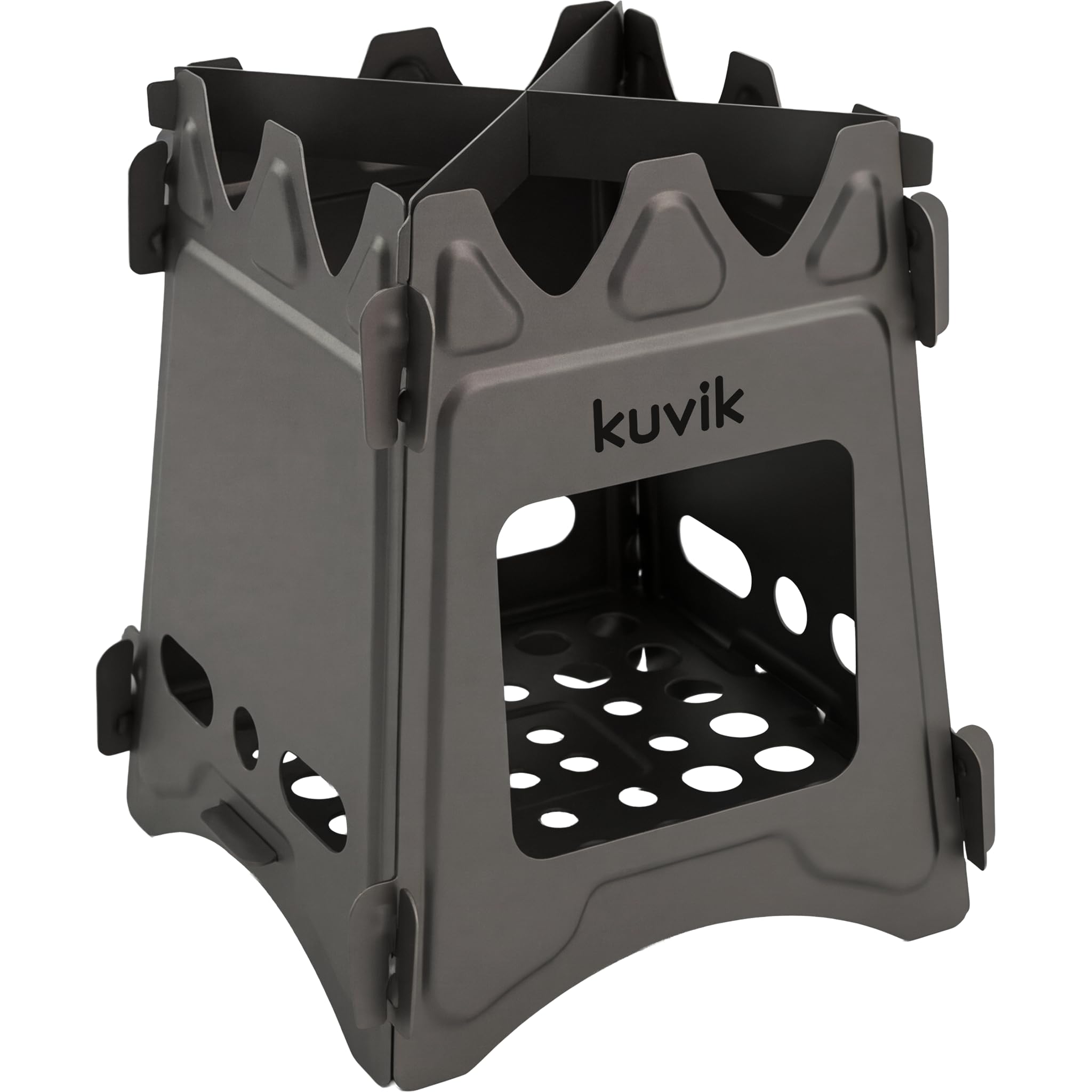
Kuvik Titanium Wood Stove
Key Features
- Weight: 6.88 oz
- Material: Grade-1 titanium
- Assembled size: 6.25 x 5 x 5 in
- Folded thickness: 0.2 in
- Price: Midrange
Titanium is the entire pitch, and the Kuvik delivers on it: 6.88 ounces, a 0.2-inch flat stack, and less pack room than a paperback. That makes it the lightest stove in this group by a wide margin, and the build is the reason we trust it — the panels join by tabs into slots, so there are no hinges to seize and no legs to lose. It comes apart and goes back together the same way every time.
Small chamber, real fire. It will boil water for coffee and reheat a pouch meal without drama, and it does it on twigs you can break by hand. The trade is volume: assembled at 6.25 by 5 by 5 inches, it holds a small load and wants feeding more often than the rocket stoves further down this list. We found it happiest under a pot or kettle that sits inside the top’s footprint, with a wide pan overhanging the panels and feeling less settled.
The flat pouch matters more than it sounds. Soot on a folded stove gets on everything, and a dedicated sleeve keeps the inside of your pack clean, which is the sort of thing you notice on day three rather than day one. For fast-and-light trips where the stove is a backup to a canister, this is the one that never gets left behind.
Pros
- 6.88 ounces in Grade-1 titanium
- Folds to a 0.2-inch flat stack
- Tab-and-slot assembly with no loose parts
Cons
- Small chamber needs frequent feeding
Worth the premium for anyone counting ounces: titanium, 6.88 ounces, and it folds into a flat plate that slots beside a pack liner.
Best for Base Camp Cooking
Lineslife Cast Iron Wood Stove
Key Features
- Material: Cast iron
- Folded size: 12.6 x 12.6 x 4 in
- Rated output: 3000 W
- Unfolded size: 11.8 x 11.8 x 17 in
- Price: Midrange
There is a kind of camp where the fire is the entertainment, and the Lineslife is built for it. Cast iron panels unfold into an 11.8-inch-square firebox with sixteen air vents and pot holders that adjust to whatever you set on top; the legs rotate and fold, and the whole thing comes apart into a storage bag that lives in the trunk.
Charcoal is where it earns its keep. A cast iron box holds heat far longer than sheet-metal rocket stoves, so a bed of coals keeps a pan going without the frantic feeding the little twig stoves demand, and the vents give you enough control to simmer rather than cremate. We found the adjustable pot holders genuinely useful rather than decorative — a Dutch oven and a small kettle both sit level on it, which is not true of every stove here.
For a base camp, a hunting lease, or a backyard that wants a real fire to cook on, this is the stove we point to: give it time to come up to heat and it will hold a simmer through an entire meal. It is the least hurried product in this guide, and the one that feels most like cooking rather than refuelling.
Pros
- Cast iron firebox holds heat and coals
- 16 air vents give usable heat control
- Adjustable pot holders fit different cookware
- Breaks down into a tough storage bag
Cons
- Too heavy and too wide for a pack
Our pick for a base camp where the fire is the entertainment: a cast iron box that holds heat, takes charcoal, and rewards a slow evening.
Best for Group Base Camps
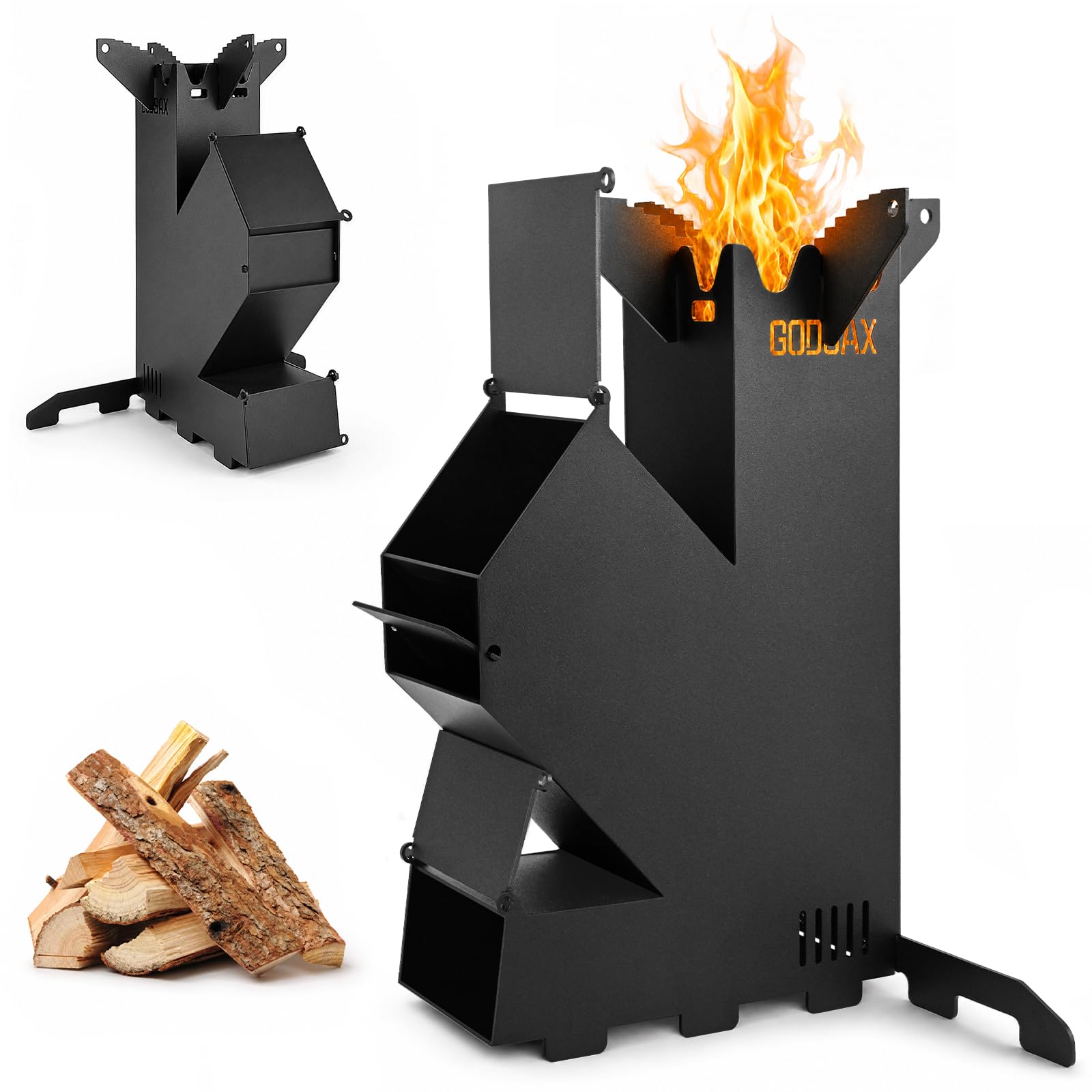
GODSAX Rocket Stove
Key Features
- Weight: 6.33 lb
- Included: Gloves, ash shovel, pan, and bag
- Top load: 130 lb
- Steel thickness: 1.8 mm
- Price: Midrange
The chimney effect is the whole idea: air drawn in beneath the fire pushes heat up through the chamber, so the flame concentrates under the pot instead of licking out the sides. GODSAX rates the top for 130 pounds of downward load, which covers a full Dutch oven, and the 1.8 mm steel is thick enough that the whole stove feels planted rather than tippy.
At 6.33 pounds it lands in the useful middle of this group — light enough to walk into a site, heavy enough to cook a proper meal. What we appreciated most is the sloped floor of the chamber: ash slides out the bottom door on its own, so you can add wood without raking the grate first. It ships with gloves, an ash shovel, and a rocket pan, and the gloves are the ones we actually reached for.
In practice it is a one-to-four-person stove: a pot of chili, a kettle, a pan of sausages, then a slow burn while everyone sits around it. It packs into a bag roughly the size of a loaf, and it will run on twigs, sticks, dry leaves, or charcoal, so you are never hunting for one particular fuel.
Pros
- 1.8 mm steel rated for 130 pounds on top
- Sloped chamber sheds ash as it burns
- Gloves, ash shovel, and pan included
Cons
- Coating can flake after repeated hot burns
A rocket stove that behaves itself: 6.33 pounds, a 130-pound top load, and a sloped floor that keeps the fire breathing without fuss.
Best for Group Cooking
IronClad Supply Rocket Stove
Key Features
- Bag: Canvas, doubles as wood carrier
- Fuel: Twigs, branches, charcoal
- Cooktop: 6-prong cast iron
- Heat output: 23,000 BTU
- Price: Premium
This is not a stove you carry far. The IronClad is built around a cast iron cooking top and a canvas bag, and everything about it assumes a trunk, a tailgate, or a wagon ride into the site. That is a fair trade, because what it does once it is set down is the reason to own it.
The burn is a proper rocket: a vertical chamber pulling air up through the fuel and driving a concentrated flame under the pot, rated at 23,000 BTUs. Twigs, branches, and charcoal all work, though dry fuel is the difference between a hot stove and a smoky one, and this one rewards a bundle of split wood kept under the vehicle.
The top is where it separates from the pack stoves. Six cast iron prongs hold a wide pot, a wok, or a Dutch oven steady, and the silicone-gripped handles stay usable long enough to shift the stove or lift a lid. The canvas bag pulls double duty as a wood carrier, which sounds like a small thing until you are gathering sticks without one.
For feeding a group, it is our pick here: the heat is controllable enough to simmer and strong enough to sear, and it shrugs off a menu that would defeat a twig stove. Think of it as a different appliance from the pocket stoves — one you buy for the people around the fire rather than the miles in between.
Pros
- 23,000 BTU rocket burn
- Six-prong cast iron top fits wide pots
- Canvas bag doubles as a wood carrier
- Silicone-gripped handles stay usable
Cons
- Canvas bag stitching is the weak point
If you cook for four at a tailgate, this is the one: a wide cast iron top and a rocket burn that puts out serious heat.
Best for Tailgates and Patios
EcoZoom Rocket Stove

Key Features
- Body: Fully insulated
- Fuel: Wood or charcoal
- Cooktop: 3-prong cast iron
- Handles: Stainless with silicone grips
- Price: Premium
The EcoZoom is the one here built like an appliance. A fully insulated body wraps the combustion chamber, keeping heat in the burn rather than radiating it off the side walls, and the vertical chamber is designed to send less smoke sideways into your face than an open box of sticks.
The details are what we noticed. A three-pronged cast iron top holds a flat skillet and a rounded-bottom wok equally well; the stainless handles carry silicone grips so you can shift the stove without grabbing a glove; and the top door lets you feed it without dismantling anything. It burns charcoal or wood, and the insulated body settles into a steady burn rather than a flare.
For tailgates, beach fires, and a backyard where the stove stays outside year-round, this is the one we point to: it is the calmest, steadiest cooker of the group and it accommodates heavy cast iron cookware without complaint. What we cannot tell you yet is how the coating holds up over several seasons — ours is still new, so treat long-term finish as the open question.
Pros
- Insulated body keeps heat in the chamber
- Three-prong cast iron top fits rounded pots
- Silicone-gripped handles stay cool
- Burns wood or charcoal
Cons
For a patio or tailgate where the stove lives outside, this is the steadiest burner here and the easiest to cook a whole meal on.
How We Tested Wood-Burning Camp Stoves
We started with a shortlist of more than 30 wood burners sold by outdoor retailers, then narrowed it by packed size, weight, claimed burn time, materials, and price. From that group, we bought 12 stoves and tested them for eight months, from late spring through a cold snap in fall.
Each stove came on day hikes, car camps, and a few backyard nights, where we boiled water, cooked simple one-pot meals, and simmered. We weighed every stove on a kitchen scale, measured packed dimensions against a 1-liter bottle, and timed how long a full load of dry kindling kept a pot at a rolling boil. We also noted how many pieces of wood it took to boil two cups of water, whether the fire stayed lit in a breeze, and how much soot ended up on the pot.
Durability got the less gentle treatment: we dropped each stove from waist height onto gravel, packed and unpacked it a dozen times, and checked hinges, welds, and folding legs for wobble. We cooked with damp foraged wood on purpose, because that’s what many trips actually deliver, and recorded whether the stove kept going or needed constant coaxing. At the end, we compared each stove’s price against its boil time, packed weight, and how well it survived the drops; a cheap stove that warped after two fires wasn’t a value.
How to Choose a Wood Burning Camp Stove
The stove that wins is the one whose weight and firebox match the way you actually camp, so settle the carry question before you read another specification.
Start With the Carry, Not the Burn
Weight is the first thing we look at, because it decides which trips a stove goes on at all. Under about two pounds and it rides in a pack without a second thought — the Ohuhu at 0.98 pounds and the Kuvik at 6.88 ounces are genuinely forgettable in a pack. Past six pounds you are into car-camp territory.
The trap is the word compact. A stove can fold to four inches thick and still have a 12.6-inch-square footprint, which is a trunk item no matter how flat it gets. Check the folded length and width against the widest compartment of your pack, not just the thickness.
Firebox Size Sets Your Feeding Rhythm
A wood stove is a fuel-feeding job, and the chamber decides how often you stand up. Small twig stoves want pencil-thick sticks added in handfuls; a rocket chamber takes branches closer to wrist thickness and holds a burn longer. Neither is better in the abstract — they suit different fuelling.
The mistake is buying a big stove and feeding it the thin deadfall you can gather in five minutes. Match the chamber to the wood you will really find. Charcoal is the reliable shortcut when you want a steady bed of heat without tending a fire.
Pot Support Decides Whether Dinner Happens
A three- or six-prong cast iron top is stable under a heavy pot but leaves gaps a small kettle can slip between; folding arms grip better but spread wide. We set our pot on a stove before committing to it, and we suggest you do the same with the widest and narrowest thing you plan to cook in.
Watch the ratio of pot base to stove top. A pan that overhangs the panels turns a stable stove into a lever, and a narrow canteen cup rattles on arms built for a one-liter pot. The GODSAX’s anti-tip stabilizer and 130-pound rated top are the most forgiving arrangement here.
Ash, Cooldown, and Packing Up
Ash handling is the difference between a stove you keep using and one you leave in the garage. A removable ash catcher or a sloped chamber that dumps ash out the feed door means you can keep the fire breathing without raking the grate with a stick.
Let the stove cool completely before it goes back in its bag, and empty the ash into a bag you carry out rather than scattering it at the site. A stove with a proper carry bag and a few loose parts takes longer to pack than the fold-flat titanium panels, and that half-minute is worth knowing about before you buy.
Frequently Asked Questions
Can you use a wood burning camp stove inside a tent?
No. Nothing here is vented, and a smoldering twig fire gives off carbon monoxide in a space with no airflow. Cook outside, keep the stove a few feet clear of tent fabric and guy lines, and put it out properly before you sleep.
The stoves with chimney pipes are a different product built for heating, and even those need their own clearances and venting. A cooking stove belongs outdoors.
How do you get one lit when the wood is damp?
Take dead branches still standing on the tree rather than what is lying on the ground, and split them to reach the dry core. Shave a few feather sticks, start with a fire starter or a solid fuel tablet, and add fuel in small handfuls instead of building a mound.
Several stoves here, including the Ohuhu, take solid fuel tablets as a backup, which is the sensible insurance policy for a wet weekend.
Will a wood stove blacken my pots?
Yes — soot and creosote collect on the base, and that is the price of cooking over wood. Rub a thin film of bar soap on the outside of the pot before it goes on the fire and most of the black wipes off afterward with dry grass and a little grit.
Keep the pot in its own stuff sack so the soot does not migrate through your pack, and scrub the inside rather than the outside.
Final Verdict
The Ohuhu is the stove we recommend to most people, because most people carry their kit further than they expect: it is barely a pound, it boils on what you can pick up off the ground, and it stows in a side pocket.
Change the requirement and the answer changes. If you are cooking for a group from the back of a car, the IronClad’s wide cast iron top and 23,000 BTU rocket burn earn their bulk. Buy for the trip you take most often, not the one you daydream about.