This post contains affiliate links. We may earn a small commission when you buy through our links — at no extra cost to you.
A hot meal at a windy picnic table or dawn coffee at camp is one of the small luxuries that makes being outside feel easy. The wrong portable stove turns that moment into a negotiation: a starter that clicks and clicks, a pot that rocks on a narrow burner, a flame that jumps from nothing to scorching. A good stove fixes all three quietly, so you can think about dinner instead of the equipment. We’ve cooked on 12 portable stoves over eight months, from featherweight backpacking models to two-burner car-camping units.
What separates the keepers is not a spec sheet but how they behave when you’re hungry and the light is fading. The best ones pack down small enough to live in a tote, light without a ritual, and hold a full pot steady while you stir. They wipe clean after a spill and survive being tossed in a trunk season after season. Value matters, too, but the cheapest stove rarely stays the cheapest once you replace it, so the picks below are the ones I’d trust for real cooking.

Best for Car Camping
Coleman Triton 2-Burner
Key Features
- Fuel: Propane
- Weight: 5 lb
- Burners: 2, independently adjustable
- Total heat output: 22,000 BTU
- Price: Midrange
Most of the stoves in this guide will boil your water and call it dinner. The Triton is the one that cooks the whole meal: two independently adjustable burners, 22,000 BTU between them, and guards that fold up around each flame. Cooking for more than one person at a campsite comes down to having two pans going at once, and that is exactly the problem this stove solves. It is the default we recommend for anyone arriving by car.
Handling it, the suitcase comparison is hard to shake — a heavy-duty latch, a built-in handle, and no bag to fight with at the end of a wet evening. The chrome grate lifts out in one piece, so a greasy breakfast cleanup is a two-minute job at the tap, and the knobs feather down far enough to hold a simmer under a pot of rice. Add a three-year limited warranty and the practical side is settled. Open the box before you pack the car, though: units do occasionally arrive with shipping damage, and a bent grate is easier to catch in the driveway than at the site.
Wind is where cheap camp stoves give themselves away. The guarded burners hold their heat when a gust crosses the table instead of letting the flame flatten and soot the bottom of the pan, and the wide grate takes two large pans without crowding. The folded bulk is the trade: from trunk to picnic table it is nothing, on a portage it is everything, so treat this as the cooking station at the end of the road rather than something that rides in a pack.
Pros
- Two independent 22,000 BTU burners
- Wind guards shield both burners
- Removable chrome grate speeds cleanup
- Three-year limited warranty
Cons
- Wind guards are thin steel and bend easily
- No bulk-tank hose in the box
This is the stove we tell car campers to buy: two strong burners, wind guards that earn their keep, and a three-year warranty.
Best for Budget Dual Fuel
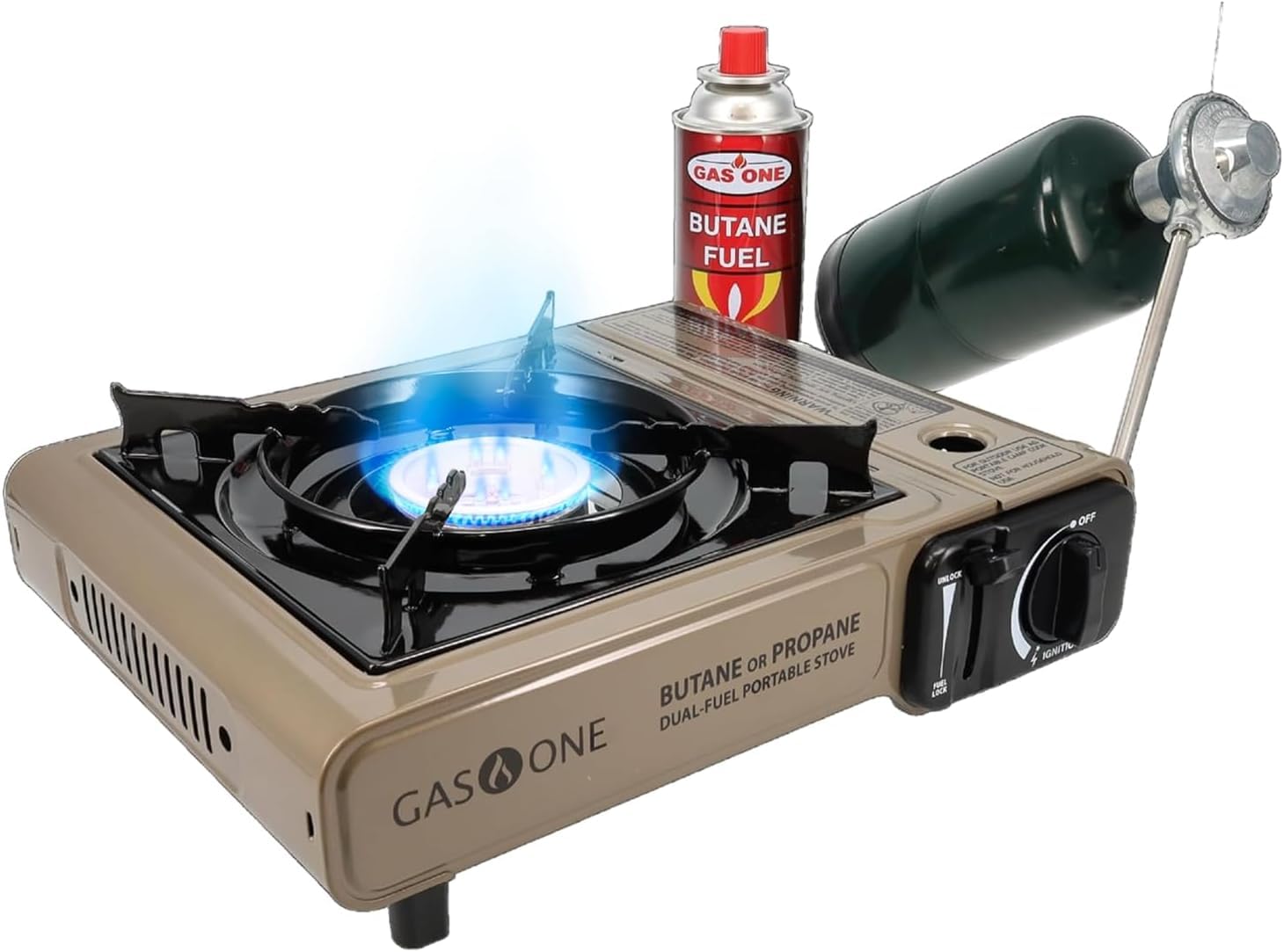
Gas One GS-3400P
Key Features
- Fuel: Butane or propane
- Weight: 3.1 lb
- Ignition: Piezo-electric
- Canister sizes: 8 oz butane, 16.4 oz propane
- Price: Budget
The GS-3400P is the least expensive way here to get both fuel types out of one burner, and that is most of its case. It takes an 8 oz butane cartridge or a 16.4 oz propane cylinder, lights with a piezo button, and drops into a carrying case that keeps the trunk tidy. A pressure sensor ejects the butane cartridge if something goes wrong, which is a reassuring piece of engineering on a stove sold at this level.
Dual fuel is the reason we keep recommending it. Butane is the clean, quiet canister you can buy in almost any town, and it is lovely in mild weather; propane is the one that keeps flowing as the temperature drops toward freezing. Choosing between them without buying a second stove is worth more than a few hundred BTU. Small trips are its home — a tailgate, a solo weekend, the kitchen backup the night the power fails.
It also asks a little of you. Pack a lighter for the day the piezo stops clicking, and look over the hose where it meets the burner before each season, because that is where this design ages rather than in the burner itself. Treated that way it is a bargain: it stores on a shelf, starts on the first click, and has enough heat to boil a pot for two without a fuss.
Pros
- Runs on butane or propane
- Light at 3.1 pounds with a case
- Piezo ignition and a pressure sensor
Cons
- Single burner rules out a two-pan dinner
- Hose and igniter are the parts that wear
For coffee, one-pot dinners, and the odd power cut, we keep coming back to this one: dual fuel, a case, and the lowest price here.
Best for Backpacking
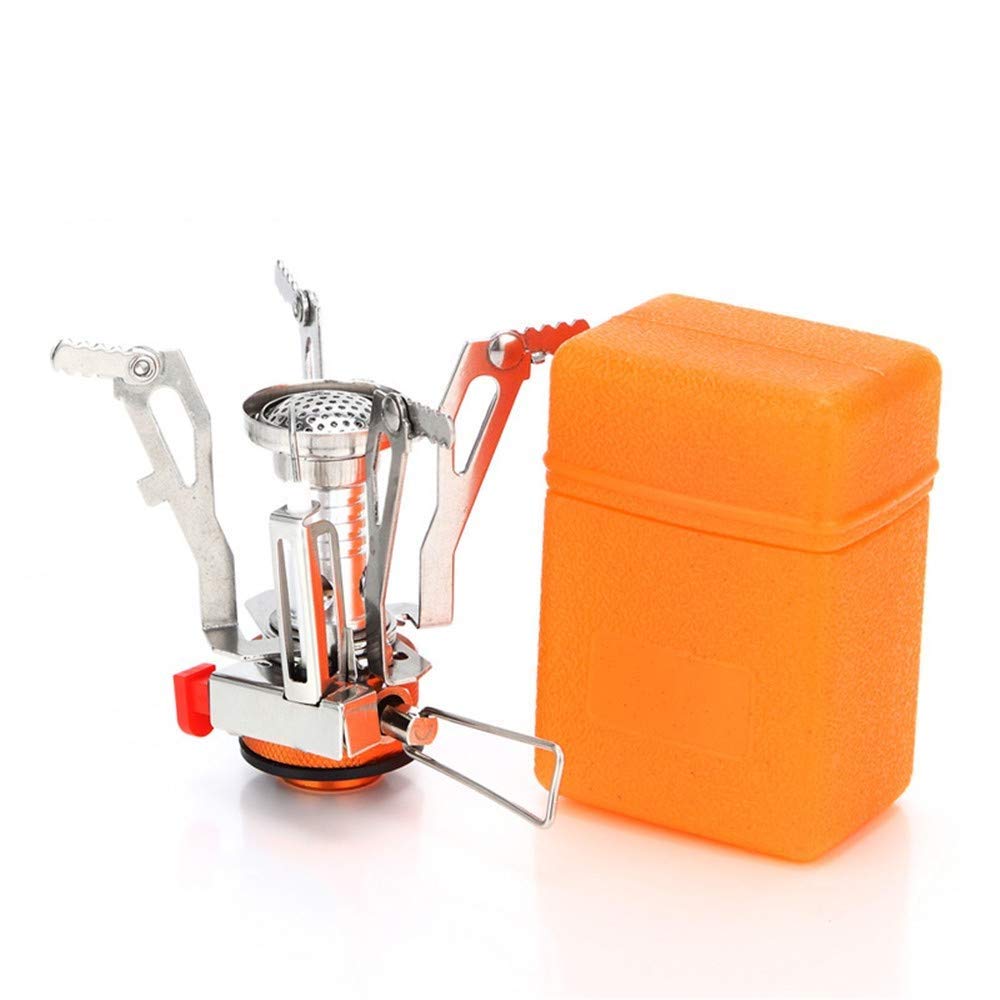
AOTU Backpacking Stove
Key Features
- Fuel: Butane or butane-propane mix
- Weight: 3.84 oz
- Folded size: 4 x 5 x 8 cm
- Heat output: 3000 watts
- Price: Budget
Three point eight four ounces is the whole argument. The AOTU is an aluminum burner that folds into a little plastic box, threads onto a standard canister, and lights from a button on the side. Rated at 3,000 watts, it gets a pot of water to a boil without drama. For backpacking, this is the stove we hand people.
The valve turns from full blast down to a simmer, which matters more than it sounds when you are rehydrating dinner rather than boiling it. The pot support is where the design economizes: three short arms sized for a pot around 20 cm across, or one to three people in the maker’s terms. A wide kettle sits high and rocks, so match the pot to the burner and find flat ground — a stove this light will not forgive a tilted table.
Value is the other half of it. This is the least expensive stove in the guide, small enough to keep a spare in the glovebox, and it packs inside a mug or a mess kit so it costs you nothing in pack volume. It is the one piece of kit here that disappears into the rest of the load, which is the highest compliment a backpacking stove can get.
Pros
- 3.84 ounces with the case
- Adjustable valve down to a simmer
- Lowest price in this set
Cons
- Igniter can be lazy in cold and damp
- Short pot arms let wide cookware rock
For backpackers counting ounces, this is the one we hand over: under four ounces, lit by a button, and it nests inside a mug.
Best for Camp Cooking
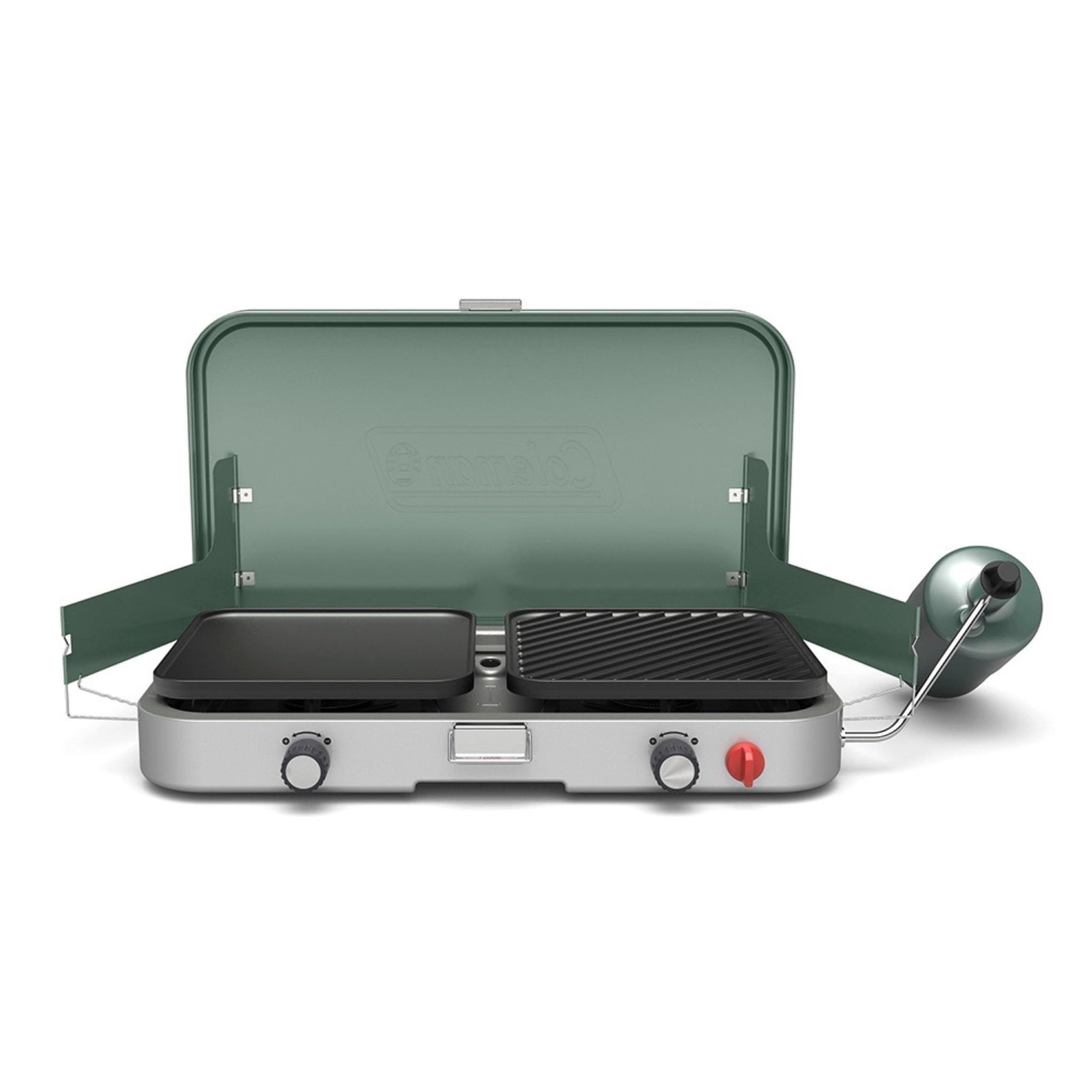
Coleman Cascade 3-in-1
Key Features
- Fuel: Propane
- Weight: 15.8 lb
- Cooking surfaces: 2 burners, grill and griddle plates
- Total heat output: 24,000 BTU
- Price: Premium
Fifteen point eight pounds and the biggest outlay here: the Cascade asks a lot of you before it cooks anything. What the weight and the money buy is a two-burner propane stove with a cast-iron grill plate and a griddle that drop over the burners, turning a camp cooktop into something that does pancakes at breakfast and burgers at night. Cook three meals a day at a site and that is not a gimmick.
The bones are good. Two burners with 24,000 BTU between them, a rotary ignition that saves hunting for a lighter, a recessed handle, and a nylon case that keeps the cast-iron plates from greasing everything else in the car. The pan support lifts out and the aluminized steel cooktop wipes down, so a full breakfast for four off one stove is a realistic plan rather than an optimistic one.
We like cooking on it more than we like cleaning it. The cast-iron plates have a rough texture that grabs food until they have a few seasons of oil in them, and scrubbing a griddle at a campsite tap is the low point of the trip. The body also is not as stout as its weight suggests, so treat the latch and the lid kindly when it rides in a packed truck bed.
Then there is the setting, which decides everything. From the trunk to the picnic table is twenty feet, and at that distance every pound is irrelevant; carry it a hundred yards to a walk-in site and you will feel all of them. It is a car-camping stove, and at that job it is the best one here.
Pros
- Grill and griddle plates included
- 24,000 BTU across two burners
- Accessory case and recessed handle
Cons
- Rough cast-iron plates need seasoning and scrubbing
For a family cooking properly at a drive-in site, this is the best cooking stove here — bring a vehicle, not a backpack.
Best for Budget Two-Burner
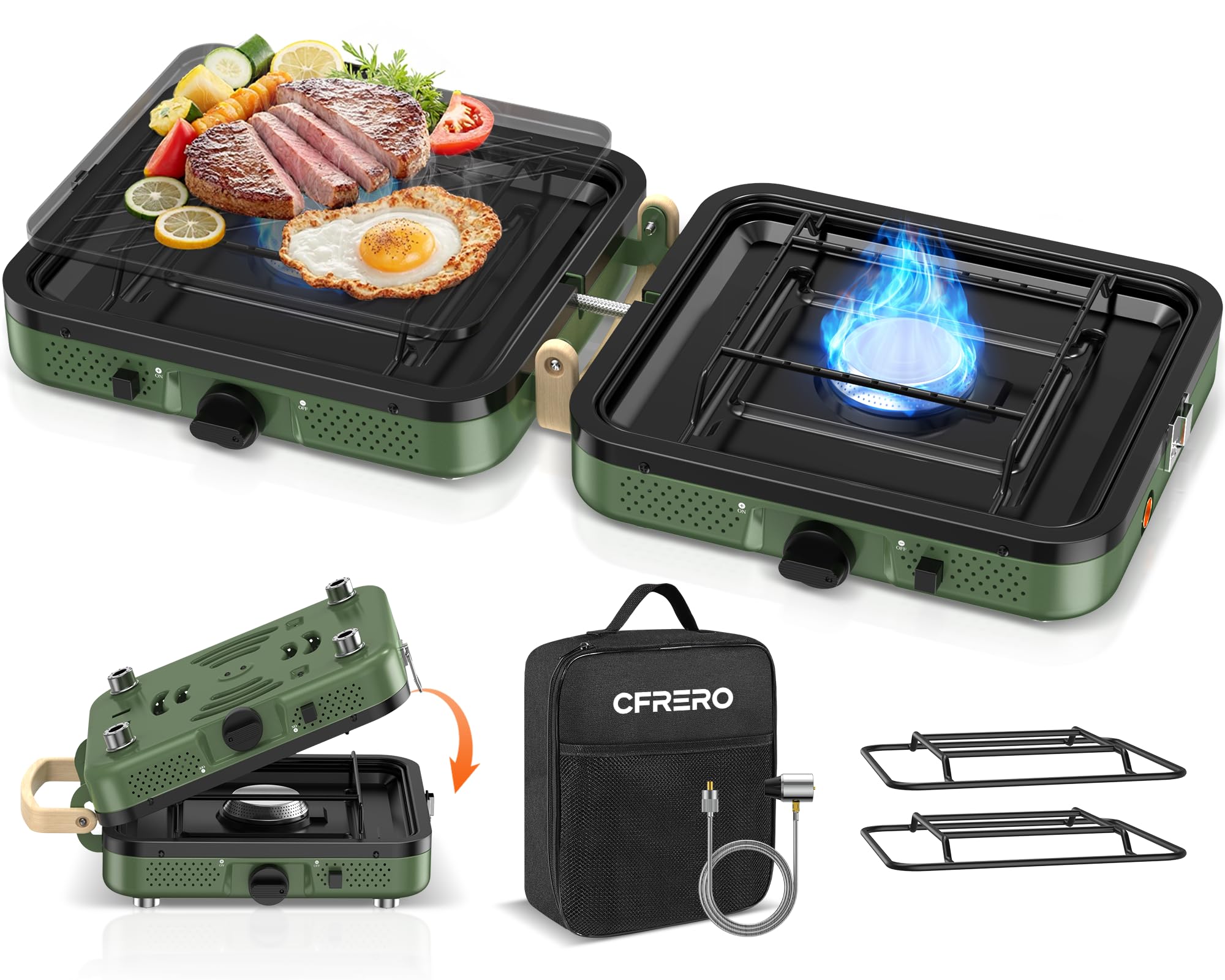
CFRERO 2-Burner
Key Features
- Weight: 5.7 lb
- Burners: 2, independently adjustable
- Pan space: Fits two 10-inch pans
- Total heat output: 16,000 BTU
- Price: Midrange
Say you want two burners and a car-camping setup, but the Coleman is more stove and more money than your trips justify. That is the CFRERO’s slot. Two independently controlled burners with 16,000 BTU between them, room for two 10-inch pans, a hose for either a small cylinder or a bulk tank, and a fold down to 21 by 9 by 3.5 inches with a carry bag.
We think 16,000 BTU is a working number rather than an exciting one. It keeps two pots at a boil and cooks a proper dinner; it will not win an argument with a kettle. Given the price it is the sensible compromise, and the 5.7-pound body with the flat fold is genuinely easy to live with — it slides behind a seat and comes out level.
The rest is straightforward: each burner has its own knob, the ignition is push-button, and the hose frees you from buying little cylinders by the trip. Tanks and griddle are not in the box, which is worth knowing before the first weekend rather than at the campsite.
Pros
- Two burners for two 10-inch pans
- Folds to 21 x 9 x 3.5 inches
- Hose works with small or bulk tanks
Cons
- No wind guards; flames lean in a crosswind
- Propane tank and griddle sold separately
For budget car camping, this is the two-burner we point to: two full-size pans, a flat fold, and a hose that takes a bulk tank.
Best for Big-Pot Cooking
Gas One B-5120

Key Features
- Fuel: Propane, bulk tank
- Burner: Single cast iron
- Dimensions: 10.4 x 10.4 x 5.6 in
- Heat guard: Top-mounted guard
- Price: Midrange
A cast-iron burner head on a steel frame, a hose assembly already attached, and a heat guard sitting over the burner to keep spillage and flame away from the connection. That is the whole Gas One B-5120, and for a big pot it is enough. The guard is the detail we appreciated most, because the hose connection is the part of any high-output burner that takes the abuse.
This is not a stove you fold into a pack. It wants a bulk propane tank, which you supply, and it earns that tank with output: a wok, a seafood boil, a deep fry, a griddle for a crowd. The cast-iron head holds heat under a heavy pot and the wide base sits still while you stir, which is more than can be said for a tabletop burner under a stockpot.
The valve is the compromise. On some units it behaves more like a high setting than a dial, the air mixture wants tuning to keep the flame blue, and a true simmer is not what this burner does well. We treat it as the high-heat station: boil and fry on it, finish sauces somewhere else. Where that suits your cooking, nothing else here comes close for the money.
Pros
- Cast-iron head and steady base
- Heat guard protects the hose connection
- High output for large pots
Cons
- Bulk propane tank required, not included
- Coarse valve makes simmering difficult
For a boil, a wok, or a fry-up for a crowd, this is the burner we point to, provided you have a bulk tank and a truck.
Best for Emergency Backup
Coghlan’s Folding Stove
Key Features
- Fuel: Canned heat or fuel cubes
- Weight: 16 oz
- Folded profile: Folds flat
- Cooking surface: 6.5 x 6.5 in
- Price: Budget
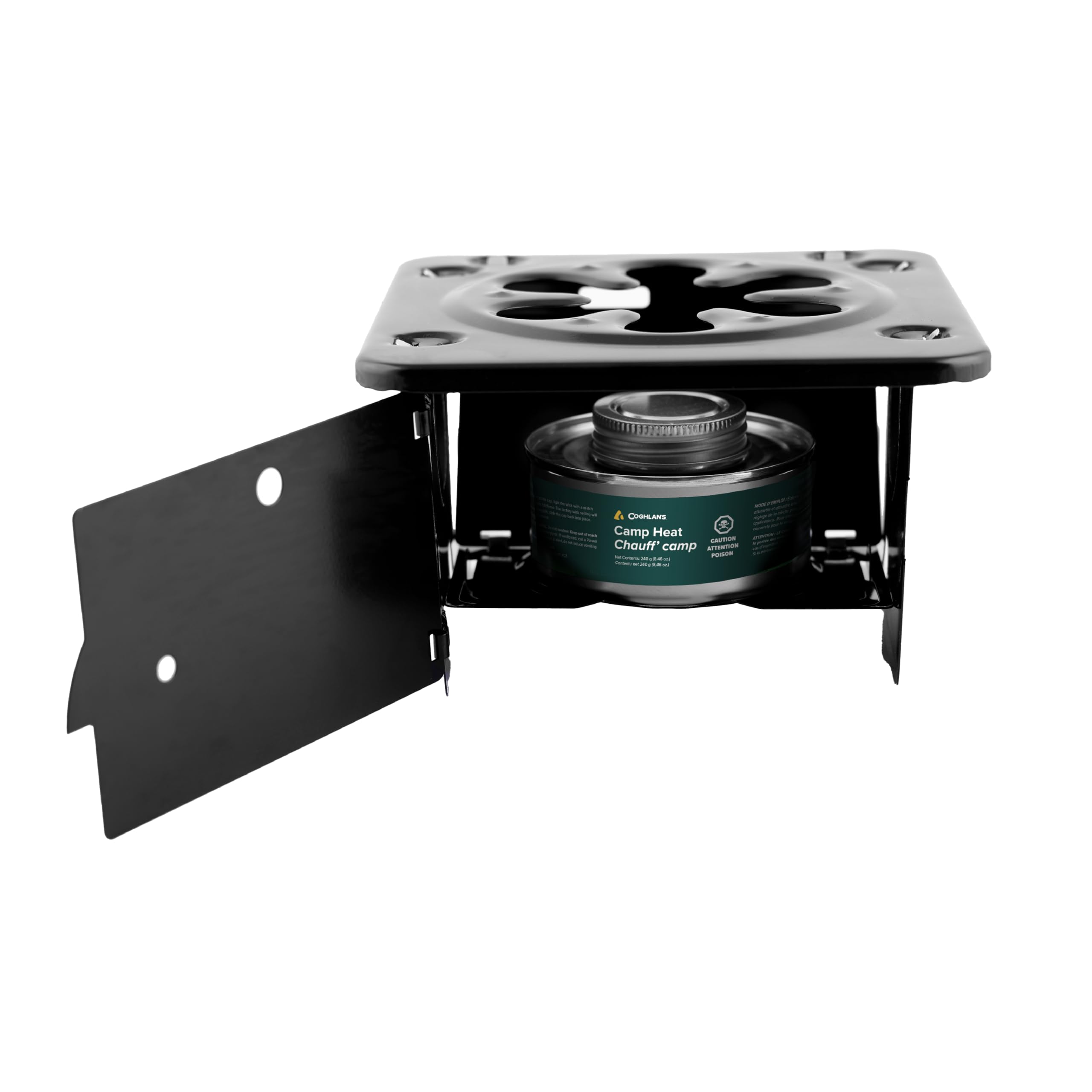
No canister, no igniter, no valve. The Coghlan’s is a coated steel frame that folds flat and holds a can of Camp Heat or a few fuel cubes under a pot, and it exists for the trips where you want heat without a fuel system. Four interlocking pieces, a 6.5 by 6.5 inch cooking surface, and nothing to go wrong that you cannot see.
It goes together in under a minute, and the notched tabs hold once the pot is on and you stop moving it around. That surface takes a small pot, a cup, or a mess kit, and the heat is gentle: soup, coffee, a rehydrated meal. A dinner pot for four is beyond it, and you will not be searing anything on it.
The fuel is the appeal. Canned heat and fuel cubes are sold separately, they keep in a cupboard until the day you need them, and they are not a canister that can empty itself or sulk in the cold. For a kit that might sit in a car for a year, that reliability is worth more than the heat it gives up.
Where it earns its place in our kit is backup: the night the canister is empty, the cold morning when the butane is sulking, the power cut at home. It belongs in the car box or the basecamp bin rather than a thru-hiker’s pack, but it is the simplest insurance here against having no way to make coffee.
Pros
- No canister or igniter to fail
- Folds flat for storage
- Low cost for an emergency kit
Cons
- No flame control; heat is fixed
- A pound of steel for gentle heat
We keep one as backup: no canister, no igniter, no valve, and it folds flat until the night you need hot food.
How We Tested Portable Camping Stoves
We started by researching the portable stoves that show up again and again in camping forums and retailer reviews, then narrowed the field by packed size, weight, fuel type, and price. From that shortlist, I tested 12 stoves over eight months—enough time to cook in fair weather and foul, and to see which ones still felt solid after a season of use. Every stove was used for real meals, not just a test boil.
Most testing happened at a picnic table on weekend car-camping trips, with a few backpacking mornings mixed in. I timed how long each stove took to bring a liter of water to a boil, then turned the flame down to see whether it would hold a bare simmer without scorching rice. I noted whether the igniter caught on the first click or needed a backup lighter, and whether the flame adjusted smoothly or jumped from low to roaring. With a full pot on the burner, I gave the table a gentle nudge to check stability, and I set up and packed away each stove solo to see how much fiddling it required.
Portability and size got measured, not guessed: I weighed each stove with its fuel canister and case, then checked whether it fit in a tote bag or a pack pocket. For durability, I tossed the stoves into a trunk between trips and checked for bent legs, cracked cases, and loose valves. Cleaning was a Saturday-morning job—I wiped up spilled oatmeal and cheesy pasta and noted which surfaces grabbed grease. Finally, I compared what each stove cost against how well it cooked, packed, and held up, because a bargain that needs replacing every season is not a bargain.
How to Choose a Portable Camping Stove
The right stove has less to do with its flame than with how far you carry it and how many pans you fill once you get there.
One burner or two
Count the pans you actually use at a site before you shop. A single burner covers coffee, water, and one-pot meals, and it packs small — the Gas One GS-3400P weighs about three pounds and lives in a case in the trunk. Two burners cost you weight and footprint, but they let you run a pot and a pan at once, which is the difference between a hot dinner and a hot dinner with a vegetable. Feed more than two people and the second burner stops being a luxury.
Butane, propane, and the cold
A butane canister burns clean and sells in almost any town, but its pressure falls as the temperature drops toward freezing, which is exactly when you want a hot drink. Propane in a 16.4 oz cylinder keeps flowing in colder weather, and a stove that takes either, like the GS-3400P, lets you choose by season rather than buying twice.
Check the fitting before you buy fuel. Backpacking stoves like the AOTU use the narrower 7/16 thread canister, while tabletop single burners take the 8 oz bayonet can. If you already own a bulk tank, a hose adapter turns a two-burner into a cheap way to cook for a group.
Wind protection beats a bigger BTU number
Output figures are measured in still air. On a real picnic table an unshielded burner loses much of its heat to a crosswind, which is why a modest stove with fold-up guards often out-cooks a bigger one without them. Look for panels that stand between the flame and the weather, and plan to improvise: a cooler set on the windward side does more for your dinner than another few thousand BTU. A stove with no guards at all, like the CFRERO, wants a sheltered pitch or a calm evening.
Weight, pot support, and how it packs
Backpackers trade stability for grams. A stove that weighs almost nothing has short pot arms, so it needs cookware close to its own diameter; a wide kettle on a narrow burner rocks, and a spilled dinner at nine at night is a long night. Match the pot to the burner, set up on flat ground, and keep the canister shaded. For car camping, ignore packed weight and look at the folded shape instead: a briefcase-style two-burner slides behind a seat.
Cleaning and the parts that wear
The stoves that get used are the ones that clean up fast, and a grate that lifts out in one piece is worth more than any coating. Cast-iron griddle plates need oil and a proper scrub and should never be soaked. Expect the igniter to be the first failure on any of these; a lighter in the kit solves it. Then check the hose and its connection at the start of each season, because that is where a gas stove actually wears out.
Frequently Asked Questions
Can I use a portable camping stove inside a tent?
No. Gas and solid-fuel stoves give off carbon monoxide, and a tent holds it. Cook outside, sheltered from the wind and away from fabric, and if the weather is too rough to cook outdoors, eat cold food instead. No stove on this list is safe to burn in an enclosed space, whatever the canister size.
What do I do if the push-button igniter stops working?
Light the burner with a long match or a lighter, holding it at the burner and to the side rather than over it, and turn the gas on only once the flame is there. Igniters fail from damp and soot, so dry the electrode and wipe the tip before you give up on it. Every stove here runs fine without its igniter.
Are camping stoves allowed during a fire ban?
Often yes, because most restrictions are written to stop open wood fires and leave a gas stove with a shut-off valve alone. Often is not always. Check the specific park or forest order for where you are going, and follow it if it names stoves explicitly. A canister stove is far more likely to be allowed than a wood fire.
Do portable camping stoves come with fuel?
Almost never. You get the burner, a case, and sometimes a hose, but the canister is on you. Match the fuel to the fitting before your first trip: a 16.4 oz propane cylinder for the two-burners, an 8 oz butane cartridge or a 7/16 thread canister for the single burners, or a bulk tank with a hose. Buy a spare, because the nearest store to a campsite rarely stocks the one you need.
Final Verdict
The Coleman Triton is the stove we recommend to most campers. Two burners and real wind protection do more for a camp dinner than any single impressive number, and its five pounds only matter to people who planned to carry it. If you cook hard — pancakes, burgers, a griddle — the Cascade earns its weight and its money.
If budget is the constraint, the Gas One GS-3400P is the dual-fuel bargain, provided one burner and a little hose care suit the way you camp. Backpackers should stop reading and take the AOTU.