This post contains affiliate links. We may earn a small commission when you buy through our links — at no extra cost to you.
The coffee water is the tell. On a cold campground morning, the stove that lights on the first click and holds a flame in a breeze gets breakfast moving; the one that sputters, or tips when you set a full kettle on it, turns a small chore into a twenty-minute negotiation. A camping stove is an unglamorous piece of gear that quietly decides how the rest of your morning goes — and what you’re really buying is a flame that stays lit, a pot that stays put, and a stove that packs down small enough to actually come along.
We spent the past eight months cooking on 12 of them — canister burners, two-burner propane models, a couple of liquid-fuel holdovers — at picnic tables, on windy ridges, and in the rain. The lesson that stuck: the lightest stoves are often the tippiest, because narrow pot supports save ounces and cost stability. Every pick below earns its spot the same way — it lights, it holds, and it carries.



Best for Family Camp Meals
Coleman Triton 2-Burner
Key Features
- Weight: 5 lb
- Burners: 2
- Ignition: Matchless rotary
- Total output: 22,000 BTU
- Price: Midrange
Two burners stop being a luxury the first time you cook for four in the rain. The Triton splits 22,000 BTUs across two independently adjustable burners and folds its lid up into a pair of wind guards, so bacon and eggs come off together instead of one pan going cold while you wait on the other. It’s the shape most people picture when they hear camping stove, and for a car-camping trip we think that shape is still the right answer.
What earns it the top spot is how little it asks of you. The rotary ignition lights without a match on a damp morning, the knobs turn down far enough to hold a simmer rather than scorch it, and the chrome grate lifts out, so a pot of chili that boils over doesn’t become a permanent feature of the stove. It also comes with a three-year limited warranty, where the Camp Chef and the Gas One carry one year.
Five pounds and a briefcase shape is the trade. This is a stove that rides in the truck and gets set on a picnic table, not one that goes in a pack, and two big skillets will crowd each other on the grates — a large pan and a saucepan is the comfortable pair. Set it somewhere level; a full stockpot balanced on a cooler lid is asking for trouble.
The heavy latch is the kind of detail you notice only when it’s missing, and ours held shut with the regulator and a spatula rattling around inside. Check the lid and the grates when the box arrives, not when you unpack at the campsite.
Pros
- Two independently adjustable 22,000 BTU burners
- Wind guards and matchless rotary ignition
- Removable chrome grate wipes clean
- Three-year limited warranty
Cons
- Five pounds and a briefcase shape, so car camping only
Two burners, wind guards that work, and matchless light at five pounds — this is the stove we recommend for anyone driving to a campsite and cooking real meals.
Best for Value and Backup
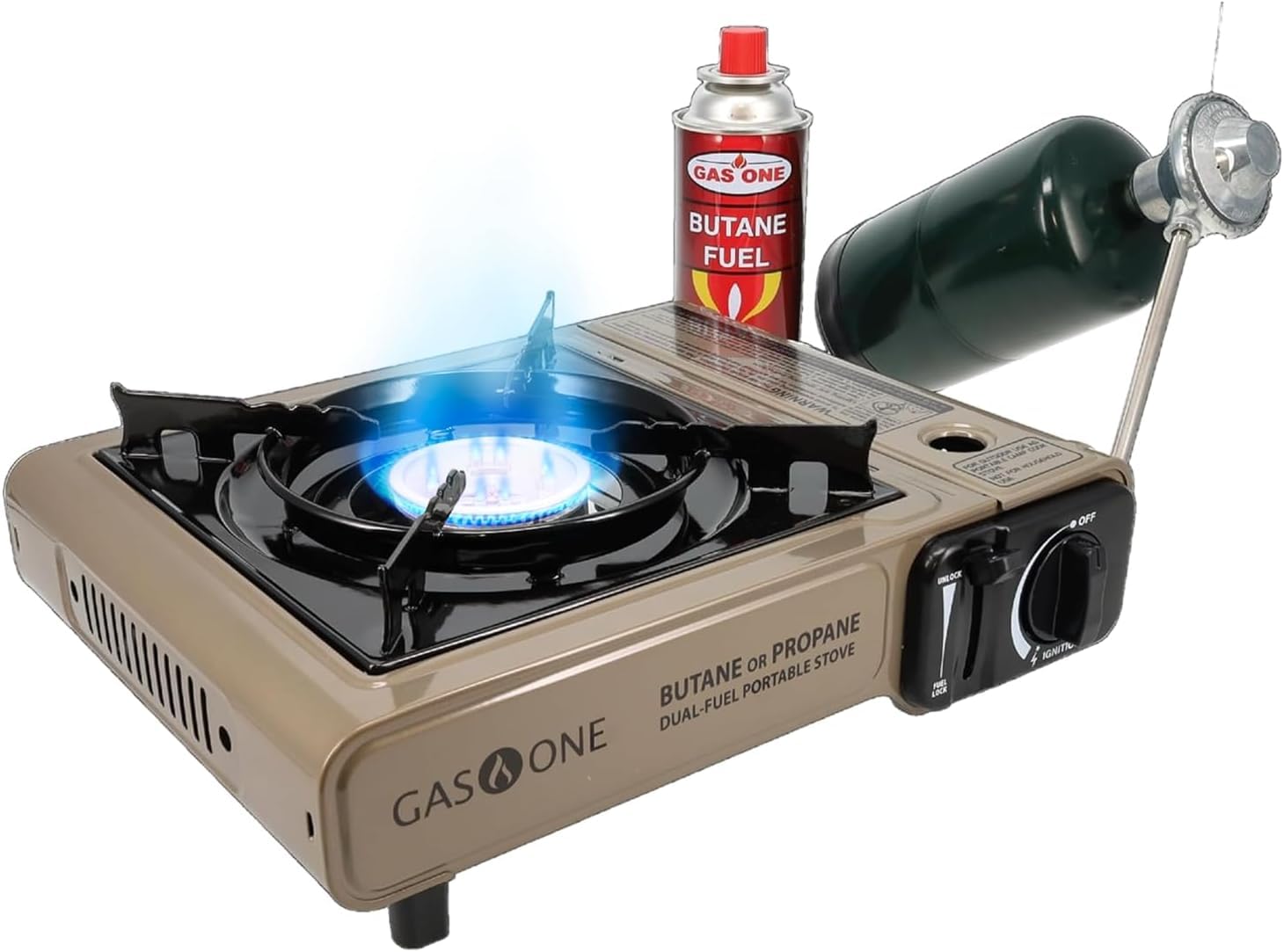
Gas One GS-3400P
Key Features
- Fuel: 8 oz butane or 16.4 oz propane
- Weight: 3.1 lb
- Burners: 1
- Ignition: Piezo-electric
- Price: Budget
You can run the GS-3400P on an 8-ounce butane cartridge or a 16.4-ounce propane cylinder, and that one decision solves the thing that ruins cartridge stoves: the morning you run out. We think the flexibility is worth more than the small step up in price from a butane-only tabletop, particularly if the stove lives in an emergency kit and only comes out twice a year.
At 3.1 pounds with a carrying case it packs like a lunchbox, and the butane side uses a pressure-sensor mount that ejects the cartridge and cuts the gas if the pressure goes wrong — a reassuring piece of design on a stove this inexpensive. The piezo ignition lights first time more often than not, and the dial turns down low enough to keep a sauce from catching.
The parts to watch over time are the fuel connection and the igniter. Check the seal every time you swap fuel, treat a hose as a wear item rather than a permanent fitting, and use the butane mount where you can — it takes the hose out of the equation entirely.
Heat isn’t the constraint. There’s enough output to get a big pot rolling, which is more than a tabletop this size has any right to. One burner is the honest limit: this is a stove for a pot of coffee, a one-pan dinner, or a second burner alongside something bigger.
Pros
- Runs on butane cartridges or propane cylinders
- Pressure sensor ejects the cartridge and cuts gas
- 3.1 pounds with a carrying case
- Piezo ignition, no lighter needed to light
Cons
- One burner means one pan at a time
- Butane output sags in near-freezing weather
Anyone who wants one burner that runs on whatever fuel is on the shelf should look here; we like the case and the safety shutoff for backup duty.
Best for Group Cooking
Camp Chef Everest 2X
Key Features
- Weight: 15 lb
- Burners: 2 at 20,000 BTU
- Ignition: Matchless
- Cooking area: 215 sq in
- Price: Premium
Forty thousand BTUs doesn’t mean much on a spec sheet. It means something when a stockpot comes back to a boil while you’re still laying out the bowls, and the Everest 2X does that with 20,000 BTUs under each of two cast-aluminum burners spread across 215 square inches — enough room for two full-size pots side by side.
The three-sided windscreen folds up around the burners and does real work on an exposed site, the ignition is matchless, and the flame turns down to a proper simmer. That last part matters more than the headline number: plenty of high-output stoves go from blast to off with nothing useful in between.
This is the stove we reach for when the cooking is the point of the trip rather than the fuel stop before a hike. Two big burners, genuine wind protection, and a low flame you can actually cook on make it the closest thing here to cooking at home, and that is the reason to carry the extra weight.
Fifteen pounds and 27 inches long is the bill. It lives in the car, runs happily off a 20-pound tank through an adapter, and empties a one-pound cylinder at full blast faster than anything else in this group. The copper gas line behind the controls is the part to protect when you load the truck, and the one that shows up as a failure after a few seasons.
Pros
- Two 20,000 BTU burners, 40,000 total
- 215 square inches fits two full-size pots
- Three-sided windscreen and matchless ignition
- Turns down to a real simmer
Cons
- Fifteen pounds and 27 inches: car camping only
- Drinks a one-pound cylinder at full blast
Buy the Everest when the group is big and the cooking matters: 40,000 BTUs and two full-size burners, at the cost of fifteen pounds — we think it’s worth the trade.
Best for Minimal Solo Kit
Coleman Bottletop Stove
Key Features
- Output: 10,000 BTU
- Burners: 1
- Ignition: Match or lighter
- Pan size: 8 in
- Price: Midrange
There’s no hose and no legs: the Bottletop threads straight onto a one-pound propane cylinder and uses the can as its base. That’s the entire design, and it’s why the thing disappears into a day pack while a tabletop stove is still being unfolded.
Ten thousand BTUs through a single adjustable burner, a pressure regulator that keeps output steady as the can cools, and wind baffles folded around the flame. It fits an 8-inch pan, holds a low simmer without drama, and there’s nothing to break except the valve. There’s also no igniter, so a lighter is part of the kit — that’s the one convenience it gives up.
For a stove that is essentially a burner head, that is most of what matters. We take it on solo trips where the stove means coffee at dawn and one pot at night, and we don’t miss the tabletop or the case.
The pot supports sit wide apart, which is fine for a real pot and useless for a narrow enamel cup or a small can — the flame just licks up the sides. Use a wider mug, or accept that this stove wants cookware rather than a drinking vessel.
Pros
- Screws onto a cylinder, no hose or legs
- Pressure regulator steadies output as the can cools
- Wind baffles shield the single burner
- Fits an 8-inch pan at 10,000 BTU
Cons
- No built-in igniter — bring a match or lighter
- Wide pot-support spacing will not hold a small cup
For solo trips where the stove means coffee and one pot, this screw-on burner is what we take: the smallest, simplest gas kit here.
Best for Backpacking
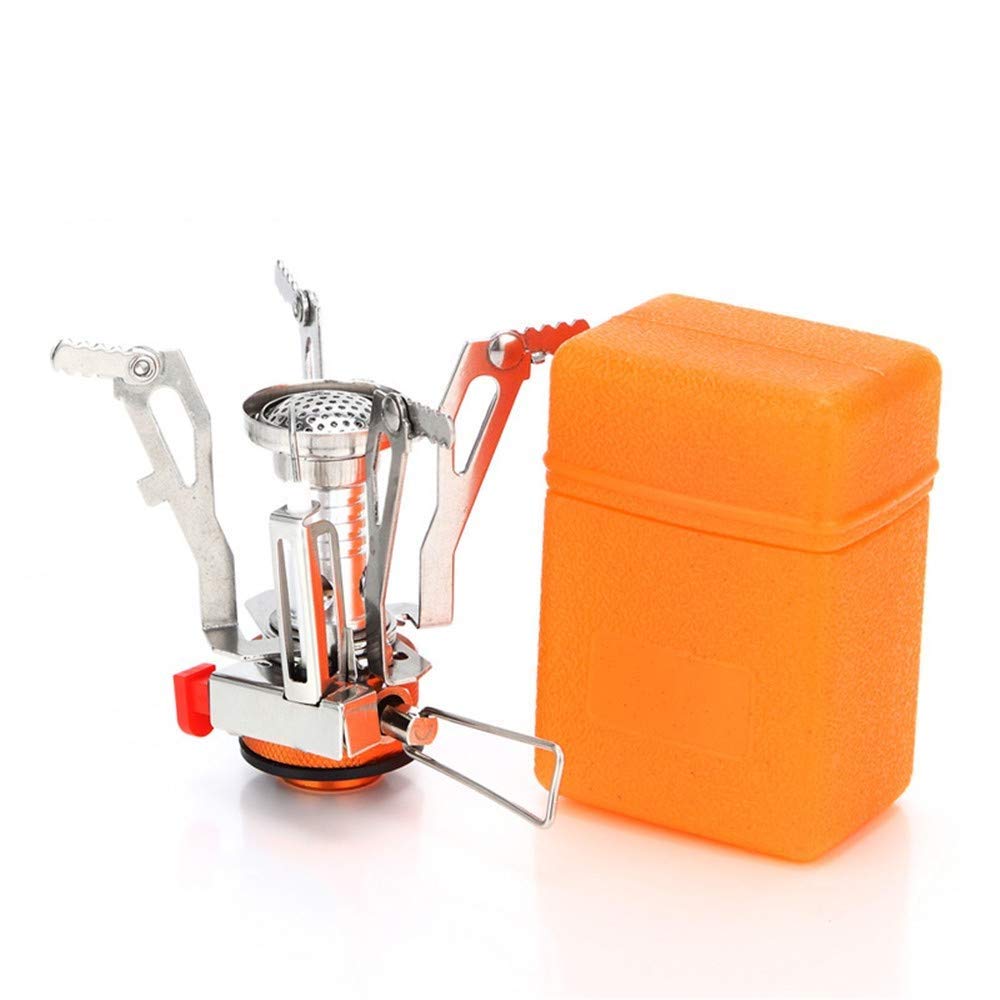
AOTU Portable Camping Stove
Key Features
- Output: 3,000 W
- Weight: 3.84 oz
- Ignition: Piezo
- Folded size: 3.74 x 2.56 x 2.95 in
- Price: Budget
At 3.84 ounces the AOTU weighs less than most of the pots you’ll set on it, and it folds into a plastic box about the size of a bar of soap. It’s also the stove here where the pot supports matter most: the arms are short, and a full pot will rock on them if the ground isn’t level.
We still carry it, because 3,000 watts through a piezo-ignited burner that turns down to a simmer is a lot of capability for the least money in this group. It lights fast, holds a low flame without pulsing, and the valve has enough travel to be useful rather than decorative.
Two things decide whether it suits you. It takes 7/16-thread butane or butane-propane canisters, sold separately, and a blended canister loses its push in genuine cold — this is a three-season stove, not a winter one. The piezo striker is also the first part to give trouble; when it starts missing, pulling the arm back before you press usually gets another season out of it.
The burner head is 9.5 centimeters across and it’s meant for a pot up to about 20 centimeters wide, feeding one to three people. Go bigger than that and the pot handles are doing the balancing, which is the point at which you want a different stove.
Pros
- 3.84 ounces, folding into a soap-sized box
- Piezo ignition and a usable simmer
- Least expensive stove in this group
- Fits standard 7/16-thread canisters
Cons
- Narrow pot supports let a full pot rock
- Piezo striker is the first part to fail
When we’re carrying the stove rather than driving it, this is the one in the pack: under four ounces, piezo-lit, and the least expensive way into this group.
Best for Emergency Kit
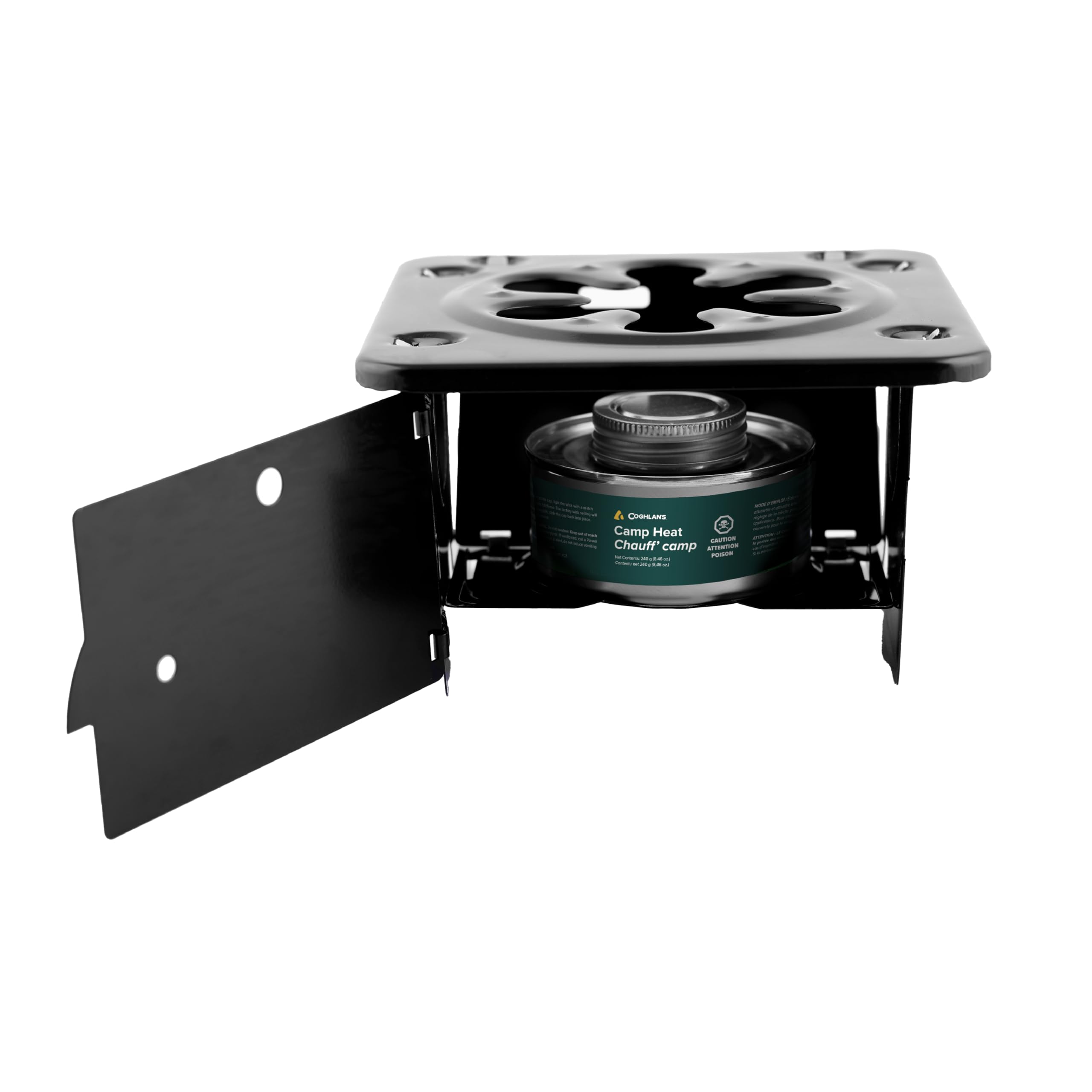
Coghlan’s Folding Stove
Key Features
- Fuel: Camp Heat, cubes, or gel
- Weight: 1 lb
- Material: Coated steel
- Cooking surface: 6.5 x 6.5 in
- Price: Budget
There’s no gas, no valve and no igniter here. You drop a fuel tablet or a cup of solidified alcohol inside, light it, and set a pot on top. The Coghlan’s is the oldest idea in camping stoves, and it has survived this long by being cheap, light, and impossible to clog.
What it does well is disappear. It folds flat from a little over a pound of coated steel, opens into a 6.5-inch square platform, and burns Camp Heat, fuel cubes, or any other condensed fuel you can lay hands on. In a bug-out bag or a car trunk that’s a real kind of usefulness: no canister to leak, nothing pressurized, nothing with a shelf life to watch.
The tabs that lock the panels together are the weak point. Set it up and leave it — shuffling it while it’s hot will pop the frame apart under the pot. That’s an easy habit to keep.
We keep one in the emergency box and don’t ask much of it: it heats a can of soup, boils a small pot of water, and gives you a flame to warm your hands over when the power is out. What it won’t do is cook a meal, because the only setting is on.
Pros
- Folds flat at about a pound
- Burns tablets, cubes, or solidified alcohol
- Nothing pressurized to leak or expire
- Stable 6.5-inch platform for a small pot
Cons
- Fuel tablets and gel sold separately
- Reheats and boils small amounts only
We keep one as emergency backup, not as the stove you cook dinner on: it folds flat, burns any solid fuel, and has no flame control at all.
Best for Budget Two-Burner
SENBOWE 2-Burner Stove

Key Features
- Kit: Griddle, windscreen, hose, bag, baking tray
- Weight: 7 lb
- Burners: 2 at 12,000 BTU
- Total output: 24,000 BTU
- Price: Midrange
The carry bag holds a two-burner stove, a windscreen, a 40-inch gas hose, a griddle and a baking tray, which is either a thoughtful package or a pile of parts you didn’t ask for, depending on how you camp. For a first stove, we lean toward thoughtful.
Two independently adjustable 12,000 BTU burners add up to 24,000 BTUs, and the griddle turns one side into a flat top for pancakes and bacon. It folds to roughly laptop-bag size and latches magnetically, and at seven pounds it’s a car-camping stove rather than a pack one.
The parts that let it down are small ones. The igniter is weak enough that a lighter belongs in the bag, and the griddle surface scuffs and scrapes easily — season it the way you would cast iron, don’t scrub it, and it behaves. The grill lifts out for cleaning, which matters more than it sounds after a breakfast of bacon.
Where it earns its mention is what comes in the bag for the money: two burners, a hose, a windscreen and a griddle for about what the Coleman Bottletop costs on its own. If you’re outfitting a first car-camping kit and want a flat top, that’s a compelling box.
Pros
- Two 12,000 BTU burners, 24,000 total
- Hose, windscreen, bag, and griddle included
- Folds and latches for transport
- Removable grill lifts out for cleaning
Cons
- Weak igniter — a lighter belongs in the bag
- Griddle surface scratches and scuffs easily
We think it’s a sensible first two-burner if you want a griddle and a hose in the box and don’t mind carrying seven pounds.
How We Tested the Best Camping Stoves
We started with roughly 40 stoves, drawn from brands we’ve cooked on for years and newer models that kept surfacing in reviews, then cut the list by spec: packed weight, burner count, folded footprint, price. Anything with folding legs that wobbled on a tabletop was out. That left 12 stoves, which we cooked on for eight months.
Testing happened where stoves actually live: a windy ridge before sunrise, a rainy tailgate, a picnic table at a crowded campground. We boiled two cups of cold water and timed it, then tried to hold a simmer without scorching the pot. On breezy days we watched how long a flame survived before it needed a hand cupped around the burner or a windscreen. We set a full pot on each grate and gave it a nudge to see whether it slid or tipped.
Ignition got its own workout — twenty clicks per stove, including cold mornings and after a weekend bouncing around in a tote bag. We weighed each one with and without fuel, packed it into a 40-liter backpack to see what it crowded out, and wiped it down after bacon. Over eight months we tracked rust, bent supports, and knobs that stiffened.
How to Choose a Camping Stove
The stove that suits you is settled by two things — how far you carry it and how many pans you want going at once — and almost everything else is detail.
One burner or two
Two burners are about time, not appetite. If dinner is a pot of chili and breakfast is coffee, one burner is plenty and the stove will be smaller and lighter for it. The moment you want a pan and a pot at once — eggs and bacon, rice and a stir-fry — a two-burner starts earning its weight, and the ones here run from five pounds for the Coleman Triton to fifteen for the Camp Chef Everest 2X.
Check the grate against your biggest pan. Two large skillets crowd each other on nearly every two-burner stove, so the realistic pairing is one wide pan and one saucepan. If you routinely cook two big batches simultaneously, go wide rather than light.
What it burns, and cold mornings
Butane cartridges are inexpensive and simple to load, but butane stops vaporizing as the temperature approaches freezing, so output sags before the canister is empty. Propane in a one-pound cylinder keeps working in real cold. If you cook in shoulder-season weather, choose a stove that runs on propane — the Gas One GS-3400P’s dual-fuel mount exists for exactly this reason — or keep your cartridges inside your jacket until you light.
Beyond that, think about what you can buy where you camp. One-pound propane cylinders are sold almost everywhere; 7/16-thread canisters are not, and a backpacking stove without a canister is a paperweight. Match the fuel to the resupply, not to the stove.
Heat, wind, and the part that fails
Published output tells you which stoves are in a different class, not which one will boil your water first. Wind decides that. A burner with folding baffles or a windscreen holds its flame on a breezy morning; an exposed one throws much of its heat sideways while you stand there turning the knob up. If you cook where it blows, prioritise the screen over a bigger BTU number.
Ignition is the other moving part. A piezo is convenient and it is also the first component to give trouble, particularly once it gets damp. A lighter in the utensil bag costs nothing and rescues dinner.
What portable actually means
Compact in a listing usually means it fits a car trunk, not a pack. Read weight and folded size together: five pounds in a briefcase shape is a stove you carry twenty yards from the tailgate, while anything over ten pounds is furniture that lives at the site. Backpacking is a different category — under a pound, a canister-top burner, and pot supports sized for a one-liter pot rather than a stockpot.
Decide which trip you are buying for before you compare anything else, because the two answers barely overlap.
Stability, cleaning, and the long haul
A full pot of water is the heaviest thing your stove will ever hold, and short pot supports are where small stoves let you down — the AOTU’s arms are fine under a one-liter pot and unnerving under anything wider. Set the stove on level ground rather than a cooler lid, and turn handles away from the burner.
For cleaning, a removable grate or drip tray is the difference between a wipe-down and a scrubbing session. Lift the grate, wipe the burner area, and leave the gas path alone. When you are comparing two stoves that look equal, the one with the longer warranty and the simpler fuel connection is the one that ages better.
Frequently Asked Questions
Can I use a camping stove inside a tent or a garage?
Not with a gas stove. Burning propane or butane produces carbon monoxide, and a tent, a vehicle, or a shut garage holds it. Cook outside. If the weather is foul, rig a tarp so the stove sits at the open edge with nothing flammable overhead — never inside the tent itself, and not in a zipped-up vestibule.
How long will a fuel canister last?
Longer at a simmer than you expect, much shorter at full blast. A one-pound propane cylinder covers roughly a weekend of coffee and simple meals on a low flame; a 40,000 BTU two-burner running wide open will finish one in an evening. Carry a spare for trips over two nights, and move to a bulk tank with an adapter hose for group cooking.
Do I really need a stove, or can I just cook on the fire?
A stove lights in seconds, works in rain, and needs no fire ring or dry wood. It also keeps you cooking when open fires are banned: most land managers still allow gas stoves with a shutoff valve during restrictions and prohibit solid fuel and wood, but rules vary by park and season, so confirm with the ranger district before a dry-season trip.
Final Verdict
The Coleman Triton is the stove we point most people at. Two burners, wind guards that do something, matchless ignition, and a five-pound case that lives in the trunk make it the best all-round answer here for anyone driving to their campsite, and it costs less than the high-output alternatives.
If the stove is going on your back instead, the AOTU disappears into a pack at under four ounces and still simmers. Want one burner and the simplest fuel story? The Gas One GS-3400P takes whichever cylinder is on the shelf.