This post contains affiliate links. We may earn a small commission when you buy through our links — at no extra cost to you.
Breakfast at a campsite has a rhythm: coffee first, then bacon, then eggs that never quite fit in one pan. A two-burner stove is what makes that possible — kettle on one side, skillet on the other. But the gap between a good one and a fussy one shows up fast, usually on a cold, breezy morning when the flame sputters and the whole thing shifts under a full pot.
What I want from a stove is unglamorous: it lights on the first click, holds a low simmer, and doesn’t wobble. Over the past eight months my team and I cooked on 11 two-burner models — tailgates, car-camping weekends, a rain-soaked trip to a reservoir — and the differences were not subtle. BTUs get all the attention, but burner spacing and a windscreen that stays where you put it matter just as much; a stove that boils water fast and can’t fit two pans at once is really just a big single burner. The picks below are the ones we kept reaching for.


Best for Car Camping
Coleman Triton 2-Burner
Key Features
- Weight: 5 lb
- Burners: Two independent
- Windscreens: Two
- Total output: 22,000 BTU
- Price: Midrange
The Triton is the stove we recommend first because it gets the everyday balance right: 22,000 BTUs across two independently adjustable burners, a 5-pound body, and two wind guards that fold into the lid. That is enough heat for coffee, eggs, and a pot of chili without turning the campsite into a production. The heavy-duty latch and the chrome-plated grate that lifts out for cleaning are the practical details that matter most after a greasy breakfast; the cooking surface comes off, and cleanup stops being a chore.
The cooking surface deserves more credit than the headline number suggests. It holds two large pans, so you can run a skillet and a saucepan side by side instead of cooking in sequence. The independent knobs matter just as much: we kept one burner low for eggs while the other came up to a boil. That flexibility is why this one suits couples and small families.
The three-year limited warranty is a useful cushion for a stove that will get knocked around in a trunk, and the removable grate makes cleanup straightforward. It has the practical feel of a stove you can leave packed and ready, not a piece of gear that needs its own shelf.
Pros
- Light 5-pound body for easy carrying
- 22,000 BTU total heats campsite meals
- Two large pans fit at once
- Twin wind guards and removable grate
Cons
- Some units arrive damaged out of the box
For a car camper who wants one stove to do it all, we recommend the Triton: it’s light enough to move easily, fits two full-size pans, and puts out enough heat for real campsite meals.
Best for High-Heat Group Cooking
Camp Chef Everest 2X
Key Features
- Weight: 15 lb
- Ignition: Matchless
- Cooking area: 215 sq in
- Total output: 40,000 BTU
- Price: Premium
The Everest 2X makes its case with heat and room. Two 20,000 BTU burners give it 40,000 BTUs total, and the folding lid wraps into a three-sided windscreen that keeps the flame steady when the campsite is exposed. The matchless ignition is a small convenience that becomes a real one when you are lighting dinner in the wind.
The payoff is control. The burners turn down to a simmer, so the same stove that boils a big pot can hold a sauce without scorching it. That range is why it earns a runner-up spot for campers who cook rather than just heat water.
We also appreciate the 215-square-inch surface, which is wide enough for two full-size pots, and the folding lid and drip tray make cleanup less of a project after a big breakfast. It is a more serious stove than the Triton in both output and cooking area, and it asks for more space in return.
Pros
- 40,000 BTU total for fast boiling
- 215-square-inch surface fits two big pots
- Matchless ignition and useful simmer control
Cons
- 15-pound body is a lot to pack
If you regularly cook big pots for a group, we think the Everest 2X is worth the step up: two 20,000 BTU burners and a wide 215-square-inch surface.
Best for Basecamp Groups
Camp Chef Explorer
Key Features
- Legs: Detachable steel
- Windscreen: Three-sided
- Cooking area: 448 sq in
- Total output: 60,000 BTU
- Price: Premium
The Explorer is the stove we choose when the meal is for a crowd. Two 30,000 BTU burners give it 60,000 BTUs total, and the 448-square-inch cooking area is wide enough for two big pots or a pair of 14-inch pans. It is a stand stove rather than a tabletop model, with detachable steel legs and a three-sided windscreen.
The appliance-style knobs give it a more familiar feel than the compact stoves here, and the wide grate means a stockpot does not crowd the second burner. The legs come off for transport, which makes it easier to move between the truck and the picnic table.
Three-sided windscreen and 14-inch accessory compatibility are the details that make it feel like a system rather than a bare burner. If you already own Camp Chef pans, the Explorer is an easy basecamp centerpiece; if you pack light, it is more stove than you need.
Pros
- 60,000 BTU total for large pots
- 448-square-inch cooking area for group meals
- Detachable legs and three-sided windscreen
- Accepts 14-inch Camp Chef accessories
Cons
- Large stand needs a dedicated setup spot
- Pots can blacken after initial use
For basecamp cooking and big groups, the Explorer is our pick: 60,000 BTUs and a 448-square-inch surface make it the closest thing here to a full outdoor kitchen.
Best for Compact Car Camping
ODSD 2-Burner Camp Stove
Key Features
- Burners: Two independent
- Windscreen: Built-in
- Folded size: 10.63 × 9.06 × 5.12 in
- Total output: 20,000 BTU
- Price: Midrange
The ODSD folds down to 10.63 by 9.06 by 5.12 inches and comes with a carry bag, so it disappears into a trunk in a way that full-size camp stoves do not. The dual burners are rated at 20,000 BTUs total, with a windproof shield around the cooking area.
The kit is what makes it useful: it includes a frying pan and a coffee stand, which removes two things from the packing list, and the two burners are independently adjustable for a simple breakfast. The folded package is small enough for a hatchback, and the built-in shield gives it an edge over barebones stoves when the morning air is moving.
It is not a high-output stove, but we found 20,000 BTUs enough for eggs, coffee, and a pot of pasta at a car campsite. The carry bag and folding shape make it easy to live with, and the included pan means one less thing to remember.
Pros
- 20,000 BTU dual burners
- Folds to a small carry-bag package
- Includes frying pan and coffee stand
Cons
- Lid magnets can be too weak
The ODSD is the compact kit we recommend for car campers who want two burners, wind protection, and a coffee stand in a small package.
Best for Budget Car Camping
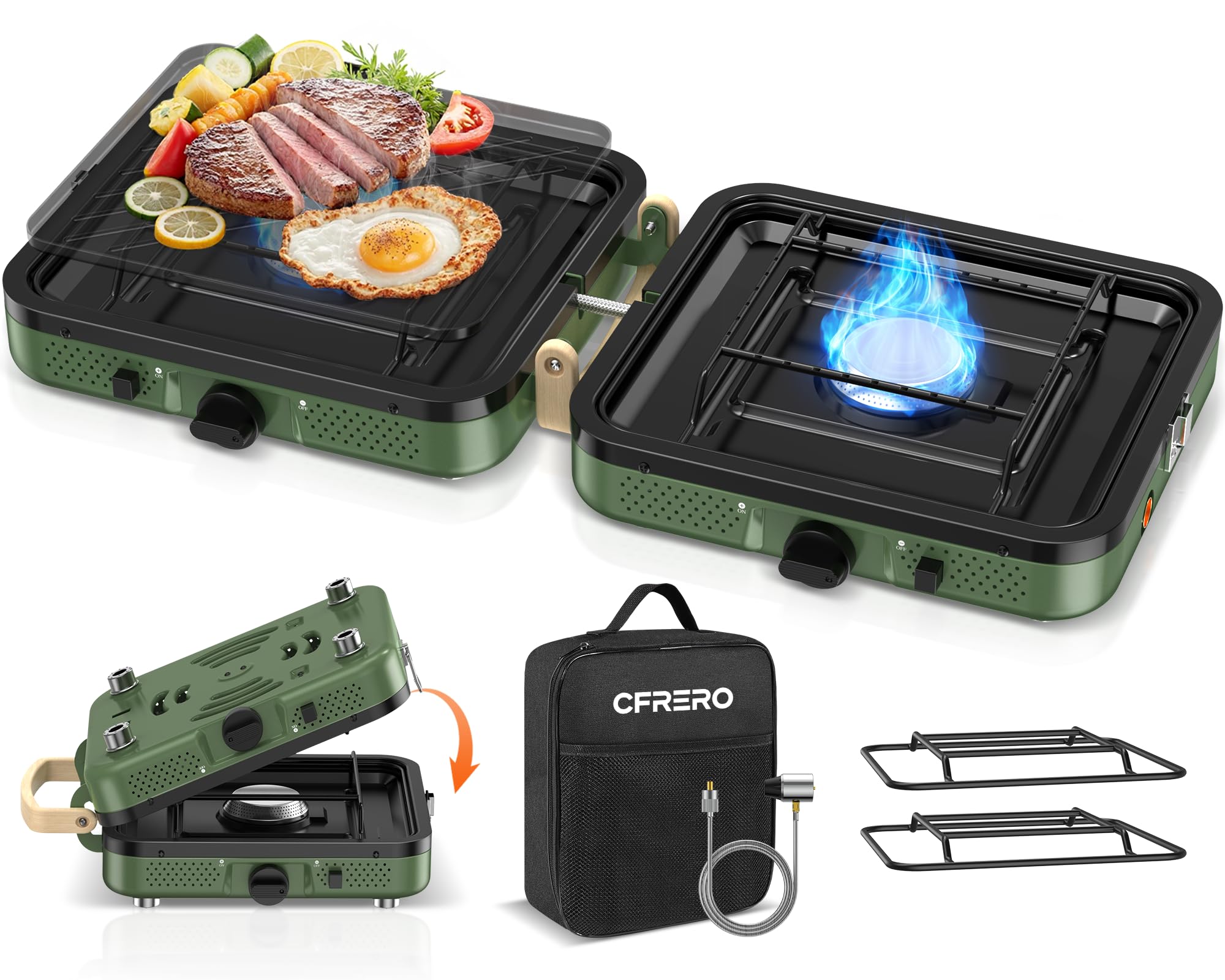
CFRERO Foldable 2-Burner
Key Features
- Ignition: Instant start
- Folded size: 21 x 9 x 3.5 in
- Pan capacity: Two 10-inch pans
- Total output: 16,000 BTU
- Price: Budget
The CFRERO keeps the pitch simple: 16,000 BTUs across two burners and a fold that measures 21 by 9 by 3.5 inches. It is the kind of stove you can leave in the car for a picnic or pull out at a tailgate without thinking through a setup ritual.
The cooking surface fits two 10-inch pans, which is the right size for a couple or a small family cooking in stages. Each burner has its own knob, and the instant ignition means you are not hunting for a match. The slim fold and carry bag make it easy to store, and the included hose saves a trip to the hardware store.
We think it is a sensible first stove or a backup for simple trips, and the slim fold stores upright in a closet between outings. The part we appreciate most is how little fuss it adds: two knobs, a hose, and a bag, with no accessory kit to sort through.
Pros
- 16,000 BTU across two burners
- Slim 21-inch fold with carry bag
- Fits two 10-inch pans
Cons
- No windshield for breezy sites
We like the CFRERO as a straightforward, affordable two-burner for car camping, with a slim fold and enough surface for two 10-inch pans.
Best for High-Output Canning
ROVSUN 2-Burner Stove

Key Features
- Height: 29.7 in
- Weight: 13.2 lb
- Burners: Two 75,000 BTU
- Total output: 150,000 BTU
- Price: Midrange
The ROVSUN is a different kind of two-burner: 150,000 BTUs total, two 75,000 BTU burners, and a stand that puts the cooking surface at adult height. It is built for a stockpot, a canner, or a turkey fryer, not for a quick breakfast at a picnic table.
The cast-iron build and adjustable CSA-listed regulator give it a sturdy, outdoor-kitchen feel, and the legs come off for transport. The 30.7 by 15.7 by 29.7-inch frame and 13.2-pound body make it a car-and-driveway tool rather than something you carry to a tent pad.
We treat it as a specialist. For high-output jobs better done outside, it is a useful piece of outdoor equipment; for a couple camping with a skillet and a coffee pot, it is more stove than the job requires.
Pros
- 150,000 BTU total for big pots
- Detachable legs and 13.2-pound body
- Adjustable CSA-listed regulator
Cons
- Low settings are hard to control
We see the ROVSUN as a tool for high-output outdoor jobs—canning, frying, a backyard boil—not for a lightweight tabletop campsite.
Best for Simple Griddle Meals
Gospowor 2-Burner Stove

Key Features
- Weight: 8.5 lb
- Included: Griddle
- Dimensions: 9 x 3.5 x 10.2 in
- Total output: 10,000 BTU
- Price: Budget
The Gospowor folds into a 9 by 3.5 by 10.2-inch package and weighs 8.5 pounds, so it takes up about as much room as a small toolbox. It has two independently controlled burners, folding wind panels on each side, and an included griddle that covers the cooking area.
The griddle is the feature that makes it interesting. It turns the two burners into one flat cooking surface for pancakes, eggs, and bacon, which is a useful trick at a car campsite. The folding panels also give the flames a better chance in a light breeze, and the whole thing packs into a compact shape.
The trade-off is heat. With 10,000 BTUs total, it is happiest with a griddle full of eggs or a small pot of coffee, not a stockpot or a crowd. The knobs offer independent control, and the low profile makes it easy to set on a stable table.
We think it is a sensible starter kit for someone who wants a griddle without buying a separate accessory. The compact body and included griddle are the reasons to pick it, and the folding panels make it a better fit for a sheltered picnic table than a bare burner.
Pros
- Compact 8.5-pound folding body
- Includes a griddle for breakfasts
- Folding side wind panels
Cons
- Ignition can be inconsistent
For simple two-pan breakfasts, we think the Gospowor bundles a griddle and wind panels in a compact folding frame.
How We Tested Two-Burner Camp Stoves
We narrowed a field of about 40 stoves to 11 using the specs that actually decide whether you’ll use the thing: burner spacing wide enough for a 12-inch skillet and a stockpot side by side, packed dimensions and weight one person can carry from trunk to picnic table, and whether a regulator, hose, and wind panels came in the box or cost extra.
Every stove got the same first job — a quart of water on the left burner, both burners wide open, timed from ignition to a rolling boil. We noted how low each one would go without the flame dying, then cooked outside on breezy afternoons with the lid propped as a windscreen to see which burners blew out and which just leaned into it.
Stability got tested with a full 12-quart pot pushed to the edge of the grate, then nudged to see how much it took to tip, including on a sloped picnic table. We carried each stove by its handle with a full fuel canister attached, packed and unpacked them solo in the dark, and checked feet, latches, and drip trays after eight months of tailgates, deck-side cooking through a week-long power outage, and one memorably muddy reservoir trip.
How to Choose a Two-Burner Camp Stove
Buy for the way you cook and pack, not for the biggest BTU number: a stove that fits your pans, your table, and your vehicle will get used more than a monster that stays home.
Start With the Cooking Surface
Two burners only help if your pans actually fit side by side. A compact stove may accept two 10-inch pans, while a wide model such as the Camp Chef Explorer gives you 448 square inches and room for two big pots. Measure the diameter of your largest skillet and stockpot before you choose; burner spacing matters as much as total width. If you mostly cook for two, a 215-square-inch surface like the Everest 2X is already generous. If you regularly use a griddle or two stockpots, go wider.
Match BTU Output to Your Menus
BTU ratings are a useful guide, not a scoreboard. A 10,000 BTU stove is a small-meal tool; 20,000 to 22,000 BTUs is enough for coffee, eggs, and a pot of pasta for a few people; 40,000 BTUs brings big pots to a boil faster; 60,000 and up is group-cooking territory. Much higher output, like the ROVSUN’s 150,000 BTUs, is for canning and frying, not tabletop simmering. High heat also burns fuel faster, so match the stove to the way you cook.
Pack for the Space You Have
Two-burner camp stoves are car-camping equipment. Even a 5-pound model is not a backpacking stove, and a 15-pound model takes up real trunk space. Look at folded dimensions and weight together: a slim 21-inch fold slips behind a seat, while a stand stove needs a dedicated corner. Decide how far you will carry the stove from the vehicle. Then choose the lightest model that still has the cooking surface and wind protection you need.
Treat Wind and Ignition as Real Features
Wind is the quiet killer of camp-stove performance. A three-sided windscreen or folding side panels keeps the flame stable and makes a modest burner feel stronger. If you often cook in exposed places, make a built-in shield a priority; if you always cook on a sheltered picnic table, you can save money and weight. Matchless or push-button ignition is convenient, but carry a lighter as backup. A removable grate or drip tray also makes cleanup easier after greasy meals.
Budget for Fuel and the Right Hose
Most two-burner stoves run on 1-pound propane canisters, but high-output models do better on a bulk tank. Check what hose and regulator come in the box, and whether the stove accepts the tank you already own. A 20-pound tank is heavier but cheaper to refill for long trips; small canisters are simpler for a weekend. Included accessories such as a griddle, frying pan, or coffee stand can save money, but only if you will actually pack them.
Frequently Asked Questions
Can I use a two-burner camp stove on a picnic table?
Only on a stable, heat-resistant surface. A metal camp table or a solid wooden table is a better bet than a plastic folding table that can soften or scorch. Keep the stove away from the edge, and never let the legs hang off. If the table feels wobbly before you light it, move the stove to the ground or a sturdier surface.
How long does a 1-pound propane canister last?
There is no single runtime because a high-output stove burns fuel faster than a low-output one. A 40,000 BTU stove will empty a canister much sooner than a 22,000 BTU model, especially in cold weather. For a weekend of coffee and simple meals, bring a spare canister; for a group or a long trip, use a bulk tank and the right hose.
Can I use a camp stove in a garage or screened porch?
No. Propane stoves produce carbon monoxide, and a garage, tent, or screened porch does not give you reliable outdoor ventilation. Set up outside, away from walls, overhead branches, and anything that can catch fire. If the weather turns, wait it out rather than moving the stove indoors.
Is a two-burner stove overkill for two people?
Not if you cook two things at once. Two burners let you keep coffee going while you finish eggs, or run a skillet and a saucepan together. A single burner is lighter for backpacking, but for car camping the extra burner is usually worth the space. If you mostly boil water, a compact single burner will do the job.
Final Verdict
For a car-camping default, we recommend the Coleman Triton. It is light enough to move without a second pair of hands, fits two full-size pans, and has the wind guards and flame control to cook real meals at a car campsite. The Camp Chef Everest 2X is the step up when you need more heat and a wider surface; the Explorer is the group-cooking choice when two big pots are the point.