This post contains affiliate links. We may earn a small commission when you buy through our links — at no extra cost to you.
An alcohol stove is basically a cup with a ring of holes: pour in a splash of fuel, light it, and flames bloom under your pot. That simplicity is the appeal — no canisters, no pumps, nothing to break — but model differences show up when you’re tired, hungry, and cooking in a breeze. A pot stand that flexes under a full pot, a priming step that fights you in the cold, a flame that wilts when the wind picks up: those turn dinner into a chore. The right stove makes all of that disappear.
Over the past five months, my team and I have cooked on 14 of them — on weekend overnights, a damp morning at a reservoir, and one gusty ridge — and the gap between a good one and a fussy one is wider than the weights suggest. First-timers are often surprised that alcohol stoves are quiet and nearly indestructible but slower than canister models, so the best pick is the one that’s efficient with fuel and stable enough that you’re not babysitting the pot. The picks below reflect that.



Best for All-Round Backpacking
REDCAMP Mini Alcohol Stove
Key Features
- Weight: 5 oz (145 g)
- Burn time: About 50 min per 100 ml
- In the box: Burner, aluminum stand, carry bag
- Flame control: Simmer ring with foldable handle
- Price: Budget
The screw cap is what sold us. Twist it down and the burner seals, so whatever alcohol is left after breakfast stays in the stove instead of evaporating into your pack or weeping into your cook pot. On a trip where you’re carrying fuel for four days, that’s the difference between topping up once and topping up every morning. At 145 grams for the burner, the aluminum stand and a small stuff sack, it also disappears into a pack.
The stand earns its place too. The base flares into a lip that shields the burner from a bit of ground breeze and cradles a two-cup mug or a small pan without wobble, and the pot supports sit low enough that a full pot doesn’t feel like a magic trick. Brass burner, aluminum legs, a foldable handle on the flame regulator: nothing exotic, but it all fits together in a way a lot of ultralight burners don’t.
Give it a minute to bloom before you cook. A cold burner throws a lazy yellow flame at first, and a pot set on too early comes off with a sooty bottom you’ll be scrubbing in a stream. Wait for blue, then cook.
Pros
- Complete kit at 145 grams
- Screw cap seals leftover fuel between trips
- Stable stand with a built-in wind lip
- Simmer ring controls heat and snuffs the flame
Cons
- Snuffer lid and flame dampener are the weak parts
We recommend the REDCAMP as the default backpacking alcohol stove: a complete 145-gram kit with a sealed cap, a stable stand and a simmer ring, for anyone who wants to cook without thinking about their stove.
Best for Cooking Real Meals
ALOCS 2250W Alcohol Stove Set
Key Features
- Output: 2250 W
- Weight: 13.3 oz
- Burn time: 45 min high, 2 hr low
- Fuel capacity: 200 ml
- Price: Premium
Two thousand two hundred fifty watts is an odd number to print on an alcohol stove, and it’s the first thing we wanted to check. The ALOCS is the only stove here that behaves like a gas burner: a short preheat, a wide ring of blue flame, and enough sustained heat to cook in a pot rather than just boil water in a mug.
That output is why it earns a place, and it’s a place for a particular trip — a long evening, two people, one pot of actual food. The 200 ml tank runs 45 minutes on high or roughly two hours on low, which is a different class of fuel capacity from the little brass burners in this guide. Simmering rice or reheating a stew is squarely within what it does.
The stand is the part to think about before you buy. It sits low, so a tall pot puts the burner close to the base and the handles get hot before the food is done; a wider, shorter pot solves most of that. Setup takes a couple of tries the first evening and then it’s a one-minute job.
Pros
- 2250 W output rivals a gas burner
- 200 ml tank for long cooks
- Two-level flame from full boil to simmer
- 304 stainless body resists rust
Cons
- 13.28 ounces is heavy for backpacking
Buy the ALOCS if your trip involves a real pot and a long evening rather than a quick mug — we think its output and fuel capacity justify the weight you carry.
Best for Ultralight Solo Trips
Kuvik Titanium Alcohol Stove
Key Features
- Material: Titanium
- Carry bag: Included
- Packed size: 3 x 3 x 1.75 in
- Pot support: Folding cross-beam racks
- Price: Premium
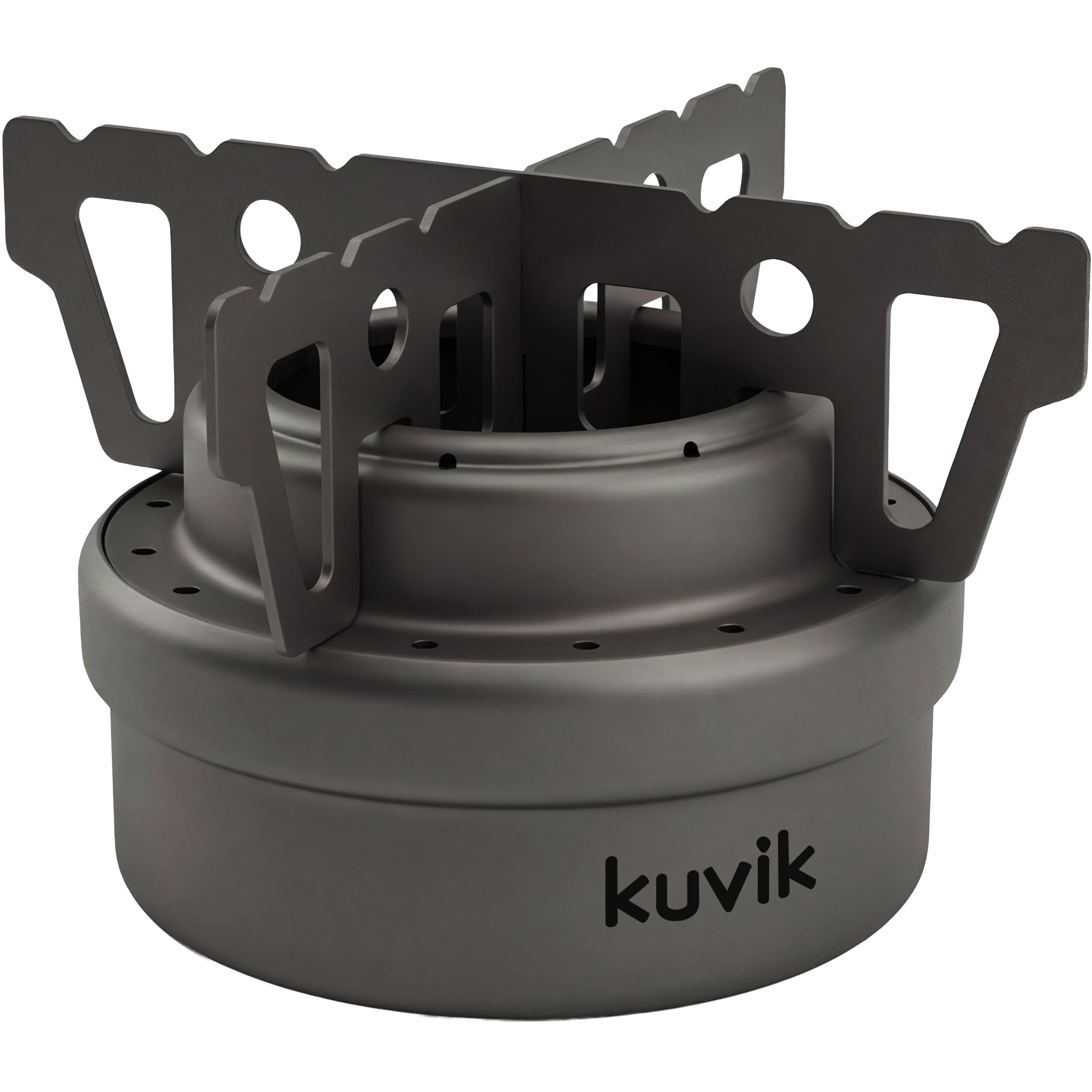
Titanium is the whole pitch, and for a stove that lives in a pack all season it’s a good one: the Kuvik won’t rust, won’t corrode from spilled fuel, and takes a knock that would put a brass burner out of round. At three inches across and an inch and three quarters tall, it nests inside a mug or a small pot and vanishes into a stuff sack.
The folding cross-beam pot support is the part we ended up liking most. Three racks fold out and sit flat, and a solo titanium pot rests on them without the wobble you get from a wire ring, even when you stir. It blooms in about a minute and settles into a hot blue flame that handles a solo portion without drama.
No windscreen comes with it, and sitting this low, a breeze reaches the burner easily — a folded piece of heavy foil fixes that for a couple of ounces, and we don’t leave without one. Titanium’s real draw here is corrosion resistance rather than a headline number, and no weight is published for this one, so treat the three-inch size as your guide.
Pros
- Titanium body resists rust and fuel corrosion
- Folding cross beams hold a solo pot steady
- Nests inside a mug or small pot
- Blooms fast and burns hot
Cons
- Sized for solo pots, not group cooking
We like the Kuvik for solo backpackers who want a stove that won’t corrode, dent or wobble under a pot, and who don’t mind paying for titanium.
Best for Minimalist Summer Trips
Gexdes Portable Mini Alcohol Stove
Key Features
- Frame: Aluminum-magnesium with stainless connectors
- Weight: 3.13 oz
- Boil time: 550 ml in about 8 min
- In the set: Folding stand and fuel bottle
- Price: Budget
Three point one three ounces, stand included, is the number that makes this one worth a look. The Gexdes is a squat bottle-style burner with a sliding cover and a three-legged folding stand that packs around it — the lightest complete setup in this guide by a clear margin.
We treat it as a summer stove and a solo one. The claim is 550 ml of water in about eight minutes, and on a still evening it gets there; the flame is broad enough for a mug of coffee and a rehydrated meal, and the sliding cover dims it without giving you anything like a true simmer. That’s the trade for the weight, and it’s one we accept on trips where cooking means boiling.
The frame is aluminum-magnesium with stainless connectors, and it feels stiffer under a full pot than three ounces has any right to. The supplied bottle seals properly, so you can fill at the trailhead and carry the rest without a fuel smell working through your pack.
Pros
- Lightest complete setup here at 3.13 ounces
- Sealed fuel bottle included
- Folding stand packs around the burner
- Brings 550 ml to a boil in about eight minutes
Cons
- Boils hard but has no true simmer
The Gexdes is the pick for anyone counting grams above all else — we found it boils a solo portion happily and packs down to nothing.
Best for First Stove on a Budget
Keweis Mini Alcohol Stove

Key Features
- Cap: Rubber o-ring seal
- Weight: 5 oz (145 g)
- Burn time: About 50 min per 100 ml
- Materials: Brass burner, aluminum stand
- Price: Budget
Set this beside our top pick and you’ll struggle to tell them apart: the same 145 grams, the same brass burner inside an aluminum stand, the same claim of about 50 minutes of burn per 100 ml. The Keweis is the cheaper of the two, and that is most of the story.
What it does well is the boring stuff. The rubber o-ring under the cover seals properly, so fuel doesn’t evaporate between trips, and the foldable handle on the regulator lets you shut the flame down without hunting for a glove. The stand is wide enough for a mug or a small pan and low enough not to feel tippy.
For the money we think it’s a sensible first alcohol stove, and a sensible second one to leave in a car kit or a backup bag. It won’t teach you anything the REDCAMP doesn’t, and it won’t fail you in a way the REDCAMP wouldn’t — that’s the point of a near-twin at a lower price.
Pros
- Same 145-gram kit as our top pick, for less
- O-ring cap keeps fuel from evaporating
- Foldable regulator handle shuts the flame down
Cons
- Flame-control cover is thin and bends easily
We think the Keweis makes sense as a cheap first stove or a second one for a car kit, as long as you’re gentle with the flame-control cover.
Best for Trangia and Diy Setups
Trangia Spirit Burner

Key Features
- Output: 1000 W
- Weight: 2.88 oz
- Included: Burner only
- Material: Brass
- Price: Premium
Here’s what the box doesn’t tell you: this is a burner, not a stove. The Trangia is built to drop into a Trangia windshield and pot-support set, and that’s the only way it holds a pot. On its own it will burn beautifully while your dinner sits on the ground next to it.
Buy it anyway if you’re assembling a setup, because as a burner it’s the best-made thing here. The simmer ring slides across the flame to take it from a rolling boil down to a gentle simmer and then shuts it off completely, the screw cap with its o-ring keeps unused fuel inside the burner, and at 2.88 ounces there’s less to go wrong than on anything else in this guide — no pump, no hose, nothing to swell or split.
Paired with the windshield set it was designed for, or a titanium cone, it’s the quietest and most controllable alcohol cooking we’ve done, and it’s the one we reach for when the evening meal actually matters. Hand it to someone with a bare pot and a lighter and you get a very good burner and no dinner.
Pros
- Simmer ring adjusts and snuffs the flame
- Screw cap keeps unused fuel in the burner
- Brass body at 2.88 ounces with nothing to fail
- Quiet, controllable burn
Cons
- Burner only; no stand or windshield included
We recommend the Trangia burner only if you already own a windshield and pot-support set — on its own it’s the finest burner here and not a usable stove.
How We Tested the Best Alcohol Stoves for Backpacking
We started by gathering every alcohol stove we could find from established makers and small reputable shops, then ruled out anything with a flimsy pot stand, unclear assembly, or materials that didn’t justify the price. That left us with 14 stoves, which we tested over five months.
Testing happened on real trips, not a lab bench: weekend overnights, a wet morning at a local reservoir, and a windy ridge where we had to crouch behind a rock to light anything. We assembled each stove bare-handed and again in wool gloves, timing how long it took to go from packed to lit. We weighed every stove on a kitchen scale, then weighed it again with its windscreen and a full fuel bottle to see how much bulk it really added to a pack.
For heat output and burn time, we boiled two cups of 50-degree water on a calm morning and repeated the test in a steady breeze, logging time to a rolling boil, how long a measured ounce of fuel kept the flame alive, and how much fuel each stove burned to get there. We ran each model through 20 consecutive burns to watch for warping, clogged jets, and scorched seals. Sturdiness got a simpler test: we nudged a full pot with a boot toe and noted whether it slid, tipped, or held. We also calculated cost per boil from fuel use, which is where value for money really sorts itself out.
How to Choose a Backpacking Alcohol Stove
Every stove here burns the same fuel; what separates them is everything around the burner — the stand, the pot fit, the seal, and the screen you remember to bring.
Count the Whole System, Not Just the Burner
Burner weights are the easiest numbers to compare and the least useful on their own. A bare brass burner is under three ounces, but without a pot stand it can’t hold your dinner, and a complete kit with stand, pot supports and a bag lands around five. Decide first whether you’re buying a burner for a setup you already own or a whole stove, then compare like with like. Add the windscreen — which none of these include — to whatever figure you settle on.
How Much Fuel to Carry
Capacity tells you how long you can cook before a refill, not how fast the water boils. The small brass burners list roughly 50 minutes per 100 ml, which is plenty of coffee and one-pot meals for a solo hiker and not much simmering. The ALOCS holds 200 ml and runs 45 minutes flat out. Match the tank to the cooking you actually do, and carry fuel in a separate sealed bottle so a long trip never depends on one fill.
Pot Fit, Stability and Wind
Compact in a listing means it fits in your pack, not that it holds your pot. Wide low bases take a two-cup mug or a small pan; folding cross-beams steady a solo pot and start to feel small when you’re feeding two. Height matters as well — the ALOCS stand sits low, which is stable but crowds the flame against the base of a tall pot. Since none of these ship with a windscreen, a folded foil screen is the cheapest speed you’ll ever buy.
Flame Control: Boil Water or Cook Dinner
Most inexpensive alcohol stoves have one real setting: on. A sliding cover dims the flame enough for coffee and rehydration and not enough for rice. A proper simmer ring — the Trangia’s is the reference, and the ALOCS uses a two-level lid — holds a low flame and then snuffs it out, which saves fuel as well as burnt dinners. If every meal is boil-and-soak, spend nothing on this. If you cook, it’s the feature worth choosing a stove around.
Keep Leftover Fuel in the Burner
Alcohol evaporates, so a burner with a plain lid is one you empty at the end of every trip. A screw cap with an o-ring — the Trangia, the REDCAMP, the Keweis — seals the fuel inside, which means less to carry on day two and no fuel smell working through your pack. Check the seal seats cleanly before you leave, carry the burner upright, and don’t overfill it.
Frequently Asked Questions
What kind of alcohol do these stoves burn?
Denatured alcohol, ethanol, or isopropyl at 90% or higher. The common 70% rubbing alcohol is nearly a third water, so it lights reluctantly and leaves you with a weak flame and a wet burner. Check the percentage on the bottle before you buy, and decant it into a sealed fuel bottle rather than carrying the original container.
How do you light an alcohol stove without a priming pan?
Fill the burner, leave the cover open a crack, and touch a flame to the fuel. Expect a yellow, sooty flame for the first minute while the burner warms; wait for it to turn blue before you set the pot on. Never top up a burner that is lit or still hot — let it cool completely first.
Can I use an alcohol stove during a fire ban?
Sometimes, but check first. Alcohol burners have no shutoff valve, so many land managers treat them as open flame and ban them alongside campfires when restrictions are in place. Call the ranger district or read the agency’s current restrictions the week you leave, and never cook inside a tent or vestibule whatever the rules allow.
Final Verdict
For most backpackers the REDCAMP is the one to buy: 145 grams, a stand that doesn’t wobble, a cap that keeps your fuel where you put it, and a simmer ring for the evenings when you’re cooking rather than soaking. It’s the least fussy way to get a hot meal on the trail.
Two exceptions are worth knowing. If you cook properly — a pot of rice, a shared dinner — the ALOCS trades weight for output and capacity and earns it. If you already own a Trangia windshield or a cone, buy the burner alone and skip the kits entirely.