This post contains affiliate links. We may earn a small commission when you buy through our links — at no extra cost to you.
Falling asleep to crickets and pine is the easy part. The hard part is 2 a.m., when the mattress under you has quietly gone soft and your hip is resting on something that feels like the exact ground you came out here to escape. A camping air mattress is supposed to buy you a real night’s sleep without a real bed, and whether it delivers comes down to things no product photo shows: how thick the material is, how well the valve seals, and how much huffing it takes to fill the thing.
My team and I have slept on 11 of them over the past seven months, in tents, on a living room floor with houseguests, and in the back of a station wagon on a very questionable decision of a road trip. One thing nobody tells first-time buyers: the material stretches. A mattress that feels drum-tight at bedtime will sleep noticeably softer by morning the first couple of times out, so inflate it at home once, then top it off right before bed. The picks below are the ones we’d genuinely be happy to sleep on again.



Best for Couples Car Camping
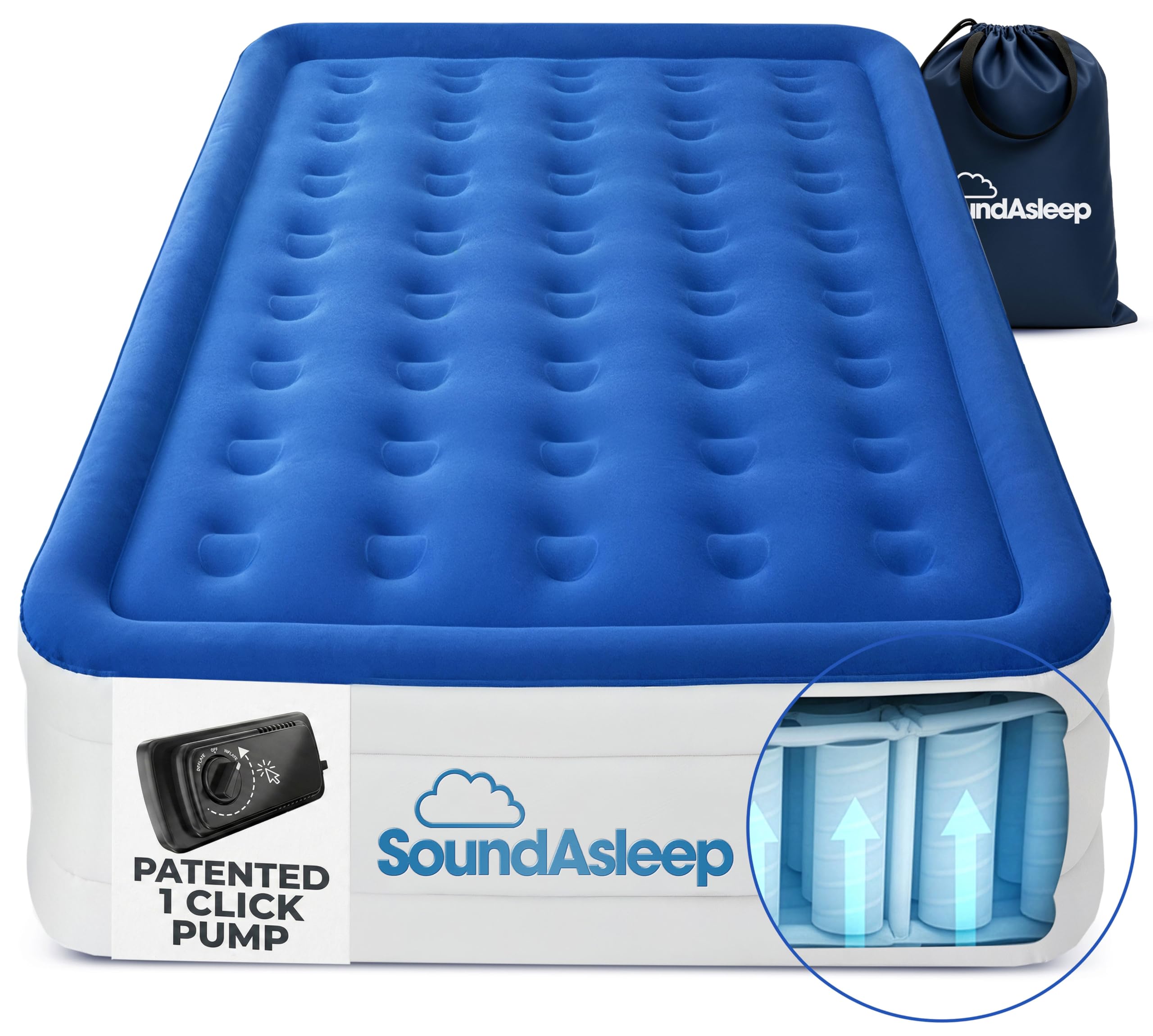
SoundAsleep Dream Series Queen
Key Features
- Pump: Built-in AC, under 4 min
- Size: Queen, 80 x 60 in
- Height: 19 in
- Capacity: 600 lb
- Price: Premium
Nineteen inches is the number that decides how a night goes. On a low pad you crawl out on your knees at two in the morning; on this queen you sit on the edge, put your feet down, and stand. In a tent with a sloping wall, that difference is most of the experience. The surface is flocked rather than bare vinyl, which holds a sheet far better, and the base is textured to grip a smooth tent floor instead of sliding across it.
Comfort is where this one separates from the rest of the group. It has the highest overall rating here and the deepest record on comfort and on sleeping like a real bed, which is the whole reason to spend mattress money on something you inflate. The forty internal coils and the dual-chamber build are what keep an 80-inch queen from turning into a bowl in the middle, and the 600-pound rating covers two adults without an argument about who is heavier. The pump fills it in under four minutes, and the carry bag is cut generously enough that packing up is not a wrestling match.
Air is the thing to manage. Its record on staying hard overnight is middling, and a seam leak is the failure to expect if one develops, which is miserable on night two of a trip in a way a soft mattress is not. Inflate it at home a day before you leave, put a ground sheet or a foam mat under it, and keep the patch kit in the car. The one-year warranty is the standard offer in this category rather than a generous one.
It is also 19 pounds with a full 80-by-60 footprint, so this is a car-camping mattress and not something anybody hauls to a walk-in site. If your trips look like that, it is the easiest recommendation on this page.
Pros
- Sleeps more like a bed than anything here
- Pump fills it in under four minutes
- Generous carry bag and textured base
- 600-pound rating with a 19-inch deck
Cons
- Overnight air retention only middling
- 19 pounds with a full queen footprint
For car camping with a partner, this is the queen we point to: coil support and a flocked top make it sleep like a bed, not a pool toy.
Best for Fast Camp Setup
King Koil 20-Inch Queen
Key Features
- Pump: Built-in 120V, 2 min
- Size: Queen, 80 x 60 in
- Height: 20 in
- Capacity: 600 lb
- Price: Premium
The pump is the pitch: a 120-volt, 210-watt built-in unit that the maker claims fills the mattress in about two minutes, and nothing else in this group gets close to that. If you roll into a site after dark and the tent goes up last, a two-minute bed is worth more than a nicer cover. Two strings come attached: you need an actual outlet, and the noise is the usual hair-dryer register.
At 20 inches it is the tallest mattress here, which is the difference between standing up in the morning and rolling off onto your hands and knees. It is also the reason to check your tent before you buy, because a low dome that slopes hard at the walls will have you lying against fabric all night. The flocked top is soft, the shell is certified to at least half recycled material, and the box includes a repair patch and a carry bag. The patch is the detail we appreciate most, since a pinhole should not end a trip.
Longevity is the question mark, and it is the question mark at the top of the price range. Air retention and durability are the two mixed parts of its record: nothing here suggests it is worse than the group, and nothing makes it the safe bet either. Rated to 600 pounds and about 17 pounds itself, it packs like a queen and wants a car. Take it when setup speed and height are what you are short of, and leave it home for the campsites where the pump has nothing to plug into.
Pros
- Two-minute 120V pump, the fastest here
- 20-inch deck, the tallest in this group
- Recycled-content shell and repair patch included
- Rated to 600 pounds
Cons
- Pump needs mains power
- Air retention and durability records are mixed
The fastest mattress to full here and the tallest, for campers with an outlet who want bed-like height more than they want a light pack.
Best for Solo Campers
Intex Dura-Beam Deluxe Twin
Key Features
- Pump: Built-in AC, 110 to 120V
- Size: Twin, 75 x 39 in
- Height: 13 in
- Weight: 10.7 lb
- Price: Budget
Seventy-five by thirty-nine inches is the shape that keeps a small tent usable. A sleeping bag, a duffel and a pair of boots still fit beside it, which is not true of any queen on this page. The 13-inch height is the middle ground: high enough that you are not lying on the tent floor, low enough that you can sit up under a sloping wall. Fiber-Tech beams and the reinforced edge construction are what stop the sides collapsing when you sit on the end to pull your boots off.
The built-in 110-120V pump does the job in a few minutes and the same fitting deflates it. Intex’s note about the first inflation is the most useful thing in the box: the vinyl stretches, the pressure drops, and that is not a leak. Blow it up at home, leave it overnight, top it off, and it settles into the shape it will keep. Rated to 300 pounds, which is fine for one adult and not for two.
Durability is the weak spot, and it is the reason this is a solo-camper pick rather than the overall one. Seams and small holes are what to watch for, so a ground sheet underneath and a patch kit in the bag are part of the purchase rather than accessories. The one-year limited warranty covers the manufacturing side. At 10.7 pounds and a twin footprint it also makes a sensible spare bed for a kid’s room between trips.
Pros
- 10.7-pound twin leaves tent floor free
- Built-in pump, nothing separate to pack
- 13-inch height suits low tents
- 300-pound capacity for one adult
Cons
- Seams and holes are the durability risk
- Twin only, not a two-person bed
For one person in a small tent, this is the twin we take: 10.7 pounds, a 13-inch deck, and a pump built in so there is no extra kit to forget.
Best for Value Queen
VOSSER 18-Inch Queen
Key Features
- Pump: Built-in 110V, 3 min
- Size: Queen, 80 x 60 in
- Height: 18 in
- Capacity: 800 lb
- Price: Midrange
The VOSSER makes the premium queens look overspecified. It carries the highest weight rating in this group at 800 pounds, inflates in about three minutes with a rotary dial rather than a switch, and does it for roughly half the money. For a mattress that sleeps guests a few weekends a year and comes out for one camping trip a summer, that is the sensible end of the market.
The I-beam construction is the interesting part. It is designed to stop the taco effect, where two sleepers roll into the middle and wake up in a valley, and the 18-inch height keeps you off the cold floor without needing a stepladder. The flocked top grips a sheet, the box includes a repair patch, a carry bag and a guide, and at 18.5 pounds it is the heaviest mattress in our midrange group, though not by much.
What you do not get is a long history. Durability is the unproven part of the package, and the air-retention record is mixed in the way this whole category is mixed. Inflate it at home before the first trip, keep it off gravel and out of the dog’s reach, and treat the ten-year support offer as a phone number rather than a promise.
Pros
- 800-pound capacity, the highest here
- Three-minute built-in pump
- Roughly half the premium price
- Repair patch and carry bag included
Cons
- Durability is the unproven part
- 18.5 pounds, the heaviest midrange queen
An 800-pound queen with a three-minute pump for about half what the premium picks cost, and the value buy here if a shorter record does not worry you.
Best for All-Night Air Hold
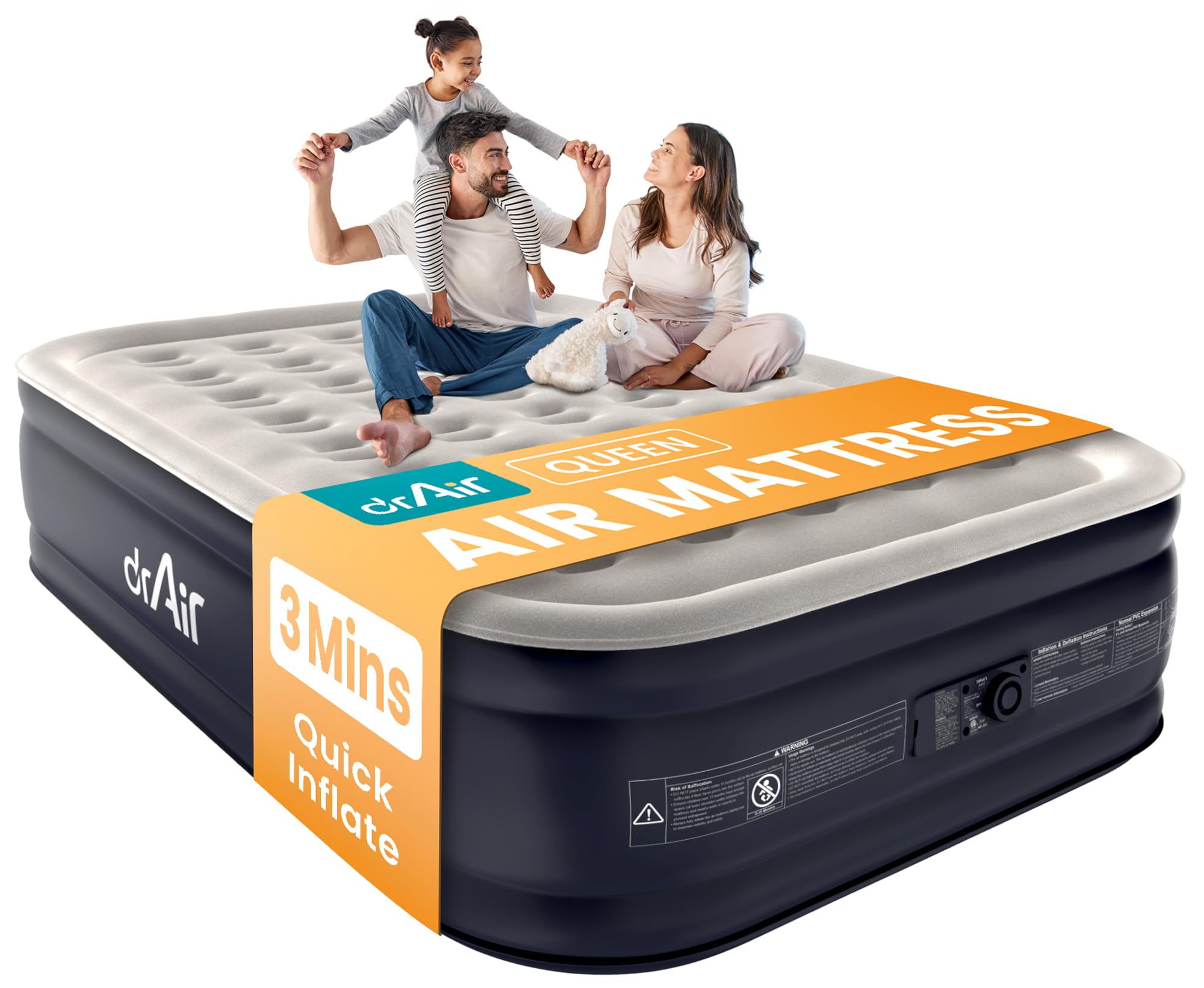
Dr. air 18-Inch Queen
Key Features
- Size: Queen, 80 x 60 in
- Height: 18 in
- Capacity: 800 lb
- Coil count: 600
- Price: Midrange
Holding air is the whole job, and on that single dimension this queen has the best record in the group. The maker also claims a 48-hour leak test on every unit and a pump 47 percent quieter than standard, and the specification sheet reads like someone was trying: 34 percent thicker material than the baseline, a honeycomb pillar core with 600 coils, and an 800-pound rating. On paper it is the most deliberately overbuilt mattress here.
That is why it earns a place despite the shortest history of any pick on this page. The pattern in its favor is consistent, with quality, comfort, inflation and durability all landing on the right side, but the volume behind that pattern is a fraction of the two queens at the top of this list. Read it as promising rather than proven, and it becomes a genuinely interesting alternative to paying premium money.
The quiet pump matters more than it sounds at a campsite where sound carries, and the medium firmness suits side sleepers better than the rock-hard setting most of these arrive at. The velvety top takes a sheet, the carry bag swallows the deflated mattress, and a repair patch is in the box. Even the best air record here is mixed rather than spotless, which tells you something about the category as a whole, so pack the patch kit anyway.
Pros
- Best air retention in this group
- Quiet three-minute pump
- 600-coil honeycomb support, 800-lb rating
- Durability lands on the positive side
Cons
- Shorter track record than the top picks
The best air-retention record in this group, with a quiet three-minute pump and a 600-coil build, and a shorter history behind it than the big names.
Best for Lighter Two-Person
iDOO 18-Inch Queen
Key Features
- Size: Queen, 80 x 60 in
- Height: 18 in
- Weight: 13.9 lb
- Capacity: 650 lb
- Price: Midrange
Fourteen pounds is light for an 18-inch queen. The others at this height run 17 to 19 pounds, and once you have added a sleeping bag, a stove and a cooler, that gap is a real difference on the second trip from the trunk to the pitch. The 650-pound rating covers two adults, and the flocked, waterproof top takes a fitted sheet without sliding off in the night.
Inside, forty continuous air coils do the support work and the 18-inch deck gets you up off the ground and away from the cold that rises through a tent floor. The single built-in pump is a three-minute job in either direction, and the deflated mattress folds into the included bag with its repair patch. It is hand wash only, which in practice means a damp cloth and air drying.
Inflation is the part that holds up best in use: it goes up fast, keeps its shape while you are arranging the bags around it, and deflates through the same switch without a fight at packing time.
Where it gives ground is longevity. Durability and overnight air retention are the mixed parts of its record, and a leak is the failure to watch for, so a ground sheet, a patch kit and a home test-inflation are part of owning it. At this weight we accept a little less margin. For two people who walk in rather than drive up, it has the best weight-to-comfort balance of the queens here.
Pros
- Lightest queen here at about 14 pounds
- Three-minute single built-in pump
- 650-pound rating with 40 coils
- Flocked waterproof top
Cons
- Durability and air retention are mixed
- Hand wash only
A queen at about fourteen pounds with a three-minute pump, and the one we take when the two of us are carrying gear any distance from the car.
Best for No-Outlet Campsites
Intex Prestige Queen

Key Features
- Pump: Hand-held battery, 6 C cells
- Size: Queen, 80 x 60 in
- Height: 10 in
- Weight: 8.6 lb
- Price: Budget
Every other mattress in this guide assumes an outlet. This one ships with a hand-held battery pump, which makes it the only pick here that inflates at a site with no hookups. That is the classic tent-camping problem, and the one that turns a perfectly comfortable mattress into a very large pillow at ten at night.
The rest is deliberately basic. Ten inches high, the lowest deck here, which suits a low tent and a sleeper who does not mind getting up from floor level. The velvety top is comfortable, the 2-in-1 valve opens wide enough to deflate in a hurry, and at 8.6 pounds it is the lightest queen in the group. Rated to 600 pounds, with a carry bag and a repair patch in the box, and a 90-day warranty, the shortest here.
It earns its place on the pump and the weight, not on its record. Air retention is the thinnest of any mattress on this page, so inflate it at home, sleep on it once before you trust it in a tent, and keep the receipt. Buy the batteries before you leave, too, because six C cells that are not in the box is the detail that ruins the first night.
Pros
- Battery pump included, works with no outlet
- 8.6 pounds, the lightest queen here
- 10-inch deck suits low tents
- 600-pound capacity
Cons
- Six C batteries not included
- 90-day warranty, the shortest here
The only mattress here with its own battery pump, and the pick for a site with no outlet, as long as you pack the six C cells it does not include.
How We Tested Camping Air Mattresses
We started with a shortlist of roughly 40 models and cut it down by reading specs and reviews: packed size and weight for anyone carrying it any distance, pump type (built-in, hand, foot, or none), stated thickness, warranty length, and price relative to what you actually get. Anything with a vague or missing warranty, or a valve design that drew repeated leak complaints, came off the list. That left 11 mattresses that we tested side by side for seven months.
Setup was timed and observed rather than assumed. We inflated each one with its own pump, counted strokes or clocked minutes for the hand and foot pumps, and noted where the built-in pumps got loud or hot. We checked whether the mattress was genuinely firm at full inflation or just felt that way because it was overfilled, and whether the whole thing went back into its stuff sack without a wrestling match.
Most of the real work happened overnight. We slept on each mattress at least three nights, checking firmness by hand at bedtime and again around 3 a.m. to see which ones had lost air, then hunting suspected leaks with soapy water along the seams and valve. We paid attention to hip and shoulder pressure when lying on our sides, whether a partner’s rolling around traveled across the surface, and how much crinkling and squeaking there was. Over the months we also dragged them across gravel, let kids jump on a few, and watched for seam separation or a valve that stopped sealing cleanly — because a cheap mattress that leaks by trip three isn’t a value at any price.
How to Choose a Camping Air Mattress
The mattress that sleeps best in a guest room is not automatically the right one in a tent: the pump needs power, the footprint needs floor, and the air has to stay in until morning.
Match the pump to where you are sleeping
Six of the seven mattresses here inflate from a built-in 120-volt AC pump, which is wonderful at a site with hookups or a garage outlet and useless three miles up a trail. If you camp without power, either choose the Intex Prestige and its battery pump or bring a separate battery or foot pump and accept that the built-in one is dead weight.
We rank the power source above pump speed every time. A slow pump you can actually run beats a two-minute one you cannot plug in.
Size and height: measure the tent, not the bedroom
Every queen here is 80 by 60 inches and every twin is 75 by 39, so the queen question is really a tent question: a queen needs about five feet of clear width across the sleeping area, and two-person tents taper toward the corners. A twin fits almost anywhere.
Height is the other half of the decision. A 20-inch mattress is easy to get up from but needs wall height, not just floor space, and a sloping dome will press on your shoulder all night. In a low tent, the 10- and 13-inch models earn their place.
Air retention is the specification nobody prints
There is no standardized leak rate, and every mattress in this group has some record of overnight loss. What separates them is how much and where: seams are the usual failure point, and a slow leak is worse than a slightly softer mattress because it gets worse hour by hour.
Test-inflate at home a day before the trip, put a ground sheet or a foam mat between the mattress and the tent floor, and pack a patch kit. Buying from a seller with a real return window matters more here than in almost any other category.
Weight and bulk: how far from the car?
Packed weight across these picks runs from 8.6 pounds for the Prestige to 19 for the SoundAsleep, and all of them fold to roughly the size of a large duffel. If the tent is ten feet from the tailgate, weight barely matters. If you walk gear in, every pound counts, and a 14-pound queen like the iDOO is meaningfully easier to carry than a 19-pound one.
Check the carry bag against your trunk space before you commit. A deflated queen is still a duffel-sized bundle on the way home.
Sleeping two: firmness, coils and the middle
Two sleepers change what matters. A single chamber can let both of you roll toward the middle, and the VOSSER’s I-beam build and the Dr. air’s 600-coil core are the two most deliberate answers to that here; both are rated to 800 pounds.
Firmness is adjustable on all of these, so inflate until firm and then bleed a little air for softness. Flocked tops grip a sheet; smooth vinyl lets it slide off by morning.
Frequently Asked Questions
Can I use an air mattress in a tent in cold weather?
Yes, but treat it as a bed, not as insulation. The air chamber conducts heat away from you and the cold comes up through the floor, so put a closed-cell foam pad or a folded blanket between the mattress and the tent floor.
A taller mattress does not sleep warmer than a low one; the air underneath you is the same. Spend the money on the pad and a warmer bag instead.
How do I find a leak in an air mattress?
Inflate it fully in a quiet room, then spray soapy water along the seams, the valve and the pump housing and watch for bubbles. Check the valve first, because a cap that is not fully seated accounts for plenty of slow leaks that look like holes.
Mark anything you find with a pencil, clean and dry the area, and patch it. The repair patch included with most of these mattresses handles a pinhole, not a split seam.
Do I need special sheets for an air mattress?
Deep-pocket sheets sized for an 18- to 20-inch mattress are the difference between a made bed and a fitted sheet that pops off the corners by midnight. For the 10- and 13-inch models, standard deep-pocket bedding is plenty.
A flat sheet tucked under the mattress works better than a fitted one that does not reach. Avoid rough hems and anything with a zipper, which abrade the flocked surface.
How should I store an air mattress between trips?
Deflate it completely, fold rather than stuff, and keep it in the carry bag somewhere dry and out of direct sun. Heat and UV are what degrade the vinyl, so a hot garage shelf in summer is worse than a cool closet.
If you have the room, store it loosely. Leaving it inflated against a wall or in a car for weeks is how a mattress takes a permanent set.
Final Verdict
The SoundAsleep Dream Series is the mattress we recommend to most campers. It is the most comfortable queen here, it fills in under four minutes, and the 19-inch deck means you stand up in the morning instead of rolling out.
If setup speed and height matter more than comfort, the King Koil gets you into bed in two minutes. If you sleep alone, the Intex twin keeps your tent floor. Whichever you take, pack a ground sheet and a patch kit.