This post contains affiliate links. We may earn a small commission when you buy through our links — at no extra cost to you.
An inflatable paddleboard promises a full-size ride that packs into a duffel and lives in a closet. The worry is simple: that it will paddle like a pool toy, sag underfoot, or lose air halfway across the lake. Pumping up boards on gravel shoulders taught me the difference between one that feels rigid and one that squirms with each stroke. A good inflatable SUP fixes that by giving you a stable platform you can carry under one arm, inflate without a fight, and trust to hold its shape all day—and through a few dock scrapes.
This spring and summer, our team tested eight inflatable boards over eight months on a local lake, a tidal river, and a breezy bay. We timed every pump-up, carried each board from car to launch, and checked pressure before and after long sessions. Advertised dimensions matter less than how a board feels underfoot at its recommended pressure—and whether the included pump gets you there without a fight. The picks below stayed firm, carried easily, and made us want to go out again.



Best for All-Around Paddling
Roc 10’6" Inflatable
Key Features
- Warranty: 3 years
- Thickness: 6 inches
- Deck dimensions: 126"L x 33"W
- Weight capacity: 350 lb
- Price: Midrange
The 33-inch deck is what sold us on the Roc for mixed groups. It gives a first-time paddler room to find their feet without turning every stroke into a balance correction, and the 10-foot-6 length still fits inside the included backpack. The 350-pound rating leaves sensible margin for one adult and a day bag, which is the way most people will use it. The non-slip deck pad is the other practical detail: it gives you grip when you step back to turn the board, rather than feeling like a slick inflatable.
The package is unusually complete for a board at this level: paddle, pump, leash, fins, and a carry bag all arrive together, so there is no scramble to buy the rest before a first launch. The six-inch thickness and wide outline make the deck feel planted when you step aboard; we also appreciate that the three-year warranty covers a longer window than most of the other kits here. The bag turns the deflated board and pump into one object to store, which is exactly what you want between weekends.
Where it gives ground is outright load: 350 pounds is generous for a solo paddler, but it is not the board we choose for two adults and a cooler. If your usual crew is one person plus a dry bag, though, the Roc’s blend of stability, support, and finish is the safest recommendation here. That makes it the board we hand to friends who are new to the sport.
Pros
- Stable 33-inch deck for new paddlers
- Complete kit ready for the water
- Three-year warranty adds confidence
- 350-pound capacity suits most solo paddlers
Cons
The Roc is the all-around board we recommend first: a stable 33-inch deck, a complete kit, and a three-year warranty make it an easy default for most adults.
Best for Heavy Loads
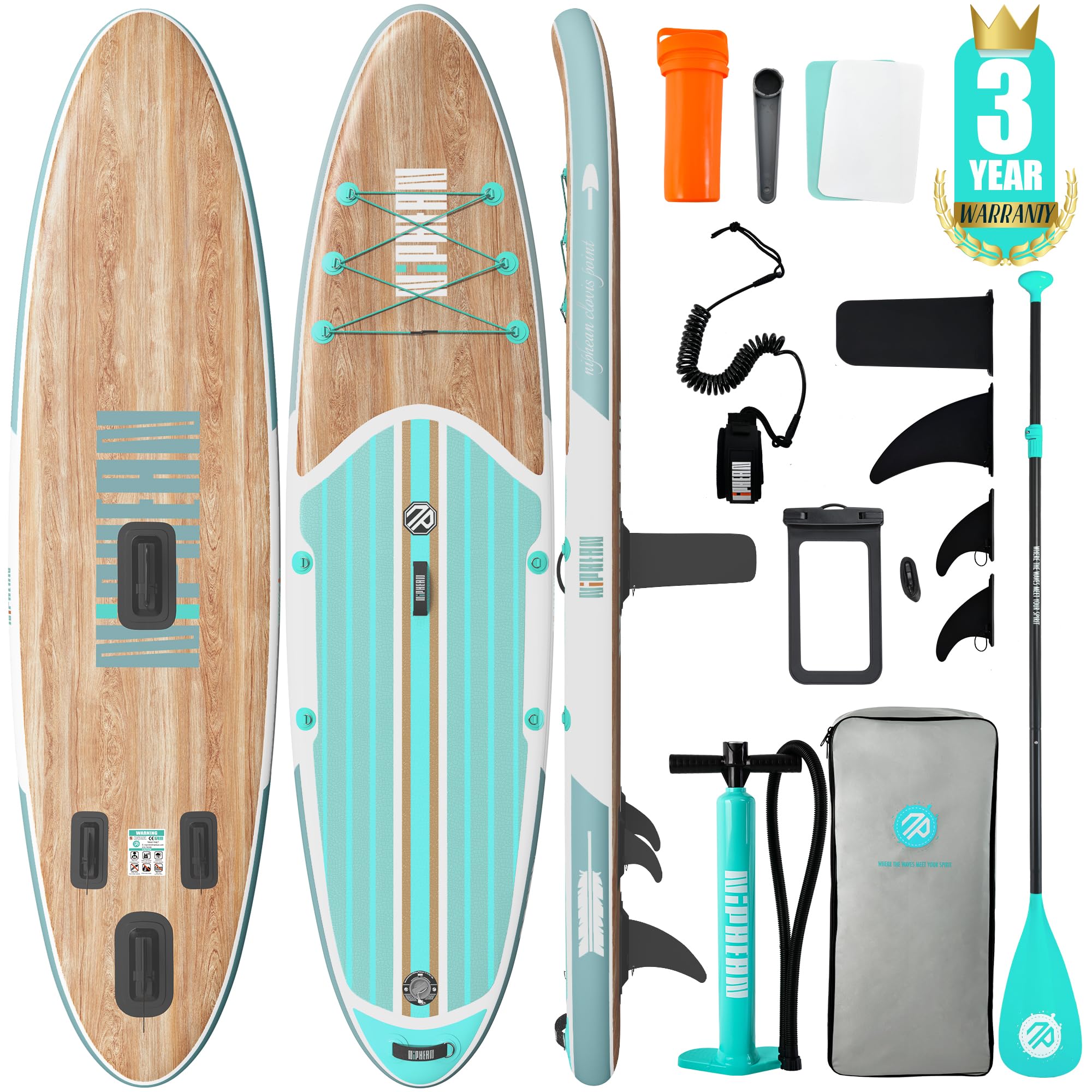
Niphean 10’6" Inflatable
Key Features
- Board weight: 19 lb
- Max pressure: 20 psi
- Deck dimensions: 126"L x 33"W
- Weight capacity: 450 lb
- Price: Midrange
The 450-pound rating is the reason the Niphean stays in the conversation. That is a lot of buoyancy for a 10-foot-6 board, and it changes who can use it: a big solo paddler, an adult with a dog, or someone hauling a cooler and camp gear all have room to work with. The 33-inch width keeps the extra capacity from feeling like a barge.
What we appreciate most is the 20 psi ceiling. It is higher than the 13-15 psi boards we list with that figure, and it gives the Niphean more room to firm up under a heavier stance. The kit is complete, with paddle, pump, three fins, leash, backpack, phone bag, and repair kit.
The included pump is the part we check before a trip: the gauge and hose are the weak links in an otherwise generous package, so an electric pump is worth having on standby. For paddlers who need the capacity, that is a manageable trade-off rather than a deal-breaker, and the board itself feels like the substantial choice here.
Pros
- 450-pound capacity handles bigger paddlers and gear
- 20 psi ceiling firms up under load
- Complete accessory kit
- 33-inch deck balances stability and glide
Cons
- At 19 pounds, long carries take effort
The Niphean is the board we point heavier paddlers toward: a 450-pound rating, 20 psi build, and full kit give it more load margin than most of this group.
Best for First-Time Paddlers
SereneLife 10’6" Inflatable
Key Features
- Board weight: 13.9 lb
- Max pressure: 13 psi
- Deck dimensions: 126"L x 32"W
- Weight capacity: 275 lb
- Price: Midrange
At 13.9 pounds, the SereneLife is the board we reach for when the water is a short walk from the car. That low packed weight matters more than a saved minute of inflation if you launch alone, and it makes the board easy to store in a closet or hall. For a first-season board, that low-friction ownership is a real advantage.
The 32-inch deck is a little narrower than the 33-inch boards here, but it still gave us a stable platform for flatwater paddling; the 275-pound rating is the limiting number. One adult and a small dry bag fit comfortably. Add a large dog or a second paddler and the board starts to sit lower than we like.
The 13 psi ceiling is lower than the high-pressure boards here, so heavier paddlers should look at the Niphean or Atoll. For a first season on calm lakes and easy rivers, though, the SereneLife’s low weight, complete kit, and forgiving price make it an easy board to say yes to.
Pros
- Lightest packed board in this group
- Stable 32-inch deck for flatwater
- Complete kit at an accessible price
- Easy to store and carry
Cons
- One-year warranty is shorter than several picks
The SereneLife is the gentle, affordable way into paddleboarding: light to carry, stable enough for calm water, and simple to live with.
Best for Longer Tours
Atoll Cove 11′
Key Features
- Board weight: 19 lb
- Max pressure: 15 psi
- Deck dimensions: 144"L x 34"W
- Weight capacity: 400 lb
- Price: Premium
Heat-welded seams are the detail that sets the Cove apart here. Instead of relying on glued joints alone, the seam is welded for a stronger bond, which is the kind of construction we look for when a board will live in a hot car and see regular use.
The 11-foot length gives it a longer waterline than the 10-foot-6 boards, so it tracks straighter across open water; the 34-inch width keeps that from turning into a tippy touring shape. We also like the 400-pound rating, which leaves room for a larger solo paddler or a small passenger without making the board feel overbuilt.
What we keep coming back to is the ride: the hull feels planted without feeling sluggish, which is exactly what we want when the wind picks up or the launch is a long way from the car. The Cove is 19 pounds, so it is not a featherweight, but the included backpack makes the carry manageable. This is the premium pick for someone who will use it often enough to feel the difference.
Pros
- Welded seams add durability confidence
- 11-foot length tracks well on open water
- 400-pound capacity suits bigger paddlers
- Planted, efficient ride for longer tours
Cons
- Premium price is a significant outlay
The Atoll Cove is for the paddler who wants a planted, efficient board for longer tours and is willing to pay for welded construction.
Best for Budget Starts
FBSPORT 11′ Inflatable
Key Features
- Thickness: 6 inches
- Max pressure: 15 psi
- Deck dimensions: 11′ x 33"
- Weight capacity: 280 lb
- Price: Budget
The 11-foot length is the first thing that separates the FBSPORT from the pack of 10-foot-6 all-around boards. That longer waterline helps it track across a lake, and the 33-inch deck still leaves enough width to stand up without feeling like you are on a balance beam.
We think the value case is strongest for a first board: the kit includes the paddle, pump, leash, fins, and carry bag, and the 15 psi ceiling is enough to firm up the deck for calm-water paddling. It is not the stiffest board here, and that is part of why we see it as a fair-weather starter rather than a rough-water touring pick.
For a few weekends a year on a calm lake, that is enough. The FBSPORT is the board we suggest when the goal is to try the sport without committing to a premium kit, and the 11-foot shape gives it a little more glide than its price tier suggests.
Pros
- 11-foot length tracks well for the money
- Complete starter kit
- Stable 33-inch deck for calm water
- Budget-friendly entry point
Cons
- 280-pound limit is tight for gear or a dog
- Carry bag and strap are weak links
The FBSPORT is the budget board we hand to curious friends: an 11-foot platform, a full starter kit, and enough stability for calm-water afternoons.
Best for Families and Kayaking
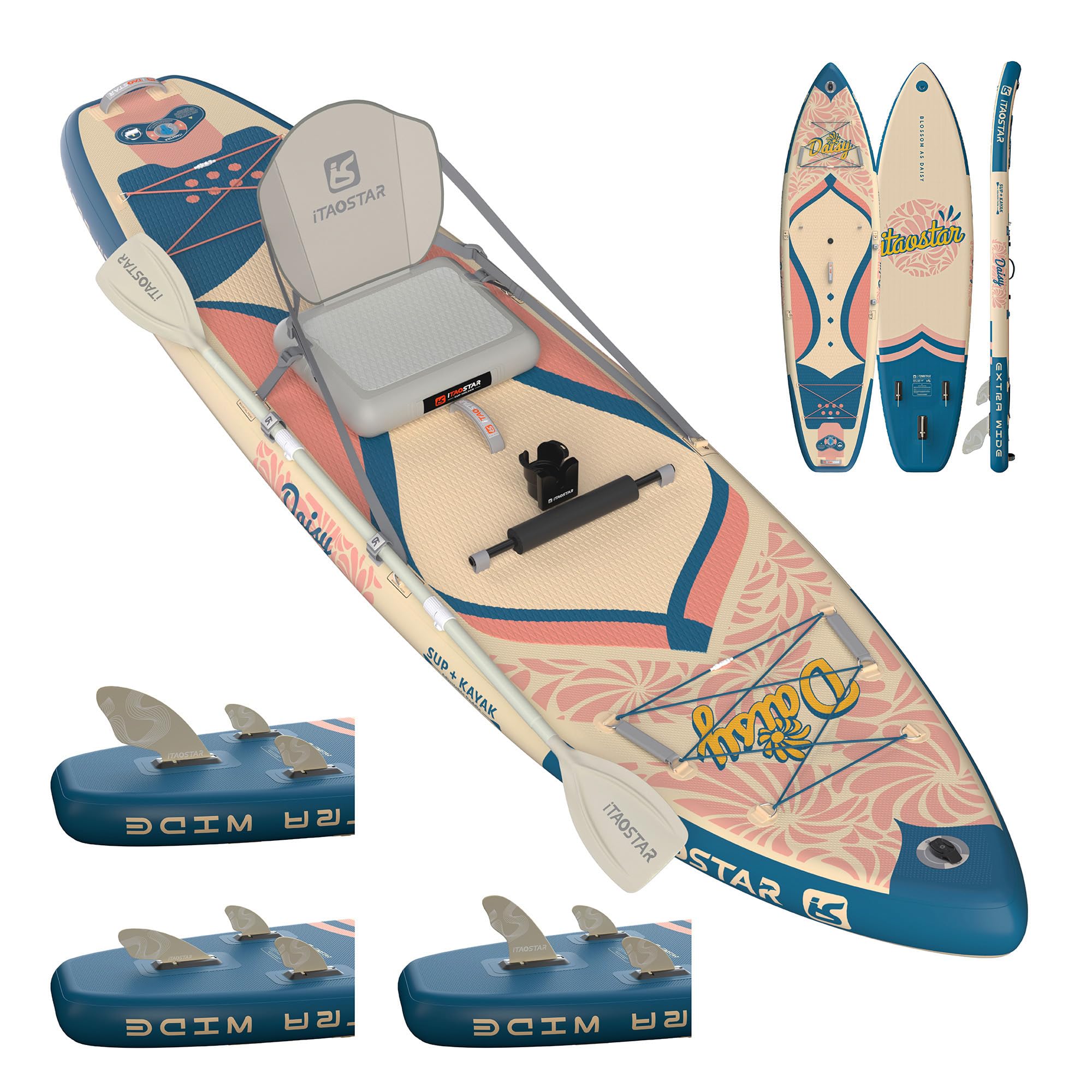
iTAOSTAR 11’6" Inflatable
Key Features
- Board weight: 20.5 lb
- Max pressure: 15 psi
- Deck dimensions: 138"L x 35"W
- Weight capacity: 450 lb
- Price: Midrange
At 35 inches wide, the iTAOSTAR is the widest board in this group, and that extra deck changes the experience. Standing up feels less like a balance test and more like having a stable platform to move around on, which is exactly what you want when a child or a dog is aboard.
The 11-foot-6 length gives it room for the kayak conversion, and the package is unusually deep: five removable fins, a seat, footrest, dry bag, shoulder strap, cup holder, and a paddle that converts for seated paddling. We like that the board can be a stand-up board for one adult or a sit-down kayak for a parent and child without buying a second craft.
The 450-pound rating backs up the family-friendly brief. It is also a 9.3 kg package, so it is not the board we choose for a long solo portage; the bulk is the price of all that width and accessory range.
The trade-off we noticed is setup: with five fins and a conversion kit, there are more pieces to keep track of than on a three-fin all-around board. That is a small annoyance on a calm morning, but it is the reason we see this as a family and kayak board first, not the simplest solo cruiser.
Pros
- 35-inch deck gives the most standing room here
- 450-pound capacity supports a family load
- Kayak conversion adds a second use
- Very complete accessory package
Cons
- Costs more than the simple all-around boards here
The iTAOSTAR is the family board we recommend: a 35-inch deck, a 450-pound rating, and a kayak conversion give it a rare second life.
Best for Style-Led Cruising
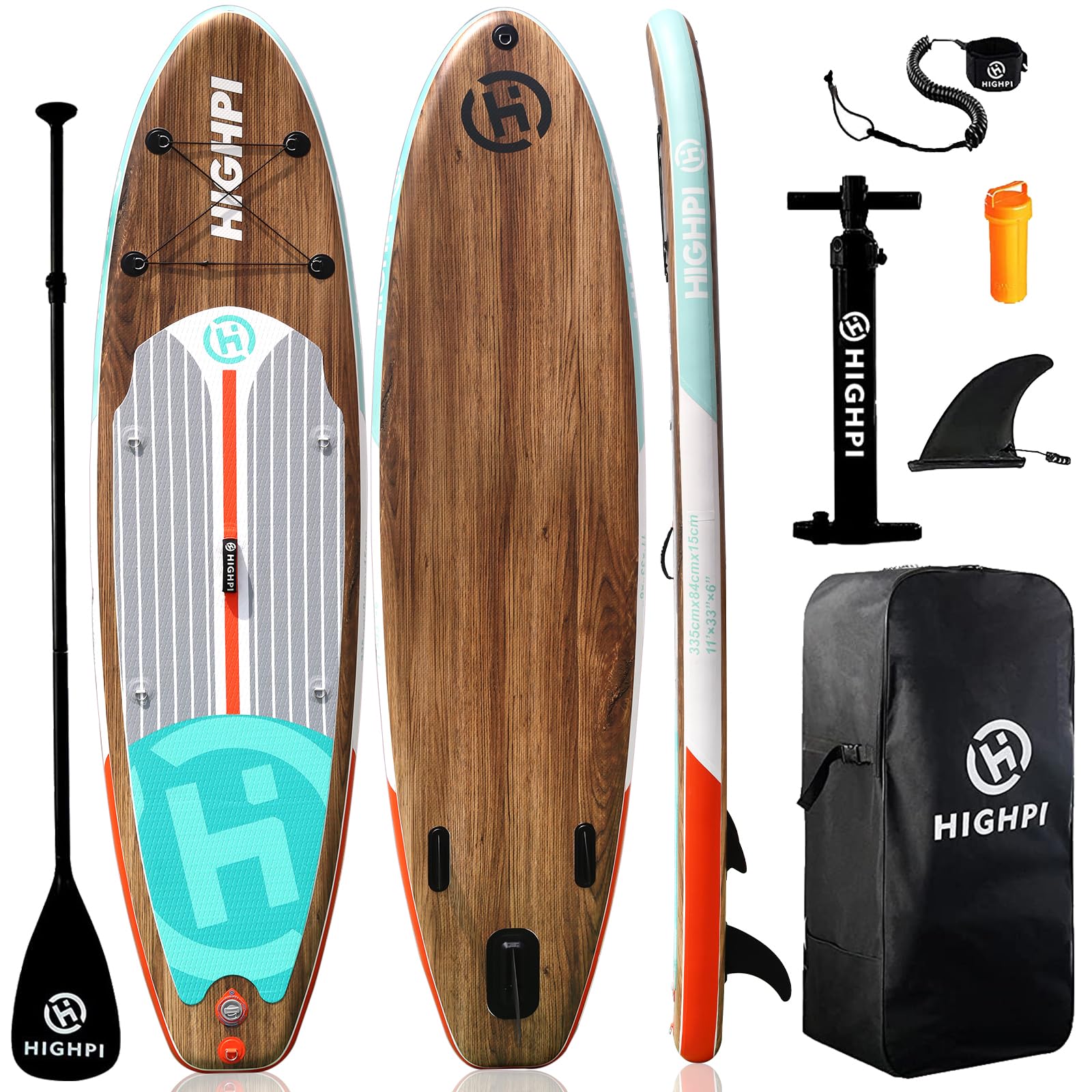
Highpi 11′ Inflatable
Key Features
- Warranty: 1 year
- Board weight: 20 lb
- Deck dimensions: 132"L x 33"W
- Weight capacity: 350 lb
- Price: Midrange
The wood-grain finish is the first thing people notice, and it is a welcome change from the usual blocks of primary color. It looks especially good on the water, where the warm tone reads more like a traditional board than an inflatable.
Underneath the finish, the 11-foot length and 33-inch width give it the steady feel of an all-around board, with a 350-pound capacity that covers most solo paddlers and a day bag. The metal paddle shaft is a small but useful upgrade: it feels more substantial in the hand than the basic paddles in cheaper kits.
What we keep coming back to is the balance of looks and usability. The package covers the essentials, but it does not try to be a kayak conversion or a family hauling platform. For calm lakes and easy rivers, that focus is the point.
Pros
- Distinctive wood-grain finish
- 11-foot length tracks steadily
- 350-pound capacity covers most solo paddlers
- Metal paddle shaft feels more substantial
Cons
- One-year warranty trails several picks
The Highpi is the style-led pick: a warm wood-grain finish, an 11-foot hull, and a 350-pound rating make it an easy board to live with.
Best for Light Solo Carry
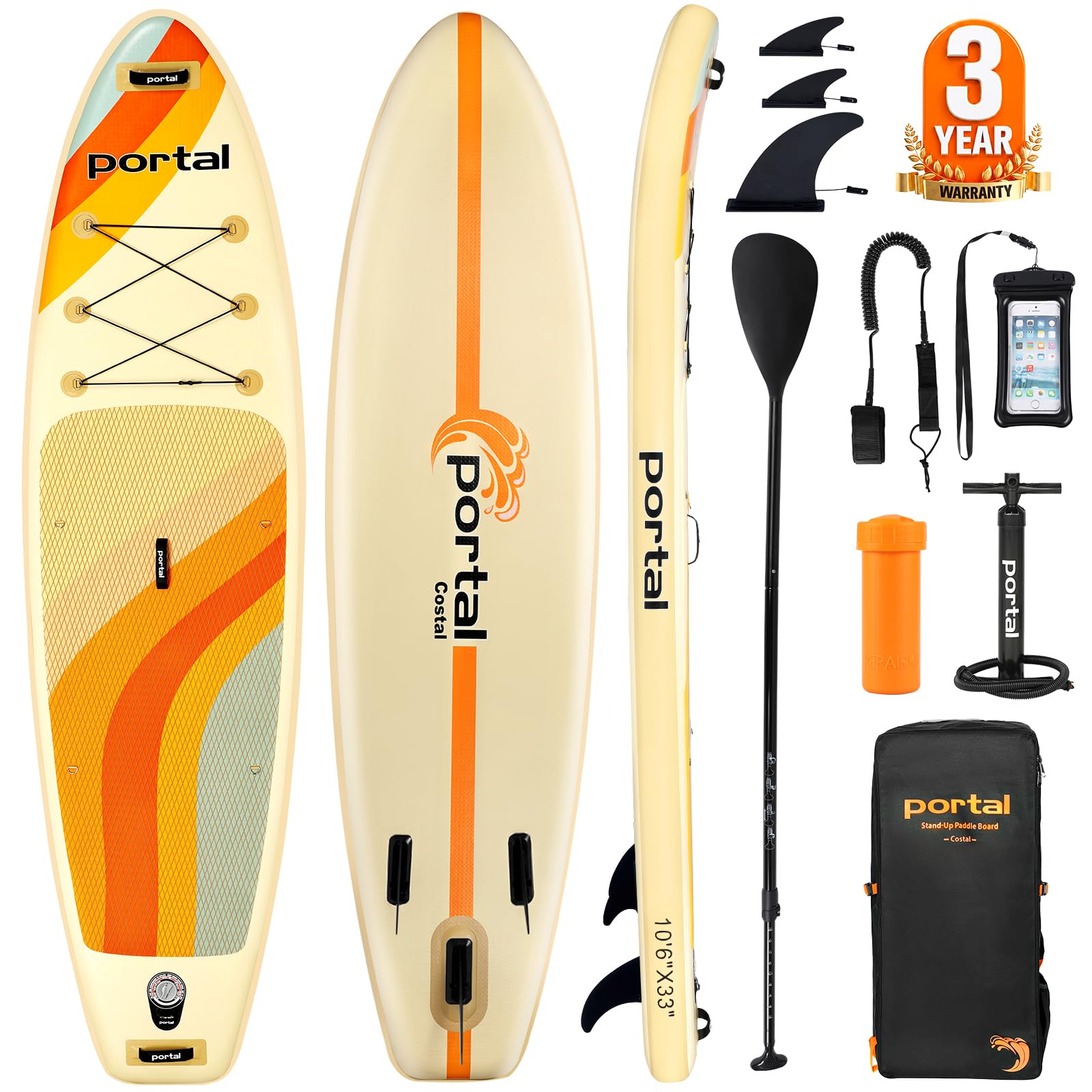
Portal 10’6" Inflatable
Key Features
- Warranty: 1 year
- Board weight: 17.8 lb
- Deck dimensions: 126"L x 33"W
- Weight capacity: 300 lb
- Price: Midrange
At 17.8 pounds, the Portal is one of the easier boards to get from the car to the launch. That matters if you are walking a quarter mile or hauling the board up a set of stairs; the difference between a 14-pound board and a 20-pound board is noticeable by the second trip.
The 33-inch deck gives it the same stable footprint as the bigger all-around boards here, and the 10-foot-6 length is compact enough to store in a closet or a corner of the garage. The included backpack has room for the board, pump, and paddle without needing a second bag for the essentials.
The colors are a practical detail as much as a style one: a bright board is easier to spot from shore, and the finish looks more expensive than the price tier suggests.
What holds it back is the load rating. At 300 pounds, it is fine for one adult and a small bag, but it is not the board we choose for a dog, a child, or a cooler. As a solo board for flatwater afternoons, though, the low carry weight and easy storage make it a smart pick.
Pros
- 17.8-pound package is easy to carry
- Stable 33-inch deck
- Packs into included backpack
- Bright colors are easy to spot
Cons
- One-year warranty is basic
The Portal is the board we grab for short carries and tight storage: a 17.8-pound package, a stable 33-inch deck, and colors that are easy to spot on the water.
How We Tested Eight Inflatable Paddle Boards
We started by researching current inflatable SUPs from brands with a track record for valves, seams, and included pumps, then filtered the list by price, packed size, claimed weight, and whether each kit came with a pump, fin, and backpack. Eight boards made the cut—a mix of all-around and touring shapes—and we spent eight months living with them.
Testing happened on a local lake before work, a tidal river on weekends, and one breezy bay day. At the launch, we timed how long each board took to inflate with its included pump, counted strokes once resistance kicked in, and checked the gauge against a separate pressure reader. We inflated to the recommended PSI, let each board sit for 24 hours, then checked again; on the water, we noted whether the deck felt firm at the first stroke and the last.
We stood, knelt, and turned in tight circles on every board, and I had a friend who had never paddled try each one so we could watch where it felt tippy. Back on shore, we carried each board fully packed from the car to the water—about a quarter mile—and noted shoulder fatigue and whether it fit in a trunk. We also dragged the rails over gravel, bumped the nose into the dock, and folded each board back into its bag after every session to check seams, valves, and fin boxes. At the end, we asked one simple question: would we take this board out again tomorrow?
How to Choose an Inflatable Sup
The right inflatable SUP is the one you can carry alone, inflate without dreading it, and stand on with enough confidence to enjoy the water; everything else is secondary.
Start with deck width, length, and real load
A 33-inch deck is the useful middle ground for most adults: wide enough to stand on without constant correction, narrow enough to paddle without feeling like a raft. The 10-foot-6 boards here are easier to store; the 11-foot and 11-foot-6 boards track better across open water.
Match the stated capacity to your actual load, not just your body weight. A 300-pound board is fine for a solo paddler and a dry bag, while a 450-pound rating leaves room for a dog or a small passenger. We prefer capacity in reserve, because a board that sits low in the water is slower and less forgiving.
Packed weight matters more than the brochure photos
An inflatable board only solves storage if you can get it to the water. A 14-pound board is a different ownership experience from a 20-pound one when the launch is a quarter mile from parking. Check the packed weight and how the backpack carries: a broad waist belt and a padded shoulder strap do more for comfort than a fancy logo.
If you regularly launch alone, choose the lighter board and accept a little less accessory range. If you paddle from a car-adjacent beach, the extra weight buys capacity and stiffness.
Treat the pump and valve as part of the board
The included hand pump is the most common weak point in a complete kit: gauges stick, hoses split, and the last few psi take real effort. A 15 psi board is not automatically better than a 13 psi board if you cannot reach the top of the range, so look for a pump with a working gauge and a hose that locks securely.
If you paddle often, an electric pump is the upgrade we prioritise before a paddle upgrade; it saves your arms for the water and makes deflating less of a chore. Check the valve for a clean seal before every trip.
Decide how complete a kit you need
Most boards here arrive with a paddle, pump, leash, fins, and backpack, but the quality of those extras varies. A basic three-piece paddle is fine for occasional use; a metal shaft is nicer if you paddle often. A repair kit and a phone bag are useful, while a kayak seat is only worth paying for if you will actually sit and paddle.
We look for a board with the fewest accessories we will not use and a warranty long enough to cover a season of mistakes.
Look beyond the deck to seams, valves, and support
Seams and valves are where an inflatable board earns or loses trust. Heat-welded seams are a step up from glued seams, and a clear warranty matters because a leaking valve can take a board out of service. The Atoll Cove is the clearest example here of welded construction; most of the others rely on glued seams.
A one-year warranty is common; a three-year warranty is a real advantage if you plan to store the board in a hot car or paddle often. Ask how to reach support before you need it, and keep the receipt and model number.
Frequently Asked Questions
Can I leave my inflatable SUP inflated between outings?
Yes for short stretches, but keep it out of direct sun and release a little pressure if it is sitting on hot sand or a car roof. Check the pressure before you launch, and deflate it fully for long storage so the seams and valve are not under constant load.
Clean and dry it before rolling it away; trapped grit is what wears the valve seal.
Will an inflatable SUP fit in a small car?
Deflated, yes: the boards here roll into a backpack-sized bundle, but check the bag’s packed dimensions against your trunk before ordering. Inflated, a 10-foot-6 or 11-foot board will not fit inside a small car, so plan to inflate at the launch or carry it on a roof rack.
If you must inflate at home, measure the longest clear space in the car with the seats down.
Do I need a life jacket and leash on a paddleboard?
Wear a properly fitted personal flotation device every time, even on calm water. An ankle leash is useful in open flatwater because it keeps the board near you if you fall, but do not use a fixed leash in moving water or around obstructions where it can snag.
Check local rules before launching, and carry a whistle or phone in a waterproof bag.
Final Verdict
For most adults, the Roc is the board we point to first. Its 33-inch deck is stable without feeling sluggish, the kit is complete enough to launch the same day, and the three-year warranty gives it a longer support window than most of this group.
If you regularly paddle with a dog, a child, or a lot of gear, step up to the Niphean’s 450-pound capacity; if longer tours matter more, the Atoll Cove’s welded seams and 11-foot hull are worth the premium. Everyone else can start with the Roc and put the difference toward a proper PFD.