This post contains affiliate links. We may earn a small commission when you buy through our links — at no extra cost to you.
An inflatable paddleboard has one job it can’t fail: make you forget it’s inflatable. A wobbly deck or a slow leak turns a calm morning into a swim, and a board that takes fifteen minutes to pump up kills the fun before you push off. The good ones are stiff enough to paddle with confidence, stable enough to carry a small cooler, and light enough to haul from the car without a second trip. I’ve spent the last six months with eight boards, from compact shapes to wide family cruisers, and the differences show up fast.
The pump matters more than I expected: a fussy gauge or a valve that won’t stay seated makes inflation a workout before you even reach the water. The boards that won me over held pressure overnight, tracked straight, and still fit in the back seat with room for the paddle. They felt solid underfoot after a full day in the sun, which is more than I can say for a couple of cheaper-feeling models. The picks below are organized for first-timers, touring types, and lazy-floaters.




Best for All-Around Paddling
Roc Inflatable Paddle Board
Key Features
- Warranty: 3 years
- Thickness: 6 inches
- Dimensions: 10’6" x 33"
- Weight limit: 350 lb
- Price: Midrange
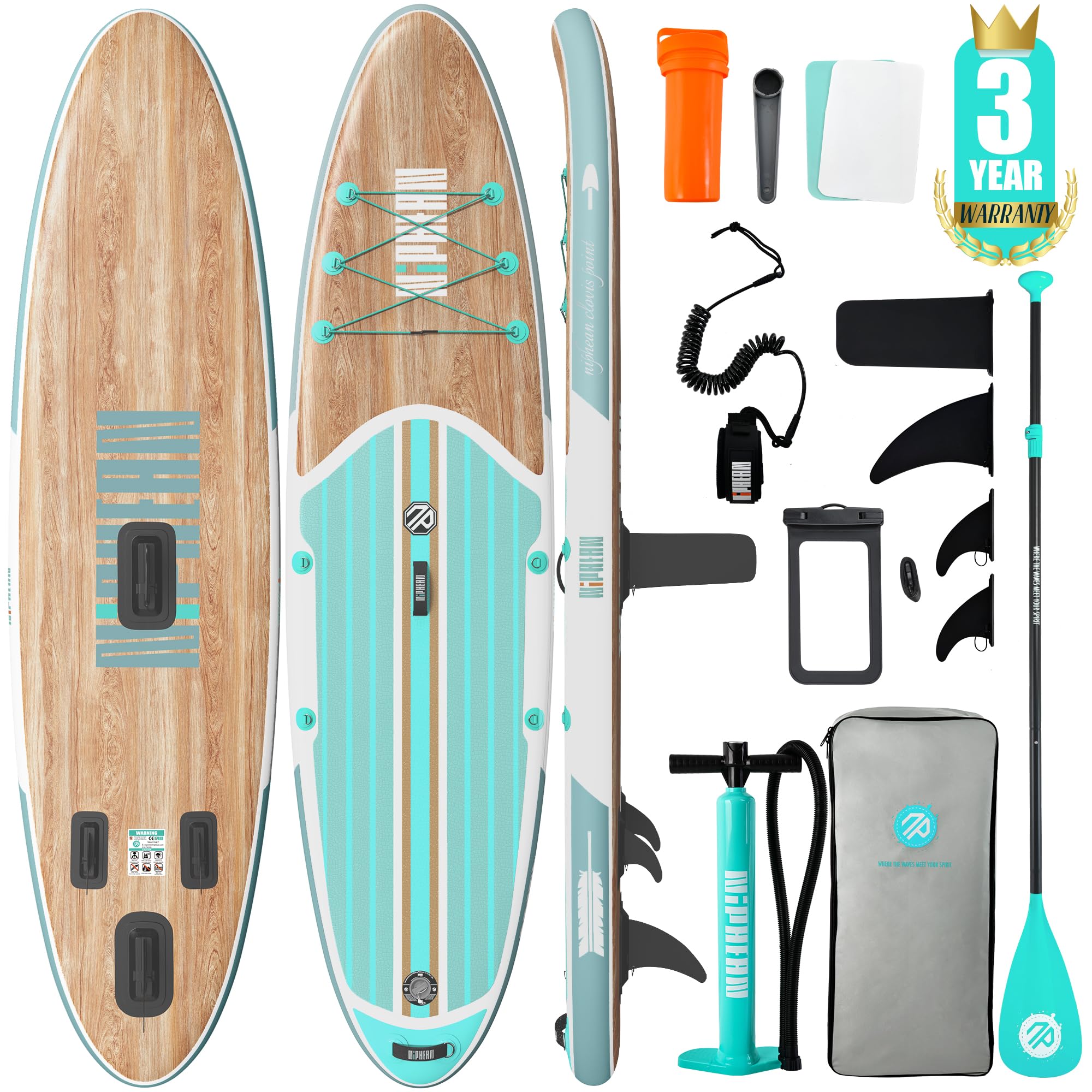
A 33-inch deck, six inches of drop-stitch PVC and a three-year warranty is the combination that makes the Roc the board we point most people to. It sits in the middle of this group on price and near the top on support: 10 feet 6 inches long, wide enough that a beginner can stand up on the first outing, with a non-slip deck pad that grips under bare feet or booties. The warranty matches the longest here, and on a board that will live in a car trunk and get dragged over gravel, that counts for more than another inch of width.
Inflating it is where our enthusiasm dips a little. The gauge on the included pump is slow to move and easy to mistrust, so we stopped watching the dial and inflated until the deck felt hard as a table under a flat palm. At that point the ride is genuinely rigid — it doesn’t fold or shimmy when a boat wake rolls through. The backpack swallows the board, paddle, pump and leash with room left over, which is what makes the walk from the lot to the put-in tolerable rather than a chore.
The bundle is more generous than we expected for the money: the package we tried came with a kayak seat and a matching paddle, so a tired kid or a windy afternoon turns a standing session into a sit-down one. All of it folds back into the same bag, which matters when you’re the one carrying it.
Pros
- Three-year warranty, the longest in this group
- Wide 33-inch deck stays steady in chop
- Backpack holds board, paddle and pump
- Kayak seat included in the bundle
Cons
- 350-pound limit rules out two adults plus gear
We recommend the Roc as the default inflatable for most adults: a stable 33-inch deck, a three-year warranty, and a bundle that fits in one backpack.
Best for Families and Big Riders
Skatinger Super Wide SUP
Key Features
- Warranty: 2 years
- Dimensions: 11’6" x 35"
- Board weight: 19.8 lb
- Weight limit: 450 lb
- Price: Premium
Thirty-five inches of deck is the number that matters here, and it’s why the Skatinger is the board that gets used when nobody wants to paddle alone. Two children sitting near the nose and a dog behind them still leaves a standing spot for an adult, and the 450-pound rating covers the whole crew. At 11 feet 6 inches it’s also one of the longest decks in this group, so it doesn’t start to feel like a bathtub once everyone is aboard.
We like it best for households that launch as a group. Three handles — nose, middle and tail — mean two people can haul it up a beach or onto a dock without a tug of war, and the 1680D backpack is heavier fabric than most of the bags in this group, with room for the pump, the included 5L dry bag and a towel. Six bungee points up front and four behind give a cooler and a dry bag somewhere to ride. It’s the second-priciest board here, and a family that goes out most weekends gets that back.
The trade-off is agility. A 35-inch platform this long is slow to bring around, and on a windy afternoon it sails like a raft. Solo paddlers who want to cover distance will be happier on the Roc or the ZLX; this one is built for the crew.
Pros
- 35-inch deck with a 450-pound rating
- Three handles make a two-person carry easy
- 1680D backpack and 5L dry bag included
- Ten bungee points for gear
Cons
- Slow to turn and catches side wind
Our pick for families and bigger paddlers: a 35-inch deck and 450-pound rating that keep kids, dogs and gear aboard without a wobble.
Best for Firm All-Round Ride
Niphean Inflatable Paddle Board
Key Features
- Dimensions: 10’6" x 33"
- Board weight: 19 lb
- Max pressure: 20 psi
- Weight limit: 450 lb
- Price: Midrange
Twenty psi is the odd number out in this group — most boards here top out at 15 — and the Niphean’s higher ceiling is something you can feel underfoot. Pumped hard, the deck barely flexes when you shift your weight, which is exactly what stops a beginner from overcorrecting in chop.
Around that core the package is tidy: three detachable fins including a removable center fin, a leash, a repair kit, a waterproof phone bag and a backpack, plus a green wood-grain graphic that looks better in person than the listing photo suggests. At 19 pounds it’s a board one adult can carry under an arm from the car, and the 450-pound rating means a taller, heavier paddler isn’t pushing the limit on every stroke.
Three years of warranty and a 450-pound rating in the middle of this group’s price range is why it earns a place: it suits someone who wants the firmness of a high-pressure inflatable and doesn’t need the extra width of a family deck. If you mostly paddle alone and want a board that feels solid rather than bouncy, this is the value pick.
Pros
- 20 psi rating gives a stiffer deck
- 450-pound capacity at a midrange price
- Three-year manufacturer warranty
- 19 pounds and carries under one arm
Cons
- Pump gauge and fitting can fail
If you want a firm, high-pressure ride and a 450-pound rating without family-board money, this is the one we point you to.
Best for Touring and Fishing
ZLX Touring Paddle Board
Key Features
- Warranty: 3 years
- Dimensions: 11’6" x 33"
- Max pressure: 15 psi
- Package weight: 28.2 lb
- Price: Midrange
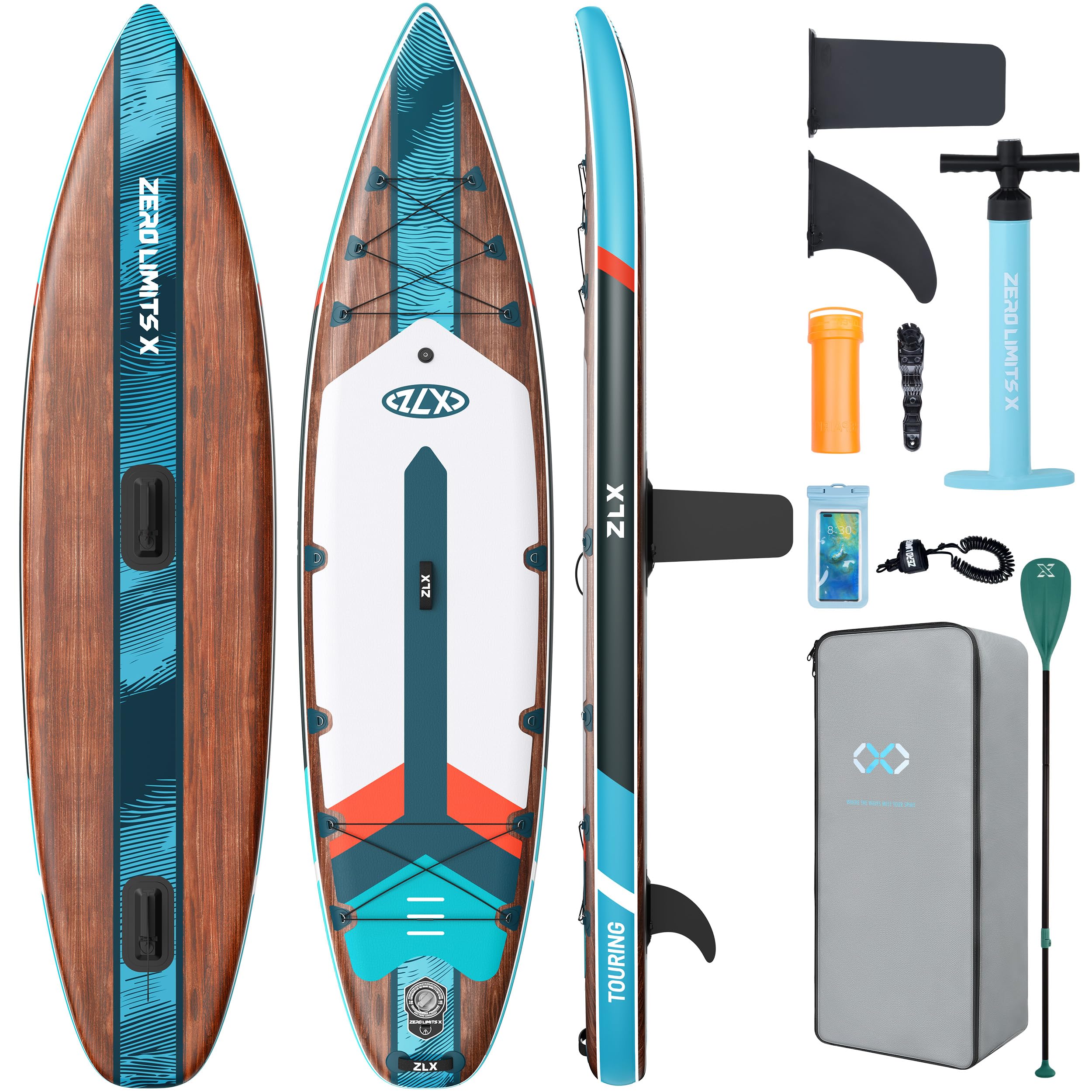
The 28.2 pounds on the spec sheet is the whole bundle — board, pump, paddle, backpack — and it’s a load you notice on a long walk to the water. That caveat belongs first, because everything else about the ZLX is aimed at people who paddle further than the beach.
The shape is the point: 11 feet 6 inches on a 33-inch beam, a longer and narrower ratio than the all-around boards here, plus a 10-inch center fin and a separate removable balance fin that a beginner can leave in and pull out once standing feels normal. Over a long stretch of flatwater it holds a line with far fewer corrections than a shorter deck.
It also comes set up for fishing and day trips: a bungee field on the nose, plenty of D-rings, and a deck that stays rigid under a cooler. The three-year warranty matches the longest coverage in this group, which is unusual for a board aimed at a narrower use.
For flatwater distance, gear and a morning with a rod, this is the board we take. Buy it knowing you’ll be carrying it in two hands from the car, and that a 33-inch deck this long tracks better than it spins — if you want to turn on a dime, the shorter Roc is easier.
Pros
- Long touring shape tracks straighter
- Extra balance fin for beginners
- Three-year warranty
- Bungee and D-rings for gear
Cons
- 28.2-pound bundle is a two-hand carry
For long flatwater days and a bit of fishing, this is the board we take — provided you don’t mind a heavier bundle at the launch.
Best for Gear and Passengers
FLYPARK Extra Wide SUP
Key Features
- D-rings: 15
- Dimensions: 11′ x 34"
- Board weight: 19 lb
- Weight limit: 420 lb
- Price: Midrange
Fifteen D-rings and a 420-pound rating are the argument for the FLYPARK: this is the board you pack when the day involves more than a paddle. Cooler, dry bag, rod holder, a kid’s water bottle — there’s a lashing point for all of it, and the 34-inch deck has the room to carry it without the nose going heavy.
At 11 feet by 34 inches with six inches of thickness it’s stable enough to kneel on while you sort gear, and at 19 pounds one adult can carry it with the bag over a shoulder. The 110L backpack and the included 10L dry bag are usable rather than token, and three padded handles give you a grab point wherever you end up standing. The little valve wrench in the box is the sort of thing that saves a trip.
Pros
- Fifteen D-rings for gear and coolers
- 420-pound rating covers a passenger
- 19 pounds with a 110L backpack
- Three padded handles
Cons
- Only one slide-in fin in the box
We reach for this one when the day involves a cooler, a dry bag and a passenger; the D-ring count and 34-inch deck make it a gear boat.
Best for First Board on a Budget
SereneLife Inflatable SUP
Key Features
- Warranty: 1 year
- Dimensions: 10’6" x 32"
- Max pressure: 15 psi
- Weight limit: 275 lb
- Price: Budget
This is the cheapest complete package in this group, and it doesn’t feel stripped: a 10-foot-6 board, a three-piece aluminum paddle, a leash, a removable fin, a repair kit, a pump and a carry backpack. For a first board that will spend most of its life on a calm lake or a sheltered bay, that’s a lot of kit for the money.
The compromises show up on the water rather than in the box. The deck is 32 inches wide — the narrowest here — and it moves under you in boat wake in a way the 34- and 35-inch boards don’t; a light, cautious paddler will barely notice, a big one will. The paddle is serviceable rather than good, and like every inflatable it sits higher on the water than a hard board, which takes a trip or two to trust. As an inexpensive way into the sport for one adult on flat water, we think it’s the smart buy.
Pros
- Least expensive complete package here
- Pump, paddle, leash, fin and bag included
- Sturdy once fully inflated
Cons
- 275-pound stated limit is the lowest here
Our budget pick for a lighter adult on calm water: it costs the least here and still comes with everything you need to launch.
Best for Looks and Calm Water
Highpi Classic Wood SUP

Key Features
- Warranty: 1 year
- Dimensions: 11′ x 33"
- Board weight: 20 lb
- Weight limit: 350 lb
- Price: Midrange
The Classic Wood graphic is the reason to look twice at the Highpi. Most boards in this group shout; this one reads as teak from ten feet away, which is why it’s the pick for someone who wants the thing leaning in the garage to look like furniture rather than gym equipment.
Underneath the finish it’s a conventional 11-foot, 33-inch all-rounder with a 350-pound rating and a metal-shafted paddle that feels stiffer in the hand than the aluminum three-piece ones in most of these bags. It inflates to a firm deck, tracks reasonably for its width, and packs into the included backpack with a wet bag for the small stuff.
So it’s a look-driven buy rather than a performance one. For calm mornings, a 350-pound ceiling and a rigid deck are plenty of board, and the wood finish is the honest reason to choose it over the plainer 11-footers. If you want the longest coverage instead, the Roc and the Niphean give you three years.
Pros
- Wood-grain finish stands out
- Metal paddle shaft feels stiffer
- Large bag holds the whole kit
Cons
- Shortest warranty here at one year
- Board skin can tear on early use
We recommend it to anyone who wants the board on the rack to look like furniture; it’s a capable calm-water all-rounder too.
Best for Sitting and Standing
iTAOSTAR Kayak Conversion SUP
Key Features
- Dimensions: 11’6" x 35"
- Board weight: 20.5 pounds (9.3 kg)
- Weight limit: 450 lb
- Removable fins: 5
- Price: Premium
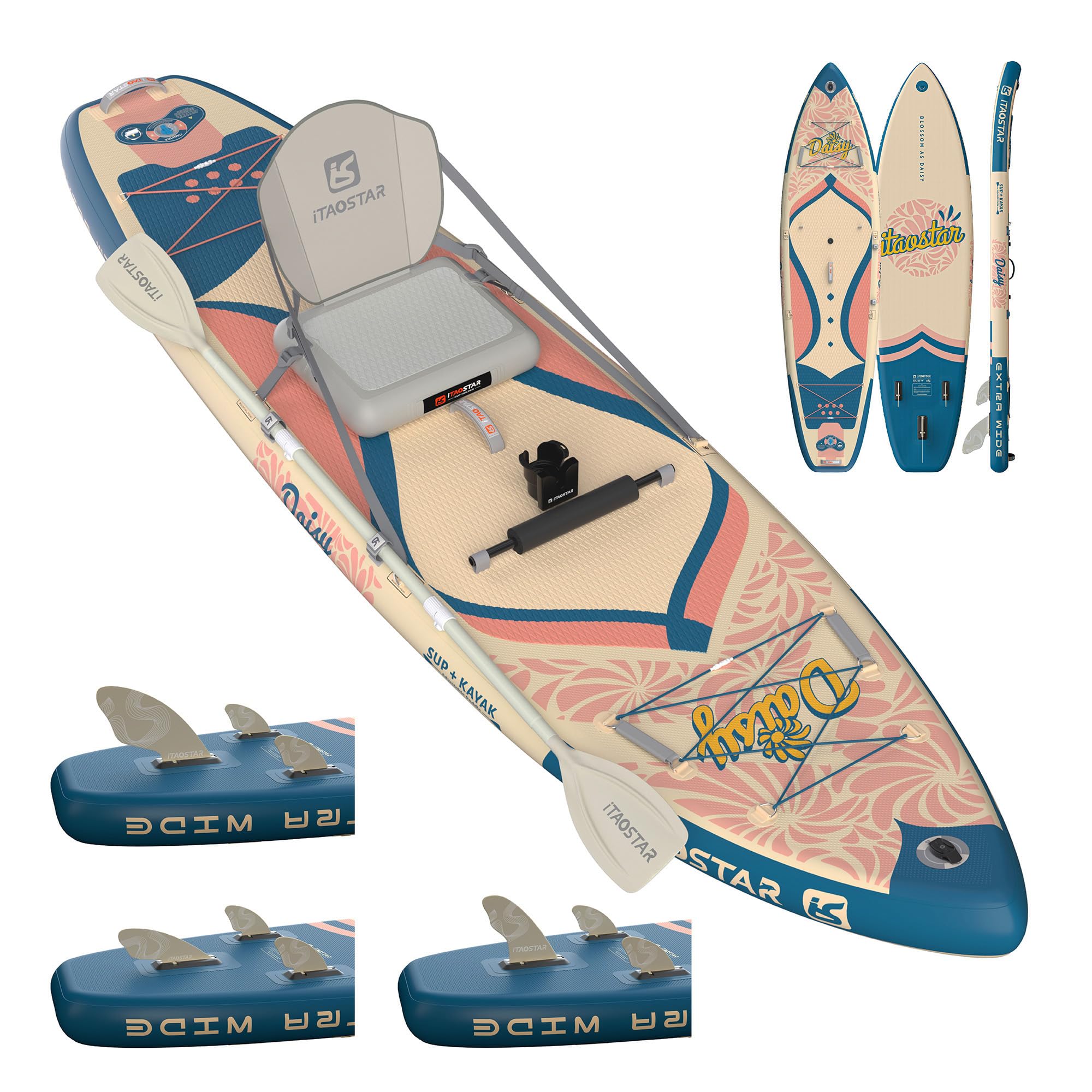
A strap-on seat, a footrest and a kayak blade for the paddle come in the box, which makes the iTAOSTAR the only board here that converts to a sit-on-top without buying anything else. For a household with a grandparent or a small child in it, that’s the difference between one board everyone uses and one board two people use.
The rest of the package is just as loaded: five removable fins — three center, two side — so you can run a big fin for open water and shorter ones for a river, plus a 10L dry bag, a waterproof waist bag, a cup holder, a flag, a whistle and a valve wrench. The 35-inch deck and 450-pound rating put it in the same size class as the Skatinger.
All of that adds weight. At 9.3 kilograms the board alone is around 20 pounds, and the backpack with seat, pump and fins inside is a two-hand carry. The kayak blade clips onto a SUP-length shaft, so it’s a compromise rather than a proper two-bladed kayak paddle — fine for a quiet paddle back to the launch, not for covering miles seated.
For one board that does standing and sitting, and for a boat shared across ages, it earns the money. If nobody in the house wants to sit down, the Skatinger carries the same 450 pounds and 35 inches for less.
Pros
- Kayak seat, footrest and blade included
- Five removable fins for different water
- 35-inch deck with 450-pound rating
- Dry bag and cup holder in the box
Cons
- One-year warranty at the top price
- 20.5 pounds before you add seat and pump
We recommend it for households that want one board to stand and sit; the kayak kit and 35-inch deck cover everyone in the family.
How We Tested Inflatable Paddleboards
To build the shortlist, I started with about two dozen inflatable SUPs from established paddleboard and outdoor brands, then filtered by length, width, stated weight, maximum pressure, included pump and bag, and price. Eight boards made the final cut for hands-on testing, and we paddled them for six months.
Testing happened where these boards actually live: flat lake mornings, windy afternoon chop, shallow launch ramps, and the back of a hatchback. We inflated each board with its own pump, timed the process, and noted whether the gauge was easy to read and whether the pump stayed seated in the valve. On the water, we stood, shuffled toward the rails, tried pivot turns, and switched riders of different sizes to see how each board sat in the water.
Portability got its own test: we carried each board in its bag from the car to the launch, weighed it packed, and paid attention to whether the shoulder straps dug in. Durability came down to repeated sessions — we checked seams, valves, and fin boxes after each paddle, left boards inflated overnight to see if pressure held, and dragged them up a gravel launch more than once. Fun is subjective, but we noted which boards made us want one more lap and which felt like work by the end of an hour.
How to Choose an Inflatable Paddleboard
Almost everything that decides whether an inflatable board is a pleasure or a chore happens before you get wet: the deck width under your feet, the weight it will actually carry, and how much work stands between the car and the water.
Start with deck width, then length
Width is what you feel first. A 32- or 33-inch deck is the all-around standard in this group and suits most adults. The 34- and 35-inch boards are noticeably steadier for beginners, for children sitting on the nose, and for anyone fishing from a seated position — but they are slower to bring around and they catch side wind like a sail.
Length works the other way. A 10-foot-6 board turns easily and suits small lakes and coves; an 11-foot-6 board tracks straighter across a big bay but needs more room to turn. Pick the width for the least confident person who will use it, and the length for the water you actually paddle rather than the water you imagine.
Take the weight limit from the specification, not the title
Capacity covers everything aboard: you, a passenger, a dog, a cooler of drinks. Boards in this group are rated from 275 to 450 pounds, and that difference decides whether the deck rides proud of the water or slogs along half-submerged. The SereneLife is the clearest caution — its title says 350 pounds while its own specification says 275.
Read the detailed spec before you order and leave roughly a quarter of the rating spare for gear. A board used at its limit is a wet, tippy ride that turns every wake into a balancing act.
Budget for a better pump
The hand pumps bundled with these packages are the most common letdown: gauges that stall near zero, plastic fittings that crack, hoses that split where they meet the pump body. The board itself is rarely the problem. Inflate to the pressure printed on the rail — 15 psi on most boards here, 20 on the Niphean — and use your palm as well as the dial: the deck should feel like a table under a flat hand, not a mattress.
If you plan to paddle weekly, an electric pump is the single best extra you can buy, and it turns a chore you dread into a two-minute job at the tailgate.
Packed weight and the bag decide how often you go
Some listings quote the board alone, others the whole bundle with pump, paddle and bag, so ask which number you are reading before comparing. A full pack adds several pounds to whatever the board figure says, and the difference between 19 and 28 pounds is felt at the far end of a parking lot.
Judge the bag as closely as the board. Heavier 1680D fabric and a large 110L pack hold up to being stuffed in a trunk season after season; thin nylon bags are the first thing to fail. If your put-in is more than a few hundred yards from the car, carrying weight should move up your list.
Fins, lacing and the extras that earn their place
A single slide-in center fin is fine for lakes and calm bays. If you paddle rivers or shallows, removable side fins give you options and save the fin box when you ground. Bungee lacing and D-rings are worth more than they look — they are what turns a board into a fishing platform or a picnic boat.
Kayak seats, dry bags and a decent coiled leash are the extras that get used; a cup holder is a bonus, not a reason. Buy the package that matches your usual day rather than the one with the longest list.
Frequently Asked Questions
Do I need a life jacket for paddleboarding?
Yes, and none of these packages includes one. Buy a fitted paddling flotation vest before the board’s first trip and try it on in shallow water so you know how it floats and how easy it is to swim in. A vest that rides up or restricts your arms is worse than useless on a windy lake.
Can two people or a dog ride one inflatable SUP?
On flat water and within the stated weight limit, yes — the 34- and 35-inch boards with 420- to 450-pound ratings handle an adult plus a seated child or a dog without drama. Inflate to full pressure first, keep the passenger forward of you and seated, and trim a dog’s nails or lay down a towel. Above 300 pounds total, choose a 450-pound board rather than a 350-pound one.
How should I store an inflatable SUP between trips?
Dry it completely, then roll it loosely and store it out of direct sun and off a hot concrete floor. Leaving a board inflated for a week or two is fine, but months of heat cycling is what fatigues seams and valves. After salt water, rinse with fresh water and let it dry before it goes back in the bag — mildew is what actually ruins the bag.
Final Verdict
The Roc is the board we recommend to most people: a 33-inch deck a beginner can stand on, a three-year warranty that matches the longest here, and a bundle that packs into one backpack. If your household paddles together, or a paddler is near 300 pounds, spend the extra on the Skatinger and its 35-inch, 450-pound deck.
If the budget is tight and the water is calm, the SereneLife gets one lighter adult afloat for the least money in this group.