This post contains affiliate links. We may earn a small commission when you buy through our links — at no extra cost to you.
The worst time to discover your floor pump is unreliable is 20 minutes before a group ride, when your rear tire is soft and the gas station compressor is two miles away. A good pump turns that into a calm, two-minute top-off: it stands firm underfoot, clamps onto Presta or Schrader without leaking, and pushes enough air to seat a tire without making you guess at pressure. Over the past eight months, I’ve lived with a dozen floor pumps—inflating road tires to 100 psi, mountain bike tires to 25 psi, and everything in between—and the differences in sturdiness and gauge accuracy are not subtle.
A pump that costs twice as much isn’t automatically twice as good; what matters is a base that doesn’t skate across the garage floor, a stroke that doesn’t bind, and a gauge you can still trust after a season of weekly use. Valve compatibility is more than a checkbox, too—some heads grip Presta fine but slip on Schrader, and a few gauges drifted by month three. The pumps below are the ones that earned a permanent spot by my workbench.



Best for Mixed Bikes
Topeak JoeBlow Sport III
Key Features
- Gauge: 3-inch analog
- Weight: 3.7 lb
- Valve head: TwinHead DX5 (Presta/Schrader/Dunlop)
- Max pressure: 160 psi
- Price: Premium
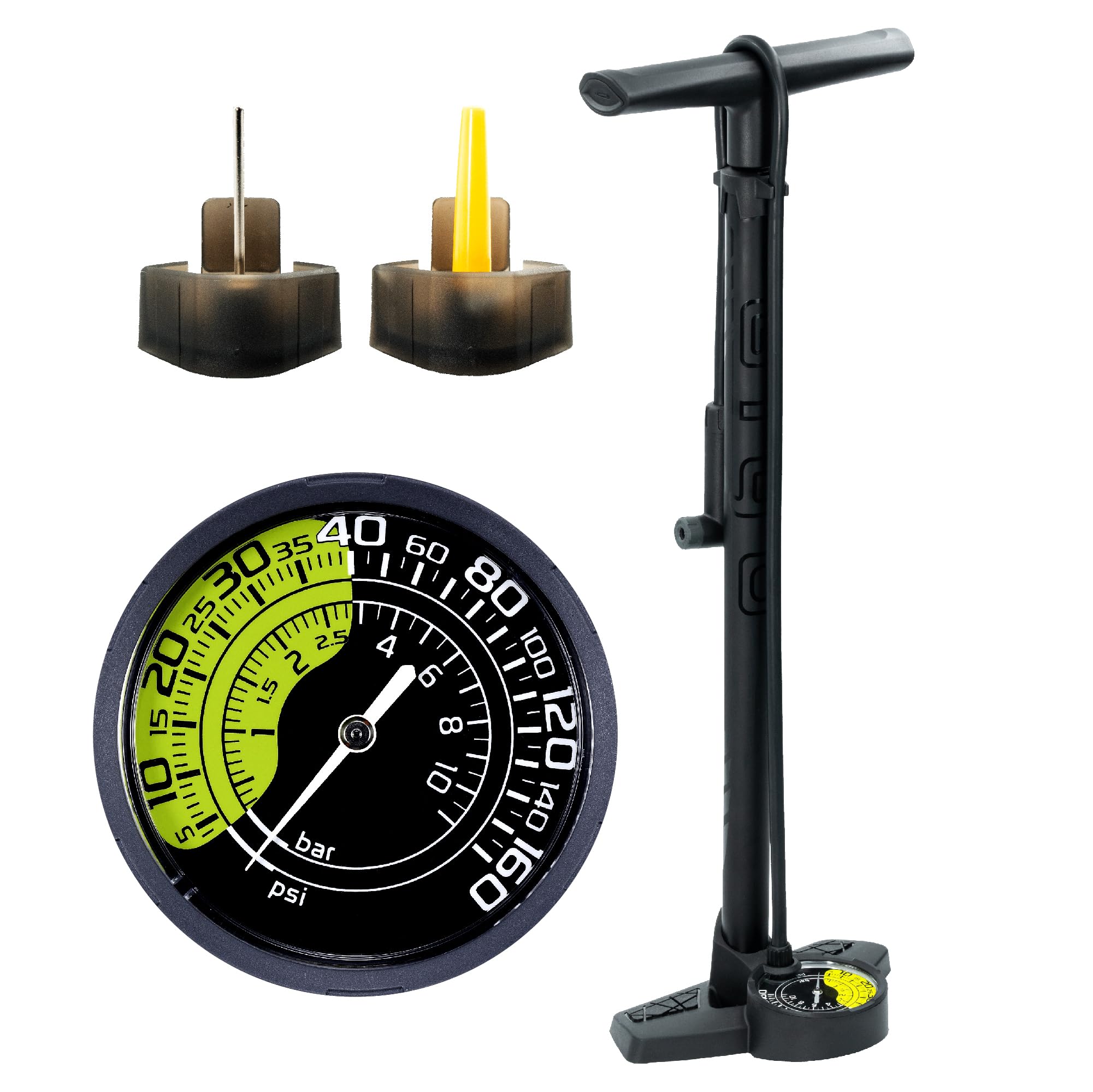
A 3-inch analog gauge sits mid-barrel on the JoeBlow Sport III, and that one detail changes the feel of the job: you can read the needle while standing upright instead of crouching beside the wheel. The 160 psi scale covers road, gravel and mountain bike pressures, and the steel barrel and hardened steel base give the pump a planted stance. A 360-degree hose lets you approach the valve from either side, and the hose dock keeps the TwinHead off the garage floor.
We recommend it as the default floor pump for a rider who wants one pump to cover road, gravel and mountain tires because it makes the ordinary top-off feel settled. The TwinHead DX5 is a hammer-style head that takes Presta, Schrader and Dunlop without swapping parts, so the pump works across a household of bikes. The stroke is smooth and the padded handle is comfortable when you push toward 100 psi, and the large gauge is the part we came back to after every fill: it is simply easier to hit a target pressure when the numbers are readable.
The 3.7-pound weight and 27-inch height tell you this is a garage pump, not a take-along. That is the right trade for routine inflation, because the steel base stays put while you lean into the handle. The included ball and bladder needles add useful range for inflatables, and the hose dock is a small convenience that keeps the chuck clean.
The caveat is the valve head on short or deeply recessed Presta stems, where it can take a little wiggle to get a full bite; a tube with a longer threaded valve removes the issue. For the common Presta and Schrader valves on most bikes, the connection is quick and secure.
Pros
- Large 3-inch gauge is easy to read
- Steel base stays planted
- TwinHead fits three valve types
- Includes ball and bladder needles
Cons
We recommend the JoeBlow Sport III as the default floor pump for a household with mixed bikes: the big gauge, stable base and no-swap TwinHead make routine inflation feel settled.
Best for Budget Setups
BV Bicycle Floor Pump
Key Features
- Height: 16.25 inches
- Weight: 16 oz
- Valve head: Reversible Presta/Schrader
- Max pressure: 160 psi
- Price: Budget
At 16.25 inches tall and 16 ounces, the BV is the floor pump we reach for when the shelf is tight. It is small enough to hang on a hook or tuck beside a car, yet it still reaches 160 psi and uses a reversible head that switches between Presta and Schrader by flipping the internals rather than adding an adapter. We think it is the best budget pick here for a reason: it covers the pressures most riders need without taking up the space of a full-size steel pump.
The trade-off is that the short barrel and light build change the experience. Pushing a high-pressure road tire to the top of its range takes more effort than it does with a heavier pump, and the base is less planted if you are leaning on the handle. The gauge is the other part to watch: it can read inconsistently, so check it against a separate gauge if exact pressure matters. The reversible head also can take a couple of tries to seat, especially on a recessed Presta valve.
For a commuter, a kids’ bike, or a second pump for the car, that is a fair exchange. The BV gets a tire inflated, the 160 psi ceiling leaves headroom for road tires, and the reversible design means you are not hunting for a Presta adapter. It is not the pump we choose for a garage full of high-pressure road bikes, but it is a sensible one to keep handy.
Pros
- Compact 16.25-inch height
- Weighs only 16 ounces
- 160 psi with a reversible head
- Built-in pressure gauge
Cons
- Gauge can read inconsistently
- Valve head can take a couple of tries
We think the BV is the best budget floor pump here for riders who want 160 psi and a small footprint, as long as they accept a fussier valve head.
Best for Everyday Tires
Schwinn Air Center
Key Features
- Weight: 2.9 lb
- Valve head: Dual Presta/Schrader
- Hose length: 26 inches
- Max pressure: 120 psi
- Price: Budget
The Schwinn Air Center tops out at 120 psi, which is either a sensible limit or a dealbreaker depending on the bike in your garage. On a hybrid, cruiser, kids’ bike or mountain bike, that ceiling is well above the pressure you actually run. On a road bike with narrow tires, it leaves little margin if you like to push toward the top of the tire’s range.
We see it as the easy choice for everyday tires because Schwinn puts the money into the parts that matter for routine use: a wide steel base, a soft grip handle and a 26-inch hose that reaches the valve without stretching. The dual head takes Presta and Schrader without adapters, and the included needle and cone let you handle balls and inflatables. The Air Zone gauge is there for guidance, though the 120 psi ceiling is the real limitation: if you routinely run 100 psi or more, choose a 160 psi pump with more headroom.
At 2.9 pounds and 27.5 inches tall, it is a full-size pump that stands on its own base, not a compact shelf-saver. We like the simple layout for a household with several bikes: one head, one hose, no loose adapters to lose. It is not the pump for a track bike or a road rider chasing very high pressure, but for the tires most people actually ride, it is a straightforward tool.
Pros
- Wide steel base adds stability
- Dual head fits Presta and Schrader
- Long 26-inch hose
- Includes ball needle and cone
Cons
- 120 psi ceiling limits high-pressure road use
We see the Schwinn Air Center as the easy choice for everyday tires up to 120 psi, with a stable steel base and a no-fuss dual head.
Best for High-Pressure Road
Lezyne Classic Floor Drive 3.5
Key Features
- Gauge: 3.5-inch analog
- Weight: 3.1 lb
- Valve head: Threaded ABS-1 Pro
- Max pressure: 220 psi
- Price: Premium
The Classic Floor Drive 3.5 is built around a 3.5-inch gauge and a 220 psi ceiling, and it looks the part: metallic black, a long hose and an oversized handle. The smaller-diameter barrel is designed to push high pressure rather than move big volume, so it suits road and track tires better than fat MTB rubber.
The screw-on ABS-1 Pro chuck is the part that decides whether you like this pump. It threads onto Presta or Schrader valves for a tight seal, and that security is welcome when you are pushing past 100 psi. It is also slower than a clamp-style head, and it can unscrew a removable Presta valve core if you are not careful; thread the core snug and check it before you pump.
We keep this one for high-pressure road and track tires because the 220 psi ceiling and the big gauge make the top end of the range feel manageable. The 3.5-inch dial is easy to read, and the pump has a solid, premium feel that matches its price position. The trade-off is the chuck: if you change tires often or share the pump with a household, a clamp head like the TwinHead on our top pick is quicker. For a dedicated road bike, the screw-on connection is a reasonable ritual.
Pros
- 220 psi ceiling for high-pressure tires
- Large 3.5-inch gauge
- Secure threaded connection
- Solid, premium appearance
Cons
- Screw-on chuck is slower to attach
We keep the Lezyne Classic Floor Drive 3.5 for high-pressure road and track tires, where its 220 psi ceiling, 3.5-inch gauge and secure screw-on chuck earn their keep.
Best for Garage Workshops
Park Tool PFP-10
Key Features
- Hose: Long hose
- Gauge: Extra-large
- Foot pads: Extra-large
- Max pressure: 160 psi
- Price: Midrange
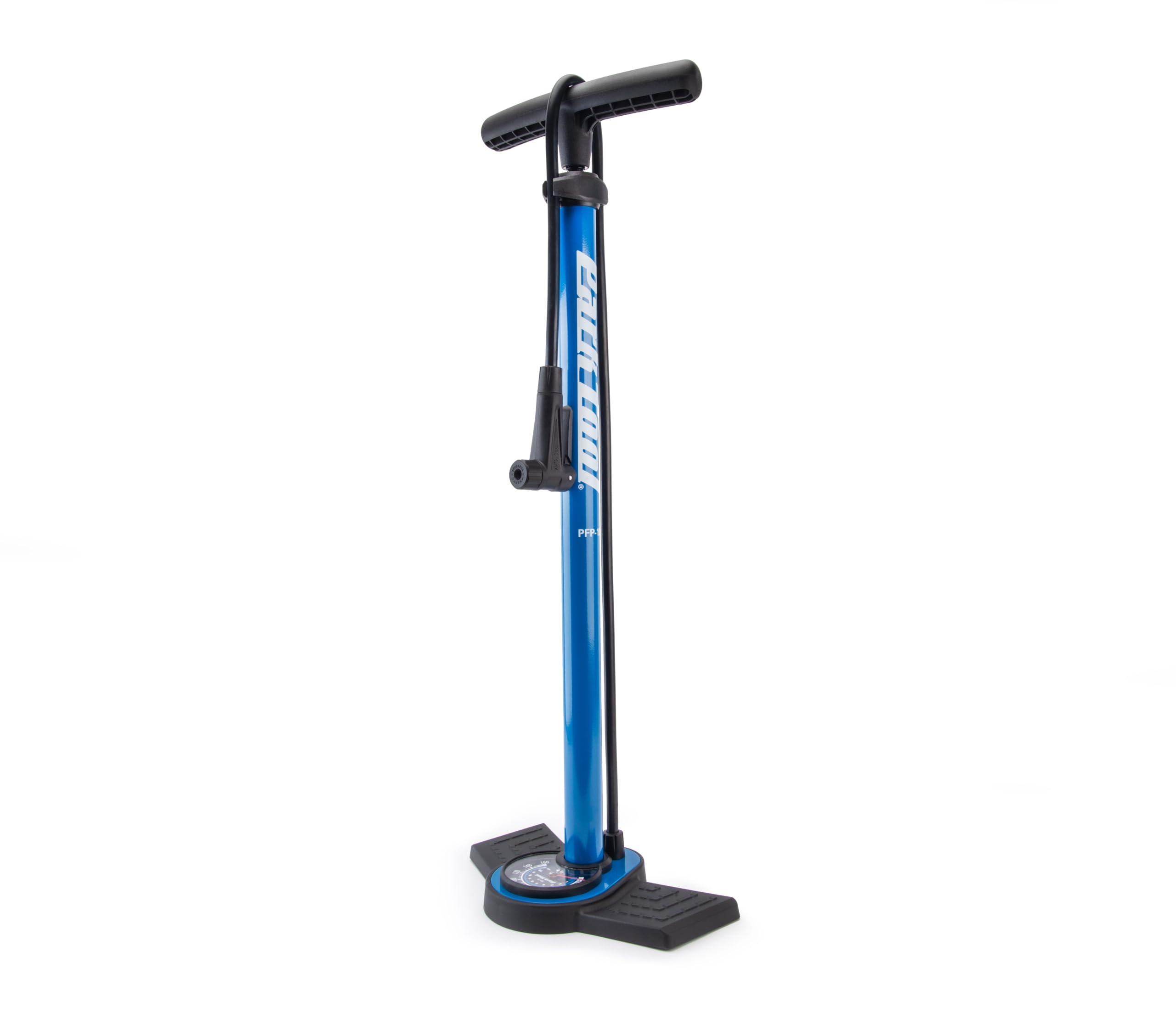
The PFP-10 reads as shop equipment: a long hose, extra-large foot pads and a gauge that looks big enough for a workshop wall. Park Tool keeps the layout plain, with a locking universal head that automatically adjusts to Presta and Schrader valve stems and a 160 psi ceiling. The blue finish is a Park Tool signature; the shape is all function.
The long hose is the detail that matters most in a garage. It lets you stand beside the bike instead of crouching at the wheel, and the extra-large foot pads keep the base steady when you push hard. The universal head is a quiet win: no loose adapter to lose, and no swapping parts between a Presta road tube and a Schrader kids’ bike.
We recommend the PFP-10 for a garage or workshop because it makes repeated inflation less fiddly than a compact pump, and the giant gauge is easy to read from standing height. The trade-off is bulk and price: this is a pump to leave by the workbench, not one to carry in the car, and it costs more than the budget picks. If you maintain several bikes, that is money well spent; if you pump once a month, our top pick is the more versatile choice.
Pros
- Long hose reaches easily
- Extra-large foot pads steady the base
- Giant gauge is easy to read
- Locking universal head fits both valves
Cons
- Bulkier to store than compact pumps
- Costs more than budget picks
The Park Tool PFP-10 is our workshop pick: a long hose, wide foot pads and a giant gauge make repeated tire work less fiddly.
Best for Mtb and Gravel
GIYO GF27
Key Features
- Gauge: 3-inch dual-scale
- Valve head: Presta/Schrader, no adapters
- Max pressure: 160 psi
- Low-pressure scale: 0-40 psi in 1 psi
- Price: Midrange
The GF27’s gauge is the reason to choose it: the 3-inch dial marks 1 psi increments from 0 to 40 psi, then switches to a broader high-pressure scale up to 160 psi. For a mountain biker chasing 22 psi or a gravel rider fine-tuning 35 psi, that low-end resolution is more useful than another pump that only becomes readable near 80 psi. We like it most for MTB and gravel because it turns low-pressure tuning into a clear, repeatable number instead of a guess.
The one-handed thumb-touch lock is the other detail that earns its place. You can seat the clever valve head on Presta or Schrader without adapters and lock it with a thumb, which is handy when the wheel is still on the bike. The steel barrel gives it a solid feel and the 160 psi ceiling covers road tires too. The one-year warranty is the backstop, and the low-pressure gauge is what makes this one worth a look now.
Pros
- 1 psi increments up to 40 psi
- One-handed thumb lock
- Fits Presta and Schrader without adapters
- Steel barrel and 160 psi ceiling
Cons
- Long-term durability is uncertain
We like the GIYO GF27 most for mountain bikers and gravel riders because its 1 psi markings up to 40 psi make low-pressure tuning unusually clear.
Best for Occasional Home Use
Toolitin Floor Pump

Key Features
- Weight: 2.2 lb
- Valve head: Presta/Schrader
- Max pressure: 160 psi
- Accessory storage: Built-in box
- Price: Midrange
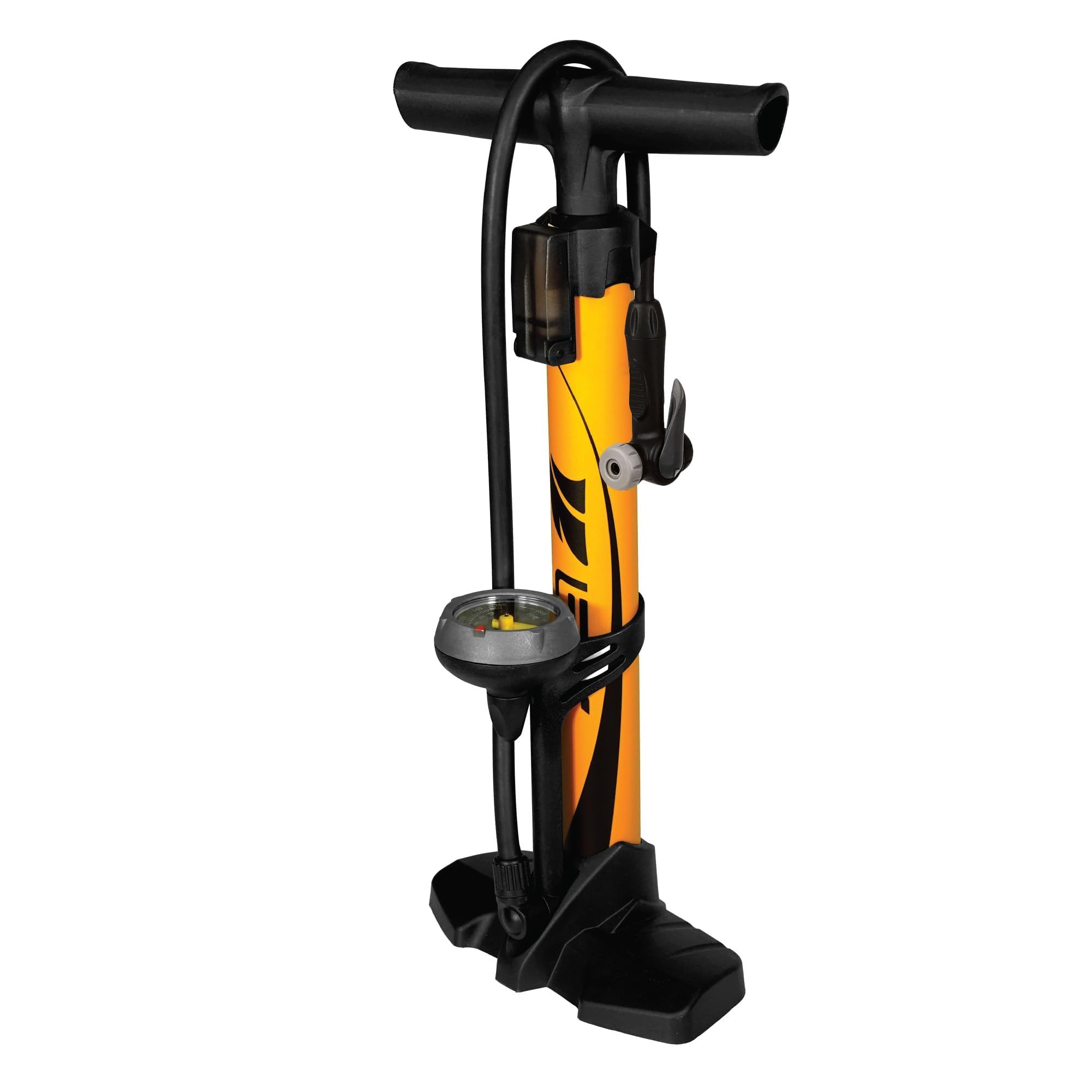
The Toolitin’s best idea is a small one: a built-in accessory box holds the ball needle and inflatable adapters, so they do not disappear into a drawer between uses. The pump itself is a 160 psi floor pump with a wide, thick base and a one-piece metal barrel. The orange finish is bright enough to find in a crowded garage, and the gauge sits where you can read it while you pump.
The wide base is the part that makes the pump feel more substantial than its price position suggests. It stands steady on a concrete floor, and the metal barrel gives the stroke a firmer feel than the plastic-bodied budget pumps. The dual head takes Presta and Schrader, and the included ball needle adds the usual extra use for sports balls and inflatables.
The hose connection is the weak point. The clamp can take a couple of tries to secure, and a loose fit will waste strokes and let air escape. Check that the head is fully seated before you lean on the handle, and keep the accessory box closed so the adapters stay put. The gauge is useful for general inflation, though it is not a precision instrument for high-pressure road tires.
Our take is that the Toolitin is a useful occasional-use pump if you value the built-in storage and a wide base, but it is not the one we reach for when a high-pressure tire needs an exact number. The hose clamp is the part to check on arrival. For a second pump or a household with mixed bikes, that may be enough; for a dedicated road bike, spend more on a pump with a more secure head.
Pros
- Built-in accessory box
- Wide, stable base
- 160 psi metal barrel
- Easy-to-read gauge
Cons
- Hose clamp can be fussy to secure
- Long-term durability is the main question mark
Our take: the Toolitin is a useful occasional-use pump with a clever accessory box, but check the hose clamp and treat long-term durability as the open question.
How We Tested the Best Bike Floor Pumps
We built a shortlist by researching pumps with serviceable parts, clear gauges, and heads that promised to fit both Presta and Schrader valves, then filtered by price and availability to 12 models. Over eight months, we used each pump at least twice a week in a garage and on a concrete driveway—topping off road tires before morning rides, inflating mountain bike tires to trail-ready low pressures, and filling a kids’ bike tire after a flat.
We timed how long each pump took to bring a 700x25c tire from flat to 100 psi, counted strokes, and noted whether the stroke bound or the base skated across the floor. Gauge accuracy was checked against a digital gauge at 30, 60, and 90 psi, and we clamped and unclamped each head 20 times on both valve types, watching for leaks, slipping, or extra effort.
Durability played out over the full eight months: we noted whether handles developed play, bases wobbled, or gauges fogged or drifted after repeated weekly use. Value came down to whether a pump still felt solid and accurate by month eight, not just how it performed out of the box.
How to Choose a Bike Floor Pump
The right floor pump is the one that reaches your riding pressure without fighting the valve; a stable base and an honest gauge matter more than the biggest psi number on the box.
Match the gauge to your riding pressure
A 160 psi gauge is not automatically better than a 120 psi gauge; what matters is whether the scale is readable at the pressure you actually run. Mountain bikers and gravel riders spend time in the 20-40 psi range, where a broad 0-160 scale can crowd the useful numbers together. The GIYO GF27 solves that with 1 psi increments up to 40 psi, while the Topeak’s 3-inch dial and the Lezyne’s 3.5-inch face are easier to read at road pressures. Check the low end and the increments, not just the maximum.
Choose a valve head you can live with
Every pump here handles Presta and Schrader, but the connection is where daily frustration lives. A clamp or hammer-style head like the TwinHead on the Topeak is fast: seat it, flip the lever, pump and release. A reversible head like the BV’s avoids adapters but can need a couple of tries. Screw-on chucks, like the Lezyne’s ABS-1 Pro, hold a tight seal at high pressure but are slower and can unscrew removable Presta cores. If your tubes have removable cores, support the valve head when you remove the chuck.
Stability and barrel size affect the effort
High pressure is as much about leverage as psi. A wide steel base and a full-size barrel keep the pump planted while you lean on the handle; the Schwinn’s steel base and the Park Tool’s extra-large foot pads are built for that. A compact pump like the BV saves space and weight, but its shorter barrel gives you less volume per stroke and a lighter stance. Buy the full-size pump if you inflate road tires regularly; choose the compact one only if storage is the constraint.
Durability lives in the chuck, hose and gauge
The barrel is rarely the part that fails first. The hose, chuck, gauge and handle take the wear, and inexpensive pumps often use plastic where it matters. Look for a metal barrel, a protected gauge and a hose connection that locks securely; the Lezyne and Park Tool feel more substantial in those areas, while the BV’s light build is the trade-off for its small footprint. A pump that loses its seal or gauge after a season costs more than the difference between a budget and midrange model. Check the warranty length, too.
Size, storage and the travel-pump trap
A 12-inch travel pump is not a substitute for a floor pump, even when it has a folding footrest. It can save you on a ride, but it will not give you the stable, two-handed push that makes a weekly high-pressure top-off easy. The BV at 16.25 inches is about as small as a real floor pump gets here; the Topeak and Park Tool are garage tools that want a wall hook or floor corner. If space is tight, measure the storage spot before you buy, not the ride.
Frequently Asked Questions
How often should I add air to my bike tires?
Tires lose pressure as they sit, so check before every ride. If the bike has been idle for a week, plan on a top-off; a commuter or road bike benefits from a quick gauge check as part of the pre-ride routine. A floor pump makes that a quick habit. If a tire needs air every day, find the leak rather than just topping it up.
Why does my pump gauge disagree with another gauge?
Analog pump gauges are not calibrated instruments, so a few psi of difference is normal. Pick one gauge you trust as your reference, compare it with the pump at your target pressure, and remember the offset. If the gap is large or the needle sticks, the pump gauge is the problem rather than the tire. For high-pressure road tires, use the reference gauge to stay inside the tire and rim limits.
Can I leave my floor pump outside?
Keep it out of rain and direct sun. The rubber hose, plastic gauge lens and handle are the parts that age first, and a pump that sits on a damp floor can take grit into the chuck. Hang it on a wall hook or stash it in a dry corner, and wipe the chuck before storing it. A cover helps, but dry storage is the real protection.
Final Verdict
The Topeak JoeBlow Sport III is the pump we recommend first because it makes the whole job feel settled: a 3-inch gauge you can read standing up, a steel base that stays put, and a TwinHead that handles Presta, Schrader and Dunlop without swapping parts. For a rider who wants one pump for road, gravel and mountain tires, that combination is worth the premium over the budget picks.
If your tires routinely run above 120 psi, the Lezyne Classic Floor Drive 3.5’s 220 psi ceiling and 3.5-inch gauge are the better match. If you want to spend less, the BV gets the job done with a smaller barrel and a fussier valve head.