This post contains affiliate links. We may earn a small commission when you buy through our links — at no extra cost to you.
A paddleboard should make a lake day easier, and yet the category hands you one tradeoff before you even get wet: the boards that paddle best are usually the ones that need a roof rack and a second set of hands. Inflatables fixed the transport problem years ago; the early ones just flexed like pool floats underfoot. That gap has mostly closed, which is what this list is about — boards that pack into a bag one person can carry and still feel solid when the wind picks up. What a good one fixes is simpler than the spec sheets suggest: you spend your energy on the water instead of on getting there.
I’ve owned three inflatables, and the lesson I keep relearning is that the pump and the bag matter almost as much as the board itself. We’ve spent the last five months living with eight of them, inflating in parking lots and paddling flat morning water and choppy afternoons. The picks below are sorted by the kind of paddling you actually do, and each one earns its price in a different way.

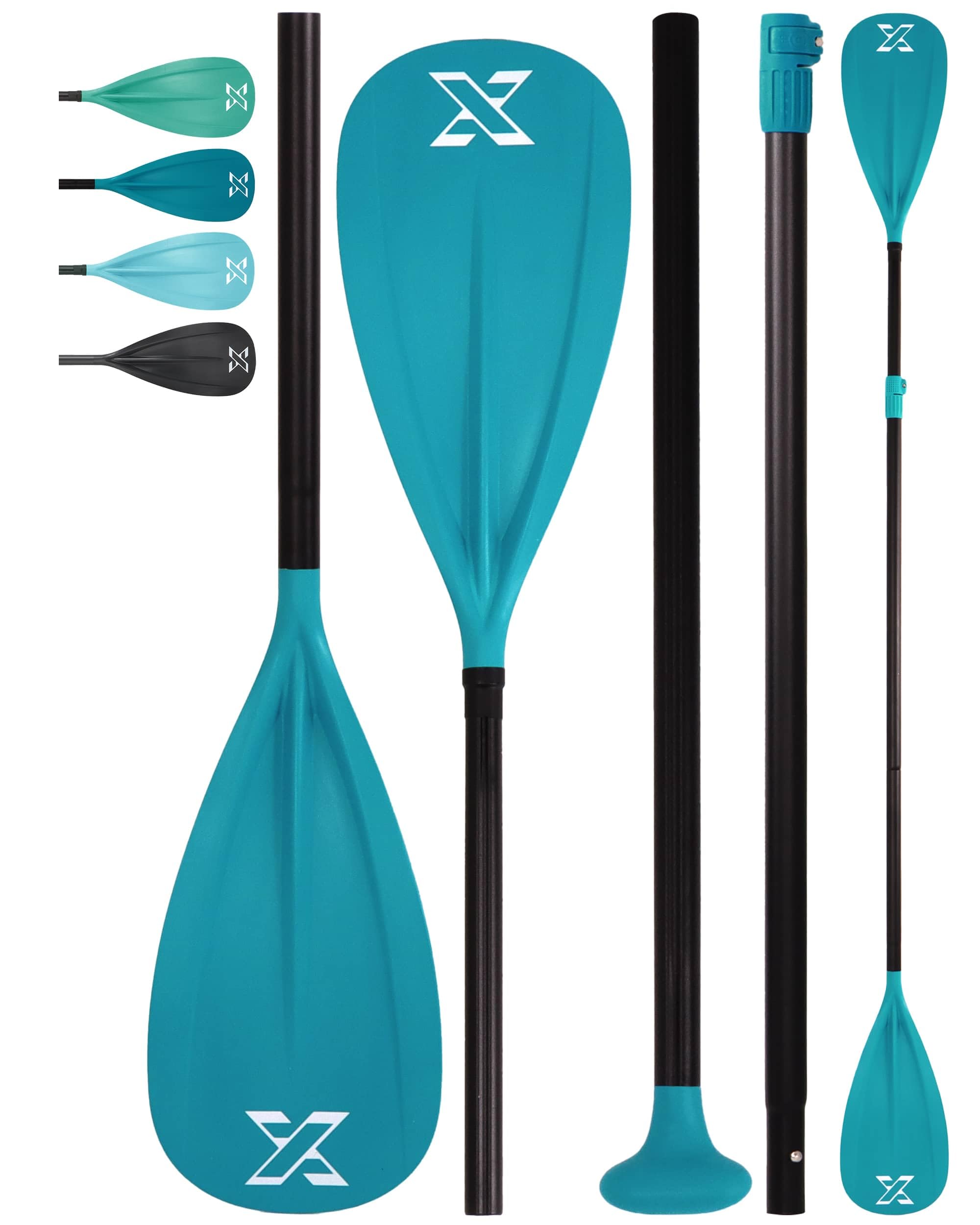


Best for All-Around Paddling
Abahub Carbon SUP Paddle
Key Features
- Blade: Fiberglass/PP, 91 sq in
- Shaft: Carbon composite
- Weight: 1.87 lb
- Length range: 67–86 in
- Price: Premium
A carbon-composite shaft and a proper travel bag are the two details that put this Abahub ahead of the aluminum paddles in this set for most buyers. The three-piece build packs into a 36-inch bag, and the paddle weighs 850 g. That is light enough to carry all day without feeling like a toy in the water.
The 67–86 inch range is the most useful part of the design. It covers short and tall paddlers, and it gives you room to reset the length when you move from standing to kneeling. We like the 91-square-inch fiberglass/PP blade for recreational flatwater: it gives a stable catch without the twitchiness of a narrow racing blade. The carbon-composite shaft keeps the weight down, though this is a blended shaft rather than a full-carbon race build.
We reach for this one when we want a single paddle that fits several people in the same household. The bag has a shoulder strap and an inner blade flap, so it can live in the car without the blade collecting scuffs. It is the paddle we hand to a guest first, and that is the clearest sign of how broadly it fits.
Pros
- Wide 67–86 inch adjustment range
- Carbon-composite shaft at 850 g
- Includes a travel bag with shoulder strap
- 91-square-inch blade gives a stable catch
Cons
- Shaft flexes under forceful strokes
We recommend this Abahub as the best all-around SUP paddle for most recreational paddlers because it combines a wide adjustment range, light carbon-composite shaft, and a genuinely useful travel bag.
Best for Kayak and Sup
ZLX Convertible SUP Paddle
Key Features
- Blade: Fiberglass/PP composite
- Weight: 2.65 lb
- Length range: 66–82 in
- Paddle modes: SUP and kayak
- Price: Midrange
If your paddleboard doubles as a kayak, the ZLX is the only paddle in this set that converts to a double-bladed kayak paddle. The three- or four-piece build switches between SUP and kayak mode without tools, and the 66–82 inch range covers the standing and seated positions most people use.
We recommend it for travel and mixed water days because one bag carries both setups. At 2.65 lb it sits near the heavier end of this group, and the wide T-handle is part of that trade: it is comfortable over long sessions, but it takes more space in the hand than a slim race grip. The fiberglass/PP blade has enough stiffness for recreational strokes, and the click-and-go adjustment is easy to reset from the water.
For a family that carries one board and one kayak seat, the ZLX earns its space. We keep it in the rotation because it saves bringing a second paddle, and the color and wide handle make it easy to spot and grab at the launch.
Pros
- Converts to a kayak paddle
- Tool-free click adjustment
- Wide T-handle is comfortable
Cons
- Max length may be short for very tall paddlers
- Extra blade adds bulk when packed
If you want one paddle that switches between standing and seated paddling, the ZLX is the one we reach for.
Best for Lever-Lock Simplicity
Freein Fiberglass SUP Paddle
Key Features
- Blade: Nylon (PA66)
- Shaft: Fiberglass
- Weight: 2 lb
- Length range: 71–83 in
- Price: Midrange
A lever lock is the detail that sets the Freein apart from the twist-and-clamp paddles here. It gives you a clear open-and-closed position, and the three-piece shaft breaks down without tools. The paddle weighs 2 lb and adjusts from 71 to 83 inches, so it is aimed at adult recreational paddlers rather than a shared family range.
We like it for paddlers who set a length once and leave it. The narrower range is the catch: if you are very tall or very short, measure before you buy, because a paddle that sits outside your height-and-stance window is a compromise no clamp can fix. For many adults, the 71–83 inch span lands in the right zone for flatwater and easy touring.
The fiberglass shaft has a softer feel than carbon, which we prefer for casual sessions because it takes some sting out of long strokes. The angled nylon blade tracks cleanly, and the paddle floats when assembled, an advantage if you drop it at the launch. We treat it as a comfortable everyday paddle rather than a sprint tool.
Pros
- Lever lock is easy to secure
- Fiberglass shaft softens vibration
- Floats when assembled
- Angled blade gives efficient strokes
Cons
- No travel bag included
- Nylon blade flexes more than composite blades
We see the Freein as the simple, comfortable choice for recreational paddlers who want a lever lock and a fiberglass feel without a premium price.
Best for First Paddle
METER STAR Aluminum SUP Paddle
Key Features
- Blade: Polypropylene
- Shaft: Aluminum
- Weight: 1.8 lb
- Length range: 67–83 in
- Price: Budget
At the budget end of this set, the METER STAR covers the basics: a 67–83 inch adjustment range, a 1.8 lb aluminum shaft, and a three-piece breakdown that packs to 30 inches. For a first paddle or a spare, that is a useful combination.
We recommend it for new paddlers because the click-and-go adjustment is simple and the polypropylene blade is the kind you can bump against a dock without treating it like glass. The 1.8 lb weight is genuinely easy to manage, and the wide range means one paddle can serve a teenager and an adult.
The simple build is the point: it is a flatwater and easy-touring paddle, not a long-distance piece. When the board is already loaded and we want a no-fuss spare, this is the one we reach for, and the 30-inch packed length means it tucks into the car without a fight.
Pros
- Budget-friendly first paddle
- Light 1.8 lb aluminum build
- Wide 67–83 inch range
- Packs to 30 inches
Cons
- Aluminum shaft feels harsher on long sessions
- Polypropylene blade is less stiff than composite
For a first paddle or a spare on a tight budget, we point to the METER STAR: light, widely adjustable, and simple to live with.
Best for Light Carbon Feel
Overmont Carbon SUP Paddle

Key Features
- Lock: Anti-twist clip
- Shaft: Carbon fiber
- Weight: 1.7 lb
- Length range: 69–85 in
- Price: Budget
A 1.7 lb carbon-fiber shaft for not much more than the aluminum budget picks is the Overmont’s opening pitch. It spans 69–85 inches, so it fits a wide range of adults, and the low weight is the kind of thing you notice when you are carrying gear from the car to the water.
We treat it as an also-consider rather than a default because the clamp is the weak point. A plastic tightening latch can fail before the first use, and the handle joint can come loose. Those are the kinds of failures that leave you with a paddle you cannot adjust on the water, so check the lock before every launch and keep the receipt.
The light swing weight is the reward, and the rubber ring at the shaft joint helps cut the wobble that multi-piece paddles sometimes develop. In flatwater, the 69–85 inch range gives most adults room to work. We just do not trust it as the only paddle on a rough-water day.
Pros
- Carbon-fiber shaft at 1.7 lb
- Wide 69–85 inch range
- Rubber joint ring reduces wobble
- Low price for a carbon paddle
Cons
- Less rigid than the top pick
We see the Overmont as a light carbon option for budget-minded paddlers who check the clamp before every launch.
Best for Shorter Paddlers
Pelican Maelström SUP Paddle

Key Features
- Blade: Polypropylene
- Pieces: 2
- Weight: 2.8 lb
- Length settings: 191, 196, 201 cm
- Price: Premium
Three fixed lengths, not a sliding range, define the Pelican Maelström: 191, 196, and 201 cm. That is a deliberate fit for a one-person board, and it makes the paddle feel simpler than the clamp-and-twist designs.
We like the push-button change for a one-person board; there is no lever to over-tighten or a joint to fuss with. The two-piece shaft breaks down for storage, though it remains a long package, so this is a paddle that lives in the car or garage rather than a daypack. The ergonomic grip is comfortable in the hand, and the polypropylene blade is built for casual flatwater.
The aluminum and polypropylene build is not trying to be a race paddle, and the 2.8 lb weight is noticeable when you carry it far. For a shorter adult who wants one dependable length and hates adjusting gear, that trade is reasonable. It is the simplest paddle here to hand to someone who just wants to get on the water.
Pros
- Push-button changes between three lengths
- Comfortable ergonomic grip
- Simple two-piece build
Cons
- Fit is limited to 5-foot-5 to 5-foot-10 paddlers
The Pelican is the pick for smaller paddlers who prefer a fixed-length, push-button paddle and do not need a wide adjustment range.
How We Tested Eight Paddleboards
We started by gathering every board we could find in the entry-level to mid-range range, then cut the list by comparing stated weight, inflated dimensions, maximum pressure, and what actually came in the box — pump, leash, fin, sometimes a paddle. Customer reviews kept flagging the same handful of complaints, so we chose eight boards that seemed to answer those complaints in different ways and spent five months with each.
Getting on the water started in the parking lot. We timed going from bag to fully inflated using only the included pump, working solo, and noted which valves and pump handles fought back. Each board was weighed on a luggage scale packed as it ships, then carried a quarter mile to the put-in to see how the bag rode on a shoulder. At the end of every session we deflated and repacked all of them — some slid back in without a fight, others took a knee and a second person.
On the water we paddled flat morning glass and choppy afternoon wind, stepped to the middle of each board to feel how much it flexed underfoot, and remounted from deep water after a deliberate fall. Durability came from the boring stuff: checking seams, valves, and fin boxes after every session, and leaving one board inflated in the sun for a week. We judged value by whether the included accessories were genuinely usable or just there to fill out a checklist.
How to Choose a Sup Paddle
The right SUP paddle is the one that matches your height, your storage space, and the kind of water you paddle, not the one with the longest feature list.
Start With Length Range, Not the Number of Pieces
SUP paddle length is usually set at your height plus about six to eight inches for flatwater, with a shorter setting for surfing or kneeling. An adjustable paddle is easier to share, but the range has to cover your body: a 67–86 inch paddle is generous, while a 71–83 inch range may leave very tall or very short paddlers outside the sweet spot. Measure your height and add the offset before you choose. If two paddles cost the same, the one with the wider safe adjustment range is the better family buy.
The Clamp Is the Part That Makes Adjustability Real
An adjustable paddle is only as good as the joint that holds its length. Lever locks, anti-twist clips, and pin systems all work, but each needs a firm, repeatable lock; if the shaft twists or slides under a hard stroke, the paddle is not usable. Before you launch, extend the paddle and push down on it as if paddling; tighten any screw or clamp that moves. On a multi-piece paddle, check every joint, not just the top one. A cheaper paddle with a secure clamp is a better buy than a premium shaft that slips.
Match Shaft and Blade Material to How Hard You Paddle
Aluminum shafts are the budget standard: durable and simple, but heavier and harsher than composite. Fiberglass and carbon-composite shafts save weight and take some vibration out of long sessions; carbon blends are usually stiffer, but the blade matters too. A fiberglass or polypropylene blade is fine for recreational flatwater and shallow bumps, while a stiffer composite blade gives more bite for distance and racing. If you paddle a few times a season, spend on a secure clamp and a comfortable grip before chasing the lightest shaft.
Plan for Storage, Travel, and a Wet Launch
Three-piece paddles break down small enough to live in a car or board bag; two-piece paddles are quicker to assemble but stay long even when separated. A travel bag is not essential, but it protects the blade and keeps the car dry. Floating is another practical detail: some paddles float when assembled and some do not, so test yours in shallow water before you trust it. A bright blade helps you spot a dropped paddle, and a quick clamp check is cheap insurance.
Frequently Asked Questions
Is it worth upgrading from the paddle that came with my board?
If your stock paddle is heavy, flexes noticeably, or its clamp slips, an upgrade can make longer sessions easier. A lighter shaft and a secure lock do more for comfort than an extra blade shape. If you paddle only occasionally and the stock paddle holds its length, keep it as a spare and spend the money on a leash or a better bag.
Can I leave my SUP paddle assembled between sessions?
Break it down after use, especially if the paddle has been in salt water or packed wet. Open the clamps, let the joints dry, and store the sections out of direct sun. Heat and constant tension can make a plastic clamp or joint harder to adjust later. A few minutes of drying keeps the locking surfaces clean and makes the next launch quicker.
What should I do if the blade hits bottom in shallow water?
Shorten your stroke and avoid using the blade as a push pole; repeated jabs into rock or hard sand are how plastic and composite blades chip. If you paddle shallow rivers often, a polypropylene blade is more forgiving than a thin composite race blade. Carry the paddle horizontally through very shallow sections rather than dragging the blade.
Final Verdict
When we want one paddle to cover the most paddlers and most recreational days, the Abahub carbon model is the one we hand over first: wide adjustment, light swing weight, and a bag that makes storage easy. If your board also gets a kayak seat, the ZLX convertible earns its extra bulk. For the tightest budget, the METER STAR covers the basics; for a shorter paddler who wants a fixed length, the Pelican is the simple answer.