This post contains affiliate links. We may earn a small commission when you buy through our links — at no extra cost to you.
A survival kit is one of those purchases you hope stays zipped in the trunk forever, right up until the night you actually need it. The trouble is that most kits look complete on a product page and turn out to be a folding knife, a whistle, and a lot of paracord. What a good one actually fixes is the first twenty minutes of a bad situation: light, warmth, water, a way to signal, and a way to stop a small cut from becoming a real problem.
Completeness is the easiest thing to advertise and the hardest to judge, since every extra item competes with portability, and a kit you resent carrying stays home. Over the past six months, my team and I worked through 12 kits, from a pocket-size tin to a full weekend bag, weighing what each could genuinely handle against what it cost. One thing I’ve learned: the gear you’ll actually use in an emergency is the gear you’ve already handled in good light, before anything goes wrong. The picks below are the ones that held up to that.



Best for All-Round Trail Kit
EVERLIT 250-Piece Survival Kit
Key Features
- Pouch: 1000D water-resistant nylon
- Pieces: 250
- Mounting: MOLLE straps
- Compartments: Three large
- Price: Midrange
The pouch is the part we keep coming back to: 1000D water-resistant nylon, three large compartments, and MOLLE straps across the back so it can hang off a pack, a headrest, or a roll bar instead of vanishing into the bottom of a duffel. Inside, the 250 pieces split into two jobs. The first aid side is stocked well past the bandage-tin stage, with the gauze, tape, and dressings you want when a cut is worse than a blister. The survival side adds a Mylar space blanket, a three-mode tactical flashlight, and a paracord bracelet.
What we appreciate most is the headroom. The compartments are sized so a few of your own items — prescriptions, a lighter, spare batteries — slide in without a fight, and the stitching and zips hold up to being thrown in and out of a vehicle. That flexibility matters more than any single gadget, because the gear you add over a season is what turns a bought kit into your kit.
Be clear about what this is: a first aid kit with survival tools attached, not a shelter-and-rations kit. There’s no food, no water, and nothing beyond the blanket to keep you warm through an unplanned night out. On a day hike or in a vehicle that balance is right, and the pouch is small enough to live in a pack without complaint. If you want a kit that covers an overnight, the RIKOJUXI is the one to look at.
Pros
- Deep first aid supply for a family-sized kit
- MOLLE pouch mounts to a pack or vehicle
- Room to add your own supplies
- Water-resistant 1000D nylon construction
Cons
- No food, water, or shelter beyond a blanket
This is the kit we hand to anyone building a first pack: a deep first aid supply, usable survival tools, and a MOLLE pouch with room to make it yours.
Best for Vehicle Evacuation
Ready America 2-Person 3-Day Backpack
Key Features
- Food: 2 bars, 4,800 calories
- Water: 12 pouches, 4.225 oz
- Weight: 7.8 lb
- Kit capacity: 2-person, 3-day
- Price: Midrange
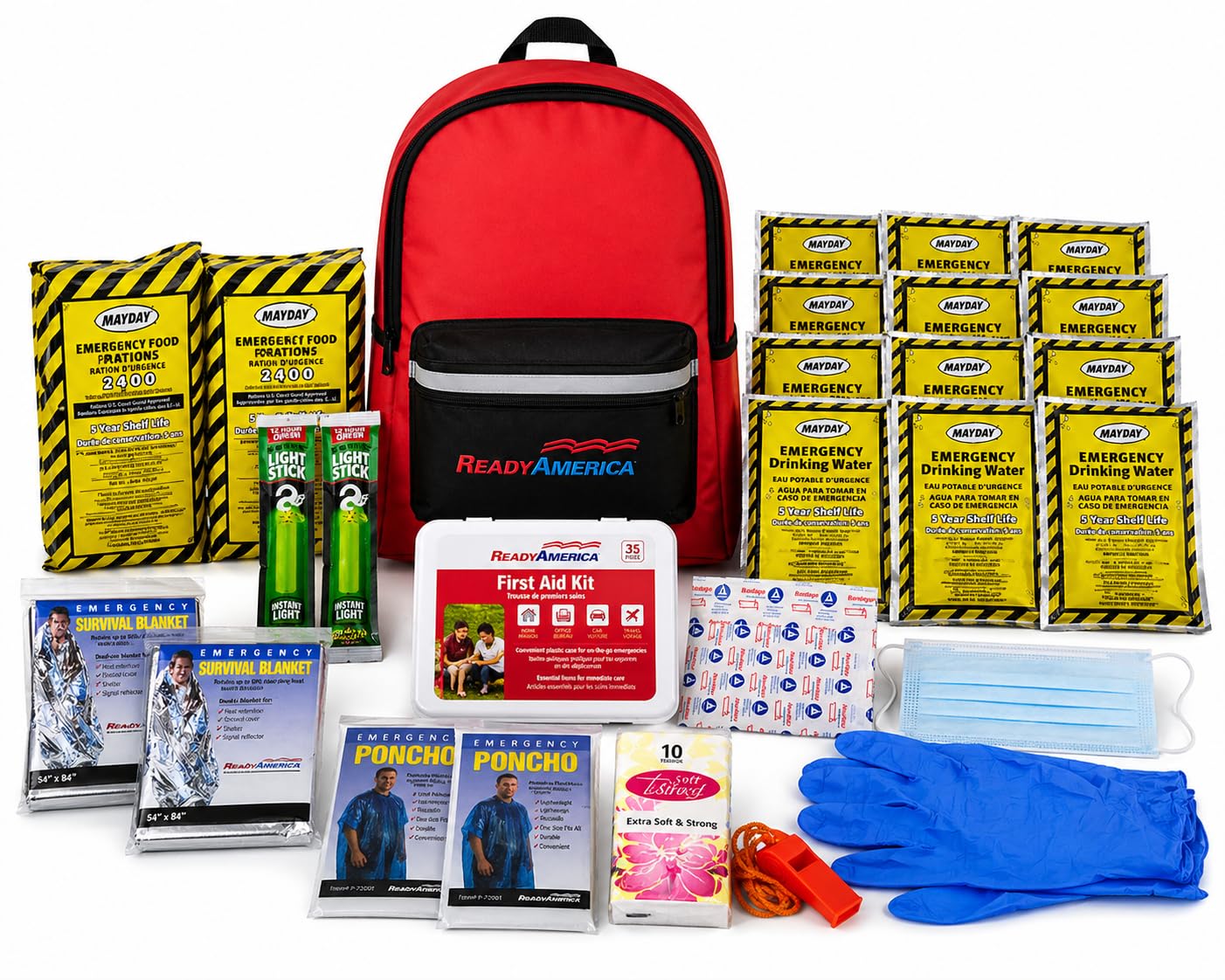
Two food bars worth 4,800 calories and twelve sealed water pouches: nothing else on this page carries rations, and that single fact decides who should buy this backpack. Add two ponchos, two survival blankets, two 12-hour lightsticks, dust masks, nitrile gloves, a whistle, and a 33-piece first aid kit, and you have a bag built for the first three days after something goes wrong. The food and water carry a five-year shelf life, which is the number to put in your calendar.
The pack itself is sized more like a small daypack than an adult hiking pack, and at 7.8 pounds it’s the heaviest kit here. We treat it as an evacuation kit rather than a hiking kit, and for that job the compactness is the point: it stows on a closet shelf or in a trunk where a full backpack won’t fit, and it’s light enough for most adults to carry out to the car.
What you’re buying here is preparedness more than polish. The zipper is the one part worth checking before you stow the bag, because a three-day kit that won’t close becomes a pile of loose supplies in a hurry. What it will do is put calories, clean water, warmth, and light in one place — more than most households have ready right now.
Pros
- Food and water for two people, three days
- Five-year shelf life on the rations
- Compact enough for a trunk or shelf
- Full first aid kit plus blankets and ponchos
Cons
- Pack fits more like a small daypack
- Starter-level first aid contents
Buy this one if the kit lives in a trunk or closet — nothing else here carries food and water for two people across three days.
Best for Camp and Shelter
RIKOJUXI 262-Piece Survival Kit
Key Features
- Pieces: 262
- Shelter: Emergency tent
- Camp tools: Axe-hammer and shovel-pick
- Dimensions: 8 x 7.5 x 10.63 inches
- Price: Premium
A detachable axe with a hammer head, plus a two-in-one shovel with a pick, is not what you expect inside a shoulder bag, and it’s the reason this kit stands apart from the pouch-and-bandages crowd. The 262 pieces also cover an emergency tent, a fishing kit, a fire starter, a flashlight, and a first aid pouch in bright red, so you can find it by feel in the dark.
The bag is better than we expected. It’s an 8 by 7.5 by 10.63-inch crossbody with multiple compartments, and it carries like a shoulder bag rather than a box you have to unpack to reach anything. The separate red first aid pouch is the detail we appreciated most: grab it, leave the tools where they are, deal with the cut.
This is a camp kit rather than a mountain kit, and the difference matters. A crossbody carries comfortably from the truck to the site and less comfortably over ten miles, and the axe and shovel are compact versions scaled to fit inside the bag. For a family site, a cabin, or a truck bed, having shelter, digging, cutting, and bandages in one grab-and-go bag is worth that compromise — it’s the pick here for campcraft by a clear margin.
Pros
- The only pick here with an emergency tent
- Axe-hammer and shovel-pick included
- Bright red first aid pouch is easy to find
- Crossbody bag keeps gear accessible
Cons
- Axe head and shovel-pick are the weak points
For basecamp and truck camping, few kits here give you a tent, an axe, and a shovel in one bag you can sling over a shoulder.
Best for Full Bug-Out Bag
ANJiME 294-Piece Survival Kit
Key Features
- Pieces: 294
- Weight: 4.92 lb
- Bag size: 11 x 9 x 6 inches
- Bag material: 1000D nylon
- Price: Premium
Eleven by nine by six inches is a lot of bag for a survival kit, and this one uses all of it. The 294 pieces live in a 1000D nylon crossbody with MOLLE webbing, and the first aid supplies sit in their own bright red bag inside rather than mixed in with the tools. At 4.92 pounds it’s something you sling over a shoulder for the walk in, not something you forget you’re carrying.
That separate red bag is the design choice we like most. When something goes wrong you want the bandages without unpacking a hatchet, and this is the only kit here that separates the two so cleanly at this size. The 1000D nylon is the same fabric the EVERLIT pouch uses, just wrapped around a much bigger load, and the compartments and straps are built to take the extra weight.
What we can’t tell you yet is how it holds up over years, because it’s the newest design on this page and the long-term picture is thinner than for the EVERLIT or the Ready America. What we can say is that the bag, straps, and zippers feel the most substantial in this group, and that the contents give you a starting point to swap and upgrade rather than a finished kit. If you’re assembling a go-bag and want a shell worth filling, start here.
Pros
- Largest bag here, with room to build out
- 1000D nylon crossbody with MOLLE webbing
- Separate red first aid bag inside
- 294 pieces including tools and first aid
Cons
- Newest design here, so the track record is shorter
Pick this when you want one big bag to build a real bug-out kit around; it has the most room and the toughest fabric here.
Best for Truck and Boat
XKASE 19-in-1 Survival Kit
Key Features
- Case: Waterproof, foam-lined
- Pieces: 19
- Case size: 8.2 x 5.1 x 2.7 inches
- Price: Midrange
A rigid, foam-lined box that’s waterproof and shockproof changes how you can treat a kit. This one measures 8.2 by 5.1 by 2.7 inches and holds 19 pieces: a knife, a wire saw, a fire starter, a flashlight, a spork, a water bottle clip, and a five-in-one paracord bracelet with a built-in compass. Nothing in it gets crushed, and nothing gets wet.
If your kit’s job is to sit in a door pocket or a boat locker for two years and then work, the case matters more than the piece count. A nylon pouch takes a beating in that role; a hard shell shrugs it off, and the foam keeps the contents from grinding against each other on a rough road. That’s the whole argument for it, and we think it’s a good one.
Two checks when it arrives. Test the compass against a known direction and strike the fire starter once, because a compass that points the wrong way is worse than no compass and an untried fire starter is a gamble. Then leave the foam in and resist overfilling the box — it’s sized for exactly what’s inside it, and cramming more in defeats the point of a hard case.
Where this one earns its place is the container rather than the breadth of the gear. It’s the pick here for a truck, a boat, or a snowmobile, where a kit gets knocked around and the contents have to survive it. Give it a quick inventory once a year and it will be the kit that’s still ready when the others have been raided for their batteries.
Pros
- Waterproof, shockproof hard case
- Foam insert keeps gear organized
- Small enough for a door pocket
- Covers cutting, fire, light, and signaling
Cons
- Tools are miniature, sized to fit the case
A hard waterproof box that survives a truck bed beats a bigger kit that gets crushed — this is the one for a vehicle or a boat.
Best for Tight Budgets
XUANLAN 13-in-1 Survival Kit
Key Features
- Case: Waterproof carry case
- Weight: 6.4 oz
- Bracelet: 5-in-1 paracord
- Case size: 4.1 x 1.8 x 6.3 inches
- Price: Budget
The least expensive kit here is also one of the smallest: a 4.1 by 1.8 by 6.3-inch waterproof case weighing 6.4 ounces, holding an emergency blanket, a five-in-one paracord bracelet with a compass and fire starter built in, an aluminum whistle rated at 120 decibels, a wood cutter, a water bottle clip, and a pen. Roughly paperback-sized, it disappears into a glovebox, a jacket pocket, or a boat locker.
That’s the reason to buy it. A kit you’ll actually carry beats a better kit on a shelf, and at this size there’s no excuse to leave it behind. The blanket and the whistle are the two pieces that matter most in a real emergency — warmth and signal — and both are here. Pair it with a first aid kit and you have a decent minimum for a day hike.
Two checks before you rely on it: strike the fire starter and test the flashlight the day it arrives, and compare the compass against a known direction. Those are the pieces that decide whether a budget kit is a bargain or a paperweight. Once they pass, this is the one that ends up in the glovebox and stays there — which is more than most people can say for the kit in their closet.
Pros
- Least expensive kit here, and the smallest
- 5-in-1 paracord bracelet with compass and fire starter
- 120 dB whistle for signaling
- Waterproof carry case
Cons
- Smaller than the photos suggest
- Tools and case feel light-duty
The least expensive way onto this list, and the one small enough that you’ll actually keep it in the glovebox.
Best for Glovebox and Daypack
VEITORLD 12-in-1 Survival Kit

Key Features
- Kit: 12-in-1
- Case: Waterproof box
- Fire: Flint stone scraper
- Shelter: Emergency blanket
- Price: Midrange
Twelve pieces in a waterproof box that disappears into a glovebox — that’s the pitch, and it’s an honest one. Inside you get a wire saw, a flint stone scraper, an emergency blanket, a flashlight, a spork, and a water bottle clip, which covers the four jobs a small kit should handle: cutting, fire, warmth, and light.
It’s a starter kit, and that’s not a criticism. This is the one for a new driver’s car, a first apartment, or a daypack that mostly carries lunch. Nothing in it substitutes for real tools, but the fire starter throws sparks and the saw gets through a branch, and that’s the level of job this box is built for.
The gift angle is real: this is the easiest kit here to hand to someone who is outdoors a few times a year, and it looks and feels like more than it costs. The trade-off is that it’s built for occasional use — the case is basic and the tools are finished to match. If you want a kit that survives a decade in a truck bed, spend more; if you want one that gets someone started, this does it well.
Pros
- Covers cutting, fire, warmth, and light
- Waterproof box fits a glovebox
- Easy first kit or gift
Cons
- Starter-grade tools and case
A tidy little starter kit that suits a glovebox, a first apartment, or a gift for someone just getting outdoors.
Best for Pocket Backup
Verifygear 17-in-1 Survival Kit

Key Features
- Case: Waterproof box
- Pieces: 17
- Weight: 1.3 lb
- Case size: 4.3 x 1.9 x 5.9 inches
- Price: Budget
Seventeen pieces, one small waterproof box, and a foam insert that holds everything in its place until you open it. The contents cover the basics: a knife, a wire saw, a fire starter, a flashlight, a compass, a multitool card, a five-in-one paracord bracelet, an emergency blanket, a tungsten pen, and two screwdrivers, all in a 4.3 by 1.9 by 5.9-inch case.
For the size, that’s a lot of capability, and at 1.3 pounds it slips into a jacket pocket or a glovebox without a second thought. We like it as a car kit or as a backup that lives in a daypack permanently — the kind of thing you stop noticing until the day you need it.
The catch is the container. Once everything is out, getting seventeen pieces back into that box with the padding in place is a genuine chore, and it’s the sort of thing that ends with a kit in a drawer instead of a pack. Our fix is simple: take the foam out and pack the pieces into a small stuff sack inside the case, or accept that the box is for storage rather than for a kit you’ll open in the rain.
What tips it toward a recommendation is capability per cubic inch. As a compact tools kit that covers fire, light, cutting, and signaling in something the size of a paperback, it earns its space in a glovebox or a pack lid — just be ready to repack it deliberately rather than in a hurry.
Pros
- 17 pieces in a 1.3-pound case
- Waterproof box
- Fits a jacket pocket or glovebox
- Covers fire, cutting, light, and signaling
Cons
- Blade does not lock open
Seventeen tools in a box you can hold in one hand — good value if you want a compact kit and don’t mind repacking it carefully.
How We Tested the Best Survival Kits for the Outdoors
We started with several dozen kits and cut hard. Anything without a light source or a real shelter layer was out, and so were kits whose impressive item counts came from fish hooks and 50 feet of cord while the first aid pouch held six bandages. That left 12 kits, spanning a pocket-size tin to a full weekend bag. Before any of them went outside, we priced the worthwhile contents separately — a decent knife, a light, water treatment, an emergency blanket — to see whether a kit was a fair deal or a box with a logo on it.
For six months, one kit lived in a car trunk through a stretch of cold, wet weather while the rest rode in daypacks on hikes and on one overnight in steady rain. At home we emptied every kit onto a table and sorted the contents into light, shelter, water, first aid, and repair, which made the gaps obvious fast. Then we repacked each one in the dark, wearing gloves, and timed how long it took to get light and a way to start a fire.
Bags got stuffed into pack lids, dropped on pavement, and left out in the rain to see whether the contents stayed dry and whether the closure still sealed after a dozen reopenings. We weighed each kit packed and stripped down, noting whether it would truly live in a glovebox or a jacket pocket. Finally we checked the parts that quietly fail — battery dates, purification shelf life, rations, and whether the light and knife were worth carrying at all — and whether someone opening the kit for the first time could use it with cold hands.
How to Choose an Outdoor Survival Kit
The kit that helps is the one you actually have with you, so decide where it will live before you compare a single piece count.
Match the kit to the job, not the photo
Two different products get sold under the same name. Trail kits — the EVERLIT pouch or the XKASE case — are built around first aid and small tools, and they’re light enough to forget in a pack. Evacuation kits like the Ready America backpack are built around calories, water, and shelter, and they weigh several pounds because three days of supplies does.
Buying one to do the other’s job is the most common mistake we see in this category. For hiking, camping, and everyday preparedness, a trail kit plus a water bottle is the sensible starting point. For a house or a vehicle that might have to carry two people through a disaster, start with rations and shelter and treat tools as the extra.
Read the contents, not the piece count
A 250-piece kit and a 19-piece kit can cover the same jobs, because most of that 250 is bandages and wipes. What separates a good kit is the shorter list: a blade, a fire starter that sparks, a light, a whistle, a blanket, and a saw. Those should appear by name in the contents.
When a kit promises a hatchet, a shovel, and a saw as well, expect compact, light-duty versions of each. That’s a fair trade, not a trick — but plan on using them for kindling and cat holes rather than for cutting a shelter frame.
Pouch, hard case, or backpack
Fabric pouches with MOLLE straps hang off a pack, a headrest, or a roll bar, and they leave spare compartments for your own additions. Rigid waterproof cases protect what’s inside from being crushed or soaked, but they’re sized to the factory packing, so they’re awkward once opened. Backpacks carry the most and the heaviest loads.
For a pack, we prefer a pouch that mounts and repacks easily. For a truck bed, a boat locker, or a snowmobile, a hard case is worth the loss of flexibility. Put a backpack where it will sit rather than be carried far.
Judge the first aid by what’s missing
The medical side is usually the thinnest part of a store-bought survival kit: plenty of bandages, little else. Check for gauze, tape, antiseptic, and gloves before you buy, and expect to add blister care and any personal medication yourself.
This is where container design earns its keep. A bag with spare compartments takes those additions; a molded case with a foam insert usually doesn’t. If you take medication or travel with someone who does, buy the bag.
Weight decides whether it comes along
Under two pounds, a kit goes into a daypack without a second thought. Around five pounds it becomes a shoulder bag you carry deliberately. Seven or eight pounds is vehicle or closet territory. None of those is wrong; they’re different products for different jobs.
Pick the weight you’ll tolerate for the way you’ll actually use it. A three-day evacuation bag carried on a two-hour hike is a bag you’ll resent, and a pocket kit in a closet at home is doing nothing at all.
Frequently Asked Questions
I already carry a first aid kit. Do I need a survival kit too?
They do different jobs. A first aid kit handles injuries; a survival kit adds warmth, fire, light, and signaling for when you’re stuck after dark or off route. If your current kit is a bandage tin in a zip bag, the gap is a blanket, a light, and a way to make fire.
If you already carry those, put the money toward water treatment and a better blade instead.
Can I fly with a survival kit?
Not in a carry-on if it contains a knife, an axe, or a fire starter — those have to travel in checked baggage, and the rules differ by airline and country, so confirm with your carrier before you pack.
If you’re flying to a trailhead, check the bag or buy the blade at your destination and keep the rest in your pack. Don’t plan on talking your way through security with a flint.
Is it okay to leave a survival kit in the car?
Yes, with rotation. Heat and cold are hard on food bars, water pouches, batteries, and adhesive bandages, so a kit that lives in a trunk needs its consumables replaced on a schedule — check the dates each spring and swap the batteries then too.
Keep it out of direct sun and out of the footwell where it gets kicked. A rotated kit in the trunk beats a perfect kit in the closet.
Final Verdict
The EVERLIT 250 is the kit we point most people to. It covers injuries properly, carries tools you can actually use, and the MOLLE pouch gives you room to make it yours over a season — the right balance of first aid and gear for a pack, a glovebox, or a first kit.
If the job is different, change the pick. A trunk or closet that might have to support two people for three days calls for the Ready America backpack, rations and all. A basecamp where you want a tent and digging tools in the same bag as the bandages points to the RIKOJUXI.