This post contains affiliate links. We may earn a small commission when you buy through our links — at no extra cost to you.
The worst time to find out your first aid kit is missing sterile gauze—or that the adhesive bandages have gone brittle—is during an actual emergency. A good kit isn’t the one with the highest piece count; it’s the one with fresh, organized essentials you can find with one hand while the other is holding a towel to a cut. That’s why the kits we recommend are built around quality and completeness, not a hundred cheap items you’ll never touch.
Over the past six months, my team and I have unzipped, inventoried, and used 12 first aid kits in kitchen cuts, scraped knees, and a stubborn splinter. I kept one in a glove box, one in a hall closet, one in a hiking pack; the ones that disappeared into those spaces were the ones we reached for first. We compared how compact each kit was, how easy it was to carry, and whether it felt worth the money once we saw what needed replacing. The picks below balance size, contents, and cost without making us hunt for gauze.


Best for Home and Car
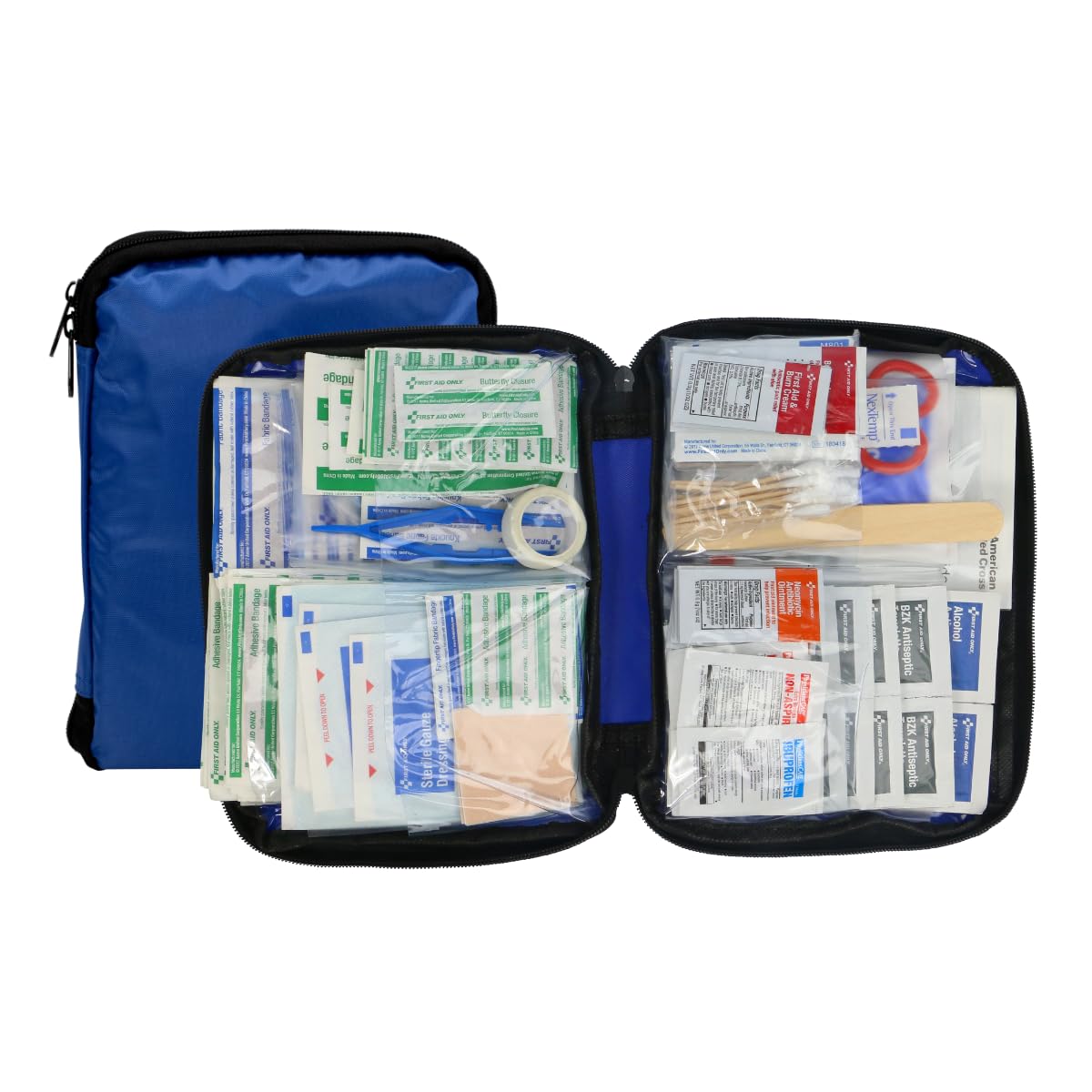
First Aid Only 298-Piece Family Kit
Key Features
- Case: Soft-sided, two layers
- Pieces: 298
- Weight: 1 lb
- Dimensions: 9.25 x 3 x 7 in
- Price: Budget
Two hundred and ninety-eight pieces is the number on the box, but the reason this kit took the top spot is the spread of them: fabric and plastic bandages, antibiotic ointment, BZK antiseptic wipes, burn cream packets, and a gauze roll with pads. That’s the range a household actually reaches for over a year, the kitchen knife slip and the gravel scrape and the pan handle, rather than a shoebox of bandages in one size. Of everything here, this contents list reads most like someone thought about a real kitchen.
Size is the second half of the argument. At 9.25 by 3 by 7 inches and about a pound, it drops into a glovebox, a desk drawer, or the top of a daypack without a reshuffle, and the case splits into two layers with individual compartments. Two layers sounds like a small thing until you’re digging one-handed for a bandage while the other hand holds a paper towel on a cut.
The case is soft-sided and doesn’t pretend to be waterproof, so on a boat or in a wet pack, bag it before it goes in. The ointments and burn cream carry dates on them, so set a yearly reminder and swap them out rather than discovering the problem at the wrong moment.
Pros
- Wide spread of bandages, antiseptic, gauze, and burn cream
- Two separate layers with individual compartments
- One pound and glovebox-sized
Cons
Our pick for a house, a car, and a first apartment: broad wound-care coverage in a one-pound case that disappears into a glovebox or drawer.
Best for Cars with Kids
Band-Aid All-Purpose 160-Piece Kit
Key Features
- Case: Hard plastic
- Pieces: 160
- Dimensions: 9.5 x 7 x 3.25 in
- Medications: Neosporin, Benadryl, Tylenol
- Price: Budget
Most kits in this roundup are bandages, gauze, and a couple of wipes. This one is closer to a small pharmacy: Neosporin antibiotic cream, Benadryl Extra Strength, and Tylenol sit alongside the Band-Aid brand bandages, cleansing wipes, and gauze pads.
That’s why it’s our pick for a car with children in it. An insect bite that swells at a trailhead, or a headache two hours from the next exit, gets handled from the bag instead of from a detour into a pharmacy. The bandages are not made with natural rubber latex either, which matters if there’s a sensitivity in the family; the last thing you need mid-scrape is to be squinting at a label.
Physically it’s a 160-piece kit in a hard plastic case, 9.5 by 7 by 3.25 inches and a shade over a pound. That’s bulkier than the soft pouches here and it won’t squash into a hipbelt pocket, but the shell survives being tossed in a trunk and the compartments make a refill straightforward.
Pros
- Neosporin, Benadryl, and Tylenol included
- Brand-name bandages not made with natural rubber latex
- Hard plastic case with organized compartments
Cons
- Medicines expire and need an annual date check
This is the kit for a car with kids, since the medicines are already in the bag and a bite or a headache doesn’t turn into a pharmacy stop.
Best for Packs and Vehicles
Surviveware Comprehensive 98-Piece Kit
Key Features
- Pieces: 98
- Mounting: MOLLE straps and D-rings
- Dimensions: 6 x 4 x 8 in
- Organization: Labeled compartments
- Price: Midrange
Every pocket in the Surviveware kit is labeled, and that single decision is why it holds a place here. In an emergency you are not browsing. You want the gauze, and you want it in the second the zip opens. The compartments are printed with what belongs in them, which is the sort of detail that costs a manufacturer almost nothing and saves a genuine amount of fumbling.
The rest of the package is aimed at being carried: a rip-resistant 600D polyester shell with MOLLE straps, snaps, and D-rings, at 6 by 4 by 8 inches and a pound. It attaches to a pack or a vehicle panel instead of floating loose at the bottom of a bag. The removable CPR pouch earns its keep for the same reason, since it comes out and goes to where the person is.
The count is 98 pieces, modest next to the big family kits, and this one doesn’t try to be a household kit. Water-resistant is the accurate word for the shell rather than waterproof, so a soaking trip still means a dry bag. For a pack, a motorcycle, or a vehicle that gets used hard, trading volume for organization is a deal we take every time.
Pros
- Labeled compartments you can search in a hurry
- MOLLE straps and D-rings for pack mounting
Cons
- 98 pieces is thin for a whole household
The one we strap to a pack: labeled pockets mean the gauze turns up in seconds, and 98 well-chosen pieces cover a day out.
Best for Wet Trips
Protect Life 100-Piece Travel Kit
Key Features
- Case: Waterproof hard shell
- Pieces: 100
- Weight: 9.88 oz
- Dimensions: 7.5 x 5.2 x 1.5 in
- Price: Budget
A hard shell changes where a kit can live. This one measures 7.5 by 5.2 by 1.5 inches and weighs 9.88 ounces, and the case is built to keep moisture, dirt, and the general grit of a truck bed away from what’s inside. For a boat, a kayak hatch, or a car that gets rained on, that matters more than another fifty bandages.
Inside, the 100 pieces cover the basics: bandages, gauze, antiseptic wipes, gloves, and scissors, plus a thermal emergency blanket, which is the item people forget to pack and then badly want. A first aid guide is included too. It’s no substitute for training, but it beats a bag of unlabeled packets when your hands are shaking.
We reach for this one when the kit is going somewhere wet, and that is the whole recommendation. What we don’t love is how tightly the supplies are packed: once you’ve opened it in anger, getting everything back inside takes patience, and a 1.5-inch case leaves no slack for a sloppy repack.
Pros
- Waterproof hard case protects supplies from moisture
- Thermal emergency blanket included
- Under ten ounces and glovebox sized
Cons
- 100 pieces is thin for a family
For a car, a boat, or a wet pack, this is our choice: the hard shell keeps water out and the blanket earns its space.
Best for Day Hikes
General Medi Mini 110-Piece Kit
Key Features
- Extras: Foil blanket, scissors
- Pieces: 110
- Weight: 0.35 lb
- Dimensions: 7.1 x 1.9 x 5.1 in
- Price: Budget
At 0.35 pound and 7.1 by 1.9 by 5.1 inches, this is the kit that disappears, into a running vest, the lid of a daypack, a large fanny pack, or the console of a small car. We stopped noticing it was in the bag, which is about the highest compliment safety gear can get.
The 110 pieces are the right ones for a day out: bandages and dressings, a foil emergency blanket that folds to nothing, and scissors, which is the item the cheapest kits leave out. For a solo hike or a bike ride that’s the working set, enough to clean and cover something until you’re back at the trailhead. This is the kit that goes in the pack when the plan is hours rather than days.
The limit is quantity. It’s a pouch rather than a case, and most items are single doses, which is exactly right for one person and wrong for a family of four. Think of it as the kit in the pack, with something bigger waiting in the car.
Pros
- 0.35 pound, small enough for a fanny pack
- Foil emergency blanket and scissors included
Cons
- Soft pouch loses its order once you add supplies
The day-hike kit we reach for: a third of a pound, a foil blanket, and enough to clean and cover a scrape until you’re back at the car.
Best for Jobsite Walls
First Aid Only 25-Person Contractor Kit
Key Features
- Case: Wall-mountable metal
- Weight: 1.38 lb
- Rated capacity: 25 people
- Price: Midrange
This kit is shaped like a piece of equipment rather than a bag of supplies: a metal case with a carry handle, a wall-mount option, and an easy-release latch. That shape tells you where it belongs, on a shop wall, in a job trailer, or on a garage shelf, and it’s why it’s the one we point workplaces toward.
Inside are the dressings a crew burns through: adhesive fabric and plastic bandages, antibiotic ointment, BZK antiseptic wipes, burn cream packets, a gauze roll and pads, gloves, and scissors. It’s rated for 25 people, which in practice means enough repeats of the common items that nobody has to ration a bandage after a minor injury.
The metal matters more than it sounds. A plastic case in a hot truck goes brittle and a soft pouch in a toolbox gets punctured, and neither is what you want to find when someone needs a gauze pad. At 1.38 pounds it’s still light enough to lift off the wall and carry to wherever the injury is. Plan on adding your own painkillers if you want them on the same shelf.
Pros
- Wall-mountable metal case with carry handle
- Stocked for up to 25 people
- Easy-release latch for fast access
Cons
- A wall fixture, not a backpack kit
Hang it where the injuries happen: a metal case, a quick latch, and enough dressing for a small crew.
Best for Second Kits
Vriexsd 150-Piece Mini Kit

Key Features
- Case: Waterproof EVA hard shell
- Pieces: 150
- Weight: 0.73 lb
- Dimensions: 6.49 x 4.92 x 2.76 in
- Price: Budget
The least expensive kit here is also one of the smallest: 150 pieces in a waterproof EVA shell measuring 6.49 by 4.92 by 2.76 inches and weighing 0.73 pound. It has a hard, slightly rubbery feel that shrugs off a wet backpack, and the carabiners on the outside let you clip it to a strap instead of burying it.
Inside, the case is divided into small independent sleeves, one category per pocket, which is more structure than you usually get at this size. That’s what makes it usable: you open a side and the thing you need is in front of you rather than at the bottom of a bag.
Where it earns its place is as a second or third kit. One in the bike bag, one under the car seat, one in the daypack you grab on the way out; at this size and this money, stocking several is realistic in a way that buying three family kits isn’t.
It’s a supplement, not a household’s only kit. A hundred and fifty pieces sounds like a lot until two people need dressings in the same week, and this one is built to live in a bag that goes out rather than a shelf that stays put.
Pros
- Waterproof EVA hard shell
- 0.73 pound with carabiners for clipping on
- Categorized inner sleeves
Cons
- Hard to repack once the contents come out
The cheap one we scatter: a waterproof shell small enough for a bike bag or a second car, with supplies for a weekend’s scrapes.
Best for Overland and Boats
EVERLIT 250-Piece Survival Kit

Key Features
- Case: 1000D water-resistant MOLLE pouch
- Extras: Flashlight, paracord, space blanket
- Pieces: 250
- Compartments: Three large
- Price: Premium
This arrives in a 1000D water-resistant nylon MOLLE pouch with three large compartments, mounting straps, and a flag patch, and the pouch alone explains a good part of the price. It’s built to be strapped to a roll cage, a saddlebag, or the back of a seat and take abuse without splitting a seam.
The 250 pieces include the medical basics plus a Mylar space blanket, a three-mode tactical flashlight, and a multi-function paracord bracelet, gear aimed at the moment when the injury is only part of the problem. For an off-road rig, a boat, or a remote job site, that’s a coherent package rather than a gimmick shelf.
The count is also where things get slippery. A survival kit’s piece count includes tools, so 250 here is not 250 of the same things a family kit gives you; the medical depth is closer to a mid-size kit with gear bolted on. We like that trade for the setting and dislike it for a bathroom closet, where plain dressings are what actually gets used.
What settles it for us is the mounting. A kit strapped visibly to the cage gets used, and one buried under luggage does not, and that argument is stronger than the flashlight. The pouch is also the part you’ll still be using after the supplies are replaced, which is not something you can say about a soft bag.
Pros
- Rugged 1000D water-resistant MOLLE pouch
- Flashlight, paracord, and space blanket included
Cons
- Much of the count is tools, not medical supplies
Our pick for a truck, a boat, or an off-grid trip: a rugged MOLLE pouch that carries tools alongside the dressings.
What We Put These First Aid Kits Through
We started with a shortlist of about 40 first aid kits, then filtered out ones with vague contents lists, expired sterile supplies, or cases that looked likely to crack under a car seat. That left 12 kits, which we tested for six months. Each one lived somewhere different—a hall closet, a car glove box, a hiking daypack, and a kitchen shelf—so we could see how it held up in the places people actually store first aid supplies.
On day one, we inventoried every item, counted the pieces, and noted what a basic home kit should include but didn’t. To judge completeness, we tried to assemble a wound-cleaning and bandaging setup—gloves, gauze, tape, ointment, scissors—from each kit without digging. We opened sterile packages to see if they tore cleanly, stuck adhesive bandages to sweaty fingers, and checked expiration dates on anything that touched a wound.
For portability and compact size, we weighed each kit, measured its footprint, and carried it in a daypack and a glove box to see if it was easy to grab and put back. We dropped each case from waist height to check for cracked hinges, and compared the cost of replacing the five most-used items—bandages, gauze, tape, gloves, and ointment—to judge value. The kits that rose to the top were the ones we could find, open, and use one-handed, and that still had fresh supplies at the six-month mark.
How to Choose a First Aid Kit
The kit that helps is the one that’s in the room when something happens, so the first decision is where it lives and the contents follow from that.
Coverage Matters More Than the Count
A 330-piece kit and a 110-piece kit can treat the same cut if the smaller one carries tape, gauze, and an antiseptic wipe. Big numbers get inflated by bandages in a handful of sizes, so read the contents rather than the box: adhesive bandages in more than one size, gauze pads plus tape, antiseptic wipes, gloves, and something for a burn. Scissors and a foil blanket are the next tier up. If a listing leads with a number and then stops, the number is doing the persuading.
Pick the Case for Where It Will Live
A glovebox, a wet boat, a shop wall, and a hipbelt pocket want different shells. Soft pouches squash into a pack and cost least; hard plastic or EVA shells keep moisture and crush damage out; a metal wall case is the only one of the three that becomes part of a room rather than luggage. Watch the word compact, which in a listing usually means it fits a car compartment rather than a running vest, and check the stated dimensions against the space you actually have before ordering.
Organization Is What You Notice Under Stress
A kit that has been opened once and shoved back together is a kit you’ll empty onto the ground at the worst possible moment. Labeled compartments and separate layers are worth a few dollars more, and they’re the reason a 98-piece kit can beat a 300-piece one in a hurry. If you buy a stuffed pouch, repack it into small zip bags by category the week it arrives, while you still remember what went where.
Medications, Expiry, and What the Kit Costs Later
Kits with painkillers, antihistamines, and antibiotic cream cost more up front and ask for maintenance: a date check once a year, with anything expired replaced. Kits without them cost less and never go stale that way, but the tablets get bought separately. Either approach is fine. What isn’t fine is finding a hardened ointment tube and a browned wipe at the bottom of a bag the first time you need them, so pick a kit you’re willing to open and inspect annually.
Match the Kit to the People It Covers
One person on a day hike needs a few ounces of dressings and a foil blanket; a household needs depth in bandages and burn care; a crew of twenty-five needs a wall-mounted supply anybody can open with gloves on. Buying a single big kit to cover everything usually means it stays in the garage. Two smaller kits, one for the house and one for the car, get used, and a third for the pack is worth adding if you hike or ride regularly.
Frequently Asked Questions
Can I take a first aid kit in my carry-on?
Usually, with caveats about what’s inside. Sharp items such as scissors belong in checked baggage unless the blade is within your carrier’s allowance, so pack those separately and confirm the current rule before you fly. Liquids and gels, including antiseptic and ointment tubes, fall under the standard one-quart bag and 3.4-ounce container limits. A soft pouch clears security faster than a hard case that has to be opened and repacked.
Is a general first aid kit enough for a serious injury?
No. These kits are built for cuts, scrapes, and minor burns; they don’t carry a tourniquet, hemostatic gauze, or a chest seal, and those take training to use well. If your plans put you hours from help, buy a trauma kit as a separate item and take a stop-the-bleed course before you rely on it. For the kitchen, the car, and the campsite, a general kit is the right purchase.
Where should a first aid kit live at home?
Between the kitchen and the bathroom, at waist height, and not in the garage. Those two rooms produce most household injuries, and a kit on a shelf you pass daily gets restocked and used, while one behind a toolbox does not. Keep a second in the car, in a hard case or under a seat rather than on a parcel shelf that bakes in summer. If your home has more than one floor, put a small kit on each.
Final Verdict
If one kit has to cover a house, a car, and a first apartment, the First Aid Only 298-piece is where we point people. The coverage is broad enough for real kitchen and driveway injuries, the case fits almost anywhere, and nothing else here covers the same ground for the outlay.
The Band-Aid 160-piece is the better buy when the kit lives in a car with children, because the medicines are already in the bag and a bite or a headache stops being a second errand. For a shop wall, the First Aid Only contractor case is the shape that survives there.