This post contains affiliate links. We may earn a small commission when you buy through our links — at no extra cost to you.
The worst time to discover that your first aid kit is mostly crumpled wrappers is a mile from the trailhead with a bleeding palm. A hiking kit should disappear into your pack until you need it, then contain the moleskin, tape, and gauze that get you back to the car. Completeness matters, but so do weight, compact size, and whether the pouch still zips after bouncing against a water bottle all day. Over six months, my team and I hiked with 12 different kits to see which ones earn their space.
The surprise wasn’t the item count—it was how often kits skipped things hikers actually use, or included gloves that tore on the first blister. We judged each one by how it carried: strap or no strap, hard case or soft pouch, whether it slid into a hip-belt pocket or took over a daypack. Price only mattered next to what you got; a kit that replaces three separate purchases beats a cheap one you have to rebuild. The picks below struck that balance for scrapes, twists, and small emergencies miles from the car.


Best for Day Hikes
General Medi Mini 110-Piece
Key Features
- Extras: Foil blanket and scissors
- Pieces: 110
- Weight: 0.35 lb
- Packed size: 7.1 x 1.9 x 5.1 in
- Price: Budget
Five and a half ounces is what this kit weighs, and 110 pieces is what it carries. That ratio is the whole argument for putting it at the top of this list. The pouch measures 7.1 by 5.1 by 1.9 inches, so it lies flat across a pack lid or slides into a hipbelt pocket instead of bulging out the middle of your load, and a foil blanket and a pair of scissors come with it.
Think about what actually goes wrong on a day hike: a cut, a blister, a turned ankle, and the cold that settles in while someone walks out for help. The blanket and the scissors are the two items mini kits most often skip, and having them means this one covers the waiting as well as the wound. We also liked that 110 pieces is enough to treat a companion, not just yourself, without turning into a group kit.
The case is fabric, so a zip-top bag inside is worth the two grams if rain is likely, and restocking is easy because the pouch is plain and roomy enough for a few extra dressings. Ours has picked up a couple of blister pads and a spare antihistamine since the first trip, and it still zips without a fight.
Pros
- 110 pieces at 0.35 pounds
- Foil blanket and scissors included
- Fits a pack lid or hipbelt pocket
Cons
- Soft pouch, so no crush protection
Our pick for most hikers: 0.35 pounds, 110 pieces, and the foil blanket and scissors that make a mini kit useful when the day goes wrong.
Best for Flat Pack Carry
Band-Aid Travel Ready 80-Piece
Key Features
- Pieces: 80
- Weight: 6.88 oz
- Packed size: 6.25 x 5.5 x 1.6 in
- Brand-name contents: Band-Aid, Neosporin, Tylenol
- Price: Budget
At 1.6 inches thick, this is the flat kit: the one that slides into a pack lid, a map pocket, or the space behind a car seat without changing the shape of anything. We recommend it to hikers who want supplies they recognize at a glance, because the 80 pieces come from brands you already know — BAND-AID bandages, NEOSPORIN, TYLENOL caplets — alongside cleansing wipes and gauze pads in a 6.88-ounce case.
The piece count is the compromise. Against the 110- and 150-piece kits here it holds fewer dressings, so it suits a solo hiker or a couple rather than a group. What you get in return is leftover room, and that is the part we care about: blister dressings and a spare foil blanket drop in without straining the zip, so the kit ends up tuned to the trail you actually walk rather than the one on the contents list.
Pros
- Only 1.6 inches thick
- Recognizable brands inside
- Room left to add supplies
Cons
- Fewer dressings than the 110- and 150-piece kits
We recommend it to anyone who wants recognizable supplies — bandages, antibiotic cream, pain relievers — in a case flat enough to forget about until you need it.
Best for Wet Weather
Vriexsd Mini 150-Piece
Key Features
- Case: Waterproof EVA hard shell
- Pieces: 150
- Weight: 10.9 oz
- Packed size: 6.49 x 4.92 x 2.76 in
- Price: Budget
Wet weather is where this kit separates itself. A day of rain, a splash through a creek, or a damp stuff sack is enough to turn gauze and bandage wrappers into mush, and the EVA shell here is a hard case rather than a fabric pouch, so the supplies inside stay dry. It measures 6.49 by 4.92 by 2.76 inches and weighs about eleven ounces — a small box rather than a flat sleeve, so give it a pocket-shaped space rather than a lid.
Inside, 150 pieces sit in labeled sleeves and small independent compartments, which sounds like housekeeping until you are the one hunting a plaster in the rain. Two carabiners come with it, so the kit can hang off the outside of a pack where it stays reachable without unpacking anything.
The honest trade is weight: at nearly twice our top pick it is the kit we reach for on wet trips and leave home on dry ones. That is the price of a shell that keeps a week of rain out of your sterile dressings, and for anyone hiking in the Pacific Northwest or the Scottish Highlands it is worth paying.
Pros
- Waterproof EVA hard shell
- Labeled sleeves keep supplies findable
- Two carabiners for clipping outside a pack
- 150 pieces in a compact box
Cons
- Packed tight, so repacking outdoors takes patience
We choose this one for wet weather: the waterproof hard shell keeps dressings dry, and the labeled sleeves make it easy to find one with cold hands.
Best for First-Time Hikers
Protect Life 100-Piece
Key Features
- Case: Waterproof hard case
- Pieces: 100
- Weight: 9.88 oz
- Packed size: 7.5 x 5.2 x 1.5 in
- Price: Budget
The printed guide is what makes this the kit we hand to someone heading out on their first real hikes. It walks through the common trail injuries step by step, and it lives in the case with a thermal blanket, gloves, scissors, gauze, bandages, and antiseptic wipes — 100 pieces in a waterproof hard case that measures 1.5 inches thick and weighs under ten ounces.
Flat enough for a pack lid and sealed against a spill, it is the easiest of these kits to hand to a nervous beginner, and the blanket is one of the few here that gives you something to do about cold as well as cuts. The one job before your first trip is to split the contents into two zip bags, because everything arrives packed in tight and a one-handed search with cold fingers is not the moment to learn the layout.
Pros
- Step-by-step first aid guide included
- Thermal blanket, gloves, and scissors
- Waterproof case, 1.5 inches thick
Cons
We hand this to beginners: the printed guide and foil blanket do more for a first-timer than extra piece count, and the hard case is flat enough to pack.
Best for Ultralight Day Hikes
DMI 76-Piece
Key Features
- Case: Water-resistant
- Pieces: 76
- Weight: 3.52 oz
- Packed size: 4.92 x 3.37 x 2.36 in
- Price: Budget
Smaller than a thick paperback, this kit disappears. It goes in a hipbelt pocket, a running vest, the lid of a small daypack, or the door pocket of a car, and at 3.52 ounces in a 4.92 by 3.37 by 2.36 inch case you stop noticing it is there at all.
For a fast, light day out, the injuries you actually meet are blisters and a scrape, and 76 pieces handles both. Thirty heavy woven fabric bandages, ten fabric bandages, ten spot bandages, butterfly closures, alcohol pads, and sterile gauze cover fingers, heels, and a grazed palm. The count leans hard on dressings, which is how a kit this small works: you supply the ointment and a couple of pain relievers and it stops being a bare-bones kit.
It sits in the same price tier as the cheapest kits here, so buying one for each pack is an easy call — a spare in the glove box, one in the hiking bin, one in the saddlebag. What it will not do is look after two people or a long day, and that is fine, because you would not carry it then anyway.
Pros
- 3.52 ounces and pocket-sized
- Dressings for blisters and scrapes
- Room left for a few extras
Cons
- Water-resistant case, not fully waterproof
We keep one in every pack — at 3.52 ounces it is the lightest kit here, and it is cheap enough to buy a second for another bag.
Best for Families with Kids
Welly 130-Count
Key Features
- Case: Metal tin
- Pieces: 130
- Weight: 14.1 oz
- Ointments and meds: Antibiotic, hydrocortisone, ibuprofen
- Price: Midrange
Forty-eight standard fabric bandages and thirty small ones are the heart of this kit, and they are the reason to consider it. They seal on all four sides, they stay on through sweat and a shower, and the small ones fit the kind of scrape a six-year-old collects on a woodland walk.
Around them you get waterproof bandages, butterfly strips, non-stick pads and tape, cleansing wipes, triple antibiotic and hydrocortisone ointments, and ibuprofen caplets. That is a rounded kit rather than a box of plasters, and the ointments are the part most trail kits make you buy separately.
It arrives in a metal tin, 6.5 inches square, which shrugs off being sat on in a pack and holds up to living in a car boot for a season without the contents turning into confetti.
We carried it on family walks and left it behind on long ones, because the place this kit earns is the trip where a bandage has to last until bath time, not the one where you are counting grams. If your hiking is a two-hour circuit with children in tow, it is the least fussy thing here.
Pros
- Fabric bandages that stay put
- Ointments and ibuprofen included
- Crushproof metal tin
Cons
- 14 ounces is heavy for a daypack
- Square tin, not a flat case
We spend more here when the bandage has to survive a kid’s whole afternoon — the fabric strips hold, and the tin protects everything inside.
Best for Car and Cabin
First Aid Only 298-Piece
Key Features
- Case: Soft two-layer zip case
- Pieces: 298
- Weight: 1 lb
- Packed size: 9.25 x 3 x 7 in
- Price: Midrange
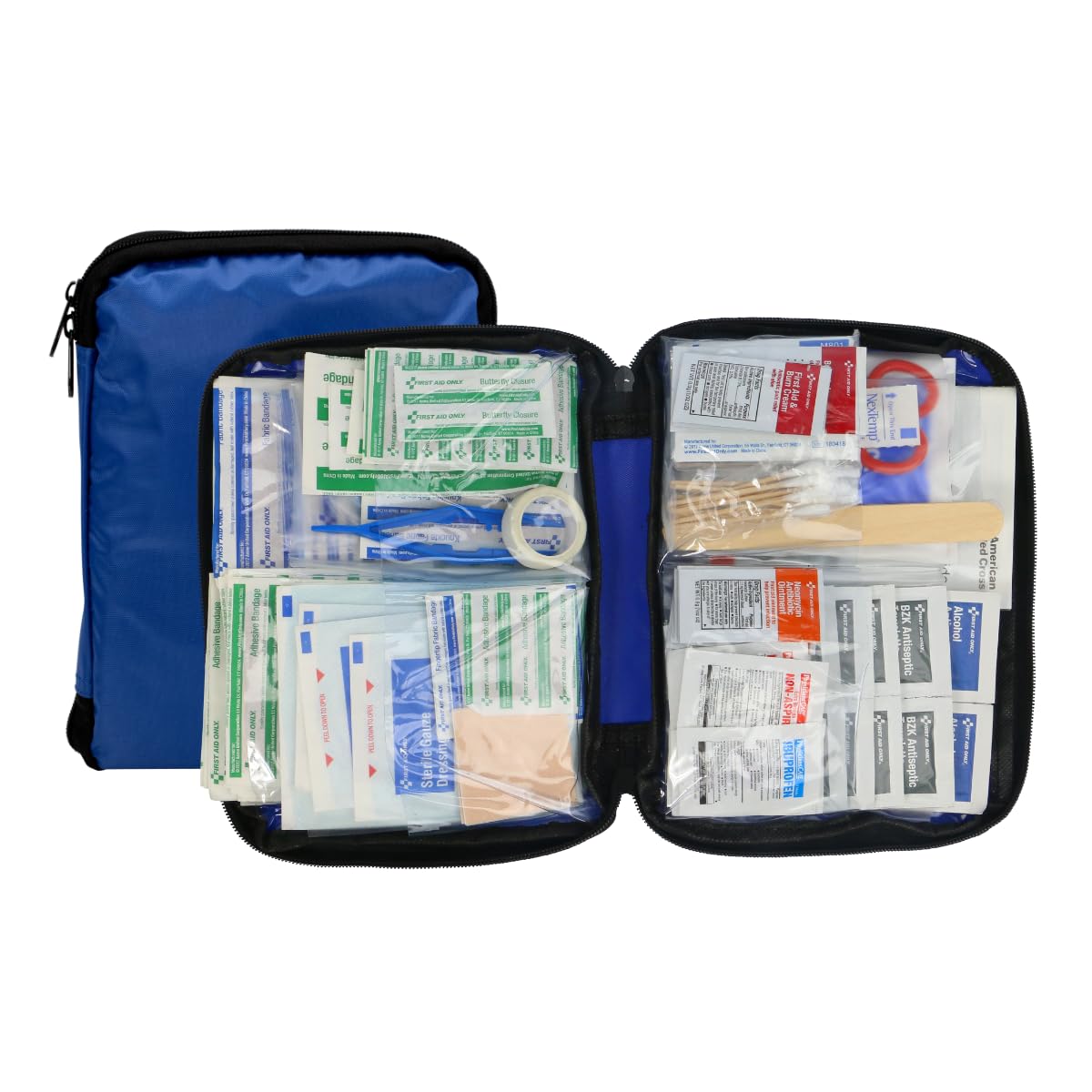
Nine and a quarter inches long, seven wide, and a pound on the kitchen scale. Those are car-kit dimensions, and it is worth being clear about that before anything else, because this is the most popular kit here and the photograph does not tell you how much shelf it wants.
What it does, it does thoroughly. The 298 pieces sit across two zippered layers with individual compartments, and the contents run to fabric and plastic bandages, antibiotic ointments, BZK wipes, burn cream packets, and a gauze roll with pads. Families get the most out of that spread, since burn cream and bulk dressings are exactly what a small trail kit cannot spare.
So the way we use it is as the second kit: leave it in the car at the trailhead and you come back to burn cream, gauze, and a spare of everything. For car-camping weekends it is the only kit here worth packing, and for a summit day it is the one that stays behind.
Pros
- 298 pieces across two zippered layers
- Burn cream and bulk dressings included
- Compartments keep contents findable
Cons
- One pound and 9.25 inches long
We rate it the second kit rather than the pack kit: 298 pieces for the car at the trailhead, the cabin shelf, or a car-camping weekend.
Best for Basecamp and Vehicles
EVERLIT 250-Piece

Key Features
- Pouch: 1000D water-resistant MOLLE
- Pieces: 250
- Survival extras: Mylar blanket, flashlight, paracord
- Price: Premium
The pouch is the first thing you notice: 1000D water-resistant nylon, three large compartments, MOLLE webbing and straps. It is built to be lashed to something — a rig, a saddlebag, the back of a truck seat — rather than tucked into a daypack, and the stitched seams are the tidy kind you check when a bag is going to live outdoors.
Inside are 250 pieces of first aid supplies plus survival gear: a mylar space blanket, a three-mode flashlight, and a paracord bracelet among them. The medical side is broad enough for a family, and the survival extras are genuinely useful when help is an hour of dirt road away.
For overlanding, basecamp, or a vehicle kit that stays packed all season, that combination makes sense. The pouch has room to add your own supplies too, which is how most people end up running a kit like this — a few extras for the dog, a couple of the medications you actually take.
Our reservation is the setting, not the contents. This is a kit you keep where the vehicle is, and it earns its place there; for the pack on your back, the smaller kits above do the same job with far less to carry.
Pros
- Rugged 1000D MOLLE pouch with straps
- 250 pieces plus survival tools
- Room to add your own supplies
Cons
- Bulkier and heavier than a daypack kit needs
For a truck, a basecamp, or overlanding, this is the kit we reach for — a rugged MOLLE pouch, 250 pieces, and survival tools the day kits skip.
How We Tested Hiking First Aid Kits
We started with a shortlist of 30 kits based on component lists, packed weight, pouch dimensions, and whether replacement supplies were sold separately. From that, we narrowed to 12 models that covered soft pouches, hard cases, and minimalist blister kits, then carried them for six months of day hikes, trail runs, and one overnight.
Each kit was weighed on a kitchen scale, measured with a tape, and packed into a daypack lid pocket, hip-belt pouch, and main compartment to see where it actually fit; we also checked whether straps or carabiners let it ride outside without swinging. We dropped each kit from waist height, shook it inside a loaded pack, and opened it wearing wet gloves, noting zipper snags, torn elastic loops, crushed sterile packaging, and whether the contents stayed put.
At a picnic table, we emptied every kit against its included checklist, checked expiration dates, and sorted each item into “useable on trail” or “filler.” We then used the kits for real blisters, a scraped shin, a bee sting, and a rolled ankle, tracking how many supplies were single-use, whether the pouch could be refilled, and how many hikers each size could reasonably serve. Value came down to usable items per dollar, not the total item count.
How to Choose a First Aid Kit for Hiking
The right hiking kit is the one you never think about until you need it, and that comes down to weight and footprint far more than the number printed on the box.
Weight and where the kit rides
The kits here run from 3.5 ounces to well over a pound, and that spread is what decides which ones actually leave the car. A flat case under two inches thick slides into a pack lid, a hipbelt pocket, or the sleeve behind a hydration bladder; a square tin or a box takes the space of a folded layer.
Watch the listing trap: compact usually means it fits a glove box, not that it disappears into a hipbelt pocket, so read the dimensions before the photograph sells you. For a solo day hike we look for something in the three-to-eleven-ounce range with a footprint no bigger than a paperback.
What the piece count actually buys
A big number is a marketing device before it is a measure of coverage. Seventy-six pieces can be almost entirely adhesive bandages; a hundred and fifty can be mostly small strips and pads. Neither tells you whether the kit can dress a proper graze.
Count categories instead: sterile gauze and tape, one dressing large enough for a knee, cleansing wipes, an antibiotic ointment, and something for pain. Two or three of those missing matters more than a hundred extra plasters, and it is the fastest way to compare two kits on a shelf.
Hard shell, soft pouch, or tin
Water is the quiet destroyer of a first aid kit. Cardboard wrappers, adhesive, and sterile packaging all suffer in a damp stuff sack, and a hard shell — the Vriexsd and the Protect Life both use one — costs a few ounces in exchange for real protection on wet trips.
A fabric pouch is lighter and squashes into odd spaces, and a zip-top bag inside gets you most of the way there for almost no weight. A metal tin survives being sat on, but it adds ounces and a square footprint that is harder to fit around.
Match the kit to the trip and the party
Two people on a day hike need more dressings than one, and four need more again. Eighty to a hundred and ten pieces covers a couple comfortably; the 250- and 298-piece kits here belong with a vehicle, a basecamp, or a car-camping weekend where nobody is carrying them far.
If your hiking is a short walk in from the car, a heavier kit costs you nothing and covers more. If it is a summit day, the small flat kits win every time. Buy for the trip you take most often, then add one piece of gear for the trip you take once a year.
Frequently Asked Questions
Do I really need a first aid kit on a day hike?
Yes, and the smaller it is, the more likely it is to be with you. Most trail problems are blisters, small cuts, and turned ankles a few miles from the car, and a three-to-six-ounce kit with dressings, tape, and a blanket handles all three. If you debate the weight on every trip, the kit stays home.
What should I add to a store-bought kit before a hike?
Blister dressings and a small roll of tape go in first, because they cover the injury hikers actually get. Then fine-point tweezers for splinters and ticks, an antihistamine, and any prescription medication you take, in a labeled bag. Write the contents on the pouch so you can check it at a glance without unpacking.
Can I fly with a first aid kit?
In a carry-on, the usual snag is scissors and any gels or liquids, which have to follow the standard carry-on limits — a kit with a small pair of scissors, or none, avoids the conversation entirely. Checked luggage has no such problem. Bag your ointment tubes either way, since a squeezed tube in a pressurized cabin makes a mess of everything around it.
How do I know when to replace what is in the kit?
Go through it once a season: check the printed expiry dates on ointments, wipes, and any medication, and replace whatever you used on the trail. Adhesive bandages that have spent a summer in a hot car are worth swapping even if the wrapper looks fine. Write the restock date on the pouch so the next check is quick.
Final Verdict
For most hikers, the General Medi 110-piece kit is the one to buy. It weighs 0.35 pounds, lies flat in a pack, and includes the foil blanket and scissors that turn a scrape-and-blister kit into something that helps when the day goes wrong.
If you want brand-name supplies in an even flatter case, the Band-Aid Travel Ready is the alternative we reach for, and if you count every ounce the DMI covers blisters and scrapes at 3.5 ounces. Wet-weather hikers should look hard at the Vriexsd’s hard shell.