This post contains affiliate links. We may earn a small commission when you buy through our links — at no extra cost to you.
A camping first aid kit has an awkward job. It has to be small enough to actually slide into a pack, and complete enough for a real injury two miles from the trailhead, where the nearest pharmacy is a long drive away. Most kits solve half of that: a tidy pouch with three bandages, or a five-pound nylon suitcase that never leaves the car. What you want is a kit matched to your trip that covers the things that really happen outdoors — cuts, blisters, sprains, burns, ticks — without a pile of filler.
We’ve spent the past eight months testing 12 kits, from ultralight pouches to soft-sided weekenders. One thing I’d tell any first-time buyer: piece counts are marketing — a 100-piece kit can mean sixty bandages and almost nothing to hold them on with. The ones that worked gave every item a job and stayed small enough that you forgot they were in the pack. The picks below earned a permanent spot in ours.


Best for Backpacking and Hiking
Vriexsd Mini First Aid Kit 150
Key Features
- Case: Waterproof EVA hard shell
- Pieces: 150
- Weight: 10.9 oz
- Packed size: 6.49 x 4.92 x 2.76 inches
- Price: Budget
What sold us is the shell. A molded waterproof EVA case with two carabiners on the outside means this kit rides on a shoulder strap or a belt loop instead of sitting at the bottom of a stuff sack next to a leaking bottle. At 6.49 by 4.92 by 2.76 inches it is a small brick in the hand rather than a bag of loose pouches, and it is the one here we have set down on wet grass without worrying about what was inside.
The 150 pieces are split into labeled sleeves, so a hand goes straight to gauze, tape, or a plaster without tipping the lot out, which sounds fussy until you are doing it one-handed with a cut on the other palm. Povidone-iodine and gloves are in there. Ointment is not, so we added a small tube, and the case still closes.
What keeps it at the top of our list is that it gets carried. A kit left in the car because it is too big is a kit you do not have at the top of the ridge, and at 10.93 ounces this one disappears into a pack. It is sized for one or two people; a group of six will empty it inside a weekend, and that is where the bigger bags here start to make sense.
Pros
- Waterproof EVA hard shell
- Two carabiners for pack mounting
- Labeled sleeves for one-handed access
- 150 pieces at 10.93 ounces
Cons
- No antibiotic ointment included
Our default for any trip where the kit rides in a pack: the shell keeps water out, the clips keep it on the outside, and 150 pieces handle the everyday damage.
Best for Car Camping
Band-Aid All-Purpose 160-Piece Kit
Key Features
- Case: Compartmented hard plastic
- Pieces: 160
- Weight: 1.19 lb
- Packed size: 9.5 x 7 x 3.25 inches
- Price: Midrange
Set this next to our top pick and the first thing you notice is the box: 9.5 by 7 by 3.25 inches of hard plastic with a hinged lid, 1.19 pounds loaded. That is not a kit that disappears into a daypack. It is the one that lives in the truck, on the camper’s shelf, or in the cupboard by the door and comes out when the weekend starts.
What the bulk buys is consumables you recognize. The 160 pieces run on Band-Aid brand bandages in several styles, made without natural rubber latex, plus cleansing wipes, gauze pads, antibiotic cream, an antihistamine for insect bites, and a pain reliever, the last three being exactly what small kits leave you to remember on your own. Internal compartments keep the sizes apart, which matters at seven in the morning when you are hunting for the big square plaster with one eye open.
For a family site it is the sensible default: kids’ knees, a cooking burn, a headache after a bad night in a tent, all handled from one box you can open on a picnic table. It is also the easiest kit here to restock as things run out, which the tightly packed minis are not.
Our call is that this is a vehicle-based kit rather than a walking one, and it is very good at that job. If your trips start and end at a tailgate, the brand-name supplies and the pain relief are worth the extra pound. If you are hiking in, leave it in the truck and take something you will not notice.
Pros
- Band-Aid brand bandages in several styles
- Antibiotic cream, antihistamine and pain reliever
- Compartmented hard case keeps sizes apart
- Easy to restock as supplies run out
Cons
- Bulky 9.5 by 7 inch case
For a family campout, the supplies are the argument: real Band-Aid brand bandages, antibiotic cream, and pain relievers in a case that keeps everything findable.
Best for Remote Trips
Protect Life Travel First Aid Kit 100
Key Features
- Extras: Thermal blanket and first aid guide
- Pieces: 100
- Weight: 9.88 oz
- Packed size: 7.5 x 5.2 x 1.5 inches
- Price: Budget
Two extras set this apart from our top pick: a foil thermal blanket and a written first aid guide. The blanket is the item you never think to pack and the one that matters most when a turned ankle stretches a two-hour walk into an unplanned night out. The guide is the part you hope stays folded.
At 7.5 by 5.2 by 1.5 inches and 9.88 ounces it is the flattest kit here: it slides into a pack sleeve or a glove box instead of sitting on top of everything, and 100 pieces still cover cleaning and dressing a wound, with scissors, gloves, and antiseptic wipes. For a long day hike where the car is hours away, that combination of flat, sealed, and carrying a blanket is what we want in the pack.
Where it gives ground is capacity. A hundred pieces is a solo or pair kit, and split across a family of four it runs thin after the first day of scrapes. That is the trade for the profile: you get something that slips into a sleeve rather than a box that has to ride on top.
Pros
- Thermal blanket included
- Written first aid guide in the box
- Flat 1.5-inch case fits a pack sleeve
Cons
- Packed tight, so repacking takes patience
If your trips could run long, this is the one to take: a thermal blanket and a written guide in a case slim enough to forget.
Best for Ultralight Hiking
General Medi Mini First Aid Kit 110
Key Features
- Extras: Foil blanket and CPR respirator
- Pieces: 110
- Weight: 5.6 oz
- Packed size: 7.1 x 1.9 x 5.1 inches
- Price: Budget
At 5.6 ounces, this is the kit that ends the weight argument. It measures 7.1 by 1.9 by 5.1 inches, a slim pouch that drops into a hip belt pocket or a pack lid, and it still holds 110 pieces including a foil emergency blanket, scissors, and a CPR respirator, which is more than we expect from something this small. For a fast day hike or a long trail run, that is the whole case for owning it: it gets carried.
What you give up is capacity and protection. A hundred and ten pieces is a solo kit, and it thins out fast if you are re-dressing a wound daily. The pouch is fabric rather than a hard shell, so it goes inside a zip bag when the forecast turns. Neither point bothered us on a three-hour outing, and on a week-long trip we take something with more in it.
Pros
- 5.6 ounces, lightest kit here
- Foil blanket and CPR respirator included
- Slim enough for a hip belt pocket
Cons
- Fabric pouch rather than a hard shell
The choice when every ounce is argued over: 5.6 ounces, a foil blanket, a CPR respirator, and just enough to clean and cover a wound.
Best for Blister Care
General Medi 2-in-1 258-Piece Kit
Key Features
- Extras: Moleskin pad and ice pack
- Pieces: 258
- Weight: 1.5 lb
- Packed size: 9.8 x 6.3 x 3.5 inches
- Price: Midrange
Blisters end more hikes than cuts do, and most kits answer them with a plaster that peels off by lunchtime. This one includes a moleskin pad, the material that actually stays put on a hot spot, plus an ice pack for the ankle you turned on the way down. For a hiking kit specifically, that is the first thing we check.
The rest is a proper kit: 215 pieces in the main bag and a second 43-piece mini bag, an emergency blanket, scissors, tape, and gauze, all in a 9.8 by 6.3 by 3.5 inch bag that weighs 1.5 pounds. Multiple compartments keep it navigable, and the two-bag split is the part we like most. Leave the big one at camp and take the small one up the hill.
It sits a step below our top pick for solo trips, because 1.5 pounds and a nine-inch bag is basecamp luggage rather than something you forget you are carrying. As a shared kit for two or three hikers it earns its place, and the moleskin is the reason we reach for it over the kits here that are all bandages and gauze.
Pros
- Moleskin pad for blisters
- Ice pack and emergency blanket
- Second 43-piece mini kit
- Multiple compartments keep it navigable
Cons
- Too bulky for a summit day pack
A kit built around the injury hiking actually produces: moleskin for blisters, an ice pack for a bad step, and a second bag for the car.
Best for Basecamp
First Aid Only 298-Piece Kit
Key Features
- Case: Two-layer soft zip
- Pieces: 298
- Weight: 1 lb
- Packed size: 9.25 x 3 x 7 inches
- Price: Midrange
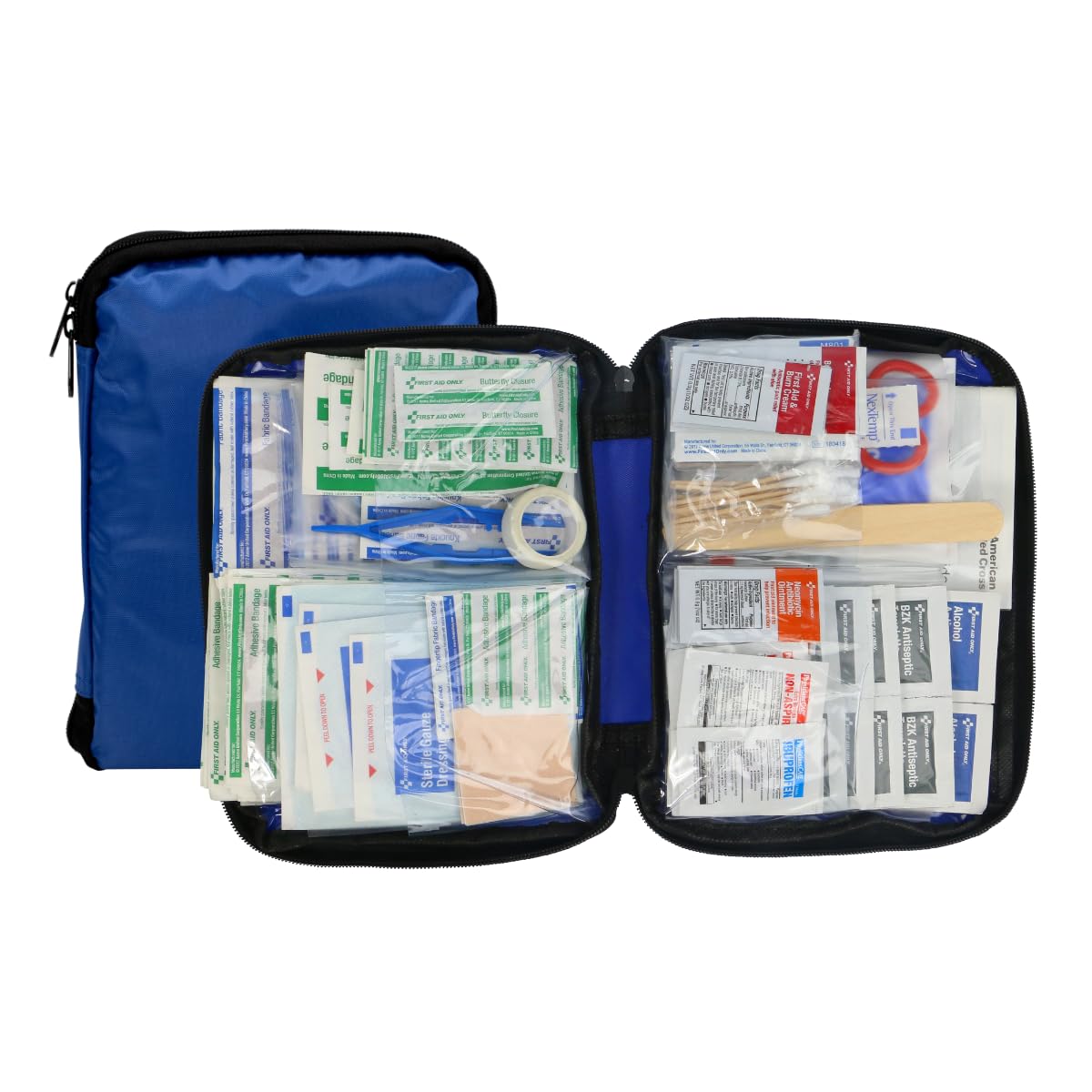
The case is a soft zip binder, 9.25 by 3 by 7 inches, and that one fact sets its job: this is a kit for the tent, the tailgate, or the glove box. What you get in exchange is 298 pieces in a one-pound case.
What is in it is the ordinary stuff, done in quantity: fabric and plastic bandages in a range of sizes, antibiotic ointments, BZK antiseptic towelettes, burn cream packets, gauze rolls and pads, split across two layers with individual compartments.
Those two layers open out, and that is the underrated part. Everything is visible at once, so you can see what you have used and what needs replacing instead of excavating a pouch. We topped ours up with a sleeve of good adhesive bandages and a couple of blister plasters, and it still closed comfortably.
For basecamp it is the sensible buy and the best-stocked kit here for the weight, and it is the one we hand to a family heading out for a weekend. It stays at the tent, though. A pound of soft-sided kit is fine on a picnic table and less so on a ridge, where the hard-shell minis do the same job with less fuss.
Pros
- 298 pieces in a one-pound case
- Two layers open flat for visibility
- Room to add your own supplies
Cons
- Soft zip case, not a hard shell
If the kit stays at the tent or in the truck, this is the best-stocked one here: 298 pieces in a one-pound case with two layers of compartments.
Best for Group Trips
Vriexsd 400-Piece First Aid Kit

Key Features
- Case: 1680D polyester with labeled sleeves
- Pieces: 400
- Weight: 2.5 lb
- Packed size: 5.1 x 9.8 x 7.4 inches
- Price: Premium
Six people, one campsite, a week of cooking and a kid who finds every sharp edge: that is the trip this bag is built for. Four hundred pieces in a 1680D polyester bag with labeled sleeves, big enough that you are not rationing gauze on day three.
The organization is what makes it work. Each compartment is labeled, so someone who has never opened the kit can find a burn dressing while you are holding a hand under the tap, and the straps let you hang the whole thing inside a trailer or on a shelter wall where it stays visible.
We treat it as the group kit rather than a personal one: hand it to whoever is organizing the trip and let it live at the site. The trade is that the contents sit loose in the sleeves, so opening it on uneven ground invites a spill, and we keep a zip bag inside for the small pieces. Next to our basecamp pick it holds more and organizes better, at two and a half times the weight.
Pros
- 400 pieces with labeled compartments
- Straps to hang it at camp
- Enough supplies for a group
Cons
- 2.5 pounds is a lot to carry far
Hand this to whoever runs the trip: 400 pieces in labeled compartments, with straps to hang it where everyone can find it.
Best for Glove Box
Care Science 110-Piece Kit

Key Features
- Case: Soft box with pouches
- Pieces: 110
- Weight: 10.6 oz
- Packed size: 6 x 5.5 x 1.75 inches
- Price: Budget
The box is 6 by 5.5 by 1.75 inches and weighs 10.55 ounces, which puts it in the same bracket as a paperback, small enough to leave in a glove box or drop in a daypack lid and forget about. Inside, 110 supplies sit in organized pouches rather than loose in a bag, which makes refilling it with your own additions straightforward.
That is the case for it: it gets carried because it costs you nothing in space, which is more than we can say for the boxy kits here. We keep ours in the car. It handles scrapes at the park and gets checked over at the start of each season. For a cold, wet trip we take one of the hard cases instead, but as the kit that is actually within arm’s reach, this does the job.
Pros
- Paperback-sized, fits a glove box
- Pouches make refilling easy
- 110 pieces at 10.55 ounces
Cons
- Box is overstuffed and awkward to reclose
For the glove box or the bottom of a daypack: paperback-sized, 110 pieces, and small enough that you will actually have it with you.
How We Tested Camping First Aid Kits
We started by gathering every camping first aid kit we could find from outdoor brands, pharmacy shelves, and large online listings — around 40 in all — and read the contents lists line by line before buying anything. Anything that padded its count by calling every adhesive bandage a separate piece got flagged, and anything with no refill option got dropped. That left 12 kits, from budget pouches to soft-sided weekenders, which we used over eight months of camping and hiking.
Each kit rode in a daypack on hikes and sat at the bottom of a tote on car-camping weekends, and we opened it in the field whenever something happened: a sliced thumb near a stove, a blistered heel, a sprained ankle on a root, a kid’s scraped knee. Back home, we emptied each one onto a table and sorted the contents into two piles, things we’d genuinely reach for and filler. We weighed every kit packed, measured its footprint against a one-liter bottle, and checked whether it fit a hip-belt pocket or had to be buried in the pack.
We also pushed on the small stuff. Bandages went on a sweaty hike and through a hand wash to see whether they stayed put, scissors had to cut gauze cleanly, tweezers had to pull a splinter, and we checked the expiry dates on wipes and ointments and whether each case still sealed after being stuffed and dropped. Then we costed out every kit by the items we’d actually use, which is where a few of the pricier ones fell apart.
How to Choose a Camping First Aid Kit
The kit that helps is the one you are actually carrying when something goes wrong, so we start with packed size and weather sealing and only then count what is inside.
Count the Contents, Not the Pieces
Three hundred pieces sounds like more kit than a hundred. It usually means more small plasters. Read the contents list and look for the things a camping injury needs: antiseptic wipes, gauze and tape, a range of plaster sizes, gloves, something for a burn, and blister care. The Band-Aid kit here earns its space by including antibiotic cream and a pain reliever instead of another fifty bandages, and the General Medi 2-in-1 carries the moleskin most kits leave out.
Hard Shell or Soft Bag
A hard shell earns its keep on any trip where the kit sits on wet ground, rides in a rainy pack, or gets thrown in a canoe. A soft bag is lighter and squeezes into odd gaps, which suits a kit that lives in a vehicle or a tent.
Check two things in either case: whether the case itself is described as water-resistant, and whether the closure is too. A waterproof box with an unsealed zipper still lets water in, and that zipper edge is the part listings quietly leave out.
Weight and Where It Rides
The kits here run from 5.6 ounces to 2.5 pounds, and that gap decides who carries what. Under about a pound, a kit goes in a daypack or a hip belt pocket and gets used. At a pound and a half and up, it is a basecamp bag that moves between the truck, the table, and the tent.
Watch the footprint as closely as the weight. A 9.5 by 7 inch case is compact for a truck and enormous for a pack, so measure the space you actually have before you fall for a high piece count.
Match the Kit to the Trip
A solo day hike wants the smallest kit that covers cuts and blisters. A weekend for two wants roughly 150 pieces. A group or a family site wants 250 and up with real compartments, because four people rummaging through one bag is how the contents end up in the dirt. If you camp both ways, buy the big kit for the site and a mini to carry.
Can You Find Things in the Dark?
Organization matters more in a first aid kit than in almost any other gear purchase. Labeled sleeves or two-layer compartments let you put a hand on gauze without emptying the bag, and they show you what needs restocking. The trade is that precisely packed kits are fiddly to close again, so check there is slack for an extra tube of cream or a few of your own medications.
Frequently Asked Questions
What should I add to a store-bought camping first aid kit?
A few things earn their place in almost any kit: a larger gauze dressing or two, a roll of tape you trust, blister plasters, tweezers, a small tube of antibiotic cream, a spare pair of gloves, and any medication you or your group actually take. Write the date on the case so you know when you last went through it.
How often do I need to replace the supplies?
Go through the kit once a season and again before any trip longer than a weekend. Adhesive bandages lose their stick, antiseptic wipes and ointments dry out, and anything past its printed date should go. Replace what you use as you use it rather than waiting for the box to empty, because half a kit is what you will be holding when you need it most.
Can I fly with a camping first aid kit?
Bandages, gauze, tape, and wipes travel fine in a carry-on. The two sticking points are scissors and anything liquid or gel, so check the blade length against your airline’s published limit and pack ointments with your liquids. If you prefer not to risk the scissors, put them in checked luggage and buy a small pair at the other end.
Final Verdict
The Vriexsd mini is the kit we recommend for most camping trips: it survives a wet pack, clips where you can reach it, and holds enough to treat what a hike actually produces.
If your camping happens around a vehicle and a family, the Band-Aid kit is the better buy for its brand-name supplies and pain relief. Counting ounces instead? The General Medi mini is the lightest way to carry a blanket and a bandage.