This post contains affiliate links. We may earn a small commission when you buy through our links — at no extra cost to you.
A travel first aid kit has a Goldilocks problem. Pocket-size kits fit in a glovebox but run out of gauze after one scraped knee; big ones could handle minor surgery but never leave the hotel room. What you actually want is a compact kit that covers the handful of things that derail a trip — blisters, cuts, a twisted ankle, a headache — without taking up a packing cube. That balance is the whole game.
I’ve carried everything from a single bandage in my wallet to a full expedition kit, and the useful ones share a trait: they’re small enough that you actually bring them. Over four months, my team and I tested 14 kits on weekend flights, day hikes, and a very hot rental car. We packed and repacked them, weighed them, and used them on real blisters and cuts. The differences came down to content quality, whether a kit was complete for a normal trip, how it carried, and whether the price matched what you’d use. The picks below are the ones I’d trust a mile down a trail.


Best for All-Purpose Travel
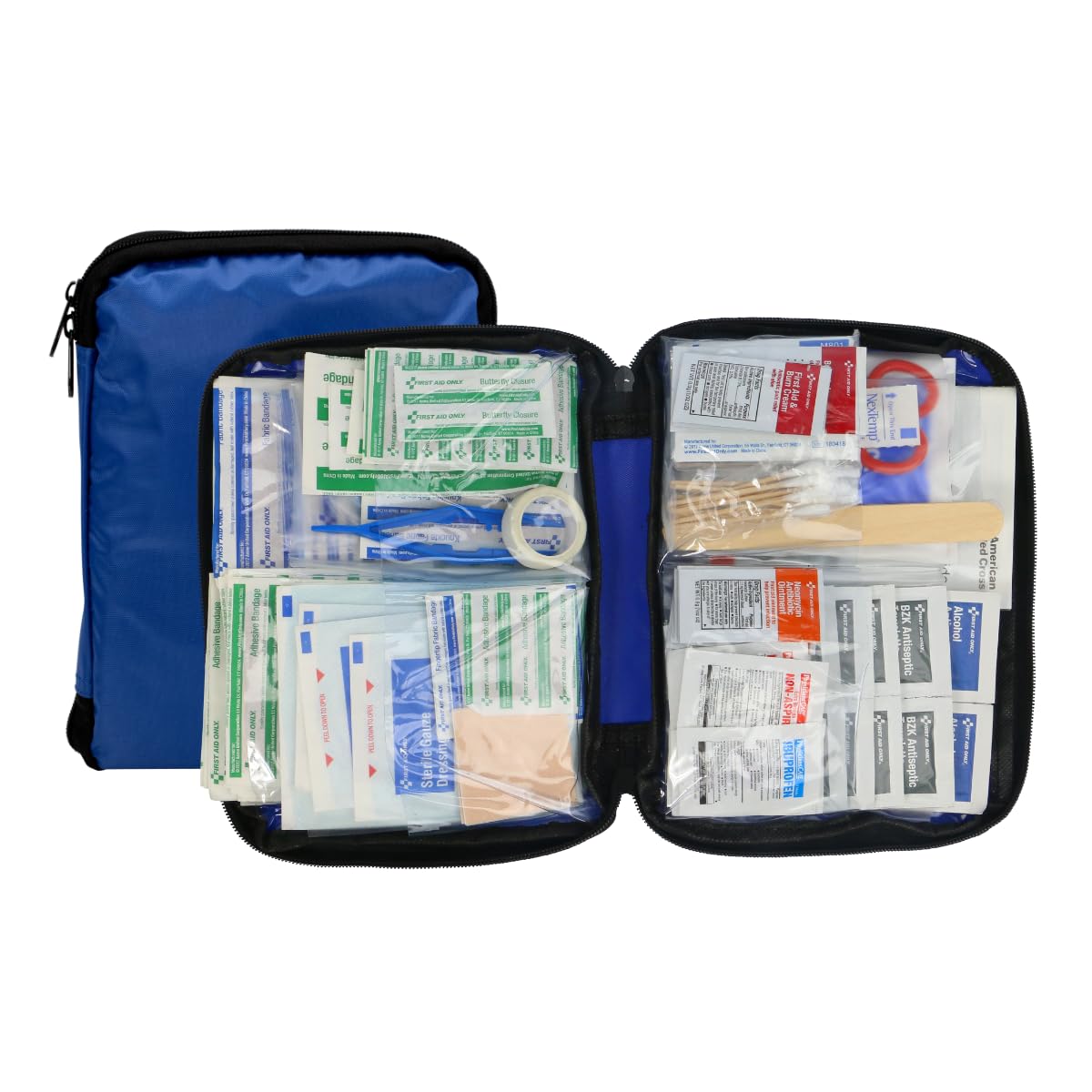
First Aid Only 298-Piece Kit
Key Features
- Case: Soft-sided zippered binder
- Weight: 1 lb
- Dimensions: 9.25 x 3 x 7 inches
- Piece Count: 298
- Price: Midrange
The first thing that registers is how flat it is. At 9.25 by 7 inches and 3 inches deep, this is a binder rather than a box, so it slides under a car seat or stands upright against the back panel of a backpack instead of bulging out of it. It weighs about a pound, which means carrying it never becomes a decision.
That shape is most of why it is our default kit. A first aid kit is only worth the space it takes if it is actually with you, and this one covers a week away without needing a bag of its own. Open the two layers and you get adhesive bandages across a wide range of sizes, gauze rolls and pads, tape, antiseptic wipes, antibiotic ointment, burn cream, and a small pair of scissors — enough for a cut, a blister, a graze, and a minor burn in the same afternoon.
The layer arrangement is the part we grumble at. Nothing is visible at a glance; you unzip, flip the top layer back, and hunt. Unfolded flat on a tailgate or a hotel bed it is manageable, and after a couple of uses you know which side the gauze lives on, but it is slower than a case with a lid.
Pros
- Slides under a seat or into a pack
- Wide bandage range plus gauze, tape, ointment
- Around a pound, so it travels easily
Cons
- Soft case gives contents no crush protection
- Piece count leans heavily to adhesive bandages
Our default travel kit: flat enough to live under a car seat, light enough to forget, and broad enough to handle a family’s cuts, blisters, and burns.
Best for Family Car Kit
BAND-AID 160-Piece Kit
Key Features
- Case: Plastic hard case
- Weight: 1.19 lb
- Includes: Antibiotic cream, antihistamine, pain reliever
- Piece Count: 160
- Price: Midrange
Three things you cannot improvise at a campsite: antibiotic cream, an antihistamine, and a pain reliever. This kit carries all three in individually wrapped, brand-name doses, which is why it does more for a bad afternoon than a box twice its size full of bandages.
The case is a hard plastic shell roughly the size of a small briefcase — 9.5 by 7 by 3.25 inches, a bit over a pound — with compartments that hold their shape and a lid that opens flat. It protects what is inside from being crushed in a duffel, and it keeps the small packets findable instead of loose at the bottom of a pouch.
We rate it the best-stocked kit in this group, and the medicine is why. For a family car, a rental, or a cabin weekend, that is the difference between treating a scrape and getting through a miserable night of itching or aches. The bandages hold up their end too: latex-free, in several sizes, with real tape rather than paper strips.
Pros
- Antibiotic cream, antihistamine, and pain reliever included
- Compartmented hard case keeps packets findable
- Latex-free bandages in several styles
Cons
- Bulky for a daypack at 9.5 by 7 inches
We rate this the best-stocked kit here: real medicine beside the bandages, in a hard shell that keeps everything findable.
Best for Wet-Weather Hikes
Vriexsd Mini 150-Piece Kit
Key Features
- Case: Waterproof EVA hard shell
- Weight: 10.9 oz
- Dimensions: 6.49 x 4.92 x 2.76 inches
- Piece Count: 150+
- Price: Budget
Cardboard first aid boxes fail at exactly the wrong moment — the bottom of a wet pack, a splash in a canoe, a tent floor during a downpour. This one is a molded EVA shell with a zip closure, and water beads off it. At 6.49 by 4.92 by 2.76 inches and just under 11 ounces, it is one of the smaller kits here that still feels like a real kit rather than a sampler.
The 150-plus pieces sit in labeled sleeves, and the tools are a pleasant surprise: full-size scissors and tweezers rather than the fold-out toys that usually come in a kit this size, plus a whistle and safety pins we did not expect. There is no antibacterial ointment in the box, so plan on adding a small tube before you zip it shut. That is the only real gap; everything else you would reach for on a wet hike is in there.
Pros
- Waterproof EVA shell for boats and wet packs
- Full-size scissors and tweezers
- Small and light enough for a pack lid
Cons
- Packed tight, awkward to repack once opened
We take this one when rain is likely: a sealed shell that shrugs off spray, with 150 pieces and full-size tools inside.
Best for Glove Box Standby
Protect Life 100-Piece Kit
Key Features
- Case: Waterproof hard case
- Weight: 9.88 oz
- Includes: Emergency foil blanket and first aid guide
- Piece Count: 100
- Price: Midrange
An inch and a half of depth is the number that matters. This case slides into a glove box or the pocket behind a seat and does not come back out until something happens, which is how a car kit should behave. At just under ten ounces, keeping it there costs you nothing.
Inside, 100 pieces cover the ordinary run — bandages, gauze, tape, antiseptic wipes, gloves, scissors — and two extras that suit a roadside: a foil emergency blanket and a printed first aid guide. The blanket earns its place on a cold night with a broken-down car. The guide earns its place when the person reading it is the person who is shaken up.
The hard case keeps dust and damp out, and the contents are packed in tight, so the first search takes longer than it should. Repack it deliberately, with gauze and tape on top, and it stops being a problem. As a car or boat kit for a couple of people it is the right size, and the blanket and guide are why we reach for it over the bigger cases.
Pros
- 1.5 inches deep, ideal for a glove box
- Foil blanket and printed first aid guide included
- Waterproof hard case keeps contents dry
Cons
- Coverage runs thin for more than two people
For the car we want thin, and this is the thinnest kit here with a foil blanket inside: an inch and a half deep, with a guide for the wait.
Best for Ultralight Hiking
General Medi Mini 110-Piece Kit
Key Features
- Case: Soft mini pouch
- Weight: 5.6 oz
- Includes: Foil blanket, scissors, CPR face shield
- Piece Count: 110
- Price: Budget
At 5.6 ounces this is one of the lightest kits here with real contents in it; only the DMI is lighter, and it carries fewer pieces. It is a soft red pouch, 7.1 by 1.9 by 5.1 inches, flat enough to slide behind a hydration bladder or into a lid pocket.
For hiking, that is the right trade. You are carrying it uphill, so weight and flatness beat a hard shell every time, and the contents match what actually happens on a trail: fabric bandages that stay on a knuckle, gauze for a scraped shin, and a foil blanket and CPR face shield we did not expect in a pouch this small. Scissors are in there too, which is not a given at this weight.
Pros
- 5.6 ounces, one of the lightest here
- Foil blanket, scissors, and face shield inside
- Flat pouch fits a lid pocket or fanny pack
Cons
- Soft pouch offers no crush protection
We take this one up the hill: 110 pieces and a foil blanket in a pouch that weighs less than a water bottle.
Best for Travel with Kids
KEEP>GOING 130-Piece Kit
Key Features
- Case: Stain- and water-resistant fabric case
- Weight: 9.6 oz
- Dimensions: 2 x 7 x 5 inches
- Piece Count: 130
- Price: Premium
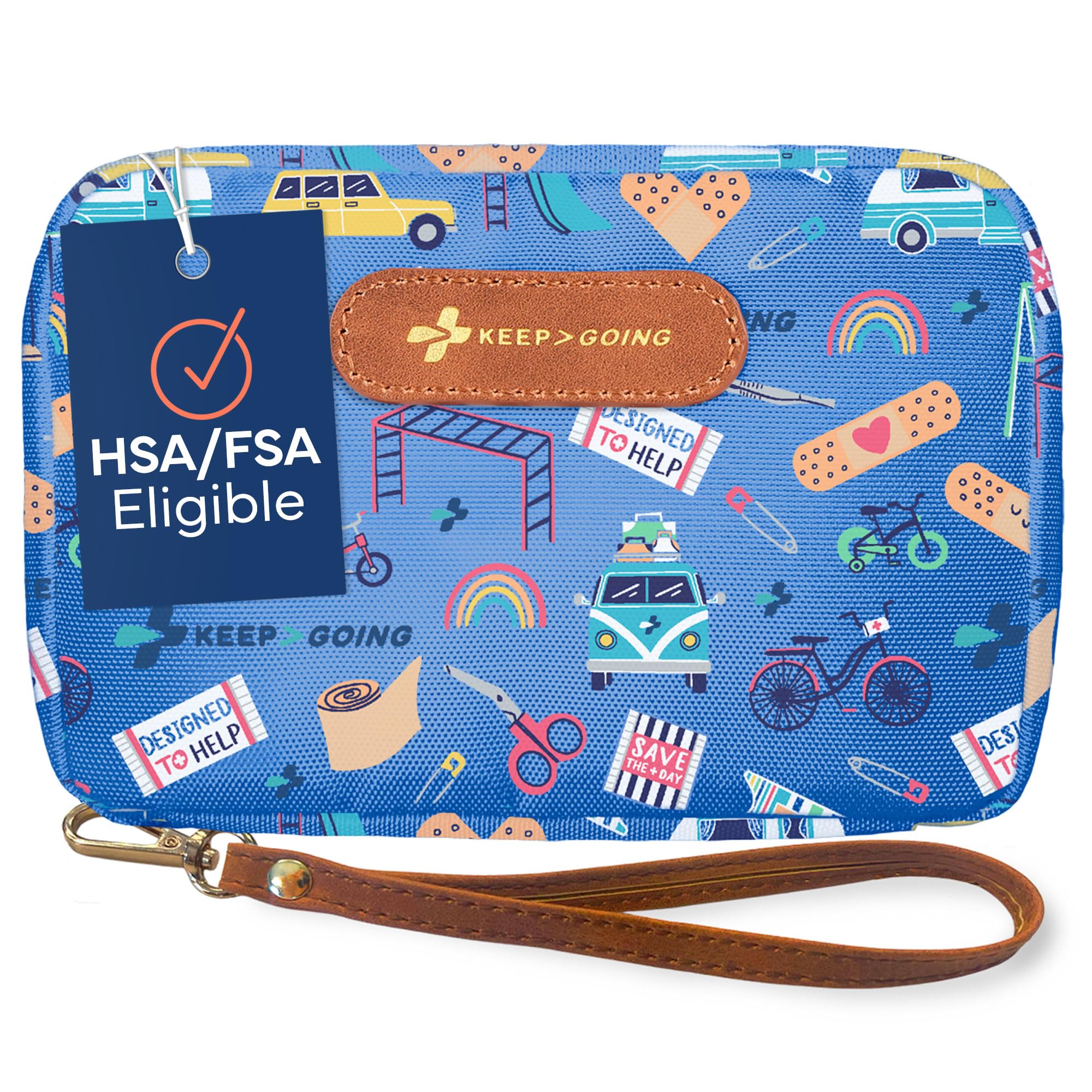
Two things separate this from every other kit here. The pockets are labeled, so you read instead of rummaging when you open it in a hurry — and when you restock, the empty label tells you exactly what is missing. The other is the contents: small bandages in patterns a four-year-old will sit still for, plus lip balm and a sheet of stickers. That combination is why we point parents here.
The case is stain- and water-resistant fabric, 7 by 5 by 2 inches and 9.6 ounces — soft enough to squash into a diaper bag, tidy enough to sit on a hotel shelf. Refill pouches are sold separately, which is the detail that makes the labeled pockets worth having: when a sleeve empties, you replace the sleeve, not the kit. The 130 pieces cover a week of travel with children, and adults will find the assortment plain.
Pros
- Labeled pockets make restocking obvious
- Kid-sized patterned bandages and stickers
- Soft fabric case survives a diaper bag
Cons
- Costliest kit in this group
We point parents here: labeled pockets, kid-friendly bandages, and a fabric case that lives in a diaper bag.
Best for Work Truck
Be Smart Get Prepared 180-Piece Kit

Key Features
- Case: Hard plastic case with slide latches
- Weight: 1.3 lb
- Dimensions: 3 x 10 x 8 inches
- Piece Count: 180
- Price: Budget
One hundred and eighty pieces in a hard plastic case, for less money than most of the kits we rate above it. On quantity for the price, nothing else here comes close.
The case is the better half of the deal. It is an impact-resistant box, 10 by 8 by 3 inches and 1.3 pounds, with two slide latches that click into place and stay there — the sort of thing that survives being shoved under a work truck seat or into a boat locker, and keeps dust out while it does.
Inside, everything sits in molded compartments: bandages in bulk, gauze, tape, antiseptic wipes, gloves, a small pair of scissors. It is a dressing kit more than a pharmacy, and the piece count leans hard on adhesive bandages — you get a lot of sizes of the thing you use most and fewer of the things you use once.
Where it earns a place is as a second kit: the work truck, the boat, the car a teenager drives, where a case that latches and a deep supply of bandages matter more than a foil blanket. Two of these cover a household better than one bigger kit does.
Pros
- 180 pieces for the least money here
- Impact-resistant case with locking slide latches
- Molded compartments keep contents ordered
Cons
- Hard case is bulky in a backpack
This is the one we point at for a work truck or a boat: the most kit for the least money here, in a case that latches shut.
Best for Purse and Pocket
DMI 76-Piece Kit

Key Features
- Case: Water-resistant zip case
- Weight: 3.52 oz
- Dimensions: 2.36 x 4.92 x 3.37 inches
- Piece Count: 76
- Price: Budget
Under five inches wide and 3.4 inches tall, this is the only kit here that disappears into a glove box, a handbag, or a desk drawer and is still there when you go looking. It weighs 3.5 ounces.
The 76 pieces are honest about what they are: 30 heavy woven fabric bandages, ten more fabric bandages, ten plastic spot bandages, butterfly closures, alcohol pads, and a few gauze pads. For the injuries that actually happen away from home — knuckles, fingers, knees — that is a better mix than the number suggests.
The case is a small water-resistant box with a zip, and it has a bit of slack, so a travel tube of antibiotic ointment and a couple of pain relievers fit alongside what is supplied. There is no ointment in the box to start with, which is the first thing to fix.
Where it earns its keep is in numbers. One in the car, one in a purse, one in a desk drawer costs less than most single kits here, and a kit you do not have to remember to pack is the only kind that gets used. It will not cover a long trip for four. It will cover the scraped knee on the way home.
Pros
- Pocket-sized and 3.5 ounces
- Bandage mix covers knuckles, fingers, knees
- Slack for a small ointment tube
Cons
- Water-resistant case, not a sealed one
We keep coming back to this for the car and the purse: small enough to disappear, cheap enough that a second one is not a decision.
How We Tested Travel First Aid Kits
We started with more than two dozen kits from outdoor, pharmacy, and travel brands, then narrowed to 14 based on size (small enough for a daypack or glovebox), price, and whether the contents list named actual items rather than "assorted bandages." Kits with expired medication or vague contents were cut before testing.
For four months, the 14 kits stayed in rotation. One rode in a carry-on through weekend flights, one lived in a hiking daypack, one sat in a glovebox through a heat wave, and one went into a pool bag with kids. We opened and repacked each kit at least three times, including after using items on real cuts and blisters.
Completeness was judged against a list of things that actually happen on trips: blisters, cuts, splinters, headaches, stomach trouble, a twisted ankle. We noted whether the kit had the right sizes — a 1-inch bandage doesn’t cover a scraped knee — and whether medications were single-dose or loose pills. For quality, we opened wrappers, checked adhesive, and looked at expiration dates. For portability and size, we weighed each kit and measured it against a quart-size bag, then tried opening it one-handed and dropping it from waist height to see if the case stayed shut.
Value came last: we tracked what we used versus what we threw away, compared the cost against buying the contents separately, and checked whether the case could be refilled or had to be replaced whole.
How to Choose a Travel First Aid Kit
The kit that helps is the one that is actually in the bag when something happens, so start with where it will live and work backward to what goes inside.
Start With the Bag, Not the Piece Count
Measure the space before you shop. A glove box, a daypack lid, and a diaper bag take three different shapes, and the kits here run from a 3.5-ounce box that fits a handbag to a three-inch-thick binder that lives under a seat. Pick the case first, then check that it carries gauze, tape, gloves, and something antiseptic.
Piece count tells you less than the number on the front suggests. A 298-piece kit and a 160-piece kit can cover the same injuries, because most of the difference is adhesive bandages in more sizes. A high count with no ointment and no tape is a box of plasters with extra steps.
Hard Shell, Soft Pouch, or Sealed Case
A rigid case protects what is inside from being crushed in a duffel and keeps wipes and packets dry, but it does not compress — the BAND-AID case is the size of a small briefcase, which is fine on a shelf and awkward in a pack. Soft pouches mold around other gear and are usually lighter; the First Aid Only binder and the General Medi pouch both disappear into a bag.
If the kit rides in a boat, a kayak, or the bottom of a wet backpack, pay for a sealed shell like the Vriexsd’s EVA case. For everything else, case choice is preference, and the contents matter more.
Check the Items That Are Awkward to Improvise
Bandages are the easy part. Look for a roll of tape, sterile gauze, a pair of gloves, antiseptic wipes, antibiotic ointment, and blister care — the things you cannot substitute with a clean sock and a prayer. A foil blanket costs almost nothing, weighs less, and matters on a cold roadside. Tweezers and small scissors earn their place too.
Read the contents list rather than the headline number. A kit that lists 150 pieces but no ointment still sends you to a store after the fact.
Make It Easy to Search and Restock
You will open this kit one-handed, in bad light, with the other hand holding a light or a child. Compartments and labeled pockets matter more than they sound: the KEEP>GOING labels tell you what is missing the moment you look, and a case that opens flat on a tailgate beats one you have to dig into.
Whatever you buy, replace what you use as soon as you get home rather than on the way out of the door next time. Kits that get restocked stay useful; kits that do not become a bag of empty wrappers.
Frequently Asked Questions
Can I take a first aid kit in my carry-on?
Yes, though the contents decide it. Creams and ointments count as liquids, so they need to travel in your quart bag in containers of 3.4 ounces or less, and scissors pass security only with blades under four inches measured from the pivot.
A kit built around a full-size tube of antibiotic cream should be checked. Keep a small tube in the cabin bag instead.
Do the supplies in these kits expire?
Some of it does. Antiseptic wipes dry out, ointments and medicines carry use-by dates, and adhesive loses grip over time. Open the kit once a year, discard anything past its date, and replace what you used on the trip rather than the morning you leave.
A strip of tape inside the lid with the date you last checked makes the next check quick.
Where should a first aid kit live in the car?
Under a seat or in a cargo-side cubby — not on the dashboard and not in a trunk that bakes. Heat softens adhesive and degrades ointments, and a kit you have to unload the trunk to reach is a kit you will not use.
A small enough case can live in the glove box, as long as the glove box is not already full of paperwork.
Is it cheaper to build a kit myself?
Rarely. Assembling your own means buying full-size boxes of everything, and you end up with a shelf of leftovers and still no case. Buy a kit, then add the two or three things you actually rely on.
Building from scratch makes sense when you need something specific: a prescription, an auto-injector, or a bandage size that fits a particular hand.
Final Verdict
The First Aid Only 298-piece kit is the one we point most people to. It is flat enough to live under a seat, light enough that carrying it is never a decision, and broad enough to handle the ordinary run of cuts, blisters, and burns without a second trip to a store.
If you want medicine in the case, the BAND-AID kit is better stocked and worth the extra bulk. If the kit is going up a hill rather than into a car, take the General Medi Mini and spare your shoulders the weight.