This post contains affiliate links. We may earn a small commission when you buy through our links — at no extra cost to you.
The cut wasn’t serious — a rock edge caught my shin a mile below the ridge — but the kit in my pack held eleven adhesive bandages and nothing to clean the wound with. That’s the trap most hiking first aid kits fall into: they’re built to look complete through the plastic window rather than to handle the two or three things that actually go wrong on a trail. A good kit closes that gap, staying small and light enough that you’ll genuinely carry it while still holding what you’d reach for during a bad blister, a rolled ankle, or a cut that needs more than a bandage.
I’ve been let down by that gap enough times that I stopped trusting the contents list and started opening boxes. Over the past six months my team and I hiked with 12 kits — day hikes, a couple of overnights, and one long wet slog — and dumped each one out at the trailhead before it earned a place in a pack. The ones worth carrying stayed under a pound, sealed their sterile items individually, and gave you a real way to clean a wound. A first aid kit is the piece of gear you hope never leaves the bottom of your pack, and these are the ones we’d still trust if it did.



Best for Most Day Hikes
Vriexsd Mini First Aid Kit
Key Features
- Case: Waterproof EVA hard shell
- Pieces: 150
- Weight: 10.9 oz
- Dimensions: 6.49 x 4.92 x 2.76 inches
- Price: Budget
Rain is the normal condition for a hiking kit, not an exception: a wet shell in the same compartment, damp gloves, a bottle that didn’t quite seal. The Vriexsd’s molded EVA shell is the reason we reach for it. At 6.49 by 4.92 by 2.76 inches it takes up about as much room as a paperback, and the sealed surface means a soaked pack doesn’t turn your gauze into pulp.
The 150 pieces are split into separate, categorized sleeves rather than poured into one compartment, and that layout is what makes the kit usable when your hands are cold and you want one dressing rather than an inventory. We were also impressed by the tools: the scissors and tweezers are full-size rather than the folding miniatures a lot of compact kits use, and the two carabiners let you clip the case to a daisy chain instead of burying it.
The sleeves are cut close, though. Once a dressing comes out, getting it back in takes a fold and a tuck, and the case doesn’t close on a shove the way a loose pouch does. On a dry, flat rock that’s a minute of housekeeping; in the rain with gloves on, it’s the moment you notice.
None of that changes our recommendation for a three-season daypack. A case that keeps dressings dry, sleeves you can read at a glance and a footprint that fits a lid pocket are the things that separate a kit you use from a kit you merely carry, and this one gets all three right at the lower end of this group’s price range.
Pros
- Waterproof EVA shell keeps supplies dry
- Categorized sleeves for fast access
- Full-size scissors and tweezers
- Two carabiners for outside-the-pack carry
Cons
- Heavier than the pouch kits here
- Tight sleeves are fiddly to repack
The kit we recommend for most day hikes: a waterproof hard shell, categorized sleeves you can read at a glance, and a footprint that fits a pack lid.
Best for Fast, Light Hikes
General Medi Mini 110-Piece Kit
Key Features
- Case: Mini pouch
- Pieces: 110
- Weight: 5.6 oz
- Dimensions: 7.1 x 1.9 x 5.1 inches
- Price: Budget
Five and a half ounces is the whole argument. The General Medi kit packs 110 pieces, a foil blanket and a pair of scissors into a pouch that disappears into a pack lid, and that’s the trade we want on a fast, light hike: the kit you don’t think about is the kit that actually comes along. Half a pound saved is a jacket you can carry instead.
The contents come bagged inside the pouch rather than divided into sleeves, so finding one specific plaster means rummaging through the lot. That’s the cost of the weight saving, and it’s a cost you can soften by repacking the things you use most — dressings, tape, antiseptic wipes — into a small zip bag at the top.
Where this kit makes sense is the hike where weight is the constraint: a long ridge day, a fastpacking overnight, a scramble where you want a foil blanket and a way to clean a cut without carrying a box. Where it doesn’t is a wet climate or a pack with no liner, because a soft pouch offers none of the protection a hard shell does.
Pros
- Lightest full kit in this group
- Foil blanket included
- Scissors and 110 pieces in a small pouch
Cons
- Soft pouch gives no water or crush protection
- Bagged contents are slower to search
For fast, light hikes this is the one: barely over five ounces, with a foil blanket and a full set of basics in a pouch you forget you’re carrying.
Best for First-Time Buyers
Protect Life Travel First Aid Kit
Key Features
- Case: Waterproof hard case
- Pieces: 100
- Weight: 9.88 oz
- Dimensions: 7.5 x 5.2 x 1.5 inches
- Price: Midrange
The booklet is the part we didn’t expect to matter. Protect Life includes a written first aid guide alongside the 100 pieces, and on a trail with no signal it is the difference between knowing which dressing goes where and improvising with a sock and hope. For anyone who has never had to dress a wound outdoors, that’s worth more than another ten plasters.
The case is the flat one here — 7.5 by 5.2 by 1.5 inches — and the shape is quietly useful: it slides down a pack’s back panel or into a lid without making a lump against your spine. Inside there are bandages, gauze, antiseptic wipes, gloves, scissors and a thermal blanket, which is a sensible inventory for cuts, grazes and a cold turn in the weather.
For a first kit, or a gift for someone who has just started walking hills, this is the one we point to: the guide does the teaching and the contents cover ordinary mishaps. Choose it if you want instructions in the case; skip it if you already know your way around a dressing and would rather spend the space on supplies.
Pros
- Written first aid guide included
- Flat case slides into a pack panel
- Thermal blanket and gloves included
Cons
- Packed so tight the case is hard to reclose
A strong first kit for someone learning as they go: a written guide, a thermal blanket, and a flat case that slides down a pack’s back panel.
Best for Group Trips
BAND-AID All-Purpose 160-Piece Kit
Key Features
- Pieces: 160
- Weight: 1.19 lb
- Dimensions: 9.5 x 7 x 3.25 inches
- Medications: TYLENOL, BENADRYL, NEOSPORIN
- Price: Midrange
At 9.5 by 7 by 3.25 inches this is the outlier in the group — closer to a lunchbox than to the pocket kits, and at 1.19 pounds it is the one you notice in a daypack. That is not a design failure; it is a different job, and the job is a group rather than a solo hiker counting grams.
The 160 pieces include BAND-AID adhesive bandages in several sizes, cleansing wipes, gauze and antibiotic cream, and the bandages are made without natural rubber latex, which matters if someone in your group reacts to it. Then there is the part that sets it apart from every other kit here: actual medicine. TYLENOL for a headache or a tweaked knee, BENADRYL to calm the itch from bites or a rash, NEOSPORIN for a graze that needs more than a wipe.
For a group hike, a basecamp, a family trip, or the car that always ends up at a trailhead, this is the kit we recommend, because medicine is the thing you cannot improvise from gauze and tape. A headache, a bee sting, a scraped elbow on a tired child: the box handles it without anyone raiding their own supply.
The plastic case is meant to be refilled rather than thrown away, with compartments you can restock from a pharmacy, so the box stays useful long after the first season’s supplies are gone. That is also the small catch — tablets carry dates, and dated tablets need a note in your calendar.
Pros
- Ships with TYLENOL, BENADRYL and NEOSPORIN
- 160 pieces across several bandage sizes
- Refillable compartmented case
Cons
- Tablets expire and need replacing
Buy this one when you’re carrying for a group: 160 pieces plus pain, allergy and antibiotic medicine in a case built to be refilled.
Best for Hikes with Kids
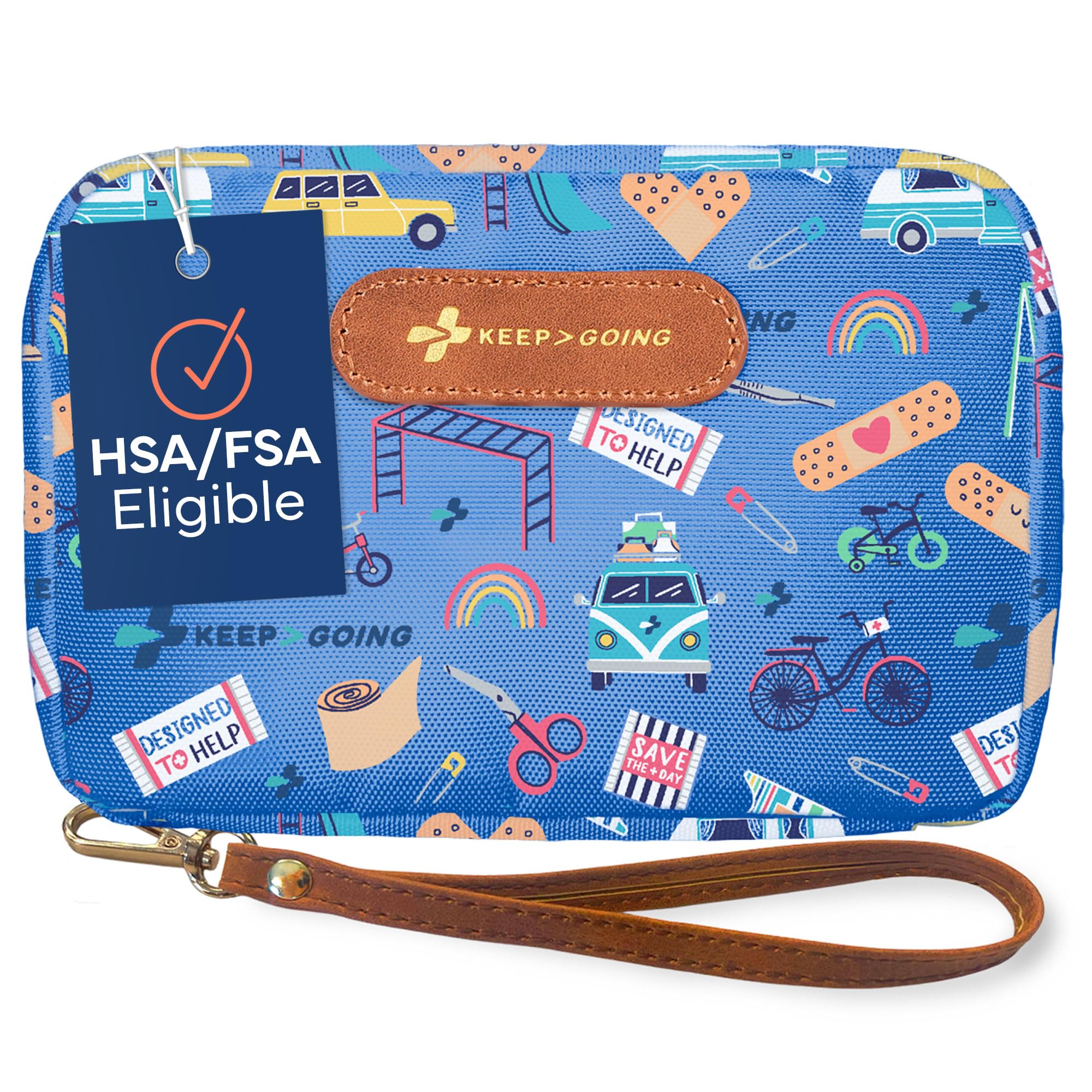
KEEP>GOING 130-Piece Travel Kit
Key Features
- Case: Stain- and water-resistant
- Pieces: 130
- Weight: 9.6 oz
- Dimensions: 2 x 7 x 5 inches
- Price: Premium
A scraped knee on a four-year-old is not a medical emergency, but try telling that to the four-year-old. This kit is built for exactly that moment: 130 pieces in a 2 by 7 by 5 inch pouch, with kid-sized bandages, stickers and lip balm, all in labeled compartments so you can reach the fun bandage without unpacking the serious supplies. We think the kit a child lets you open is worth more than a bigger kit they howl at.
It is the most expensive kit here, and the contents lean family-first rather than mountain-first: plenty of plasters and comfort items, less of the heavy gauze and tape a rough, remote trip might call for. For a morning walk with small children, a diaper bag that doubles as a trail kit, or a first kit for a teenager, that is a fair trade. For anything far from a road, pair it with a proper dressing.
Pros
- Kid-friendly bandages and stickers
- Labeled compartments for restocking
- Light 9.6-ounce pouch
Cons
- Most expensive kit in this group
- Soft case rather than a hard shell
For hiking with small children, the kid-friendly bandages, stickers and labeled compartments turn a scraped knee into a five-minute stop.
Best for Pocket and Purse
DMI Mini 20-Piece Kit
Key Features
- Case: Water-resistant
- Pieces: 20
- Weight: 1.76 oz
- Dimensions: 4 x 3.5 x 1 inches
- Price: Budget
The cheapest kit here is also the smallest by a wide margin: 20 pieces, 1.76 ounces, and a case 4 by 3.5 by 1 inch that genuinely disappears into a hipbelt pocket or a jacket. Six alcohol swabs, two gauze pads, a bandage roll, tape and ten bandages — that’s the entire inventory, and the water-resistant case keeps it intact.
That’s enough for a blister, a graze or a small cut on a well-trodden trail, and not enough for anything that bleeds properly or needs a dressing held in place. We treat it as a second kit: one in the hipbelt for short local walks, the full kit in the pack. If your hikes are short, close to a road and mostly fair-weather, it’s the least fussy way to carry the basics without adding noticeable weight.
Pros
- Fits a pocket at 1.76 ounces
- Cheapest kit in this group
- Water-resistant case
Cons
- No ointment or emergency blanket included
Our pick for a hipbelt pocket on a short, familiar trail: 20 pieces and under two ounces, with the real kit staying in your pack.
Best for Small Packs
Atickyaid 120-Piece Hard Case

Key Features
- Case: Waterproof EVA hard shell
- Pieces: 120
- Weight: 7.9 oz
- Dimensions: 5.9 x 4.3 x 1.9 inches
- Price: Midrange
A clip and a 1.9-inch-thick case are the two details that make this one easy to live with: it goes on the outside of a pack when you want it in reach, and it lies flat enough inside a small daypack that you forget it is there. At 7.9 ounces it is the lightest hard-shell kit in this group.
Inside, 120 pieces sit in divided internal pockets rather than heaped in one compartment, and the shell zips shut over them. That zip matters more than it sounds if your kit lives loose in a pack that also carries a stove, a tripod or a wet shell — the contents stay put and stay dry.
It sits just behind our top pick, and the reason is arithmetic rather than design: fewer pieces for a little more money. What you get for the difference is a case that weighs roughly three ounces less, which is exactly the right trade for a small pack or a fast day where the kit hangs off a daisy chain.
Choose it when pack space and weight matter more than inventory, or when you want the kit clipped outside rather than buried. The hard shell and the divided interior are what earn it a place; the contents are a starting point you can adjust as you learn what you actually use.
Pros
- Waterproof EVA hard shell
- Divided pockets, not one compartment
- Clip for outside-the-pack carry
Cons
- More expensive than the top pick with fewer pieces
A lighter hard-shell alternative to our top pick, with a clip for outside-the-pack carry and divided pockets instead of one open compartment.
Best for Budget Backup
Care Science 110-Piece Kit

Key Features
- Pieces: 110
- Weight: 10.6 oz
- Dimensions: 6 x 5.5 x 1.75 inches
- Price: Budget
Opening this case is the fun part; closing it is the test. The 110 pieces go into a 6 by 5.5 by 1.75 inch box and they go in tight — the internal pouches are organized, but the box is packed to the lid, so reaching one plaster often means lifting a layer of something else first.
What’s inside is decent for the money: a broad mix of bandages, wipes, tape and dressings, plus a physician-recommended contents list that takes the guesswork out of what’s there. The case is the weak link rather than the supplies, and that is the whole reason it sits in also-consider here. Buy it for a car, a cabin or a boat where it stays put and gets checked once a season, and move the contents into a pouch you already like if you want it in a pack.
Pros
- Broad spread of bandages, wipes and dressings
- Budget price
- Organized internal pouches
Cons
- Crammed case is hard to reclose
A budget kit with a sensible spread of supplies; the case is the compromise, so buy it for a car or a cabin rather than a summit pack.
How We Chose and Tested Hiking First Aid Kits
We started with more than 40 kits sold through outdoor retailers and big-box stores, then filtered hard: anything over a pound, anything north of $60, and anything whose contents were mostly adhesive bandages got cut. That left 12 kits in a range of sizes, from ultralight pouches meant for a solo day hike to fuller kits built for two or three people. We then carried them for six months on day hikes, two overnights, and a wet weekend where nothing stayed dry.
At the kitchen table, we emptied each kit and sorted the contents into two piles — items we’d actually use on a trail and filler — then counted both. Each kit went on a kitchen scale with and without its pouch, and we measured the folded size against a hipbelt pocket and the lid of a daypack to see where it realistically fit. We also checked expiration dates on every medication, whether the pouch resealed after being opened, and what the cost worked out to per genuinely usable item.
On the trail, we treated real blisters and one shin laceration, and we opened packaging with cold hands and once with a bandaged thumb to see how it went one-handed. We timed how long it took to find the antiseptic wipe by headlamp, checked whether the pouch stayed shut after a full day bouncing in a pack, and noted whether tape stuck to damp skin and whether the included scissors could cut gauze cleanly. Kits that couldn’t be restocked with refills lost points, since a first aid kit is only as good as its second season.
How to Choose a Hiking First Aid Kit
The kit that helps is the one you actually carry, so weight and pack fit decide more hikes than piece counts do.
Start With Weight and Where It Rides
Every kit here is small, but they run from under two ounces to more than a pound, and that gap decides whether the kit leaves the car. Pick the spot in your pack before you shop: a hipbelt pocket suits a case around 4 by 3.5 inches, a lid suits a 6-to-7-inch box, and a flat case slides down the back panel against your spine.
The trap is pack volume. A 30-liter pack says nothing about whether a 9.5-inch case fits the gap you had in mind, so measure the space rather than the liter count. We would rather carry a 10-ounce hard shell we never think about than a five-ounce pouch that ends up in the glovebox.
Waterproof Beats Water-Resistant on a Wet Hike
A fabric pouch labeled water-resistant will shrug off a splash. It will not survive a soaking pack, and the zipper is where the water gets in. A molded EVA shell with a sealed surface is the version to choose if you hike in rain, cross streams, or keep the kit loose in a pack that also holds a wet shell.
If your pack has a liner and your hiking is mostly dry-weather, the lighter pouch is a fair swap. Judge it by the case rather than the label: a kit that keeps its wipes and dressings dry is worth several ounces more than one that doesn’t.
Read the Contents, Not the Piece Count
Piece counts include alcohol swabs, safety pins and small plasters, so a 150-piece kit is not 150 dressings. What a trail kit needs is a way to clean a wound, cover it, and hold the dressing on: antiseptic wipes, gauze, tape, and a dressing big enough for a palm-sized scrape.
Then look at what else earned its space. A foil or thermal blanket is the item that matters when a day runs late, and medicine is the other differentiator — only one kit in this group ships with pain, allergy and antibiotic products, and that is worth knowing before a headache starts on a ridge.
Organization Decides Whether You Use It
You will open this kit with cold hands, possibly in the rain, and you will want one item rather than an inventory. Divided sleeves and labeled compartments are worth paying for; a box packed to the lid means tipping everything into the wet to find a plaster.
The question we ask of any layout is simple: can you find a dressing and close the case again without taking your gloves off? A case with a little spare room passes, and one that has to be forced shut does not.
Buy a Kit You Can Refill
Consumables run out and expire, so the case matters after the first season. A hard shell with spare compartments outlasts a sealed, single-use kit you throw away once the wipes dry up, and it lets you swap in what your own hikes actually use.
Note the expiry dates on wipes, ointments and tablets when the kit arrives, and check them each spring. Replacing a handful of items from a pharmacy is cheaper and quicker than starting over with a new box.
Frequently Asked Questions
Can I build my own hiking first aid kit instead of buying one?
You can, and if you already know exactly what you use, it is a good route. The catch is cost and packaging: buying dressings, tape, gauze and wipes individually usually costs more than a stocked kit, and you still need a case that survives a pack.
A practical middle path is to buy a stocked kit for the case and the basics — the Vriexsd is a good base — then add the two or three items you personally reach for.
Is a hiking first aid kit the same as a survival kit?
No. A survival kit trades medical supplies for gadgets such as a flashlight, paracord or a fire starter, and many of those you already carry anyway. On a marked trail, the job is dressing a wound and keeping someone warm.
If a contents list leads with tools rather than dressings, gauze and tape, it is not the kit to put in a hiking pack.
Can I take a first aid kit in a carry-on?
Yes for bandages, wipes, tape and tablets. The item to check is scissors: the General Medi kit includes a pair, and blade rules vary by country, so confirm the limit with your airline or put that kit in checked luggage.
The KEEP>GOING kit is sold as TSA-approved travel size if you prefer to avoid the question entirely.
Final Verdict
If you want one answer, it is the Vriexsd Mini First Aid Kit. The waterproof hard shell and the categorized sleeves are the two things that make it usable on a real trail rather than just present in your pack, and it sits at the lower end of this group on price.
Change the requirement and the pick changes with it: the General Medi kit if you count ounces and hike dry, the Protect Life kit if you want instructions in the case, and the BAND-AID kit when you are carrying for a group rather than for yourself.