This post contains affiliate links. We may earn a small commission when you buy through our links — at no extra cost to you.
Hotel coffee is a gamble — a lukewarm pod, a powdered creamer packet, and a line of people in pajamas waiting for the lobby urn to catch up. A travel coffee maker is the fix: a small, packable rig that lets you make a cup you actually want to drink in your room, at a campsite, or at your desk before anyone else is up. I’ve hauled enough mediocre coffee gear through airports to be picky about which ones earn the space in my bag.
The first thing I learned: a travel coffee maker lives or dies by the morning after. If it leaks into your duffel, takes ten minutes to rinse, or needs three parts and a special pod you forgot, it stays home. We paid attention to packed size, brew speed, durability, and whether the coffee tasted like coffee. Over six months, my team brewed with 13 models in hotel bathrooms, on picnic tables, and at kitchen counters — the picks below are the ones that survived real mornings.
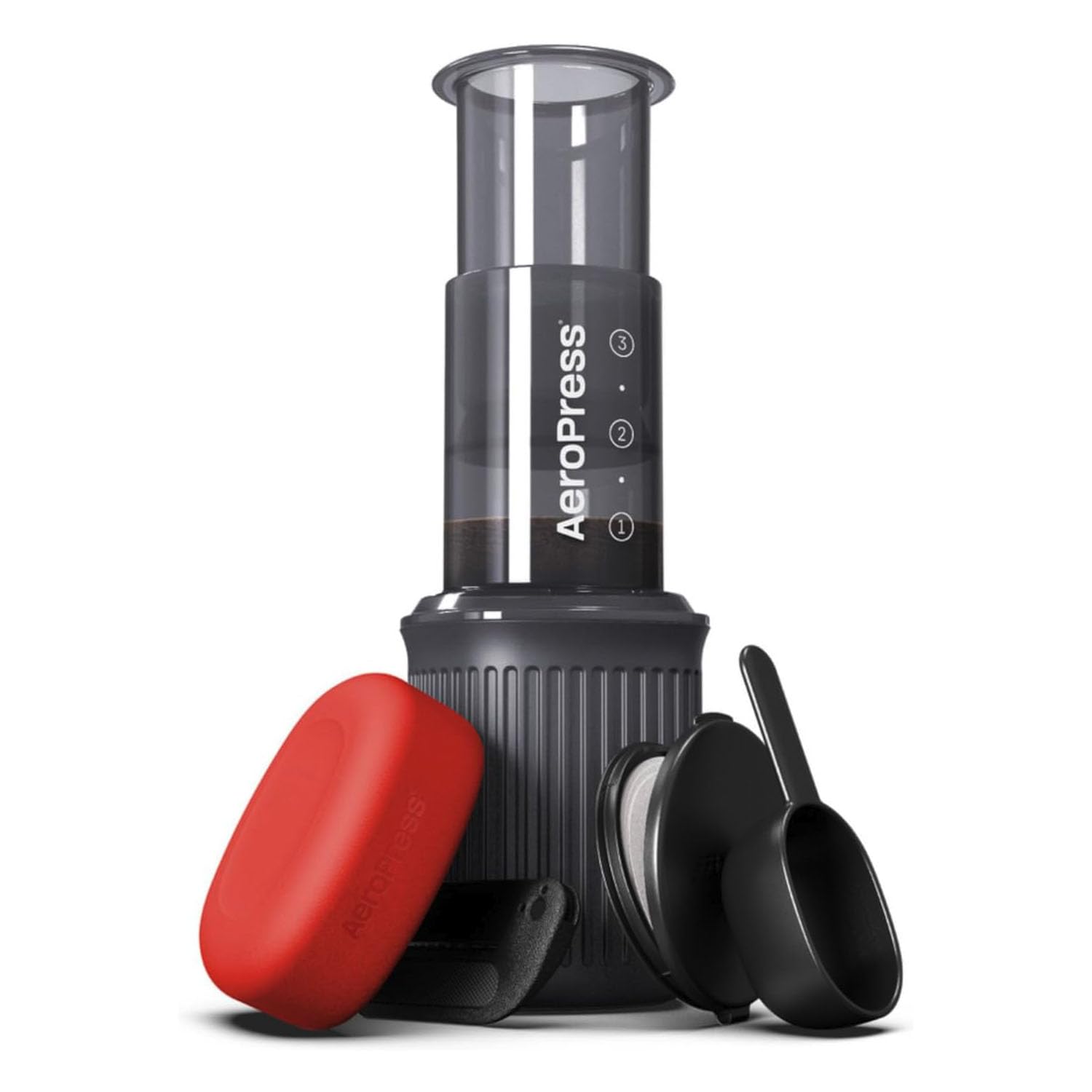


Best for Packing for Trips
AeroPress Go
Key Features
- Weight: 11.2 oz
- Filter type: Paper micro-filter
- Brew capacity: 8 oz
- Packed dimensions: 4.2"D x 4.2"W x 7.3"H
- Price: Premium
The Go’s trick is that the mug is the case. The brewer, the plunger, the filter holder and a stack of paper micro-filters all nest inside the eight-ounce cup, and the lid clamps over the top. That is the reason it is our top pick, and it has less to do with coffee than with packing: it is the only one here that comes out of a daypack as a single object rather than a small collection of parts. Closed up it measures 4.2 by 4.2 by 7.3 inches and weighs 318 grams, roughly a large insulated mug, so it drops into a bottle pocket and you stop thinking about it.
Brewing is the familiar AeroPress routine: grounds in, hot water to the mark, a stir, thirty seconds of waiting, then a slow press. Air pressure through a paper micro-filter makes a concentrated, clean cup — closer to a pour-over than to a French press, with none of the sludge — and you can dilute it to americano strength or press it straight over ice. The clean-up is what convinced us for travel: the grounds leave as one puck, so you rinse a single tube instead of picking grit out of a mesh.
Eight ounces is the honest limit. That is one proper mug, so two people drinking together means brewing twice, and the second round costs another two minutes and another scoop. In a hotel room that is a non-issue; at a campsite with two coffee drinkers it is worth knowing before you order, and it is the main reason to look at the Original below.
Pros
- Brewer, mug and filters pack as one
- Paper filter leaves a clean, grit-free cup
- Grounds come out as a single puck
- Packs to 318 g and fits a bottle pocket
Cons
- Filter holder lid doesn’t latch shut
We recommend the Go as the default travel brewer: one object to pack, a solid eight-ounce cup, and a two-minute brew anywhere you can boil water.
Best for Bigger Single Cups
AeroPress Original
Key Features
- Weight: 6.4 oz
- Brew styles: French press, pour-over, espresso style
- Filter type: Paper micro-filter
- Brew capacity: 10 oz
- Price: Midrange
Set the Original beside the Go and the trade is easy to see: ten ounces instead of eight, and 6.4 ounces of brewer instead of 318 grams of kit. It is the same press in the size that started it, and the cup it makes is identical in character — concentrated, clean, filtered through paper. The extra capacity comes from a taller chamber rather than a different design. The real difference is in how the two travel: one arrives as a kit, the other as a brewer.
That suits a particular traveler, and it is the one we reach for when the trip has a kitchen at the other end — a rental flat, a friend’s sofa, a hotel room where a mug is already on the desk. Ten ounces is a more generous single cup than the Go manages, the brewer itself disappears into a bag, and the money you save goes toward coffee. It is also the most adjustable of the group: grind, water temperature and steep time are all yours to play with, so the same press covers a rushed morning cup and a stronger concentrate for milk.
The chamber, plunger, stirrer, scoop and a sleeve of filters arrive as separate pieces, which is the cost of the lighter, cheaper package. A stack of paper filters lives in the bag with the scoop and weighs nothing, but it is one more thing to check before you zip up.
Pros
- Ten-ounce brew, larger than the Go
- Light to carry at 6.4 ounces
- Full control of grind, heat and steep time
Cons
- No cup or case; you pack a mug
Buy the Original if you already travel with a mug: ten ounces, less to carry, and the same brew for less money than the Go kit.
Best for Keeping Coffee Hot
Bodum Travel Press
Key Features
- Weight: 14.4 oz
- Capacity: 15 oz
- Insulation: Double-wall vacuum
- Filter type: Reusable mesh
- Price: Midrange
The Travel Press isn’t a brewer that happens to have a cup attached; it is a 15-ounce vacuum-insulated travel mug with a plunger running down through the lid. You add coarsely ground coffee and hot water, stir, seal it, wait a few minutes, then press the mesh filter down and drink from the top. Of the six here, it is the only one that keeps coffee hot after the brewing is finished, and in cold weather that is not a small thing.
It is also the biggest cup in this group at 15 ounces and the heaviest at 14.4 ounces, and those two numbers describe the same trade: you are carrying a thermos rather than a brewer. For a drive, a ferry crossing, or a morning at a trailhead before a hike, that is exactly the right shape — the silicone grip is there for cold hands, it goes in the dishwasher, and the mesh filter means nothing to restock. This is the one we take when the coffee has to survive an hour in a rucksack pocket.
One thing to know before you pack it: the lid is spill-resistant rather than leakproof, so it rides upright in a bottle sleeve instead of loose in a duffel. Tipped far enough, coffee comes out of the drinking spout. That is the price of a lid you can open and drink from one-handed, and for commuting and car travel we think it is a fair one.
Pros
- Brews and drinks from one vessel
- Keeps coffee hot for hours
- Largest capacity here at 15 ounces
- Reusable mesh filter, nothing to restock
Cons
- Plunger filter can work loose over time
We like the Travel Press for anyone who wants to brew and then drink from the same insulated vessel and still find it hot an hour later.
Best for Espresso Drinkers
Wacaco Minipresso GR
Key Features
- Weight: 12.7 oz
- Shot size: Up to 50 ml
- Dimensions: 2.76"D x 2.36"W x 6.89"H
- Water tank: 70 ml
- Price: Premium
You fill a small basket with ground coffee, pour hot water into the 70 ml tank, and pump by hand until roughly 50 ml of espresso, crema on top, lands in your cup. No battery, no cord, no capsule. It is the only machine here that makes espresso rather than filter coffee, and if your morning is a short black instead of a mug of drip, that distinction decides the whole purchase before anything else gets weighed.
At 0.36 kg and 6.89 inches tall it goes into a pack the way a water bottle does, and it is the one we reach for on a trip where the coffee has been poor for three days straight. The work is real: fine grind, leveled and tamped with the scoop that comes attached, water hot but not boiling, then steady pressure until the shot runs. Cleaning is the part we mind — the basket knocks out easily, but the outlet below it needs a rinse and a wipe, which is more than an AeroPress puck ever asks of you.
The tank is the hard constraint. Seventy millilitres is one short shot with nothing left to rinse through, so a long drink means refilling and pulling a second. Longevity is the other reservation: a piston and a set of seals do all the work here, and that is the mechanism to think about if you plan to use it daily rather than a few trips a year.
Pros
- Real espresso with crema, by hand
- No battery, cord or capsule
- Packable at 0.36 kg
Cons
- 70 ml tank yields one short shot
- Basket and outlet need a proper rinse
Choose the Minipresso if a real shot with crema matters more than convenience — it delivers, at the cost of a small tank and some fiddling.
Best for Hotel-Room Brewing
Primula Brew Buddy

Key Features
- Fit: Most standard mugs
- Cleaning: Dishwasher safe
- Pack count: 2 filters
- Filter type: Reusable fine mesh
- Price: Budget
Give this a mug, a kettle and a scoop of ground coffee and it makes a better cup than most hotel-room trays manage. The Brew Buddy is a plastic basket with a fine mesh floor: set it on the rim, add coffee, pour hot water over it in slow circles, lift it off when the dripping stops. Two come in the pack, and they sit on most mugs, including the thick-rimmed ones that arrive with a room.
Because the floor is stainless mesh rather than paper, there is nothing to restock and nothing that can run out halfway through a week away. The basket dumps and rinses in seconds and is dishwasher safe when you get home, which is more than you can say for most of the brewers here. Packed, a filter and a bag of coffee take up less room than a paperback, and there is no part that can break.
What we like most is that it asks nothing of you. No seals to lose, no plunger to press, no filter count to check before a trip. Be clear about what it is, though: a filter, not a brewer. Without a kettle and a cup in the room it does nothing at all, so it belongs to the traveler who already carries both.
Pros
- Nothing to restock: reusable fine mesh
- Fits most mugs, including hotel china
- Two per pack, dishwasher safe
Cons
- Fine mesh leaves some sediment
For hotel rooms and car campers traveling with a kettle, we think the Brew Buddy is the least fuss and least money for a decent cup — as long as you pack a mug.
Best for Flat Packing
Attsky Collapsible Dripper

Key Features
- Material: Food-grade silicone
- Pack count: 2 drippers
- Filter size: #2 cone
- Heat resistance: Up to 464°F
- Price: Budget
The case for the Attsky is made in a stuff sack. It is a silicone cone that collapses into a flat disc you can drop inside a mug, and it comes two to a pack, so one lives in the camping box and one lives in the travel bag. Expanded, it holds a #2 cone filter and sits on most mugs. The silicone is food-grade and rated to 464°F, which is well past anything a kettle produces.
Pouring into a soft cone is a slightly different technique from a rigid one. The sides give a little when it is loaded, so we steady it with one hand and pour with the other, and because the silicone is opaque you can’t watch the mug fill — pour in stages rather than in one long go. In exchange you get a paper-filtered cup with none of the silt a mesh cone leaves behind, and a rinse that takes seconds.
Where it earns its place is the bottom of a pack, a bike bag, the corner of a duffel — the places a rigid brewer won’t go. At home it hangs on a hook and makes a single cup without dragging out the machine, and at a campsite it is the least fussy thing here to wash: a rinse, a shake, back in the bag.
Pros
- Collapses flat enough to stow in a mug
- Two drippers per pack
- Paper filter gives a clean cup
Cons
- Requires #2 paper cones, sold separately
We recommend the Attsky for ultralight trips where space matters more than ritual, and you don’t mind carrying paper filters.
How We Chose and Tested Travel Coffee Makers
We started by pulling together more than 40 travel coffee makers from established and newer brands, then narrowed the list by size, price, and whether they needed proprietary pods or paper filters you can’t find on the road. The 13 finalists ranged from manual presses to battery-powered brewers, and we used each one for six months in the places they’d actually live: hotel bathrooms with a single outlet, campsite picnic tables, office desks, and kitchen counters during early shifts. We also packed them into carry-ons and duffels for weekend trips.
At each stop, we timed cold water to full cup, checked brew temperature with an instant-read thermometer, and tasted every batch black against the same medium roast to compare body, bitterness, and any plastic or metallic aftertaste. We rated ease of use by counting steps: how many parts had to be assembled, whether the basket needed a countertop, and whether we could manage it half-awake without spilling grounds. Cleaning was tested right after brewing and again after an hour: we rinsed under a hotel tap, checked for grounds trapped in threads and valves, and noted which parts needed a brush.
Portability and size came down to measurement: we weighed each unit packed and checked whether it fit in a backpack side pocket, a carry-on corner, or a glovebox. To test leakage, we filled each water chamber, sealed it, shook it for a full minute, and packed it next to a stack of clean clothes in a duffel — then checked for damp spots after a two-hour drive. Durability got judged through repeated packing, countertop knocks, and the wear that comes from living in a bag. The models below are the ones that kept brewing well and came home clean.
How to Choose a Travel Coffee Maker
What separates these brewers has less to do with the coffee than with the number of loose parts, because that is what decides whether the kit actually leaves the bag on day three.
Count the Parts You’ll Carry
Every brewer here needs three things: coffee, hot water and something to drink from. The difference is which of those the product supplies. The AeroPress Go nests its own mug and filters inside the brewer, the Bodum is the mug, and the Original and both pour-over cones assume you packed a cup yourself.
The trap is a brewer that depends on something you left at home — a cone with no mug is a very light paperweight. Lay the whole kit on the bed before your first trip and count the separate objects. Once it is more than two, you’ll start leaving it behind.
Filter Coffee or Espresso
The AeroPresses and the pour-over cones make a clean, filter-style cup: bright, low in sediment and easy to dilute into an americano. The Bodum is an immersion press, so you get more body and a little oil. The Minipresso is a different drink altogether — roughly a 50 ml shot with crema, produced by hand pressure.
You cannot convert one into the other, so settle it before you buy. If your morning is a mug of black coffee, an espresso maker means topping up with hot water every single day.
Nothing Here Heats Water
Not one of these brewers boils anything, so the real question is what you’ll pour into it: a hotel kettle, a camp stove, a thermos filled at a gas station. They all work, as long as the water is genuinely hot when it meets the grounds.
What varies is what happens afterward. Only the Bodum is insulated, which is the reason to choose it for a cold-weather commute or a slow morning outdoors. Around a campsite where the cup is drunk within a minute of pressing, that insulation is weight you don’t need.
Filters Are the Recurring Cost
Paper is the hidden subscription. Both AeroPresses use small round micro-filters, the Attsky uses standard #2 cones, and each needs a fresh one per brew. They weigh almost nothing, but they are a supply you have to remember to pack, and running out in a town with no coffee shop ends the routine.
The Primula’s mesh basket, the Bodum’s mesh plunger and the Minipresso’s basket need nothing at all. Paper gives the cleaner cup; mesh gives you one less thing to run out of. Decide which failure you would rather have at seven in the morning.
Plan the Clean-Up
Cleaning away from a sink is where these quietly separate. The AeroPress design wins: the grounds leave as a single puck you can bag or bin, and a rinse handles the rest. Mesh cones need a scrub so the oils don’t turn in a pack, and a hand-pump espresso maker has an outlet that takes more than a shake.
For a hotel stay, add a small cloth and a zip bag for used grounds. For backpacking, favour the brewer with the fewest parts, because the piece you lose is always the small one.
Frequently Asked Questions
Is a travel coffee maker worth packing if hotels have kettles?
If the room has a kettle, you already own the expensive half. What you’re adding is the brewing end — around 300 grams of gear and a bag of ground coffee — which beats hunting for a decent café before a 7 a.m. start. Skip it if you’re happy with what’s on the tray; bring it if a bad cup spoils the morning.
How many cups can I brew at once?
One at a time with every pick here. The Go holds 8 ounces, the Original 10, the Bodum 15, and the Minipresso about 50 ml of espresso. Two people wanting a full mug each means brewing twice, which is roughly four minutes with an AeroPress. The two cone drippers are quickest to repeat because the used filter lifts straight off.
Can I use any coffee, or do I need pods?
No pods anywhere in this article — every one of these takes loose ground coffee, which is the point of carrying it. Buy a bag from a local roaster and have it ground on the spot: filter grind for the AeroPresses and the pour-over cones, coarse for the Bodum press, and espresso-fine for the Minipresso.
Final Verdict
If you want the short answer, it’s the AeroPress Go. It packs as a single object, brews in about the time it takes a kettle to boil twice, and cleans up with a rinse. Nothing else here is as easy to actually carry, which is the whole job.
Where your trip differs, so should the pick. Already traveling with a mug and wanting a bigger cup — take the Original. Want the brew and the cup to be the same insulated object — the Bodum. Need real espresso rather than a mug of coffee — the Minipresso, small tank and all. The two drippers are filters you build a kit around, not kits themselves.