This post contains affiliate links. We may earn a small commission when you buy through our links — at no extra cost to you.
Camp coffee usually forces a tradeoff: you can have it fast and easy, or you can have it good, and most gear lands firmly on one side. The instant packets and the cowboy pot are convenient right up until you taste them, while the hand-grinder-and-pour-over ritual makes a great cup that nobody wants to assemble at 6 a.m. with numb fingers. What you want is a setup that puts hot, well-extracted coffee in your mug with the fewest moving parts and the least cleanup — because at camp, cleanup means however much water you’re willing to sacrifice.
Grind size and water temperature matter more than the price tag — a coarse grind in boiling water turns bitter and muddy no matter what device it’s sitting in. Over eight months, my team and I brewed with 12 makers, from palm-sized presses to battery-powered drip machines, and the keepers separated from the fussy ones fast. The ones that made the cut were the ones I could run half-asleep and rinse clean with a cup of water from the jug. They’re below, sorted by how you camp.


Best for Most Campers
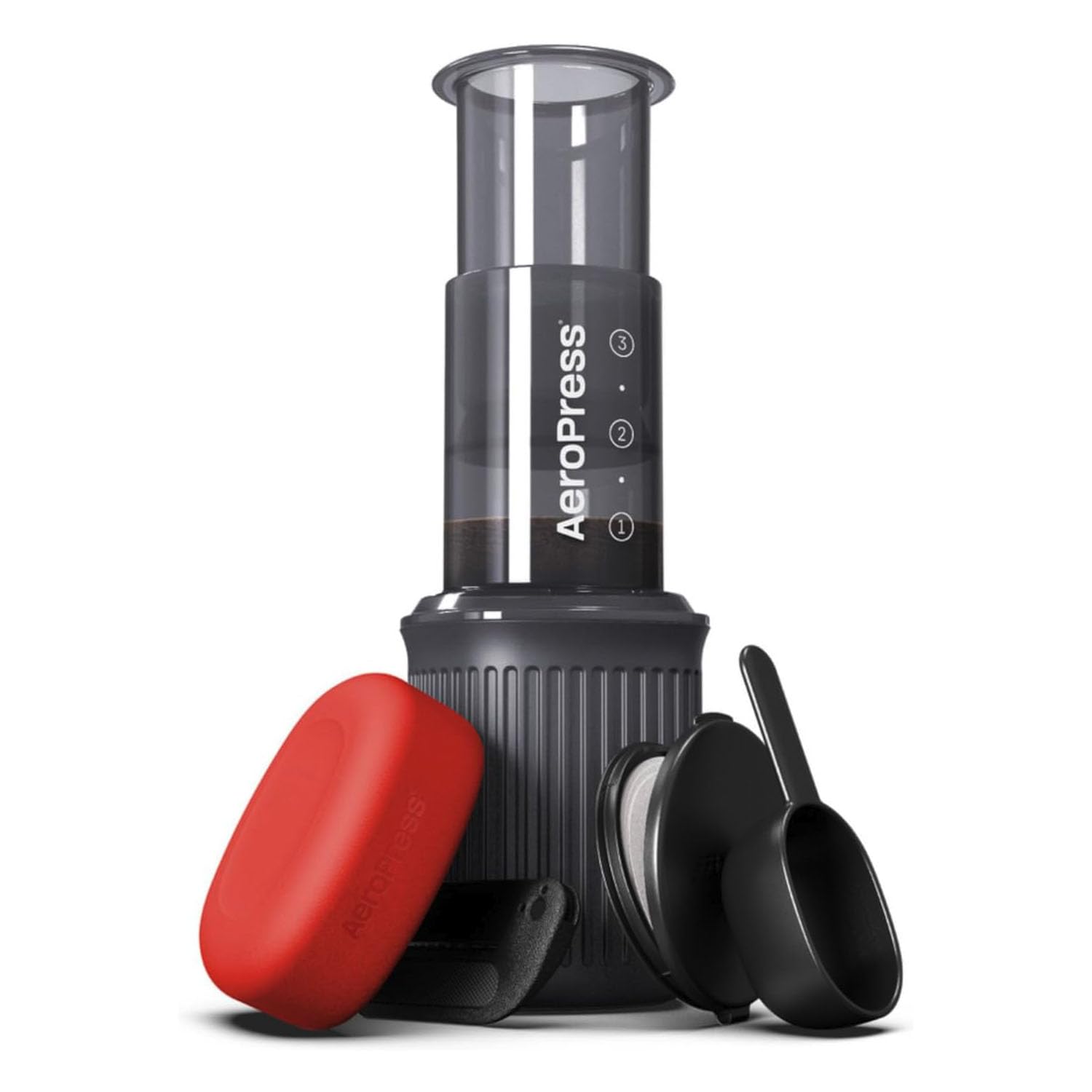
AeroPress Go
Key Features
- Filter: Paper micro-filters
- Packed size: 4.2 x 4.2 x 7.3 in
- Brew capacity: 8 oz
- Packed weight: 11.2 oz
- Price: Premium
The Go is an AeroPress packed into its own mug, and that single decision is why it is the kit we hand to most campers. Brewer, mug, lid, filter holder and scoop nest into a cylinder about 4 inches across and 7 inches tall, so there is nothing loose to lose in a duffel and nothing to assemble in the dark. It asks for hot water and a flat spot, and that is the entire list.
The brew is an immersion steep followed by a slow press through a paper micro-filter, which gets you the body of a French press without the sludge at the bottom of the cup. What we noticed at camp is how forgiving the method is: the steep is timed by you rather than by the stove, so a gusty morning that keeps knocking the flame about does not wreck the cup the way it can with a pot that has to keep perking at a steady temperature.
Cleanup is the part that sells it. The spent grounds come out as a puck you can tip into a bag, and the cap and seal rinse in a cup of water — no scrubbing, no grounds going down a campsite drain. Eight ounces is also the boundary: two people means two rounds, and a third person means you are running a small cafe.
Against the Original further down this list, you are paying for the mug, the lid and the nesting case, and carrying around 11 ounces packed instead of 6.4. For car camping, a canoe trip or a weekend at a site with a picnic table, we make that trade happily.
Pros
- Brewer, mug and lid pack as one
- Brews a clean cup in about two minutes
- Grounds pop out; rinse and go
Cons
- Filter holder does not latch shut
This is the camping coffee maker we recommend first: a brewer, mug and lid that pack into one cylinder, brew a clean 8-ounce cup in about two minutes and rinse in a splash.
Best for Group Brewing
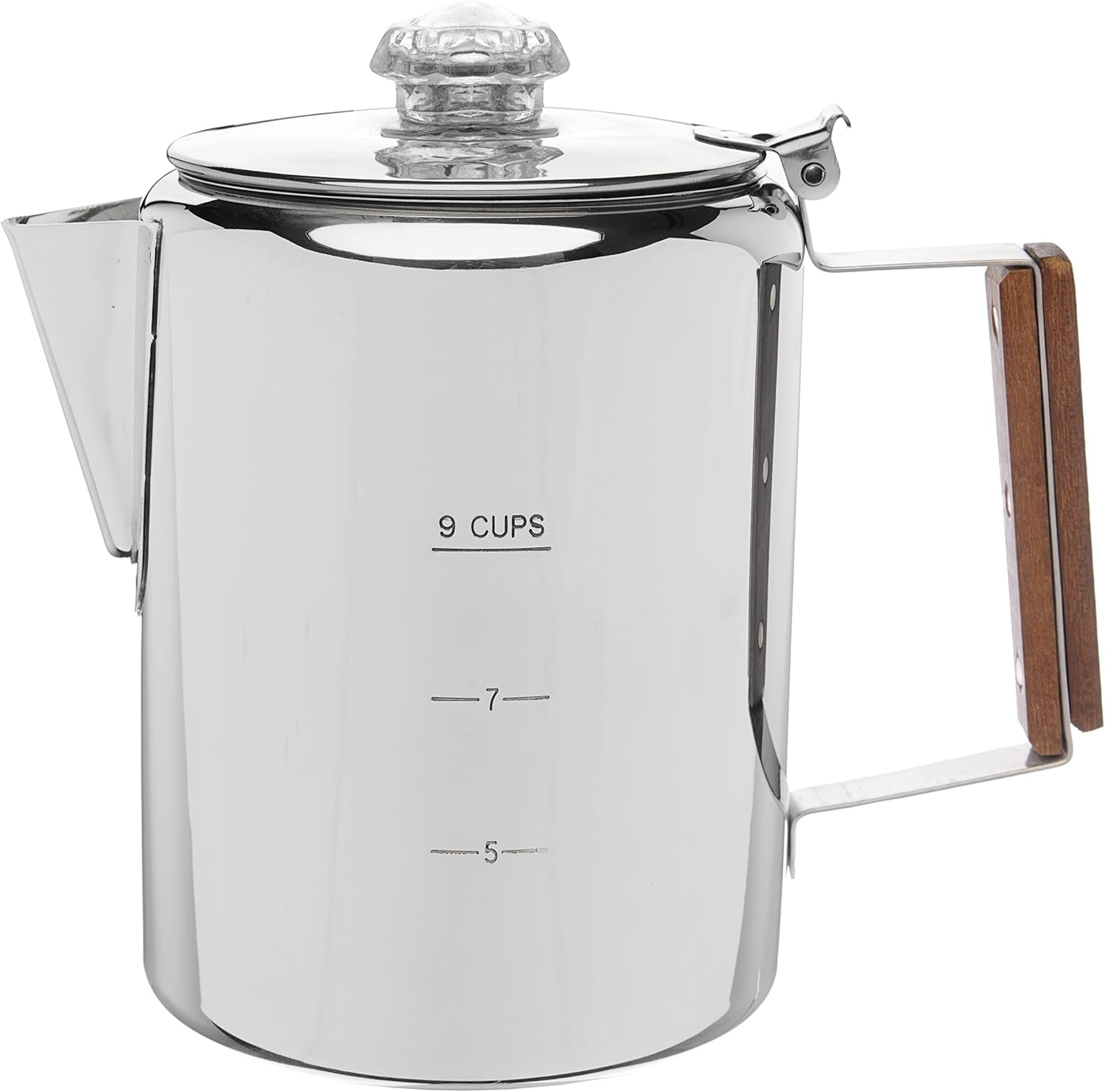
COLETTI Bozeman Percolator
Key Features
- Filter: Reusable basket
- Capacity: 45 fl oz (9 cups)
- Material: Stainless steel, glass view top
- Dishwasher safe: Yes
- Price: Midrange
Nine cups sounds like a lot until you do the arithmetic: percolator cups run 5 or 6 ounces, so 45 ounces is about four mugs of the size people actually drink. That makes this the group pot — one brew at breakfast and a second round without rebuilding the whole operation.
What we like is the material list. The body is stainless steel with a glass view top, and there is no aluminum or plastic in the path the coffee takes, which matters if you are the sort of person who notices a metallic edge in a cup. It is dishwasher safe once you are home, it rinses clean at camp, and the glass knob lets you watch the perk and cut the heat at the right moment, which is the whole skill of a percolator.
Two pounds and a wide base put it in car-camp territory rather than backpack territory, and the brew rewards attention: walk away and it will happily boil the coffee bitter. For a family or a group of four who want one pot and no queue, though, it is the least fuss of the pots here.
Pros
- 45 ounces, about four mugs
- No aluminum or plastic in the brew path
- Dishwasher safe at home
Cons
- Glass view top is the breakable part
- Lid can work loose
For four people at a picnic table, this is the pot: 45 ounces of stainless percolator that works on a camp stove or a fire and needs no paper filters.
Best for Backpacking
Primula Brew Buddy
Key Features
- Fits: Most mugs
- Type: Reusable pour-over cone
- Filter: Fine mesh, reusable
- Pack size: 2-pack
- Price: Budget
There is no brewer here at all, which is the point: a fine mesh cone in a plastic frame that perches on the rim of a mug and holds the grounds while you pour. Two come in the pack, one lives in the mug you already carry, and the whole setup disappears from your weight list. That is the trade we take on any trip where walking is the main event.
It is the simplest hot-water method there is, and the cup is as good as the coffee you pack — the mesh is fine enough that very little grit gets through, and you can brew as strong as you like by pouring slower. The technique takes one trip to learn: grounds in, a splash of water to let them bloom, then top up in stages and stop before the cone fills.
There is nothing to run out of, either — no paper filters to restock and no pot to scrub. We keep one in the mug and a second as a spare, and this is the setup that goes in the pack when the trip is more walking than sitting.
Pros
- Packs inside your own mug
- No filters to buy, ever
- Rinses clean in seconds
Cons
- Rim fit varies from mug to mug
Two mesh cones that ride inside whatever mug you already carry, need no paper filters and rinse in a mouthful of water — our pick for backpacking.
Best for Coffee for Two
Utopia Kitchen French Press
Key Features
- Filter: 4-layer stainless
- Weight: 2 lb
- Capacity: 34 fl oz (946 ml)
- Material: 304 stainless, double-walled
- Price: Budget
Glass is what goes wrong with a French press at camp. Set a carafe down hard on a picnic table, or let it ride next to the stove on the way out, and the rest of the trip is instant coffee. This press is 304 stainless inside and out, double-walled, and it holds 34 ounces — two generous mugs or four polite ones.
The double wall earns its keep beyond surviving the trip. Coffee stays hot through the second cup, which matters when the pot is standing in cold morning air, and the outside stays comfortable to grab. The four-layer filter does its job as well: with a coarse grind we got a clean cup and no grit at the bottom.
The one thing that catches us out is the lid, which has no marker for the pour spout — you hunt for the opening by feel until you scratch a line beside it. Otherwise it asks nothing of you, and for two people who want a pot rather than a cup it is the simplest thing here.
Pros
- Double wall keeps the second cup hot
- 34 ounces covers two mugs
- Steel body will not shatter in a pack
Cons
- Two pounds empty, so car camping
A 34-ounce stainless press that survives being packed next to the stove and keeps the second cup hot — the one for a couple who want a pot, not a cup.
Best for Solo Campers
AeroPress Original
Key Features
- Filter: Paper micro-filters
- Weight: 6.4 oz
- Included: 50 filters
- Brew capacity: 10 oz
- Price: Midrange
This is the same press without the mug, and for a lot of campers that is the better buy. The chamber brews 10 ounces rather than the Go’s 8, it weighs 6.4 ounces, and it ships with 50 paper micro-filters, so the first trip costs you nothing extra.
The method is the one that made the AeroPress famous: grounds in, water in, a stir, thirty seconds, then a slow press. You get real control over steep time, water temperature and grind size — more adjustment than most campers need, and exactly enough for the ones who want it.
Where we come down: the Original is the better choice for a solo backpacker or anyone whose kit already has a mug, and the Go is the better choice for a car camper who wants one object to grab and go. Both make the same clean cup; one just comes with the cup.
Pros
- 10-ounce brew, larger than the Go’s
- 6.4 ounces packed
- 50 paper filters included
Cons
- No mug or case in the box
If a mug is already in your kit, this is the smarter AeroPress: a 10-ounce cup, 6.4 ounces packed, 50 filters in the box and less outlay than the Go.
Best for Espresso-Style Coffee
Bialetti Moka Express
Key Features
- Filter: Reusable
- Capacity: 6 espresso cups
- Material: Aluminum
- Heat source: Gas stovetop
- Price: Premium
A moka pot is the closest thing here to a stovetop espresso, and Bialetti’s is the shape everyone else copies. Six espresso cups is roughly two small cups of very strong coffee, or one big mug loosened with hot water — this is a brewer for people who want a short, intense cup rather than a pint of filter coffee.
The method has a rhythm worth learning: water to the valve, coffee level in the basket and never tamped, medium heat, and off the stove the moment it starts to gurgle and spit. Get it right and the cup is thick and bittersweet with no paper taste at all; leave it on and it turns bitter and metallic.
Care is simple but specific: a rinse with water and no detergent, because detergent strips the aluminum and the pot starts to taste of it. At a campsite washing-up bowl that is a thirty-second job, which makes it one of the easier pots here to look after.
It wants a stable burner and a few minutes of your attention, and it is happiest on gas. What you get in return is the best short cup in this group — we reach for it on trips where a strong coffee is the point rather than the fuel.
Pros
- Six espresso cups of strong coffee
- No paper filters, ever
- Rinses with water only
Cons
- Handle is the weak point in the build
- Not dishwasher safe
For a short, strong, espresso-style cup off a gas burner, this is the classic: six demitasse servings, no paper filter and a ritual that rewards the attention.
Best for Car Camping
Farberware Yosemite Percolator

Key Features
- Filter: Permanent basket
- Capacity: 8 cups
- Material: Stainless steel
- Dishwasher safe: Yes
- Price: Midrange
Percolators are unfashionable and completely practical, and this one is a heavy-gauge stainless pot with a permanent basket, a glass knob in the lid and a mirror finish that looks better than camping kit has any right to. Eight cups at 5 or 6 ounces each pours about three mugs of real coffee.
Brewing takes attention: fill the basket, set it on the heat, watch the knob, and turn the burner down as soon as the coffee starts colouring it. The reward is a pot that stays hot while you fill three or four cups, with a handle that stays cool enough to hold.
Here is the case for it. The inside cup markings are hard to read in low light until you know the pot, which is a small thing, and a lifetime warranty on a stainless pot is more backup than most camping gear ever gets. Ours does not live in a pack; it lives on the kitchen stove between trips, which is the surest sign a piece of camp kit was worth buying.
Pros
- Stainless steel and dishwasher safe
- Lifetime warranty
- Eight cups, about three mugs
Cons
- Plastic knob and glass top are failure points
- Inner lip traps the last of the pot
The cheaper of our two stainless percolators, and the one that keeps earning its place at home between trips: eight cups, dishwasher safe and a lifetime warranty behind it.
Best for Gram Counting
Attsky Collapsible Dripper

Key Features
- Type: Collapsible silicone cone
- Filters: #2 paper cones
- Pack size: 2-pack
- Heat resistance: Up to 464°F
- Price: Budget
Folded, it is a disc of food-grade silicone a fraction of the size of any pot here; opened, it is a cone that takes a #2 paper filter and perches on a mug. Two come in the pack, the silicone is rated to 464°F, and it goes in the dishwasher at home.
We like it for trips where every gram gets argued over, and it makes a genuinely good cup: the paper filter catches the fines a mesh cone lets through, so you can grind as fine as your brewer at home without drinking the result. The opaque cone hides the level in your mug, though, so you lift it to check between pours.
If you prefer to carry nothing you have to restock, the Brew Buddy is the same idea in mesh and never runs out. This one is for the camper who already carries paper filters for something else, or who wants the flattest, lightest cone in the bag.
Pros
- Folds flat into a pocket
- Paper filter gives a clean cup
- Dishwasher safe at home
Cons
- Needs #2 paper filters to work
- Silicone softens with boiling water
For gram-counters, this is the whole setup: a silicone cone that folds flat, needs only a #2 paper filter and slips into a pocket.
How We Tested a Dozen Camping Coffee Makers
We started by gathering every camping coffee maker that could plausibly live in a gear bin: presses, pour-over cones, percolators, collapsible drippers, and a few battery-powered machines. Anything that needed wall power, outweighed a small stove, or locked us into proprietary pods got cut, which left 12 units spread across a wide price range.
Testing ran for eight months, mostly on weekend car-camping trips and a handful of cold, dark trailhead starts, with each maker also spending a week on my kitchen counter so I’d use it without the novelty carrying it. For taste, I brewed the same medium roast at the same grind, drank every cup black, and noted bitterness, sludge in the bottom of the mug, and how warm the coffee still was by the time I sat down.
Ease of use got timed rather than guessed: I started a stopwatch when I opened the stuff sack and stopped it at the first sip, once in daylight and once by headlamp with cold hands. Cleaning was judged at the camp table with only a splash from the water jug and a rag — I counted parts, checked whether grounds packed into threads and corners, and flagged the ones that really needed a sink. Performance meant paying attention: whether a percolator needed babysitting to avoid boiling over, and whether cup two tasted like cup one.
Every maker rode in a tote with cast iron and firewood, then got checked for cracked lids, stretched seals, and stiff hinges, plus a waist-high drop onto gravel. Size and weight were measured packed, with each brewer set beside a standard camp mug and a one-pound stove for scale, since the best brewer in the world is useless if it eats half your food bag.
How to Choose a Camping Coffee Maker
The best camping coffee maker is the one you still bother with on the third cold morning, which is why we weigh steps and cleanup before we weigh brewing cleverness.
Count mugs, not cups
Every pot here counts in coffee cups, not the 12-ounce mug you actually drink from. A percolator cup runs 5 or 6 ounces, so a nine-cup pot pours roughly four mugs and an eight-cup pot about three. Single-serve brewers give you 8 to 10 ounces per press, which is one person and one extra round for a second drinker.
Decide how many people want coffee at the same moment before you choose anything else. Brewing twice on a cold morning is the fastest way to fall out of love with a small kit, and a pot that is too big means cold leftovers.
What survives a pack
Materials decide more than durability. Glass carafes and glass view tops are the parts that break, and a broken pot means no coffee and a bag full of shards. Stainless steel is the sensible default for anything that rides in a truck bed or a canoe; silicone and mesh are the sensible default for anything that rides on your back.
Heat source matters just as much. Aluminum moka pots and percolators are happiest over gas, and aluminum does not respond to induction, so a steel pot is the safer buy if that is the stove you cook on at home or at camp.
Washing up with a liter of water
Cleanup design is where campsite regret lives. The easiest systems leave the grounds in one piece — an AeroPress puck, a plunger packed with wet grounds, a basket you can tip straight into the fire bag — so nothing sludges up a washing bowl. A wide-mouthed pot rinses far faster than one with a narrow neck and a lot of corners.
Paper filters add a step. They give you a cleaner cup, but they come out wet and heavy and have to be packed out, so factor that into how much you want to carry. Mesh cones and steel baskets rinse in half a cup of water and ask for nothing else.
Attention is an ingredient
Percolators and moka pots need you. Heat too high, or a pot left to keep going, turns the coffee bitter and metallic, so someone has to watch the glass knob or listen for the gurgle and pull it off. A press or an AeroPress is largely hands-off once the water is in, and a pour-over cone needs one patient minute.
Wind, cold and a bad night’s sleep all argue for the method with the fewest decisions. Pick the brewer whose worst morning you can live with, not the one that impresses on a sunny afternoon.
Frequently Asked Questions
Can you make coffee over a campfire without a stove?
Yes, with the right pot. A stainless percolator set over coals rather than open flames will perk a full pot, and a moka pot can sit on a grate above low coals. Keep the fire modest so the knob and the handle survive, and wear gloves — the body and lid still get hot.
Is it worth carrying a coffee maker instead of instant?
If coffee is part of why you go, yes. The AeroPress Go’s 318 grams or a mesh cone that weighs almost nothing buys you a cup instant cannot approach, and the cleanup is a rinse. On a long thru-hike where every gram is counted and you drink one cup, sachets still win.
How much coffee should I pack, and what grind?
For a French press or a pour-over, start with about two level tablespoons of medium-coarse grounds per 6 ounces of water and adjust from there. A moka pot wants a finer grind, filled level in the basket and never tamped. Pack a little more than the arithmetic suggests: coffee is the one thing you cannot borrow at a campsite.
Final Verdict
Most people should buy the AeroPress Go. It is the only kit here that gives you a brewer, a mug and a home for every small part, and it makes a cup worth getting out of the tent for in about two minutes, with a rinse instead of a wash.
If you are brewing for four, or cooking over a fire, the COLETTI Bozeman is the better answer. If you are counting grams, take the Brew Buddy and leave the pot at home.