This post contains affiliate links. We may earn a small commission when you buy through our links — at no extra cost to you.
Camp mornings have a rhythm: unzip the tent, pull on boots, light the stove. The weak link has always been the coffee. Instant if you’re being efficient, a filter cone you have to babysit if you’re being ambitious, and a lukewarm cup either way once the wind picks up. A percolator fixes that one specific problem — no paper filters to forget, no glass carafe to wrap in a sweatshirt, and enough capacity that four people get a mug before the pot goes back on the burner.
The catch is that percolators are not built to the same standard, and the differences show up fast when you’re half awake and wearing gloves. Since early spring, my team and I have brewed with 12 of them — on camp stoves, over coals, and on my kitchen range between trips — and the ones worth carrying share a few things: a pump that moves water without churning the grounds into mud, a handle you can grab barehanded, and a lid that comes off without a fight. The picks below are the ones that earned a permanent spot in the gear bin.


Best for Most Camping Trips
COLETTI Bozeman 12-Cup
Key Features
- Filter: Perforated disc, takes #4 paper
- Weight: 2 lb
- Capacity: 12 cups (60 oz)
- Brew path: Stainless steel, glass view top
- Price: Midrange
Twelve cups is five mugs, and that is the number to plan around. COLETTI spells out its own math — a cup is 5 ounces, the same as the marking on a kitchen drip machine — so the Bozeman’s 60 ounces pours out as four or five generous camp mugs with a little left for the thermos. That is the size we reach for on most trips, and it is the biggest reason this pot is our default: full enough to brew properly for a small group, small enough that you are not pouring away a quart of dark, stewed coffee at the end of breakfast.
The brew path is the other half of it. Stainless steel throughout, a glass view top you can watch the coffee rise through, and no aluminum or plastic anywhere the coffee sits, which matters when the pot spends ten minutes over a flame. The basket is a perforated disc rather than a paper filter, and a #4 paper filter folded over it is the trick we use when we want the last cup clean instead of sludgy.
At 2 pounds and a bit over 8 inches tall it drops into a plastic tote and finds a spot on a two-burner without a fight. It is happy on gas, on electric or on coals, and the whole thing is dishwasher safe once you are home, which is not something every pot here can claim.
Cleanup is where the design pays you back. The basket and stem lift out together, so the grounds go into the fire and the pot gets a rinse; do it while the pot is still warm and the job takes a minute. Leave it until morning and you will be picking grounds out of the perforations with a twig.
Pros
- 60 ounces pours about five mugs
- Stainless brew path, no aluminum or plastic
- Glass top shows the perk start
- Two pounds packs easily in a tote
Cons
- Glass view top is the breakable part
We recommend the Bozeman as the pot most campers should buy: twelve honest cups, stainless where the coffee goes, and a glass top that shows the perk starting.
Best for Large Group Campouts
COLETTI Scoutmaster 24-Cup
Key Features
- Weight: 3 lb
- Capacity: 24 cups
- Included: Hanging bail, 20 paper filters
- Material: 18/8 stainless steel
- Price: Premium
Some camps wake up in waves and some wake up all at once. If yours is the second kind, a 12-cup pot means brewing twice, and the second pot is always rushed. The Scoutmaster holds 24 cups — at 5 ounces a cup, roughly a dozen 10-ounce mugs from a single perk — and the reinforced steel bail lets you hang it over the fire instead of fighting for grate space.
We think it earns its bulk on group trips and nowhere else. Three pounds of 18/8 stainless with a base just under 9 inches across wants a real grate or a wide burner; perched on a pocket stove it hangs over the edge and never settles into a steady perc. Given proper heat, though, the thick walls hold temperature and the wide bottom sits flat on a fire ring, and one brew serves the whole site before the coffee starts to turn.
Twenty paper filters come in the box, which is a head start on the first morning and one more thing to remember to pack after that. And a full bail of boiling coffee is not something to grab bare-handed, so put a pot lifter or a thick glove in the kit with it.
Pros
- 24 cups, about a dozen mugs
- Steel bail hangs over an open fire
- 20 paper filters included in the box
- Thick 18/8 stainless body
Cons
- Wide base needs a grate or big burner
For a dozen mugs from one brew, the Scoutmaster is the pot we hand over: 24 cups, a steel bail and heavy 18/8 stainless.
Best for Camp and Kitchen
Farberware Classic Yosemite
Key Features
- Weight: 2.5 lb
- Capacity: 12 cups
- Cleaning: Dishwasher safe
- Material: Polished stainless steel
- Price: Midrange
Most of the pots here look like camping gear; the Yosemite looks like it belongs on a kitchen counter, which is exactly why we keep it on this list. It is the pot that does both jobs — mirror-polished stainless, a permanent metal basket instead of paper filters, and a body that is fully immersible and dishwasher safe. Twelve cups is the same 60 ounces the other big pots hold.
At 2.5 pounds it is the heaviest of the 12-cup stainless pots in this group, and about 10 inches tall with the knob up, so it is a chunky thing to slide into a camp box. What it gives back is easy cleanup: no paper to pack, no fiddly parts, and a basket that lifts out in one piece. On a two-burner it behaves like any other 12-cup pot — bring it to a perk, drop the heat, let it finish.
One detail we noticed on the second pot: the inside of the top rolls inward in a lip, and that lip holds the last half cup. Pour for four and nobody notices; count on every drop for the final mug and you will tip the pot further than you want to over a fire. You learn it in a week and stop thinking about it after that.
Pros
- Dishwasher safe and fully immersible
- Permanent basket, no paper filters to pack
- Polished finish earns counter space at home
Cons
- Inner lip traps the last half cup
We keep the Yosemite for campers who also want a percolator on the kitchen counter: dishwasher safe, filter-free, and finished like kitchenware.
Best for Packing Light
Stansport Aluminum 9-Cup
Key Features
- Handles: Wire bail and side handle
- Capacity: 9 cups
- Material: Polished aluminum
- Dimensions: 4.75 x 4.75 x 8 in
- Price: Budget
Aluminum, a wire bail, a side handle, and a pot 8 inches tall: the Stansport is built for the trip where the coffee kit goes in the pack rather than the truck bed. Nine cups at 5 to 6 ounces a cup is roughly four mugs, which is the right size for two people who each want a second cup before the hike.
The bail is the part we care about. It gives you a way to hang the pot over coals or lift it clear without hunting for a handle, and aluminum heats fast, so the perk starts sooner than it does in the heavier stainless pots. The stem and basket come out as one assembly, too, and at the end of a long day fewer pieces to lose in the dark is worth more than a nicer finish.
Where it gives ground is in the cup. The basket is a loose perforated affair and a fine grind will find its way through into the mug; grind coarse, or cut a paper filter to fit, and the problem mostly goes away. The aluminum also dents if you drop it on rock, which is the trade for a pot this light.
The spout is cut generously, a real pour spout rather than a notch, and that is a small mercy at 6 a.m. with cold hands and a narrow mug.
Pros
- Wire bail hangs over a fire
- Aluminum keeps the load light
- Nine cups, about four mugs
Cons
- Handles get too hot to grab bare-handed
- Basket lets a fine grind through
We pack the aluminum Stansport when the coffee kit goes in a backpack: 9 cups, a wire bail, and nothing heavy to carry.
Best for One or Two
Mixpresso 5-8 Cup
Key Features
- Weight: 1.8 lb
- Capacity: 8 cups (37 oz)
- Material: #304 stainless, plastic knob
- Dimensions: 9 x 5 x 8.5 in
- Price: Budget
Thirty-seven ounces is the whole pot, and it is the number to buy on: the Mixpresso makes two generous mugs, or four small ones, and then it is done. That is a limitation in a group and a virtue on a solo trip, where a bigger pot means either wasted coffee or a mug you feel obliged to finish.
The build is #304 stainless with a cool-touch handle and a removable filter, basket, pump tube and spout, so it comes apart for washing and the body can go in a dishwasher at home. The sight knob is plastic rather than glass — cheaper, and less likely to shatter in a pack, which we count as a fair trade.
For a couple or a solo camper we rate it the sensible pick: it perks in five to ten minutes on medium heat, it is light enough to forget in the tote, and it leaves room on a two-burner for the frying pan. The filter basket has a wide foot as well, so it stands upright on the wash table while you rinse the pot instead of tipping its grounds into the sink.
Pros
- 37 ounces brews two generous mugs
- #304 stainless body and basket
- Cool-touch handle on a hot pot
Cons
- Lid rests loosely and lifts off awkwardly
We choose the Mixpresso for one or two people: 37 ounces of stainless-brewed coffee in less stove space than anything else here.
Best for Value 12-Cup
MEREZA 12-Cup
Key Features
- Weight: 2.2 lb
- Capacity: 12 cups
- Material: 304 stainless steel, glass top
- Dimensions: 5.7 x 5.7 x 8.66 in
- Price: Midrange
The top of the MEREZA does not come off. It is a flip-top design, so at the stove you lift the lid and at the wash basin you rinse around it. That is not a dealbreaker, but it is the first thing we noticed and the thing we still notice a few trips in.
Everything else is straightforward. 304 stainless inside and out, including the basket and stem, a glass view top, and a 12-cup body under 6 inches across, so it sits on a small burner without overhanging. It works on a gas stove, an electric ring, a grill or a fire, and at 2.2 pounds it is light enough to live in the tote permanently.
We like it as the value pick: it is the least expensive route to a fully stainless 12-cup pot in this group, and the coffee comes out clean and full-bodied with a coarse grind. Shake the basket over the fire before you rinse it and the grounds stay out of your wash water — with a top that will not detach, that little habit earns its keep.
Pros
- 304 stainless inside and out
- 12 cups for the least money here
- Under 6 inches across, fits small burners
Cons
- Lid does not sit down firmly
Our value pick for 12 cups: 304 stainless inside and out, for less than the other big pots here.
Best for Basecamp Stoves
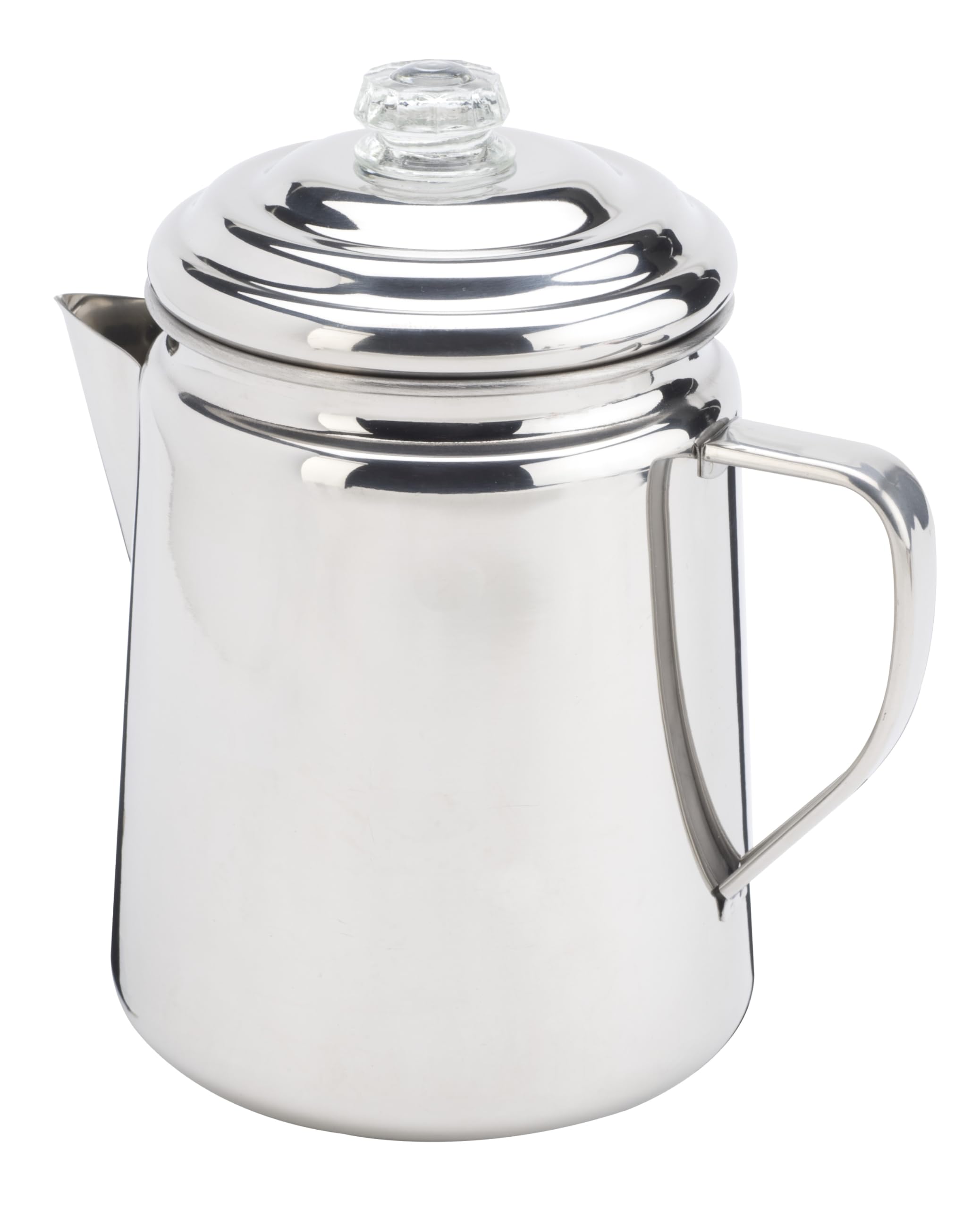
Coleman Stainless 12-Cup
Key Features
- Filter: Reusable basket, no filters needed
- Weight: 2.2 lb
- Capacity: 12 cups
- Material: Stainless steel, glass top
- Price: Premium
The Coleman name is why plenty of people will buy this pot without reading another word, and that is fair — the company has been in camp kitchens for decades. What arrives is a 12-cup stainless percolator with a glass sight top, a basket, tube and basket lid, and no paper filters required.
It brews well on a propane two-burner, which is where a pot like this spends most of its life, and the stainless body wipes down without fuss. The basket comes with its own lid, which holds the grounds down while the water circulates, and there is nothing to buy or remember before a trip.
Where it loses ground is value. It costs more than every other 12-cup pot here, and what the extra buys is a name and a body that feels a little more substantial in the hand. If the pot lives on a propane stove at a cabin or in an RV, that is a reasonable trade; if it rides in a tote with the rest of the gear, it is harder to justify.
We rate it a good pot in a crowded field rather than the best buy. It does what the Bozeman does and asks more for it, and the fire is where it is least comfortable — keep it on a grate or a burner and it will brew pot after pot without complaint. Buy it because the brand is what you trust, not because it brews better.
Pros
- 12 cups with no paper filters needed
- Basket lid holds grounds in place
- Stainless body wipes clean
Cons
- Handle gets very hot over an open flame
- Priciest 12-cup pot in this group
A dependable 12-cup stainless pot for a basecamp stove; we rate it good, though it costs more than pots that do the same job.
Best for First Percolator
Eurolux 9-Cup

Key Features
- Weight: 1.9 lb
- Capacity: 9 cups
- Cleaning: Dishwasher safe
- Included: Filter basket and paper filters
- Price: Budget
Eurolux ships the pot with a small stack of paper filters and a printed instruction card, which is more useful than it sounds if you have never percolated. Drop the basket in, add coarse grounds, fill to the marks inside the pot, and set it on the burner — the card covers the part everyone gets wrong, which is turning the heat down once it starts.
It is a 9-cup pot at 1.9 pounds with a glass sight top and a base about 8 inches across. That base wants a reasonably wide burner, but on a camp stove or a grate it sits well enough to leave alone while you break camp.
The build is where it loses points. The lid hinge works loose over a few trips, and once it does the lid stops sitting down properly. The body also flexes more than the heavier stainless pots, so it wants packing with a little care rather than a toss into the truck bed.
For car camping and a first percolator, it is a fair buy: 9 cups, light enough to move around a hot stove, and filters and instructions that mean you can brew a decent pot on the first morning. It is the pot we hand someone who wants to learn the technique without spending much, with the understanding that it will not take the abuse the stainless COLETTIs will.
Pros
- Paper filters and instructions included
- 9 cups at 1.9 pounds
- Dishwasher safe when you get home
Cons
- Lid hinge loosens and stops sealing
We like the Eurolux for a first percolator: 9 cups, light in the hand, filters in the box, and instructions for the technique.
How We Tested the Best Camping Percolators
We started with roughly 30 percolators sold for camping and narrowed them by capacity, material, price, whether the glass knob could be replaced on its own, and — honestly — how each one looked sitting on a picnic table. Anything with a plastic basket or a lid that took two hands to seat got cut early. That left 12 pots, from a two-cup solo model to a 12-cup one that feeds a whole site.
Testing ran eight months, early spring through a cold October, in the places these pots actually live: weekend car-camping trips, two backpacking overnights, and weekday mornings on my gas range when the drip machine felt like too much effort. We timed each one from cold water to first perk, checked handle temperature with a bare hand and then an instant-read thermometer, and poured a second cup 20 minutes off the heat to see what stayed drinkable. Each pot also rode in a duffel and a bear canister so we could see what rattled, dented, or cracked in transit, and we noted how much pack space it ate.
Flavor got the most attention, because percolators punish small mistakes. We brewed the same coarse grind in every pot, watched how aggressively the pump moved water, and marked which cups came out clear and which turned bitter after five minutes of hard boiling. After each trip we washed them by hand in a camp sink and again at home, tracking how easily the basket and stem came apart, whether grounds hid under the spring, and whether the glass top survived the ride home. Then we did it all again the next weekend.
How to Choose a Camping Percolator
Every pot here brews the same way, so the decision comes down to three things: how many mugs you need at once, what you will set the pot on, and how much the parts have to survive.
Count mugs, not cups
Percolator cups are 5 or 6 ounces, the same convention as a drip machine, so a 12-cup pot holds about 60 ounces — five 12-ounce mugs, not twelve. Do that arithmetic before you buy. Two people are well served by an 8- or 9-cup pot, and six or more want the 24-cup class.
The usual mistake is buying big to be safe. A pot that is half full is harder to control, and the coffee keeps darkening while it waits for late risers. Buy for the number of mugs you actually pour, not for the number on the box.
Match the base to your heat
On a two-burner or an RV range, any of these pots works; what changes is how much of the burner the base covers. A 24-cup pot needs a wide grate or a big ring, and a narrow 9-cup pot can struggle to register on a large electric element.
If you plan to cook over an open fire, a wire bail is the feature to look for: it lets you hang the pot or lift it clear. It does not make a thin pot safe over a tall flame, and it does not replace a glove.
Stainless, aluminum or enamel
Stainless is heavier and it costs more, and it is what we choose for a pot that lives in a camp tote: it resists dents, does not pick up flavors, and most of it can go in a dishwasher at home. Aluminum is lighter and cheaper and heats fast, but it dents, scours, and holds the smell of old coffee. Enamel looks the part until it chips at the rim, and a chipped rim is where rust starts. Buy aluminum for a pack, stainless for a truck.
The sight knob and the wash-up
Nearly every pot here has a glass or plastic knob on the lid so you can watch the perc start, and it is the part that breaks first — usually from being tightened down or knocked around in a tote. Treat it like a French press lid, hand-wash it, and keep a spare in the kit if you can find one.
At camp, rinse the basket and stem while the pot is still warm. Grounds that set overnight take far longer to pick out of the perforations, and a pot that goes back in the tote dirty tastes of the last brew for the rest of the trip.
Frequently Asked Questions
How long should coffee perk?
Bring the pot to a perk over medium heat, then drop the flame so the water bubbles gently rather than rolling, and let it go about ten minutes. Anything longer, or any full boil, is what makes percolator coffee bitter. Set a timer and pull the pot off the heat when it is done — leaving it on the burner to stay hot keeps the cycle going.
Why is there sludge in the bottom of my cup?
A grind that is too fine, a basket that is overfilled, or both. Grind coarse, roughly the texture of coarse sea salt, and leave a finger of space at the top of the basket so water can move through it. If you want a cleaner cup, fold a paper filter over the basket before the lid goes on; a #4 fits the Bozeman’s basket.
Will a camping percolator work on an induction cooktop?
Only if the base is magnetic. Test it with a fridge magnet before you pack: if the magnet sticks, the pot will heat on an induction ring, and if it does not, it will not. Aluminum pots are out, and not every stainless alloy is magnetic, so the ten-second test is worth doing before an RV trip.
Final Verdict
Most campers should buy the COLETTI Bozeman: twelve honest cups, a stainless brew path with no aluminum or plastic in it, and a glass top that shows the perk starting. It is the pot that fits the most trips without asking anything of you beyond a coarse grind and ten minutes of attention.
If your camp is eight people or more, the Scoutmaster’s 24 cups and wire bail earn their bulk. If the pot has to disappear into a pack, the aluminum Stansport is the one that does it.