This post contains affiliate links. We may earn a small commission when you buy through our links — at no extra cost to you.
The first ten minutes out of the sleeping bag set the tone for the whole day, and nothing sours them faster than a cup that takes twenty minutes and four separate parts to produce. A good camping coffee maker is the difference between crouching in the cold wrestling a plunger and actually sitting down with something hot while the lake steams. What you want is a brewer that makes a cup worth waking up for, rinses clean without a real sink, survives the bottom of a duffel, and doesn’t look like a science project sitting on the picnic table.
I’ve spent the better part of eight months brewing with 14 of them — at picnic tables, under a tarp during a downpour, and, less romantically, on my kitchen counter on weekday mornings. The pattern I keep seeing is that the models which pack down smallest tend to go lukewarm fastest, and the ones that brew genuinely good coffee are the ones with a couple of parts worth rinsing properly. There’s no single winner here; it comes down to whether you’re carrying it on your back or tossing it in the trunk.



Best for Solo Trips
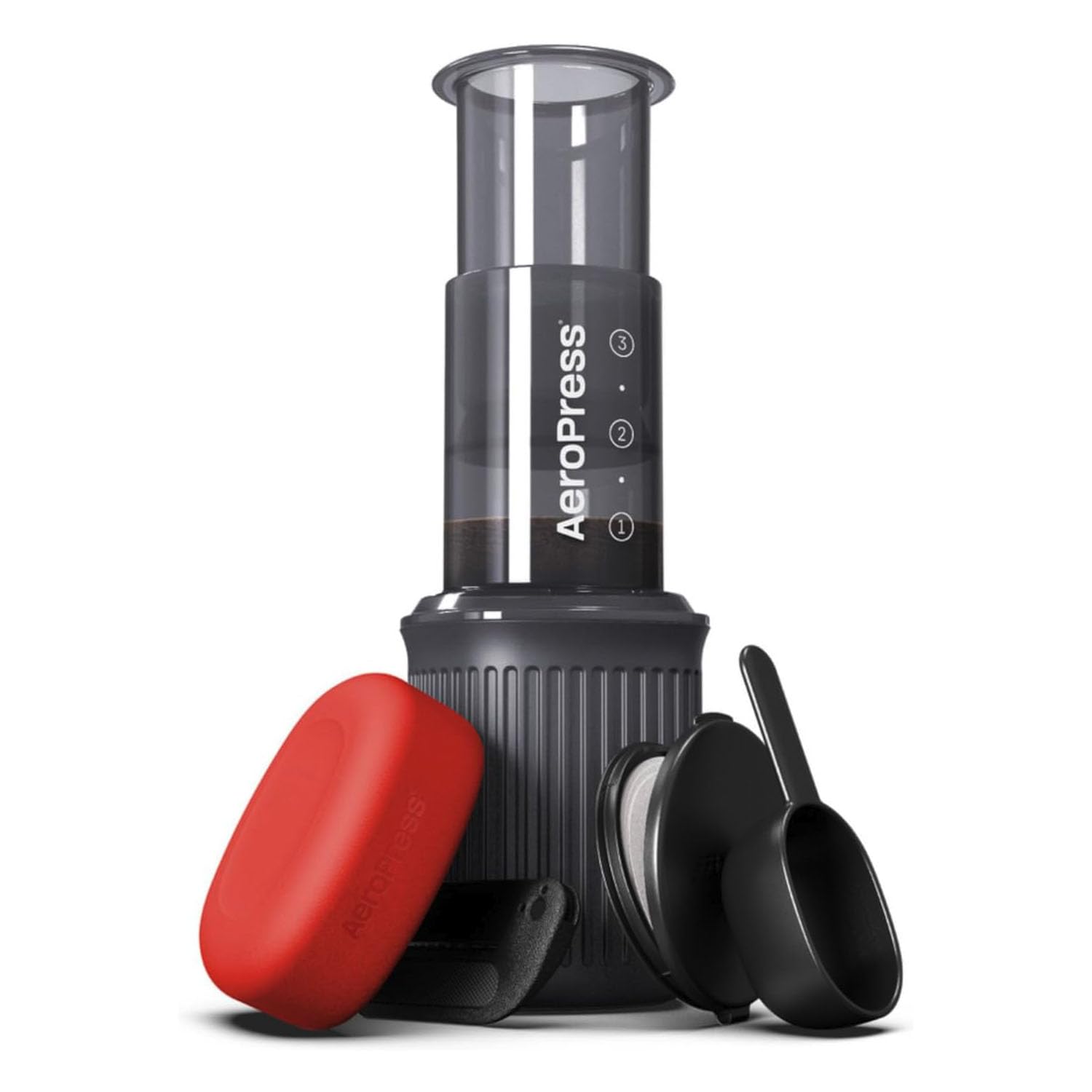
AeroPress Go
Key Features
- Weight: 11.2 oz
- Dimensions: 4.2"D x 4.2"W x 7.3"H
- Filter type: Paper (#4)
- Brew capacity: 8 oz
- Price: Premium
The whole kit nests inside its own mug: brewer, plunger, scoop, and the lid that holds it all down. That’s the fact that decides it for us. At 318 grams and roughly the size of a travel mug, the Go disappears into a daypack, and there’s nothing loose to hunt for at the bottom of a stuff sack.
What it brews is the better argument. Thirty seconds of steeping and a slow press gives a clean, concentrated cup with none of the grit a French press leaves behind, and you can loosen it with hot water if you want something to sip over an hour. Grind and steep time are yours to adjust, which matters when you’ve carried the beans yourself. The eight-ounce brew is one proper mug — generous solo, tight for two.
The Go never touches a flame. Heat water in a kettle, on a stove, or over coals, pour, press, done — which makes it the most flexible thing here when the stove is busy or the fire is still catching. Cleanup is a push of the plunger to eject the puck into a bag, then a rinse. No sink, no grounds in the washing-up bowl.
Two things to plan for. The paper micro-filters are the running cost, and running out mid-trip means no coffee, so pack more than you think you need and keep them dry. And the mug is microwaveable, which is a quiet bonus on a road trip where a kettle or a microwave is closer to hand than a stove.
Pros
- Everything nests into one mug-sized kit
- Clean, grit-free cup from hot water alone
- Grounds pop out as a puck — no sink needed
- Full control of grind and steep time
Cons
- Brews one 8-ounce mug per press
- Paper micro-filters are a recurring buy
This is the camping coffee maker we hand to almost everyone: it packs into its own mug, brews from hot water alone, and rinses out without a sink.
Best for Sharing at Camp
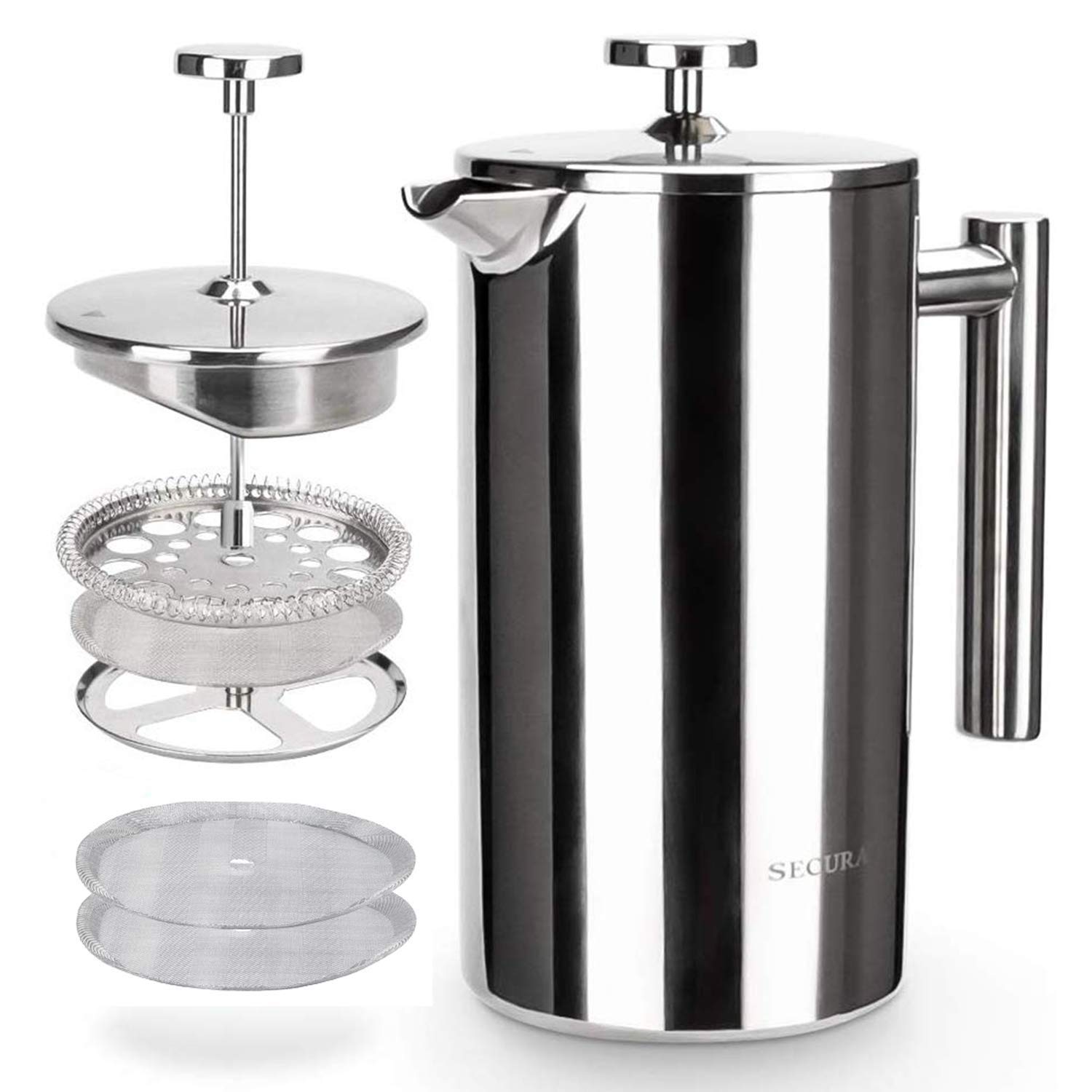
Secura French Press
Key Features
- Weight: 2.4 lb
- Capacity: 1 liter (34 oz)
- Material: 304 stainless steel
- Dishwasher safe: Yes
- Price: Midrange
Two and a half pounds of stainless steel is a lot to put in a camp box until you’ve watched a glass carafe die on the way to the tent. This is the press we’re happy to have banged around: 18/8 steel inside and out, no glass anywhere, and a build that turns a knock against the cooler into a story instead of the end of the trip.
The insulation earns its keep after the pour, too. Coffee stays hot noticeably longer than it does in a glass press, and the handle and knob stay cool while you’re pouring next to a fire. Three layers of filter hold back the fines, so you get the body of a press without a mouthful of sludge, and Secura throws in two spare screens.
Thirty-four ounces is roughly two big mugs or four small ones, which makes this a basecamp pot rather than a backpacking one — we leave it in the vehicle on long walking days. Every part is dishwasher safe once you’re home; at camp you’ll rinse it and wipe the grounds into a bag to pack out. The two-year warranty is the sort of thing that matters on a pot used every weekend.
Pros
- Stainless body survives camp knocks
- Holds heat far longer than glass
- Two spare filter screens included
Cons
- Too heavy to carry far at 2.4 pounds
We recommend the Secura when the coffee is for a table of people: it’s the sturdiest press here and it keeps the second cup warm.
Best for Packable Daily Brewing
AeroPress Original
Key Features
- Weight: 6.4 oz
- Warranty: 1 year
- Filter type: Paper (#2)
- Brew capacity: 10 oz
- Price: Midrange
Compared with the Go kit, the Original is the same brewer without the cup it nests into. It’s lighter at 6.4 ounces, it takes up less room in a pack, and it turns out a slightly bigger ten-ounce brew — enough that two people can split one press without feeling shortchanged.
The method is unchanged: grounds in, hot water, a short wait, then a slow press. What we get for the simpler kit is more room per brew and fewer pieces to keep track of. AeroPress also includes a starter stack of paper micro-filters with this one, which covers the first trip or two.
The cup is the same one we praise in the Go: clean, no grit, and a puck of grounds that drops into a bag rather than down a sink. What it gives up is the self-contained part. Chamber, plunger, and scoop need a bag of their own, and you’re relying on whatever mug the campsite has. For a car camper with a kettle already in the kit, that’s a fair trade.
Pros
- Lighter than the Go at 6.4 ounces
- Brews a 10-ounce cup
- Filters included to start
Cons
- No mug or case to hold the parts
- Paper filters are a consumable
We recommend the Original for anyone who already has a mug and wants a bigger brew with less bulk: ten ounces a press, 6.4 ounces in the pack.
Best for Camp Percolator
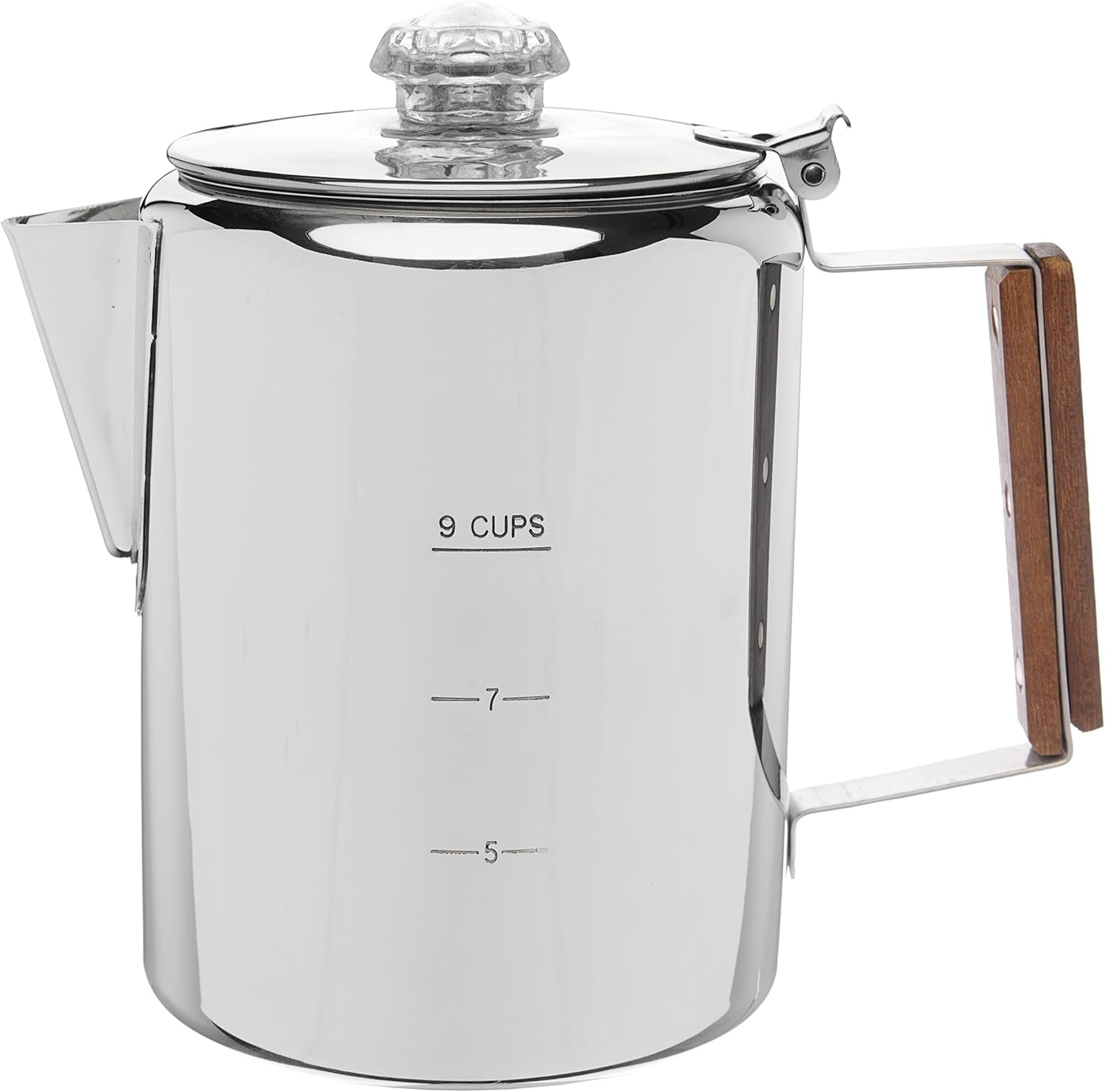
COLETTI Bozeman Percolator
Key Features
- Weight: 2 lb
- Capacity: 45 fluid ounces (9 cups)
- Material: Stainless steel, glass top
- Dishwasher safe: Yes
- Price: Midrange
Percolating is something you watch as much as something you drink. The glass knob on the Bozeman’s lid shows the first dark bubbles climbing, and that’s your signal to drop the heat — a genuinely useful gauge on a camp stove, where the flame is never quite where you left it.
Our favorite thing about it is the brew path: steel and glass only, no aluminum, no plastic, and parts simple enough to take apart and rinse at the table. Nine cups sounds grander than it is — 45 fluid ounces works out to about four mugs, enough for two people to have a second cup without starting a new pot.
The glass top is the piece to look after. It’s the part that goes first if the pot tips over in the back of a truck, so it travels better boxed or wrapped than loose in a crate. Percolating also wants a few minutes of your attention once it starts; walk away and you come back to coffee that’s been boiled rather than brewed. Neither is a dealbreaker, but they’re why this stays a camp pot rather than a grab-and-go one.
Pros
- No aluminum or plastic in the brew path
- 45 ounces fills about four mugs
- Glass knob shows the perk at a glance
Cons
- Glass view top can break in transit
- Needs watching once it starts perking
Our pick for a percolator that lives outdoors: steel and glass only, roughly four mugs of capacity, and a lid you can watch the coffee come up through.
Best for Crowded Camp Kitchens
Farberware 12-Cup Percolator
Key Features
- Weight: 2.5 lb
- Capacity: 12 cups
- Material: Stainless steel
- Filter type: Permanent metal basket
- Price: Midrange
Twelve cups is the number that decides this one, and for a group we think the capacity is worth the weight and the fiddling. Those are five-ounce cup markings, so the pot holds about 60 ounces — enough to fill six mugs with something left for the late risers. Six rounds of a single-cup brewer is not the same morning.
The body is polished stainless steel with a permanent metal filter basket, which means no paper to pack and nothing to run out of halfway through a trip. It sits on any camp stove or a grate over coals, and the clear knob on the lid tells you when perking has started so you can turn the heat down before the coffee turns.
The trade-offs are attention and small parts. Percolating is hands-on: bring it up, watch for the first perk, then back the heat off and let it finish, because coffee left perking goes bitter and woody. The lid knob and the handle are the pieces that end a pot’s life early, so pack it upright with the lid protected rather than rattling loose with the fire irons. It’s dishwasher safe once you’re home.
Pros
- 12 cups fills six mugs
- Permanent filter — no papers to pack
- Works on any camp stove or grate
- Dishwasher safe at home
Cons
- Lid knob and handle need careful packing
- Bitter if left perking too long
We take the Farberware when six people are waiting on coffee: it’s the biggest pot here, it needs no paper filters, and it works on any camp stove.
Best for Stovetop Espresso
Bialetti Venus Moka Pot
Key Features
- Weight: 1.19 lb
- Capacity: 7.9 ounces (6 cups)
- Material: 18/10 stainless steel
- Hob compatibility: Induction, gas, electric
- Price: Premium
A moka pot doesn’t brew so much as push: water in the base, grounds in the basket, heat underneath, and pressure driving the water up through the coffee. The Venus does it in 18/10 stainless steel, which makes it usable on an induction hob as well as gas and electric — still unusual for a moka pot, and the reason it’s here rather than one of the aluminum classics.
Six espresso cups is 7.9 ounces, which pours two americanos or one serious latte. It’s compact at 540 grams and takes up less burner space than a percolator, which matters on a two-ring camp stove with a pan already on the other side.
It asks for a fine, even grind and a bit of nerve with heat: too fierce and the coffee scorches, too gentle and it never comes through. Cleaning is a rinse with water only — no detergent, never the dishwasher, or the finish dulls.
We keep the Venus for the trip where the coffee is the point rather than the fuel. A proper espresso after a cold climb is a different pleasure from a mug of brewed coffee, and we leave it home when one pot has to serve a crowd. Watch the basket and the handle; those are the parts that give out first on a pot that lives in a camp box.
Pros
- Works on induction, gas, and electric
- 18/10 stainless instead of aluminum
- Small footprint on a crowded stove
Cons
- Rinse only — no soap or dishwasher
- Basket and handle are the wear points
We keep the Venus for the camper who wants espresso rather than a mug of brew — stainless, induction-friendly, and small on a crowded stove.
Best for Family Basecamps
Belwares 50oz French Press
Key Features
- Weight: 2 lb
- Capacity: 50 fluid ounces (1.5 L)
- Material: Double-wall 304 stainless
- Filtration: 4-level, 2 spares
- Price: Midrange
The second cup is where a French press usually lets you down: you press, you pour, and by the time you come back for more the coffee has gone lukewarm. The Belwares is double-walled 304 stainless, so the 50-ounce body holds heat between pours and the outside stays comfortable to hold while it does.
Fifty ounces is 1.5 liters — around three big travel mugs, or a round for four. That’s the reason to pick it: one press covers a family breakfast instead of two. The four-level filter comes with two spare screens, and the plunger comes fully apart so the grounds rinse out rather than cling to the mesh.
We choose it when the pot has to outlast the morning, and it does that better than any glass press here. The matte black finish looks smart and hides fingerprints, though paint on a working pot is a wear item — the base is where it shows first if the press rides loose in a truck bed, and it’s cosmetic rather than structural.
Pros
- 50-ounce carafe covers a family breakfast
- Double wall keeps later cups hot
- Four-level filter with two spares
- Steel body won’t shatter like glass
Cons
- Coating can chip at the base
- Two pounds and a large carafe suit groups
We choose the Belwares when the pot has to last the morning: fifty ounces, double-walled, and the last cup still hot.
Best for Ultralight Trips
Attsky Collapsible Dripper

Key Features
- Material: Food-grade silicone
- Pack count: 2
- Filter type: Size 2 paper cones
- Heat resistance: Up to 464°F
- Price: Budget
It’s a silicone cone that folds flat and sits on whatever mug you’ve got. Two come in the pack, the whole thing weighs next to nothing, and it takes a standard size-2 paper filter — which makes it the lightest way to drink real pour-over here.
Brewing is a two-handed job: a splash to bloom the grounds, then slow circles of hot water while it drains through. That pace is the point and the problem. A slow pour is a cold pour on a windy morning, so find a sheltered spot and keep the mug on something level.
The silicone softens when boiling water hits it, so lift the mug rather than the cone and steady the rim while you pour. Filters are the other thing: bring more than you think you need, because a size-2 cone filter isn’t something you can improvise at a campsite, and no mug comes in the pack.
We like it best for a solo backpacker or a hotel-room brewer: an inexpensive way to get a proper cup with almost nothing added to the load. Set against a press, the difference is time and attention — you stand there pouring while the water drains through, and that’s the whole method.
Pros
- Folds flat enough for a pack lid
- Fits most mugs and size-2 filters
- Two in the pack
Cons
- Needs paper filters and your own mug
- Slow work for more than a cup or two
For backpackers we keep it simple: a folding cone and a paper filter make a real pour-over for almost no weight in the pack.
How We Tested 14 Camping Coffee Makers Over Eight Months
We started by sorting the field by brew style — pour-over cones, presses, percolators, and a few oddballs — then narrowed by packed weight, cup capacity, and whether the filters were proprietary. Anything that required a special filter you can only buy from the manufacturer got set aside unless it brewed something exceptional. Fourteen made the final cut, and they’ve been in rotation ever since.
Testing happened where the coffee actually happens: three- and four-night car camping trips with a two-burner stove, one backcountry trip where every ounce in the pack was argued over, a wet weekend under a tarp, and weekday mornings at home so we could see how each one held up to daily use. We brewed before coffee, in the dark, wearing a headlamp, and timed everything from stove-light to first sip.
Each morning we checked the water temperature with an instant-read thermometer mid-brew and tasted cups side by side, noting grit, bitterness, and whether the second cup was still hot fifteen minutes later. Cleaning was done the way you’d actually do it — a liter of water and a spigot — and we noted which baskets held onto grounds and which parts needed a brush. Everything got packed loose into a duffel, bounced around in truck beds, and knocked off a picnic table; we checked for cracks in plastic and hinges that worked loose. We also judged how each one looked sitting out on the table, and whether it still looked that way in month eight.
How to Choose a Camping Coffee Maker
The method you choose decides almost everything else — the weight, the pack size, the cleanup, and whether you need a burner at all.
Decide whether you need a burner
Camping brewers split on heat. A press-style brewer or a pour-over cone needs hot water and nothing else: boil it in a kettle, over a fire, or on the stove, then brew away from the flame. A French press sits in the same group, since it only steeps. A moka pot or a percolator needs a burner under it for the whole brew, which puts it in competition with the breakfast pan.
If your stove has one ring, choose from the first group and you’ll never be waiting on someone else’s eggs. Car camping with two burners makes a stovetop pot no hardship at all.
Match capacity to the headcount
Cup markings are the trap. A twelve-cup percolator holds around 60 ounces, because the trade counts a five-ounce cup; a six-cup moka pot holds under eight ounces, because those are espresso cups. Read the fluid ounces and divide by the size of your mug instead.
Eight ounces is one person, 34 ounces is two to four, and 50 ounces covers a family. Overbuying means carrying weight and pouring coffee nobody drinks, so buy for the people who will actually be standing there.
Treat glass as a wear item
Glass is what ends a camping coffee maker’s life: a carafe in a camp box, a view knob on a percolator lid. Stainless bodies survive being dropped and cost more for it, and a double wall holds heat noticeably longer between cups.
If you do pick a glass press or a percolator with a glass top, pack it upright and wrapped rather than loose, and store the lid separately from the fire irons.
Plan the cleanup before you leave
There’s no sink at a campsite, so decide where the grounds go before the first brew. A press leaves a wet puck that drops into a bag; a percolator basket and a moka pot funnel need knocking out and a rinse. Pack the grounds out with your food waste rather than scattering them at the tent.
Save the dishwasher for home. Several stovetop pots are rinse-only by design, and detergent dulls the finish on stainless moka pots.
Weigh pack size, not the word compact
A listing that calls a coffee maker compact may mean it fits a car trunk, not a backpack. Weigh the packed unit rather than the brewer alone: a 2.4-pound steel press is a fine basecamp tool and a miserable thing to carry up a hill.
For walk-in trips, a folding silicone cone or the AeroPress Go earns its place. In the back of a vehicle, capacity and heat retention matter far more than grams.
Frequently Asked Questions
Is a percolator or a moka pot better for camping?
They make different drinks. A percolator cycles hot water through the grounds again and again, which gives you a big pot of brewed coffee to pour for a group. A moka pot pushes water up through the grounds once under pressure, so you get a small, concentrated shot closer to espresso.
If the camp wants mugs to hold with both hands, take the percolator. If you want espresso, take the moka pot and smaller cups.
Do I need to buy filters for a camping coffee maker?
Only for some. Percolators and French presses use built-in metal filters, so there’s nothing to restock. An AeroPress needs its round paper micro-filters, and a collapsible pour-over cone needs size-2 paper cones.
Buy a supply before the trip and keep it in a zip bag: running out mid-trip means no coffee at all.
How do I keep the second cup hot at camp?
Choose a double-walled steel pot and put the lid back on between pours — that combination holds heat far longer than a glass carafe. If you’re working with a single-walled pot, warm it with a splash of boiling water and swirl before you brew.
Pour the second cup sooner rather than later, and don’t leave the pot sitting on a cold table.
Can I use a moka pot or percolator on a campfire?
On a level grate over hot coals, yes; directly in flames, no. Both pots need a flat, stable base and a handle that stays clear of the heat.
A moka pot is under pressure while it brews, so let it cool before opening the top chamber. A camp stove is the safer default, especially in wind.
Final Verdict
If you want one answer, it’s the AeroPress Go. It asks for hot water and nothing else, packs into its own mug, and makes a cup that beats what most campsites manage with a pot. Nothing else here combines that little weight with that little fuss.
Buy the Secura instead if the coffee is for a table of people and you want a steel press that survives the cooler. Take the Farberware when six people are waiting and percolating one big pot beats brewing six times. Both need a stove or a fire — and that requirement is exactly the line that separates them from our top pick.