This post contains affiliate links. We may earn a small commission when you buy through our links — at no extra cost to you.
An e-bike motor doesn’t pedal for you — it takes what your legs are already doing and multiplies it, which is why the way power arrives matters far more than the wattage printed on the spec sheet. On a real trail, with loose gravel under the tires and a climb that runs longer than you planned, a bike that surges at the wrong moment is worse than one with less power delivered smoothly. What you’re actually buying is a ride you’ll keep choosing over the truck.
I’ve been riding dirt for years and still got the basics wrong at first: claimed range is measured in the lowest assist level on flat pavement, so cut it in half before you plan a loop. Our team has spent the past eight months living with six off-road e-bikes — assembling them in the garage, commuting on them, and grinding them up rocky singletrack — and the ones worth your money weren’t always the ones with the biggest numbers. The picks below are the ones that held up.

Best for All-Terrain Trail Riding
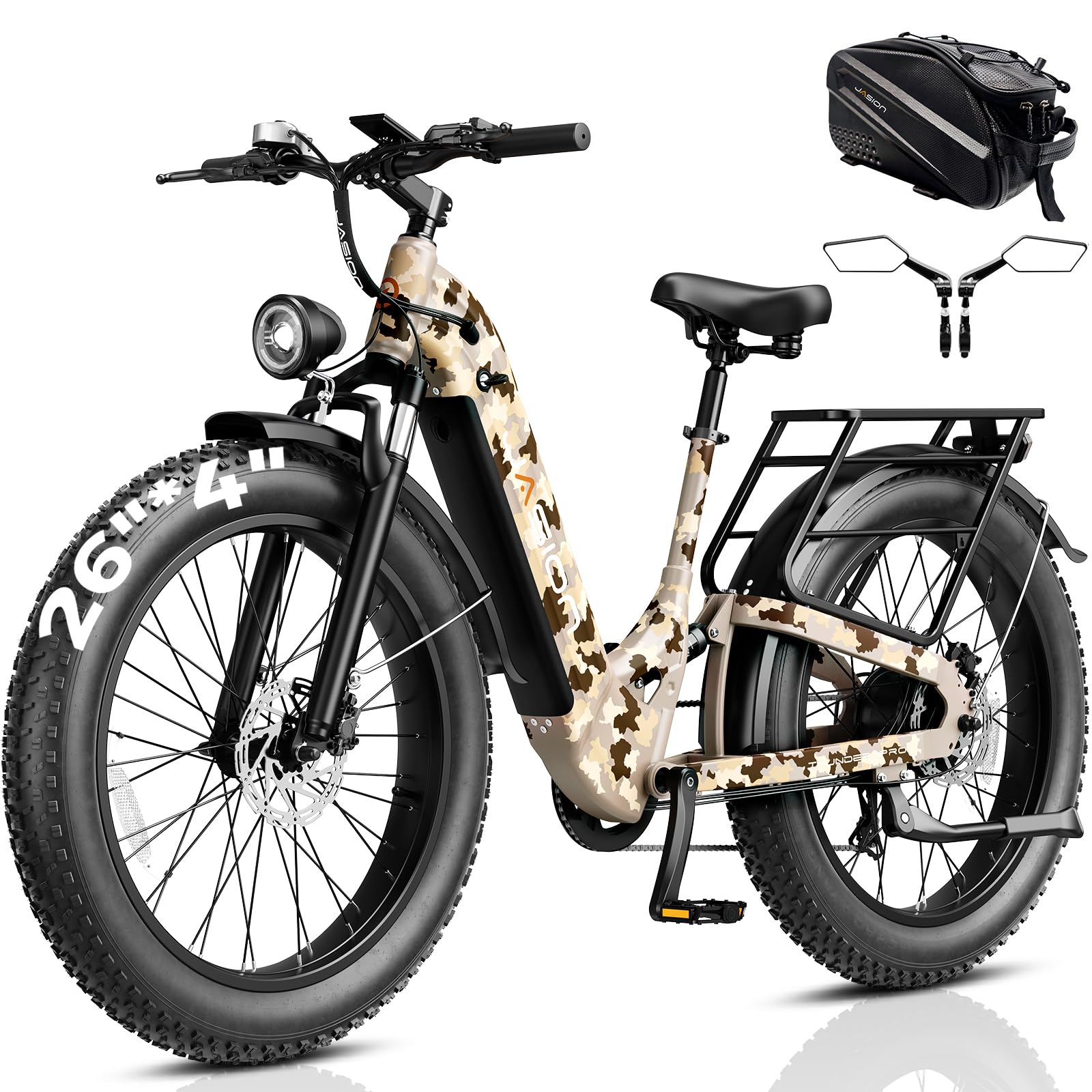
Jasion Thunder Pro ST
Key Features
- Motor: 2000W peak
- Tires: 26 x 4 in
- Brakes: Hydraulic disc
- Battery: 52V 20Ah (1040Wh)
- Price: Midrange
Fat tires are cheap to bolt onto anything. A rear shock and hydraulic brakes are not, and the Jasion Thunder Pro ST has both, plus a frame rated to 500 pounds. That matters most on the way down: a loaded fat-tire bike picks up speed fast, and oil-actuated discs with a shock keeping the rear wheel planted are what let you stay off the levers instead of fighting them.
That hardware is why it tops this list. You get 26 x 4 tires, a full-suspension frame with a rear shock, hydraulic discs, and a capacity that covers a big rider with a loaded frame bag. On a bike this heavy those are not luxuries. They are the difference between a loose descent that is fun and one that feels like a negotiation.
The battery is a 52V 20Ah pack rated at 1040Wh, with 90 miles claimed in pedal assist and about 35 on throttle alone. Treat the big figure the way you treat any PAS number on a listing: low assist, flat ground, a light rider. Something in between is what a real day out looks like. UL 2849 certification is on this one, which counts for more on a bike carrying this much battery than on a budget hardtail.
Two things to know before ordering. Minimum rider height is 66 inches, so shorter riders should look at the 20-inch ASKGO or the AYOLNY instead. And it is a physically big bike — camo frame, fat tires, rack, and fenders — that wants a garage or a shed rather than a stairwell.
Pros
- Hydraulic discs on a heavy fat-tire bike
- Full suspension with a real rear shock
- 500 lb capacity and a 1040Wh battery
- UL 2849 certified electrical system
Cons
- Riders under 66 inches are ruled out
- Range collapses under throttle alone
We recommend the Thunder Pro ST as the off-road default: 26-inch fat tires, a real rear shock and hydraulic discs, with a 500-pound rating that covers a big rider and gear.
Best for Steep, Loose Climbs
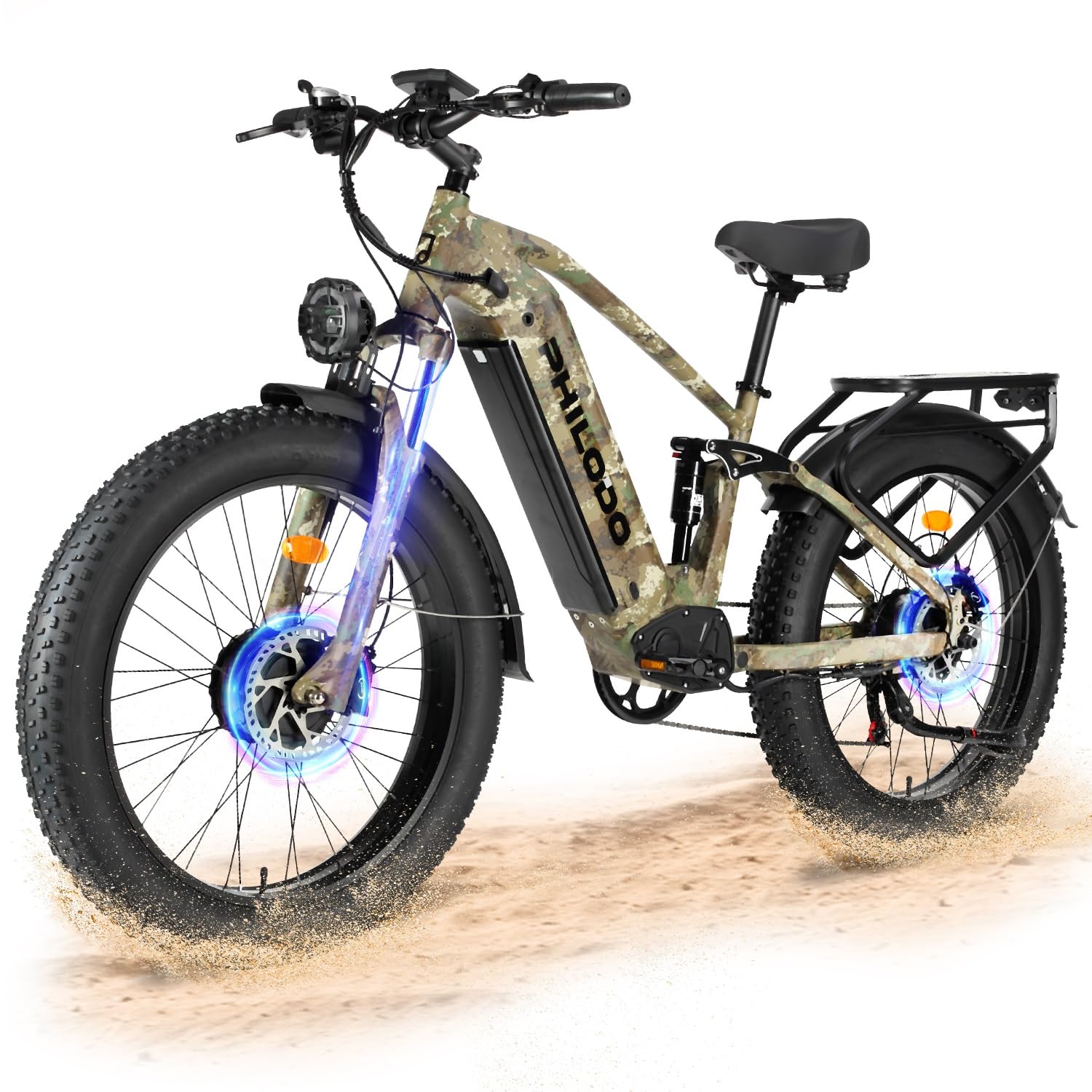
PHILODO Falcon
Key Features
- Tires: 26 x 4 in
- Motors: Front and rear hub
- Battery: 1460Wh
- Suspension: Full, air rear shock
- Price: Premium
Where one hub motor spins out on gravel, a second one keeps driving. The Falcon runs front and rear motors you can use together or separately, and on a steep, sandy climb that front wheel pulling while the rear pushes is the entire difference. Of everything here, it is the bike built most specifically for going up loose ground.
The six modes are not a gimmick. Single-motor mode stretches range on the flat approach road, walk mode hauls a 60-volt bike up a ramp you cannot ride, and cruise is genuinely useful on long gravel. We found the front wheel’s pull the hardest thing to trust in a loose corner — the correction takes a few rides before it becomes instinct rather than a surprise.
We rate it the pick here for the rider who wants maximum grunt and will accept a premium price and a learning curve. The rear air shock is the detail we appreciate most: an air can is tunable to rider weight with a pump instead of fixed at whatever the factory chose, and the front fork locks out for the climb back to the trailhead.
One expectation to set. The 100-mile range figure is pedal assist at low output; no fat-tire bike this heavy gets near it with both motors running. Plan a loop around half of it and you will not be pedaling home a heavy bike on an empty pack.
Pros
- Front and rear motors, usable separately
- Rear air shock you can tune to weight
- Big 60-volt battery for long assist range
- Walk and cruise modes for real use
Cons
- Heavy to lift onto a hitch rack
- Advanced-rider setup, not a first e-bike
For steep, loose climbs we point experienced riders at the Falcon: two driven wheels, a tunable air shock and a big 60-volt battery, at premium money.
Best for First Off-Road E-Bike
Funhang EB-M1
Key Features
- Motor: 500W, 1000W peak
- Tires: 26 in
- Battery: 48V 374.4Wh, removable
- Certification: UL 2849
- Price: Budget
UL 2849 is the certification that says an e-bike’s battery, charger, and motor have been tested together as a system. The Funhang EB-M1 carries it at the budget end of this group, and for a first off-road e-bike that is worth more than a slightly bigger motor.
What you are getting is a hardtail mountain bike with a motor rather than a fat-tire trail machine: 26-inch wheels, a front shock, seven gears, and a 500W motor peaking at 1000W. On gravel roads, packed dirt, and gentle singletrack it does the job, and the gearing means you can actually pedal when the assist runs out — not true of every budget bike. Point it at rock gardens and the missing rear shock will find you out.
Assembly is the pleasant part. It arrives 85 percent built with the tools in the box, so a front wheel, handlebars, and pedals is an evening’s work rather than a lost weekend, and the fenders, headlight, and horn are already in the kit.
The mechanical disc brakes want a check before the first few rides. They bed in, and budget brake hardware does not forgive neglect the way a hydraulic system does. Do those slow stops in a driveway before you trust them on a descent.
Pros
- UL 2849 certified at a budget price
- Removable 48V battery charges indoors
- 85 percent pre-assembled with tools
Cons
- Range lands well below the 30-mile claim
We recommend the EB-M1 as the budget starting point: UL 2849 certified, removable battery, easy assembly, and a range you should plan around rather than trust.
Best for Budget Hardpack Riding
AYOLNY EB3

Key Features
- Motor: 1000W peak
- Tires: 26 x 1.95 in
- Battery: 36V 10.4Ah, integrated
- Max rider weight: 264 lb
- Price: Budget
The battery on the EB3 stays in the frame. No key, no slide-out pack, no spare in your bag — you charge the bike where it sits. In a garage that is a non-issue. In a third-floor walk-up it is the detail that decides the purchase before anything else gets a look.
What you get for the least money here is more mountain bike than the price suggests: 26-inch wheels on 1.95-inch tires, a seven-speed drivetrain, dual disc brakes, and a smart display with app pairing and a USB port that will keep your phone alive on a long ride. The listed 50.8 pounds is manageable solo, which matters more than it sounds when the bike lives on a hook.
It is a trail-shaped commuter more than a trail bike, and we think that is fine as long as you buy it for the right ground. Gravel, hardpack, and forest road suit the 1.95-inch tires and the seven gears. Sand, snow, and deep mud do not — that is fat-tire territory.
For a lighter rider who wants the mountain-bike shape and the pedal feel without spending much, it adds up to a good deal, and the USB display is a genuinely useful touch on a long day. If you are carrying a loaded frame bag or you are a heavier rider, the Jasion’s 500-pound rating covers what this one does not.
Pros
- Least expensive route to a 26-inch e-MTB
- Seven-speed gearing and dual disc brakes
- Smart display with app and USB charging
Cons
- 264-pound rider weight limit
We recommend the EB3 to lighter riders who want a 26-inch e-MTB cheaply and can charge it where it parks; the 264-pound rider limit rules out heavier riders.
Best for Compact All-Terrain
ASKGO S9

Key Features
- Gears: Single speed
- Motor: 2000W peak
- Tires: 20 x 4 in
- Battery: 48V 20Ah
- Price: Budget
Twenty-inch wheels change what a bike is for. On the ASKGO S9 they make a fat-tire machine with the smallest footprint here — one that turns quicker than a 26-inch bike and, with four-inch rubber and rear shock absorbers, rolls over roots and curb cuts better than the wheel size suggests.
The S9 is a compact all-terrain runabout, not a trail bike. Field edges, gravel roads, rutted two-track, and short steep pitches on throttle are its territory; sustained climbing and rocky singletrack are not. There is one gear, so your legs get a single ratio, and the small wheels drop into holes a 26-inch wheel rolls across.
The 2000W peak motor and 48V 20Ah battery are serious equipment for the money, and the truck-bed case is the one that makes sense to us: it is the only bike here shipping with a phone holder, riding bag, and NFC unlock, and it fits in a garage corner the fat 26ers will not. Mechanical discs keep maintenance simple, though they ask more of your hands than the hydraulic setup on the Jasion.
Pros
- Compact 20-inch fat-tire footprint
- 960Wh battery at budget money
- NFC unlock, phone holder and bag included
Cons
- Single gear limits pedaling on climbs
- Throttle range falls short of the 65-mile claim
We rate the S9 as a compact all-terrain runabout for truck beds and field roads; its single gear and 20-inch wheels stop it short of real singletrack.
How We Chose and Tested These Off-Road E-Bikes
We started with a list of roughly 40 models sold both direct-to-consumer and through bike shops, then filtered by the things that actually decide whether a bike gets used: motor type and where the power engages, battery capacity and whether the cells are certified, standover height, stated weight, and price against what you get for it. That cut the field to six, which we bought at retail rather than accepting loaners — we wanted to see exactly what shows up in the box.
Every bike got the same first hour in my garage: unboxing against a stopwatch, checking whether the wheels, brakes, and stem arrived true, and noting how much of the assembly actually required the manual. Then I torqued every bolt to spec and re-checked them monthly — the bikes that kept loosening up were the ones with thinner hardware and sloppier welds, which told us a lot about long-term durability before we’d ridden a single mile.
On the trail, we rode a 12-mile loop of gravel fire road and chunky singletrack in each assist level until the battery died, then charged and repeated it, logging the real mileage every time. Speed we measured twice: at the top of each assist mode on flat ground, and on a quarter-mile climb where a motor’s cutoff behavior shows up fast. Functionality came down to small things — a display you can read in direct sun, a throttle and shifter that don’t fight for the same thumb, brakes that bite when the trail turns to wet roots.
By month eight we were looking at brake pads, tire wear, and whether the frame still felt tight, and we weighed value for money against warranty length and how many of the parts you can replace yourself.
How to Choose an Off-Road Electric Bike
The listings sell watts. What decides whether an off-road e-bike is fun or frightening is tires, suspension, brakes, and whether the thing fits you — so start there and read the motor figure last.
Tires and suspension decide where the bike can go
Tire width is the cheapest off-road upgrade there is. A four-inch tire run soft floats over sand, snow, and loose gravel where a 1.95-inch tire digs in, and a 26-inch diameter rolls across roots and holes that a 20-inch wheel drops into. A front fork softens the hits; a rear shock is what keeps the back wheel driving instead of skipping.
The trap is assuming a fat tire fixes a rigid frame. A fat-tire hardtail is still a hardtail. If your off-road riding is gravel roads, hardpack, and forest tracks, the Funhang or the AYOLNY will do it. If it is sand, snow, ruts, and rock, budget for 26 x 4 tires and full suspension, the way the Jasion and the PHILODO are built.
Compare watt-hours, not range claims
Range figures on these listings are pedal-assist numbers: low output, flat ground, a light rider. What you can actually compare is watt-hours. The PHILODO’s 1460Wh pack holds nearly four times what the 375Wh budget bikes carry, and the Jasion’s 1040Wh sits in between. More watt-hours means a heavier, more expensive bike, so size the pack to your longest realistic ride rather than the brochure.
Then check whether the battery comes out. The Funhang’s pack lifts out, so you can carry it inside to charge. The AYOLNY’s is integrated, which means charging where the bike lives — fine in a garage, a problem in a third-floor walk-up. That single design choice eliminates more bikes for apartment riders than any spec on the motor.
Brakes and heft are the hidden cost
These bikes are heavy, and momentum is what brakes have to fight. Mechanical discs work, but they need lever effort and periodic readjustment, and they are the first thing to suffer when maintenance slips — the ASKGO is the clearest example here. Hydraulic discs self-adjust and ask far less of your hands on a long descent, and the Jasion is the pick carrying them.
Heft shapes ownership as much as riding. Lifting one onto a hitch rack, up a step, or onto a wall hook is a two-hand job, and a bike you dread moving is a bike that stays in the shed. If you will store it in a basement, weigh that against the range a bigger battery buys.
Fit comes before features
Three numbers can end the decision before you reach anything else. Minimum rider height excludes more people than any other spec: the Jasion wants 66 inches, the PHILODO 5 feet 6, the Funhang 160 centimeters. Maximum rider weight is the second — 264 pounds on the AYOLNY, 500 on the Jasion. Third is standover, which matters most for anyone who needs to plant a foot on uneven ground.
Measure your inseam and check the minimum height before you read the motor specs. A well-specced bike that is too tall is a bad bike, and no amount of torque fixes it.
Plan an evening for assembly
Every bike here ships mostly built but not ready to ride. You will fit a front wheel, handlebars, pedals, and a seatpost, then check the brakes and torque the fasteners. The Funhang arrives 85 percent assembled with tools in the box, which is better than most at the budget end.
Do it properly: bed the brake pads in with a handful of slow stops, set tire pressure by feel for the surface you actually ride, and recheck every bolt after the first outing. Skipping that first check is how a first ride ends early.
Frequently Asked Questions
Can you ride an off-road e-bike on mountain bike trails?
That is a land-manager question, not a bike question. Many trail systems restrict e-bikes by class and some ban them outright, and the rules change between a state park, a national forest, and a private trail network.
Check the rules for the specific trail before you drive out. If trail access is your main reason for buying, choose a bike you are happy to ride in pedal assist only — all five picks here allow that — rather than the fastest one in the group.
How do you transport a fat-tire e-bike?
Not on a strap-on trunk rack. These bikes are heavy and wide, and a trunk rack is rated for a fraction of the load. A hitch rack rated for e-bikes, a tray rack, or a truck bed is the sensible setup, and a ramp makes loading a solo job.
On models with a removable pack, pull the battery first — the Funhang’s lifts out, the AYOLNY’s does not. And measure the tray against a four-inch tire before you buy the rack.
Do you have to pedal an off-road e-bike?
No. Every bike here has a throttle, and throttle-only riding is the easiest way to cover ground on a hot afternoon. It also drains the pack much faster than pedal assist — on the Jasion the two claims are 90 miles and about 35, and that gap is typical of the category.
If you want exercise, a lighter bike rewards pedaling more; if you want range, ride in assist and save the throttle for the climbs.
Final Verdict
Most riders should buy the Jasion Thunder Pro ST. Hydraulic brakes, a real rear shock, and 26-inch fat tires are the three things that separate a trail-capable off-roader from a heavy toy, and it puts all three together without premium money.
If your riding is steep, loose climbing and you have some miles behind you, the PHILODO Falcon’s second motor is worth the step up in price and weight. If the budget is the binding constraint, the UL-certified Funhang EB-M1 is the sensible way in — as long as you can live with a shorter day.