This post contains affiliate links. We may earn a small commission when you buy through our links — at no extra cost to you.
The first time I rode a good e-bike up the hill by my house, I laughed out loud—then spent the rest of the ride wondering why anyone would buy a bad one. Electric bikes promise to flatten climbs, haul groceries, and get you to work without a sweat stain, but that only holds if the motor, battery, and brakes are sorted. A cheap-feeling model makes you feel every pound the moment the assist cuts out. Over eight months, my team and I rode seven e-bikes through commutes, grocery runs, and weekend gravel detours, and the gap between the best and the rest was obvious within the first mile.
What surprised me most wasn’t top speed—it was how much assembly and small-component quality changed the experience. Two bikes arrived nearly ready to roll; one took an evening and a second set of hands. And a quick spin won’t tell you whether a battery holds its range after months or if a kickstand tips when you load a rear rack. That’s why the picks below are the ones we kept reaching for.


Best for Everyday Commuting
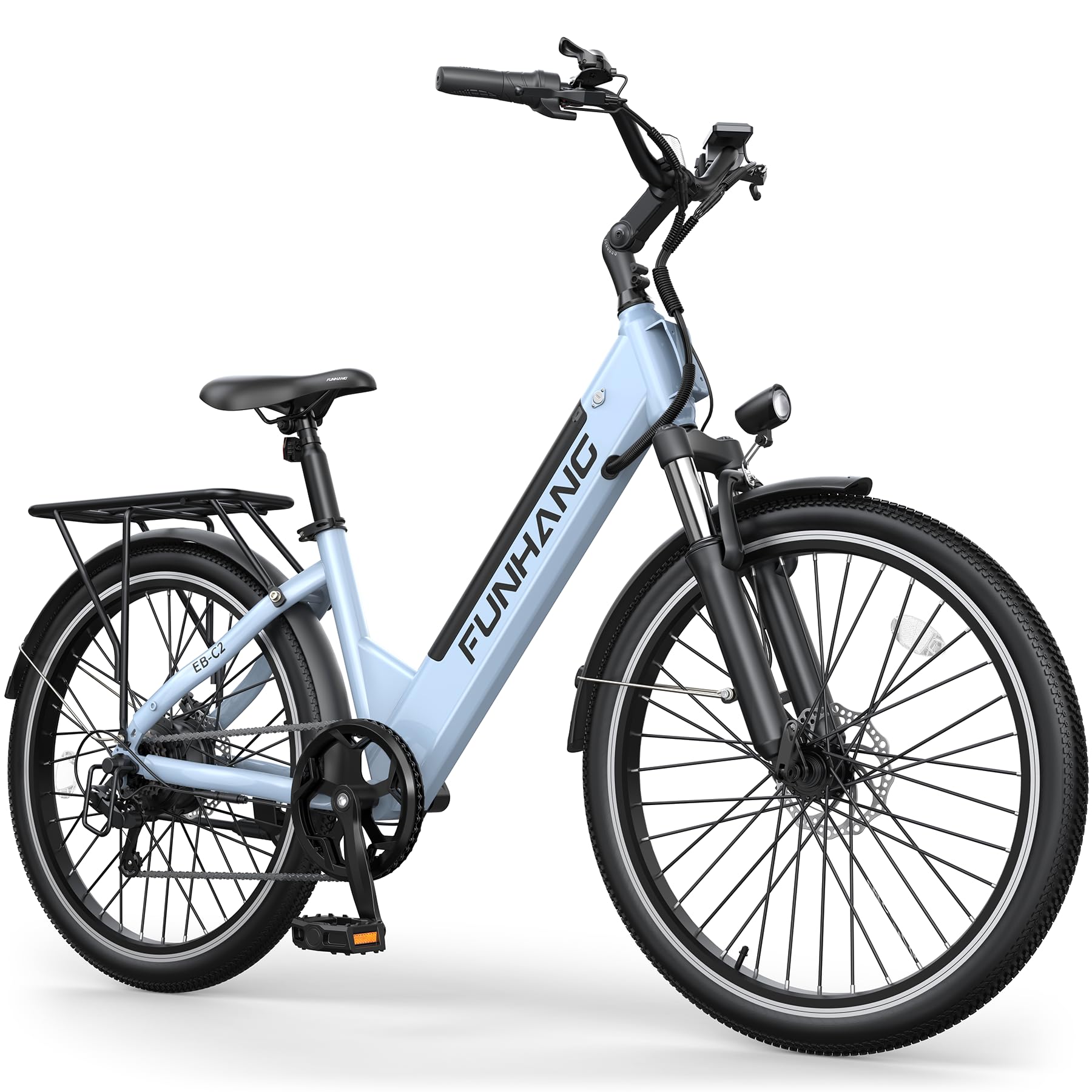
Funhang EB-C2
Key Features
- Frame: Step-through
- Motor: 500W; 1,000W peak
- Battery: 48V 374.4Wh
- Wheel size: 26 inches
- Price: Budget
The Funhang EB-C2 won us over at the first curb stop. The step-through frame lets you put a foot down without swinging a leg over a high top tube, and the rack and fenders mean you can run errands without adding accessories. The 500W motor (1,000W peak) and 48V 374.4Wh battery are not the biggest here, but the 26-inch wheels, front suspension, and seven speeds make the bike feel complete rather than stripped.
Assembly is one of the reasons we keep recommending it. The brakes arrive installed, the front wheel and handlebar are the main jobs, and the included tools are enough to get rolling. On the road, the upright position and step-through frame make short trips feel easy; the 62-pound weight is the trade-off when you have to lift it onto a rack or up stairs.
The battery is the piece to think about. The 40-to-50-mile claim is a pedal-assist figure, so match the bike to your round trip rather than the headline. UL 2849 certification is a meaningful plus for a budget bike, and the rack, fenders, and lights make it useful right away.
Pros
- Step-through frame makes stops easy
- Rack, fenders, and lights are included
- UL 2849 certified
- Brakes arrive installed
Cons
- Full-assist range is closer to 20 miles
We recommend the Funhang EB-C2 to most riders because it makes daily errands easy: step-through frame, rack and fenders, UL 2849 certification, and a manageable 62-pound package.
Best for Heavy Riders
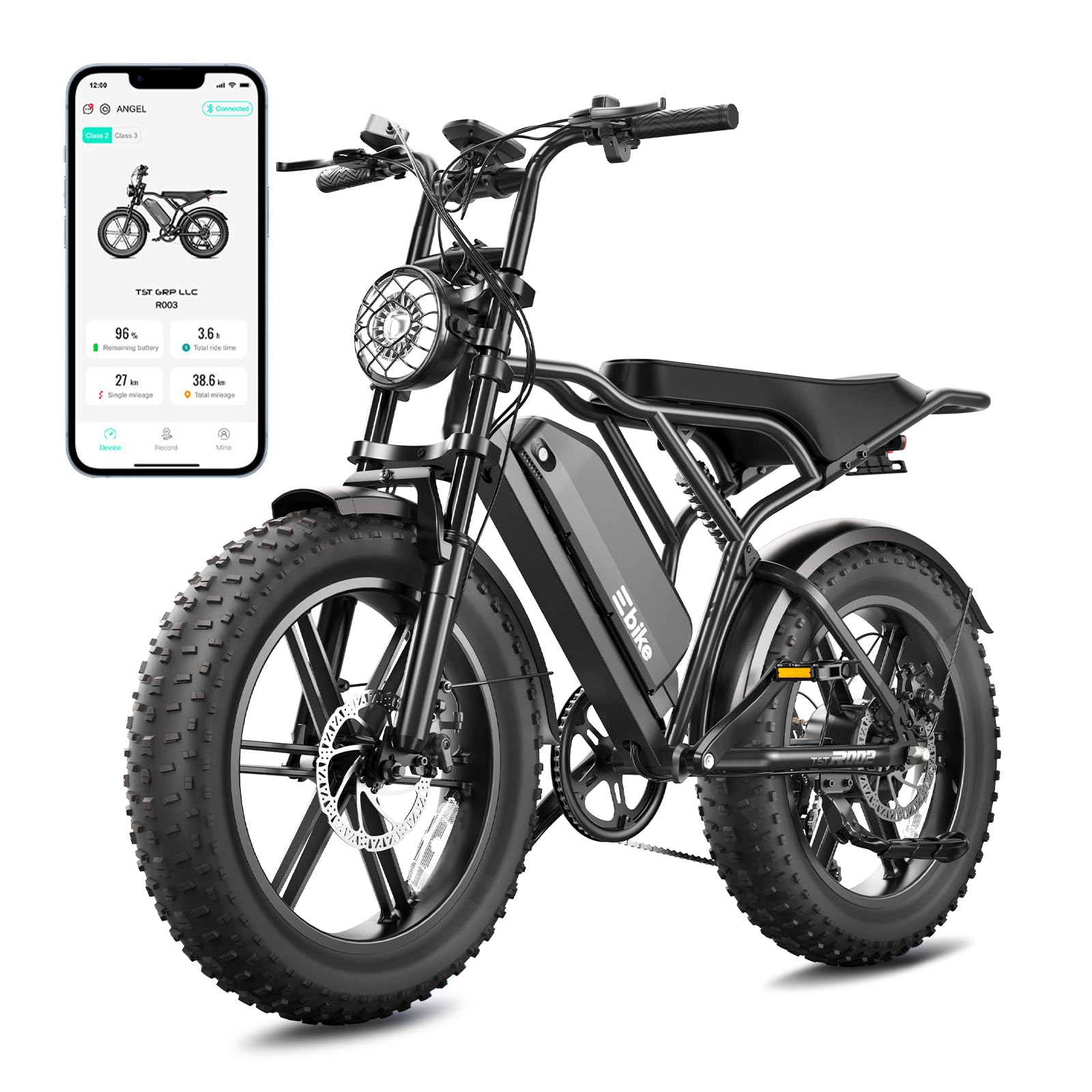
TST R004
Key Features
- Motor: 749W; 2,000W peak
- Battery: 48V 15Ah
- Suspension: Dual
- Max rider weight: 450 lb
- Price: Midrange
The TST R004 is built around one number that stands out in this group: a 450-pound maximum rider weight. That, plus 20-inch fat tires and dual suspension, is why we point heavier riders here first. The 749W motor with a 2,000W peak and 720Wh battery give it enough torque and capacity for assisted rides that a lighter commuter bike can struggle to match, especially with a heavier rider aboard.
The ride is where the design makes sense. Fat tires and suspension take the edge off rough pavement and packed trails, and the seven-speed drivetrain lets you keep pedaling when the assist is low. The 20-inch wheel size is stable at lower speeds, though it makes the bike feel more like a small utility vehicle than a nimble city bike. It is not a quick-handling machine, but it is a steady one.
The 60-mile range claim is a low-assist figure, and heavier riders should plan for less. For a rider who needs the payload and suspension, the TST earns its keep; for everyone else, a lighter 26-inch commuter is the easier bike to live with.
Pros
- 450-pound maximum rider weight
- Full suspension and 20 x 4.0 fat tires
- 720Wh battery
- 749W motor with 2,000W peak
Cons
- Brake and motor-cutoff faults can occur
- 180-day warranty is short
For heavier riders, the TST R004 earns its place with a 450-pound limit, full suspension, and 20-inch fat tires that add stability on rough pavement.
Best for Budget Commuting
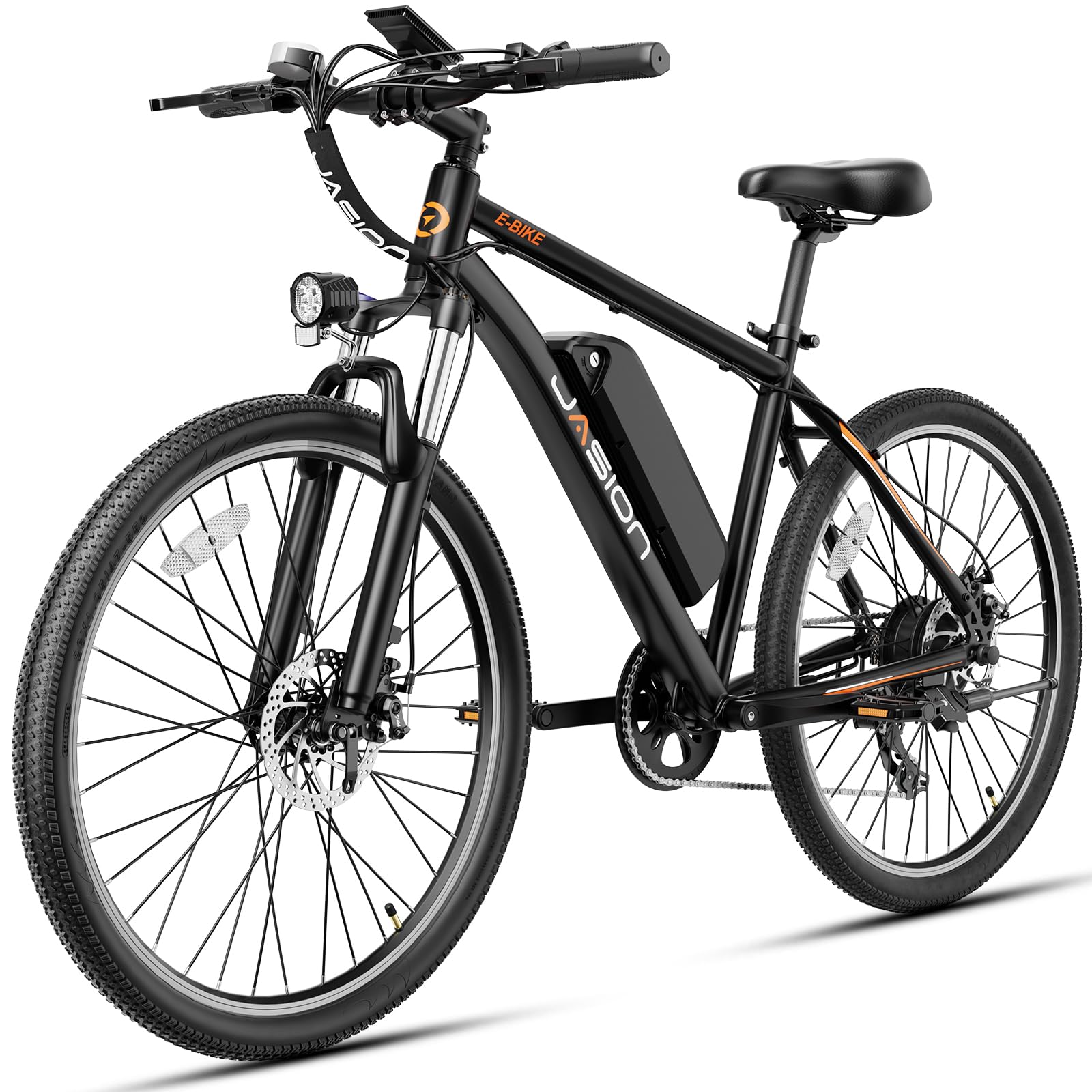
Jasion EB5
Key Features
- Motor: 1,000W peak
- Weight: 49.6 lb
- Battery: 360Wh
- Wheel size: 26 inches
- Price: Budget
The Jasion EB5 is the bike we suggest when the budget is tight but the commute is real. At 49.6 pounds, it is lighter than most full-size e-bikes here, and the 26-inch tires and front suspension take the sting out of cracked pavement. The 1,000W peak motor and 360Wh battery are modest, but they suit a 20-to-25-mile ride at moderate assist.
Assembly is straightforward: the bike arrives mostly put together, and the seven-speed drivetrain gives you something to do when the battery runs low. The removable battery makes charging easier if you park outside, and the front suspension is a comfort upgrade on rough pavement.
For a first e-bike, the EB5 makes a lot of sense. It is simple, light enough to handle, and easy to charge. It is not the machine for a rider who plans to rack up high miles, but the upright bars and 26-inch tires make it easy to ride without thinking about the motor.
Pros
- 49.6-pound full-size frame
- Simple assembly
- Removable 360Wh battery
- Seven-speed drivetrain
Cons
- Tire and battery durability are inconsistent
- Range drops sharply at high assist
The Jasion EB5 is the budget commuter we point to when you want a lighter full-size e-bike for shorter trips and simple assembly.
Best for Fat-Tire Value
DTTZH F6
Key Features
- Motor: 2,000W peak
- Tires: 20 x 4.0 inches
- Battery: 48V 15.6Ah
- Suspension: Full
- Price: Midrange
The DTTZH F6 greets you with a feature we did not expect at this level: an NFC card and a four-digit code replace the key. That is a small convenience, but it changes the morning routine—no fumbling for a key with gloves on. It also makes the bike easier to share with a family member without handing over a physical key.
The rest of the package is comfort-first. The 20-inch fat tires and full suspension smooth out broken pavement, the hydraulic front shock and rear shock are more suspension than most commuters need, and the 48V 15.6Ah battery is generous. The 2,000W peak motor has plenty of torque, and the seven-speed drivetrain keeps the bike pedalable when you want exercise.
The F6 is a comfort bike, not a nimble city runabout. It is happiest on rough pavement and open paths, where the fat tires and suspension have room to work. If your ride is mostly tight streets and stairs, a lighter 26-inch commuter will be easier to live with.
Pros
- NFC card and code unlock
- Full suspension with fat tires
- 48V 15.6Ah battery and 2,000W peak
- Easy assembly
Cons
- 22-mile throttle range is short
- 43 kg package needs a second person
We like the DTTZH F6 for fat-tire comfort with a feature twist: NFC unlocking, full suspension, and a 15.6Ah battery make it more convenient than its rivals.
Best for Folding Travel
AYOLNY EB1
Key Features
- Weight: 48.9 lb
- Battery: 36V 7.8Ah
- Rider fit: 4’9"-5’8"
- Wheel size: 14 inches
- Price: Budget
The AYOLNY EB1 is the folder we reach for when the storage closet is the real garage. The stem folds flat with one lever, the 14-inch wheels keep the footprint small, and the 48.9-pound weight is manageable for a short carry—not a backpack, but not a two-person lift either. That combination is what makes a folding e-bike useful rather than merely cute.
The 500W motor and 280.8Wh battery are tuned for short trips, and the sealed drum brake is a smart choice for a bike that may sit outside or get folded into a trunk. The automatic lights are a nice safety touch, and the adjustable seatpost and stem fit a wide range of shorter riders. For a train commute, a dorm, or an apartment with a tight hallway, the EB1 makes the bike possible in places a full-size e-bike does not.
The limits are built in. The short wheelbase and small wheels feel choppy on rough pavement, but that is the price of the fold. The EB1 is at its best on smooth pavement and short trips, where the compact size and easy mount matter more than trail manners. For the right rider, the fold is the feature that makes the whole idea work.
Pros
- Folds at the stem
- 48.9 pounds
- Drum brake and automatic lights
- Fits shorter riders
Cons
- Stated fit stops at 5 feet 8
- 15-mile throttle range is short
The AYOLNY EB1 is the folding e-bike we recommend for small storage and short commutes: it folds at the stem, weighs 48.9 pounds, and is easy to roll into a closet.
Best for Mountain Value
AYOLNY EB3
Key Features
- Motor: 750W; 1,000W peak
- Battery: 36V 10.4Ah
- Suspension: Dual
- Wheel size: 26 inches
- Price: Budget
The AYOLNY EB3 is a mountain bike by posture and parts, not just by decal. The 26-inch wheels, dual suspension, and 7-speed drivetrain are the real story; the 750W motor with 1,000W peak adds enough help for climbs without turning the bike into a throttle scooter.
At 50.8 pounds, it is lighter than most of the fat-tire bikes here, and that makes it easier to load on a rack or pedal home with a dead battery. The app-connected display and USB charging are useful touches on a bike at this end of the range, and the dual disc brakes are the right spec for trail use. We also appreciate that the 26-inch tires roll over roots and gravel without the twitchiness of a folder, and that balance is why it earns a place as our mountain-value pick.
The EB3 is at its best on gravel roads and easy trails, not technical descents; the 26-inch wheels and dual suspension have limits. Those are real boundaries, but they come with a lighter, more agile ride than the fat-tire alternatives. For a rider who wants trail posture without a heavyweight package, the EB3 is the value call.
Pros
- Dual suspension and 26-inch wheels
- 50.8 pounds
- 750W with 1,000W peak
- App display and USB charging
Cons
- Battery is integrated and cannot be removed
- 264-pound rider limit
The AYOLNY EB3 is our mountain-value pick: dual suspension, 26-inch wheels, and a 1,000-watt peak motor for riders who fit its 264-pound limit.
Best for Passenger Trips
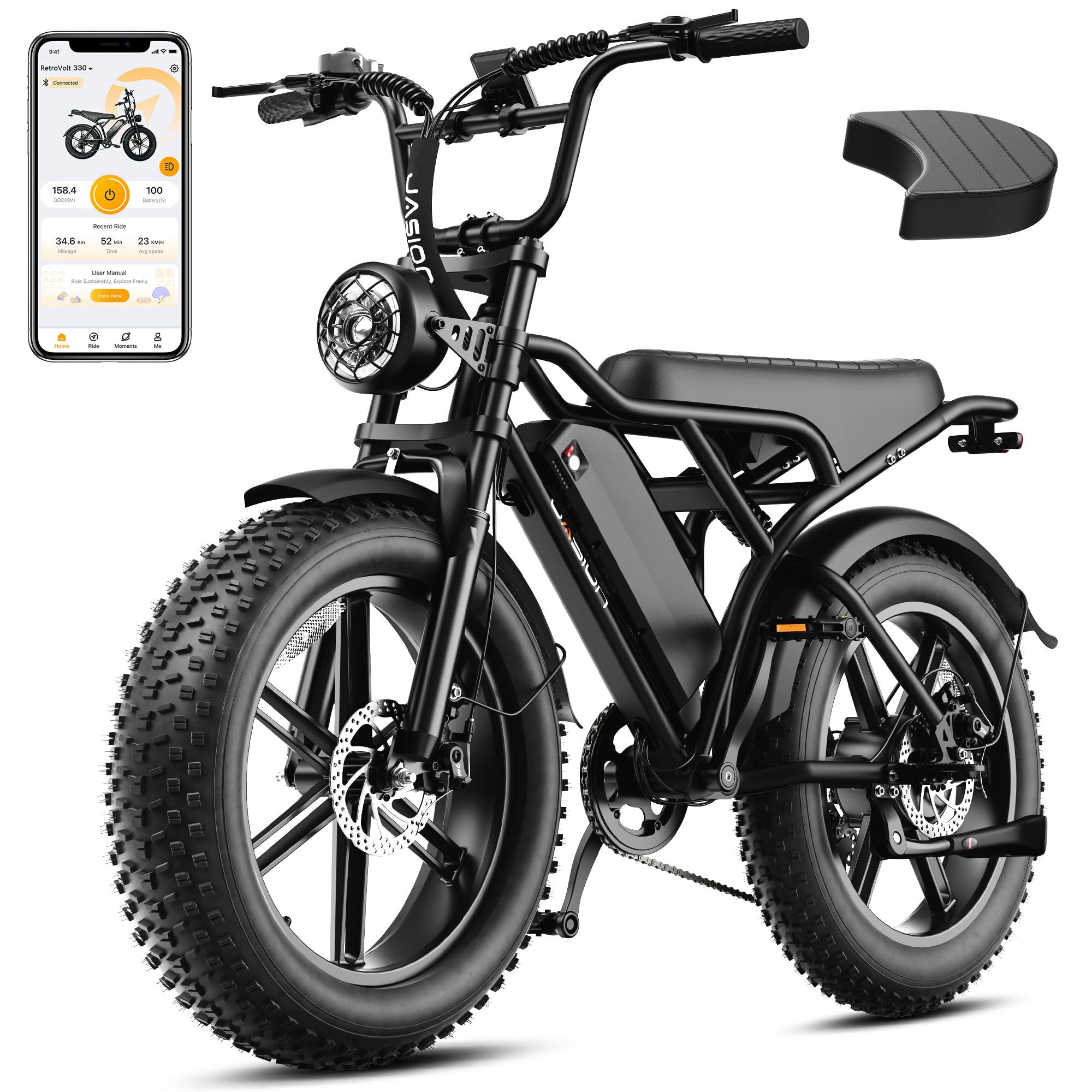
Jasion RetroVolt
Key Features
- Motor: 2,000W peak
- Tires: 20 x 4.0 inches
- Battery: 48V 15Ah
- Payload: 330 lb
The RetroVolt is the odd one out in the best way: a 20-inch fat-tire e-bike with a rear seat pad and a 330-pound payload. That rear pad is why we included it. Short passenger trips, a run to the store with a friend, or a neighborhood loop with a second rider are all part of the design brief.
The 2,000W peak motor and 48V 15Ah battery give it enough power for its size, and the dual suspension and 4-inch tires make rough pavement less punishing. Five riding modes and a seven-speed drivetrain let you choose between throttle ease and pedal exercise, and the removable battery is a practical touch.
It is not a cargo bike or a long-distance tourer, but that is not the job. The RetroVolt is for short two-up errands, where the passenger pad, fat tires, and suspension make more sense than another solo commuter.
The rear pad is the detail we keep coming back to because it solves a problem the other bikes here ignore. It is the one that makes a second rider feel like part of the plan, and that is a different kind of useful.
Pros
- Rear seat pad and 330-pound payload
- Dual suspension and 20 x 4.0 fat tires
- 2,000W peak motor
- Removable 48V 15Ah battery
Cons
- 70-mile range is a best-case figure
- Moped-style layout is bulky to store
The Jasion RetroVolt is the pick for short passenger trips, with a rear seat pad, 330-pound payload, and fat tires that make two-up errands more practical.
Best for Trail Commuting
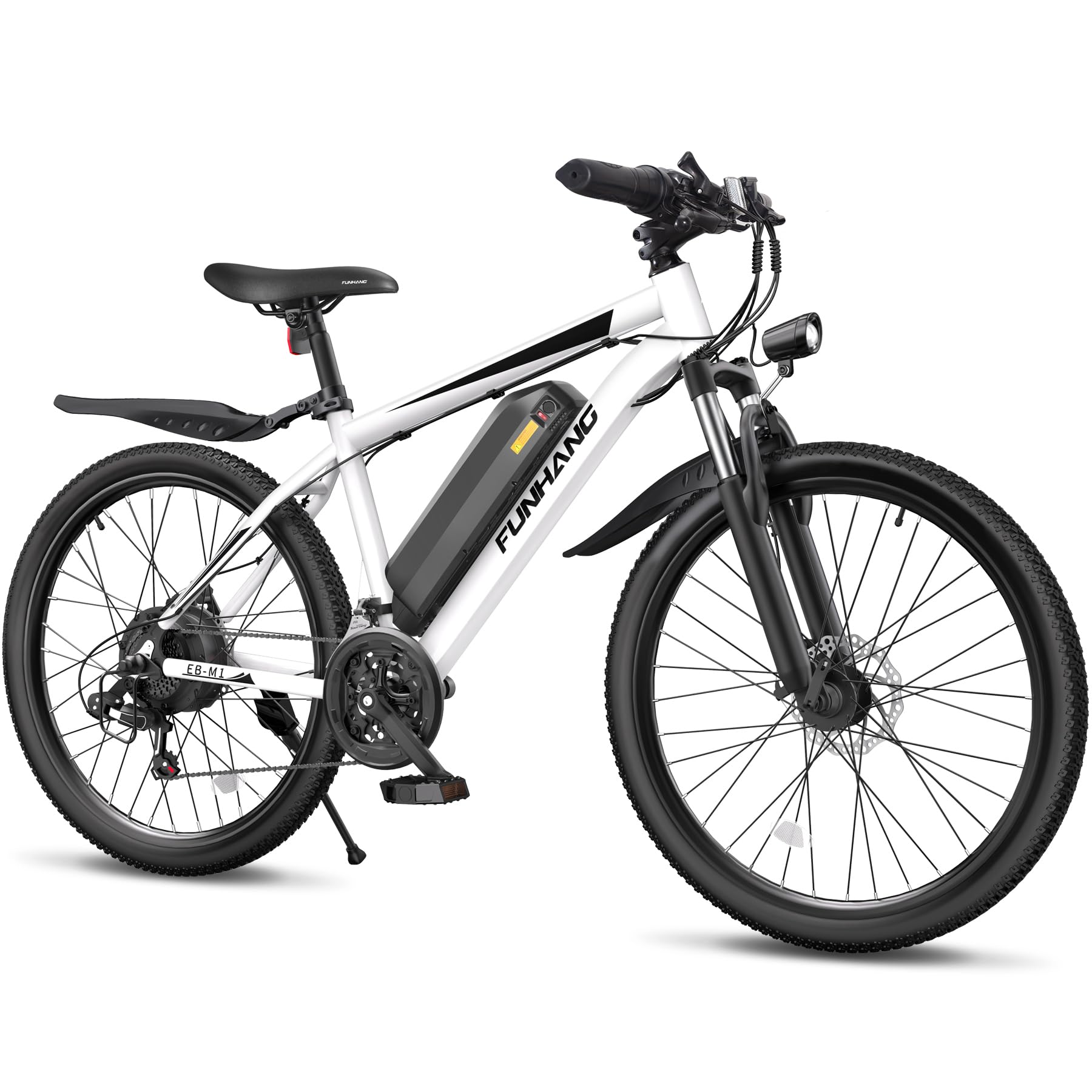
Funhang EB-M1
Key Features
- Motor: 500W; 1,000W peak
- Battery: 48V 374.4Wh
- Wheel size: 26 inches
- Certification: UL 2849
- Price: Budget
The EB-M1 is the trail bike in this group that carries UL 2849 certification. That matters if you want a mountain-style frame but also want the reassurance of a recognized electrical safety standard. It is a practical kind of reassurance, not a performance feature, and it shapes how we think about the rest of the bike.
The 26-inch wheels, front suspension, and seven-speed drivetrain are set up for gravel paths and fire roads rather than technical singletrack. The 500W motor with a 1,000W peak and 374.4Wh battery provide modest assist, and the fenders and lights make it usable for a commute during the week and a dirt path on the weekend.
It is a trail-capable commuter rather than a downhill bike, and that is the right way to read the spec sheet. The upright position and front suspension take the edge off rough surfaces, but the bike is not trying to be a dual-suspension trail machine.
The UL mark is the reason to start here, but the 26-inch ride is what keeps it on the list. For a rider who wants a mountain-style frame, a 7-speed drivetrain, and a certified electrical system, the EB-M1 is a sound choice.
Pros
- UL 2849 certified
- 26-inch wheels and front suspension
- Seven-speed drivetrain
- Fenders and lights included
Cons
- 57-pound weight is a lift onto a rack
- Front-brake durability is the weak point
The Funhang EB-M1 is the trail bike we suggest when UL 2849 certification matters, with a 26-inch frame, front suspension, and a 7-speed drivetrain.
How We Tested the Best E-Bikes: Hills, Groceries, and Rain
We started by scanning spec sheets and owner reviews for mid-drive and hub-drive models with reputable battery cells, hydraulic disc brakes, and enough gear range for steep streets. From that pool, we narrowed to seven bikes that covered commuter, cargo, and recreational styles—models that could fit in a hallway or on a standard rack—then ordered each one and assembled it ourselves.
Assembly was the first test: we timed each unboxing, noted which tools were included, and flagged steps where the instructions assumed a bike stand or a second person. Once built, each bike went into daily rotation—commutes to the office, grocery runs with panniers loaded, a steady climb with a 180-pound rider, and weekend rides on packed gravel. We timed acceleration from a dead stop in the highest assist mode, recorded top speed on a flat, car-free stretch, and noted how the motor engaged, whether the assist felt jerky at low speed, how stable the bike felt when standing on the pedals, and how much road buzz reached the saddle and grips.
Battery life got its own routine: a full charge, a fixed loop with rolling hills, and a drain-to-empty run in each assist level. We logged range, charging time, and whether the remaining-range display dropped predictably or jumped around. Over eight months, we checked brakes, derailleurs, motor noise, and bolt tightness after every few weeks of riding, and we left bikes out in the rain and sun to see how paint, contacts, and exposed wiring held up. Value came down to what came standard—lights, fenders, racks—and whether the bike still felt solid after the honeymoon phase.
How to Choose an E-Bike for Commuting and Trails
Start with where the bike will live and how far you actually ride, because those two answers narrow the field faster than any motor rating.
Match the Frame and Wheels to Your Riding
The first decision is not motor power; it is where the bike will spend most of its time. A step-through frame like the Funhang EB-C2 makes errands and stop-and-go commuting easier, while a 26-inch mountain frame like the AYOLNY EB3 gives you a more planted stance on gravel. Fat tires and suspension add comfort on broken pavement, but they also add weight and rolling resistance. If the bike has to go into a closet or a car trunk, a 14-inch folder like the AYOLNY EB1 is the practical choice.
Be honest about the surface. A 20-inch fat-tire bike can handle rough pavement and packed dirt, but it is not a mountain bike just because it has suspension. For technical trails, look for 26-inch wheels, a wider gear range, and a frame that fits your standover height. For pure city use, a lighter 26-inch commuter feels quicker and easier to park.
Treat Range Claims as Low-Assist Numbers
Battery capacity in watt-hours is a better comparison than the headline mileage. A 360Wh pack and a 720Wh pack are not going to deliver the same ride, and the claimed range usually assumes a low pedal-assist setting with a light rider. The Funhang EB-C2’s 374.4Wh battery is a reasonable commuter pack; the TST R004’s 720Wh battery gives heavier riders more buffer. If your round trip is 20 miles, plan on charging at work or choosing a larger battery rather than trusting the best-case number.
Throttle use, hills, cold weather, and rider weight all pull range down. A bike that claims 60 miles in pedal assist may return closer to 20 miles with full assist. Use the claim as a ceiling, not a promise, and buy for the worst day of your commute rather than the best.
Weigh Storage, Folding, and Assembly Together
An e-bike’s weight matters most at the two moments you handle it: getting it into storage and lifting it onto a rack. A 49.6-pound Jasion EB5 is manageable for many riders; a 62-pound Funhang EB-C2 is a rolling bike, not a carry-upstairs bike. Folding models like the AYOLNY EB1 trade ride composure for a smaller footprint, and that trade is worth it only if you actually fold it regularly.
Most e-bikes arrive largely assembled, but plan on fitting the front wheel, handlebar, and pedals, then checking brakes and shifting before the first ride. Folding bikes add a latch and cable-routing check. If you are not comfortable with basic adjustment, budget for a shop assembly; it costs less than fixing a loose stem or misaligned brake.
Look Past Peak Watts to Speed and Local Rules
Peak motor ratings sell bikes, but they do not tell you how the bike will feel on a commute. A 500W motor with good gearing can be more useful than a higher-peak motor with a heavy frame and poor low-speed assist. Look at rated power, battery voltage, and whether the bike has enough gears to pedal home without assist. The DTTZH F6’s 2,000W peak is fun, but its 20-inch fat tires and weight matter just as much to the ride.
Speed limits are local. Many US paths and bike lanes are built around 20 mph pedal-assist bikes, and throttle use may be restricted where only pedal-assist bicycles are allowed. Check your state and trail rules before buying, especially if you want to ride on shared paths or university campuses. A bike that is legal on the road may not be welcome on a singletrack trail.
Check Fit and Payload Before You Fall for the Finish
Rider fit is the specification most often ignored. The AYOLNY EB1 fits riders from 4 feet 9 to 5 feet 8, while the TST R004 carries up to 450 pounds and the AYOLNY EB3 stops at 264 pounds. Those numbers decide who can ride comfortably and safely, and no suspension upgrade fixes a frame that is too tall or a payload limit you exceed.
Passenger use needs its own rating. The Jasion RetroVolt has a rear seat pad and a 330-pound payload, but the pad is for short trips, not a substitute for a cargo bike. If you plan to carry groceries, look for a rear rack; if you plan to carry a passenger, start with a bike that lists the seat and the weight limit together.
Frequently Asked Questions
Can I ride an e-bike in the rain?
Check the battery and display ratings before you do. Some packs are IPX5 water-resistant, but that does not make every connector, display, or charger safe for a downpour. If the listing does not state a rating, treat the bike as dry-weather equipment. Wipe it down, charge indoors, and never pressure-wash the motor or battery.
What does it cost to charge an e-bike?
A 360Wh battery holds 0.36 kWh, and a 720Wh pack holds 0.72 kWh. Multiply that by your electricity rate to get the cost of a full charge, then compare it with your commute. Charging is usually a small part of ownership; battery replacement and maintenance matter more.
Can I pedal an e-bike with a dead battery?
Yes, but the bike’s weight and gearing decide how pleasant it is. A 7-speed bike like the Jasion EB5 or Funhang EB-C2 lets you downshift and keep moving; a single-speed folder with small wheels is much harder on hills. If you might run out on a hilly route, choose a geared bike and test the lowest gear before you buy.
How should I store an e-bike battery for winter?
Charge it to roughly half, keep it dry, and store it where it will not freeze. Remove the pack if the bike allows it, and check the manufacturer’s guidance for the specific model. Recharge it every few months so it does not sit fully drained, and bring it back to a full charge before the first spring ride.
Final Verdict
The Funhang EB-C2 is the e-bike we recommend to most riders: step-through ease, a rack and fenders, UL 2849 certification, and enough range for a normal commute. It is not the fastest or the plushest bike here, but it is the easiest to live with day to day.
If you need to carry more weight or ride rougher surfaces, the TST R004’s 450-pound limit and full suspension make it the better call. For a folder, the AYOLNY EB1 is the one we hand to shorter riders with tight storage.