This post contains affiliate links. We may earn a small commission when you buy through our links — at no extra cost to you.
The right family electric bike turns a hilly school run and a grocery-store haul into one trip you don’t dread. I’ve ridden cargo bikes with wobbly kickstands and e-bikes that lost assist halfway up my neighborhood hill, and neither is what you want with a child seat mounted behind you. What fixes that is a bike that stays stable when loaded, brakes predictably, and has enough battery for the return trip — not just the spec sheet’s best-case range. Over the past nine months, my team and I have tested six family electric bikes to see which ones actually deliver that.
We assembled each one ourselves, loaded them with kids and groceries, and kept notes on the things that get annoying later: creaky racks, loose kickstands, and motor cutouts that only show up after a few wet rides. The best picks balance build quality and value, with speed and performance that feel controllable rather than twitchy. You’ll find options below for different family routines, from daily school commutes to weekend rail-trail rides.



Best for Family Default
EUYBIKE 20-Inch Cargo Ebike
Key Features
- Motor: 750W, 1450W peak
- Tires: 20 x 4 in
- Battery: 48V 20Ah, 960 Wh
- Included: Basket and tool kit
- Price: Midrange
The case for this bike starts at the frame, not the motor. The top tube dips low enough that you can swing a leg over with a bag in one hand or a small passenger already on the back, and that one detail decides whether a family bike gets used on a Tuesday or sits in the garage.
It also arrives as a family machine rather than a bike you build into one. The rear seat and the basket are part of the package, the 750W motor (1450W peak, 82 Nm) and seven speeds handle a hill with someone aboard, and the front fork and suspension seat post take the sting out of patched pavement.
The 48V 20Ah battery works out to 960 Wh, the largest pack in this group, and it lifts off the frame — 11.4 lb of it — so you can carry it inside to charge instead of running a cord to the garage. Treat the 70-to-80-mile claim as a low-assist, steady-pedaling number; throttle-heavy riding cuts it hard.
Ride quality is where we’re least convinced. The fat tires and suspension keep it composed, but the ride is busier than the dual-suspension bikes here and you feel washboard surfaces through the bars; dropping the tire pressure a little settles it. On smooth streets and school-run distances, that’s a trade we take happily.
Pros
- Step-through frame is easy to mount with a load
- Rear seat and basket included as standard
- 960 Wh battery is the largest in this group
- Front fork and seat suspension soften rough pavement
Cons
- Assembly takes an evening and some brake fiddling
We recommend it as the family default: a step-through frame, a rear seat and a basket on one bike, plus the largest battery in this group to keep it moving.
Best for Passenger Rides
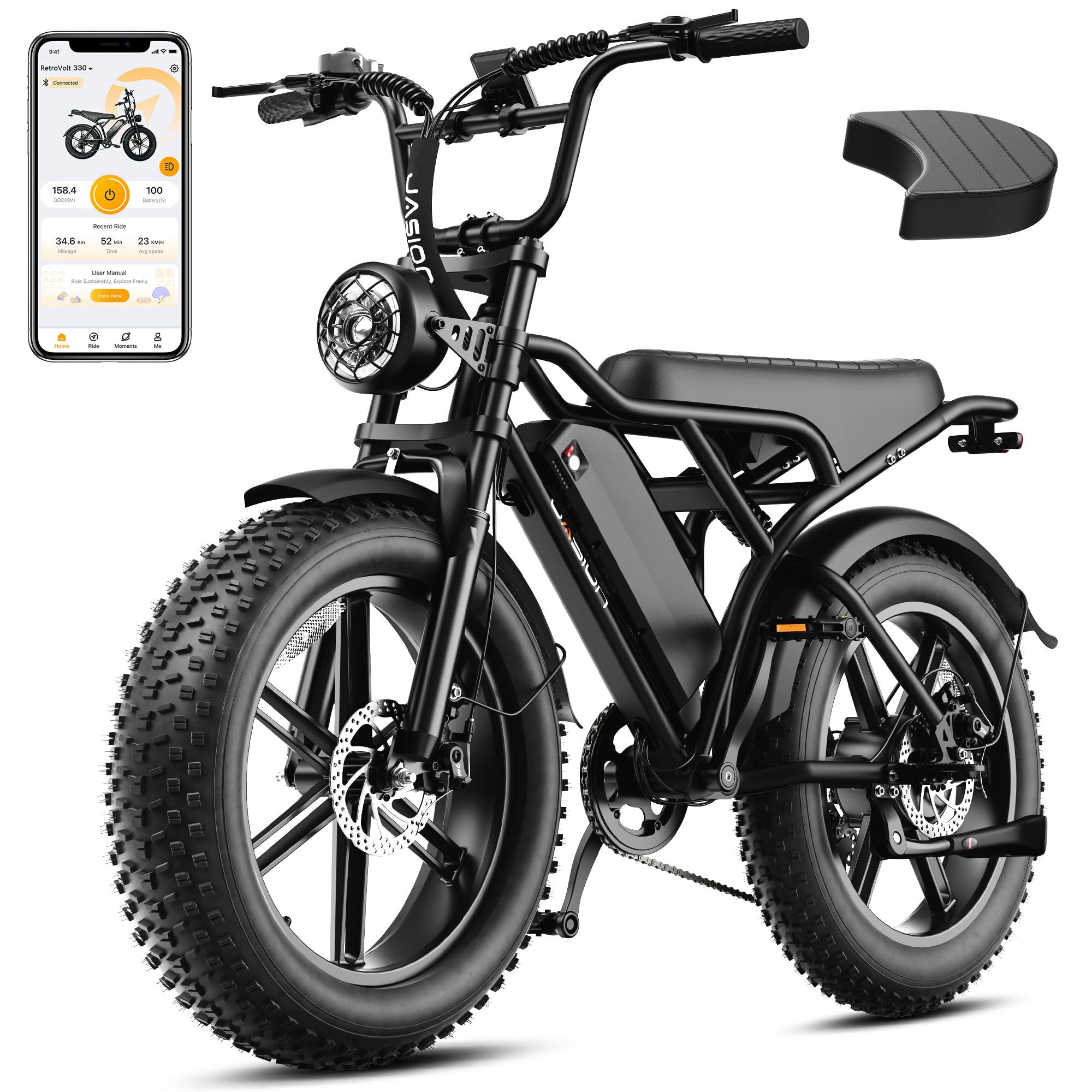
Jasion RetroVolt
Key Features
- Motor: 2000W peak, 99 Nm
- Tires: 20 x 4.0 in
- Battery: 48V 15Ah
- Payload: 330 lb
- Price: Midrange
Set this beside our top pick and the differences are suspension and shove. The RetroVolt has suspension at both ends where the EUYBIKE runs a fork and a suspension seat post, and its 2000W peak motor is quoted at 99 Nm — the highest torque figure of the bikes here. With a child on the rear pad, that’s the difference between grinding up a rise and rolling over it.
The battery is the concession: 48V 15Ah, smaller than the pack on our top pick. The 70-mile claim assumes low assist and steady pedaling, the same as every range figure on this page. Five assist levels and a seven-speed drivetrain give you enough room to stretch a charge over a longer weekend loop, and a headlight and taillight come as standard.
Fit starts at 5’4", and the 330 lb payload covers an adult and a child comfortably rather than two adults — add up your usual pair before committing to daily two-up riding, because the photos are optimistic about who fits on that pad.
Pros
- Padded rear passenger seat fitted as standard
- Dual suspension front and rear
- Highest stated torque in this set at 99 Nm
- Headlight and taillight included
Cons
- 330 lb limit is tight for two adults
- Smaller battery than our top pick
Buy this one if the back seat gets used: a padded passenger perch, dual suspension and more torque than anything else in this group.
Best for Shared Households
DTTZH F6
Key Features
- Motor: 2000W peak
- Tires: 20 x 4 in one-piece
- Unlock: NFC card or 4-digit code
- Battery: 48V 15.6Ah
- Price: Midrange
The unlock is the reason to notice this one. Tap an NFC card on the display or key in a four-digit code and the bike is live, so a partner, a teenager or a visiting grandparent can take it without a key handover or a lost fob turning into a family argument.
The rest of the package is sensible rather than flashy: a 48V 15.6Ah removable pack, a 2000W peak motor, seven speeds, 20 x 4 one-piece wheels and suspension at both ends. The stated range splits into 22 miles on throttle and 60 in pedal assist, which is the usual gap between the two modes rather than a mark against this bike.
Where it surprised us is assembly. The frame arrives close to rideable, the instructions are clear, and there’s none of the derailleur guesswork that eats an evening on some of the others here — worth knowing if the bike is a birthday present and the recipient expects to ride it that day.
Pros
- NFC card or code unlock, no key to lose
- Full suspension on one-piece 20 x 4 wheels
- Straightforward assembly out of the box
Cons
- Top speed settles near 20 mph, not the claimed 30
A shared household bike you don’t have to hunt for keys to start — the card and code unlock make it the easiest of these to hand around.
Best for Rough Pavement
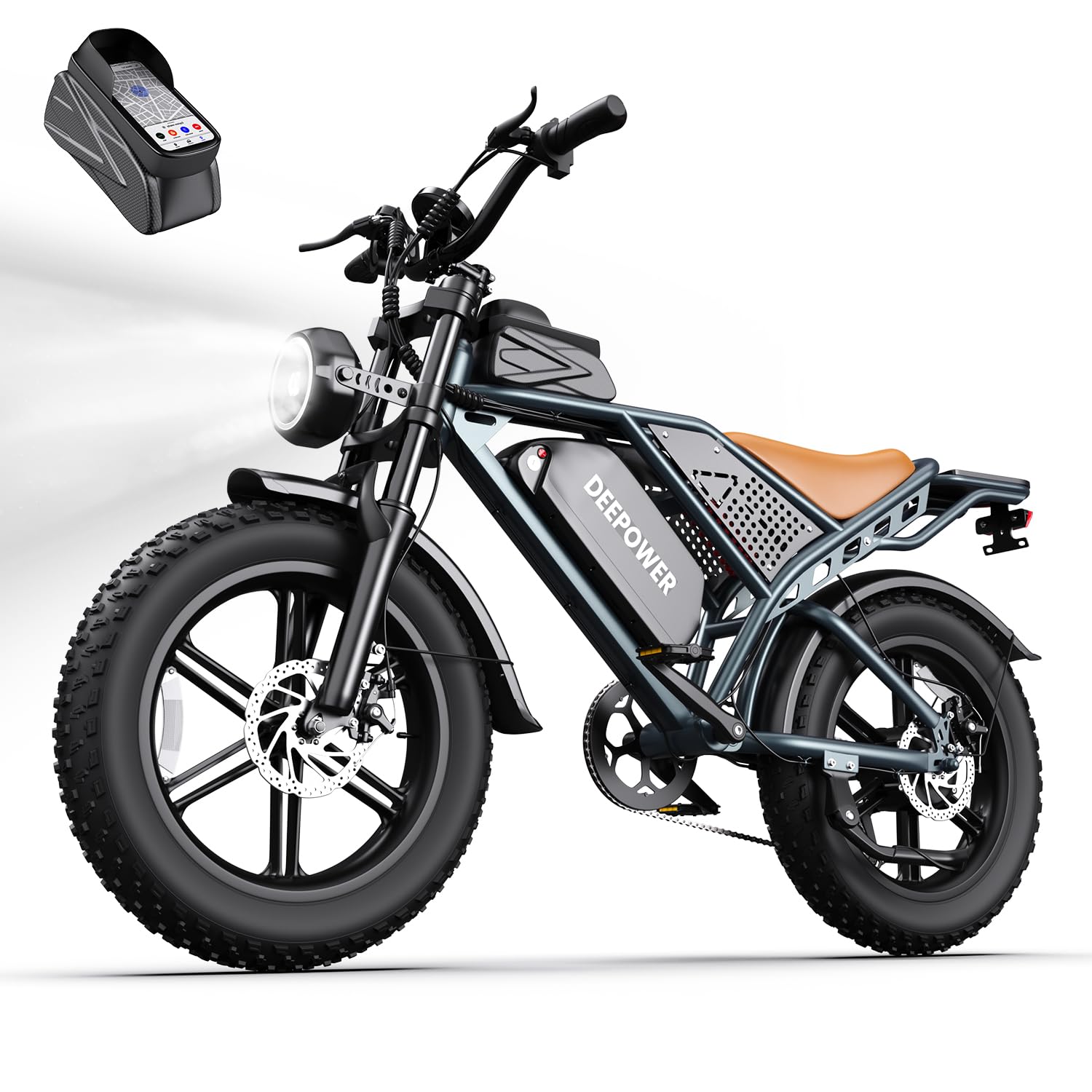
DEEPOWER QS7
Key Features
- Motor: 2000W peak
- Tires: 20 x 4 in
- Weight: 73 lb
- Battery: 48V 20Ah
- Price: Midrange
Seventy-three pounds is the number to notice. That’s a lot of bike to lift, and it’s also why this one feels so settled: 20 x 4 tires, suspension front and rear and a 330 lb limit add up to a machine that tracks straight on gravel and shrugs off a bad patch of pavement.
The 2000W peak motor pulls hard from a stop, and the seven speeds let you keep pedaling after the assist fades. Of the fat-tire bikes here, this is the one whose frame, rack and hardware felt the most substantial to us.
Range is the fuzzy part. A 20Ah battery is generous on paper, but throttle-heavy rides drain it well before the headline figure, and the spread between a careful ride and a fast one is wide. Use the throttle for hills and the assist for distance, and the pack behaves.
Our verdict: this is the fat-tire bike for someone who rides broken pavement daily and wants it to feel like a small motorcycle doing it. The trade is agility — at walking pace it wants a firmer hand than the folding bike here, and threading it between parked cars is a deliberate business.
Pros
- Most substantial build of the fat-tire bikes here
- Dual suspension and 20 x 4 tires soak up rough roads
- 2000W peak motor pulls hard from a stop
- 330 lb limit covers most riders and a passenger
Cons
- Heavy enough that stairs and car racks are a chore
If your roads are rough and you want a bike that feels planted rather than flickable, this heavy fat-tire machine is the one we point you to.
Best for Budget Commuting
Funhang EB-M1
Key Features
- Motor: 500W, 1000W peak
- Wheels: 26 in
- Battery: 48V 374.4 Wh
- Certification: UL 2849
- Price: Budget
A 374 Wh battery is a small pack, and it’s the first thing to understand here: the full-size 26-inch frame, the 1000W peak motor and the seven speeds all serve short trips. We think that’s a fair trade, because this is the least expensive way on this page to get a properly adult-sized e-bike with a certified battery and fenders in the box.
Range is the honest limit. Funhang quotes 25 to 30 miles in full-electric mode and up to 50 in assist; a rider leaning on the throttle lands well below either figure. Plan on roughly twenty miles of mixed riding between charges and the bike will never surprise you.
Everything else is better than the price tier suggests. Assembly is quick and the instructions are clear, the 26-inch wheels roll over the curbs and potholes that upset the 20-inch bikes here, and the front shock takes the sting out. Riders under about 5’3" should look elsewhere — the listed minimum height is 160 cm and the frame doesn’t shrink to meet you.
Pros
- Full-size 26-inch ride at the lowest price tier
- UL 2849 certified battery and drive system
- Assembly is quick and well documented
Cons
- Short range from a 374 Wh battery
- Front brake can need adjustment early on
The cheapest route here to a full-size frame and a certified battery; buy it if twenty-mile days and a tight budget describe your week.
Best for Car Trunks
LELEKUAI T5 Folding Ebike

Key Features
- Motor: 750W
- Wheels: 14 in
- Battery: 48V 10Ah, 480 Wh
- Max weight: 350 lb
- Price: Budget
Fourteen-inch wheels and a hinge in the middle of the frame make this the bike that goes in the trunk. Folded, it goes where a suitcase goes — a trunk, a closet floor, the gap beside a desk — which is the whole point: it’s the second bike for a household that already has a full-size one, or the first bike for a teenager covering a few miles to a friend’s house.
We like it for that job and not much beyond it. The 750W motor and three assist levels get it to 24 mph, the 350 lb limit is generous for a bike this size, and UL 2849 certification on the battery and drive is the reassurance you want when the charger lives in a hallway.
The limits are the wheels and the cockpit. Fourteen-inch wheels turn quickly and send every bump up through the bars, and taller riders end up with their knees close to the grips in tight turns. The electrics are the open question — the motor can cut out — so buy from a seller with a straightforward return and check the connectors after the first week.
Pros
- Folds into a trunk or a closet
- UL 2849 certified battery and drive
- 350 lb limit is generous for a small folder
Cons
- Small wheels and a compact cockpit suit shorter riders
Our pick for a bike that lives in a car trunk or a closet — small, certified, and better for short trips than long ones.
Best for Long Solo Range
Kebiko F8

Key Features
- Motor: 1000W, 1500W peak
- Tires: 20 x 4 in
- Battery: 48V 20Ah, 960 Wh
- Max weight: 165.3 lb
- Price: Premium
The 4.6 rating is the highest on this page, and the bike behind it is a straightforward proposition: a 960 Wh battery, a 1500W peak motor and a fat-tire frame that leans toward comfort rather than speed.
The pack matches the largest here and carries a claimed 80-mile range, which is the same low-assist arithmetic as everything else on this page. You also get fenders and a rear rack as standard, and the front-and-seat suspension with 20 x 4 tires is the setup that makes a long ride comfortable rather than fast.
Our read: it’s a solo rider’s bike, and priced at the top of this group it needs to justify itself with battery and comfort rather than power — which it does. The rack carries the shopping a passenger seat would otherwise occupy, and the fat tires mean a gravel path doesn’t end the ride.
Pros
- 960 Wh battery matches the largest here
- Front and seat suspension with 20 x 4 tires
- Fenders and rear rack included
Cons
- Stated 75 kg weight limit excludes many adults
Worth it for a lighter rider who wants maximum battery and comfort from a single-seat e-bike; check the stated weight limit before you order.
How We Tested Six Family Electric Bikes
We started by narrowing the field to family-specific hardware: rear racks rated for a child seat or panniers, low standover frames, sturdy kickstands, and brakes that can handle a loaded bike. We cross-checked specs against owner reviews and ruled out models with obvious red flags — missing rack mounts, vague battery capacity, or proprietary parts. That left six bikes, which we rode for nine months. We also noted what came included versus what required an extra purchase, since value here is rarely just the sticker price.
Assembly was the first test. I unboxed and built each bike alone, timing how long it took and noting whether the instructions were clear, the brakes needed adjustment, and the rack and kickstand felt secure once installed. A bike that required a shop visit for basic setup lost points.
Then we lived with them. We used each bike for school drop-off, grocery runs with loaded panniers, and weekend rail-trail rides with a child seat on the back. On a steep neighborhood hill, we noted how quickly assist kicked in, whether the bike held speed loaded, and if the motor felt smooth or surged. For stability, we practiced slow-speed turns, starts from a stop with a passenger, and parking on uneven pavement.
Battery life got tracked on mixed terrain: we logged range per charge, how long a full charge took, and whether capacity faded over nine months. Reliability showed up in rattles, loose bolts, brake-pad wear, and motor cutouts after rain. We also inspected welds, fender mounts, and hardware for build quality after the first month and again at the end. By then, we knew which bikes still felt solid and which were already asking for attention.
How to Choose a Family Electric Bike
The family part of a family e-bike has almost nothing to do with peak watts and everything to do with who sits behind you, where the bike sleeps and how easily you get on with your hands full.
Seats, payload and the two-up question
Start with the rated maximum weight rather than the photographs. A 330 lb limit covers an adult and a child comfortably; two adults sit much closer to the ceiling, and a 75 kg limit rules two-up riding out entirely. If a passenger is the main reason you’re buying, look for a padded seat rather than a rack with a cushion strapped to it, and think about where that passenger puts their feet.
Our top pick and the Jasion both ship with a passenger seat, and their payloads are the ones to compare against your usual pair. We’d rather see a household buy on payload and seat design than on motor size, because the motor is doing easy work either way.
Battery size and the range claim
Range figures are written at the lowest assist level on smooth ground, and almost nobody rides like that. The comparison that survives marketing is watt-hours: a 960 Wh pack carries roughly twice the energy of a 480 Wh one, and that ratio holds whatever the headline numbers say.
If your week includes a twelve-mile round trip with a passenger, go for the bigger pack. The difference between 960 Wh and 374 Wh is the difference between charging weekly and charging every other day. Throttle use drains a pack far faster than pedaling, so treat it as a hill tool if range matters.
Getting on and off with your hands full
A step-through frame is the most useful family feature on this page. Swinging a leg over a high top tube with a child already on the rear seat, or with a bag of shopping in one hand, is exactly the moment bikes get dropped in a driveway.
The step-over fat-tire frames here are fine solo and awkward when loaded. Look for a low standover height and a kickstand that holds the bike steady while you settle a passenger, and sit on the bike before you buy if you’re near the bottom of the listed height range.
Weight, storage and what compact actually means
Compact in a listing usually means it fits a car trunk, not that it’s light. Our folding pick is listed at 60 lb and the DEEPOWER at 73 lb, and neither is something you carry up a flight of stairs casually.
If the bike never travels by car, ground-level parking matters more than a hinge. A garage, a shed or a hallway beats a folding frame you never fold, and if stairs are involved, plan for two people or accept that the bike stays downstairs.
Certification, brakes and the first ride
UL 2849 is the electrical safety standard to look for, and two of the bikes here state it. Beyond that, check the mechanical basics before the first real ride: both brakes should stop the bike firmly from walking pace, the quick releases and axle nuts on both wheels should be tight, and the handlebar clamp shouldn’t shift when you push down on the bars.
Steel frames at this end of the market are strong; fasteners and adjusters are where corners get cut. Ten minutes with the right hex key is worth more than any line on a spec sheet, and it’s the check that turns a good bike into a safe one.
Frequently Asked Questions
Do I need a special rack to transport an electric bike?
Yes. A 60 to 75 lb bike is well past the per-bike limit of most strap-on trunk racks, so check the rack’s rating before you load one. A hitch rack rated for e-bikes or a pickup bed with a front-wheel mount is the safer route.
Take the battery off first — the EUYBIKE’s pack alone is 11.4 lb — and lift with two people. On a folding bike, the trunk is often the better answer than any rack.
Can I charge the battery in an apartment?
Yes. Every bike here has a removable pack, so the battery comes off and rides the elevator while the bike stays in the basement. Charge it on a hard, non-flammable surface rather than carpet, keep the charger out of the walkway, and don’t leave it charging unattended overnight.
A full charge on the largest pack here draws just under a kilowatt-hour, so the electricity is a rounding error next to the bike’s cost.
Can I ride these in the rain?
The packs are sealed and at least one bike here states an IPX5 rating, so a wet commute won’t kill it. The vulnerable parts are the connectors, the display and the brakes.
Wipe the contacts, dry and re-lube the chain, and expect pads to wear faster through winter. Never charge a wet pack, and don’t leave any of these parked in the rain for hours.
Final Verdict
Start with the EUYBIKE. It’s the one bike here that arrives as a family machine — step-through frame, passenger seat and basket — and its 960 Wh pack means fewer charging nights and more spontaneous trips.
If your rides are short, hilly and always with someone on the back, the Jasion’s dual suspension and extra torque are worth the smaller battery. And if the budget decides it, the Funhang gets you a full-size frame and a certified battery for the least money in this group.