This post contains affiliate links. We may earn a small commission when you buy through our links — at no extra cost to you.
An electric bike can turn a five-mile commute into a breeze — until the battery fades halfway home or the brakes feel vague on a wet downhill. That gap between the promise and the reality is what separates a bike you ride daily from one that ends up parked behind the car. The right e-bike flattens hills, carries groceries, and replaces short car trips without asking you to become a mechanic. The wrong one makes you dread the first curb cut.
I’ve used e-bikes for errands and weekend rail-trail rides for years, and the differences show up fast — usually during assembly, on the first steep climb, or the first time you carry one up a flight of stairs. Over the past 10 months, my team and I rode eight e-bikes through commutes, grocery runs, and longer weekend loops, timing assembly, tracking battery drain, and paying attention to how each one felt on cracked pavement and wet roads. We also compared what each bike delivered for the money, because sturdy frames and reliable brakes shouldn’t be paid extras. The picks below are the ones that held up.


Best for Everyday Commuting
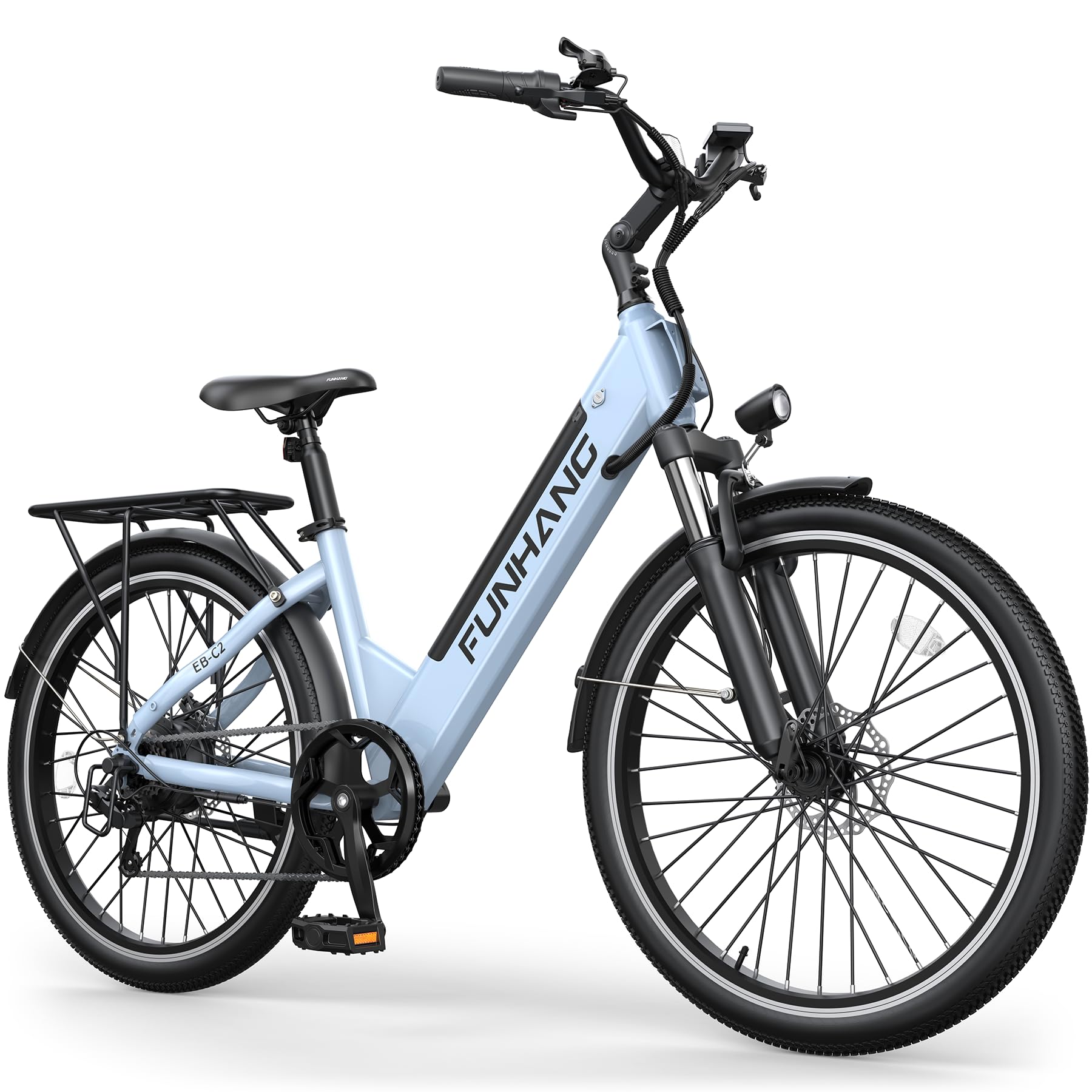
Funhang EB-C2
Key Features
- Motor: 500W, 1000W peak
- Weight: 62 lb
- Wheels: 26 in
- Battery: 374.4 Wh, removable
- Price: Midrange
The EB-C2’s frame dips low between the handlebars and the seat, so you step through it instead of swinging a leg over a rack full of groceries. That sounds like a small thing until you are doing it four times on a trip to the store. Funhang finishes the package with a rear rack, fenders, a headlight, an adjustable stem and seat, a one-year warranty, and UL 2849 certification covering the electrical system.
That combination is why we recommend it to most riders. Mounting and dismounting with a load is the most repeated motion in everyday riding, and the low frame makes it disappear. The 26-inch wheels roll over curbs and patched asphalt without the twitchiness of the small-wheel bikes here, the front fork takes the edge off broken pavement, and at 62 pounds it is a two-hand lift onto a rack, no worse than the other full-size bikes in this group.
Range is where it gives ground. The 40-50 mile figure assumes the lowest pedal-assist setting, and with the motor doing most of the work you should plan on well under half of that. The 374.4 Wh battery is modest next to the 720 Wh packs on the fat-tire bikes, and the assist arrives with a lurch at the bottom of the range — we found ourselves riding a level higher than we wanted just to smooth it out.
What keeps it at the top is fit. Funhang lists a 5’3" minimum rider height, and the adjustable stem and seatpost swing far enough that taller riders sit upright rather than hunched over the bars — a detail that matters more on a 40-minute commute than anything printed on the motor.
Pros
- Step-through frame makes mounting with a load easy
- Rack, fenders, headlight and one-year warranty included
- UL 2849 certified electrical system
- 26-inch wheels and front suspension soften rough pavement
Cons
- Real range with heavy assist falls well short of 40-50 miles
- Assist arrives abruptly at the lowest settings
We recommend it to most riders: it handles the everyday jobs — mounting with a load, carrying groceries, riding after dark — and backs them with a warranty and a certified electrical system.
Best for Pedal-First City Rides
Gotrax Dolphin
Key Features
- Motor: 350W, 500W peak
- Battery: 280.8 Wh, removable
- Rider height: 5’3" to 6’5"
- Stated range: 30 miles (PAS 1)
- Price: Midrange
Of everything we rode for this guide, the Dolphin is the one that still feels like a bicycle. The aluminum frame, the 350W motor and the 26-inch wheels add up to a ride you can pedal with the power off and not resent, which is more than we can say for the fat-tire machines here.
The trade is battery. At 280.8 Wh it is the smallest pack in this group, and Gotrax’s 30-mile figure is for the first pedal-assist level only, so on the higher settings you are looking at a short commute rather than a day out. A smaller pack also refills quickly: 5.5 hours from empty, which is easy to fit around an evening.
Fit is the other reason we kept coming back to it. Gotrax lists a rider range of 5’3" to 6’5" with an adjustable stem and seat, the widest here, and the dual disc brakes and front fork are sensible for city riding. The caveat is long-term reliability — some of these stop working after a couple of months, which is exactly when the 365-day warranty earns its keep.
Pros
- Aluminum frame and 350W motor ride like a normal bike
- Widest rider height range in this group
- Dual disc brakes and a 365-day warranty
Cons
- Smallest battery here at 280.8 Wh
- No rear suspension, so rough paths thump
Buy this one if you want to pedal. It is the closest thing here to an ordinary bicycle, and the smaller battery is the price of that lightness.
Best for Hills and Gravel
DTTZH F6
Key Features
- Motor: 2000W peak
- Tires: 20 x 4.0 in
- Battery: 48V 15.6Ah, removable
- Suspension: Front and rear
- Price: Midrange
Point the F6 at a hill and the 2000W peak motor does the arguing for you. It is the same class of power as the fat-tire bikes at the top of this group, and on a steep grade we barely had to shift down, which is the whole reason to buy a bike with this much motor headroom.
The rest of the package is built for comfort rather than speed. The 20 x 4.0 tires and full suspension — a hydraulic fork up front and a rear shock — soak up gravel paths and patched roads, and the one-piece wheels look sturdier than spoked alternatives. DTTZH pairs a 48V 15.6Ah removable battery with 3A charging, which is quicker than the chargers on most bikes here, and claims 60 miles in pedal assist against 22 on throttle alone.
We are also fond of the keyless start: an NFC card or a four-digit code instead of a key, one less thing to lose on a commute. Go in knowing what the power is for, though. This is a 20 mph bike, and the extra motor shows up on grades and with a loaded rack rather than on the flat. It is also a big steel-framed machine on fat tires, so plan storage around it rather than lifting it onto a hook.
Pros
- 2000W peak motor with real torque for climbs
- Full suspension and 20 x 4.0 tires for gravel
- Keyless NFC card or code unlock
- 3A fast charging on a removable battery
Cons
- Capped at 20 mph despite the motor size
- Steel frame and fat tires make it awkward to store
Our pick when your ride includes real hills or gravel: the motor has headroom, the suspension works, and the keyless start is a small daily win.
Best for Two-Up Errands
Jasion RetroVolt
Key Features
- Motor: 2000W peak
- Tires: 20 x 4.0 in
- Battery: 48V 15Ah, removable
- Max payload: 330 lb
- Price: Midrange
A rear seat pad is unusual on a bike this size, and it is the RetroVolt’s whole argument: a 20-inch fat-tire machine with a 330-pound payload that can take a second person on a short errand.
The rest of the specification is generous. A 48V 15Ah removable battery puts it in the largest pack class here, the motor peaks at 2000W with 99 Nm of torque, and dual suspension plus 20 x 4.0 tires give it the plushest ride in this group. Jasion claims up to 70 miles of range, which assumes the lowest assist; on throttle or high assist, halve your expectations, as with every bike in this guide.
Practical details are covered: a headlight and taillight, a digital display, five riding modes, a seven-speed drivetrain, and a listed fit from about 5’4" upward.
We like it for the specific job it does — a passenger pad and a payload rating that the commuter bikes here do not come close to — and the F6 is the better all-round pick of the two unless that second seat is why you are shopping. It is not the bike for a tight hallway or a third-floor walk-up: fat tires, dual suspension and a steel frame add up to bulk you feel when parking, not when riding.
Pros
- Rear seat pad and a 330-pound payload
- Largest battery class here at 48V 15Ah
- 2000W peak and 99 Nm of torque
- Dual suspension and 20 x 4.0 fat tires
Cons
- Bulky to store and lift onto a rack
- Passenger pad suits short hops, not long rides
Choose the RetroVolt if a second seat and a 330-pound payload matter more to you than a nimble, easy-to-store bike.
Best for Trunk and Closet Storage
Gotrax R1
Key Features
- Motor: 350W
- Weight: 45 lb
- Battery: 374.4 Wh
- Warranty: 180 days
- Price: Premium
Forty-five pounds is the number that makes the R1 make sense: it is the lightest bike here with a published weight, and it folds. We carried it up a flight of steps and put it in a hatchback without needing a second pair of hands, which is more than we can say for anything else in this group.
The fold is a proper frame fold rather than a hinged stem, and the pedals fold in too, so the whole thing goes flat enough for a trunk or a closet floor. Gotrax pairs it with a 48V 7.8Ah battery, a 40-mile claim measured at the lowest assist, 20-inch tires, dual disc brakes and a 20 mph top speed. There is no suspension, so the ride is firm over anything worse than smooth asphalt, and the tires are narrow enough that every seam comes through the bars.
The other thing to weigh is longevity. The warranty runs 180 days, the shortest here, and the failure that turns up is electrical — a bike that runs fine and then will not power on. That is the risk the fold buys you, and it is worth knowing before you commit.
Pros
- Lightest bike here at a published 45 pounds
- Full frame fold with folding pedals
- UL 2849 certified with dual disc brakes
Cons
- No suspension, so rough pavement thumps
- Shortest warranty in this group at 180 days
For anyone who has to fold the bike to own it — a trunk, a closet, a stairwell — this is the one we point to, as long as 180 days of cover feels acceptable.
Best for Heavier Riders
TST R004
Key Features
- Motor: 749W, 2000W peak
- Brakes: Linear pull
- Battery: 720 Wh, removable
- Max rider weight: 450 lb
- Price: Midrange
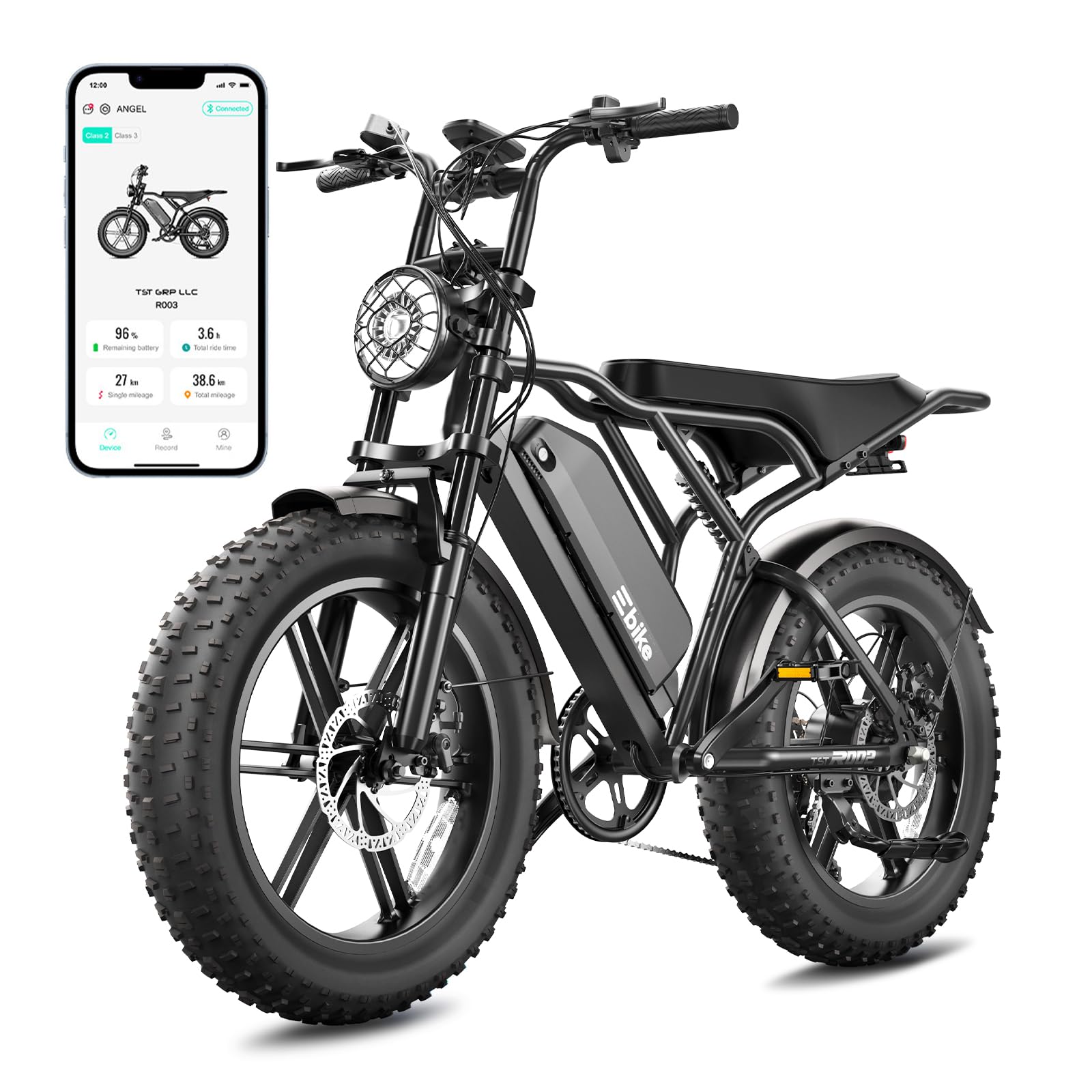
A 450-pound maximum rider weight is the highest rating in this guide by a wide margin — the next closest is 330 — and that is the reason to look at the R004 before anything else. It backs the rating with a 749W motor peaking at 2000W, dual suspension, 20 x 4.0 tires and an iron frame.
Range is the other headline. At 720 Wh this matches the biggest pack here, and TST claims 60 miles in pedal assist from a 6-7 hour charge. Real-world distance depends on how much throttle you use, as it does on every bike on this page, so treat the number as a ceiling rather than a plan.
The details are a mixed bag. There is an LCD display, seven speeds, a bright headlight, and most of the bike arrives assembled, though the front end needs a careful check for stripped bolts before the first ride.
Our hesitation is the brakes. Linear-pull rim brakes on a bike rated for a 450-pound rider is a combination worth inspecting: check pad alignment and cable tension out of the box, and have a shop do the first tune if you are a heavier rider. Do that, and the R004 is the most capable bike here for a big rider or a long, loaded commute.
Pros
- 450-pound rider rating, the highest here
- 720 Wh battery matching the biggest here
- 2000W peak motor with dual suspension
Cons
- Short 180-day warranty for a heavy-duty bike
- LCD, seven speeds, lights but no passenger provision
The bike we point heavier riders and long-distance commuters to, with the caveat that the brakes deserve a careful look before the first ride.
Best for First E-Bike
Jasion EB5

Key Features
- Motor: 350W, 1000W peak
- Weight: 49.6 lb
- Battery: 360 Wh, removable
- Rider height: From 5’0"
- Price: Budget
The EB5 is the least expensive way into this guide, and it does not feel like a stripped-down compromise on paper: a 26-inch bike with a 350W motor, front suspension, disc brakes, front and rear lights and a one-year warranty.
For a first e-bike or a short city commute, that is a genuinely sensible buy. At 49.6 pounds it is one of the lighter full-size bikes here, the seat drops low enough for riders from 5’0", and the 20 mph assist is plenty for bike lanes. We appreciate that Jasion kept the gearing and the lights rather than cutting them to hit a price.
The battery is where the money went missing. It is 360 Wh, and the 25-40 mile claim assumes low assist; figure on something closer to the low twenties when you use the motor freely. The bigger concern is the tires and long-term durability — thin stock rubber and a run of early failures are the recurring themes, so budget for a better set of tires and check the rear cog and chain after the first few rides.
Pros
- Least expensive bike in this guide
- 49.6 pounds and fits riders from 5’0"
- One-year warranty, lights and disc brakes
Cons
- Thin stock tires need replacing early
- 360 Wh battery limits real-world range
A sensible first e-bike if the budget is tight: it covers the basics and fits shorter riders, provided you replace the tires early.
Best for Small Apartments
AYOLNY EB1

Key Features
- Motor: 500W, 1000W peak
- Wheels: 14 in
- Battery: 280.8 Wh
- Rider height: 4’9" to 5’8"
- Price: Budget
Fourteen-inch wheels and a folding handlebar stem make the EB1 the smallest thing here. It tucks beside a desk, into a hall closet or behind a car seat, and at 48.9 pounds most adults can carry it one-handed up a short flight of stairs.
What it is not is a full folder. The frame stays rigid and the stem releases with one lever, dropping the bars flat — that shrinks height rather than length. Fine for a closet, less useful for a car trunk, and worth knowing before you picture loading it into a hatchback.
For a short urban commute or a last-mile errand we think it is a smart little bike: 20 mph from a 500W motor, a 280.8 Wh battery good for about 25 miles in pedal assist, automatic lights, and a sealed front drum brake that needs almost no maintenance. It also fits riders from 4’9" to 5’8", the shortest range here and the reason the bike exists at all. Just do not plan on gravel — 14-inch wheels pass along everything they find, and the drum brake is dependable rather than sharp.
Pros
- Smallest footprint in this group
- Fits riders from 4’9" to 5’8"
- Sealed drum brake and automatic lights
Cons
- Only the stem folds, not the frame
- About 15 miles on throttle alone
The right choice for a short rider in a small apartment: tiny footprint, low standover, and enough range for errands rather than adventures.
How We Chose and Tested the Best Electric Bikes
We started by scanning the market for bikes with reputable motors and batteries, then filtered by price, frame size, and intended use — commuter, cargo, and recreational. We ruled out models with vague battery specs or no local service support, and narrowed the field to eight bikes we could actually live with for 10 months. That mix included Class 1, 2, and 3 models, so we could compare pedal-assist behavior across the range.
Each bike arrived in a box and was assembled solo with the included tools; I timed the process from opening the carton to the first test ride, noted whether brakes and derailleurs needed adjustment out of the box, and flagged any confusing instructions. On a flat, car-free stretch, I ran each bike through its assist levels to see how smoothly power kicked in, how quickly it reached top assist speed, and whether the motor felt jerky at low speeds. Then I repeated the same loop with a steep half-mile climb and a loaded rear rack.
Battery testing meant riding a fixed 12-mile loop with a known elevation profile and recording remaining charge at the end, then timing a full recharge. I rode the same cracked pavement, gravel path, and wet-road stretch on every bike to judge ride quality — whether the fork and tires smoothed out potholes or transmitted every jolt. Over the 10 months, I kept notes on loose bolts, brake pad wear, motor cutouts, and anything that rattled or rusted. Value came last: I compared what each bike’s frame, brakes, drivetrain, and rack mounts actually delivered for its price, not just the spec sheet.
How to Choose an Electric Bike
The number that decides how an e-bike feels to own is not the motor wattage on the box, but the battery’s watt-hours and how much assist you actually use.
Start with watt-hours, not range claims
Every range figure on this page is measured in the lowest pedal-assist setting, with a light rider on flat ground. A 280 Wh pack and a 720 Wh pack are not the same purchase whatever the claims say: the small one gives you a short commute and a little spare, the big one gives you a day out. If your regular ride is under ten miles each way, something in the 375 Wh class is workable; past that, look at the 700 Wh bikes.
Charge time belongs in the same decision. The fat-tire bikes here accept a 3A charger and refill a large pack faster than the 5.5-hour chargers on the city bikes, which matters if you live somewhere you cannot leave a bike plugged in overnight.
Match motor power to your hills, not your ego
Rated and peak watts are different numbers. The commuter bikes here are rated at 350 to 500W and peak at 500 to 1000W, while the fat-tire machines claim 2000W peak and, in one case, 99 Nm of torque. On flat city streets a 350W bike is genuinely enough, and it is lighter and thirstier in the right way — less motor, more range.
We put the extra money into torque only when the route earns it: a steep commute, a loaded rack, or a heavier rider. A big motor on a small battery is the worst combination in this category, because the assist you paid for drains the pack you skimped on.
Weigh it before you buy it
Published weights here run from 45 to 62 pounds, and the fat-tire bikes mostly do not publish one, which tells you something. Anything over about 50 pounds is a two-hand lift onto a hitch rack and a genuine problem up a flight of stairs. Measure the doorway, the hallway, and the trunk before you fall for a bike.
If space is the constraint, be precise about what folds. The Gotrax R1 folds its frame and its pedals; the AYOLNY EB1 only releases the handlebar stem, which shrinks height rather than length. One goes in a trunk, the other goes in a closet.
Use the stated fit and payload figures
Every bike here lists a minimum rider height, and they range from 5’0" to 5’4"; the compact AYOLNY starts at 4’9" and stops at 5’8". Maximum rider weight is the other hard limit: 264 pounds on most, 330 on the RetroVolt, 450 on the TST. Those are ratings for the frame and brakes, not suggestions, and a bike near the top of its range will feel flexy and stop worse.
Step-over style deserves the same attention. A step-through frame is easier to mount with a rack loaded, and it is close to essential for anyone with hip or knee limits.
Brakes, warranty, and the parts you will replace
Brakes are where budget e-bikes economize: disc brakes on most of these, a sealed drum on the AYOLNY, and old-fashioned linear-pull rim brakes on the TST. Discs are the easiest to live with and the easiest to get serviced. We put more weight on warranty length than on peak motor watts, because a battery or controller failure in month eight is the difference between a repair and a write-off, and 180 days is not long cover.
Assume a set of tires in the first year on the cheaper bikes, check that pads and cables are stocked for the brand, and ask a local shop whether they will work on it before you order.
Frequently Asked Questions
Can I ride an electric bike in the rain?
Usually yes, with care, because water resistance is rated per component and not per bike. The Funhang battery carries an IPX5 rating, but displays, connectors, and throttles often carry none at all.
Dry the charge port before you plug anything in, charge indoors, and wash the bike with a bucket rather than a hose. If you commute in the rain daily, check the battery’s IP rating on the listing before you buy, and keep the contacts lightly greased.
What does it cost to keep an e-bike running?
Less than a car, more than a bicycle. Tires and brake pads are the recurring items, and the cheapest bikes here ship with thin rubber worth replacing early. A replacement battery is the one large future expense, so a common pack size is easier to source in three years than a one-off.
Charging is close to free: a full charge on the smallest battery here uses well under half a kilowatt-hour, which is pennies at any household rate.
How do I make the battery last more than a couple of years?
Do not store it full or empty. Lithium packs age fastest at 100 percent and at zero, so for winter or a long gap leave it around half charge in a cool, dry room and top it up before the first ride back.
Charge at room temperature rather than in a freezing garage, and unplug once the light turns green instead of leaving it connected for days.
Final Verdict
The Funhang EB-C2 is the bike we recommend to most riders. A step-through frame, a rack, fenders, lights, a one-year warranty and UL 2849 certification cover the things you actually do on a bike, and it does them for a lot less than the premium machines here.
Its limit is range. If your commute routinely runs past 20 miles with heavy assist, go to the TST R004 and its 720 Wh pack; if the bike also has to fold into a trunk, the Gotrax R1 is the one that makes that possible.