This post contains affiliate links. We may earn a small commission when you buy through our links — at no extra cost to you.
Every multitool looks capable in the package; the truth shows up the first time you put weight behind a blade and feel the handle flex, or the lock give a fraction of an inch. I’ve had one fold onto my knuckles because it couldn’t hold a screwdriver under load. A good one turns the moment you need pliers, scissors, or a sharp edge into a thirty-second job instead of a walk back to the toolbox — and it only does that if it’s small and light enough that you don’t leave it sitting in a drawer.
I’ve carried a lot of these, and the pattern is that the best ones rarely pack the most tools. Sharpness out of the box is easy; holding an edge through months of cardboard and wire isn’t, and neither is a locking mechanism that stays tight after a few hundred openings. Over the past six months my team and I carried and used 12 multitools, pocket-sized to full-size, and more than one budget pick out-worked tools at twice the price. The ones below are the ones we kept reaching for.
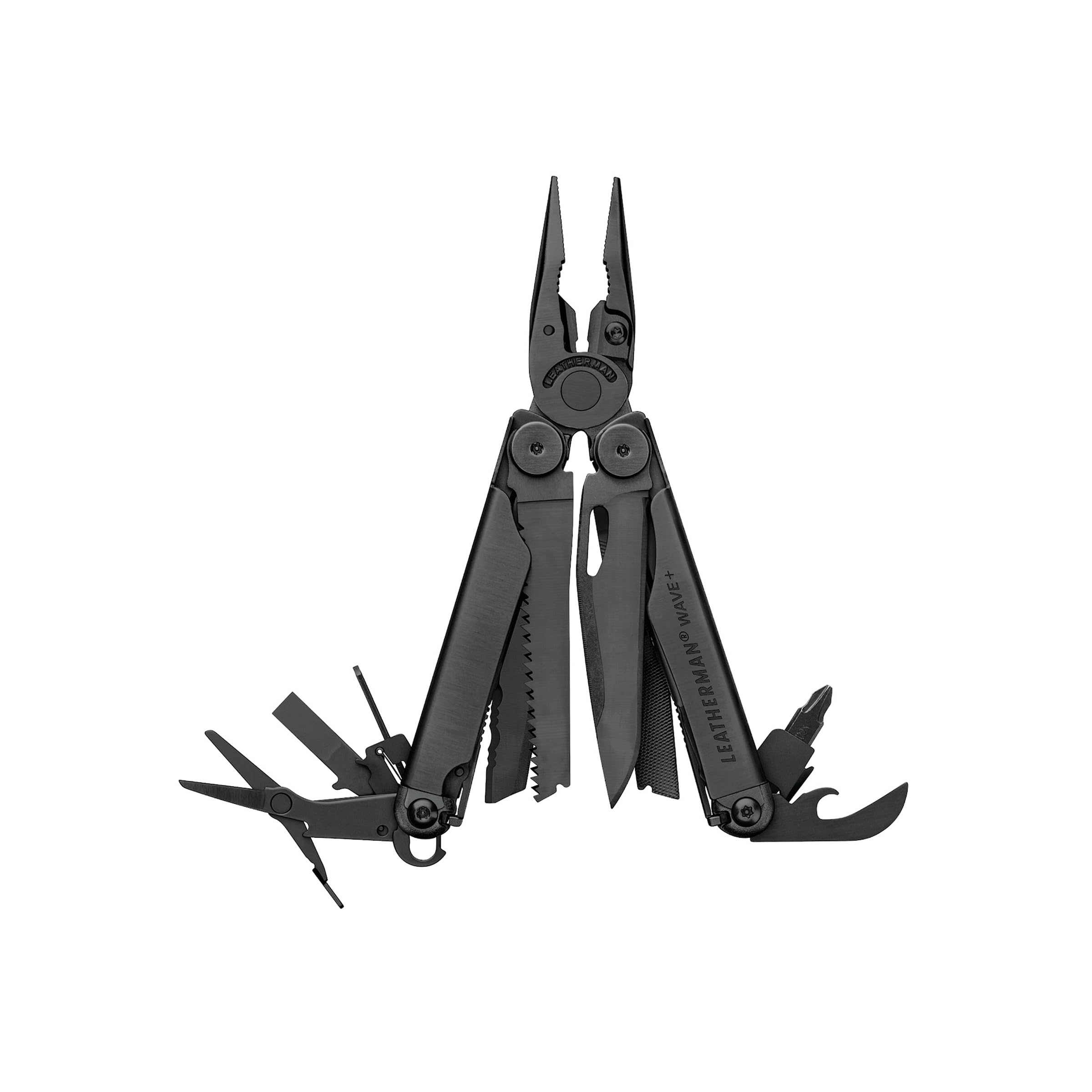


Best for Trail and Home
Leatherman Wave Plus
Key Features
- Tools: 18
- Warranty: 25 years
- Blade access: Outside, one-hand
- Wire cutters: Replaceable
- Price: Premium
Four tools on the Wave Plus open from outside the handles without unfolding the pliers, and that is what makes it our default. A blade and a saw you can get to one-handed, with a lock that clicks over, is the difference between a tool you use on a cold morning and one you leave in the pack. Add spring-action scissors, a full plier head, and replaceable wire cutters, and you have the most complete tool here.
The replaceable cutters are the detail we appreciate most over time. Wire cutters are the part of a multitool that dies first — chew through a coat hanger or a length of fence wire and the edge goes — and on the Wave you unbolt the worn insert and fit a new pair instead of retiring the tool. Leatherman backs the whole thing with a 25-year warranty, which is a serious number for something that lives outdoors.
It carries like a full-size tool: 4 inches closed, built around a proper plier head, the sort of thing that lives in a pack or on a belt rather than a trouser pocket. The handles are shaped so a hard squeeze does not dig into your palm, and the outside tools are the ones you want on a trail — blade, saw, and a file.
The catch is money: this is the most expensive multitool here by a wide margin, and that is the honest barrier. If you use a multitool a few times a month rather than a few times a day, the Sidekick covers the same trail jobs for far less, and the Huntsman handles the cutting and sawing at a fraction of the weight.
Pros
- Blade and saw open one-handed
- Wire cutters are replaceable
- Every tool locks open
- 25-year warranty
Cons
- The most expensive tool in this group
We recommend the Wave Plus to anyone who wants one tool for trail repairs, camp chores, and household jobs — it opens one-handed, locks every tool, and its wire cutters can be replaced.
Best for Full-Size on Budget
Leatherman Sidekick
Key Features
- Tools: 14
- Pliers: Spring-action
- Weight: 6.88 oz
- Warranty: 25 years
- Price: Midrange
The Sidekick is the Wave Plus with the extras trimmed away. You keep the saw, the spring-action pliers, the outside-opening blade, and the 25-year warranty; you lose the scissors, the replaceable cutters, and some of the polish that comes with a more expensive tool.
Nothing that matters for a day outdoors got cut, and that is why we recommend it. The saw takes a fallen branch down to kindling, the spring-action pliers save your hand when you are squeezing again and again — pulling a splinter, holding a nut, bending a stake — and the plain-edge blade opens one-handed. At 3.8 inches closed and 6.88 ounces it slides into a jacket pocket or a pack lid without a thought.
The one practical annoyance is carry: there is no pocket clip, so it is a sheath or the lanyard ring. That suits a pack and frustrates a jeans pocket. Beyond that, the compromises are all in the tool list rather than the build, and the steel, pivots, and lockup feel like the same family as the Wave.
Pros
- Saw plus spring-action pliers
- Outside blade opens one-handed
- 25-year Leatherman warranty
Cons
- No scissors in the tool set
If a Wave Plus is more tool than you need, the Sidekick keeps the saw, the one-hand blade, and the 25-year warranty for a lot less money.
Best for Hiking and Camp
Victorinox Huntsman
Key Features
- Tools: 15
- Weight: 3.42 oz
- Warranty: Lifetime
- Key tools: Wood saw, scissors, blade
- Price: Midrange
The Huntsman is here for one tool: the wood saw. A hiker who needs to break down a dead branch for a fire gets more from that saw than from any number of screwdriver bits, and it is the reason we reach for this Victorinox over the smaller Classic when a pack is going on.
The rest of the 15 functions are the classic Victorinox set — large blade, scissors, screwdrivers, can opener, tweezers, toothpick — packed into 3.42 ounces and 3.6 inches closed. That is light enough to forget in a hip-belt pocket, and the blade and scissors arrive sharp enough to trim a blister dressing or cut a cord cleanly, which is most of what a day hike actually asks.
It is a folding saw, not a pruning saw: an inch-thick branch is a few strokes, and anything past your wrist takes a while, so plan your firewood accordingly. Where it earns its keep is the small stuff — trimming a strap, cutting cheese and cord, sawing a branch down to size — and it does that with less bulk in a pocket than any plier tool here.
Pros
- Wood saw handles kindling branches
- 3.42 oz in a pocket
- Lifetime warranty
Cons
- No pliers, so no gripping or bending
We point hikers at the Huntsman when the day’s jobs are cutting, sawing, and trimming — it does all three at 3.4 ounces and asks nothing of your pocket.
Best for Keys and Pockets
Victorinox Classic SD
Key Features
- Tools: 7
- Length: 2.25 in
- Weight: 0.7 oz
- Key tools: Blade, scissors, nail file
- Price: Budget
The Classic SD is the multitool that actually gets carried, because it lives on a key ring. At 58 mm and 21 grams it adds nothing you notice to a set of keys, and it is there when a tag needs cutting, a screw on your glasses works loose, or a nail splits.
For that weight you get seven functions: small blade, scissors, nail file, screwdriver, tweezers, toothpick, and the key ring itself. The scissors are the standout — they cut thread, tags, and fingernails without a hunt through a bag — and the blade handles tape and packaging. Both come sharp and stay useful with an occasional touch-up.
The honest limit is size: 58 mm closed means the blade is shorter than most people picture, and it is a key-ring tool rather than a knife for camp chores. As a gift it is the easiest call in this group, small and useful and hard to get wrong, and for plenty of people it is the only multitool they will ever need.
Pros
- Disappears on a key ring at 21 g
- Scissors earn their place daily
Cons
- Plastic scales scratch over time
Twenty-one grams, seven functions, and a place on your keys: the Classic SD is the multitool you will carry every day, even if it never handles a real repair.
Best for First Plier Tool
Gerber Suspension NXT
Key Features
- Carry: Pocket clip
- Tools: 15
- Weight: 6.4 oz
- Closed length: 4.25 in
- Price: Budget
Fifteen tools, spring-action pliers, and a locking blade: the Suspension NXT reads like a lot of tool for the money, and in the hand it mostly delivers. The frame is stainless, the butterfly opening is smooth, and the tools sit in the handles ready for a thumbnail.
Spring-action pliers are the feature we care about most at this end of the market, and having them alongside a blade that arrives sharp and holds a working edge is what earns the NXT its place. Prying a lid, bending a bracket, cutting a zip tie, driving a screw — it does the jobs a multitool is actually asked to do, and the lock keeps the blade where you put it.
Plan on a break-in. The lock tabs take a firm thumb when your hands are cold or greasy, and working every tool open and closed a dozen times when it arrives makes a real difference. Past that, the compromises are the predictable ones at this price, and none of them stopped us using it.
Pros
- Spring-action pliers at a budget price
- Fifteen tools that all lock
- Blade arrives sharp and holds an edge
Cons
- Flimsy pocket clip
- Small blade and drivers
For a first plier tool or a truck glovebox, the Suspension NXT covers everyday jobs at a budget price and does not feel disposable doing it.
Best for Belt Carry
Gerber Truss
Key Features
- Blade: Full serrated
- Carry: Sheath included
- Tools: 17
- Weight: 8 oz
- Price: Midrange
The Truss is the one here that arrives with a sheath and expects to be worn. That sounds minor until you have carried a full-size plier tool loose in a pocket for a day: on a belt it stops being a lump against your thigh and becomes something you can reach with one hand while the other holds a branch.
Seventeen tools, and the camp-relevant ones are all present: a saw, a full serrated blade, scissors, a cross driver, three flatheads, wire cutters and a stripper, plus openers. The serrated blade is the piece we reach for at a campsite — rope, webbing, a stubborn bag of kindling — because it keeps cutting where a plain edge skates on grit.
The weak point is the plier head. This is a tool for squeezing a bent stake or holding a nut, not for cutting fence wire or leaning on a rusted bolt, and stiff wire under a hard squeeze is where it is most likely to let you down. Treat it as a camp and trail tool and it is fine; treat the pliers like a proper pair and you are asking for trouble.
Where it lands for us is the hiker who wants the tool on a belt and does not plan to do any real wrenching. Sheath, saw, serrated blade, and a limited lifetime warranty cover most of what a campsite asks for, and the belt carry means it is with you rather than buried in the pack.
Pros
- Sheath included for belt carry
- Saw and full serrated blade
- Seventeen locking tools
- Limited lifetime warranty
Cons
- Stiff tool-lock tabs
The Truss is the pick for belt carry: a sheath, a saw, a serrated blade, and 17 tools that cover campsite chores without asking for a pack pocket.
Best for Glovebox and Garage
Mossy Oak 21-in-1

Key Features
- Carry: Sheath with bit pocket
- Tools: 21
- Weight: 1 lb
- Locking: Self-locking tools
- Price: Budget
Most cheap multitools hand you a hex sleeve and no bits to put in it. The Mossy Oak ships with a screwdriver bit set and a sheath with an elastic pocket on the front for the spares — the sort of practical detail that decides whether a tool gets used or left in a drawer.
Twenty-one functions, every one of them self-locking, laid out so the tools open without unfolding the pliers first. There is needle-nose pliers with a wire cutter, plain and serrated blades, a wood and metal file, a saw, a ruler, and a bit driver that takes standard bits, so you can add the ones your own work needs.
What you are buying is capability, not refinement. At 454 grams this is a heavy tool, and it belongs in a glovebox, a boat locker, or a workshop drawer rather than a hiking pack, where the bit set spares you a trip back to the toolbox. Judged as a tool that stays somewhere and covers a bit of everything, it is a lot for the money.
Pros
- 21 tools including a bit set
- Every tool self-locks
- Sheath with a bit pocket
Cons
- Tools stiff out of the box
- Sheath wears out first
Buy the Mossy Oak to leave in the car, the boat, or the workshop: 21 locking tools and a bit set, at the low end of this group’s prices.
Best for Budget First Tool
WETOLS 21-in-1

Key Features
- Tools: 21
- Pliers: Spring-loaded needle-nose
- Weight: 11.8 oz
- Closed length: 4.13 in
- Price: Budget
The WETOLS and the Mossy Oak are the same idea from different factories: 21 tools in a stainless body, a sheath, and a price at the bottom of this group. The difference that matters is weight — 334 grams against 454 — which makes the WETOLS the easier of the two to keep in a pack.
The tool set covers the same ground: spring-loaded needle-nose pliers, regular pliers, wire cutters, plain and serrated blades, a wood and metal file, a ruler, a hex sleeve, and a sheath. Spring-loaded pliers at this price are worth noting, because they save your hand when the jaws open and close over and over.
It measures 4.13 inches closed and 5.91 inches open, in hardened stainless with a sandblasted handle, and the tools lock. It is a lot of metal for the money, and it is easy to see why it gets sold as a gift: it looks more expensive than it is, and a first-time multitool buyer will not be disappointed.
Where it sits for us is a second tool — the car, the shed, a boat bag — where being a little chunky does not matter and having 21 tools within reach does. It is not as refined as a Leatherman and it will not replace a pocket knife, but as a knockabout spare it earns its place.
Pros
- 21 tools with a hex sleeve
- Spring-loaded needle-nose pliers
- Lighter than the Mossy Oak
Cons
- Bulky at 334 g for a pocket
The WETOLS is the cheapest way into a full-size plier tool here, and a sensible one to leave in the car or the shed.
How We Tested: Locks, Blades, and Pocket Time
We built the shortlist from specs rather than marketing: blade steel, closed length, weight, tool count, and — the detail most shoppers skip — what kind of lock holds each blade open. Anything over about 10 ounces, or listed with a vague stainless steel claim and no lock description, got cut before we spent a dollar. That left 12 multitools, which we bought ourselves and used for six months.
Testing happened where multitools actually live. Each one spent at least a month riding in a front pocket for daily carry, where we noted whether it dragged on jeans or dug in when we sat down. In the garage we tightened bike brake cables, pried paint can lids, and drove screws into cabinet hinges, leaning on each open blade and driver until something moved so we could see which locks crept. We opened every tool one-handed, wore work gloves for half of it, and timed how long the pliers took to reach.
Blades were shaved against paper when they came out of the box, then checked again after weeks of cutting cardboard and paracord and a little whittling on pine. For durability, each tool got dropped on concrete and left a week in a damp shed to see what spotted with rust. We also weighed every one on a kitchen scale and counted how many tools we’d genuinely reach for versus filler, since a long list of functions you never touch isn’t versatility — it’s weight.
How to Choose a Multitool
The best multitool is the one that is on you when something needs fixing, and that comes down to one question: will it live in a pocket, on a belt, or at the bottom of a pack?
Pliers or a pocket knife?
A plier-based tool is the right answer if your repairs involve holding, bending, or turning: a bent tent stake, a loose nut on a stove, a wire that needs cutting. A Swiss Army-style knife packs a similar tool count into less weight, but it has no jaws, so anything that needs a grip is out of reach.
Our picks split along that line. The Wave Plus, Sidekick, Suspension NXT, Truss, and both 21-in-1 tools have pliers; the two Victorinox knives do not. If your trips are mostly walking, cutting, and sawing, a pocket knife is the better use of weight. If you fix bikes, stoves, or cars, get the pliers.
Weight decides where it carries
Twenty-one grams disappears on a key ring. Around 100 grams is a pocket knife you notice but tolerate. Anything past 200 grams wants a clip, a sheath, or a pack lid, and once you pass 300 grams the tool has stopped being something you carry and become something you keep somewhere.
Decide where the tool will live before you fall for a tool count. A 454-gram multi-tool in a hiking pack is dead weight you will resent on the third climb; the same tool in a glovebox is a bargain.
Locks, one-hand opening, and cold hands
A lock keeps the blade from folding onto your fingers, so it is worth having on anything you will use with force. The catch is the release: a tab that needs a firm thumbnail is fine at a workbench and miserable in gloves. Work every lock open and closed a dozen times when a tool is new; most of them ease up noticeably.
One-hand opening matters more than it sounds. The Wave Plus and the Sidekick both let you get the blade or saw out without unfolding the handles, which is the difference between using the tool and putting it down to free up a second hand.
Tool counts and the tools you will use
Twenty-one tools sounds better than fifteen until you count the flathead drivers. Look for the four or five you will actually reach for: a blade, a saw if you are outdoors, scissors if you are not, pliers if you fix things, and a bit driver if you work on equipment with screws.
Warranty is the other half of value. Leatherman covers its tools for 25 years, Victorinox for life, and Gerber’s limited lifetime warranty applies to the plier tools here. In a category where the pivots and cutters wear first, that coverage is worth more than two extra drivers.
Frequently Asked Questions
Can you take a multitool on a plane?
Not in carry-on. A blade of any size has to travel in checked baggage, and that includes the tiny one on a key-ring Swiss Army knife — security will take it otherwise. Pack it in your checked bag, or leave it at home and carry a bladeless tool for the flight.
How do you clean and oil a multitool?
Wipe off grit and sap with a rag and a little warm soapy water, dry it thoroughly — the pivots are where rust starts — then put a drop of light oil on each joint and work every tool open and closed. Do that after a wet trip and the action stays smooth; skip it and even stainless will spot and stiffen.
How do you sharpen a multitool blade?
Most touch-ups need only a few passes per side on a fine stone at the angle the factory grind already has, with the tool open and locked so the blade cannot fold on you. Serrated edges only need the flat side dressed. Keep pull-through sharpeners away from the saw — the teeth are set and easy to round over.
Final Verdict
The Wave Plus is the tool we reach for first: the blade and saw come out one-handed, every tool locks, and the wire cutters can be replaced instead of ending the tool’s life. If the money is the obstacle, the Sidekick keeps the saw and the one-hand blade for far less. If the weight is the obstacle, the Huntsman carries a saw and scissors at 3.42 ounces and you will never notice it in a pack.
Buy for the jobs you actually do, not the tool count.