This post contains affiliate links. We may earn a small commission when you buy through our links — at no extra cost to you.
The wood at your campsite is never the size you need it to be. Deadfall comes in lengths too long for the fire ring and branches too thick to snap over your knee, which is when someone starts swinging a hatchet they don’t know how to use. A folding saw fixes that in about a minute: it packs down to the length of a paperback, weighs less than a water bottle, and breaks down a six-inch limb without bringing anything sharp near your shin.
I figured folding saws were all the same until I started paying attention to the blade lock, the one part that decides whether the tool is convenient or genuinely hazardous. Over the past six months we’ve cut, folded, dropped, and dulled our way through a dozen folding saws, from bargain-bin hardware-store models to nicer pruning saws pulled off the gardening shelf. One thing worth knowing: out-of-the-box sharpness means little if you can’t buy a replacement blade later. Below are the ones that earned a spot in the pack.
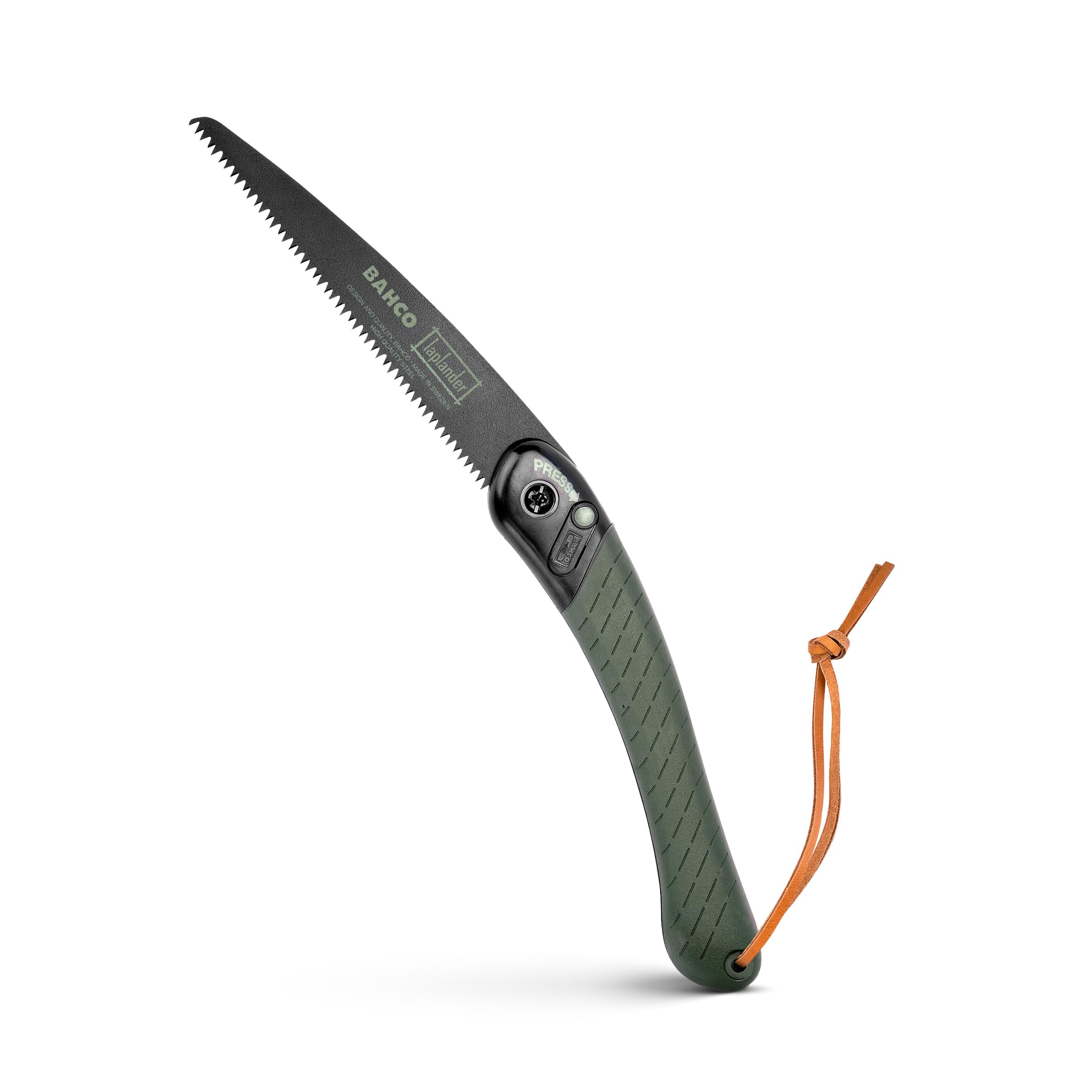


Best for All-Around Camp Use
Bahco Laplander 396-LAP
Key Features
- Teeth: 7 TPI
- Weight: 7.52 oz
- Blade lock: Open and closed
- Blade length: 7.5 inches
- Price: Midrange
At 7.52 ounces, the Laplander is the saw we reach for when we do not know what we will be cutting. It folds into a stub that drops into a side pocket, and the blade locks open and closed — the second part matters more than it sounds, because a blade that stays shut cannot chew a hole through a stuff sack on the hike in. That combination of low weight and a lock at both ends is why it is our top pick: it handles the ordinary job of deadfall, kindling and a pot-hanger stick without asking you to plan around it.
The 7-1/2-inch blade runs Bahco’s XT toothing at 7 teeth per inch, and the low-friction coating earns its keep once the sap starts. We cut green limbs and dry, seasoned firewood with it, and the plate is thick enough that it does not wander or bind the way thin blades do. The pull stroke does the work; pressure just slows it down. The two-component handle stayed secure in wet weather, which is more than we can say for the smooth plastic grips on some saws in this group.
The handle is long enough that a gloved hand still has somewhere to sit, and the leather strap at the end turned out to be the detail we used most: loop it over a wrist on a slope and the saw hangs there while you stack wood with both hands.
Pros
- Light at 7.52 ounces for a locking saw
- Locks both open and closed
- Cuts green and dry wood without binding
- Grip stays secure in wet weather
Cons
- Lock button is small and stiff
- 7.5-inch blade tops out at limb-sized wood
We recommend the Laplander as the default camping saw: light, locks both ways, and handles the limb-sized wood most campers actually cut.
Best for Ultralight Backpacking
Silky PocketBoy 170
Key Features
- Weight: 10.4 oz
- Blade length: 6.75 inches (170mm)
- Cut capacity: 3.4 inches
- Included case: Hard plastic belt case
- Price: Premium
Pack space, not cutting power, is why the PocketBoy earns a place here. The 6.75-inch blade lives in a clear plastic flip-lock case with a belt clip, and it is the one saw in this group we clip to a hip belt rather than bury in a pack. There is also a second open locking position set at an angle for flush cuts, which is the one you use when you are taking a stub off level with the ground — a small feature we ended up using more than the main lock position.
Where it wins us over is the cut. The hard chrome plated blade is 1.4 mm thick with 8.5 teeth per inch, and it pulls through dry hardwood with a smoothness none of the budget saws here match. It also demands good manners: this is a thin blade, and pushing down on it bends rather than speeds it, so let the teeth do the work. Rated capacity is 3.4 inches, so it is a limb-and-kindling saw — but for a fire at a lake or a blocked trail, that is the whole job. The medium tooth pattern is the practical choice for most campers, leaving a cleaner edge on seasoned wood than the aggressive 7 TPI blades.
Pros
- Very sharp 8.5 TPI blade leaves clean cuts
- Hard plastic case protects pack and blade
- Second locking position for flush cuts
- Small enough to clip to a hip belt
Cons
- Cut capacity stops at 3.4 inches
- Premium price for a small saw
Pack space is the whole argument for the PocketBoy, and it wins it: the sharpest small saw here, with a hard case that protects the rest of your gear.
Best for Base Camp Firewood
Agawa Canyon BOREAL15
Key Features
- Frame: Anodized 6063 aluminum
- Weight: 15.2 oz
- Blade length: 15 inches
- Blade changes: No tools required
- Price: Premium
The BOREAL15 does not hinge like the others. Three hinged sections in an anodized aluminum frame unfold into a rigid 15-inch trapezium and tension the blade automatically, and folded it collapses into a bar about an inch wide. That is the trick worth understanding: it packs as a straight line, not as a lump, so it slides down the side of a pack instead of fighting for space in the middle of it. The frame is 6063 aluminum with stainless hardware and a fiberglass-reinforced nylon handle cover.
In use, the rigid frame changes the work. You are not fighting flex, so full-length strokes go through logs that would stall the smaller saws here, and the saw sits in the cut instead of skating across bark. Build quality is the strongest in this roundup: the frame, the hardware and the grip all feel like a tool rather than an accessory, and it folds and unfolds in seconds without a blade touching your hand. We also like that the blade changes without tools, so a dull edge is a swap.
Fifteen inches of frame does not drop into a side pocket, and at 15.2 ounces it is the heaviest saw here — a fair trade for base camp, car camping and any trip where you are processing wood rather than just tidying a fire ring. Carrying it up a mountain is a decision you make consciously.
Pros
- Rigid frame takes a 15-inch blade without flex
- Cuts logs well beyond limb size
- Blade changes without tools
- Folds into a slim bar for packing
Cons
- Most expensive saw in this roundup
This is the one we take when firewood is the point of the trip: a rigid 15-inch frame that turns logs into camp wood and folds flat afterward.
Best for Cutting Larger Limbs
Silky GomBoy 240
Key Features
- Teeth: 8.5 TPI
- Weight: 8.82 oz
- Blade length: 9.5 inches (240mm)
- Cut capacity: 4.7 inches
- Price: Premium
Read the cut capacity before the blade length. The GomBoy 240’s 9.5-inch blade is rated to 4.7 inches of wood, and that number is what decides whether the log in front of you is a job or a struggle. It is also 250 g, which means the saw that can take a four-inch limb weighs barely more than the pack saw in this group.
It is a pull-stroke saw with medium 8.5 TPI teeth, and the cut is smooth enough that the surface looks planed rather than torn. The Japanese-style handle fills the hand and keeps a gloved grip behind the teeth, and the hard plastic case it ships with is a real one — hinged, close-fitting, and enough to keep the teeth away from your tent fabric.
This is the saw for the camper who wants more than a limb saw but will not carry a 15-inch frame. It sits between our top pick and the base-camp saw in every way that matters: more capacity, more money, a little more weight. Where the money goes is the tooth geometry — the impulse-hardened, taper-ground teeth leave a surface you can run a hand along, and 4.7 inches of capacity means one saw covers limbs and small rounds on the same trip.
Pros
- 4.7-inch cut capacity from a 250 g saw
- Impulse-hardened teeth cut fast and clean
- Hard plastic case included
Cons
- Thin blade can snap if twisted in a kerf
- Costs more than the top pick
Our pick when limbs are not enough but a 15-inch frame is too much: 4.7 inches of cut capacity in a 250 g saw with a case.
Best for Budget Day Trips
FLORA GUARD 7.7-Inch Folding Saw
Key Features
- Teeth: 7 TPI
- Weight: 8.48 oz
- Blade lock: Spindle lock
- Blade length: 7.7 inches
- Price: Budget
The FLORA GUARD is the least expensive saw here, and it is the saw we hand to someone who wants one in the car and does not want to think about it. The 7.7-inch SK5 blade carries 7 TPI staggered teeth, the whole thing weighs 8.48 ounces, and it opens and locks in one motion. It cuts, too: green branches come apart quickly, dry stuff takes a little more patience, and the rubber handle is comfortable for a saw this size.
What you give up is the finishing. There is no case or sheath in the box, so the folded blade rides loose in a pack until you find something to put it in — a heavy sock works, and so does a piece of inner tube. The spindle lock is a basic design and the grip is plainer than the Silky saws, but at this price those are fair trades. Think of it as a second saw, a scout saw, a glovebox saw; it is not the one we trust for a week of fires in wet country.
Pros
- Least expensive saw in this roundup
- 8.48 ounces and folds small
- Sharp 7 TPI blade handles green and dry wood
Cons
- No sheath or case in the box
Spend the least and still get a sharp, packable saw; we keep the FLORA GUARD in a day pack or a glove box without worrying about it.
Best for Car Camping
MOSSY OAK 7-Inch Folding Saw

Key Features
- Weight: 9.17 oz
- Blade length: 7 inches
- Included case: Belt and pack pouch
- Blade material: D6A and M2 bimetal
- Price: Budget
Mossy Oak’s blade is bimetal — D6A and M2 steel with a Teflon coating — and at 7 TPI with triple-ground teeth it is built to keep cutting after the shine wears off. The auto-lock catches as soon as the blade reaches full extension, and when the saw is folded no teeth are exposed, which is the sort of thing you appreciate the first time it goes into a pack next to a sleeping bag.
The pouch is the reason we pick this over the other budget saws. It loops onto a belt or a pack strap and the saw sits flat against the hip instead of swinging from a lanyard, and the whole package is 0.26 kg. The non-slip handle is long enough for a gloved hand and the 7-inch blade is right for limbs and kindling.
For car camping and a scout-camp woodpile, that is a sensible combination: automatic locking for people who do not saw often, a coated blade that shrugs off sap, and a pouch that keeps the saw where you can find it. It will not out-cut the Silky saws on seasoned hardwood, and it costs much less money, which is the trade most weekend campers are happy to make.
Pros
- Bimetal blade with Teflon coating
- Auto-locks when fully open
- Pouch attaches to belt or pack strap
Cons
- Blade flexes under hard pulling
A sensible budget choice for car campers who want an auto-locking blade, a coated bimetal blade and a pouch that rides on the pack strap.
Best for Light-Duty Firewood
REXBETI 8-Inch Folding Saw

Key Features
- Teeth: 7 TPI
- Weight: 9.76 oz
- Blade length: 8 inches
- Cut capacity: 4 to 5 inches
- Price: Budget
An 8-inch SK-5 blade at 9.76 ounces is the pitch, and it is a good one: an inch more blade than our top pick, and still light enough to forget in a pack. The 7 TPI staggered teeth are aggressive, the handle is longer than most at this size, and the rubber coating stays grippy with wet hands.
The extra blade length is aimed at 4- to 5-inch branches, and that is the honest edge of it — bigger wood means more strokes, not more capacity. It folds down to a package that fits a pack lid, and it pulls through green wood quickly, which is most of what you cut at a campsite.
The blade is where the savings come from. It is a thin plate, and levering it out of a kerf is what breaks blades; keep your strokes straight and it does the work, twist it and you will hear about it. Treat the saw as light-duty and it lasts a season of weekend fires.
For a truck box, a cabin woodpile or a couple of car-camping weekends a year, it is an easy buy: a long blade, a light saw, very little money at risk. It is the one saw here we treat as disposable rather than as kit we plan a trip around.
Pros
- 8-inch blade at 9.76 ounces
- Aggressive teeth cut green wood fast
- Long rubber-coated handle
Cons
- Lock can release during a cut
- No sheath in the box
Cheap, light and long-bladed, but the lock and the thin plate do not inspire confidence; buy it for light camp chores, not remote trips.
How We Picked and Tested Folding Saws
The shortlist started with a sweep of the camping, pruning, and hardware aisles, then a filter: a blade that locks open, a handle that won’t shred a bare hand, and ideally a blade you can replace rather than throw away. Twelve folding saws made the cut. Each one spent six months going where a saw actually goes: strapped to a daypack on three camping trips, rattling around in a truck bed, and left out overnight in the rain at least once.
Cutting performance got the most attention. We timed every saw through a four-inch seasoned oak limb and counted strokes, then repeated the cut on green pine and on gritty driftwood to hurry the wear along. Out-of-the-box sharpness showed up in the first ten strokes; what separated the group was stroke twenty-five, when the cheaper teeth started skating instead of biting. We also watched whether the gaps between teeth cleared sawdust or clogged and needed a shake-out.
Blade locking we tested like a skeptic — spine pressed against a log with our weight behind it, then handle-up and shaken hard to see if the blade crept. We opened and folded each saw with gloves on, one-handed, in the dark. Handles were checked for flex and cracks after a season of being tossed in truck beds, pivots for rust, and every saw went on a kitchen scale and into a hip-belt pocket to see how it really carried. Value, in the end, came down to how each one felt after months rather than minutes.
How to Choose a Folding Saw for Camping
The saw that earns a place in your pack is the lightest one that still cuts the wood you actually gather — for most campers that means a 7- to 8-inch blade under 10 ounces, not a 15-inch frame.
Blade length and cut capacity
Blade length and cut capacity are not the same number, and the second one decides what you can actually get through. The Silky PocketBoy’s 6.75-inch blade is rated to 3.4 inches of wood, the GomBoy 240’s 9.5-inch blade reaches 4.7 inches, and the 15-inch Agawa Canyon frame takes logs the others cannot start. A 7.5-inch blade like the Laplander’s comfortably handles arm-thick limbs, which is what most camp fires are made of.
Look at the deadfall where you camp before you buy. If you are breaking up limbs and making kindling, a short saw is faster and lighter; if you are bucking rounds for a wood stove or a long fire, buy length and accept the weight.
Weight and folded shape
The difference between a saw that comes along and one that stays in the car is usually a few ounces and a folded profile. Our picks run from 7.52 ounces to 15.2 ounces, and the heavy end is a deliberate trade: the BOREAL15’s aluminum frame buys rigidity you can feel in a deep cut. Folded shape matters just as much. A short saw drops into a side pocket; the Agawa folds into a long, thin bar, so it rides in a pack lid or strapped outside rather than in your pocket.
Weigh your whole kit before deciding. Two pounds of saw on a five-mile hike is a decision; the same saw in a car-camping tote is not.
Locks, hinges and handles
Every folding saw here locks open. Fewer lock closed, and closed is the position that keeps a blade out of your tent fabric. Our top pick locks both ways. Auto-locking designs like the Mossy Oak’s catch as the blade reaches full extension, which suits people who saw a few times a season; a manual slider is slower but you feel it engage.
Whatever you buy, press the spine of the open blade with your thumb before you trust it, and shake the folded saw to confirm it stays shut. Handle length matters more than handle shape: a longer grip keeps a gloved hand behind the teeth.
Teeth: green wood versus dry
Tooth count tells you how a saw behaves, not how good it is. A 7 TPI blade like the Laplander’s or the REXBETI’s clears chips fast and suits green limbs; the finer 8.5 TPI teeth on the Silky saws leave a cleaner edge on dry, seasoned hardwood but clog more in sappy spring wood. Hard chrome plating and impulse-hardened teeth hold an edge considerably longer than plain steel.
Blade thickness is the other half of the feel. Thicker stock, as on the Laplander, resists flex and steers straighter in a deep cut; thin stock is lighter and faster but far less forgiving of a crooked stroke.
Cases, sheaths and what is in the box
Box contents differ more than the photos suggest. Silky ships the PocketBoy and the GomBoy in hard plastic cases, Mossy Oak includes a belt pouch, and the FLORA GUARD and REXBETI arrive as bare saws. Budget for a sheath, or wrap the blade, before either goes into a pack with a sleeping bag.
If you cut often, check whether the blade is replaceable. The BOREAL15 changes blades without tools, which spreads the cost over years of use and keeps a good frame working after the teeth dull.
Frequently Asked Questions
Is a folding saw or a hatchet better for camp?
For turning deadfall into firewood, the saw wins: it makes clean cuts, throws no chips at your shins, and needs no swing radius in a tight campsite. A hatchet is for splitting kindling and chopping through knots. If you carry only one tool, carry the saw — most camp woodwork is cutting to length, and a 7- to 8-inch blade handles limbs up to arm thickness.
Can you sharpen a folding saw blade?
Usually not. These blades use impulse-hardened teeth with a hard chrome or similar plating, and a file skates across them instead of cutting. Treat the blade as a wear part: the Agawa Canyon BOREAL15 is built for tool-free blade changes, so a dull blade is a swap rather than a new saw. For occasional camp use, one blade lasts many seasons.
Why does my folding saw bind halfway through a cut?
Pressure, almost always. These blades cut on the pull stroke and the plates are thin, so leaning on the handle bows the blade and pinches it in the kerf. Use long, light strokes and let the teeth clear the chips. On a limb that is under tension, make a short cut from underneath first so the wood does not close on the blade.
Final Verdict
Start with the Bahco Laplander. At 7.52 ounces it is light enough to live in a pack without a second thought, it locks open and closed, and it cuts the limb-sized wood that most camp fires are built from — which is the entire job. The 7.5-inch blade is the size that fits the most trips.
Change the requirement and the pick changes. If pack space is the constraint, the Silky PocketBoy is smaller, sharper and better protected in transit. If firewood is the reason you are out there and you can spare 15.2 ounces, the Agawa Canyon BOREAL15 turns logs the others only nibble at.