This post contains affiliate links. We may earn a small commission when you buy through our links — at no extra cost to you.
A backpacking saw has to cut deadfall like a real tool, then disappear into your pack without adding a pound you’ll feel on the climb. I’ve carried folding bow saws, tiny pack saws, and one optimistic wire saw; the difference between a quick fire and a frustrating hour usually comes down to sharpness, blade lockup, and whether the blade binds in green wood. What you’re really buying is saved effort: a saw that bites on the first stroke, stays tight when you’re tired, and doesn’t cost you extra weight or pack space. Over eight months, my team and I carried 14 backpacking saws on weekend trips, backyard woodpiles, and a few muddy trail-clearing mornings.
Some were wonderfully light but flexed; others cut fast but felt loose at the hinge. The keepers balanced portability and weight against cutting performance, quality, value, and blades that still bit after knots and dirty bark. The picks below are the saws we’d pack again, whether for camp kindling or a small blowdown.
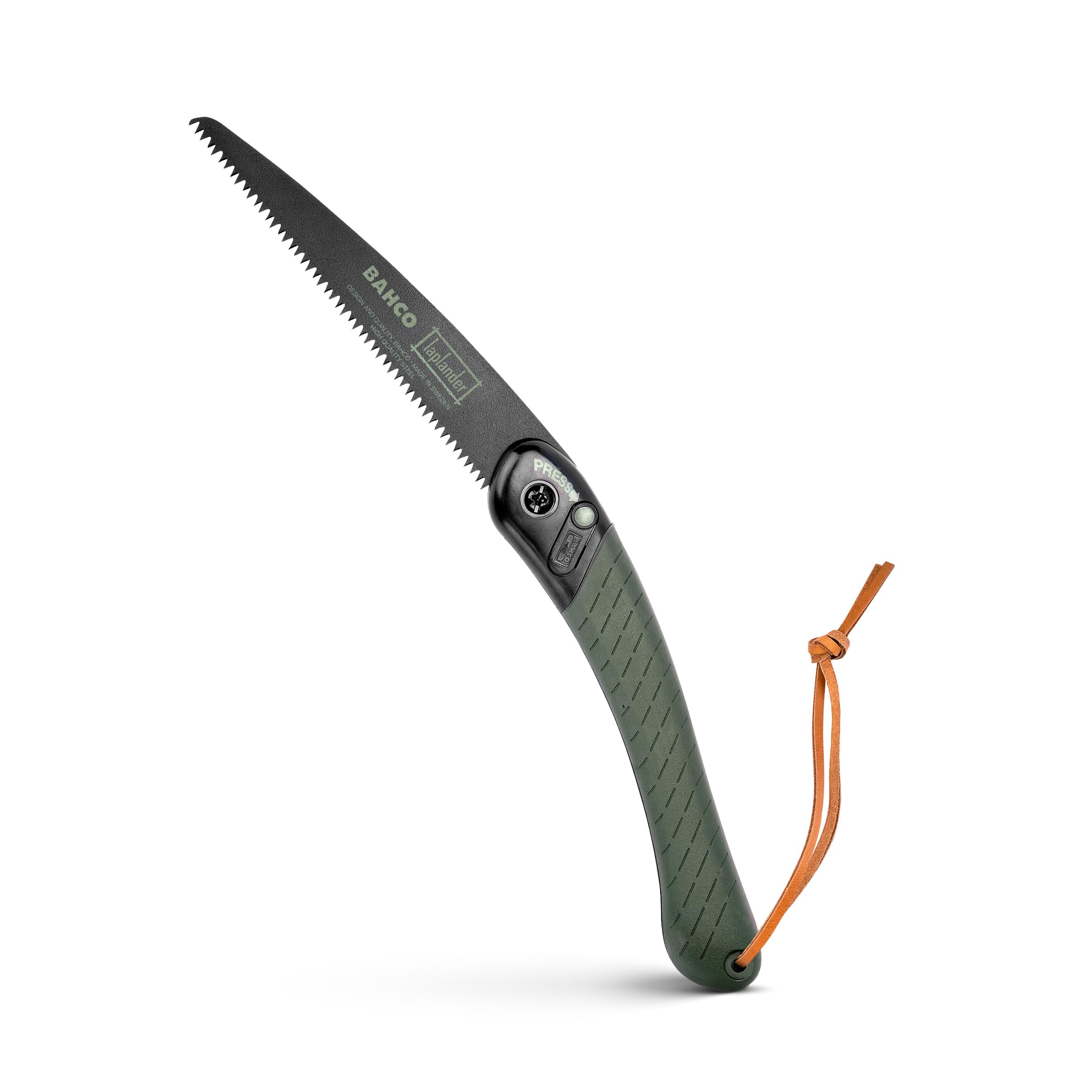


Best for All-Around Backpacking
Bahco Laplander 396-LAP
Key Features
- Carry: Leather strap
- Teeth: 7 TPI
- Weight: 7.52 oz
- Blade Length: 7-1/2 inches
- Price: Midrange
At 7.5 ounces with a 7.5-inch blade, the Laplander makes the packing decision easy: it is light enough to disappear into a daypack and long enough to deal with the wrist-thick deadfall that usually blocks a trail. The 7 TPI XT teeth are aggressive without feeling uncontrollable, and the low-friction coating helps the blade clear green or dry wood instead of gumming up.
We think this is the balance most backpackers want. A longer blade cuts faster, but it also adds swing weight and a longer package; a shorter one packs smaller but turns every bigger limb into a chore. Bahco lands in the middle, then adds the details that matter after the novelty wears off: a lock that holds the blade open and closed, and a two-piece handle that stays planted when your hands are wet or gloved. The leather strap is a nice touch for carrying.
Where it stops: this is a camp saw, not a chainsaw. For bigger logs or a group fire, the longer Silky GomBoy or Agawa Boreal15 makes more sense; for most three-season backpacking, the Laplander is the one we reach for first. It is also the saw we hand to someone who wants one dependable tool rather than a collection.
Pros
- Light 7.52-ounce pack weight
- Fast 7 TPI cutting
- Locks open and closed
- Comfortable non-slip wet-weather grip
Cons
- Leather strap is not a hard case
For most backpackers, we recommend the Laplander: it is light, fast on small limbs, and locks securely open and closed.
Best for Larger Limbs
Silky GomBoy Professional 240
Key Features
- Teeth: 8.5 TPI
- Weight: 8.82 oz
- Blade Length: 9.5 inches
- Cut Capacity: 4.7 inches
- Price: Premium
The GomBoy’s 9.5-inch blade is a step up, and for backpackers who routinely cut larger limbs, we think it earns its place. The longer blade reaches across a log, the 4.7-inch cut capacity covers the wood most camp saws choke on, and the 8.5 TPI teeth are ground thin and hard for a fast, clean pull.
The trade-off is technique. This is a thin, high-performance blade, not a pry bar; let the teeth do the work and the GomBoy slices instead of bucking. The clear plastic case is a real plus in a pack, because the teeth stay covered and the case keeps the blade from snagging nylon.
At 250 grams it is not the lightest saw here, and it is more saw than a solo overnight needs. We still choose it when the day’s wood is likely to be bigger than a wrist, or when a group fire needs a steady supply of limbs. For ounce-counting solo trips, the Bahco or PocketBoy is easier to justify.
Pros
- Long 9.5-inch cutting blade
- Generous 4.7-inch cut capacity
- Fast, clean pull cut
- Clear hard case included
Cons
- Thin blade can crack if forced
- Premium price for occasional users
We recommend the GomBoy for backpackers who regularly cut bigger limbs and want a faster, cleaner blade; it rewards a light touch.
Best for Compact Packs
Silky PocketBoy 170
Key Features
- Weight: 10.4 oz
- Carry Case: Clear plastic belt case
- Blade Length: 6.75 inches
- Cut Capacity: 3.4 inches
- Price: Premium
The PocketBoy is the saw we tuck into a hipbelt pocket when we want a real cutting tool without strapping a full-size saw to the pack. The 6.75-inch blade folds into a compact package, and the clear plastic flip-lock case clips to a belt and keeps the teeth away from pack fabric.
The 8.5 TPI blade is razor sharp and cuts on the pull stroke, so small branches and roots part with little downward pressure. Two open locking positions let you work in line or flush against a cut, which is handy when you are clearing a limb close to the trunk. It is a precise little saw rather than a brute.
We think it is the best compact premium choice here for tight packs, day hikes, and hunters who want a saw in a pouch. The catch is capacity: 3.4 inches is the listed cut, so it is not the tool for a steady diet of bigger logs, and at 10.4 ounces it is not lighter than some longer saws. Buy it for control and packed size, not for maximum wood per stroke.
Pros
- Compact 6.75-inch folding blade
- Two open locking positions
- Razor-sharp blade cuts on the pull
- Hard belt case included
Cons
- Premium price for a small saw
We choose the PocketBoy when packed size and control matter more than raw capacity; its short blade is a precision tool, not a log splitter.
Best for Budget Trips
Flora Guard 7.7-Inch Folding Saw
Key Features
- Lock: Open and closed
- Teeth: 7 TPI
- Weight: 8.48 oz
- Blade Length: 7.7 inches
- Price: Budget
The Flora Guard is the saw we hand to a friend who needs a camp saw and does not want to spend much. It has a 7.7-inch blade, 7 TPI staggered teeth, and a rubber handle that is comfortable enough for a few cuts around camp. The blade locks open and closed, and the whole thing weighs 8.48 ounces.
We think it is the budget pick for occasional backpackers, car campers, and anyone who wants a saw in a go bag. It cuts cleanly through small branches, folds small, and does not ask for careful handling. It is not as refined as the Bahco or the Silkys: the lock is simpler and the handle has less shape.
The blade is the place where the savings show. It is not as stiff as the premium saws, so a binding cut can feel vague, and you need to keep the stroke straight. For light trail clearing, kindling, and the odd marshmallow stick, that is a fair trade. We keep one in the truck and hand it out when someone needs a saw without fuss.
Pros
- Low-cost pick for occasional trips
- Sharp 7.7-inch cutting blade
- Light 8.48-ounce pack weight
- Simple open and closed lock
Cons
- No sheath or case included
For occasional camp wood on a tight budget, we think the Flora Guard cuts cleanly and packs small enough to leave in a daypack.
Best for Basecamp Wood
Agawa Boreal15
Key Features
- Frame: Anodized 6063 aluminum
- Weight: 15.2 oz
- Blade Length: 15 inches
- Blade Tension: Automatic
- Price: Premium
The Boreal15 is the best pick here for bigger camp wood, and it is what we reach for when a pocket saw is not enough. A 15-inch blade sits in a three-hinged aluminum frame that snaps open in seconds and tensions automatically, so the saw feels rigid instead of flexy. The anodized 6063 aluminum frame and stainless hardware are built for wet, rough camps.
The 15-inch blade has enough reach to cut through thicker logs with a steady rhythm, and the frame’s tension keeps the blade from wandering. It folds into a long, skinny package rather than a chunky one, which makes it easy to strap to the outside of a pack. At 15.2 ounces it is not an ultralight choice, but the stiffness and length are worth it when you plan to process real firewood.
This is a basecamp and shoulder-season tool, not the saw we choose for a fast-and-light overnight. If your trips involve gathering wood for a group fire, the extra blade pays you back; if you mostly clear a blowdown and move on, the Bahco is easier to carry. The automatic tension and tool-free blade changes are the details that make it feel like a long-term tool rather than a novelty.
Pros
- 15-inch blade for bigger wood
- Stiff anodized aluminum frame
- Automatic blade tensioning system
- Folds slim for pack straps
Cons
- Premium price for a specialist saw
We recommend the Boreal15 for basecamp trips where you process bigger wood; its long tensioned blade is more tool than most backpackers need.
Best for Larger Logs
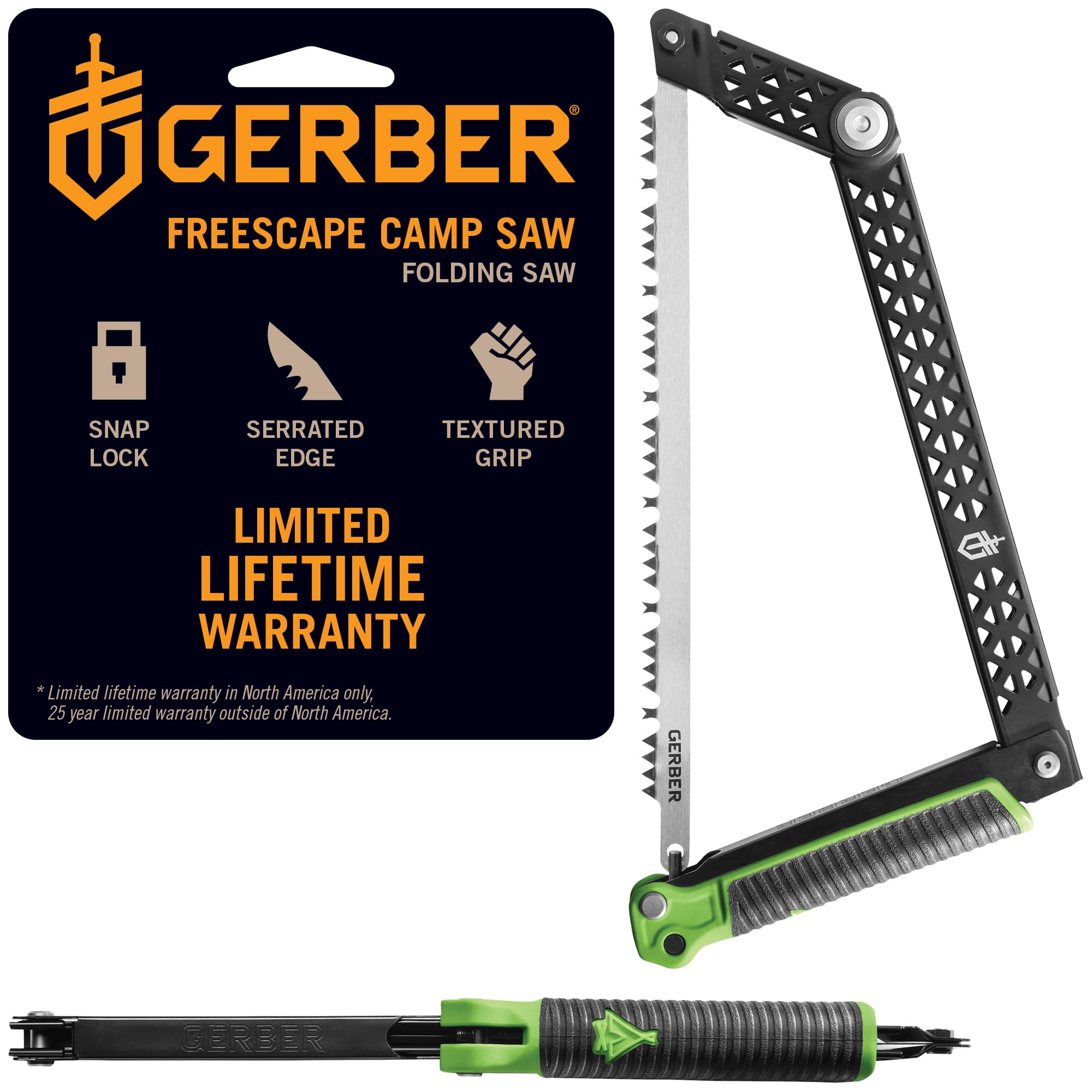
Gerber Freescape Camp Saw
Key Features
- Frame: Four-pivot folding bow
- Handle: Textured rubber
- Weight: 16 oz
- Blade Length: 12 inches
- Price: Premium
The Freescape looks like a bow saw that learned to fold flat. Its 12-inch blade runs on four pivots, so the frame collapses into a compact bundle without loose parts, and the bright green accents make it easy to find in a gear bin. The textured rubber handle gives you a solid grip when the blade starts pulling hard.
The bow-saw geometry is the point: it holds the blade under tension and gives you more clearance than a folding pocket saw, so larger logs and dry branches cut quickly. It is not a delicate tool. The 12-inch blade makes it a pack tool for basecamp, car camping, and short approach hikes rather than a long-distance ultralight kit.
We think it is the best folding bow saw here for someone who wants to process bigger wood without carrying a fixed-frame saw. It is a basecamp tool, and that is the right way to judge it. For a weekend camp with a group fire, it earns its space; for a long backpacking trip, the Bahco or Agawa is a better fit.
Pros
- 12-inch blade on a folding frame
- Four pivots, no loose parts
- Cuts larger logs quickly
- Textured rubber handle grip
Cons
- 16-ounce weight is a lot for long hikes
- Handle and pivot can fail under hard use
We like the Freescape for basecamp and car camping, where its folding bow-saw frame earns the extra weight by cutting larger logs.
Best for Pouch Carry
Mossy Oak 7-Inch Folding Saw

Key Features
- Carry: Belt or pack pouch
- Teeth: 7 TPI
- Weight: 9.17 oz
- Blade Length: 7 inches
- Price: Budget
The Mossy Oak gets the small stuff right: a 7-inch blade, an auto-lock that snaps open and stays put, and a pouch that attaches to a belt or pack. That pouch is the detail we appreciate most, because a loose saw in a pack is a teeth-first invitation to a ripped stuff sack. At 0.26 kg it is light enough to forget about until you need it.
The D6A and M2 bimetal blade has 7 TPI triple-ground teeth and a Teflon coating, and it cuts small branches and kindling quickly. It is not the fastest saw here on dry hardwood, but it is sharp and the folding action is simple. The handle has a non-slip feel and a hole for a lanyard or attachment.
The lock and handle are simple, and the pouch is the real convenience. It is a saw for occasional use, not a daily workhorse.
We think it is a sensible value for a daypack, a hunting bag, or a truck kit, especially if you want the pouch and auto-lock. It is not the saw we choose for a week of hard trail clearing; the Bahco and Silkys hold up better to repeated force. For occasional camp wood, it does the job without fuss.
Pros
- Handy belt or pack pouch
- Automatic blade lock for safety
- Fast 7 TPI bimetal blade
- Light 0.26 kg body
Cons
- Blade flexes when a cut binds
We think the Mossy Oak is a sensible value for occasional use, especially if you want an auto-lock and a pouch that stays on your belt.
Best for Longer Budget Blade
REXBETI 8-Inch Folding Saw

Key Features
- Teeth: 7 TPI
- Handle: Rubber-coated polymer
- Weight: 9.76 oz
- Blade Length: 8 inches
- Price: Budget
The REXBETI gives you an 8-inch blade for budget money, and that extra length is the reason to look at it. It weighs 9.76 ounces, folds into a compact package, and uses 7 TPI staggered teeth that bite quickly through green branches and kindling.
In light use, it is a lot of saw for the price: branches, kindling, and small logs come apart fast, and the rubber-coated polymer handle gives you a decent grip. The blade is stiff enough for straight cuts when it is sharp and the lock is seated.
That puts it behind the Bahco and Silkys for repeated work. The REXBETI is a saw for a truck kit, a camp box, or a backup, not the one we pack for a long trip.
We think it is a fair budget choice if you want a longer blade and will use it lightly. The 8-inch blade gives you reach beyond the smallest folding saws, and the price leaves room for a case or a spare. For hard, repeated trail clearing, spend more; for occasional camp wood, it earns a spot in the truck.
Pros
- 8-inch blade at a budget price
- Fast 7 TPI teeth
- Light 9.76-ounce pack weight
- Comfortable rubber-coated polymer handle
Cons
- Blade can bend or break under hard use
- Lock may not hold when folded
We see the REXBETI as a light-duty budget saw: the longer blade helps, but hard use is where its limits show.
How We Tested Backpacking Saws
We started with a shortlist of saws sold for backpacking and camping, reading spec sheets and owner reviews, then filtering out models that were too long for a pack side pocket, too heavy for a multi-day carry, or vague about blade replacement and lock design. That left 14 saws, which we used over eight months in the same places they’d actually work: campsite woodpiles, overgrown trail sections, and my backyard pile of seasoned and green hardwoods. We weighed each one on a kitchen scale, packed it into a side pocket and a hipbelt pocket, and carried it on day hikes to see whether it poked, rattled, or added noticeable weight.
Cutting performance came down to strokes, not specs. We timed how long each saw took to cut through wrist-thick deadfall and counted strokes in green wood; a sharp blade bit immediately, while a dull or poorly set one skated. We also watched whether blades bound in wet wood, whether teeth dulled after dirty bark and knots, and whether a blade chipped or bent when we pushed harder than we should have. For blade locking, we opened and closed each saw repeatedly, shook it upside down, and put side pressure on the blade mid-cut to see if the lock shifted or folded.
Quality showed up in the small parts: hinge play, handle comfort, tension, and whether the saw still closed cleanly after a weekend in the dirt. We compared cost against cutting performance and weight, because a bargain that cuts slowly or a featherweight that flexes is no value at all. The saws that scored best did the job without drama, packed away easily, and kept their edge after repeated use.
How to Choose a Backpacking Saw
The right backpacking saw is a compromise you can feel in your arm and your pack: cut speed, carried weight, and safe control all pull against one another.
Start With the Wood You Actually Cut
A 6.75- to 7.5-inch blade is the sweet spot for most backpackers: it handles wrist-thick limbs and kindling without adding a lot of weight. Step up to a 9.5- or 12-inch blade when you regularly process bigger logs, and look at a 15-inch frame saw for basecamp wood. The listed cut capacity matters more than blade length alone: a 6.75-inch Silky PocketBoy lists 3.4 inches, while the 9.5-inch GomBoy lists 4.7 inches. If your trips are mostly trail clearing, a shorter saw is easier to control; if you build a fire every night, the extra reach pays off.
Weigh the Carry, Not Just the Blade
Ounces matter, but a saw you leave behind because it is awkward is heavier than one you carry. Look at folded shape as well as weight: a long, skinny saw can ride on pack straps, while a short, thick one disappears into a lid pocket. The Bahco Laplander is the easy default at 7.52 ounces; the Agawa Boreal15 is 15.2 ounces and much longer, which is fine for basecamp and less fine for a fast overnight. Check where the saw will live before you fall for a blade length.
Locking and Safe Carry Are Not Optional
A folding saw needs a lock that holds the blade open under load and, ideally, closed in the pack. Some saws lock in both positions; others rely on a sheath or case. A hard case protects the teeth and the rest of your gear, and it is worth paying for if the saw will live in a backpack. Test the lock with gloves on before a trip, and keep the blade closed and covered when you are not cutting. An exposed tooth line in a pack is a repair bill waiting to happen.
Match the Tooth Geometry to Your Cutting Style
Lower tooth counts, around 6 to 7 TPI, cut aggressively and clear chips fast, which suits green limbs and camp wood. Finer 8.5 TPI blades leave a cleaner cut and feel smoother in dry wood, but they reward a lighter touch. Japanese-style saws such as the Silkys cut on the pull stroke; let the teeth do the work instead of bearing down. A thin blade is fast, but it can bind or crack if you twist it. Choose the stroke you will actually use, then practice a steady rhythm.
Decide How Much Saw You Need
Budget saws can cut well; the extra money goes into blade steel, lock precision, handle comfort, and a case. If you cut once a season, the Flora Guard is enough. If you clear trail or process wood on every trip, the Bahco or a Silky is the better long-term buy. Check whether the blade can be replaced before you spend up; a saw with a worn-out blade and no replacement path is a disposable tool.
Frequently Asked Questions
Can I legally cut wood with a saw while backpacking?
Check the land manager’s rules before you go. Many parks and wilderness areas prohibit cutting standing or dead wood, while some allow clearing a fallen limb from a trail or gathering downed wood for a campfire. If a ranger or permit says no, leave the saw in the pack and use deadfall you can break by hand.
Folding saw or pocket chainsaw for backpacking?
A folding saw is the better default for camp wood. It gives you a rigid blade, a comfortable handle, and a fast clean cut with less setup. A pocket chainsaw packs smaller and can be useful in an emergency, but it takes more technique and tends to bind in green wood. Choose one only if packed size matters more than speed.
How do I keep a folding saw from rusting?
Dry the blade and hinge after a wet trip, wipe off sap, and put a light oil on the pivot rather than the teeth. Store the saw with the blade closed and the case open enough to let air circulate. A rust-resistant coating helps, but grit and moisture left in the hinge are what shorten a saw’s life.
Final Verdict
For most backpackers, the Bahco Laplander is the saw to buy: it is light enough to carry without thinking, long enough for the limbs that block a trail, and the dual-position lock and comfortable handle make it easy to use in bad weather. If you regularly process bigger logs, the Agawa Boreal15 is the better tool; if you want the lowest-cost saw that still cuts cleanly, the Flora Guard is the budget answer. Start with the Bahco unless your wood supply says otherwise.