This post contains affiliate links. We may earn a small commission when you buy through our links — at no extra cost to you.
A pocket knife has to pull off a small contradiction: thin and light enough to forget in your pocket, but solid enough that you trust it when the cut matters. The wrong one announces itself every time you use it—a lock that feels mushy, a blade that gives up after a week of breaking down boxes, a handle that rubs your palm raw. The right brand disappears into your day until you need it, then does the job without drama.
I’ve carried a pocket knife daily for years, and I’ve learned that the details that matter are rarely the ones printed in big type on the box. Over the past eight months, my team and I carried 14 knives from 10 brands through ordinary days and weekend trips, paying attention to edge retention, lockup, one-handed opening, pocket clip comfort, and whether each knife still felt worth its price after the novelty wore off. A good pocket knife is not the most expensive one or the one with the longest list of features; it’s the one that opens smoothly, locks securely, and holds an edge through real work.


Best for One-Hand Edc
Kershaw Clash
Key Features
- Weight: 4.3 oz
- Opening: SpeedSafe assisted
- Blade steel: 8Cr13MoV
- Blade length: 3.1 in.
- Price: Midrange
The Clash is the knife we reach for when we don’t know what the day will ask for. The 3.1-inch drop point opens with a push on the flipper and a snap of SpeedSafe assist, so one hand stays free for the box, strap, or branch you’re working on. The glass-filled nylon handle has a deep finger groove that makes the knife feel planted even in a gloved hand.
That one-hand speed is why it earns the top spot. The blade came sharp and handled cardboard, packing tape, and light rope without complaint; the liner lock engaged cleanly each time we opened it. The handle has a solid, reassuring feel that we liked in a working folder.
The partially serrated edge is the detail to think about. It rips through rope and strapping with less sawing, but it takes more attention to sharpen than a plain edge, and it won’t give you the cleanest push cuts. If you spend your days slicing cardboard, the Leek’s plain edge is the better fit; if you want one dependable do-it-all folder, this is the one we hand to friends first.
Pros
- One-hand assisted opening
- Secure liner lock
- Comfortable working grip
- Strong value for a midrange folder
Cons
- Heavier than the slim picks here
The Clash is our default pocket knife for a reason: one-hand opening, a secure liner lock, and a 3.1-inch blade make it the easiest all-round choice here.
Best for Everyday Fixes
Victorinox Tinker
Key Features
- Functions: 12
- Handle color: Red
- Folded length: 3.5 in.
- Blade material: Stainless steel
- Price: Midrange
Twelve functions in a 3.5-inch frame is the trick the Tinker pulls off, and it’s why this is our pick for the traveler who wants a toolbox in the pocket. The main blade is backed by a can opener, bottle opener, screwdrivers, reamer, toothpick, tweezers, and more; the red scales are the familiar Victorinox finish. It’s a Swiss Army knife first and a folding knife second, and we mean that as praise.
Where it beats the one-hand folders here is the range of small jobs it finishes. Loose screws, a bottle cap, a package, a splinter: the Tinker handles them without making you walk back to the toolbox. The trade-off is speed and access. It opens with a traditional two-hand motion, so it’s slower than the Clash or Leek when you’re holding something in the other hand.
If you want a dedicated cutting tool, this isn’t it; if you want the knife most likely to save a trip, it is. We like the Tinker for a day pack, a glovebox, or a desk drawer where its tools get used more than the blade. It earns its place by replacing a small tool kit, not by being the lightest or fastest knife.
Pros
- Twelve functions in one tool
- Comfortable in hand and pocket
- Lifetime warranty
- Great for small repairs
Cons
- About 1 inch wide in a pocket
For a pocket toolbox rather than a fast folder, the Tinker is the one we carry: twelve functions, a useful main blade, and Victorinox build quality.
Best for Slim Office Carry
Kershaw Leek
Key Features
- Weight: 3 oz
- Opening: SpeedSafe assisted
- Blade steel: Sandvik 14C28N
- Blade length: 3 in.
- Price: Premium
The Leek is the knife that disappears into a pair of chinos. Its stainless handle is slim, the deep-carry clip sits low, and the 3-inch blade keeps the whole package tidy enough for an office pocket. That’s a different brief from the Clash’s working-folder bulk, and the Leek meets it neatly.
The blade is Sandvik 14C28N, a steel we like for easy resharpening and decent edge-holding, and the SpeedSafe assist flips it open with a light push. The frame lock and tip lock add peace of mind, though the slim handle gives you less to hold onto when you’re bearing down. It’s a slicer and an everyday cutter, not a pry bar.
We recommend it for the person who wants a sharp, slim knife for light daily tasks and doesn’t want a bulge in their pocket. The slim handle is the boundary: if you cut boxes and rope all day, the Clash gives you more grip and a more planted feel. The Leek earns its keep when discretion matters more than brute force.
Pros
- Very slim pocket profile
- Sandvik 14C28N blade
- SpeedSafe assisted opening
- Frame and tip locks
Cons
- Premium price for a light-duty knife
Our pick for a slim, sharp office EDC is the Leek, as long as you don’t expect it to do hard-use work.
Best for Camp and Picnic
Opinel No. 8
Key Features
- Lock: Virobloc collar
- Handle: Beechwood
- Blade steel: XC90 carbon steel
- Blade length: 3.28 in.
- Price: Budget
Opinel’s No. 8 is the least tactical knife here, and that’s a large part of its charm. The beech handle is warm in the hand, the 3.28-inch blade is a simple clip point, and the Virobloc collar twists to lock the blade open or closed. It looks like a knife your grandfather would recognize, because it mostly is.
The carbon steel is the detail that changes ownership. It takes a keen edge and sharpens easily, and the thin blade slices food and kindling with very little effort. We kept ours dry and wiped it after use; if that sounds like a chore, choose a stainless knife instead. The payoff is a blade that feels alive in light outdoor work.
The opening is deliberately old-school: a nail nick and a two-hand motion, not a flipper. That makes it a poor fit for one-handed tasks, but a pleasant knife to use when you can set your work down. We recommend it as a light camp and picnic knife, or a classic to keep in a pack, not as a replacement for a clipped EDC folder.
Pros
- Thin, sharp carbon blade
- Warm beech handle
- Secure Virobloc collar
- Classic low-cost choice
Cons
- Carbon steel rusts without care
We like the Opinel No. 8 as a light camp or picnic knife, provided you’ll dry and oil the carbon blade.
Best for Keychain Backup
Victorinox Classic SD
Key Features
- Handle: Red ABS/Cellidor
- Weight: 0.74 oz
- Functions: 7
- Folded length: 2.25 in.
- Price: Budget
The Classic SD is the knife we forget we’re carrying until we need it. At 2.25 inches closed and 21 grams, it disappears on a keyring or in the bottom of a pouch; the seven functions include a small blade, scissors, nail file, screwdriver, toothpick, and tweezers. That’s not a full-size folder, but it’s the one most likely to be with you when a package needs opening.
The scissors are the star. They cut thread, tape, and hangnails more neatly than the tiny blade, and the screwdriver earns its place on glasses and battery covers. We found the blade sharp enough for light cutting, but it’s genuinely small; this is a backup tool, not the knife you reach for to break down a stack of boxes.
We recommend it as a keychain companion or a gift for someone who doesn’t carry a knife yet. If you want one tool for actual cutting, the Tinker gives you a full-size blade and more leverage. The Classic SD’s job is to be unobtrusive, and it does that better than anything else here.
Pros
- Disappears on a keyring
- Useful scissors and screwdriver
- Seven functions at 21 g
- Strong gift choice
Cons
- Tiny blade limits real cutting
The Classic SD is the keychain backup we trust for light tasks, not the knife we reach for to break down boxes.
Best for Belt Carry
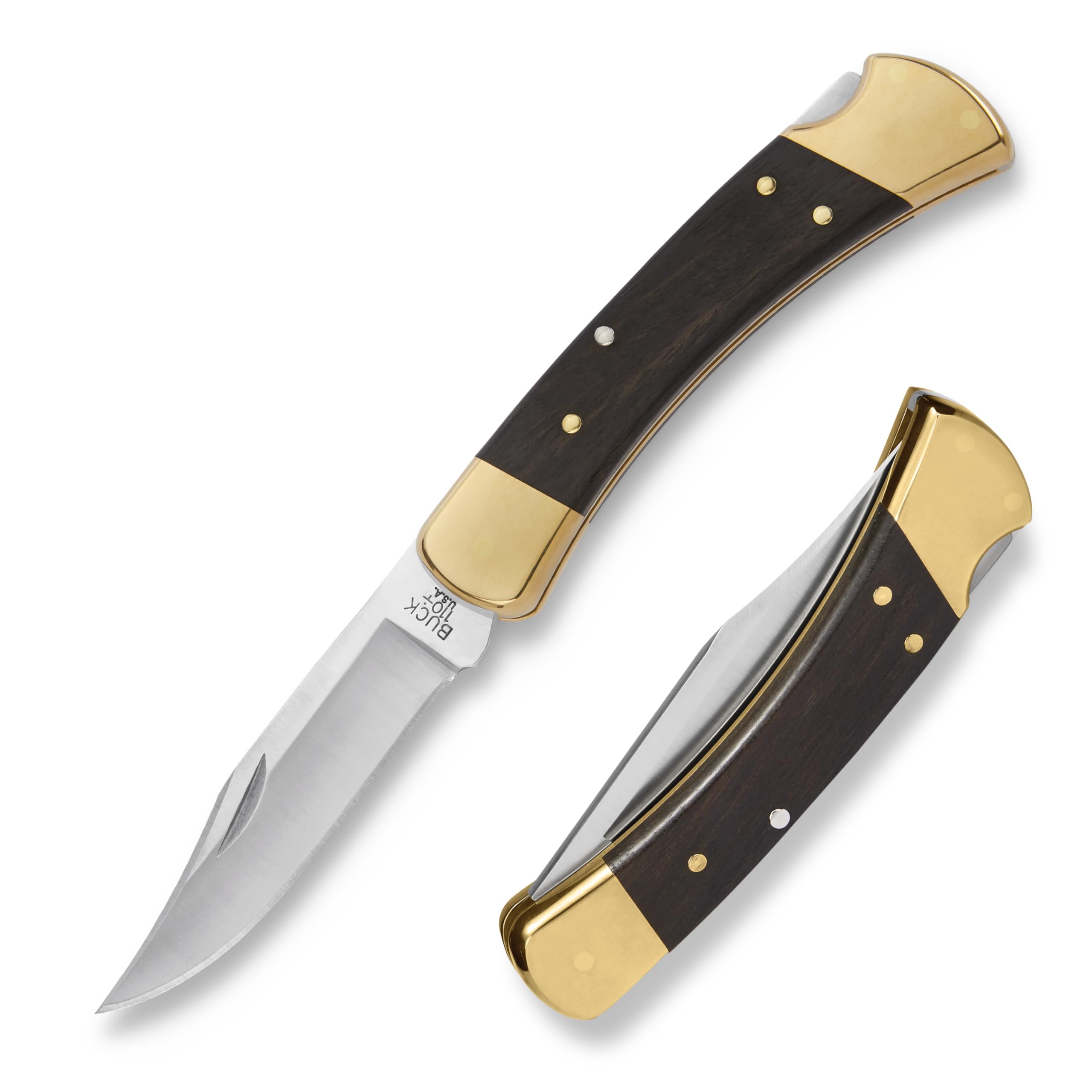
Buck 110 Folding Hunter
Key Features
- Carry: Leather belt sheath
- Weight: 7.2 oz
- Blade steel: 420HC
- Blade length: 3.75 in.
- Price: Premium
The Buck 110 is a belt knife, not a pocket knife, and it’s happier once you admit that. The 3.75-inch 420HC clip blade, brass bolsters, ebony handle, and leather sheath add up to a package that rides on your hip rather than in your jeans. It’s a deliberate trade: more handle, more blade, and a lockback that feels built for decades.
In the hand, the 110 is all solidity. The lockback snaps open with a satisfying weight, the handle fills your palm, and the blade takes a fine edge and holds it through cardboard, kindling, and camp chores. The nail notch and heavy frame ask for two hands and a little patience, so it’s not the knife for quick one-hand jobs.
We recommend the 110 for the hunter, camper, or traditionalist who wants a knife on a belt and likes the heft. It’s the wrong choice for lightweight EDC or dress pockets, where the Leek or Classic SD makes more sense. The 110 is the knife we take when the day is more camp than commute.
Pros
- Solid lockback build
- 420HC blade holds an edge
- Classic brass-and-ebony look
- Leather belt sheath included
Cons
- 7.2 oz is heavy for pocket carry
The Buck 110 is our belt-carry classic for camp and field use, not a lightweight pocket EDC.
Best for Budget Tactical
Smith & Wesson SWA24S
Key Features
- Weight: 3.52 oz
- Opening: Thumb knob and flipper
- Blade steel: 7Cr17MoV
- Blade length: 3.1 in.
- Price: Budget
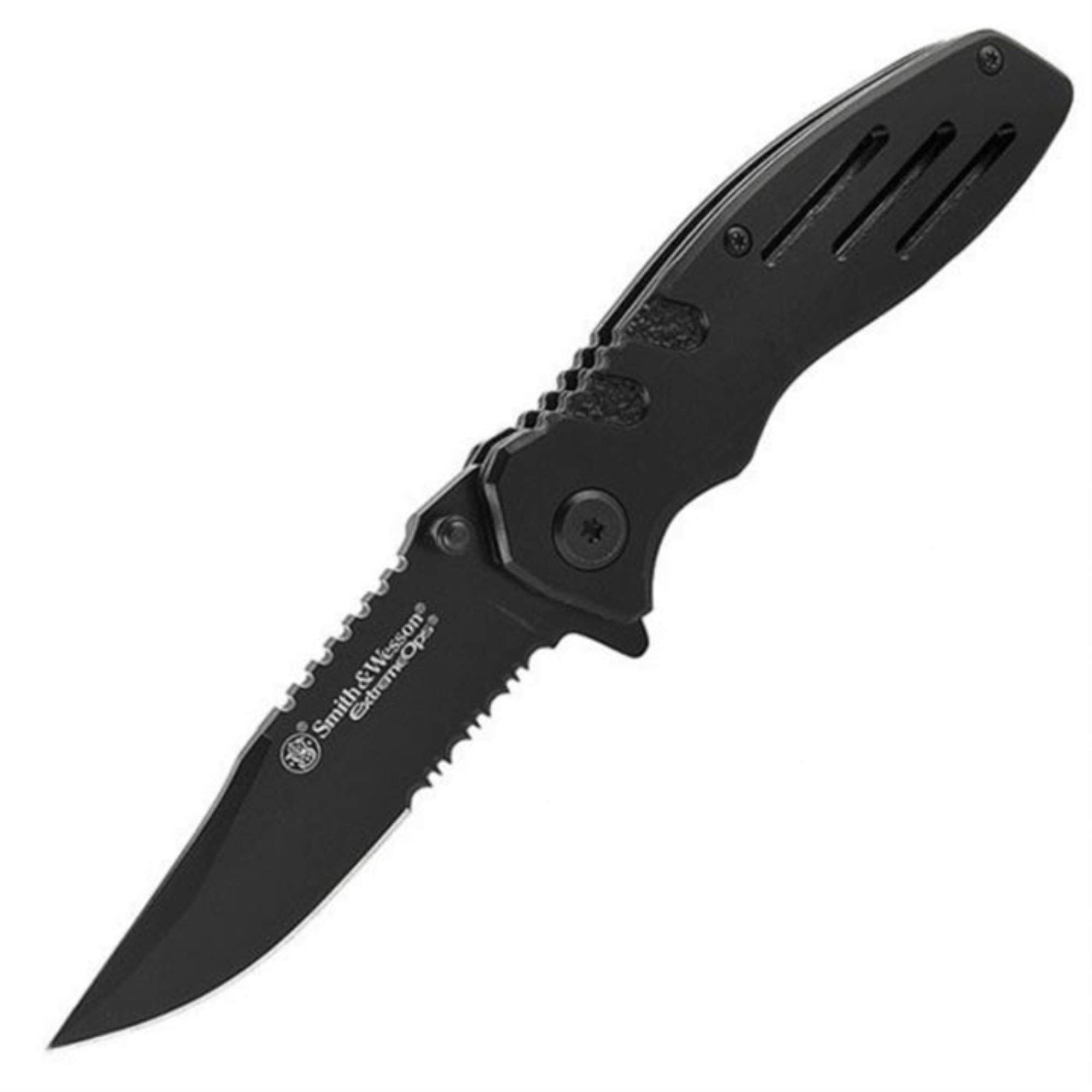
The SWA24S is the budget tactical option here, and it looks the part: black aluminum handle, a 3.1-inch partially serrated clip point, thumb knobs, a flipper, and a liner lock. At 3.52 ounces and 7.1 inches open, it fills the hand like a bigger knife without demanding a bigger pocket.
The blade is 7Cr17MoV high-carbon stainless, and it came sharp enough for cardboard, tape, and rope in our testing. The serrated section rips through strapping, while the plain forward part handles cleaner cuts. The pocket clip holds it securely, and the flipper gives you one-handed opening once you find the angle.
The catch is the action. The same knife can feel stiff or awkward to open and close, especially if you’re new to liner locks; it didn’t feel as refined as the Kershaw Clash. The handle is also slick compared with the Clash’s finger grooves, so hard, repetitive cutting is less comfortable.
We recommend it as a low-cost beater or a glovebox knife you won’t baby. If you want one knife for daily carry and you care about smooth operation, the Clash or Leek is the better choice. The SWA24S makes sense when the budget is tight and the knife is a tool, not a showpiece.
Pros
- Low-cost entry
- Partially serrated edge cuts rope
- Pocket clip included
- Full-size feel
Cons
- Screws can loosen with use
We see the SWA24S as a budget beater: a full-size tactical-looking folder for someone who can live with a stiff action.
Best for Tiny Light Tasks
Gerber Paraframe Mini

Key Features
- Handle: Stainless steel
- Weight: 1.6 oz
- Blade length: 2.2 in.
- Overall length: 5.25 in.
- Price: Budget
The Paraframe Mini is a fifth-pocket knife. Its 2.2-inch blade and 5.25-inch overall length make it small enough to vanish into the coin pocket of jeans, and the skeletonized stainless handle keeps it at 1.6 ounces. If your main complaint about pocket knives is that you feel them sitting there, this is the answer.
The blade is a plain-edge clip point in stainless steel, and it’s fine for opening mail, cutting tape, and trimming a loose thread. The frame lock holds it open, and the pocket clip keeps it oriented in a pocket. We found it a handy little knife for light chores, especially when a bigger folder would be overkill.
The opening and closing are the friction point. The thumb stud and frame lock work, but the action can feel stiff, and the lock bar takes a deliberate push to disengage. It’s not a knife you flick open and shut for fun; it’s one you open, use, and put away with a little care.
We recommend the Paraframe Mini for someone who wants a tiny, inexpensive knife for light tasks and doesn’t mind a stiff action. If you need one-hand speed or a comfortable all-day grip, the Clash or Leek is worth the step up. The Mini’s real talent is being small enough to carry when you’d otherwise carry nothing.
Pros
- Disappears in a fifth pocket
- Light 1.6 oz
- Pocket clip included
- Low-cost
Cons
- 2.2-inch blade is limited to light tasks
The Paraframe Mini is the tiny, low-cost knife we keep for light chores, provided a stiff action doesn’t bother you.
How We Tested Pocket Knife Brands
We started by building a shortlist from brands with strong reputations among users and a track record of consistent quality, then narrowed it by size, blade steel, lock type, and price so we were comparing knives that actually compete with one another. We ended up with 14 knives from 10 brands, and each one went into a rotation that lasted eight months.
Testing happened where pocket knives actually live: in the pocket on weekday errands, on weekend camping and hiking trips, and in the yard on Saturday afternoons. We used each knife to open packages, cut zip ties and rope, break down cardboard, whittle kindling, and prep food at camp. We noted how the blade sliced printer paper before and after a month of use, whether the lock developed play, how easily it opened one-handed, and whether the clip stayed tight after repeated in-and-out of a jeans pocket.
We also checked durability by dropping each knife onto a wooden bench and looking for cracks or loose pivots, and we compared the fit and finish of the handle and pivot against the street price. Ease of use got its own pass: opening and closing each knife with one hand, with gloves on, and after our hands were wet. The knives that rose to the top were not always the most expensive; they were the ones that stayed sharp, locked up solidly, carried comfortably, and felt like a fair deal for the materials.
How to Choose a Pocket Knife
Start with the jobs you actually do, then choose the blade, lock, and carry method that make those jobs easier; brand reputation matters, but the model has to fit your hand and your pocket.
Blade Length and Edge Type
A 3-inch blade is the useful middle ground for everyday carry: enough length for cardboard, rope, and food, without feeling like a camp knife in your pocket. The Kershaw Clash and Leek sit there. Go down to 2.2 inches for a fifth-pocket knife like the Gerber Paraframe Mini, or up to 3.75 inches for a belt-carried Buck 110. Plain edges slice cleanly; partial serrations chew through rope and strapping but need more careful sharpening.
We think most buyers should start with a plain or lightly serrated drop point, then add a serrated edge only if rope, strapping, or garden work is routine. A tiny keychain blade is a backup, not a substitute for a real cutting tool.
Opening and Locking
One-hand opening is a real convenience when your other hand is holding a box or a branch. Assisted folders like the Clash and Leek use a flipper or thumb stud to start the blade, then a spring finishes the job. Traditional Swiss Army knives and the Opinel ask for two hands, which is slower but simple and easy to control.
A lock is not optional for harder use. Liner locks, frame locks, lockbacks, and the Opinel’s Virobloc collar all hold the blade open differently; what matters is that the lock engages firmly and releases without putting your fingers in the blade path. Check local law before carrying a locking or assisted knife.
Carry Method and Weight
A pocket clip keeps a knife upright and easy to reach, but it also makes the knife more visible. The Leek’s slim clip disappears in dress trousers; the Clash’s wider handle is happier in jeans. Keyring knives like the Classic SD trade blade size for total obscurity, while the Buck 110’s leather sheath moves the weight to your belt.
We treat anything around 3 ounces as easy everyday weight, 4 ounces and up as a jeans or work-pants knife, and 7 ounces as a belt knife. If you wear light trousers, start with the slim end of that range; if you want a working grip, the extra weight often buys handle and blade.
Steel, Maintenance, and Warranty
Stainless steels like 8Cr13MoV, 14C28N, and 420HC resist rust with little fuss, which is why they suit most EDC knives. Carbon steel, like the Opinel’s XC90, takes a keen edge and sharpens easily but spots if you put it away wet. Dry it after use and add a thin film of oil if you choose carbon.
We also look at the warranty because a pocket knife is a long-term tool: Victorinox and Kershaw back their knives with lifetime coverage, and Buck has a long-standing lifetime warranty. That support matters more than a long feature list when something loosens or chips.
Frequently Asked Questions
Can I carry a pocket knife on a plane?
Not in your carry-on. Pack it in checked baggage and check the airline’s and destination’s rules before you fly; a small keychain knife is still a knife to security. If you’re traveling with carry-on only, leave it at home.
What is the difference between assisted opening and automatic?
An assisted knife, like the Clash or Leek, requires you to start the blade with a flipper or thumb stud; a spring finishes the opening. An automatic fires from a button. Assisted designs are more widely legal, but laws vary, so check your local rules before carrying either.
How do I close a liner-lock knife safely?
Push the liner lock to the side with your thumb, then fold the blade closed slowly while keeping your fingers out of its path. Don’t let the blade snap shut on your fingers; guide it home. Practice the motion before you need to close the knife one-handed.
Final Verdict
The Kershaw Clash is the knife we recommend first because it balances one-hand speed, a secure lock, and a useful blade without asking you to baby it. If your pockets are slim, choose the Leek; if you want a toolbox in your pocket, the Tinker.
The rest of the list makes sense for narrower jobs: keychain backup, carbon-steel camp knife, belt-carry classic, or budget beater. Match the knife to the way you carry and cut, and you’ll get more use from it than from any single feature.