This post contains affiliate links. We may earn a small commission when you buy through our links — at no extra cost to you.
A survival knife is the tool you bet a bad night in the woods on. The worry isn’t whether it looks tactical—it’s whether the edge holds after you baton through a knotty branch, whether the handle blisters your palm by dinner, and whether the sheath keeps the blade where you put it when you’re scrambling over rocks. I’ve carried fixed blades on camping trips for years, and the failures are rarely dramatic: a dull edge, a hot spot, a loose stitch. What you’re buying is less drama—a knife that cuts cleanly, carries comfortably without dragging on your belt, and doesn’t quit when the trip runs long.
Over eight months, my team and I put 12 survival knives through camp chores, trail carry, and wet-weather storage. We sharpened, chopped, carved, and resheathed them until the differences were obvious. The best earned their keep on sharpness, build quality, and ergonomics without making you pay for features you’ll never use; the rest dulled early, felt clumsy, or made us dread the sheath. The picks below are the ones we’d trust with the weekend’s only cutting tool.




Best for All-Round Camp Use
Cold Steel SRK
Key Features
- Weight: 7.9 oz
- Blade Steel: SK-5
- Blade Length: 6 inches
- Blade Thickness: 5 mm
- Price: Midrange
Five millimeters of SK-5 steel behind a six-inch clip point is what settled this one for us. That is among the thickest stock in this group, and it is why the SRK takes on splitting, limbing, and scraping jobs that make a thinner blade flex. SK-5 is a carbon tool steel chosen for toughness rather than stain resistance, which is the right priority in a knife that gets hit with a baton.
The sheath is what surprised us. Cold Steel’s Secure-Ex grips the blade firmly enough that the whole rig can be turned upside down without the knife sliding out, and the belt loop sits it high and clear of a pack strap. Set that against the soft nylon pouches on the budget bowies here and the difference shows the first time you bend over in the brush.
Kray-Ex, the rubber handle compound, is the other detail that earns its keep. It stays grippy with wet or cold hands without the tacky feel of cheaper rubber, and the palm swell fills the middle of your hand so the blade indexes the same way each time you draw it. With gloves on, that repetition is worth more than another half-inch of edge.
One thing to know before you buy: SK-5 is carbon steel, so it wants a wipe-down and a drop of oil after a wet day, and it will spot if you sheath it damp and leave it for a week. That is the price of the toughness, and it is a two-minute habit rather than a burden. If you want one blade for heavy work and a small stainless one for carving, this is the heavy half of that pair.
Pros
- Thick, tough six-inch SK-5 blade
- Secure-Ex sheath holds the blade firmly
- Kray-Ex grip works wet or gloved
- Splits and limbs without flexing
Cons
- Thick blade coating drags in deep cuts
For most people heading into the woods, this is the survival knife we recommend: a thick six-inch blade, a rubber handle that holds when wet, and a sheath that keeps it exactly where you put it.
Best for Lightweight Camping
Morakniv Companion
Key Features
- Weight: 3.9 oz
- Blade Steel: Sandvik 12C27
- Blade Length: 3.88 inches
- Blade Thickness: 0.08 inch
- Price: Budget
At 3.9 ounces with the sheath on, the Companion is the lightest knife in this group, and at 0.08 inch its blade is the thinnest. That combination is the entire argument. On a harness, in a lid pocket, or clipped to a belt, it is barely there until the moment you need it.
What makes it worth carrying is how well the thin blade cuts. Sandvik 12C27 stainless takes a fine edge and holds it through wood, rope, and dinner, and the Scandinavian grind lets you steer a cut with your thumb instead of forcing it. The handle impressed us too: soft-friction polymer with a finger guard, secure in wet weather, and no hot spot after an hour of whittling.
Where the Companion stops is heavy work. A 0.08-inch blade is built to slice, not to be hammered through knots, and that fine tip is not a pry bar. For a hiker, a paddler, or anyone who wants a rust-resistant knife for camp chores without the weight, that boundary never comes up, which is why it is the one we pack most often.
Pros
- 3.9 ounces with the sheath
- Sandvik 12C27 resists rust
- Fine edge for carving and food
- Secure, comfortable handle
Cons
- Plastic sheath with a basic belt clip
Ounce for ounce this is the knife we reach for most: sharp stainless steel, a secure grip, and a weight you forget about until the moment you need it.
Best for Pack Mounting
Gerber StrongArm
Key Features
- Handle: Rubber diamond texture
- Sheath: Multi-mount MOLLE
- Blade Steel: 420HC
- Blade Length: 4.8 inches
- Price: Premium
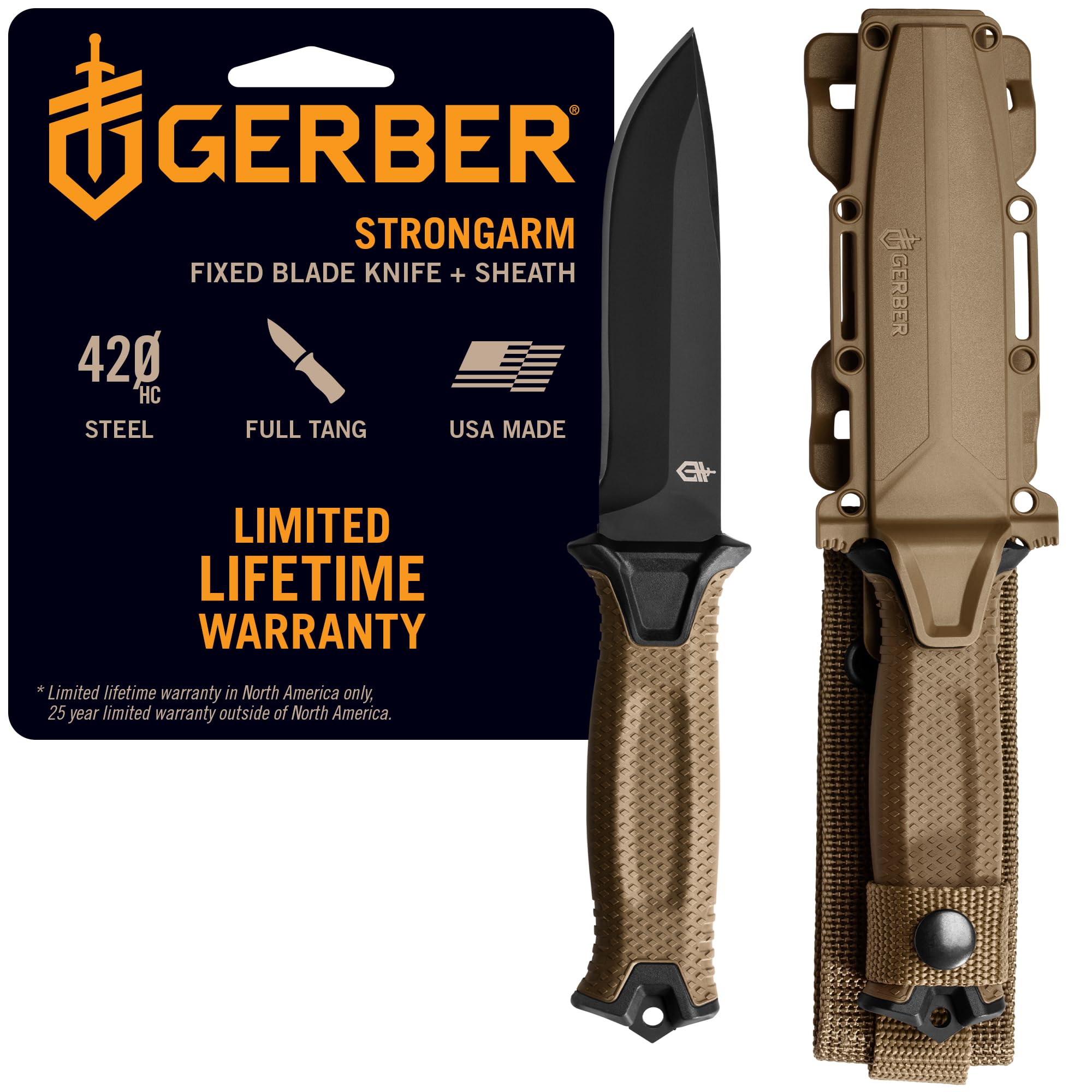
The StrongArm’s sheath is the reason to buy it. Gerber’s multi-mount system hangs the knife vertically on a belt, horizontally across the back, or laced into MOLLE webbing on a pack, and the blade locks in hard enough that a fall will not shake it loose. Of everything here it is the most flexible carry setup, and for a knife that lives on a pack that matters more than another half-inch of blade.
The knife underneath is a full-tang 4.8-inch drop point in 420HC with a Cerakote finish and a rubber handle molded in a diamond texture. 420HC will not hold an edge as long as the SK-5 or the 1095 in this group, but it comes back on a pocket stone in a minute, which is the trade most people are happy to make on a knife used in short bursts.
In hand, the diamond texture is the detail we kept noticing. It locks your grip without sanding your palm, and the finger guard gives a hard stop when your hands are wet and cold. The blade is thick enough to baton small wood and thin enough behind the edge to make feathers, so it is a genuine all-rounder rather than a chopper that cannot carve.
The catch is money. It costs about the same as the KA-BAR, which is a bigger knife with more steel in it, so you are paying for the mounting system rather than for blade length. If your knife rides on a pack most days, that is a fair trade. If it lives on your belt, the SRK does the same work for less.
Pros
- Multi-mount sheath with several positions
- Full-tang 4.8-inch blade
- Diamond-texture grip stays secure
- Quick to resharpen in the field
Cons
- 420HC loses its edge sooner than SK-5
Buy it for the sheath: several carry positions, a lockup that will not let go, and a full-tang blade that handles carving and splitting without complaint.
Best for Chopping and Heritage
KA-BAR USMC
Key Features
- Handle: Stacked leather
- Blade Steel: Carbon steel
- Blade Length: 7 inches
- Overall Length: 11.875 inches
- Price: Premium
Seven inches of carbon steel and a stacked leather handle: the KA-BAR is the biggest traditional knife here after the budget bowies, and it is built to swing. The blade reaches into brush, the clip point pierces, and the weight forward of the guard gives it a chopping authority no four-inch knife can fake.
The pattern has not changed in decades, and the details explain why. The compressed leather handle fills the palm and gets tackier as it wears in, the leather sheath has a retaining strap that holds the blade against the guard, and the whole thing is simple enough that there is nothing to fail.
For our money it is the best big knife in this group: long enough to chop, shaped well enough to slice, and heavy enough that the swing does the work. It is also a commitment. Carbon steel and leather both want attention, and the matte coating on the blade is thick enough to slow you down on a stone. Buy it if you want one large traditional blade to last; buy the StrongArm if you want similar length without the upkeep.
Pros
- Seven-inch blade chops and reaches
- Stacked leather handle and leather sheath
- Simple construction with little to fail
- Holds an edge through hard use
Cons
- Thick blade coating slows sharpening
- Long blade is awkward for fine work
Seven inches of carbon steel that chops like a small hatchet and carries like a knife — if you will look after the steel, it is a knife for a decade.
Best for Splitting Firewood
KA-BAR Becker BK2
Key Features
- Handle: Ultramid
- Weight: 16 oz
- Blade Steel: 1095 Cro-Van
- Blade Length: 5.25 inches
Sixteen ounces is the first thing to get straight about the Becker Companion. That is about double the weight of the SRK, and it rides on a belt like a small hatchet. What you get for it is a 5.25-inch 1095 Cro-Van blade on a full tang with Ultramid scales: a tool closer to a splitting wedge with an edge than to a slicer.
For the right buyer, that trade is worth it. If your evenings involve processing firewood, cleaning up a campsite, or building a shelter, a thick spine and a blade that shrugs off being hammered through knots matter more than finesse, and at that work the Becker is the most capable knife here. The heft is what buys the capability rather than a side effect of it.
The blade takes a working edge quickly and holds it through dirty wood, and the Ultramid handle stays comfortable when your palms are wet. The weight is the honest summary of the whole knife: nothing else here splits like it, and nothing else here is as tiring to carry up a hill.
Pros
- Splits better than anything here
- Full-tang 1095 Cro-Van blade
- Comfortable Ultramid handle
Cons
- Sixteen ounces is a burden on long trips
Sixteen ounces of 1095 that splits, chops, and takes a beating — the best wood-processing knife here if you are not counting grams on the climb.
Best for Emergency Kit
Gerber Ultimate
Key Features
- Edge: Half-serrated
- Weight: 11 oz
- Blade Length: 4.8 inches
- Sheath Tools: Ferro rod and sharpener
- Price: Midrange
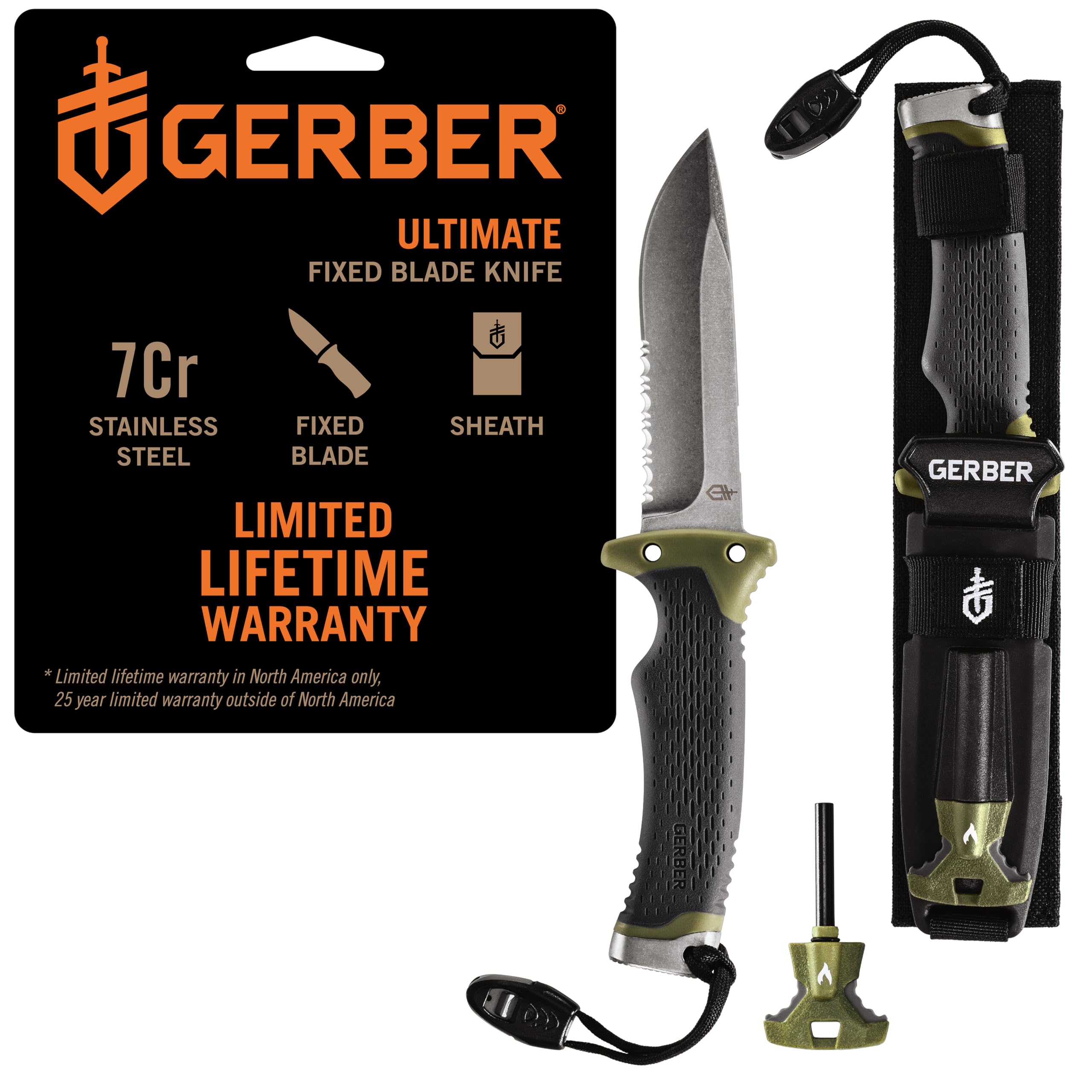
The sheath is the pitch. Gerber builds a diamond sharpener and a ferrocerium rod into it, adds a whistle, and puts a flat hammer pommel on the butt of the knife, so the whole emergency kit is one object you can strap to a pack and forget about until you need it.
The knife itself is a 4.8-inch drop point in stainless with a rubber handle and a full tang, and the edge is half-serrated. That is a deliberate choice: the plain section handles wood and food, while the serrations chew through rope, webbing, and the fibrous material that makes a plain edge skate.
The kit is more useful than it sounds. The ferro rod throws a good shower of sparks onto dry tinder, the sharpener is coarse but honest for a field touch-up, and the pommel gives you something to hammer with that is not the spine of the blade. None of it replaces a real fire kit, but all of it is attached to the knife, which is the point.
Where it falls short is the edge. Sharpness is the weakest part of the package: the grind arrives workable rather than shaving, and the sharpener in the sheath maintains an edge rather than creating one, so plan a session with a proper stone before a trip. We still recommend it, because as a single object covering fire, sharpening, signaling, and cutting it does more than any other knife here.
Pros
- Sheath carries a ferro rod and sharpener
- Half-serrated edge cuts rope and webbing
- Hammer pommel and whistle add utility
- Full-tang stainless blade
Cons
- Edge needs work before a trip
- Serrated section is awkward to sharpen
One object that covers fire, sharpening, signaling, and cutting, with a solid blade and a sheath that earns its extra bulk.
Best for Budget Chopper
Mossy Oak 15-Inch

Key Features
- Weight: 1.2 lb
- Included: Fire starter and sharpener
- Blade Length: 10 inches
- Overall Length: 15 inches
- Price: Budget
Fifteen inches overall and a ten-inch blade: this is not a knife you slip in a pocket. The first thing that struck us is how much tool you get, with 3.8 mm of stainless, a rubber handle with a guard, and a clip point with enough spine to push on. It is, functionally, a short machete with a knife handle.
The kit is where it earns attention. A fire starter and a sharpener are packed in the box, tucked under the insert, so check the packaging before you throw it out; the rod throws sparks well enough to light a fire with dry tinder. The nylon sheath has a belt loop and a snap strap and holds the blade without drama.
A ten-inch blade is a chopping tool, and that is how we judge it. It clears brush, splits kindling, and does the rough work of a hatchet, and it is the wrong tool for carving a spoon or skinning a rabbit. For a truck knife, a camp chopper, or a first big blade on a tight budget, it earns its place; if you want one knife that covers more ground, the SRK is the better single answer.
Pros
- Ten-inch blade chops brush and kindling
- Fire starter and sharpener included
- Rubber handle with a finger guard
- A lot of knife for the money
Cons
- Edge can arrive uneven
- Too big to carry on a belt all day
Ten inches of chopper for very little money: brush, kindling, and camp wood handled, with a fire starter in the box, as long as you are not after finesse.
Best for First Fixed Blade
Grand Way 148109

Key Features
- Sheath: Cordura
- Weight: 6.74 oz
- Blade Steel: 440C
- Blade Length: 4.45 inches
- Price: Budget
If you are buying a first fixed blade and do not want to agonize over it, this is the one we point to. An 8.86-inch overall knife with a 4.45-inch 440C blade is small enough to live in a day pack, big enough for real camp work, and at 7 ounces light enough that you will not leave it in the car.
The handle is the surprise. A rubber overmold with a finger guard and a palm swell fills a large hand properly, and the grip does not taper away toward the butt the way it does on a lot of inexpensive knives. The full tang runs under all of it, which is more construction than the price implies.
440C is a sensible steel at this end of the market. It resists rust, takes a sharp edge off a simple stone, and is easy to bring back when it dulls, which is what most people actually need from a camp knife. Nothing about the blade asks for special equipment or a technique you have to learn.
The sheath is the weak link: a soft Cordura pouch with a belt loop that holds the knife well enough and feels like an afterthought. A stiffer aftermarket sheath fixes it for very little, and it is the only upgrade the knife needs. For a glovebox, a bug-out bag, or a first fixed blade you will actually carry, it is an easy yes.
Pros
- Light seven-ounce package
- Rubber handle fits large hands
- 440C resists rust and sharpens easily
Cons
- Edge holding trails the carbon steels here
The easiest first fixed blade to say yes to: light, comfortable in a big hand, sharp out of the box, and modest enough that you will actually carry it.
How We Tested Survival Knives
We started by building a shortlist of fixed-blade knives sold for camping, backpacking, and survival use, then cut it down by blade steel, handle material, sheath design, and price band. The goal was not the most tactical-looking knife but the one that would hold up to repeated camp work. Over eight months, we tested 12 of them on weekend camping trips, day hikes, and backyard firewood sessions.
Sharpness got checked first: slicing printer paper, shaving curls from a dry stick, and cutting through old climbing rope. We then batoned kindling, carved tent pegs and feather sticks, and prepped food, noting whether the edge rolled, chipped, or needed frequent honing. Durability came from repeated batoning, controlled drops onto gravel, and leaving each knife in a damp sheath overnight to see what rusted or loosened. For ergonomics, we used them bare-handed and with wet gloves, paying attention to hot spots, grip security, and control during long whittling sessions. Weight was judged on the belt and in a pack during three-mile hikes—some knives carried fine until mile two.
Sheaths were tested upside down with a hard shake, re-sheathed one-handed, and checked for retention after the knife was wet and muddy. We also checked fit and finish at the handle and guard, then compared what each knife included against its price band to judge value—not just the blade, but the handle finish, sheath construction, and whether the edge held after a full weekend. The knives that rose to the top stayed sharp, stayed put, and stayed comfortable long enough to forget we were carrying them.
How to Choose a Survival Knife
A survival knife is a compromise between carving, chopping, and carrying, and the right one is whichever compromise matches the ground you actually walk on.
Match the blade to the work you do
Most people who buy a survival knife spend their time making shavings, opening food, and cutting cord, not clearing trails. A four-to-five-inch blade does that work with less weight and better control. Step up to six or seven inches if splitting and limbing are regular jobs, and treat the ten-inch bowies as machete-class choppers: excellent at that one thing, clumsy at everything else. Be honest about the split. If you will whittle ten times for every fire you build, buy the carver.
Stainless or carbon
The steel question is really a care question. Stainless — Sandvik 12C27 on the Mora, 420HC on the Gerber StrongArm, 440C on the Grand Way — shrugs off rain, salt, and a night in a damp pack. Carbon and tool steels such as SK-5 and 1095 take a keener edge and hold it longer under hard use, and they will spot if you sheath them wet.
If your knife lives in a boat, a pack, or a truck, stainless is the sane default. If you will wipe it down and oil it after every trip, carbon gives you more knife for the work.
The sheath decides whether you carry it
A blade you leave in the car because the sheath is uncomfortable is a wasted purchase. Check three things: retention, meaning the knife stays put when the rig is upside down; carry position, whether that is high belt, low belt, horizontal, or laced to a pack; and material. Molded plastic shells shed water and wipe clean, leather looks better and wants wax, soft nylon is light and is the first part to feel cheap.
If the knife rides on a pack, a multi-mount sheath like the one on the Gerber StrongArm is worth paying for.
Handle fit, wet hands, and gloves
Handles fail in the wet and the cold, not on the shelf. A rubber or soft-friction handle holds better with wet hands than polished wood or plain plastic, a finger guard gives you a stop before the edge does, and a palm swell keeps the blade from rotating in a hard cut. Try the fit with the gloves you will actually wear, because a handle that is perfect bare-handed can be unusable in a winter glove. Big hands should look at the Grand Way and the KA-BAR; smaller hands at the Mora.
Weight is a feature
The best knife is the one still on your belt at hour six. The range here runs from under four ounces to a full pound, and that difference is real over a day: a light knife carves and slices, a heavy one splits and chops, and almost nobody needs both on the same trip. If you drive to camp, weight barely matters. If you hike in, decide which job you are doing and buy for that one.
Frequently Asked Questions
Can I fly with a survival knife?
Not in carry-on. A fixed blade has to travel in checked baggage, with the sheath taped shut or the knife packed in a hard case so it cannot shift in transit. Rules differ by airline and by country, so check the carrier’s prohibited-items page before you fly, and do not count on buying one abroad and bringing it home in the cabin.
Do I need a full-tang knife?
Full tang means the steel runs the length of the handle, which is what you want if you plan to baton wood or lean on the spine. The StrongArm and the Becker are both full tang. A lighter hidden-tang knife like the Mora is plenty strong for carving and slicing, and it saves ounces. Decide by whether your knife is going to get hit with a stick.
How should I store a survival knife between trips?
Clean it, dry it, and put a thin film of oil on the blade before it goes away — mineral oil is fine, and you wipe off the excess before using the knife on food. Take it out of a leather sheath for long storage, because leather holds moisture against steel, and keep the whole thing somewhere dry rather than in a damp basement or a wet pack.
Plain edge or serrated?
A plain edge does almost everything better: it pushes through wood, slices food, and sharpens on any flat stone. Serrations win on rope, webbing, and fibrous material, and a half-serrated blade like the Gerber Ultimate’s gives you both, at the cost of a section that is awkward to sharpen and can snag in a deep cut. Carry one knife and you are better served by a plain edge and a stone.
Final Verdict
Most people should buy the Cold Steel SRK. Six inches of thick SK-5 in a sheath that holds it still is the balance of chopping, carving, and carrying a general-purpose woods knife needs, and it leaves room in the budget for a stone and a fire kit.
If the budget is tighter or the pack is lighter, the Morakniv Companion does the carving work better than anything else here and weighs almost nothing. If your evenings are about splitting wood rather than whittling it, the Becker BK2 is the tool for that job.