This post contains affiliate links. We may earn a small commission when you buy through our links — at no extra cost to you.
A multi-tool earns its keep ten seconds after something goes wrong — a hose clamp letting go at a trailhead, a hinge screw working loose in a rental cabin, a zipper pull snapping on a duffel. Most of us buy one, drop it in the glovebox, and forget it’s there until that exact moment. What separates the tool you trust from the one that folds shut on your knuckles is whether the blade arrives sharp and stays that way, whether the implements lock open under load, whether the springs feel crisp instead of mushy, and whether the whole thing is light enough that you actually carry it. A good one quietly replaces a small toolkit; a cheap one is a pocket knife with extra lumps.
I’ve carried one daily for years, and over the past eight months my team and I worked through 12 models, from slim two-layer pocket tools to full-size pliers-based rigs. The pattern that held: completeness matters less than you’d think. A tool with six implements that lock up tight beats one with nineteen that wobble. The picks below survived being dropped, soaked, and handed to people who don’t read instructions.


Best for Survival and Camping
Leatherman Signal
Key Features
- Tools: 19
- Weight: 8 oz
- Fire starter: Ferrocerium
- Closed length: 4.5 in
- Price: Premium
The fire starter is what earns this one its place at the top. It’s a ferrocerium rod that stows in the handle, and Leatherman pairs it with a whistle and a diamond-coated sharpener, so ignition, signaling and edge repair — the three things people usually assemble separately for a backcountry kit — are already inside the tool. Add the hammer face at the base of the pliers for tent stakes and the Signal covers more emergency ground than anything else here; it’s also the only pick in this set with a built-in sharpener.
Closed, it measures 4.5 inches and weighs eight ounces, which puts it at the heavy end of the pocketable picks and well short of the belt tools. The handle is shaped with a notch for the pocket clip, and that small piece of machining matters more than it sounds: it lets the tool ride flat against a hip instead of twisting sideways and digging in.
The pliers arrive stiff. Ours needed a few dozen open-and-close cycles and a drop of oil before they moved the way the rest of the tool does, and that’s a break-in job to finish at home rather than on the first evening of a trip. Everything else — the saw, the drivers, the locking tools — worked out of the box.
A weekend of rain didn’t trouble ours, but stainless resists rust rather than ignoring it, and drying the tool before it goes back in a pack costs nothing. The premium here buys the survival extras and the fit of the frame, and both are things you notice on the second trip rather than the first.
Pros
- Fire starter, whistle and sharpener built in
- Hammer face for driving tent stakes
- 19 tools in a 4.5-inch frame
Cons
- Costs more than any other pick here
- Corrodes if kept wet with salt water
Buy the Signal if you want one tool to cover fire, signaling and edge repair on the trail; it is the most complete survival set here.
Best for Budget Everyday Carry
Gerber Suspension NXT
Key Features
- Tools: 15
- Weight: 6.4 oz
- Blade length: 2.25 in
- Closed length: 4.25 in
- Price: Budget
The distance between this and our top pick is nothing like the distance in price. The Suspension NXT carries 15 tools — needle-nose pliers, a wire stripper, three flatheads, two cross drivers, an awl, a nail file, scissors, can and bottle openers and a 2.25-inch partially serrated blade — in a butterfly frame that opens to 6.5 inches and closes to 4.25.
We came away impressed by how much of a normal day it covers. The blade takes a sharp edge out of the box, every tool locks open, and at 6.4 ounces with a pocket clip it goes with you instead of sitting in a drawer. For a first multi-tool, or a second one that lives in a glovebox, that combination is hard to argue with.
The clip is the weak part: it’s a stamped spring standing proud of the frame, and it’s the first thing to bend when the tool shares a pocket with keys. The locks want a deliberate push to release, which is fine bare-handed and fiddly in gloves. Neither is a reason to skip it for a daypack, where you’re opening it a few times a day rather than a few times an hour.
The 4.25-inch closed length is the other thing to weigh. It’s compact in a pocket and short in a big hand, and if you plan to lean on the pliers rather than the blade, the extra length of the Gerber Truss is worth the added weight.
Pros
- 15 locking tools including a 2.25-inch blade
- 6.4 ounces with a pocket clip
- Sharp blade straight out of the box
Cons
- Belt clip bends under pocket wear
- Tool locks are stiff to release
The best first multi-tool here: 15 locking tools, a sharp blade and 6.4 ounces that actually leave the drawer.
Best for Light Pocket Carry
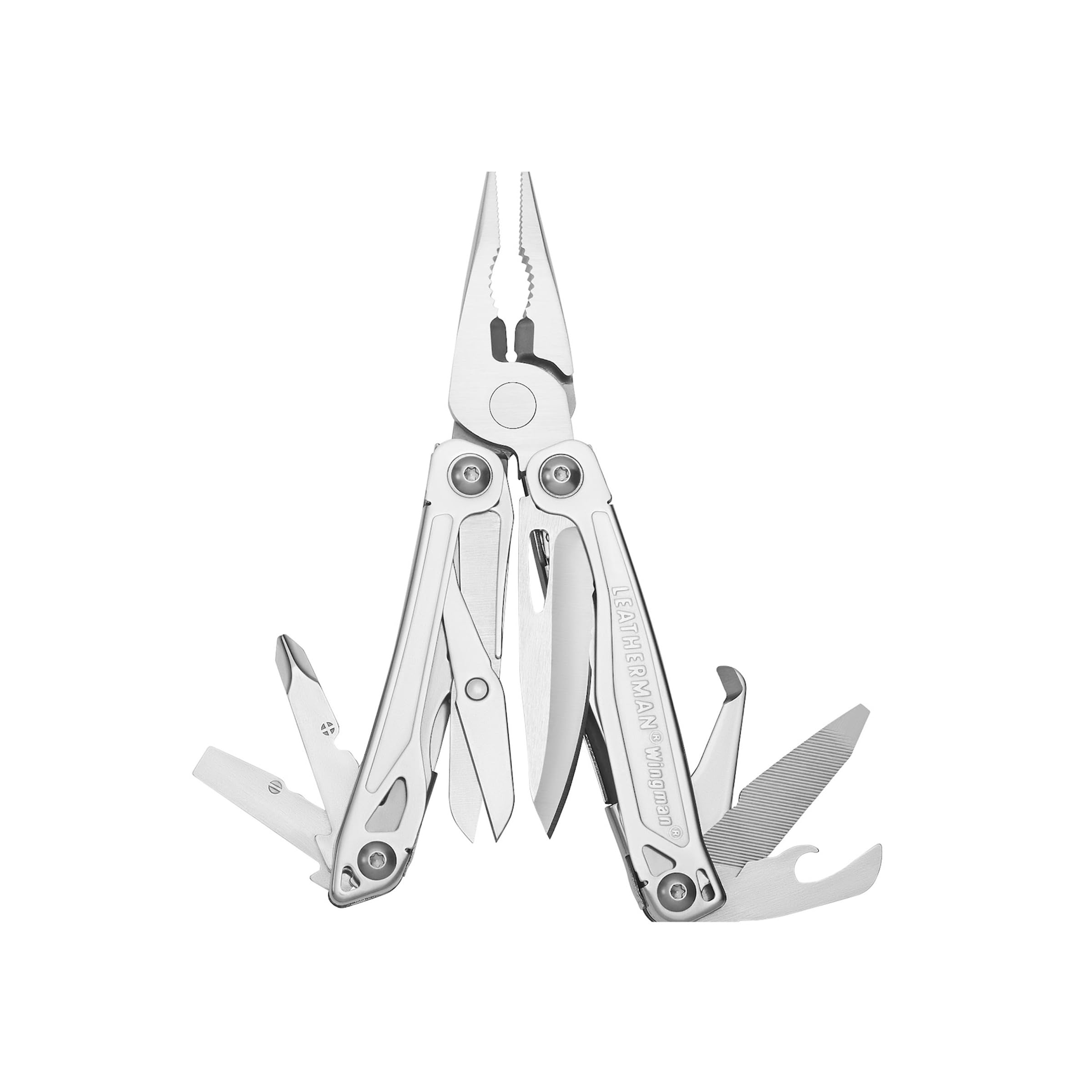
Leatherman Wingman
Key Features
- Tools: 14
- Pliers: Spring-action
- Weight: 6.88 oz
- Closed length: 3.8 in
- Price: Midrange
One-hand opening is what keeps the Wingman in a pocket rather than a drawer. Every tool on the frame opens with a thumb, including the ones that live inside the handles, and the blade locks once it’s out. Holding a tarp corner with one hand in the wind, that’s not a specification — it’s the difference between finishing the job and giving up on it.
The spring-action pliers are the other thing we appreciated. Jaws that return to open on their own let you pinch, reposition and grab again with one hand, and on a tool this small you feel the help. Closed length is 3.8 inches and the weight is 6.88 ounces, which puts it near the top of this set for pocket comfort while still carrying 14 tools.
Leatherman’s 25-year warranty is part of what you’re buying, and it’s the part that outlasts the novelty of a new tool. A multi-tool gets dropped, lent and left in a wet jacket; a company that will service it is worth more than two extra implements.
The scissors are the exception to the spring story. They’re listed as spring-action alongside the pliers, but ours are plain pivot scissors you open and close by hand. It doesn’t touch the knife, the drivers or the pliers, and it’s the one place the description overpromises.
Pros
- Every tool opens with one hand
- Spring-action pliers and scissors
- 6.88 ounces with a removable clip
- Backed by a 25-year warranty
Cons
- Scissors are not spring-action as described
For a tool that lives in a pocket, the Wingman’s one-hand opening and 6.88 ounces beat the extra implements on heavier picks.
Best for Belt and Glove Use
Gerber Truss

Key Features
- Carry: Belt sheath
- Tools: 17
- Weight: 8 oz
- Closed length: 4.25 in
- Price: Midrange
A sheath and a saw are the two things people forget to check for, and the Truss has both. Gerber’s 17-tool frame pairs needle-nose pliers, standard pliers and wire cutters with a full serrated blade, a wood saw, scissors, a file, a ruler and the usual drivers, and it ships with a belt sheath rather than a clip.
On a belt is where it makes sense. At 8 ounces and 4.25 inches closed it’s a substantial tool — heavier than either pocket pick here — and the sheath keeps it off your hip until you need it. If your hands are in gloves most of the day, a sheath you can grab is a lot faster than fishing in a pocket.
The trade-off is the pliers. This is a light-duty jaw, and hard wire pulling is the wrong job for it; treat it as a cutter for small-gauge wire and it behaves. Within that boundary the saw and the serrated blade earn their keep, and the steel takes and holds a working edge.
The tool locks want a firm thumb and stayed stiff, which is a two-second annoyance on a tool you open deliberately rather than constantly. A lanyard point at the tail end means you can tie it off on a pack strap, which is the other way this one ends up coming with you.
Pros
- Belt sheath included in the box
- Saw and full serrated blade on one frame
- Every tool locks open
Cons
- Pliers are not built for hard wire work
Choose the Truss when the tool rides on a belt: a sheath, a saw and a serrated blade make it the camp-work pick of this set.
Best for Basecamp and Vehicle
Mossy Oak 21-in-1

Key Features
- Carry: Nylon pouch
- Tools: 21
- Weight: 1 lb
- Folded size: 4 x 1.8 x 0.8 in
- Price: Budget
The first thing you notice is the weight. At 454 grams this is a belt tool rather than a pocket one, and the folded body — 4 by 1.8 by 0.8 inches — is dense in a way that makes the lightest tools here feel hollow.
We came around to it anyway, because the tool set is unusually complete: 21 functions including needle-nose and regular pliers, wire cutters, a magnetic hex sleeve, plain and serrated knives, a saw, a file, a punch and a ruler, all of it self-locking. The magnetic sleeve is the detail we liked most — it takes standard screwdriver bits, so the tool grows with the bits you already own instead of locking you into whatever shipped in the pouch, and there’s an elastic pocket on the front for spares.
The pivots start stiff. The first few openings take a thumbnail and some patience, and a cold morning makes it worse; a drop of oil and an evening of opening and closing everything on the frame fixes most of it. Do that before the trip, not during it.
What the weight buys is a frame that doesn’t flex when you lean on the pliers, and that’s the argument for keeping it in a glovebox or a basecamp box, where a pound on a shelf costs nothing. It is the wrong tool for a summit pack, and it doesn’t pretend otherwise.
Pros
- Magnetic sleeve takes standard driver bits
- All tools self-lock in the handles
- Pouch holds spare bits up front
Cons
- 454 g is a lot to carry on a hike
- Pouch belt loop wears through
A glovebox and basecamp bargain: 21 self-locking tools with a standard-bit sleeve, as long as you never plan to pocket it.
Best for Vehicle Emergency Kit
WETOLS 27-in-1

Key Features
- Tools: 27
- Weight: 9.38 oz
- Fire starter: Included
- Closed length: 4.37 in
- Price: Midrange
Fire starter, whistle, hammer and window breaker: the 27-in-1 is built around emergencies rather than repairs. Alongside the survival extras it carries needle-nose and regular pliers, soft and hard wire cutters, a wire stripper, a metal and wood file, drivers and a belt clip — 27 functions in a 4.37-inch closed frame that opens to 6.65.
Where it makes sense is in a bag that lives in a vehicle, a boat or a basecamp box. A window breaker is only useful if the tool is within reach when glass matters, and a hammer that drives a tent peg is only useful if it isn’t buried at the bottom of a pack. Mounted or clipped where you can grab it, the extras stop being marketing and start being a plan.
Every tool self-locks, and the butterfly frame opens in one movement rather than two, which is the right arrangement for a tool you want to deploy in a hurry. The sheath is a hard-wearing nylon pouch rather than a clip, so it’s a belt or bag tool by design rather than by accident.
Where it loses to our top pick is refinement. At 9.38 ounces with a hammer head it’s a tool you carry deliberately, not one that disappears into a pocket, and 4.37 inches closed is long enough to feel against a thigh. For the bag under the seat, neither of those matters, and the survival extras come with it.
Pros
- Fire starter and whistle on board
- Hammer and window breaker in the frame
- Self-locking tools, sheath included
Cons
- 9.38 oz and 4.37 in is bulky for a pocket
The pick for a bag that lives in a vehicle: fire starter, whistle, hammer and window breaker, provided you don’t want it in a pocket.
Best for Camp Wood and Pegs
GIRIAITUS 16-in-1

Key Features
- Head: Axe and hammer
- Tools: 16
- Fire starter: Flint and magnesium
- Overall size: 4 x 1.1 x 6.2 in
- Price: Budget
The axe is why this one exists. Where everything else here is a folding plier frame, the GIRIAITUS puts a small axe head and a hammer on the end of the handles, then fits pipe-grip and needle-nose pliers, a knife, a saw, a file, drivers, a whistle and a flint-and-magnesium fire starter inside them.
At 4 by 1.1 by 6.2 inches it runs smaller than the pictures suggest — closer to a kindling hatchet than a chopping tool. It splits finger-thick wood and drives tent pegs without complaint, and it isn’t the thing to swing at anything with real diameter.
As a camp kit rather than a chopper, the combination is smart. The magnesium rod gives the fire starter something to catch on when tinder is damp, the whistle is on the frame rather than in a pocket, and the hammer and nail claw handle pegs and stakes while the pliers deal with a bent tent pole. That’s a more coherent survival set than several tools here with longer function lists.
Check the axe cover before you pack it. It’s a thin sleeve, and a sharp edge can work through it inside a bag; a wrap of tape or a replacement sheath is the fix, and it’s worth doing before the first trip. The rest of the frame is tighter than we expected at this level.
Pros
- Axe and hammer on the handle ends
- Flint and magnesium fire starter
- Compact 6.2-inch overall package
Cons
- Runs small for a hatchet-style tool
Worth it if you want an axe in a compact camp kit, but go in knowing it is a kindling hatchet, not a chopping tool.
How We Tested 12 Survival Multi-Tools
We started with manufacturer spec sheets — blade steel, closed length, tool count, locking style, weight, warranty — and cut anything that wouldn’t name its steel, listed a tool count without saying which tools, or leaned on a lock design we’d seen fail before. That left 12 multi-tools, and we spent eight months with them: in the glovebox, in a daypack, in the kitchen drawer, and on a few trips where the only repair option was whatever we’d brought along.
Sharpness got checked the boring way — each blade sliced hemp rope and double-walled cardboard on day one and again at the end, and we noted which edges rolled or needed real pressure just to start a cut. For the locking mechanism, we opened each tool, bore down on the blade and the drivers the way you would on a stubborn screw, and watched for wiggle or a lock that let go early. Spring-loaded pliers were worked one-handed, with work gloves on, standing in a dim garage; the ones that needed two hands got marked down.
We weighed every tool on a kitchen scale and carried each in a front pocket for a week, since the number means less than whether it digs into your thigh when you sit down. Durability testing was blunt: three drops onto concrete from waist height, an overnight soak, then two weeks forgotten in a damp shed, checking afterward for rust at the pivots and play in the hinges. And because half of these ship with implements nobody touches, we logged which ones actually got used across a month of real repairs. The answer was almost always the blade, the pliers, and one Phillips driver.
How to Choose a Survival Multi-Tool
The most useful decision you can make before comparing tools is whether this one lives in your pocket or in your pack — almost everything else follows from it.
Decide what survival has to mean for you
Most tools sold as survival gear are ordinary everyday-carry frames with a couple of extras bolted on. The extras worth paying for are the ones you would otherwise carry separately: ignition, a signal, and a way to bring an edge back. A fire starter, a whistle and a sharpener built into the handles genuinely shrink a pack. A bottle opener and a corkscrew do not.
The trap is buying ignition you have never practiced with. A ferrocerium rod throws sparks onto dry tinder, not onto wet leaves, and if the tool’s fire starter lives in a handle you should test it at home before you rely on it in the rain. If you want the fire-starting part solved, the Leatherman Signal is the pick here that pairs a rod with a whistle and a diamond sharpener.
Tool count is not the same as capability
A 27-in-1 and a 15-in-1 can differ by a set of screwdriver bits and nothing else. Count the tools you would actually use away from a workbench — pliers, a knife, a saw, cutters, a couple of drivers — and treat the rest as a bonus. Pliers are the working end of a pliers-based tool, so the jaw and the cutters deserve more of your attention than the number on the box.
Two details tell you more than the count. Replaceable wire cutters mean the part that dulls first can be renewed instead of retiring the tool. A magnetic hex sleeve that takes standard bits means the driver set grows with the bits you already own, which is what makes the Mossy Oak’s tool list more useful than its length suggests.
Locks and access: will it open with cold hands?
Every tool that cuts or twists should lock open, and the lock should release with a thumb rather than a fingernail. Stiff pivots are the most common complaint in this category, and the problem is worse in the cold, when hands are numb and gloves are on. Work a new tool open and shut a few dozen times at home with a drop of oil before a trip; that fixes most of it.
Then think about access. Blades that open from the outside of a folded tool are quicker when the tool is closed; on a butterfly frame, everything comes out once the handles are apart. If you will mostly be wearing gloves, one-hand opening — the Wingman’s strongest feature — matters more than an extra implement.
Weight and how you carry it
Carry method decides whether the tool comes with you. A clip is for a 6-to-7-ounce tool that lives in a pocket; a sheath is for anything heavier or for hands that are busy or gloved. The same tool that disappears on a belt can be a nuisance in a trouser pocket, and a pound of steel in a daypack is a pound you notice on a climb.
Be honest about the trip. The pick that stays in the car is worth less than the lighter one that goes up the hill, and the heavier one that lives in a glovebox costs you nothing. Our budget pick and our top pick are both pocket tools; the Mossy Oak is not, and it doesn’t pretend to be.
What the warranty is worth
A multi-tool gets dropped, lent, and left in a wet jacket, so the service behind it is part of the price. Leatherman states a 25-year warranty on the Wingman and Gerber a limited lifetime one; both are worth more than two extra implements on a tool you will keep for a decade.
Check that service reaches your country before you pay a premium for it. A warranty you cannot use is a line on a page.
Frequently Asked Questions
Can you take a multi-tool on a plane?
Not in carry-on. A folding blade of any length is treated as a prohibited item at security in the US and most other countries, so a multi-tool travels in checked baggage. If you are flying carry-on only, leave it at home.
Pack it in its sheath or a hard case so the blade and any axe head cannot work open against the rest of your luggage.
How do you keep a multi-tool from rusting?
Dry it before it goes back in the sheath, and put a drop of light oil on the pivots a few times a year. Stainless resists rust rather than ignoring it — salt water and a damp pouch are what actually cause the brown spots.
Rinse with fresh water after a coastal trip, dry it fully, and store it open rather than clamped shut in a wet case.
What can you actually cut with the saw on a multi-tool?
Green branches, shelter poles and snagged line, using short light strokes and letting the teeth clear the cut. The blade is thin and the frame flexes, so forcing a bind is how people snap a saw blade.
For anything much thicker, carry a folding saw. The multi-tool saw is there so you don’t have to walk back to the truck.
Final Verdict
Nineteen tools, a fire starter, a whistle and a sharpener in something that still fits a hip pocket: the Leatherman Signal is the one we take when the trip is the point, and nothing else here covers as much of an emergency in one hand.
If the budget is the constraint, the Gerber Suspension NXT does the everyday half of the job well. If the tool is going to ride on a belt rather than in a pocket, the Truss and its sheath make more sense than either.