This post contains affiliate links. We may earn a small commission when you buy through our links — at no extra cost to you.
A multitool is a pocketful of compromises — the pliers are never as good as the ones in your toolbox, and the blade is never as sharp as a real knife. What it fixes is the moment halfway through pitching a tent in fading light when something needs tightening, cutting, or prying and the only thing in your pocket is a phone. The trick is finding one whose compromises land where you can live with them: light enough to actually carry, sturdy enough that the pliers don’t twist out of alignment the first time you lean on them.
The tool count on the box tells you almost nothing. I’ve owned a 20-function tool that was useless because the blade wouldn’t lock, and a three-tool one that handled everything a long weekend threw at it. My team and I spent the last six months carrying 12 multitools on camping trips, and the keepers all did two or three jobs well instead of fifteen badly. Below, they’re grouped by how people actually use them at a campsite, not by how many gadgets fold out of the handle.


Best for All-Round Camping
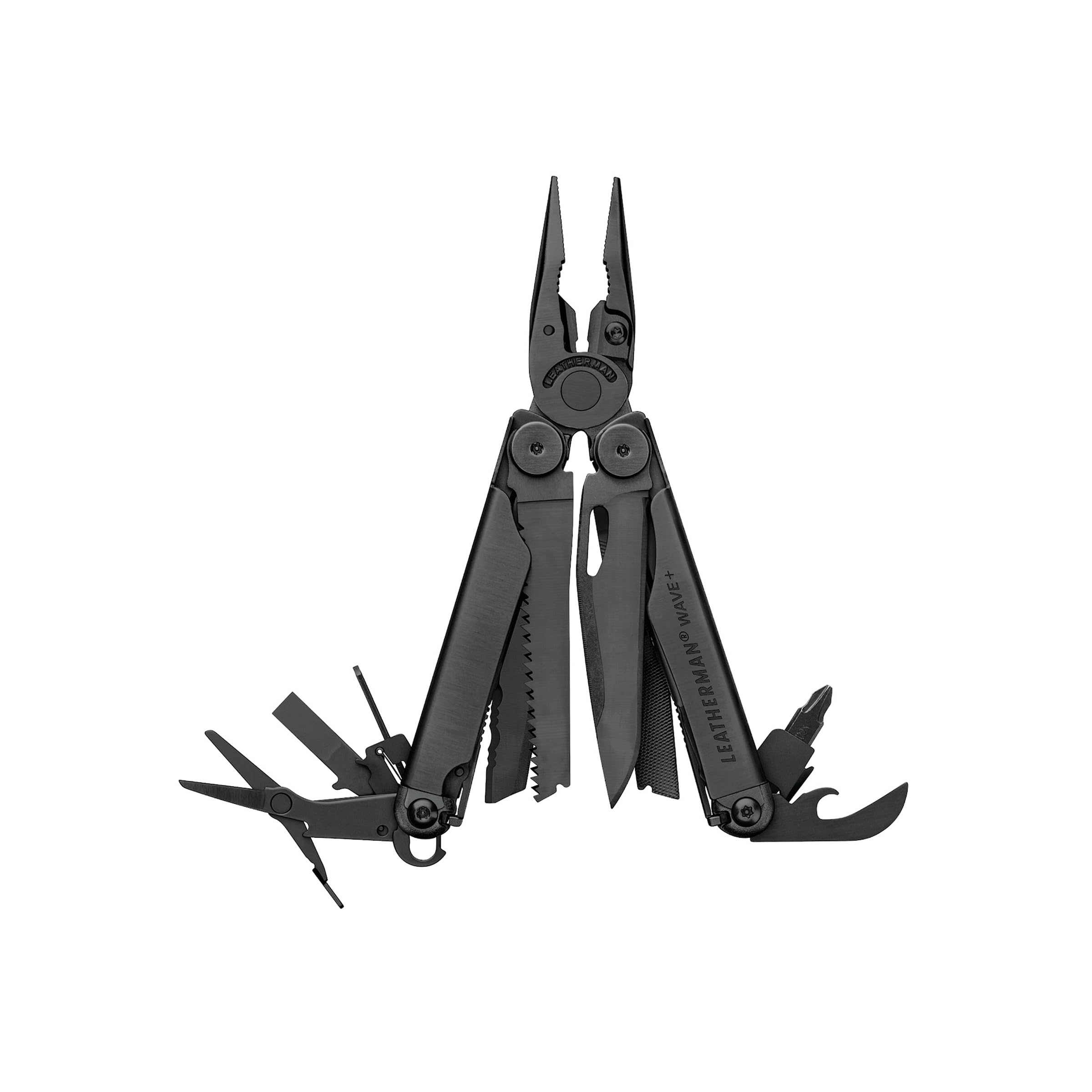
Leatherman Wave Plus
Key Features
- Tools: 18
- Blade access: Outside-accessible
- Wire cutters: Replaceable
- Closed length: 4 in.
- Price: Premium
Four jobs decide a camping multitool for us: a blade that opens with one hand, a saw that gets through a branch the size of your thumb, pliers for a bent stake or a hot pot lid, and a lock that holds while you push. The Wave+ does all four. The blade and the saw sit on the outside of the frame, so they open without unfolding the handles, and every tool in the body locks open.
That outside access is the detail that justifies the price for us. When one hand is holding a flashlight or wearing a glove, a tool that has to be unfolded before it will cut is a tool you stop carrying. Four inches closed puts it in a hip pocket or a pack lid, and the replaceable wire cutters mean the part that takes the abuse is the part you can renew rather than the part that retires the whole tool.
Inside the handles, the rest of the 18 tools fit a campsite rather than a workshop: spring-action scissors for line and tape, a can opener, a file, and drivers sized for stove screws and cooler latches. The cost is the one thing we cannot smooth over, because this is the most expensive tool in the group. The saw is the part we miss most when we carry something smaller: long enough to cut kindling instead of hunting for it, short enough to be safe in a crowded camp.
Pros
- Blade and saw open without unfolding the handles
- Replaceable wire cutters take the wear
- 18 locking tools cover camp repairs and cooking
- Long manufacturer warranty backs the spend
Cons
- Most expensive tool in this group
We recommend the Wave+ as the default camping multitool: the saw, outside-opening blade and locking tools handle kindling, cooking and repairs, and the premium price is the only real obstacle.
Best for Fire Starting
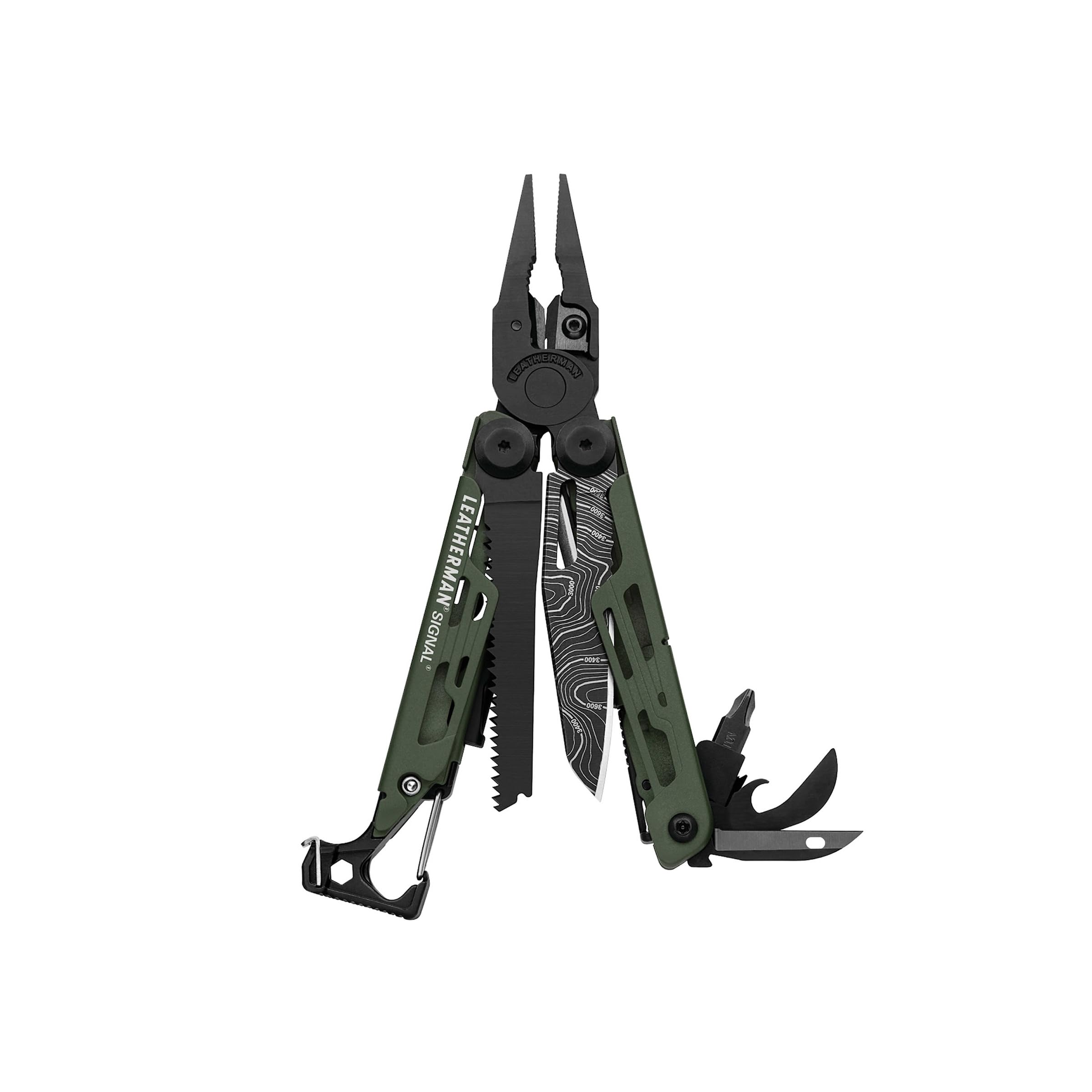
Leatherman Signal
Key Features
- Tools: 19
- Extras: Whistle and diamond sharpener
- Fire starter: Ferrocerium rod
- Closed length: 4.5 in.
- Price: Premium
A ferrocerium rod tucked into the handle, a hammer at the butt, a whistle and a diamond sharpener in the frame: the Signal is the only tool here designed around a night at a campsite rather than a shelf of chores. We think that makes it the right buy for the camper who wants fire-starting backup built into the tool already on their belt, and the wrong one for anyone who mostly turns screws.
The hammer earns its place first. Driving tent stakes with the flat of a blade is how tips get chipped, and the Signal gives you a proper striking surface at the end of the frame. The whistle is the quiet win on any trip where a group can get separated. The pliers are where our enthusiasm cools: the hinge is stiff enough that opening and closing them takes a deliberate push, and it is worth working them a few dozen times before you lean on them.
At 4.5 inches closed it is the lighter of our two Leatherman picks, and the topo-print scales are a nice change from plain stainless steel. If fire-starting is a ritual you care about, the extra cost over the Wave+ buys a rod and a hammer in the same tool, and that is the trade the Signal asks you to make.
Pros
- Built-in ferrocerium fire starter
- Hammer drives tent stakes without abusing the blade
- Whistle and diamond sharpener in the frame
- Lighter than our top pick for belt carry
Cons
- Belt clip is the weak point in pocket carry
- Finish suffers in salt water and long wet spells
Fire-starting backup, a stake hammer and a whistle in one tool is the Signal’s case, and it holds as long as the stiff pliers hinge does not put you off.
Best for Budget Full-Size
Gerber Suspension NXT
Key Features
- Tools: 15
- Weight: 8.48 oz
- Tool lock: Yes
- Closed length: 4.25 in.
- Price: Midrange
Every tool on the Suspension NXT locks open, and every one of those locks has to be pressed before the tool folds away again. That is the right call for safety and a small nuisance in camp: the release levers sit close to the frame and want a deliberate thumb, which is exactly what you do not have with cold hands in the dark.
Against the price, that is a trade we make willingly. This is a full-size butterfly tool — 15 tools, needle-nose pliers, a saw, three flathead and two cross drivers, an awl, openers — at well under what either Leatherman here costs. That is the pitch: the same camp jobs, minus the refinement.
At 8.48 ounces it is noticeable on a hip belt after a long day, so it suits a pack pocket or a truck box better than a shirt pocket. What it does have is a tool for nearly every camp repair you will actually face, and a locking frame that keeps them where you put them. If your multitool lives in a pack and comes out a few times a weekend rather than every day, we think this is the value pick of the group.
Pros
- Full-size locking tool set at a budget price
- Needle-nose pliers and a saw handle camp fixes
- Butterfly opening keeps tools stowed when closed
Cons
- Belt clip is the weak part of the tool
- Short blade and small drivers limit leverage
Our value pick: the Suspension NXT gives you a full-size locking tool set and needle-nose pliers for far less than the premium options, with a shorter blade and fussier locks.
Best for Car Camping
Mossy Oak 21-in-1
Key Features
- Tools: 21
- Sheath: Nylon with bit pockets
- Weight: 1 lb
- Locking: Self-locking
- Price: Budget
At 454 grams — a pound — the Mossy Oak is the heaviest tool in this group, and that number sets everything else about it. On a belt it swings; in a hiking pack it is a luxury. In a car-camping bin or a basecamp box it is the tool you grab, because everything is in one place.
The kit is the reason. Twenty-one tools including a saw, a serrated blade, a file and a ruler, a magnetic hex sleeve for the included screwdriver bits, and a nylon sheath with elastic pockets on the front that keep those bits with the tool instead of at the bottom of a bag. Losing the small bits is the usual way these kits stop being useful, and the pouch is a real part of the value here.
Opening it takes some persuasion. The lock buttons want a firm press and the tools come stiff, so plan on working them open and shut for a while before the tool feels quick in your hand. Ours settled in over a weekend of camp use, but the first few sessions are not the ones where it shines.
Where that leaves it: for car camping, a glovebox, or a first tool for someone building a camp kit, the sheath, the bits and the 21 tools make a persuasive package for modest money. Just do not ask it to ride on your hip for a ten-mile day — the pound is the whole story.
Pros
- Sheath pockets keep the extra bits together
- 21 tools including saw and serrated blade
- Self-locking tools stay put in use
Cons
- Heavy at 454 grams
- Sheath wears out before the tool does
Buy the Mossy Oak for car camping and basecamp boxes, where its sheath, bits and 21 tools outweigh the 454 grams you would never want on a hike.
Best for Survival Kit
WETOLS 27-in-1
Key Features
- Tools: 27
- Extras: Fire starter and whistle
- Weight: 9.38 oz
- Closed length: 4.37 in.
- Price: Midrange
Twenty-seven tools is a big claim, and it is worth knowing how the number is reached: the soft wire cutter, the hard wire cutter and the wire stripper are three separate entries on one pair of plier jaws. Count the jaws once and the WETOLS is a well-equipped 4.37-inch tool with a full plier set, a metal and wood file, drivers and openers — which is still a lot of tool for the size.
The camping extras are what separate it from a hardware-store tool: a fire starter, a whistle, a window breaker and a hammer built into the frame. A whistle and a fire starter in the tool you are already carrying is the kind of redundancy that costs nothing until the trip where it matters, and the window breaker is there for the emergency you hope never arrives.
Build-wise it is a 9.38-ounce tool with sandblasted handles, a self-locking frame and a hard-wearing sheath. That weight is the honest limit: it is a belt or pack tool, not something that disappears in a pocket the way a key-ring knife does.
We have not put a full season on this one, so our judgement rests on the design rather than on long wear. If you want a fire starter, a whistle and a full plier set in one tool without paying Leatherman money, this is the pick here — treat the tool count as marketing and the extras as the reason to buy.
Pros
- Fire starter, whistle and window breaker built in
- Full plier set plus file and drivers
- Self-locking frame with a sheath
- Compact 4.37-inch closed body
Cons
- 9.38 ounces keeps it out of a pocket
For a pack kit with a fire starter, whistle and full plier set, the WETOLS makes the most sense of the mid-priced tools here.
Best for Keychain Backup
Victorinox Classic SD

Key Features
- Carry: Key ring
- Length: 2.3 in.
- Weight: 0.74 oz
- Functions: 7
- Price: Budget
Twenty-one grams and 2.3 inches closed: on a key ring the Classic SD disappears, which is the entire argument for it. It is the tool still in your pocket at the end of a wet hike, when the full-size multitool is in the pack back at camp.
What it does at a campsite is smaller and more frequent than what the pliers tools do. The scissors cut fishing line, tape and blister dressing; the tweezers pull splinters; the blade opens food packets and cuts cord; the file tip handles the screw on a stove or a headlamp battery door. None of that is glamorous, and all of it comes up on most trips.
It is not a camp multitool in the sense the rest of this list is: no pliers, no saw, and a blade shorter than your thumb, so anything involving a stake, a pot lid or a branch is out of its range. It is the second tool, the one that is with you when the big one is not, and at this size most campers should have one on the ring.
Pros
- Disappears on a key ring at 21 grams
- Scissors and tweezers earn their keep
- Screwdriver tip handles small screws
Cons
- No pliers or saw
- Blade is too short for real cutting
We keep the Classic SD on a key ring as a second tool: 21 grams of scissors, tweezers and blade for the small jobs a full multitool is too far away to help with.
Best for Spare and Gifts
ETEH 13-in-1

Key Features
- Tools: 13
- Pliers: Needle-nose
- Folded size: 4 x 1.5 x 0.5 in.
- Price: Budget
The ETEH costs the least of these picks, and it does not read as a cheap tool: 13 functions, needle-nose pliers, a wire cutter, openers, and a holder with a set of screwdriver bits, all in a body that folds to about four inches.
The bit holder is the feature that lifts it above a plain pocket knife, because it gives you the sizes a stove, a tent pole or a cooler latch actually takes. The pliers handle the small jobs — bending a hook, holding a nut — as long as you are not asking for real leverage.
The catch is the grip. The plier handles are flat steel with nothing to soften them, and a hard squeeze drives the edges into your palm. For a glovebox, a tackle box, a spare in the car or a gift, that is fine, and the ETEH does small jobs with a straight face. For the tool you carry on every hike, spend more.
Pros
- Lowest price in this group
- 13 tools including a screwdriver bit holder
- Folds to about four inches
Cons
- Plier handles dig into the palm under a hard squeeze
- No saw in the tool set
As a glovebox spare or a gift, the ETEH is hard to argue with: 13 tools and a bit holder for the least money here, though the grip punishes hard squeezing.
Best for Tent Stakes
DR.LILIANG 13-in-1

Key Features
- Carry: Nylon belt pouch
- Tools: 13
- Weight: 10.9 oz
- Closed size: 5.9 x 2.9 x 0.8 in.
- Price: Budget
A hammer on a multitool looks like a gimmick until the first evening you are driving tent stakes with a rock. The DR.LILIANG puts a small hammer at the end of the frame with a nail claw opposite it and builds 13 tools around that, and it is the pick for a car camper who wants a stake hammer and a screwdriver in the same pocket-sized object.
The rest of the set covers camp basics: blade, Phillips and flat drivers, wire cutters, bottle opener, nail file and a hex wrench, carried in a nylon belt pouch. At 5.9 inches closed and 10.88 ounces it is a belt tool rather than a pocket one, and the screwdriver bits are the weak spot — they seat in a holder that lets them work loose. Check they are seated before you lean on a screw.
Pros
- Hammer and claw for tent stakes
- 13 tools including wire cutters and drivers
- Nylon belt pouch included
Cons
- Screwdriver bits work loose in the holder
- Bulky 5.9-inch body for a pocket
Choose the DR.LILIANG if you want a stake hammer, claw and 13 tools in one belt pouch, and you do not mind loose-fitting bits and a bulky body.
How We Tested the Best Multitools for Camping
We built the shortlist from scratch, starting with the makers whose tools come up again and again among campers, then filtering by blade steel, lock style, closed length, weight, and price. Anything too bulky to ride in a hip pocket or hang on a belt without swinging got cut, and so did tools whose owner feedback clustered around pliers snapping or edges rolling over. That left 12, which we tested over six months across spring car-camping weekends, two backpacking overnights, and plenty of backyard fire-pit evenings in between.
On those trips every tool did the same jobs: cutting 3/8-inch manila and paracord, shaving feather sticks for tinder, sawing through a two-inch dead branch, snugging tent stake loops, bending wire, and turning a rusted screw on a cooler hinge. Back home we weighed each one on a kitchen scale and carried it in a front pocket and in its sheath on a full day hike, noting which ones snagged on pack webbing or printed through fabric.
Locking mechanisms got the harshest treatment — we pushed hard on the spine of every open blade with a gloved hand to feel for wiggle, then tried to close each one with cold, wet fingers. After muddy weekends we rinsed and dried them and checked the pivots for rust and the pliers for side-to-side play. We also handed each tool to someone who’d never opened a multitool and watched how long it took them to get the knife out, and weighed what each one genuinely did well against what it cost.
How to Choose a Camping Multitool
The number printed on the box tells you very little. The two or three jobs your trip actually asks for tell you almost everything.
Start With the Jobs, Not the Tool Count
If you build fires, insist on a saw. A multitool saw cuts deadfall and kindling up to about thumb thickness; it will not process a log, and no folding tool will. If you cook, you want pliers for a hot pot lid and an opener you can work with cold fingers. Counts inflate easily — one pair of plier jaws can supply a wire cutter, a hard-wire cutter and a stripper — so read the tool list rather than the total. Both Leatherman picks here carry a real saw; the Classic SD does not.
Weight Decides How You Carry It
Twenty-one grams on a key ring, eight and a half ounces on a belt, or a pound in a camp box are three different tools for three different trips. For hiking, stay near the eight-ounce end: the Suspension NXT and the Signal are the ones here that ride a hip belt without complaint. For car camping, the 454-gram Mossy Oak is a better deal than its weight suggests, because you never carry it further than the tailgate. Be honest about which trip you take most, and buy for that one.
Locks, Cold Hands and One-Hand Opening
A locking blade is not a luxury. A folding blade that closes under pressure is how campers get cut, so check that every tool locks and that the release is workable with a thumb, not a fingernail. The Suspension NXT locks everything but asks for a firm, deliberate press on each lever. Blades that open without unfolding the handles, as on the Wave+, are worth paying for if you will be working in gloves or after dark. Open and close a new tool a few dozen times before a trip so the action loosens before you need it.
What the Warranty Tells You
A multitool is a small pile of springs, pivots and lock faces, and the maker’s warranty is a fair proxy for how long they expect those parts to last. Leatherman backs its tools for decades and keeps spare parts available; the cheaper tools here lean on replacement rather than repair. That difference is most of what the premium buys. If you plan to carry the same tool for ten years, weigh the warranty as heavily as the tool list; if it lives in a glovebox, buy on price and extras.
Frequently Asked Questions
Can I take a multitool on a plane?
Not in carry-on. A folding blade of any size counts as a prohibited item at security, including the 2.3-inch Classic SD, so the tool goes in checked luggage. If you are traveling carry-on only, leave it at home or ship it ahead, and check the rules for your destination country before you fly.
Will a multitool saw cut firewood?
It will cut kindling, not firewood. A multitool saw handles dead branches up to roughly thumb thickness; anything bigger needs a fixed-blade saw or an axe, and splitting by batoning is a job for a fixed blade, never a folding multitool. Gather wood you can snap by hand and let the saw deal with the rest.
How do I keep a multitool from rusting?
Dry it before it goes back in the sheath. Stainless steel resists rust rather than ignoring water, and a tool left damp in a nylon pouch is where spotting starts. Wipe the blade and pivots with an oily cloth after a wet trip, work a drop of oil into the joints once a season, and store the tool open and dry rather than folded wet.
Final Verdict
Start with the Wave+ unless something specific pulls you elsewhere. The outside-opening blade and saw, the locking tools and the replaceable cutters are what let one tool cover kindling, cooking and running repairs, and that is why it is the default here.
If you want fire-starting built in, the Signal is that idea made for campsites, and the Gerber Suspension NXT covers most of the same jobs for far less. For a camp box that never leaves the car, the Mossy Oak’s sheath and bits are worth more than its weight costs you.