This post contains affiliate links. We may earn a small commission when you buy through our links — at no extra cost to you.
A hunting knife gets judged in poor light and worse weather: wet hands, a heavy animal, and a blade that has to open, cut, and stay put. The shelf appeal fades fast once you’re field-dressing in the rain, so I care less about a pretty handle and more about whether the edge holds, the grip stays secure through gloves, and the lock or full tang gives me confidence when I bear down. A good knife fixes the small failures that turn a routine job into a frustrating one—a dull edge, a slick handle, a folder that develops play.
I tested 12 hunting knives over eight months, from folding models to fixed blades, using them on game, around camp, and through repeated cleanings. My team and I paid attention to out-of-box sharpness, how each edge held up after cardboard, rope, and hide, and whether the handle stayed comfortable with wet, gloved hands. We also checked construction details—pins, scales, sheath stitching—and whether the price felt fair after real use. The picks below are the ones that earned their place.



Best for All-Around Hunting
Buck 119 Special
Key Features
- Sheath: Leather
- Blade Length: 6 inches
- Blade Material: 420HC stainless steel
- Overall Length: 10.5 inches
- Price: Premium
A 6-inch clip point looks like a lot of knife for deer, and it is. What makes the Buck 119 our top pick is how well that length works as an all-around hunter: enough reach to open a carcass, enough belly for skinning, and a full tang that feels solid from guard to pommel. The 420HC blade is sharp and easy to maintain, and the integrated finger guard gives your hand a clear stop when the cut shifts.
The phenolic handle is smooth, almost polished, and it looks classic against the aluminum guard and pommel. It wipes clean easily, which matters after the work is done. The shape fills the hand without feeling bulky, and the full tang keeps the balance predictable when you choke up for detail work.
Where it earns its keep is simplicity. No lock to fumble, no blade to replace, no plastic case to sort through. The leather sheath holds the knife securely on a belt, and the whole package is easy to clean and put away. For caping, a 3-inch blade like the Sharpfinger is more precise; for one hunter that has to gut, skin, and break down an animal, the 119 is the one we reach for.
Pros
- Full-tang build with a protective guard
- Sharp 420HC blade is easy to maintain
- Simple leather sheath and easy cleanup
Cons
- Smooth handle offers little texture
The Buck 119 is the fixed blade we recommend to a first-time hunter: full-tang, sharp 420HC steel, and a leather sheath that keeps the whole package simple.
Best for Folding Field Carry
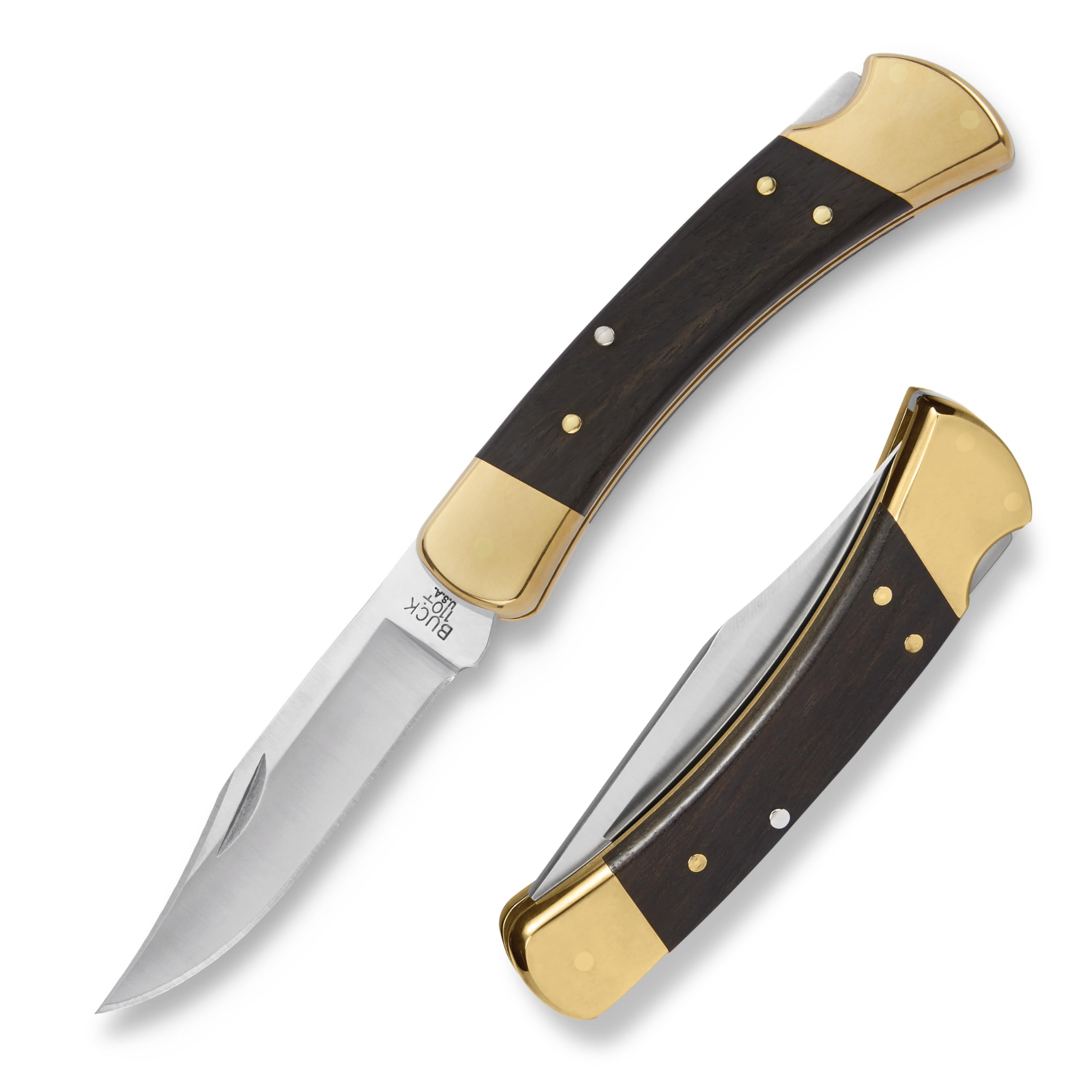
Buck 110 Folding Hunter
Key Features
- Weight: 7.2 oz
- Blade Length: 3.75 inches
- Closed Length: 4.875 inches
- Blade Material: 420HC stainless steel
- Price: Premium
The 110 is the folding answer to the 119: same 420HC steel, same brass-and-ebony look, but a 3.75-inch blade that closes into a 4.875-inch package. We prefer it when pack space matters more than fixed-blade simplicity. The lockback opens through a nail notch and locks up with a solid feel, which is the reassuring part.
At 7.2 ounces, it has the heft of a small fixed blade. We liked that in the hand, and the included leather sheath is the sensible way to carry it. The nail notch is deliberate: this is a two-hand opener, not a one-hand flicker. For a hunting knife, that is a fair trade for a lock that stays put.
The handle is comfortable in a normal grip, and the clip point is useful for skinning and camp tasks. We did wish the sheath closed more snugly, since the knife can shift inside it, but the leather itself is sturdy. If you process several animals in a season, a fixed blade is easier to clean; if you want one knife that rides in a pack and handles the occasional deer, the 110 is the classic choice.
Pros
- Solid lockback action and classic feel
- Folding 3.75-inch blade packs easily
- Leather sheath included for belt carry
Cons
- Heavy for pocket carry
If you want a Buck hunter that disappears into a pack, the 110’s lockback action and 3.75-inch blade make it the folding default.
Best for High-Volume Dressing
Outdoor Edge RazorPro L
Key Features
- Weight: 14.4 oz
- Blade Type: Replaceable
- Handle Material: Rubber
- Included Blades: 30
- Price: Midrange
A box of 30 blades is the whole pitch. When one dulls, you release it, drop in a fresh one, and get back to work. We like that for a long dressing session, especially in cold weather when sharpening is the last thing you want to do. The orange rubber handle is easy to find on the ground and stays secure in a wet hand.
The blade release is the part that gave us pause. In some grips, a thumb can trip the release while cutting, and the blade can come loose. That does not happen every time, but it is the check we make before every use: grip the handle, confirm the blade is seated, and keep your thumb behind the release. The included nylon sheath is basic but keeps the knife on a belt.
The sheath is its home; this is not a pocket knife, so plan to carry it on a belt or in a pack. We also prefer it for volume work rather than fine caping—the replaceable blade is sharp, but the handle is bulkier than a small fixed blade. If you dress one deer a year and enjoy sharpening, a conventional steel blade is simpler. If you prefer never to stop to sharpen, this is the pick.
Pros
- Thirty blades keep the edge fresh
- Blade changes take seconds
- High-visibility rubber handle stays secure
Cons
- Heavy at 14.4 ounces
- Replacement blades add ongoing cost
The RazorPro L is the one for hunters who hate sharpening: swap in a fresh blade and keep dressing, provided you check the lock.
Best for Compact Field Kit
Outdoor Edge WildLite
Key Features
- Carry Case: Hard-side
- Set Pieces: 6
- Blade Material: 420J2 stainless steel
- Handle Material: TPR
- Price: Budget
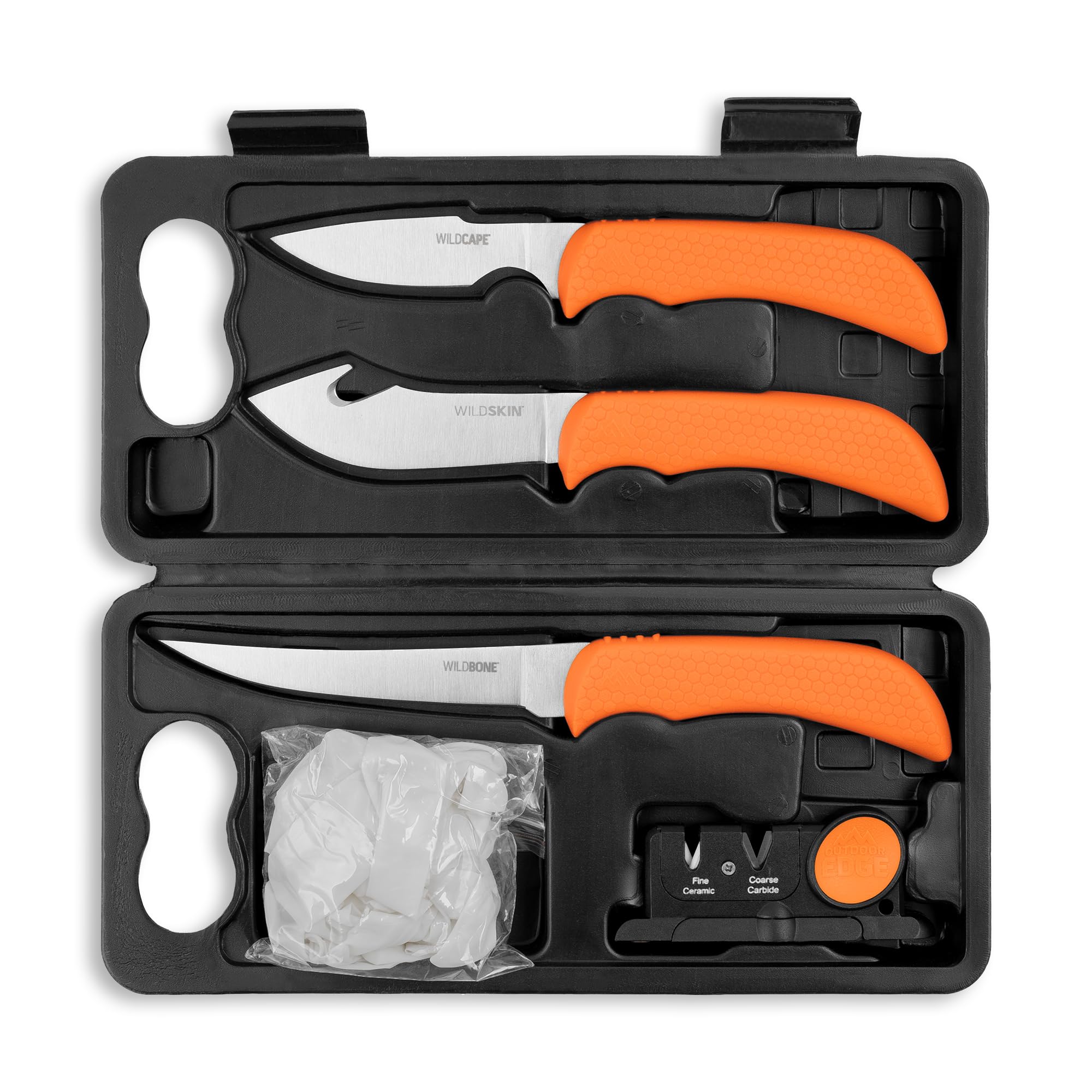
The first thing we noticed is the case: a hard-sided box that keeps the gutting knife, caping knife, boning knife, sharpener, and gloves from sliding around in a pack. That organization is the real feature. Instead of digging for a loose blade, you open one case and see what you have.
The blades are 420J2 stainless and sharpen easily with the included two-stage sharpener. The high-visibility orange TPR handles are a smart choice in the field—easy to spot on the ground and comfortable when your hands are wet. The knives are light enough to carry together without turning the pack into a toolbox.
What we like most is the role clarity: a gut hook for opening, a caping knife for fine work, a boning knife for the quarters, and a sharpener in the same box. For one or two deer a season, that is enough. If you already own a good fixed blade, buy the knife you like and add a sharpener; if you are starting from nothing, this is an easier way to cover the whole job. It does not include a saw or spreader, so look at the Mossy Oak kit for elk or full butchering.
Pros
- Hard case keeps the kit organized
- Three knives cover gutting, caping, boning
- Includes sharpener and game gloves
Cons
- 420J2 steel needs frequent touch-ups
The WildLite is the compact kit we recommend for a first full deer: three core knives, a sharpener, gloves, and a hard case in one grab.
Best for Full-Game Processing
Mossy Oak Field Dressing Kit
Key Features
- Case: Carry case
- Weight: 3.3 lb
- Set Pieces: 8
- Blade Material: Stainless steel
- Price: Budget
This is the kit we recommend when you want a full processing box rather than one knife: an 8.7-inch wood and bone saw, a steel stick and brisket spreader, a 7.5-inch caping knife, a 9.5-inch gut hook skinner, a 10-inch boning knife, a carbide sharpener, and gloves. The saw’s blunt hooked tip is the detail we liked most—it is shaped to avoid opening the bladder or intestines while you work.
The trade-off is that you are buying variety and a case rather than one premium blade. The stainless full-tang tools handle the jobs, but the set does not feel as refined as a Buck in the hand. The plastic case is handy at home and in camp, though it is the part we expect to show wear first.
For a hunter who wants one box for deer and hog and does not want to assemble tools separately, it is a sensible buy. The caping knife is the standout for detail work, and the saw earns its place on ribs and pelvis. If you already have a fixed blade and only need to skin, skip the kit and put the budget into a better single knife.
Pros
- Eight pieces cover sawing, caping, gutting, boning
- Saw’s blunt tip protects organs
- Carry case keeps the kit together
Cons
- Blades dull faster than premium steel
- Heavy to pack at 3.3 pounds
The Mossy Oak eight-piece kit is the full-processing box we recommend when you want a saw, spreader, and boning knife in one case.
Best for Precise Caping Work
Old Timer Sharpfinger

Key Features
- Sheath: Leather
- Blade Length: 3.3 inches
- Overall Length: 7.1 inches
- Handle Material: Sawcut Delrin
- Price: Budget
A 3.3-inch blade does not sound like much until you use it on a deer. The Sharpfinger’s short clip point puts your hand close to the work, and the full-tang handle with a thumb rise gives you a place to lock your grip. It is the opposite of the Buck 119: less reach, more control.
The sawcut Delrin handle is comfortable and easy to wipe down, and the 7.1-inch overall length makes the knife easy to carry all day. The included leather sheath keeps it on your belt and out of the way. This is a knife that disappears into a pack until you need it.
The size is the real story. It is a specialist: excellent for skinning and caping, less useful for opening a rib cage or reaching deep into an elk. We kept it as a companion knife rather than the only blade in the pack. If you want one knife for everything, the Buck 119 is more versatile; if you want a precise second blade, this is the one.
Pros
- Short blade gives precise control
- Full tang with thumb rise
- Light enough for pack carry
Cons
- Thin leather sheath feels flimsy
- Smooth handle lacks wet grip
The Sharpfinger is the small fixed blade we reach for when caping and skinning demand control, not reach.
Best for Budget Backup Set
Mossy Oak Fixed Blade Set

Key Features
- Sheath: Nylon dual carry
- Set Pieces: 2
- Skinner Blade: 5-1/8 inches
- Gut Hook Blade: 4-1/4 inches
- Price: Budget
You get two knives here: a 5-1/8-inch skinner and a 4-1/4-inch gut hook, both full-tang with camo handles and a nylon dual sheath. The split is sensible. The longer blade does the skinning and general cutting; the gut hook opens the hide without turning the belly into a mess.
The nylon sheath holds both knives securely, and the plastic inserts keep the edges away from the stitching. The handles are large enough for gloved hands, and the full-tang construction gives the set a solid feel that makes it seem more substantial than the case suggests.
This is a set that rewards a little prep. We test both blades on paper and check the grip with gloves before packing it, and we keep a sharpener in the truck. The two-knife layout is the reason to buy: if one edge dulls, the other is ready, and the gut hook stays dedicated to opening.
For a spare kit, a loaner, or a first field-dressing box, it earns its place. It is not the set for a once-in-a-lifetime elk hunt, and it will not replace a good fixed blade in the hand. But it covers skinning and gutting, and it leaves room for a better sheath later. If you want one knife that feels special, spend more; if you want a capable backup, this is the budget set we recommend.
Pros
- Two knives cover skinning and gutting
- Gut hook is a useful extra
- Nylon sheath holds both securely
Cons
- Edges vary out of the box
- Grip shape does not suit every hand
The Mossy Oak two-piece set is the budget kit we recommend for a spare or a first field-dressing box, as long as you check the edges.
How We Tested Hunting Knives
We started with a shortlist of fixed-blade and folding hunting knives recommended by experienced hunters and sold by established outdoor brands, then narrowed it by blade steel, handle material, sheath type, and price. I ruled out anything with vague specs or a reputation for inconsistent edges before ordering 12 knives.
Over eight months, those 12 knives went through field dressing and breaking down game, camp meal prep, rope and cardboard cutting, and repeated wash-and-dry cycles. I used them bare-handed and in wet leather gloves, paying attention to whether the handle swelled, got slick, or forced my hand toward the blade. For blade locking, I opened and closed each folder dozens of times, checked for side-to-side play, and applied controlled spine pressure; fixed blades got the same scrutiny at the handle junction. I noted grind symmetry, handle finish, and sheath stitching out of the box and again after months of use.
To judge sharpness, I sliced paper and cardboard fresh out of the box, then checked how each edge handled hide, rope, and repeated cuts without snagging or rolling. Durability meant looking for rust spots, loose pins, compressed handle scales, and sheath wear after each trip. At the end, I compared each knife’s condition against its price—not just the sticker, but what it would cost to replace or resharpen it—and only kept the ones whose construction and edge retention justified the money.
How to Choose a Hunting Knife
The first decision is not steel or brand but whether you want a fixed blade for control and easy cleaning or a folder for compact carry.
Start with fixed blade or folding hunter
Fixed blades are easier to clean, have no lock to fail, and give you a straight grip for long skinning sessions. That is why the Buck 119 is our default. A folding hunter like the Buck 110 is the better choice when the knife lives in a pack and you want the blade out of the way. We treat a folder as a convenience, not an upgrade; the lock adds a mechanism that needs checking before every use.
Match blade length to the work
Most field dressing happens in the first three inches of the blade. A 3- to 4-inch clip or drop point gives you control around the neck, legs, and cape; a 5- to 6-inch blade gives reach when opening a chest cavity. The Buck 119’s 6-inch blade is more versatile for general hunting, while the 3.3-inch Sharpfinger is the more precise skinner. Do not buy a long bowie because it looks capable: an 8.5-inch blade is awkward for caping and better suited to camp chores.
Steel, sharpening, and replaceable blades
420HC holds a useful working edge and sharpens without drama, which is why the Buck knives are easy to live with. Kit knives in 420J2 or generic stainless can cut well but may need touching up sooner; the included sharpener helps. Replaceable-blade hunters such as the RazorPro L solve dullness by swapping the edge, but check the lock and keep your thumb clear of the release. We choose replaceable blades for volume and conventional steel for simplicity.
Handle, guard, and sheath
A hunting knife is used with wet, bloody hands, so texture matters more than a pretty finish. Rubber or textured TPR handles are easier to hold; smooth wood or phenolic wipes clean but can feel slick. A finger guard or thumb rise gives you a stop when the cut shifts. The sheath matters too: leather looks classic but needs drying, while nylon and hard cases tolerate wet gear. Check that the knife clicks or snaps into place before you carry it.
Buy a kit only for the job it covers
A kit makes sense when you want one case for skinning, caping, boning, and sawing. The WildLite is compact and organized; the Mossy Oak eight-piece adds a saw and spreader for bigger processing jobs. But kits often spread quality across many tools. If you mostly skin deer, a single good fixed blade and a sharpener will outcut a box of average knives. We recommend a kit when the case and variety save you from assembling a system, not as a shortcut to premium steel.
Frequently Asked Questions
Can I pack a hunting knife in checked luggage?
A fixed blade or folding hunter should go in checked baggage, not a carry-on, and the same goes for most knives with a locking blade. Put it in its sheath inside a hard case or a secured pocket, and check the airline and destination rules before you fly. If you are driving across state lines, check the game and carry laws for each state.
How should I clean a hunting knife after field dressing?
Rinse the blade in warm water with a little mild soap, dry it completely, and put a thin coat of oil on the steel before storage. Do not put a hunting knife in the dishwasher; heat and detergent can damage the handle and sheath. Let a leather sheath air-dry separately, and store the knife outside it if the leather is damp.
Can I use a hunting knife as a camp knife?
You can cut kindling and food, but do not baton or pry with a thin hunting blade; the tip and edge are not built for it. Buck’s warranty explicitly excludes hammers, chisels, pry bars, and screwdrivers. Pack a small axe or saw for wood processing and keep the hunting knife for game and rope.
Final Verdict
The Buck 119 Special is the hunting knife we recommend first. Its full-tang build, 420HC blade, and simple leather sheath handle gutting, skinning, and general camp work without a lock or a box of parts to manage. Choose the Buck 110 if you want a compact folding hunter, or the Outdoor Edge RazorPro L if you prefer to swap blades instead of sharpen. For a complete kit, start with the compact WildLite; step up to the Mossy Oak eight-piece when you want a saw and spreader in the same case.