This post contains affiliate links. We may earn a small commission when you buy through our links — at no extra cost to you.
A bad pair of hunting boots makes itself known around mile two: hot spot on the heel, damp sock, and suddenly the ridge you were excited to glass feels like a chore. I’ve spent enough opening days in borrowed boots to know the right pair does the opposite — it disappears on your feet. That’s what I wanted when we gathered 10 pairs for this roundup. Not the stiffest or the camo-est, just boots that fit, keep you dry, and don’t leave you wrecked after a long sit or a steep climb.
Fit and warmth are where most shopping decisions go sideways. A boot that feels snug in the store can crush your toes after a few miles in heavyweight socks, and one that feels roomy in July can turn sloppy by November. Over eight months, we wore these 10 pairs through early-season scouting, cold morning sits, and muddy creek bottoms, and the gaps in sizing, water resistance, and weight were plain. The pairs below are the ones that earned a spot by the door.


Best for Wet, Cold Hunts
Muck Woody Max
Key Features
- Closure: Slip-on
- Pattern: Mossy Oak Break Up Country
- Waterproofing: Waterproof
- Price: Midrange
The balance we want in a hunting boot is simple: keep the wet out, keep the warmth in, and do not make every step feel like a negotiation with a lace. The Muck Woody Max is the closest thing to that balance in this group. It is built for wet, cold ground, and its slip-on shell is the reason we put it first.
The fit is the part that sold us. It runs true enough for most feet, with room for a wool sock, and the pull-on design means you are not fighting muddy laces at the truck. The camo pattern does more than look the part; it keeps the boot from flashing a bright panel when you move through cover. We also appreciate that the shaft is tall enough to cover the wet ground before a blind without feeling like a wader.
Warmth is the other half of the story. The Woody Max is a cold-weather boot, not a year-round one; we think of it as a late-season pick for wet, chilly hunts. The rubber shell handles mud and shallow water well, and the soft upper settles around the ankle quickly. What we do not ask it to do is stay cool in early-season heat.
What keeps us coming back is the daily usefulness of the design: step in, pull them off, and get on with the hunt. For wet, cold mornings when you want one less thing to fuss with, that is the boot we reach for first. It is not a summer boot, and it is not the cheapest here, but it does the core job with less fuss than anything else in this group.
Pros
- Warm, waterproof shell for cold wet hunts
- Slip-on design is easy in mud
- Fit draws strong satisfaction
- Camo pattern suits hunting cover
Cons
- Sole and inner lining can wear early
- Too warm for early-season heat
The Muck Woody Max is our top pick for wet, cold hunts: warm, waterproof, easy to pull on, and finished in a hunting-ready camo.
Best for Dry Upland Walks
Irish Setter Wingshooter 7-inch
Key Features
- Upper: Leather
- Height: 7 inches
- Waterproofing: Waterproof
- Price: Premium
Seven inches is the number that defines the Wingshooter. That shorter leather upper is a deliberate choice: it leaves your ankle free, keeps the boot from feeling like a rubber column, and makes long walks in dry upland cover feel more like a hike than a wade.
We think that makes it the leather pick for hunters who spend more time walking than standing in water. The leather has a broken-in feel from the first day, and the soft sole takes the sting out of gravel roads and cut fields. Waterproofing holds up in rain and wet grass. If your hunt involves a quarter mile of ankle-deep muck, this is the wrong tool; choose a taller rubber boot.
The Wingshooter is also the best-looking boot in this group, which matters if you wear it to town or to the lodge. We were struck by how well the leather holds its shape after long days, and the 7-inch cut pairs easily with gaiters when the weather turns. It costs more than our top pick, and we are comfortable saying the leather and walking comfort justify the step up for the right hunter.
Pros
- Soft leather comfort from the first wear
- Waterproof in rain and wet grass
- Leather holds its shape and looks good
Cons
- Shorter shaft is not for deep water
- Leather needs more care than rubber
Our leather pick is the Wingshooter: a comfortable 7-inch boot for drier, walk-heavy hunting days.
Best for Deep Cold Wetlands
LaCrosse Alphaburly Pro 18-inch
Key Features
- Height: 18 inches
- Footbed: EVA
- Insulation: 400G thinsulate
- Waterproofing: Waterproof rubber
- Price: Midrange
An 18-inch rubber shaft is a commitment. You feel the height when you sit down, and you notice it when you step into a ditch. What you get in return is a lot of dry leg: the Alphaburly Pro covers water and mud that a 7-inch boot cannot touch.
The 400g Thinsulate lining is the other half. It is enough for frosty mornings and long sits, but not so much that the boot feels like a sauna on a brisk walk in. The rubber shell is thick and the EVA footbed gives you a little cushion underfoot. Fit runs large for some feet, so we suggest trying your normal size with the socks you hunt in before committing to a size up.
The on/off is where we pause. The tall shaft takes effort to remove, especially with thick socks, and the camo finish can scuff and peel with hard use. We still think it is the strongest deep-wet option here when the water is over your ankle and the temperature is near freezing. If you want a boot you can kick off at the tailgate in one motion, this is not it.
Pros
- 18-inch shaft for deep water and mud
- 400g insulation for cold sits
- Cushioned EVA footbed
Cons
- Tall shaft is slow to remove
- Camo finish can scuff and peel
For cold water over your ankle, we take the Alphaburly Pro and its 18-inch waterproof shaft.
Best for Wide-Calf Fit
TIDEWE 6mm Neoprene
A 13-inch shaft circumference is the detail that makes us recommend the TIDEWE to hunters who have given up on tight-calved rubber boots. The neoprene has enough stretch to wrap a muscular calf without pinching, and the 6mm thickness gives you real warmth without the stiffness of a heavy pac boot.
The comfort rating tells you where it belongs: -4°F/-20°C to 50°F/ 10°C. We read that as a cold-weather boot that can handle a muddy walk in and a long sit, not a summer scouting boot. The reinforced toe is useful around brush and rocks, and the heel kick-off tab is a small thing we appreciate at the end of a wet day.
The TIDEWE is also the value story of this group: it gives you neoprene, insulation, and a waterproof shell without the price of the legacy brands. The trade-off is long-term durability. The sole can separate from the upper, and the fit runs slightly large for some feet. For a hunter who wants a capable cold-weather boot and does not need it to last a decade, it is an easy recommendation.
Pros
- 6mm neoprene adds warmth without bulk
- 13-inch shaft fits wider calves
- Reinforced toe and heel kick-off tab
- Strong value for a cold-weather boot
Cons
- Sole can separate from the upper
- Sizing runs slightly large
We rate the TIDEWE as the neoprene value pick here, especially for hunters who need a roomier calf fit.
Best for Warm-Weather Wetlands
LaCrosse Grange 18-inch
The Grange is the boot we reach for when the forecast is wet but not cold. Its 18-inch waterproof coverage is built for spring scouting, early-season hunts, and warm-weather marsh crossings, and its spring/summer build does not carry the insulation that makes a winter boot feel heavy by noon.
We like the ankle fit. The adjustable top strap lets you snug the boot around the ankle without cinching the whole calf, and the ZXT rubber is light enough to walk in for hours. That is the difference between a rubber boot you tolerate and one you keep by the door. The trade-off is a snug entry: the same ankle hold that keeps the boot from slipping can make it a tug to get on and off.
The Grange is not the most cushioned option here, but for wet, warm ground and a hunter who wants height without heat, it is the cleanest choice in this set. We also appreciate that the 18-inch waterproof height gives you real wading coverage without the weight of an insulated rubber boot.
Pros
- 18-inch waterproof coverage for wading
- Lightweight rubber for long walks
- Adjustable ankle fit keeps boot secure
Cons
- Not insulated for winter
The Grange is our warm-weather wetland boot: 18 inches of waterproof rubber for early-season scouting and wet spring ground.
Best for Budget Cold Hunts
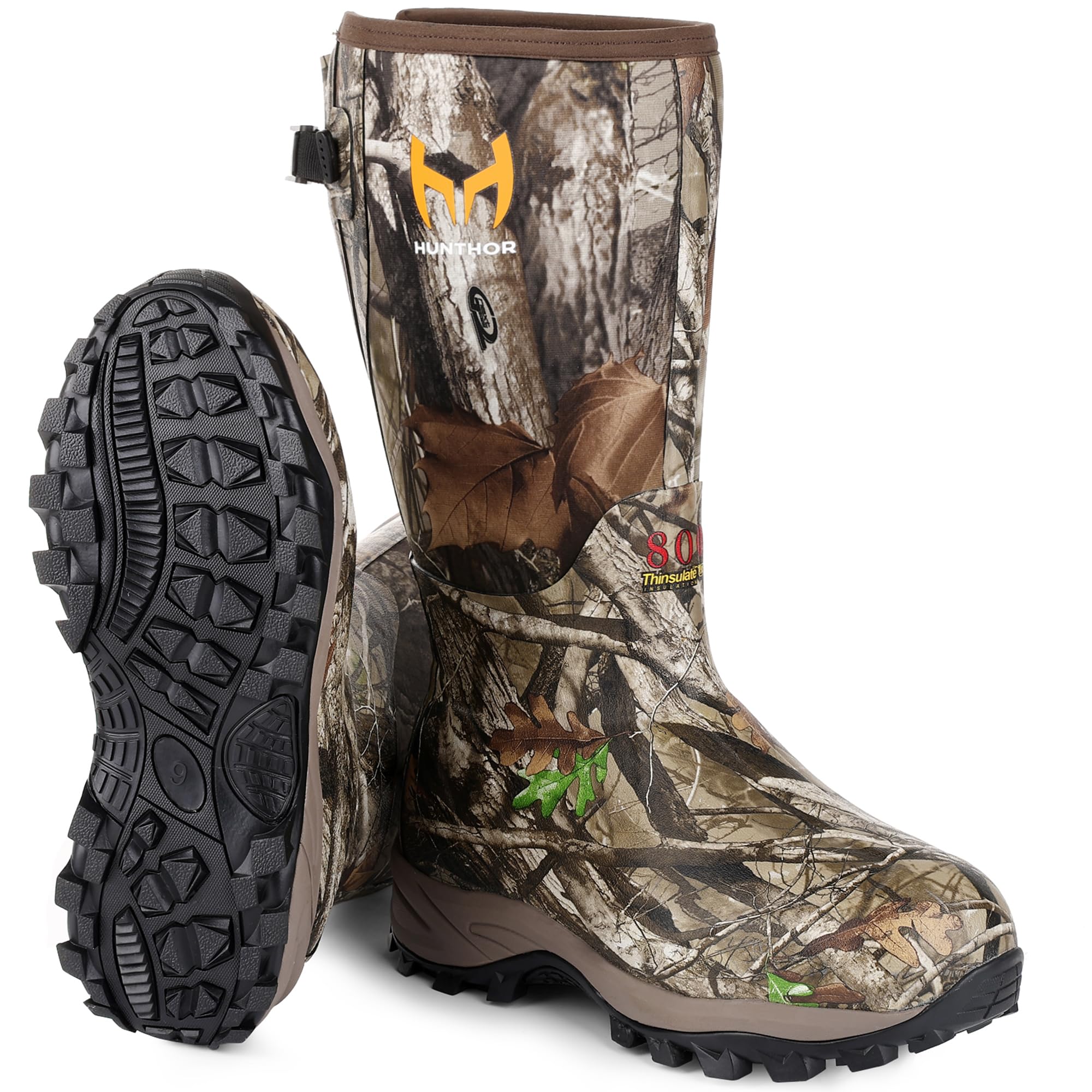
Hunthor 800g Insulated
Key Features
- Department: Men’s
- Insulation: 1.76 lb
- Waterproofing: Waterproof rubber
- Price: Budget
Eight hundred grams of insulation is a lot of warmth to wear on your feet. That number tells you the Hunthor is built for cold stands, late-season deer camps, and winter chores, not for a fast hike into the backcountry.
We were surprised by how comfortable it feels for a budget boot. The neoprene shell is thick, the insole has some give, and the pull-on design is easy to get on with cold hands. The waterproofing holds up in wet snow and shallow water, and the 800g lining keeps your feet warm when you are not moving much. If you walk a long way in, you will feel the weight and the heat.
The fit is the thing to watch. Some feet find it true to size, others find it big or narrow through the calf, so check the size chart and leave room for a wool sock. We think it is the best cold-weather value in this group for a hunter who spends more time sitting than covering ground. It is not as refined as the Muck or LaCrosse boots, but it costs the least here and does the core job.
Pros
- 800g insulation for cold stands
- Waterproof rubber shell
- Comfortable for the price
Cons
- Heavy for long walks
- Fit can run big or narrow
We point budget-minded stand hunters to the Hunthor: 800g insulation and a waterproof shell for cold sits without a premium price.
Best for Mud and Marsh
Muck Wetland

Key Features
- Sizing: Unisex adult
- Closure: Slip-on
- Waterproofing: Waterproof
- Price: Midrange
The Wetland is the Muck we choose when the ground is more mud than cold. It has the same slip-on ease that makes the Woody Max our top pick, but it is aimed at wet, mucky conditions rather than deep winter, and that makes it a useful second Muck for a different kind of hunt. We think it is the better boot for a wet walk in warm weather, provided you are not looking for much insulation.
The boot is comfortable from the first wear, with a soft shell that moves with your foot and a tall shaft that handles marsh water and deep mud. We like the traction in wet grass and the fact that you can hose it off at the end of the day. The fit can run small, so we suggest sizing with the socks you wear and checking the return policy before you commit.
Durability is the question. The sides can tear and the sole can start to come apart, so this is not the boot we recommend for someone who wants to ignore maintenance for years. It is still a versatile mud boot for scouting, duck hunting, and property work, and the easy-on design makes it a natural choice for a wet, messy day.
Pros
- Slip-on ease for muddy days
- Waterproof shell handles marsh and puddles
- Versatile for scouting and property work
Cons
- Sides can tear and soles separate
- Sizing can run small
The Wetland is our mud-and-marsh alternative to the Woody Max, with slip-on ease and a tall waterproof shell for warmer wet days.
How We Chose and Tested the Best Hunting Boots
We built the shortlist by reading specs and customer reviews, then filtering for insulation, weight, waterproof construction, and a real size range — including wide options. Price mattered, but only as part of the value question: a boot had to justify its cost with materials and construction, not a logo. From that pile, we pulled 10 pairs and wore them for eight months.
Testing happened where hunting boots actually live: early-season scouting in tall grass, late-season sits in freezing rain, a few upland bird walks, and plenty of muddy farm fields. We wore each pair with light and heavyweight socks, walked a measured mile to check heel slip and toe room, and noted hot spots before they became blisters. On cold mornings, I paid attention to whether my toes stayed warm during a two-hour sit. We weighed every boot on a kitchen scale, laced and unlaced them with cold hands, and hosed off the mud after each outing to see how the uppers shed water and how fast the linings dried. For water resistance, we stood in a shallow creek for five minutes and then checked our socks.
Durability showed up in the details: stitching that stayed put after weeks of mud, hardware that didn’t freeze, and waterproof membranes that kept socks dry through wet grass and water crossings. We also tracked sizing notes for every pair, because a half-size difference can change everything once you add wool socks. A boot can be well-made and still be a poor value if the fit is narrow or the break-in takes a month, so we called that out too.
How to Choose Hunting Boots for Wet, Cold, and Walk-Heavy Hunts
The right hunting boot is the one that matches the water depth and temperature you actually hunt, not the one with the most insulation.
Water Depth Comes Before Insulation
Water is the first filter. A 7-inch leather boot is fine for wet grass, but an 18-inch waterproof boot is what keeps you dry when the ditch is over your ankle. Water protection stops at the top of the boot, so match the coverage to the deepest water you expect to cross, not the average puddle. If you split your season between upland fields and flooded timber, one boot will not do both jobs well; the Wingshooter and the Alphaburly Pro sit at opposite ends of that choice.
Match Insulation to the Hunt
Insulation is a comfort feature until it makes you sweat. A 400g boot like the Alphaburly Pro suits cold mornings and long sits without turning a brisk walk into a sauna, while an 800g boot like the Hunthor is for stand hunting and serious cold. If you move constantly, less insulation is usually better; if you sit still, more is. The TIDEWE’s 6mm neoprene sits in the middle, warm but flexible.
Fit for Socks and Calves
Fit is where hunting boots go wrong most often. You need room for the sock you actually wear, but not so much that your heel lifts. Rubber boots are hard to break in, so start with the right size rather than hoping they loosen. Check the calf, too: the TIDEWE’s 13-inch shaft circumference is a useful benchmark if you have had trouble with tight boots. If you are between sizes, size for the thicker sock and add an insole if the fit feels loose.
Weigh the Walk and the Sit
Weight matters more on the walk in than on the stand. A tall rubber boot with heavy insulation can feel fine for a hundred yards and tiring after a mile. The 7-inch Wingshooter is the easiest walker here, while the tall rubber boots trade some of that ease for coverage. We look for a sole with enough support for uneven ground and a heel that does not slip, because a loose heel turns every step into extra work.
Plan for Mud and Maintenance
Mud changes the calculation. Laces give you a secure fit, but they are miserable to untie with cold, muddy hands; a slip-on boot like the Woody Max is easier at the truck. Plan to rinse mud off before it dries, and check the sole and upper seams regularly. Several rubber boots in this group can develop sole separation or upper wear, so buy with a return policy in mind and inspect the boot after the first hard season.
Frequently Asked Questions
How do I keep leather hunting boots waterproof?
Clean mud off with a damp cloth, let the leather air-dry, then apply a leather-safe waterproofing treatment before the season and again when the surface stops beading. Avoid direct heat, which can crack the leather. The Wingshooter’s leather holds up in rain and wet grass, but it still needs more care than a rubber boot.
How should I dry wet hunting boots?
Pull out the insoles if they come out, stuff the boots with newspaper or a dry towel, and let them air-dry at room temperature. Do not put rubber or leather boots on a radiator or beside a stove; high heat can warp the shell, crack leather, or loosen glue. Change the newspaper once it feels damp, and keep the boots out of direct sun.
Do hunting boots need a break-in period?
Rubber and neoprene boots usually feel ready right away, though the ankle area may soften after a few wears. Leather boots like the Wingshooter can feel snug at first and then loosen, so wear them around the house with your hunting socks before you take them into the field. If a rubber boot feels tight across the top of your foot, do not wait for it to stretch; return it.
Final Verdict
The Muck Woody Max is the boot we point most hunters to first. It keeps feet dry and warm, pulls on without laces, and has the hunting-specific details that matter in wet, cold cover. If your ground is dry and your days are long on foot, the Irish Setter Wingshooter is the better leather alternative. For warm-weather water, the LaCrosse Grange gives you the height without the heat. Start with the terrain and temperature, and the choice gets simple.