This post contains affiliate links. We may earn a small commission when you buy through our links — at no extra cost to you.
The first dry Saturday after a week of rain is exactly when you want to be outside — and exactly when you find the crack an inch above your old boots’ heel. Rubber boots are the one piece of gear you never think about until you’re standing in a puddle in wet socks. A pair that lasts comes down to unglamorous things: how the sole is bonded to the upper, whether the shaft is cut for a real calf, and how much rubber you’re hauling around on each foot.
I wear rubber boots for dog walks, muddy garden beds, and slushy commutes, and over the past six months my team and I have put 12 pairs through all three. What surprised me wasn’t water resistance — most keep it out at first. It was how much weight and fit decided whether I pulled a pair on at the door at all, and how many that felt fine in week one started rubbing at the calf by week three. The picks below are the ones I kept reaching for.


Best for Everyday Wet Wear
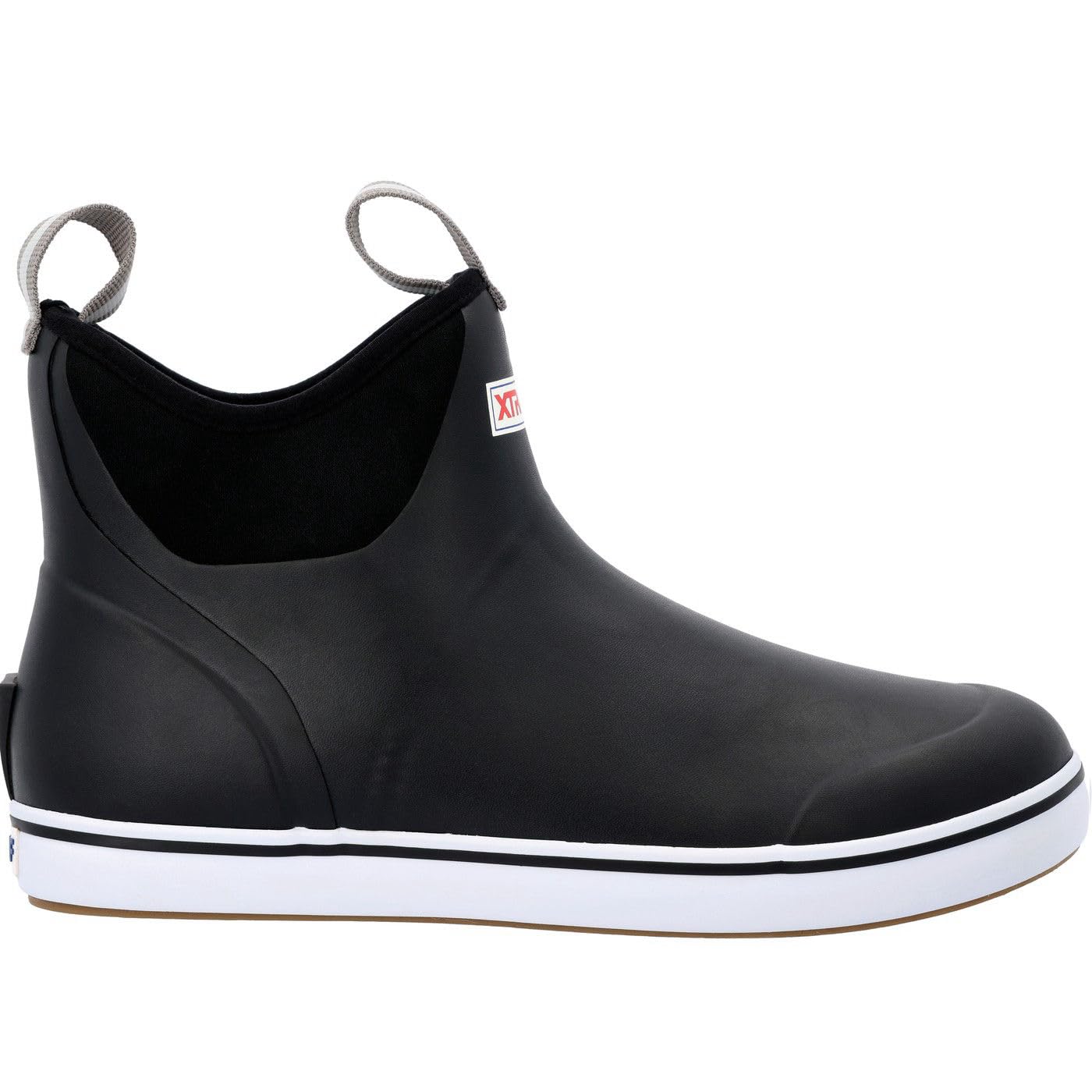
XTRATUF Ankle Deck Boot
Key Features
- Model: 22736
- Style: Ankle deck boot
- Package weight: 4.5 lb
- Package dimensions: 16 x 13 x 5 in
- Price: Premium
Barely a boot at all, the XTRATUF Ankle Deck Boot is the pair we reach for when the launch ramp is slick or the driveway is a mess. The low shaft and rear pull tab let you step in without sitting down or fighting a tall opening, and the outsole grips wet, slippery surfaces without feeling clumsy. We liked that low profile most on days when we were in and out of the truck.
What makes it useful beyond the dock is how it handles ordinary wet weather. The waterproof upper keeps splashes and rain out, the sole has enough tread for wet grass and muddy paths, and the low height means you can drive or walk without feeling like you’re clomping around in a work boot. It’s also the easiest boot here to pack or keep by the door.
The caveat is durability. The same lightweight build that makes the XTRATUF so easy to live with can separate at the sole or wear through with hard, repeated use, so we see it as a wet-deck and everyday rain boot rather than a daily construction boot. If you’re in abrasive mud or on a job site all day, a heavier rubber boot is the better long-term bet.
Pros
- Easy to step into with a rear pull tab
- Sure grip on wet decks and slick surfaces
- Low height packs and drives easily
Cons
- Runs small and comes in no wide sizes
For wet decks, rainy errands, and muddy chores that don’t go past the ankle, this is the easy-on boot we recommend first.
Best for Cold-Weather Hunting
Muck Woody Max
Key Features
- Model: Woody Max-M
- Pattern: Mossy Oak Break Up Country
- Package weight: 4.5 lb
- Package dimensions: 22 x 14.5 x 5.4 in
- Price: Midrange
The tall camo shaft makes the Woody Max look like it belongs in a duck blind, and that’s exactly where it earns its keep. The extra height over a chore boot keeps splash and mud out when you step into ruts, and the Mossy Oak finish doesn’t pretend to be a city rain boot. We took it as a purpose-built hunting boot, not a fashion compromise.
The warmth is the part that matters most. We found the boot built for cold weather, with enough insulation to take the edge off a frosty morning without turning your feet into a swamp once you start walking. The rubber shell keeps water out, the fit is secure enough for uneven ground, and the pull-on shape is quicker than laces when you’re getting ready in the dark.
We rank it as the best cold-weather hunting boot in this group because it combines warmth, waterproofing, and a confident fit in one package. It also has a substantial, stable feel underfoot that we appreciate when the ground is soft and uneven. The camo is not subtle, but it belongs in the field. For a dedicated hunting pair, that’s a fair trade.
Pros
- Warm in cold, wet hunting conditions
- Waterproof rubber keeps mud and water out
- Secure fit for uneven ground
Cons
- Sole can separate under hard use
For cold, wet hunting days when you’re standing in mud or flooded timber, the Woody Max is the warm, sure-footed boot we trust.
Best for Insulated Value
TIDEWE Rubber Work Boot
The comfort rating on the TIDEWE is the detail that made us look twice: -4°F/-20°C to 50°F/ 10°C is a wide window for an insulated rubber boot. The 6 mm neoprene shell is backed by a reinforced toe and a 13-inch shaft circumference, so it’s built for cold, wet work rather than a quick dash through a drizzle. We also appreciate the heel protrusion; step on the back of one boot with the other and you can kick it off without bending down.
We rate it the best insulated value in this group because it delivers the warmth and coverage of a hunting boot at a much friendlier price. The fit accommodates thick socks, the toe box has room for active feet, and the boot has enough structure to handle mud and brush without feeling like a cast. It isn’t as refined as the Muck pairs, but it does the job.
The long-term question is the sole junction. On a value-priced neoprene boot, that’s the first place we inspect, and it’s worth checking periodically if you’re on abrasive ground every day. For weekend hunting, farm chores, and wet walks, the TIDEWE makes a strong case.
Pros
- 6 mm neoprene warmth for cold work
- Reinforced toe and heel kick-off
- Strong value against premium hunting boots
Cons
- Sizing can be inconsistent
If you want insulated rubber boots for cold, muddy work without paying premium prices, the TIDEWE is the value pick.
Best for Budget Yard Work
Dunlop Chesapeake
Key Features
- Shaft: Wide calf
- Material: PVC
- Listed weight: 16 oz
- Water resistance: Waterproof
- Price: Budget
The Dunlop Chesapeake is the budget anchor of this group, and it makes no apology for being a simple PVC boot. The listed weight is 16 ounces, and it feels more like a heavy overshoe than a work boot, which is exactly why it’s easy to pull on for a wet walk to the shed or a session with the hose. The wide calf opens up for jeans and work pants, and the waterproof shell rinses clean in seconds. We keep it for jobs where a nicer boot is overkill.
The Dunlop is not the boot we reach for when the temperature drops or the ground turns into a long, rocky job site. It’s a fair-weather chore boot: hose it off, leave it by the door, and don’t ask it to do a neoprene boot’s job. For occasional chores, that’s a sensible trade; if you need warmth or all-day support, the TIDEWE or XTRATUF is the better call.
Where it earns a place is sheer convenience. The boot is light enough to wear all morning, the PVC doesn’t need conditioner, and a hose does most of the cleaning. If your wet work is mostly around the house, that simplicity is worth more than a fancy lining.
Pros
- Light enough to wear all morning
- Wide calf pulls over work pants
- Waterproof PVC hoses off clean
Cons
- Sole can wear under hard daily use
- Traction can slip on slick ground
For muddy yard work, pressure washing, and quick chores where warmth doesn’t matter, the Dunlop is the budget boot we keep by the door.
Best for Deep-Mud Hunting
LaCrosse Alphaburly Pro
Key Features
- Height: 18 in
- Footbed: EVA
- Insulation: 400 g Thinsulate
- Waterproofing: Waterproof rubber
- Price: Midrange
Eighteen inches of rubber and 400 grams of Thinsulate tell you the Alphaburly Pro is built for deep mud, not a quick trip to the mailbox. The tall shaft keeps water and brush away from your pants, the rubber shell is fully waterproof, and the EVA footbed gives the boot enough cushion for a long, cold sit. It looks like a hunting boot because it is one.
We rate it the best tall hunting boot in this group because it combines reach, warmth, and a stable feel in soft ground. The trade-off is weight and effort: this is a lot of boot to pull on and off, and it can feel heavy on a long walk in. If you’re getting in and out of a truck all morning, the low XTRATUF is easier; if you’re crossing a marsh, the LaCrosse is the one we want.
Fit is the detail to settle before ordering. The boot tends to run big, so if you’re between sizes or plan to wear thin socks, size down; with thick hunting socks, stay closer to your normal size. The tall shaft also means the calf fit matters as much as the foot size, especially if you layer pants underneath.
Pros
- 18-inch shaft for deep mud
- 400 g insulation for cold hunts
- Cushioned EVA footbed
Cons
- Camo finish can scuff under brush
For deep mud, flooded timber, and cold late-season hunts, the Alphaburly Pro is the tall, warm boot we choose.
Best for Steel-Toe Work
Muck Chore Steel Toe
Key Features
- Category: Industrial and construction
- Boot style: Chore boot
- Safety toe: Steel toe
- Price: Premium
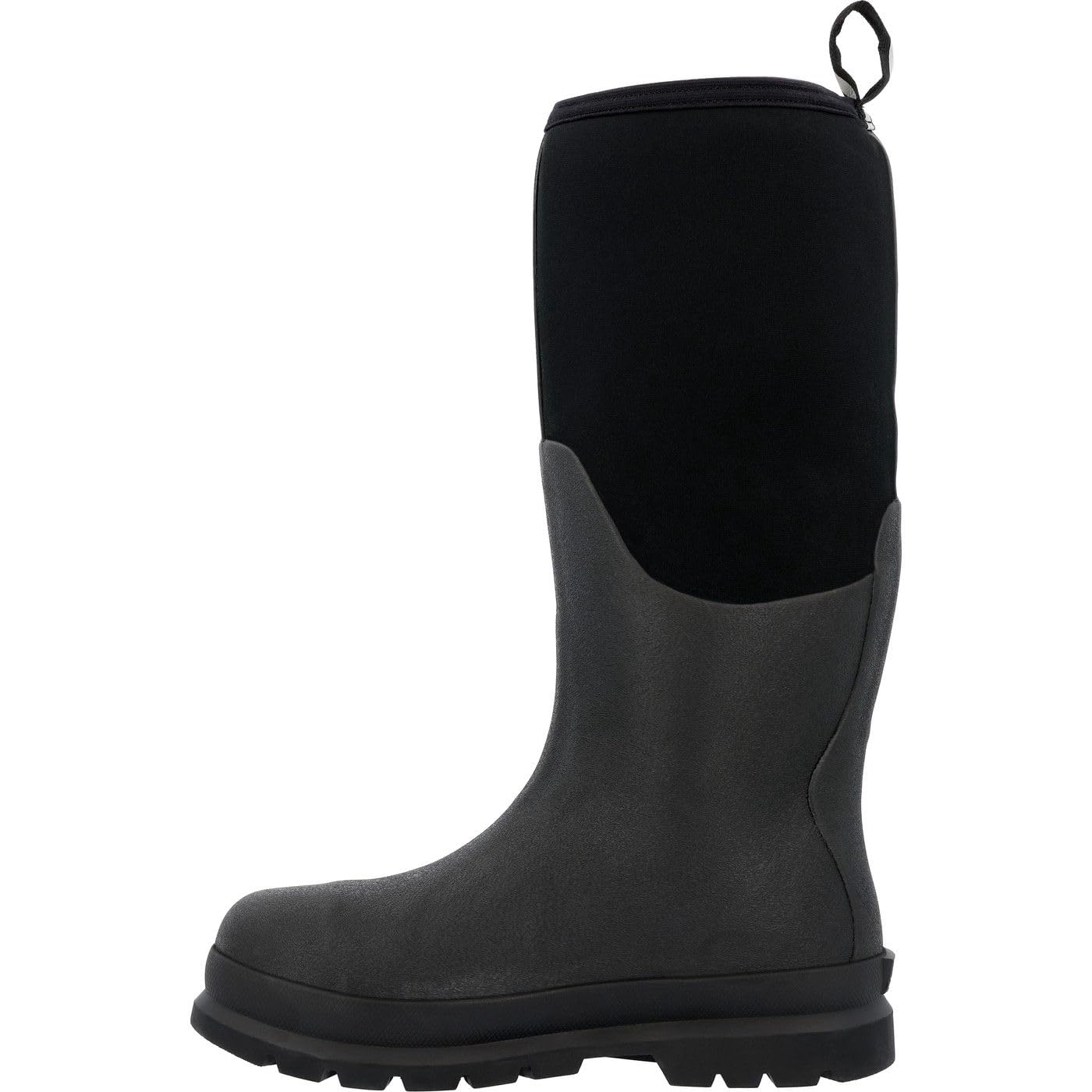
A steel toe changes the job this boot can do. The Muck Chore Classic puts a protective cap inside a warm rubber work boot, so it’s aimed at barns, job sites, and muddy yards where a dropped shovel or a horse’s misstep is a real possibility. The pull-on shape is quick to get in and out of, and the boot has enough insulation for cold, wet mornings.
Comfort is the reason it stays on. The boot has a soft, roomy feel that works with thick work socks, and the warmth is welcome when you’re standing around in wet cold. It isn’t a precise, technical fit; it’s a chore boot, and it feels like one in a good way. It also stays comfortable through a long shift, which matters more than a precise fit when you’re in and out of the barn.
We pick it for wet work sites where toe protection matters, and we accept that it’s not a deep-water boot. The waterproofing holds for splashes, shallow muck, and rain, but standing in water for long periods is where a rubber boot like this can disappoint. The steel cap is the reason we keep coming back, especially around livestock and loaded wheelbarrows.
Pros
- Steel toe protects against drops and kicks
- Warm enough for cold, wet work
- Comfortable with thick work socks
Cons
- Too hot for summer work
If your wet work involves dropped tools, livestock, or heavy loads, the Chore Steel Toe is the rubber boot we pick for toe protection.
Best for Deck and Boat
HUK Rogue Wave

Key Features
- Model: H8021007
- Style: Low-cut deck shoe
- Package weight: 2.73 lb
- Package dimensions: 13.5 x 10.31 x 5.04 in
- Price: Midrange
The HUK Rogue Wave is the least boot-like pick here, and that is both its appeal and its limit. The low-cut shape is closer to a fishing shoe than a rubber boot, so it’s easy to wear on a boat or around a wet launch ramp. The non-marking sole is the detail we noticed first; it grips wet, slimy decks without leaving black scuffs behind.
On a hot day on the water, the lighter build is welcome. The boot is comfortable for long hours, the upper keeps splashes out, and the traction on wet surfaces is the reason it earns a place in the boat bag. It’s also easier to pack than a tall rubber boot, which matters if your fishing gear already fills the truck.
The limits show up as soon as the water gets deeper than the ankle. This is not the pair for a muddy trail, a flooded field, or a job site with puddles over the sole; the low cut lets water in and the soft upper won’t protect like a tall rubber boot. We keep it for wet decks, not wet trails.
What sold us was the non-marking sole and the low profile on a crowded deck. The HUK is a specialized tool, and we like it better for that than as a do-everything boot.
Pros
- Non-marking sole grips wet decks
- Light and comfortable for long boat days
- Easy to pack and step into
Cons
- Durability can fall short under hard use
A light, grippy deck shoe for wet boat work and quick launches, not a rubber boot for deep puddles or muddy trails.
How We Tested the Best Rubber Boots for Men
We started with about 40 pairs — farm-supply staples, fishing boots, and hiking-inspired models from the brands you see in outdoor stores — and cut the list by shaft height, available sizes, weight, and price. That left 12 pairs, worn for six months, from late-winter slush through spring mud. Each went to at least two testers so one person’s wide calf or size 13 foot wasn’t the only verdict.
Water resistance came first. We stood each boot in a tray of water four inches deep for 20 minutes with a paper towel stuffed inside, hosed the shaft and seams for five minutes, and walked through soaked grass on morning dog walks, then checked the towel. We also noted how damp our socks felt after two hours — a boot can be perfectly waterproof and still leave you clammy, which is why breathability mattered almost as much as the rubber itself.
Fit got the most attention. We wore each pair with thin and thick socks to see whether sizing ran true, timed how long it took to pull them on and kick them off one-handed at the door, and weighed every boot on a kitchen scale — a pound per boot sounds trivial until you’ve walked a mile in it. Testers with wider calves reported on shaft tightness and heel slip on wet slopes, and rated the footbed after an eight-hour yard day. Durability showed up later: seams, sole separation, and cracking above the flex point at three and six months, plus whether mud stained after a wipe-down. Because almost nobody gets to try these on first, we noted which makers sell half sizes and how painless the returns were, then weighed price against how each pair was actually holding up.
How to Choose Men’s Rubber Boots
The right rubber boot is the one that matches the water you actually walk through, not the tallest or warmest pair on the shelf.
Match the Shaft to the Water
A rubber boot only keeps out the water it is tall enough to clear. An ankle deck boot like the XTRATUF is easy to step into and light on a wet dock, but it stops at the ankle; a puddle or muddy rut above that line goes straight in. A tall hunting boot like the LaCrosse Alphaburly Pro reaches much higher, which is why it makes sense for marsh, flooded timber, and deep barnyard mud.
Before you choose, think about the deepest water you routinely cross, not the worst puddle you might meet once. If it is usually below the ankle, the low boot is more comfortable and easier to drive in. If you are regularly over the ankle, pay for height and accept the extra weight.
Decide How Much Warmth You Need
PVC boots like the Dunlop are essentially shells: waterproof, easy to clean, and not warm. Neoprene boots add insulation, and the difference matters when you are standing still in cold mud or working in a wet barn. The TIDEWE’s stated comfort range runs from -4°F/-20°C to 50°F/ 10°C, which tells you it is built for cold conditions, not a summer drizzle.
More insulation is not always better. If you are active above freezing, an insulated boot can cook your feet and make them clammy. We choose unlined PVC for warm-weather yard work, light neoprene for cool, wet days, and a heavier insulated pair for standing around in cold water or snow.
Fit for Socks and Calves
Rubber boots do not break in like leather, so the first fit is close to the fit you get. Wear the socks you plan to use, and if you are between sizes, go with the roomier option for cold-weather boots and the snugger option for a deck boot you will wear barefoot or with thin socks. The XTRATUF runs small for a lot of feet, so that advice matters.
Calf circumference is the other half of the fit. A wide-calf design like the Dunlop is easier to pull over jeans, while a tall hunting boot can feel tight at the top even when the foot is right. If you have wide calves, check the shaft before you fall for the footbed.
Match the Sole to the Surface
A wet deck, a muddy trail, and an icy driveway ask different things of rubber. A non-marking deck sole with fine tread is right for a boat because it grips fiberglass without scuffing it. A deeper lug is better in mud and loose ground. Neither is a winter tire; rubber compounds harden in cold, and a mud sole can slide on ice.
We pay attention to the outsole pattern more than the boot’s overall look. For yard work and wet grass, a moderately aggressive tread is enough. For marsh mud, choose a deeper, self-cleaning lug. For snowy driveways, add traction devices rather than trusting a rubber boot on ice.
Spend for the Hours You’ll Wear Them
A budget PVC boot makes sense for occasional yard work, pressure washing, and quick trips to the shed. A neoprene or rubber boot costs more because it insulates, flexes, and usually holds its shape longer. If you are in wet boots for work every day, the cheaper boot is often the false economy.
Work-site features are worth paying for when they match the job. A steel toe like the Muck Chore’s protects against dropped tools and livestock, but it adds weight and warmth you may not want in summer. Buy for the conditions you actually meet, not the most extreme pair in the catalog.
Frequently Asked Questions
How should I dry wet rubber boots?
Rinse off mud, pull out any removable insoles, and stuff the boots with newspaper or a dry cloth. Air-dry them in a shaded, ventilated spot, not on a radiator or in direct sun. Heat can warp PVC and weaken the adhesives, so a fan and patience are better than a fast bake.
Can I hike in rubber boots?
For short, wet, muddy walks, yes, but rubber boots do not breathe and give less ankle support than hiking boots. On a long or steep trail, wear hiking boots with a waterproof membrane and save the rubber pair for the boggy section, camp chores, or a wet launch. Your feet will be drier and less fatigued.
Why do my rubber boots smell, and what helps?
Trapped moisture is the usual cause. Rinse the inside, dry the boots fully between wears, and choose moisture-wicking socks rather than cotton. A little baking soda left in overnight helps absorb odor, and rotating two pairs gives each one time to dry. Avoid storing them in a hot car or a sealed bag.
Final Verdict
For most men who want one rubber boot for wet decks, rainy errands, and muddy chores that stay below the ankle, the XTRATUF Ankle Deck Boot is the pick. It is the easiest of these to live with, with reliable grip and a low, packable shape.
When the water gets deeper or the weather turns cold, the choice changes: the Muck Woody Max is the hunting boot we choose for cold mud, the TIDEWE is the insulated value pick, and the Dunlop is the budget answer for yard work. Buy for the water you actually walk through, and the rest follows.