This post contains affiliate links. We may earn a small commission when you buy through our links — at no extra cost to you.
A rooftop tent can turn a parking spot into a bedroom in minutes—or turn a clear morning into a wrestling match with fabric and poles. The difference is rarely the view; it’s construction, ease of use, and whether the thing feels solid when the wind picks up. I’ve slept on the ground for years, but climbing into a properly mounted rooftop tent changed the math: you’re off the wet ground and set up before the cooler opens. Over nine months, my team and I lived with seven rooftop tents, and the gaps in weight, sturdiness, and quality were wider than the photos suggest.
The picks below earned their place by holding up through rain, wind, repeated setups, and months parked on a vehicle. We looked at stitching, zippers, shell finish, and mounting hardware—details that separate a tent that looks sharp in camp from one that still looks sharp after a season. Value mattered, but not in the cheap sense—essentials included, not sold separately. Appearance and durability counted, but so did whether one person can manage it alone.


Best for All-Round Overlanding
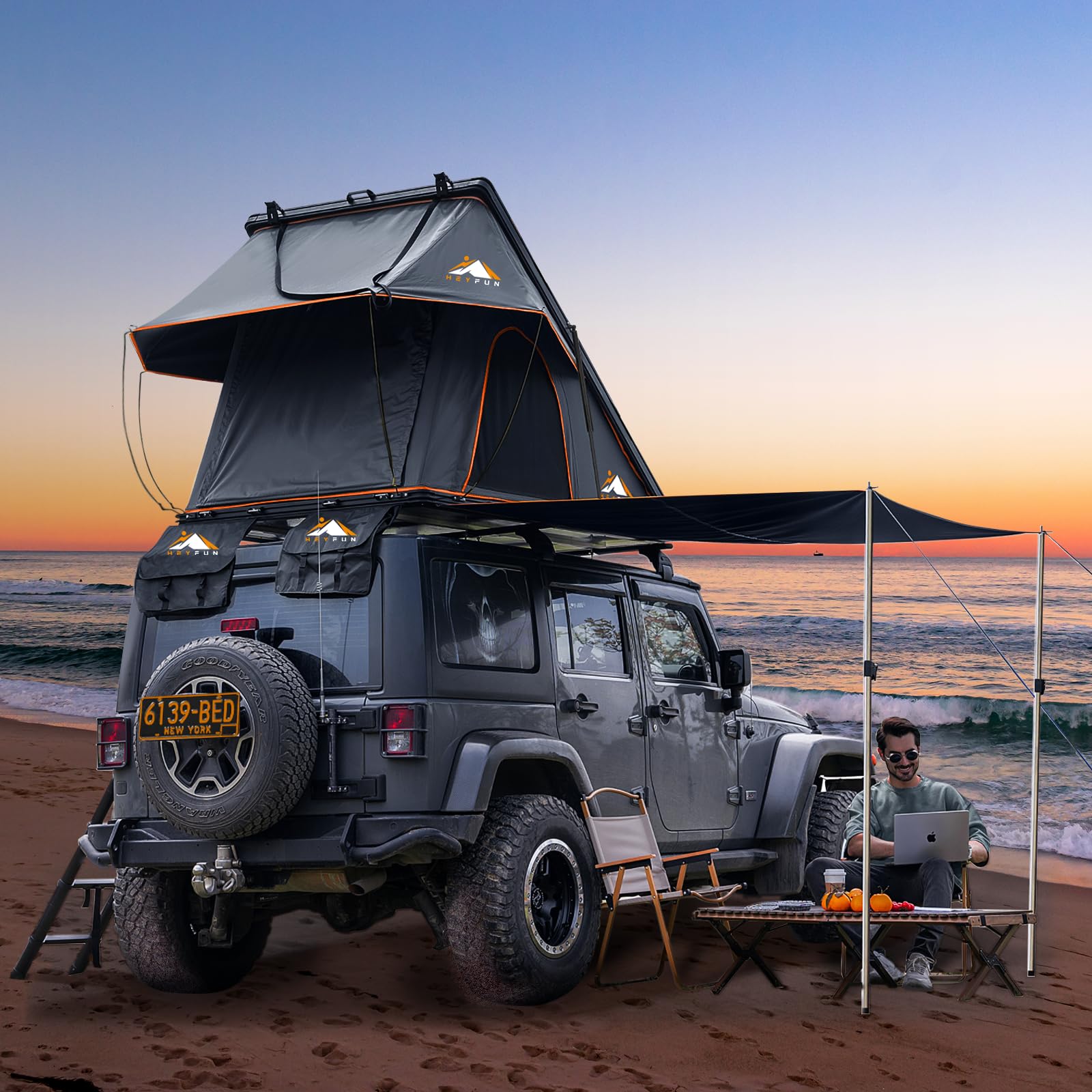
HEYFUN Adventurer Pro
Key Features
- Shell: Hard shell, aluminum
- Weight: 160 lb
- Open height: 62.99 in
- Packed size: 83.86"L x 51.57"W x 7.00"H
- Price: Budget
Two latches, a shove, and the shell rises on its own. That’s the entire arrival ritual with the Adventurer Pro, and it’s why we recommend it first: by the time the stove is lit, the mattress is already flat and the ladder is hooked on. The soft-shell tents in this group ask for poles and a rainfly before anyone lies down, and after a nine-hour drive that difference is the whole argument.
Closed, it measures 83.86 by 51.57 by 7.00 inches; open, the roof sits at 62.99 inches, which is enough to sit up and pull a shirt on without folding yourself in half. The base is honeycomb aluminum with a flocked floor lining, the walls are 320g polyester, and the gas struts are stainless steel with dual buckles. Thirteen pockets line the interior — enough for two people to claim a wall each and still have somewhere to park a headlamp.
What we appreciated most is how much comes in the crate. There’s a side awning, a sleeping mat, a condensation mat, a telescoping ladder with its own bag, shoe bags, support rods and a built-in LED strip. Buy a bare shell and you’ll spend a season buying those pieces one at a time — the condensation mat alone is the difference between a dry night and a wet mattress when the temperature drops.
It isn’t light. At 160 pounds it’s a two-person lift, and HEYFUN’s instructions call for crossbars rated for at least 165 pounds before you mount anything, which is a good moment to check what your rack is actually rated for. Three people is optimistic on a 51.57-inch floor — call it two adults and a child — and the mattress is the one part most buyers will upgrade. What settles it for us is how often you move: break camp daily and the struts earn back their cost within a couple of weeks.
Pros
- Hydraulic shell opens in seconds
- Awning, condensation mat and LED included
- 62.99 in of headroom when open
- Honeycomb aluminum base, 320g polyester walls
Cons
- 160 lb needs two people to mount
- Thin mattress; plan on a topper
The fastest camp setup here, with an awning, condensation mat and LED strip in the box — buy it if you move camp often and want three-person space.
Best for Lighter Rigs
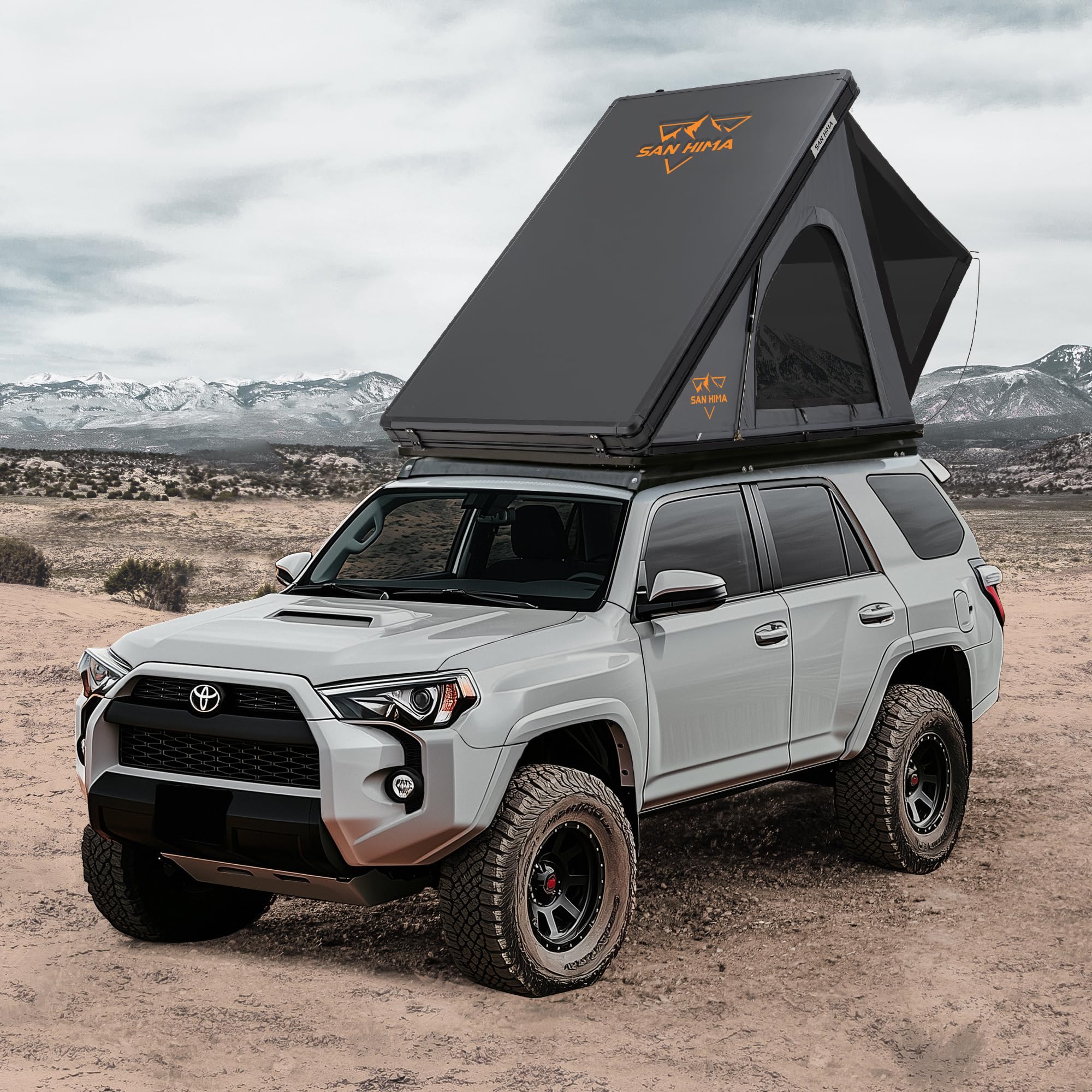
SanHima Hotham Lite Gen 2
Key Features
- Shell: Hard shell, aluminum
- Weight: 146.6 lb
- Closed height: 4.57 in
- Waterproofing: 5,000 mm
- Price: Midrange
At 4.57 inches closed, the Hotham Lite is the slimmest tent in this group by a distance — under half the packed height of the soft shells and two and a half inches under the Adventurer Pro. If your vehicle lives beneath a garage door, a carport or a parking structure, that number decides whether a rooftop tent is an option at all, and it’s the first figure we check.
It’s also the lightest hard shell here at 146.6 pounds, which matters more than any line on the feature list: this is the one two people can walk off the roof at the end of a season without a plan. The shell is aluminum over 420D double ripstop Oxford and 280G poly-cotton, rated to 5,000 mm of water with UV50+ and a 1.57-inch raised base that keeps runoff away from the seam. Inside there’s a self-inflating mattress, a full-ceiling LED strip and USB-C, USB-A and a 12V socket — the only tent here you can genuinely work from.
Two adults is the honest capacity: the floor is 51.57 inches across and there is no third berth, so a family should look at the Smittybilt instead. The other thing to close out before ordering is mounting. The tent fits a roof rack, but on some vehicles the bars alone aren’t enough and aftermarket brackets are a separate purchase, so put your rack’s spread and rating against the mounting kit first — that cost lands before your first trip, not after it.
Pros
- Slimmest shell here at 4.57 in closed
- Lightest hard shell at 146.6 lb
- USB-C, USB-A and 12V charging built in
Cons
- Two-person interior only, no third berth
The pick for a low garage door or a light-duty rack: nothing else here packs this slim or comes off the roof this easily.
Best for Off-Grid Power
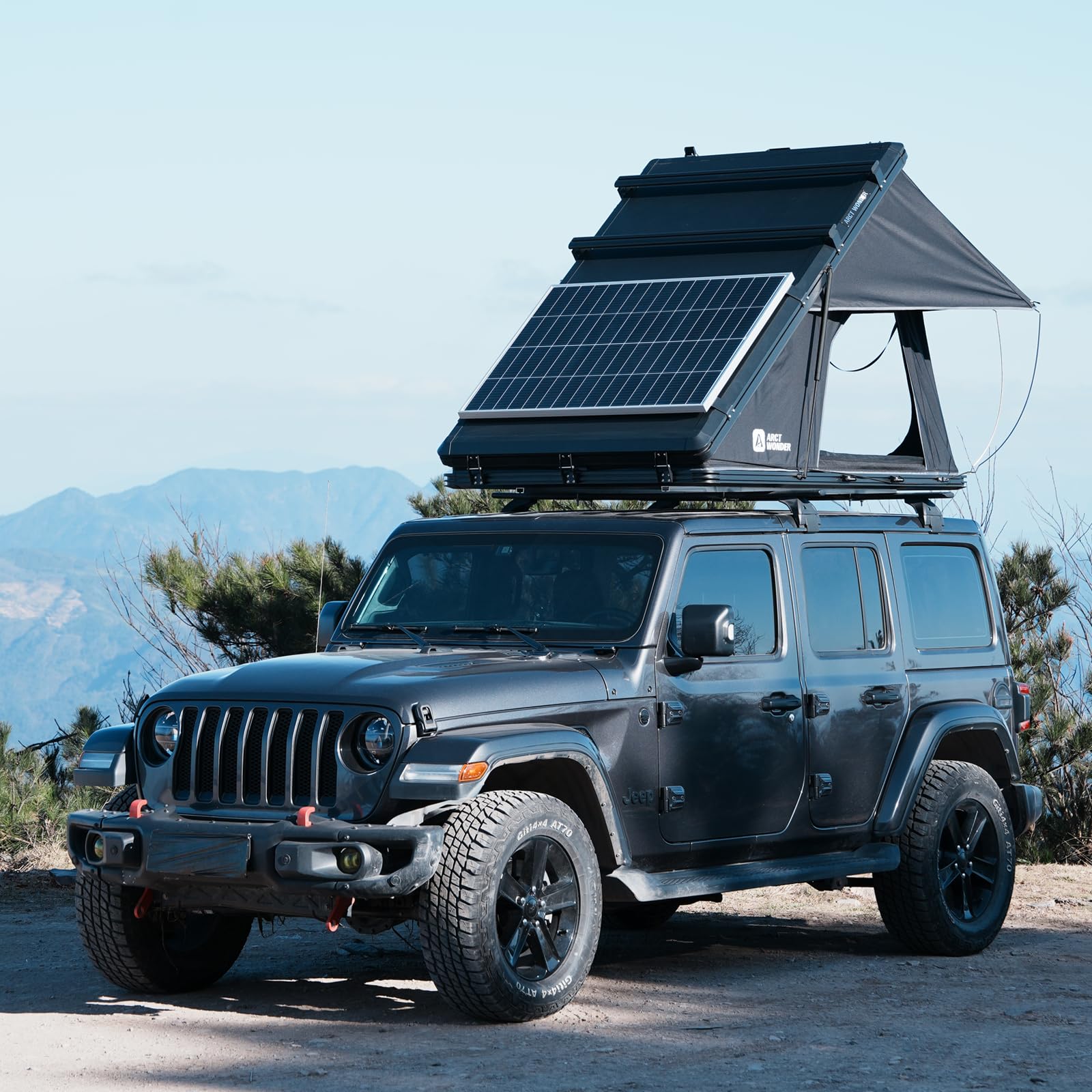
ARCTWONDER Solar Rooftop Tent
Key Features
- Shell: Hard shell, aluminum
- Weight: 198 lb
- Open size: 83"L x 51"W x 59"H
- Solar panel: 12V 216W
- Price: Premium
There’s a 216-watt solar panel bonded to the roof, and that one line is the reason this tent exists. Park in the sun and it tops up a portable power bank through the included wiring while you’re out walking; over a week of overlanding that’s the difference between rationing a battery and forgetting about it. We were skeptical of a solar tent until we thought about who buys one — the same person who already owns the power station.
The tent underneath is a proper four-season hard shell: aluminum bottom plate, top cover and corners, 320g polyester with glued seams and a black rubber sun coating, and three windows with their own awnings for cross-ventilation. The floor is 83 by 51 inches, which takes two adults plus a child or a dog, and the roof pops on air pressure rods rather than a hand crank. There’s a luggage bar on top, a shoe bag, and a ladder you can hook at any entrance.
Two things give us pause, and both are physical. At 198 pounds this is the heaviest tent in the group — three people to mount it, and a permanent tax on fuel and body roll. Closing has a sting in the tail too: the last inch of shell takes a firm pull before the latches catch, which is the one part of the routine that doesn’t get easier with repetition. Run a power station and camp off-grid and neither outweighs the panel. If you don’t, the Adventurer Pro does the same job lighter and for less.
Pros
- 216W solar panel built into the roof
- Sleeps two adults plus a child or pet
- Three windows with their own awnings
Cons
- 198 lb is the heaviest shell here
- Last inch of closing needs a hard pull
Worth the premium if you run a power station and camp where there’s no hookup — the roof panel earns its keep in the sun.
Best for Budget Soft Shell
Overland Vehicle Systems TMBK
Key Features
- Shell: Soft shell, A-frame
- Weight: 108 lb
- Open height: 51 in
- Sleeping area: 53.5" x 92"
- Price: Budget
Soft shells ask for a trade: minutes at camp in exchange for more floor for the money. The TMBK is the best answer to that trade here. It unfolds off the roof into a 53.5 by 92 inch sleeping area — long enough for a tall sleeper to lie flat without curling — and it closes down to 57 by 49.5 by 11.5 inches, tall for a soft shell but with no strut to fight on the way down.
At 108 pounds it’s the lightest tent in this group by a wide margin, and we noticed that on and off the vehicle rather than on the road: two people can walk it onto a rack in a minute. The kit is honest — a high-density foam mattress with a cotton cover, a 420D polyester Oxford rainfly, a ladder, an insulated base, and a skylight over the bed for the nights you leave the fly off. Poles, zips and seams are what decide whether a soft shell lasts, and these are the parts that feel specified rather than sourced.
The costs are the ones this design always carries. 11.5 inches of packed height is the most here, and the fabric has to be bone dry before you close it or you’ll be airing it out at home. Setup is a several-minute job, not a several-second one, and the mattress is firm and thin enough that a topper is an upgrade most people will make. What you get for all that is a three-person interior for less than the Smittybilt, in a tent two people can lift onto the roof.
Pros
- Lightest tent here at 108 lb
- 53.5 by 92 in sleeping area
- Foam mattress, rainfly and ladder included
Cons
- 11.5 in packed height is the tallest here
- Poles and rainfly take minutes, not seconds
A well-built soft shell and the cheapest way into three-person space here, if you can spare five minutes at camp.
Best for Families
Smittybilt Overland Gen2 XL
Key Features
- Shell: Soft shell
- Sleeps: 3 to 4
- Weight: 170 lb
- Bed size: King, 92.5" x 74.8"
- Price: Midrange
A king-size bed on the roof of a truck is the entire pitch. The Overland Gen2 XL lays out 92.5 by 74.8 inches of mattress and rates for three to four people, which puts it in family territory — two adults and two kids, or two adults who have stopped pretending a 51-inch shell is fine.
It’s a soft shell, so the routine is unfold, prop, rainfly, ladder. The listing suggests about five minutes, and the size is worth the extra couple of minutes over a pop-up. The base is a 2.5 cm aluminum and polyurethane sandwich, the body is gray under a light gray 420D Oxford rainfly, and the interior stands 51 inches high, with side pouches for the small stuff. The real luxury is room: sitting up, changing, and stashing bags at the foot all happen without negotiation.
The trade is weight and roof real estate. 170 pounds is a two-person lift, and a tent with this footprint wants a long roof and a rack rated for it — on a short-wheelbase vehicle it’s the wrong shape entirely. With a 2,000 mm rating it also trails the 5,000 mm hard shells here in a sustained downpour, which matters if you camp in shoulder seasons rather than July. Stock on this one comes and goes, so if it’s unavailable the day you look, the TMBK is the soft-shell fallback and the Adventurer Pro is the hard-shell one.
Pros
- King bed sleeps three to four
- Huge interior for changing and gear
- Aluminum and polyurethane sandwich base
Cons
- 2,000 mm waterproofing trails the hard shells
- 170 lb is a two-person lift
The family tent of this group: a king bed that sleeps four, provided your rack can carry it and you don’t mind poles.
Best for First-Time Buyers
WildFinder Hard Shell

Key Features
- Shell: Hard shell, aluminum
- Capacity: 3 person
- Packed size: 83"L x 52"W x 9"H
- Waterproofing: 5,000 mm
- Price: Budget
Open the crate and the WildFinder keeps going: a 7.5-foot telescoping ladder with its own organizer, ten organizer bags, two shoe organizers, three mesh windows, an LED strip, and three mattress pads on top of the built-in mattress. It’s the most completely outfitted tent here, and for a first-time buyer who doesn’t want a second shopping list, that counts for more than any single specification.
The shell is aluminum with polyester walls, rated to 5,000 mm of rain, level 6 wind and level 4 snow, and it closes down to 83 by 52 by 9 inches — two inches taller than the Adventurer Pro and five more than the Hotham Lite. Three people is the claim and 52 inches is the reality, so it’s a comfortable two with a child. The condensation pad and recessed marine pad under the bedding are the sort of detail that separates a dry night from a damp one.
The catch is pack-down. Closing the shell takes a real pull to compress the struts and get the latches to catch, and it’s the part of ownership that wears thinnest — technique helps, but lighter owners will feel it. Add thin mattress pads that most people will top with a proper pad, and you have a tent that’s better at the campsite than at the end of the trip. It sits behind the Adventurer Pro at about the same money for exactly that reason.
Pros
- Ladder, LED strip and ten bags included
- 5,000 mm rain and level 6 wind ratings
- 83 by 52 in floor in a 9 in shell
Cons
- Closing takes a firm pull to latch
- Thin mattress pads need a topper
A fully outfitted hard shell for a first-time buyer, as long as you can put some muscle into the last inch of closing.
How We Tested Seven Rooftop Tents
We started by researching the rooftop-tent market and narrowing it to seven models that covered soft-shell fold-outs, hard-shell clamshells, and hybrid designs, with a mix of mounting systems, packed sizes, weights, and prices. We ruled out tents with vague hardware specs, limited parts support, or designs that seemed to rely on two-person setup. Then we mounted each one on a daily-driven SUV or truck, followed the installation instructions exactly, and noted whether the mounting rails, brackets, and ladder felt solid before the first night out. We used them for weekend campground trips, a few dispersed-site overnights, and plenty of driveway pack-downs in between.
Testing ran for nine months, with each tent spending several weekends on a vehicle and going through at least one rainy, gusty trip. I timed solo setup and pack-down with a stopwatch, from releasing the cover to climbing in, and did it again in the morning with dew on the fabric. I weighed each tent on a shop scale and noted how that weight affected vehicle handling and whether two people were needed to lift it onto the roof. On windy nights, I paid attention to shell flex, ladder wobble, and whether the fabric flapped or stayed taut; after rain, I checked seams, zippers, and corners for water intrusion and condensation.
Throughout, we inspected stitching, zipper pulls, shell finish, and mounting hardware after every trip, looking for fraying, scratches, loose bolts, or fading. We judged value by what came in the box: mounting hardware, ladder, and weatherproofing essentials should be included, not sold as extras. The tents that stood out stayed easy to open and close after months of use, looked cared-for rather than worn out, and felt sturdy enough that I’d sleep through a gusty night without second-guessing the setup.
How to Choose a Rooftop Tent
The tent is only half the purchase — the rack under it, the height it adds to your vehicle and the minutes it costs at camp decide whether you actually use it.
Hard shell or soft shell
The choice comes down to how you camp. If you break camp every morning and drive on, a hydraulic hard shell pays for itself in patience: two latches, a lift, and the mattress is already flat. If you drive to one spot and stay a week, a soft shell buys more floor and headroom for the money, at the cost of poles, a rainfly and a shell that has to be bone dry before it closes.
We lean hard shell for anyone traveling solo or moving daily, and soft shell for families who base-camp. Be honest about which one you are: most people overestimate how much they’ll enjoy pole work in the rain.
The rack decides what you can own
Every tent here mounts to crossbars, and the bars have to be rated for it. HEYFUN asks for crossbars supporting at least 165 pounds before installation; treat that as the floor, not the target, because the vehicle’s own dynamic roof limit still applies and a 160-pound shell plus two people leaning on a ladder adds up fast.
Check bar spread as well as load rating, and expect aftermarket brackets on some vehicles — that cost lands before your first trip. Mounting any hard shell here is a two-person job.
Weight, wind and the drive
The shells here run from 108 to 198 pounds, and that number does three jobs: it decides whether you can mount the tent yourself, how much it costs you in fuel and body roll, and whether you’ll bother taking it off between trips. A slimmer shell catches less wind and adds less to your overall height, which you notice every time you pass a truck.
Neither is a reason to skip a rooftop tent; both are reasons to buy the lightest one that does the job.
Floor space, honestly counted
Three-person is generous arithmetic. A 51-to-52-inch floor is two adults who like each other; three is a squeeze, and four only works in a soft shell with a king bed like the Smittybilt. Look at length too — 92 inches lets a tall sleeper lie flat where 83 does not.
Headroom matters more than buyers expect. The Adventurer Pro’s 62.99 inches lets you sit up and dress; the TMBK’s 51 inches is a hunched-over job.
Weather ratings and what ships in the box
Waterproofing runs from 2,000 mm to 5,000 mm across these tents. If you camp in shoulder seasons rather than July, the higher figure and sealed seams are worth prioritizing. A condensation mat under the mattress is not optional in the cold — moisture collects between bedding and base — so a tent that includes one saves you a purchase.
Read the included list closely. A ladder, an awning, an LED strip and USB or 12V charging are the difference between camping on night one and placing another order, and nearly every mattress here is thin enough that a topper is money well spent.
Frequently Asked Questions
Is a rooftop tent worth it over a ground tent?
If you camp from your vehicle more than a few nights a season and you’re tired of roots, rocks and wet ground, yes — you’re off the ground in minutes and the bedding stays made. It isn’t worth it if you hike to your sites, if there’s no rack on the vehicle, or if the roof already carries a kayak or a bike.
The honest test is to count the nights you’d sleep in it this year. Under five, a good ground tent is the better buy.
Will a rooftop tent fit under my garage door?
Measure before you order. Take your vehicle’s roof height, add the rack, then add the closed shell — 4.57 to 11.5 inches across these tents — and compare that total to your door, which is typically 7 feet on a residential garage. Lifted trucks and tall racks are where the sum runs out.
If the margin is tight, the SanHima’s 4.57-inch shell is the one to pick; if you’re already close with a soft shell, plan on parking outside.
Can one person set up and pack a rooftop tent alone?
Setting up, yes. A hard shell on gas struts lifts itself, and a soft shell can be raised by one person in calm weather. Packing is the honest test: compressing a hard shell and getting the latches to catch takes a firm pull, and folding a soft shell in wind wants a second pair of hands on the fabric.
If you travel solo, practise the pack-down in your driveway before your first trip rather than at dusk in a lay-by.
Final Verdict
Start with the HEYFUN Adventurer Pro. It’s the tent here that gets you from parked to asleep fastest, it ships with the awning, condensation mat and LED strip that most of the others leave off the list, and it sleeps two comfortably with a third in a pinch.
Change the requirement and the answer changes. A low garage door or a light-duty rack points to the SanHima Hotham Lite, a power station and no hookups point to the ARCTWONDER, and a family of four should look at the Smittybilt or the TMBK before anything else.