This post contains affiliate links. We may earn a small commission when you buy through our links — at no extra cost to you.
Camping shade is a moving target. At 8 a.m. the tree line handles it; by 2 p.m. you’re hunched behind the cooler eating lunch out of a sliver of shadow, and by dinnertime the same site feels like a wind tunnel with a view. An awning fixes that — a slab of shade over the table, a dry pocket to cook in when the sky turns — but only if it goes up without a fight and stays up when the gusts arrive.
I’ve spent seven months with nine of them strapped to roof racks, truck beds, and one very patient station wagon, and the differences come down to a handful of things. Does the fabric shrug off a soaking or wick it straight through the seams? Is the mounting hardware stout enough to trust at 20 mph? Can one person pitch it in under ten minutes? Weight matters more than the spec sheet suggests, too — you feel every extra pound when you’re lifting it over your head onto a tall rack. The picks below span budgets and vehicle setups, and the right one depends on how you actually camp.



Best for Vehicle Camping
VEVOR Roof Rack Awning
Key Features
- Mount: Roof rack pull-out
- Fabric: 280GSM polyester-cotton ripstop
- Weight: 19.8 lb
- Coverage: 54 sq ft
- Price: Midrange
The roof-rack pull-out format is what makes the VEVOR our top pick for vehicle-based camping: it rolls out to 6.6 by 8.2 feet, giving 54 square feet of shade without turning the campsite into a construction project. We found the 280GSM polyester-cotton ripstop feels more substantial than the light tarp fabrics here, and the compact rail bag keeps the canopy, poles, and hardware together. For two chairs and a camp table beside an SUV, the coverage is right; this is not a family-sized pavilion.
Setup is the part that sold us. The telescoping frame and support poles use twist locks, and once the rail is mounted the awning opens in about a minute. We appreciated that the mounting kit, wind ropes, and stakes come in the box, so there is no separate bracket shopping list. The caveat is fit: the bolts and brackets are designed for common roof racks, and some cargo baskets need shorter bolts or an adapter. Test-fit the rail before you leave.
Weather protection is where this one separates itself from the cheaper tarp awnings here. The polycotton ripstop has a UV 50+ rating, and the fabric has a tight weave that does not flap like thin polyester. We still stake the wind ropes and lower the awning when a front is coming through; a pull-out awning is a fair-weather shelter, not a storm tent.
The telescoping legs are the detail we wish were more positive. The twist collars hold, but they need a deliberate tighten, and a lazy twist can let a leg creep. That is a small habit to learn, and it does not change our recommendation for a couple or small family with a roof rack.
Pros
- Quick one-minute roll-out once mounted
- Substantial 280GSM polycotton ripstop
- Mounting hardware and wind ropes included
- Compact rail bag keeps parts together
Cons
- Requires a roof rack and crossbars
The VEVOR earns our top recommendation for roof-rack campers: 54 square feet of shade, substantial 280GSM fabric, and a mounting kit that makes the first trip easier.
Best for Family Basecamp
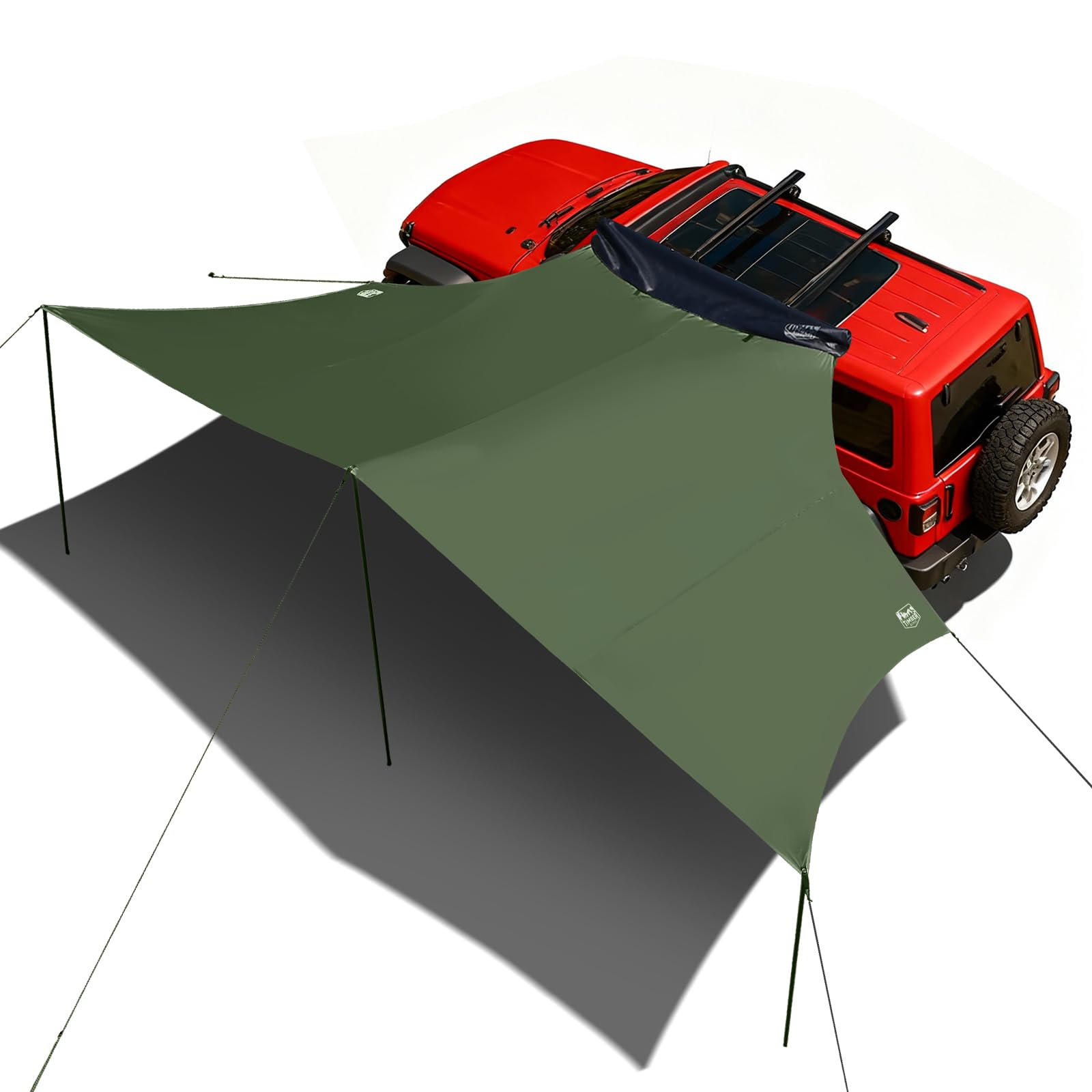
TIMBER RIDGE Blackout Car Awning
Key Features
- Size: 19 x 9.8 ft
- Fabric: Ripstop combed polyester
- Weight: 25.9 lb
- Coverage: 186 sq ft
- Price: Midrange
The first thing you notice about the TIMBER RIDGE is how much camp disappears under it: 186 square feet, or about 19 by 9.8 feet, enough for a cook station, chairs, and a few people standing up. We like that for a family basecamp where the awning becomes the main room, not a narrow strip beside the driver’s door. The blackout coating is the other draw: it cuts glare and gives the space a more private feel than a plain tarp.
The three-sided ventilation keeps the space from feeling sealed, and the coated fabric is the reason to accept the extra fuss. The three-pole frame takes more setting up than the roll-out awnings here. That is the trade-off for a canopy this large: it wants a deliberate pitch, not a quick flick open.
For a large family camp or a tailgate setup that stays put for a weekend, this is the runner-up we point to when coverage matters more than packed size. It is not the one for a solo overnighter or a vehicle with low garage clearance. The three-pole design is the trade-off: it can feel less planted than a four-leg frame when the wind shifts, so stake the legs and use the guy lines rather than relying on the frame alone.
Pros
- Huge 186 sq ft of shade
- Blackout coating cuts glare
- Three-sided ventilation keeps air moving
- Easy roll-out once installed
Cons
- Heavy at 25.9 lb
For family basecamps, we choose the TIMBER RIDGE: 186 square feet and a blackout coating make it the roomiest pick here, provided you can handle the weight.
Best for Hammock Camping
FREE SOLDIER Camping Tarp
Key Features
- Size: 10 x 10.5 ft
- Weight: 2.2 lb
- Tie-outs: Reinforced loops and grommets
- Waterproof rating: 2500 mm
- Price: Budget
The tie-out layout is the first thing we look for in a tarp, and the FREE SOLDIER has the useful kind of busy edge: reinforced loops and grommets give you options for a hammock fly, a lean-to against the car, or a flat roof over a picnic table. At 10 by 10.5 feet it covers two people and gear without becoming a sail.
For the money, this is the tarp shelter we recommend to campers who want flexibility rather than a permanent vehicle awning. The 210T ripstop polyester has a 2500mm waterproof rating, and the seams and tie-outs look properly finished. It is not the ultralight choice: at 1 kg packed, the weight is reasonable in a car kit but noticeable on a long hike.
We keep an eye on the edge seams, where loose threads can show up, and re-seal them if needed. Pack it away dry when you can, because a wet tarp in a stuff sack is a mildew problem waiting to happen. The included guy lines are a start, but this is a shelter that rewards a few extra pitching options.
Pros
- Many reinforced tie-outs and grommets
- 2500 mm waterproof ripstop polyester
- Packs to 1 kg for car kits
- Good value for a flexible shelter
Cons
- No stakes included
Our budget tarp pick is the FREE SOLDIER, which gives hammock and car campers flexible coverage at a price that leaves room for stakes and lines.
Best for Small Suv
Kelty Sideroads Car Awning
Key Features
- Fabric: 68D polyester, 1200 mm
- Weight: 8 lb
- Coverage: 81 sq ft
- Packed size: 22 x 7 x 7 in
- Price: Midrange
The Sideroads is less a roof-rack awning than a floorless side room for a small SUV or crossover: 81 square feet of coverage hangs off the vehicle and gives you a place to change, sit out a shower, or keep the camp kitchen out of the sun. We like that it attaches to the vehicle rather than requiring a permanent rail, and the floorless design means you can walk in with boots on and sweep out afterward.
The 68D polyester has a 1200mm rating, which is enough for passing rain rather than a storm, and the fiberglass poles keep the packed bundle to roughly 22 by 7 by 7 inches. Setup is a practiced job once you understand the pole pockets; the first attempt takes longer.
The lifetime warranty is a meaningful backstop for a shelter with fabric and pole wear in its future. It makes a damaged pole or seam less of a dead end, though the Sideroads still asks for careful handling.
For a small family or a couple in a crossover, this is the pick when you want a room beside the car without the bulk of a full awning. We treat it as a short-trip shelter rather than a permanent basecamp fixture.
Pros
- 81 sq ft floorless side room
- Universal vehicle mount without permanent rail
- Packs to 22 x 7 x 7 in
- Limited lifetime warranty
Cons
- Light fabric and poles are not storm-ready
We point small-SUV owners to the Kelty Sideroads for an easy 81-square-foot side room, with a lifetime warranty backing the lighter fabric and poles.
Best for Tailgate Coverage
GEERTOP Tailgate Awning
Key Features
- Size: 196 x 103 in
- Mount: Tailgate buckle straps
- Poles: 72 to 83 in adjustable
- Weight: 10.8 lb
- Price: Midrange
The tailgate-specific strap-on design is the reason to look at the GEERTOP: it buckles to the back of a van or SUV and rolls out a long 196-inch tarp, giving you a covered back porch rather than a side strip. We like that for van lifers and tailgate cooks who want the shelter attached to the vehicle they are already using, not another freestanding canopy to anchor.
The two telescoping poles adjust from 72 to 83 inches, and the tarp can be pitched as a single-pole A-frame or a dual-pole awning. Our first setup took longer than the second; the buckle straps need a clean attachment point and a firm pull to keep the tarp taut.
The big footprint gives you room to stand under the rear hatch while rain runs off the edges, and the tarp can be lowered for privacy. It is a simple shelter, not a sealed tent, so we treat the gap at the vehicle as part of the design rather than a flaw. For a tailgate lunch or a rainy school pickup, that open back is exactly the point.
Pros
- Huge 196-inch tailgate coverage
- Single-pole A-frame or dual-pole awning
- Buckles to most SUVs, vans, and trucks
- Adjustable 72 to 83 inch poles
Cons
- Water-resistant, not fully waterproof
- Heavy at 4.9 kg for a tarp
We choose the GEERTOP tailgate awning for van-life back porches: a long 196-inch tarp buckles to the rear and opens up a huge covered area.
Best for Overland Rigs
SAMOUT Roof Rack Awning

Key Features
- Size: 8.2 x 10 ft
- Fabric: 280GSM ripstop polyester
- Height: 4 to 7 ft
- Coverage: 82 sq ft
- Price: Premium
The SAMOUT is the bigger, more expensive roof-rack awning in this group: 8.2 by 10 feet and 82 square feet of shade, with 280GSM ripstop polyester and anodized telescoping poles that run from 4 to 7 feet. We like the extra room for a cooking setup and a couple of chairs, but the premium is real and the hardware is the part to scrutinize.
The twist-lock poles are quick once the awning is mounted, and the reinforced hinges are meant to take the leverage of a larger canopy. Alone, the size works against you; the 10-foot projection is easier to manage with a second person at the free end.
For an overland rig that already has a roof rack and wants shade over a bigger camp kitchen, this earns a place as the premium alternative to the VEVOR. We do not treat it as the default: the 82 square feet is more awning than a solo camper needs, and the side-arm design is the part we watch in wind.
Pros
- 82 sq ft of shade for larger camps
- 280GSM ripstop polyester with UPF50+
- Poles adjust from 4 to 7 ft
- Reinforced hinges and PVC bag
Cons
- Side-arm design is the durability weak point
Overland rigs with a roof rack get our nod for the SAMOUT’s larger 82-square-foot canopy when they want more room than the VEVOR and will pay for it.
Best for Roof-Rack Shade
JOYTUTUS Roof Rack Awning

Key Features
- Size: 6.6 x 8.2 ft
- Mount: Roof rack pull-out
- Fabric: Polyester
- Weight: 23 lb
- Price: Midrange
The one-minute setup promise is the first thing we wanted to check on the JOYTUTUS, because a roof-rack awning lives or dies on how quickly it turns a parking spot into shade. The frame is a 6.6 by 8.2-foot pull-out with twist-lock poles and a polyester canopy, and the orange trim is easier to spot across a busy campground than the muted greens here.
The aluminum tubes and joints feel better finished than the price suggests, and the canopy has glued corners rather than loose seams. We like the hook-and-loop fasteners and side storage compartments for keeping the rolled canopy tidy on the road.
The mounting instructions are the weak link: they are thin on detail, and the bracket and bolt layout takes some interpretation before you drill or clamp anything. We sorted it out, but allow an unhurried hour for the first install rather than the one minute the awning takes to deploy.
As an alternative to the VEVOR, the JOYTUTUS makes sense when you want a slightly more polished canopy and do not mind paying for it. It is still a fair-weather awning; we guy it out and lower it when the wind builds.
Pros
- 6.6 x 8.2 ft roof-rack shade
- Aluminum frame feels well finished
- Glued waterproof corners
- Hook-and-loop storage keeps canopy tidy
Cons
- Heavier than tarp-based options
We see the JOYTUTUS as the more polished roof-rack alternative, with tidy aluminum hardware and an orange canopy, as long as you allow for thin instructions.
Best for No Roof Rack
GEERTOP Side Awning

Key Features
- Size: 19 x 11 ft
- Mount: Suction cups
- Coverage: 16 sq m
- Waterproof rating: 3000 mm
- Price: Midrange
The suction-cup mount is the reason the GEERTOP side awning exists for people who do not have a roof rack: two large cups attach to the car’s side, and the 19-by-11-foot tarp rolls out to about 16 square meters of shade. We like that it avoids drilling and leaves the roof free for a cargo box, but the cups are a surface-dependent way to hold a big sail.
As a no-rack side awning, this is the pick when your vehicle has a clean, smooth panel and you mostly camp in calm weather. The 3000mm polyester has decent rain protection for a tarp this size, and the two telescoping poles adjust from 72 to 83 inches to match the terrain.
The cups need a clean, smooth panel; on a dusty or textured side, plan to add a backup tie-down. The fabric can sag when rain pools, so we keep one pole slightly higher to encourage runoff. That is a small habit, and it makes the awning feel more settled.
Pros
- No-drill suction-cup mounting
- 16 sq m of side shade
- 3000 mm waterproof fabric
- Poles adjust from 72 to 83 in
Cons
- Fabric can sag under pooled rain
We keep the GEERTOP side awning for vehicles without a roof rack: suction cups and 16 square meters of shade create a calm-weather side room.
How We Tested Camping Awnings in Real Weather
To build the shortlist, we started with the awnings people genuinely use — roof-rack and hitch-mounted canvas units, suction-cup car awnings, and freestanding shade shelters — then filtered by claimed coverage, packed weight, fabric and coating, and price. Anything with a mounting system that only worked on one vehicle, or a hardware bag that read like an afterthought, got cut. That left nine units, which we ran for seven months across driveway setups, weekend car-camping trips, and one memorably wet week in the Sierra foothills.
Setup was the first test, and it was done solo every time. I timed each awning from the moment I unzipped the bag to the moment the fabric was taut, staked, and guyed out, then timed the teardown and repack. Each one went on a luggage scale and got hoisted onto a roof rack to see how awkward the real-world lift is. Claimed size was checked against the shaded footprint that actually stayed usable at midday, with chairs and a table underneath.
Then we let the weather do the work. Ten minutes of hose spray with a paper towel taped under each seam showed which fabrics beaded and which seams wicked through, and two overnight rainstorms plus one 20 mph gust front on an exposed ridge sorted out the rest — brackets that flexed, poles that bowed, corner stakes that pulled straight out of loose soil.
Construction got checked after every trip: stitching, seam tape, and coatings, along with the small parts that fail first — bolts, mounting brackets, guy lines, and whether the hardware bag survived a season rattling around a truck bed. Value was a judgment we made in month seven, when it was clear which awnings still looked and worked like new and which had already started to fray.
How to Choose a Camping Awning
The right awning starts with how you park, not how many square feet the listing shouts about.
Match the mount to your vehicle
Roof-rack pull-outs like the VEVOR and JOYTUTUS need crossbars and enough clearance to swing the rail out; they are the cleanest choice if your vehicle already has a rack. Tailgate designs such as the GEERTOP buckle to the rear and suit vans and SUVs, while suction-cup awnings like the GEERTOP side model need a clean, smooth panel and are best in calm weather. The trap is treating no-drill as universal: a suction cup on a dusty or textured side is not the same attachment as a bolted roof bracket.
Before ordering, check the mounting hardware against your rack or vehicle panel, and test-fit at home. If you have a roof basket without lateral slats, expect to need an adapter or a different mount.
Size the shade around your camp, not the box
For two chairs and a camp table, 50 to 60 square feet is a sensible target; the VEVOR’s 54 square feet is in that range. A family camp with a cook station and several seats needs closer to 150 square feet, which is where the TIMBER RIDGE’s 186 square feet starts to make sense. A 10 by 10.5-foot tarp like the FREE SOLDIER covers a smaller group but gives you more pitching options.
Bigger canopies catch more wind, so size up only when you will use the space. Packed bulk follows coverage, and a huge awning that stays in the garage is worse than a smaller one that goes on every trip.
Read the weather rating with the seams
A hydrostatic number describes the fabric, not the whole shelter. A 1200mm polyester like the Kelty is fine for passing showers, while 2500mm to 3000mm fabrics like the FREE SOLDIER and GEERTOP side awning are better suited to steady rain. Seam tape, glued corners, and a taut pitch matter as much as the headline figure.
UV ratings and blackout coatings are about comfort rather than waterproofing. If you camp in open sun, a coated fabric that cuts glare is worth the extra weight; if you mostly chase shade under trees, spend that weight on poles and guy lines instead.
Plan for wind and setup help
Wind is what turns an awning into a kite. Guy lines and stakes are not accessories; use them every time, and lower the canopy when a front builds. Twist-lock aluminum poles are the easiest to live with on a roof-rack awning, while fiberglass poles save weight but flex more in gusts.
Setup help scales with size. A 6.6 by 8.2-foot pull-out is manageable for one person once mounted; a 19-foot side awning or a 186-square-foot canopy is easier with two. Practice the first pitch at home, before the campsite audience arrives.
Packing and storage matter more than you think
Packed length decides whether the awning lives in the truck or on a shelf. Roof-rack pull-outs pack into a long rail bag, while tarp shelters fold smaller but need stakes and lines in the same bag. We keep a small dry bag for wet guy lines so they do not soak the canopy.
Dry the fabric before long storage. A wet awning left in a stuff sack can mildew, and a mildewed coating is hard to bring back. If you have to pack wet, unfold and dry it at the first opportunity.
Frequently Asked Questions
Can I use a camping awning on a rental car?
Yes, but choose the attachment carefully. A suction-cup or strap-on awning avoids drilling, while a roof-rack pull-out needs crossbars the rental company allows you to use. Check the rental agreement before mounting anything, and test the suction cups on a clean panel before you rely on them. If the vehicle has no suitable rack or smooth panel, a dedicated tarp shelter is the safer choice.
Do camping awnings include stakes and guy lines?
It varies by kit. The VEVOR and JOYTUTUS roof-rack awnings include mounting hardware and wind ropes, while the FREE SOLDIER tarp includes guy lines but no stakes. Read the package list before you leave; if stakes are not named, add a set that matches your ground, and pack two extra guy lines for wind.
How do I clean a camping awning without damaging the coating?
Set it up, brush off loose dirt, and wash with mild soap and lukewarm water using a soft cloth. Skip detergents, bleach, and a pressure washer, which can strip the waterproof coating. Rinse well and let it dry completely before packing. For small spots, spot-clean rather than washing the whole canopy.
Final Verdict
For most campers with a roof rack, the VEVOR is the awning we recommend first: 54 square feet, a substantial 280GSM fabric, and a mounting kit that gets you camping without a separate hardware list. It is the best balance of coverage, weather protection, and quick setup in this group.
Choose the TIMBER RIDGE if your camp revolves around a big family table and you can handle the weight; choose the FREE SOLDIER if you want a packable tarp instead of a permanent rail. The GEERTOP tailgate awning is the one for van-life back porches.