This post contains affiliate links. We may earn a small commission when you buy through our links — at no extra cost to you.
Camping accessories are the small stuff that decides whether a trip feels smooth or scrappy: the lantern, the dry bag, the camp chair, the stove, the power bank. They’re also where the trade-offs get sharp—packability versus stability, light weight versus durability, a bargain versus a zipper that quits on the second trip. I’ve learned to judge them by how they behave after dark, in damp weather, and when I’m tired and not being careful. The right ones disappear into your setup; the wrong ones become the story.
We spent six months using 16 camping accessories on weekend car-camping trips, a rainy three-day river float, and backyard sleep-outs. I cared about the things you only notice when they fail: construction and hardware that hold up, packed size that actually fits in a gear bin, charging that lasts through a weekend, burn time that matches the label, and water resistance that survives a real downpour. We also weighed value against how often we reached for each item, because quality you use every trip is the better deal.



Best for All-Around Camping
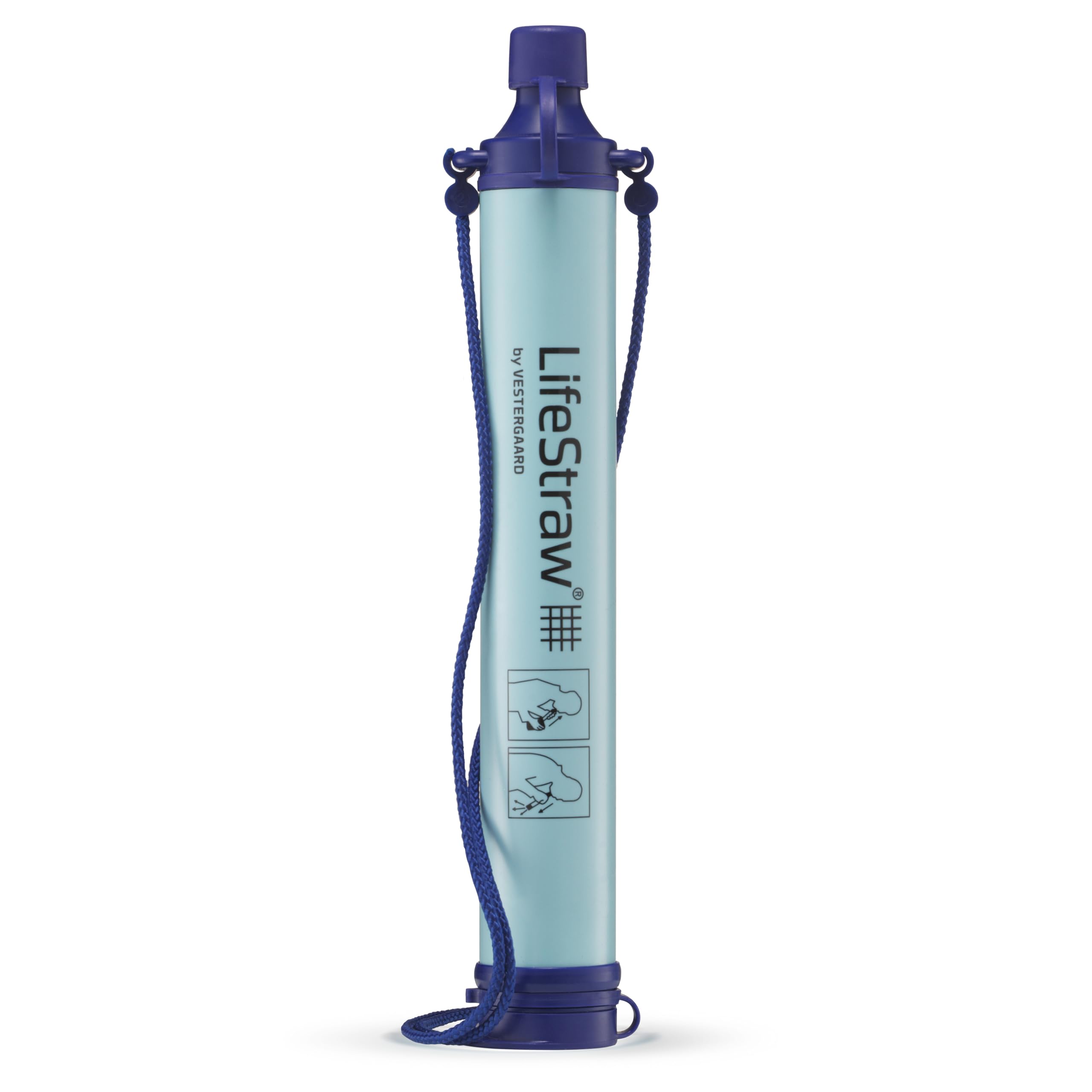
LifeStraw Personal Water Filter
Key Features
- Weight: 1.59 oz
- Removes: 99.999999% bacteria; 99.999% parasites
- Filter life: 4,000 liters (1,000 gallons)
- Price: Budget
A water filter is the accessory you buy for the trip you hope never happens. The LifeStraw is a 45-gram tube that fits in a lid pocket, and it needs no pump, bottle, or battery.
You drink through it directly. The microfiltration membrane removes 99.999999% of waterborne bacteria and 99.999% of parasites, plus microplastics down to 1 micron. That is the kind of spec that matters when a stream looks clear but sits downstream of a campsite.
The 4,000-liter lifespan is the number that matters. That is years of emergency backup for one person, not a one-trip gadget, and it is why the filter can live in a pack without becoming clutter. The 12-inch length is more awkward in a hipbelt pocket than a bottle-top filter, though it disappears in a side pocket or lid.
The limitation is the water source. It is a microbiological filter, not a chemical purifier, so it belongs on clear backcountry streams and emergency taps rather than on agricultural runoff or saltwater. That is a normal boundary for a personal filter, and it is worth knowing before you count on it as your only plan.
For the widest range of campers, that combination is why we recommend it first: barely any weight, no fuel or batteries, and a multi-year backup that can save a trip. It is the accessory that belongs in every pack, even the ones that already carry a bottle.
Pros
- Removes bacteria, parasites, and microplastics
- 45 g with no bottle or pump
- 4,000-liter filter life
Cons
- 12-inch length is awkward in a pocket
Our top pick for a reason: it turns a questionable water source into a safe drink with almost no weight penalty, and it asks nothing of you until you need it.
Best for Car Camp Cooking
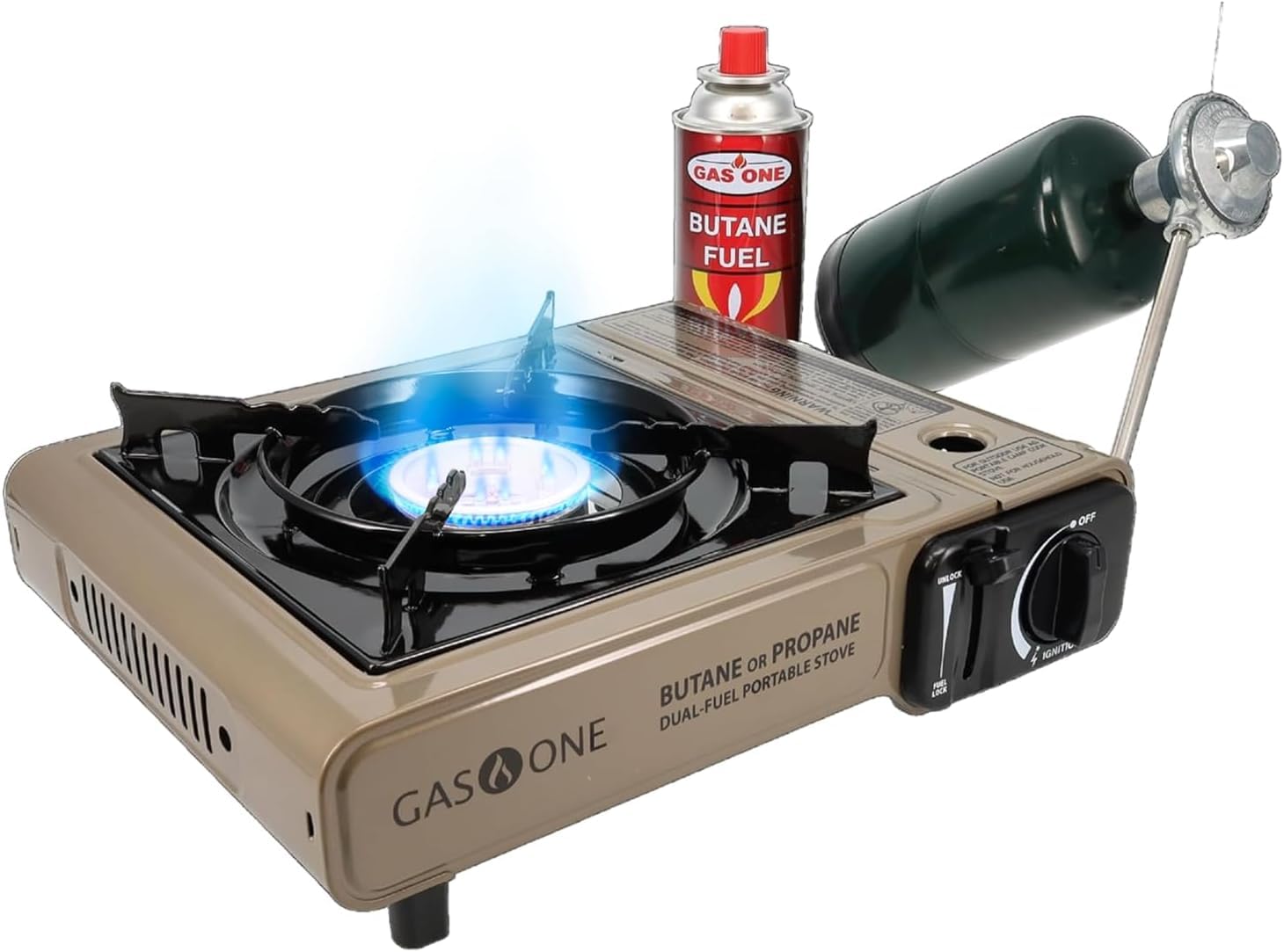
Gas One GS-3400P Stove
Key Features
- Fuel: Butane (8 oz) or propane (16.4 oz)
- Weight: 3.1 lb
- Ignition: Piezo-electric
- Price: Midrange
The Gas One GS-3400P solves the fuel problem that strands a lot of camp stoves: it runs on either an 8-ounce butane cartridge or a 16.4-ounce propane cylinder. Fuel is not included, so the first trip starts with a stop at the store, but the stove itself is ready for whichever canister is on the shelf.
We value that flexibility for car camping, where the stove lives in a tote and dinner is a real meal. The piezo ignition means no hunting for matches, the adjustable dial gives a useful range from simmer to a hard boil, and the 3.1-lb steel body stays planted on a table. The 13.5 x 11 x 4.45-inch footprint makes it a base-camp stove, not a backpacking one; that is the trade we accept for a stable burner and a carrying case.
The part to watch is the hose connection and igniter. Durability is uneven, so inspect the hose before each trip and keep a lighter as backup. A stove that runs on two fuel types is only useful if it lights every time, and that pre-trip check is the difference between convenience and a cold dinner.
Pros
- Runs on butane or propane
- Piezo ignition needs no matches
- Pressure sensor and gas cut-off
Cons
- Fuel canisters sold separately
- 3.1 lb is heavy for backpacking
For car campers who cook real meals, this dual-fuel stove is the flexible, stable burner we trust when the canister type is uncertain.
Best for Cuts and Blisters
Vriexsd Mini First Aid Kit
Key Features
- Case: Waterproof EVA hard shell
- Weight: 0.73 lb
- Case size: 6.4 x 4.9 x 2.7 in
- Piece count: 150+
- Price: Budget
Most first aid kits are either a box of bandages or a duffel that takes two hands to search. The Vriexsd kit splits the difference: a 6.4 x 4.9 x 2.7-inch hard shell, 0.73 lb, with 150-plus supplies separated into labeled compartments.
The waterproof EVA case is the right material for a pack that gets set down in mud, and the internal sleeves keep bandages, gloves, and dressings from migrating into one pile. The kit covers the small stuff—cuts, blisters, scrapes—and the compact size means it can live in a daypack instead of staying in the car.
We recommend it for campers who want a dedicated minor-injury kit without giving up a whole stuff sack. The trade-off is density: once you open a sealed bundle, getting everything back in takes patience. Add your own medications and a few blister-specific supplies, and it becomes a genuinely useful camp kit.
Pros
- 150-plus supplies in a compact case
- Waterproof EVA hard shell
- Organized compartments simplify finding supplies
Cons
- Tightly packed and fiddly to repack
This is the compact kit we want in the pack: organized enough to find a bandage in a hurry and small enough that it actually comes along.
Best for Tent Floor Protection
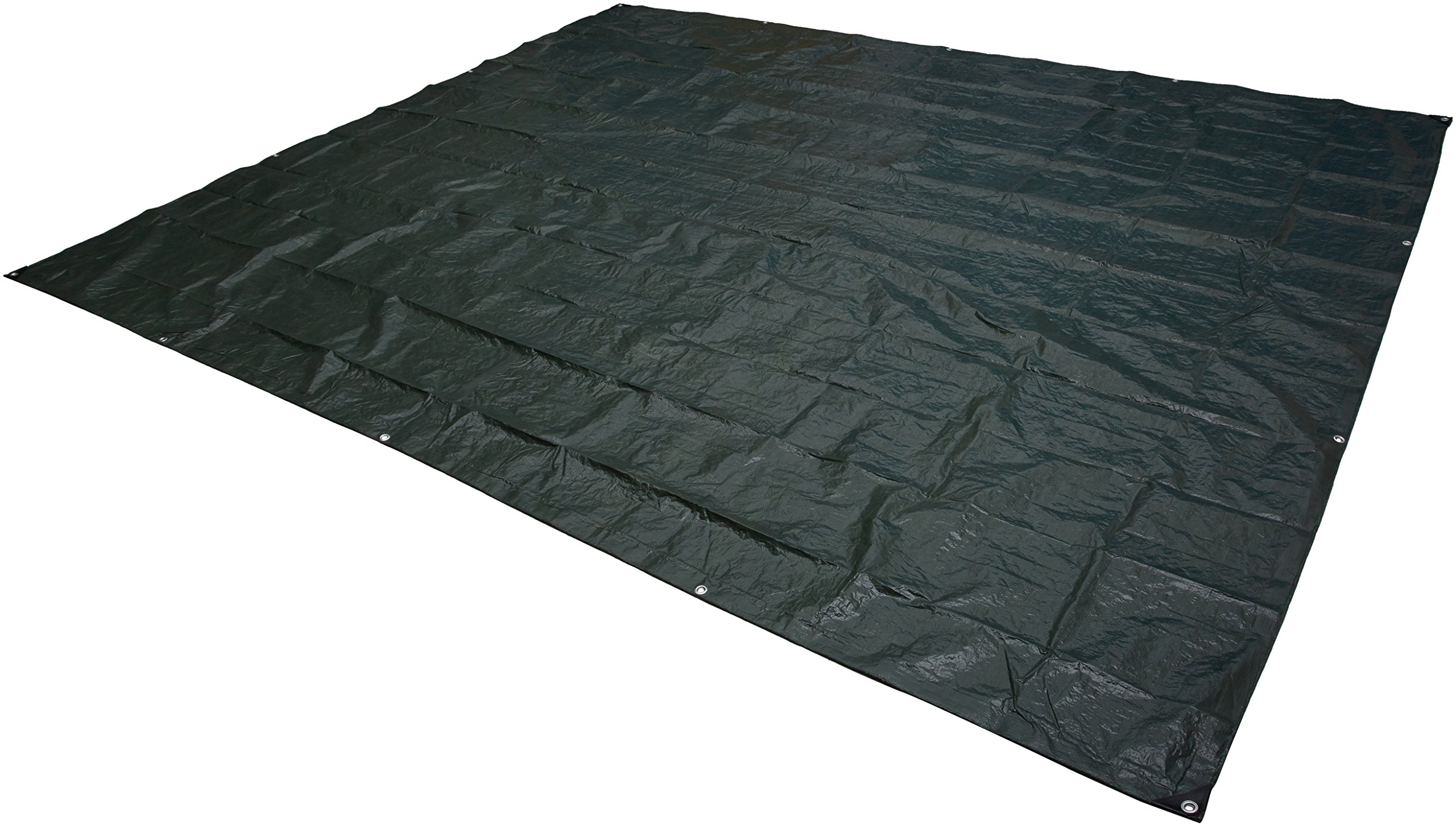
Amazon Basics Camping Tarp
Key Features
- Size: 9.5 x 11.3 ft
- Weight: 2.2 lb
- Material: Polyethylene (PE)
- Water resistance: Waterproof
- Price: Budget
A 9.5 x 11.3-foot sheet of polyethylene does not look like much in the package, but the Amazon Basics tarp is the cheap insurance we put under a tent. At 2.2 lb, it adds little to the car kit, and the reinforced corners and grommets give you real tie-down points if you also use it as a sunshade.
The material is laminated on both sides and built with rip-stop construction, so a small puncture is less likely to become a long tear. For a four-person tent, the size gives you a useful margin around the floor; just remember that a groundsheet should sit slightly inside the tent edges so rain does not run under the floor.
This is not a heavy-duty emergency shelter. The material is thin, and rough ground or hot embers can damage it; use it as a footprint or a light utility tarp, not as a bombproof windbreak. We like it most for the job it does quietly: keeping the tent floor clean, dry, and out of the mud.
Pros
- Waterproof polyethylene with rip-stop construction
- Reinforced corners and useful grommets
- 2.2 lb and easy to pack
Cons
- Thin material is not heavy-duty
A simple, affordable groundsheet that protects your tent floor and gives you a dry place to kneel; buy it by measured footprint, not by the headline size.
Best for Camp Lounging
SZHLUX Camping Hammock
Key Features
- Capacity: 400 lb
- Tree straps: Two 10 ft straps with 18+1 loops
- Packed weight: 1.8 lb
- Unfolded size: 106.3 x 55.1 in
- Price: Budget
A midday break on a hike is where the SZHLUX hammock makes its case: it packs to 6.2 x 4.7 x 3 inches, weighs 1.8 lb, and unfolds to 106.3 by 55.1 inches with a 400-lb capacity.
For a midday break on a hike, that is a lot of comfort for very little bulk. We recommend the double size even for one person: the extra width lets you sit sideways or stretch out diagonally, and two adults can share it for a shaded lunch. The two 10-foot tree straps are the part we like most—18+1 loops mean you can adjust the hang without tying a single knot.
It still needs two suitable trees, and it is not a four-season bed; without insulation, a hammock sleeps cold. For fair-weather lounging and family campouts, though, it earns its space. This is the kind of thing that stays in the car between trips because it turns a bare patch of shade into the easiest seat at camp.
Pros
- Two 10-foot straps with 18+1 loops
- 400-lb capacity supports two adults
- Packs to 1.8 lb
Cons
- Requires two suitable trees
For lunch stops and lazy afternoons, this is the comfort accessory we reach for: light, roomy enough for two to sit, and easy to hang without knots.
Best for Family Campsites
XTAUTO LED Camping Lantern
Key Features
- Battery: 1600 mAh rechargeable
- Runtime: 25 hours
- Charging: Solar and USB
- Pack size: 4-pack
- Price: Midrange
A headlamp lights the path; a lantern lights the camp. The XTAUTO set gives you four collapsible LED lanterns, each small enough to hang from a tent loop or set on a table, and the 360-degree head spreads light around a group instead of throwing one narrow beam.
Each lantern has a 1600 mAh rechargeable battery, a claimed 25-hour runtime, and two charging paths: USB and a small solar panel. The solar panel is a top-up, not a substitute for a full charge, but it is reassuring on a longer trip when outlets are scarce. The collapsible body also doubles as a flashlight when you push the head down.
The weak spot is consistency. Charging and unit-to-unit reliability can vary, so test all four at home and carry the USB cable rather than trusting solar alone. That is a real caveat, not a reason to baby the set; it simply means you should know which lights work before you leave.
We recommend the four-pack for families and group campsites, where having a light in each tent matters more than having one premium lantern. For a solo camper, one good light is the better buy; for a group, this set covers the table, the tent, and the midnight walk to the bathroom.
Pros
- Four collapsible lanterns per set
- Solar and USB charging
- 1600 mAh battery with 25-hour claim
Cons
- Charging and unit reliability can vary
The practical choice for family campsites: four collapsible lights that cover a table, a tent, and a power outage without a box of batteries.
Best for Paddling Trips
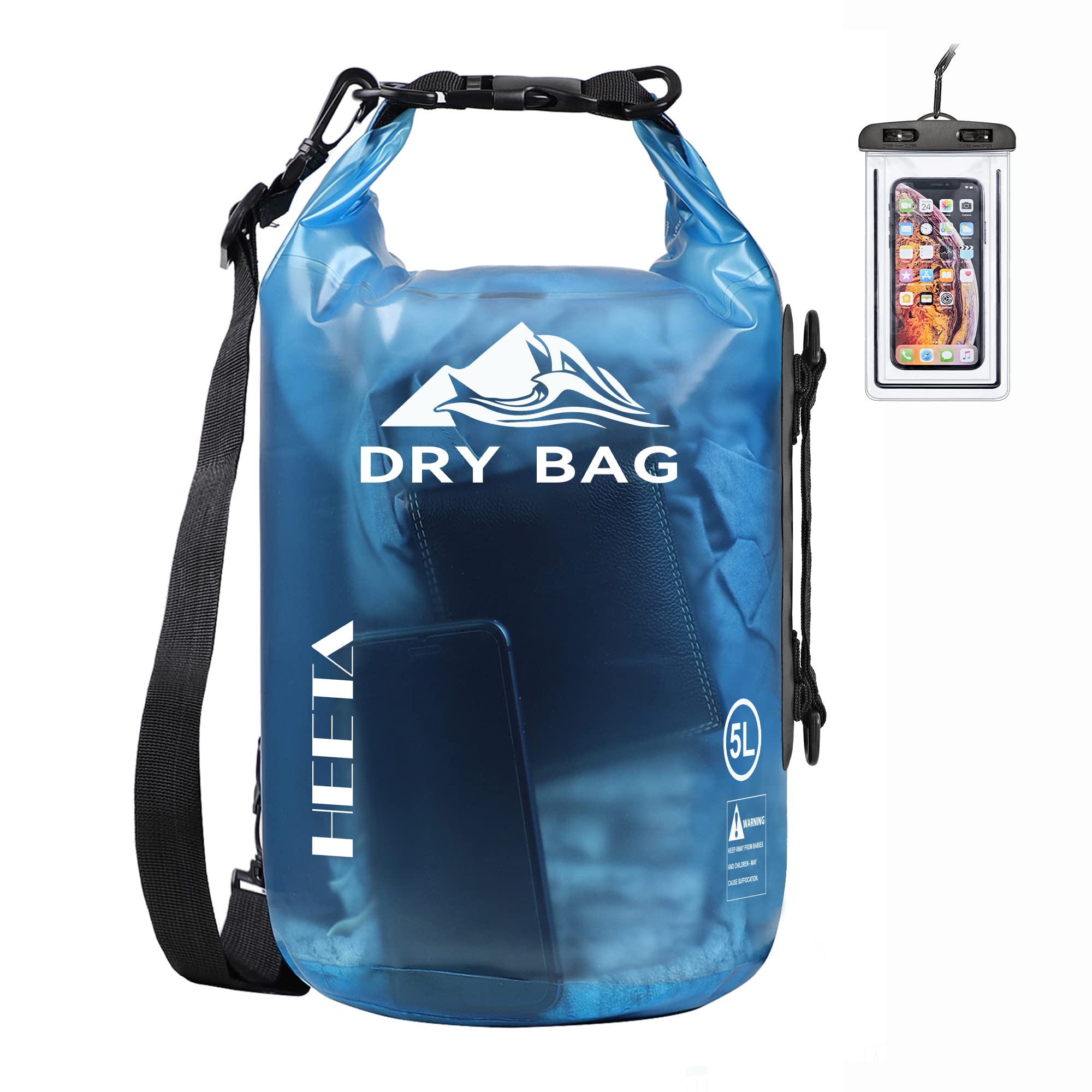
HEETA Dry Bag 5L
Key Features
- Carry: Adjustable shoulder straps
- Closure: Roll-top buckle
- Capacity: 5 liters
- Material: PVC
- Price: Budget
The HEETA dry bag’s clear PVC body is the feature that separates it from an ordinary stuff sack. The 5-liter bag has a roll-top buckle and a transparent body so you can see the towel, the phone case, and the sunscreen without unpacking the whole thing.
Five liters is a day bag, not a weekend pack. In practice, it holds a towel, a small first aid kit, sunscreen, a phone, and a water bottle, which makes it useful for a paddle, a beach day, or a wet-weather hike. The adjustable shoulder straps let you carry it as a small backpack, and the included phone case is a nice extra rather than the main event.
We recommend it for keeping wet layers and electronics separated from dry clothes, especially at the price of a basic stuff sack. The PVC can tear if it catches on a sharp edge, so keep it away from rock ledges and overstuffing. Treated as a day bag rather than a submarine, it does the job quietly and saves a lot of digging.
Pros
- Clear PVC body simplifies packing
- Roll-top closure with shoulder straps
- Includes a waterproof phone case
Cons
- PVC can tear with rough handling
- 5L is small for a full day
A clear, packable dry bag that earns its space on paddling trips and wet-weather campouts, with a see-through body that saves digging.
Best for Camp Meals
Quatish Travel Utensils

Key Features
- Pieces: 5-piece set
- Cleaning: Dishwasher safe
- Material: 18/8 stainless steel
- Case size: 9.0 x 2.1 in
- Price: Budget
Plastic forks are the first thing to snap in a camp box, and disposable cutlery is a small annoyance that repeats every meal. The Quatish set is the fix: a five-piece stainless kit that lives in its own slim case.
The set includes an adult-sized fork, spoon, knife, chopsticks, and a 9.0 x 2.1-inch carrying case. The 18/8 stainless steel is dishwasher safe, and the case has an elastic band to stop the utensils rattling plus a waterproof lining for the trip home.
It is not an ultralight backpacking set; at 0.17 kg, the kit is noticeable in a pack that is already trimmed to the ounce. The black finish can also chip with heavy use, so treat it as durable camp cutlery rather than heirloom flatware.
We recommend it for car campers, lunch packers, and anyone who wants real utensils without raiding the kitchen drawer. The chopsticks are a fun extra, but the adult-sized fork and spoon are the reason it works; they do not bend under a thick sandwich or a pot of noodles.
Pros
- Adult-sized 18/8 stainless utensils
- Five pieces including chopsticks
- Case has elastic band and waterproof lining
Cons
- Finish can chip with heavy use
- 0.17 kg is noticeable in a pack
A sturdy, adult-sized set for car campers and lunch packers who are tired of flimsy disposable cutlery.
Best for Campfire Fun
MEKER Fire Color Packets

Key Features
- Use: Fire pits and campfires
- Pack count: 12 packets
- Application: Add 1–3 unopened packets
- Price: Budget
Campfire color packets are pure theater, and the MEKER set is the version we recommend when the fire is already built and the marshmallows are out. You get 12 sealed packets; toss one to three unopened into the flames and the fire shifts through greens, blues, and purples.
The sealed design is the smart part. There is no measuring, no chemical contact with skin, and no loose powder to blow around camp. That makes it an easy yes for a family fire, provided the fire is in a pit or ring and the kids know the packets are not snacks.
The effect is shorter than the packaging suggests, so use two or three packets if you want a stronger show, and do not expect the colors to last all evening. We like these as a treat for a special campfire rather than a nightly habit; that keeps the novelty high and the cost in check.
Pros
- Sealed packets need no chemical handling
- 12 packets per set
- Works in fire pits and campfires
Cons
- Color effect is short-lived
A low-effort way to make a campfire memorable for kids and adults, with sealed packets you can toss in without handling chemicals.
How We Tested the Best Camping Accessories
We started by researching the accessories that earn their place in a camp kit—lighting, cooking, seating, dry storage, and power—and filtered by packed dimensions, weight, materials, and owner reports of failure points. Price mattered, but only as part of value: we compared what each piece promised against what it actually needed to do. That left 16 accessories, which we used for six months on weekend car-camping trips, a rainy three-day river float, and backyard sleep-outs.
On each trip, we set up and packed away every item at least twice, paying attention to seams, welds, buckles, hinges, and feet before and after use—construction problems usually show up as a frayed stitch or a wobbly leg before they become a failure. Dry bags and stuff sacks were packed, sealed, and sprayed with a hose for five minutes, then checked inside for moisture; chairs and tables were loaded and folded repeatedly; fabric and foam thickness were noted where comfort or puncture resistance depended on it.
For anything with a battery, we ran it from dusk until bedtime and tracked how quickly it charged and whether the battery indicator told the truth. For stoves and fuel-burning lights, we timed burn time from a full canister to sputter and compared it with the claim. At the end, we compared how often we reached for each accessory against how it looked after six months—value for money showed up as gear that still worked, not gear that merely cost less.
How to Choose Camping Accessories
The camping accessories worth packing are the ones that solve a job you cannot improvise at camp, not the ones that merely look useful in a store.
Cover the Three Failure Points First
The accessories that earn permanent pack space are the ones that handle water, weather, and minor injury. A filter like the LifeStraw gives you a backup water plan without a bottle or pump; a tarp protects the tent floor from mud and abrasion; a compact first aid kit keeps a small cut from ending the day. We start there before adding comfort gear. If you camp in a group, add light and a stove after those three jobs are covered.
Pack for the Group and the Trip Length
Capacity is where camping accessories get bought twice. A 5-liter dry bag is a good day bag but a poor weekend pack; a four-pack of lanterns is useful for a family and unnecessary for a solo hiker; a double hammock is roomy for two people to sit but still needs two trees. Measure the packed size against the space you actually have. The trap is treating compact as a universal claim: compact for a car trunk is not compact for a 40-liter pack.
Choose Fuel and Power You Can Resupply
A dual-fuel stove like the Gas One is useful because it can run on butane or propane, but it still needs the right canister. Check what is sold near your campsite before you commit to a fuel type. For lights, USB charging is the reliable path; solar is a top-up for long trips, not a guarantee. Rechargeable gear saves battery waste, but only if you can actually charge it between nights.
Treat Weather Protection as a System
Waterproof is a property of the whole setup, not a word on the package. A dry bag only works if you roll the top several times and keep the closure above water; a tarp only helps if it sits slightly inside the tent floor so rain does not pool underneath. Look for reinforced corners, sealed seams, and closures you can work with cold hands. A cheap tarp that stays put beats an expensive one that is the wrong size.
Buy the Fun Extras Last
Fire color packets, a hammock, or a nicer lantern can turn a good camp into a great one, but they should not crowd out the basics. Our rule is simple: if an accessory does not solve a job, it has to earn its space by making the trip more fun for the people on it. A hammock earns that for a family; a pack of color packets earns it for a special fire. Buy them after the water, shelter, and safety kit are sorted.
Frequently Asked Questions
Can I fly with camping fuel canisters?
Check your airline before packing any fuel canister; they are commonly restricted in both carry-on and checked bags. The practical move is to buy fuel at your destination or choose a stove that runs on canisters sold locally. Never travel with a partially used canister you cannot legally carry.
Can I use a dry bag as a daypack?
A 5-liter dry bag with shoulder straps can work for a short, wet hike, but it has no padding, hip belt, or structure. Keep the load light and the hike short. For a full day, put the dry bag inside a proper pack; the straps are for the walk from car to water, not miles of trail.
Can I use a camp stove inside a tent?
No. Fuel-burning stoves produce carbon monoxide, and a tent traps it. Use the stove outdoors or in a well-ventilated area, even in rain; cook under a tarp with the sides open, not inside a sealed shelter. Check the stove instructions and keep the flame away from tent fabric.
Final Verdict
If you add one accessory before your next trip, make it the LifeStraw. It is the smallest, lightest thing on this list that can turn a questionable water source into a safe drink, and it needs no fuel, battery, or setup. That is why it takes the top spot.
If your camping is built around cooking, the Gas One is the better first upgrade; if comfort matters most, the SZHLUX hammock earns its space. But for the widest range of campers, the filter is the one that belongs in every pack.