This post contains affiliate links. We may earn a small commission when you buy through our links — at no extra cost to you.
A solar generator is only as good as the moment the sun stops cooperating. I’ve watched a cloudy afternoon turn a campsite fridge into a warm box and a phone battery into a paperweight, so I care less about watt-hour bragging rights and more about whether the thing keeps camp running. The right unit turns daylight into quiet power for a cooler, a laptop, a CPAP, and a few lights—without a gas can or a generator drone.
Over the past eight months, my team and I tested seven solar generators as I use them: loaded into the car for weekend camps, hauled to a no-hookup cabin, and set up in the backyard during outage drills. We weighed each one, carried it from trunk to tent pad, timed solar and wall charging, and ran real loads until the battery quit. Some were easy to move but slow to recharge; others had plenty of capacity but an app that dropped connection. The picks below are the ones that held up after repeated cycles and balanced power, weight, charging speed, and value.

Best for Car Camping
Jackery Explorer 1000 v2
Key Features
- Weight: 23.8 lb
- Capacity: 1,070Wh
- AC output: 1,500W
- Solar panel: Not included
- Price: Midrange
1,070Wh and 1,500W is the combination that makes the Explorer 1000 v2 our default for car camping. That is enough to run a small fridge, a CPAP, lights, and a laptop with some headroom, yet the unit weighs 23.8 pounds rather than requiring two people to lift. The trade is clear: this is a station for the trunk-to-picnic-table trip, not for hiking into a backcountry site.
We appreciate the outlet layout for a family camp: three AC outlets, two USB-C ports, one USB-A, and a 12V car port cover the phones, lantern, speaker, and laptop without a power strip. The fast AC recharge is the feature we value most before a trip. Jackery says the app’s emergency mode takes the battery from zero to full in about an hour, which makes a top-up at a diner stop realistic. App pairing is the one thing we do not count on; the physical controls are enough at camp, and the app is a bonus rather than a requirement.
Solar is optional, so the station’s total cost depends on the panel you add. A 100W panel is the sensible starting point for a weekend top-up; a larger panel shortens the wait but adds another bag to carry. We like that the Explorer 1000 v2 can also charge from the car, because a cloudy weekend does not leave you dependent on sun alone.
For a long weekend with a fridge or a CPAP, this is the one we keep packed. If every pound matters and the trip is mostly phones and lights, the Explorer 300 is the easier carry; the 1000 v2 earns its weight when you need to run real appliances, not just chargers.
Pros
- 1,070Wh and 1,500W handle fridge and CPAP loads
- About one-hour AC recharge with app mode
- 23.8 lb is manageable for car camping
- Useful outlet mix for a family camp
Cons
- Solar panel sold separately
1,070Wh and 1,500W make the Explorer 1000 v2 our default for car camping: enough to run a small fridge, CPAP, lights, and laptops without a two-person lift.
Best for Ultralight Trips
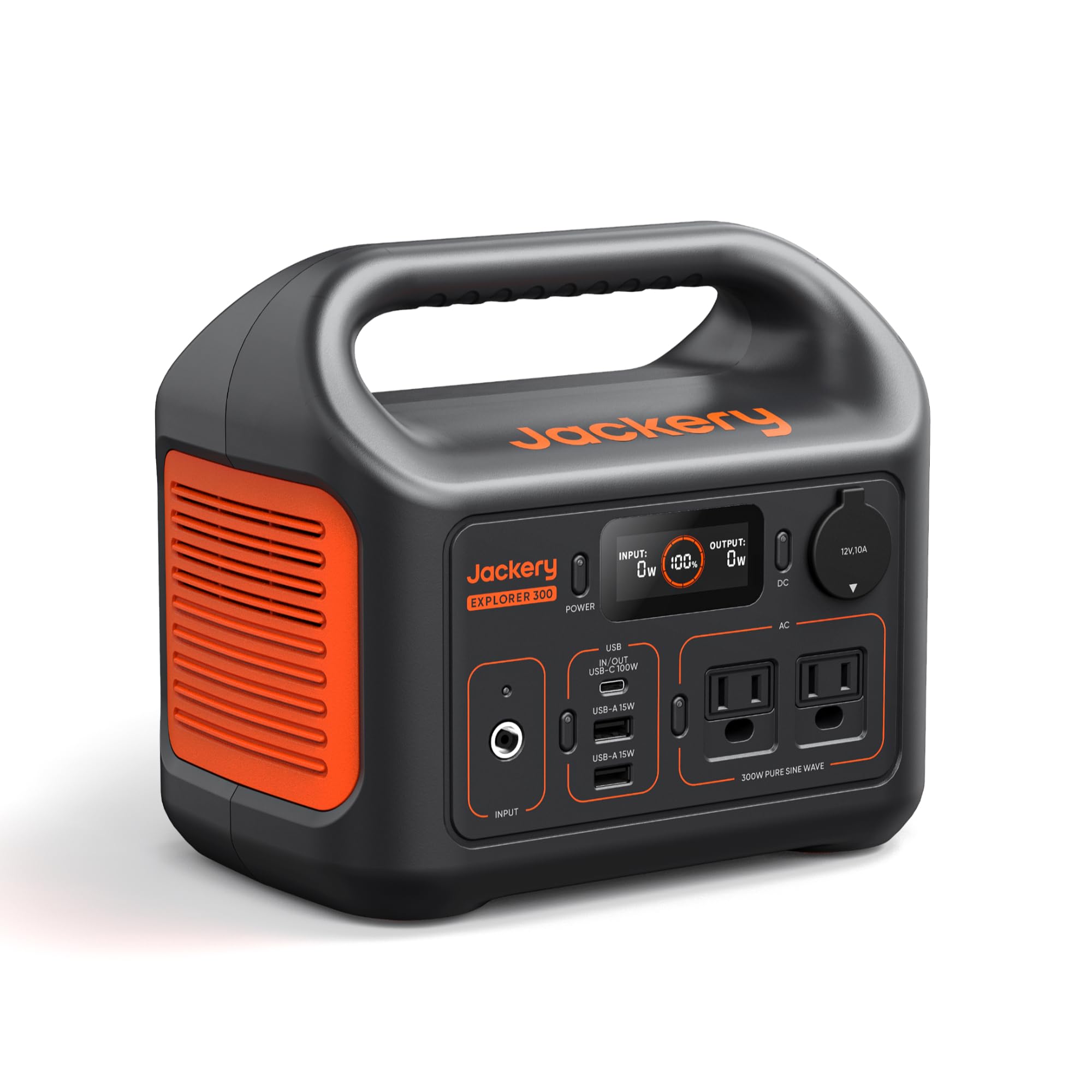
Jackery Explorer 300
Key Features
- Weight: 7.1 lb
- Capacity: 292Wh
- AC output: 300W
- Solar panel: Not included
- Price: Midrange
At 7.1 pounds, the Explorer 300 solves the problem most camping power stations create: it is easy to carry from the trunk to the tent and small enough to stash under a seat. We noticed the difference most when the station has to move twice a day, which is exactly when a heavier unit becomes a chore. The 292Wh capacity is modest, but the footprint is small enough that it can live in the car without taking over.
Where it earns its keep is the small-load list: phones, cameras, lights, a laptop, a fan, and a CPAP on a short trip. The 300W continuous output and 600W surge are enough for those, but not for a full-size fridge, kettle, or induction burner. We like the two AC outlets and the USB-C PD port because they cover a family’s overnight charging without a power strip. The carry handle is integrated into the case, so there is nothing to clip on or lose.
Solar is the catch. The panel is not included, and the 100W panel Jackery pairs with it is the realistic minimum if you want to replace a day’s use; Jackery says 80% in about 2.8 hours with that panel. That is a useful top-up, not a guarantee on a cloudy day. For a short trip with light devices, the trade is worth it. For a base camp with a fridge, step up to the Explorer 1000 v2.
Pros
- 7.1 lb and compact enough for one-hand carry
- Covers phones, lights, and a laptop
- Fast solar top-up with a 100W panel
- Two AC outlets plus USB-C PD
Cons
- Solar panel not included
- 300W output limits bigger appliances
The Explorer 300 is the one we reach for when space and weight matter: 7.1 pounds, 292Wh, and enough outlets for phones, lights, and a laptop.
Best for High-Output Camping
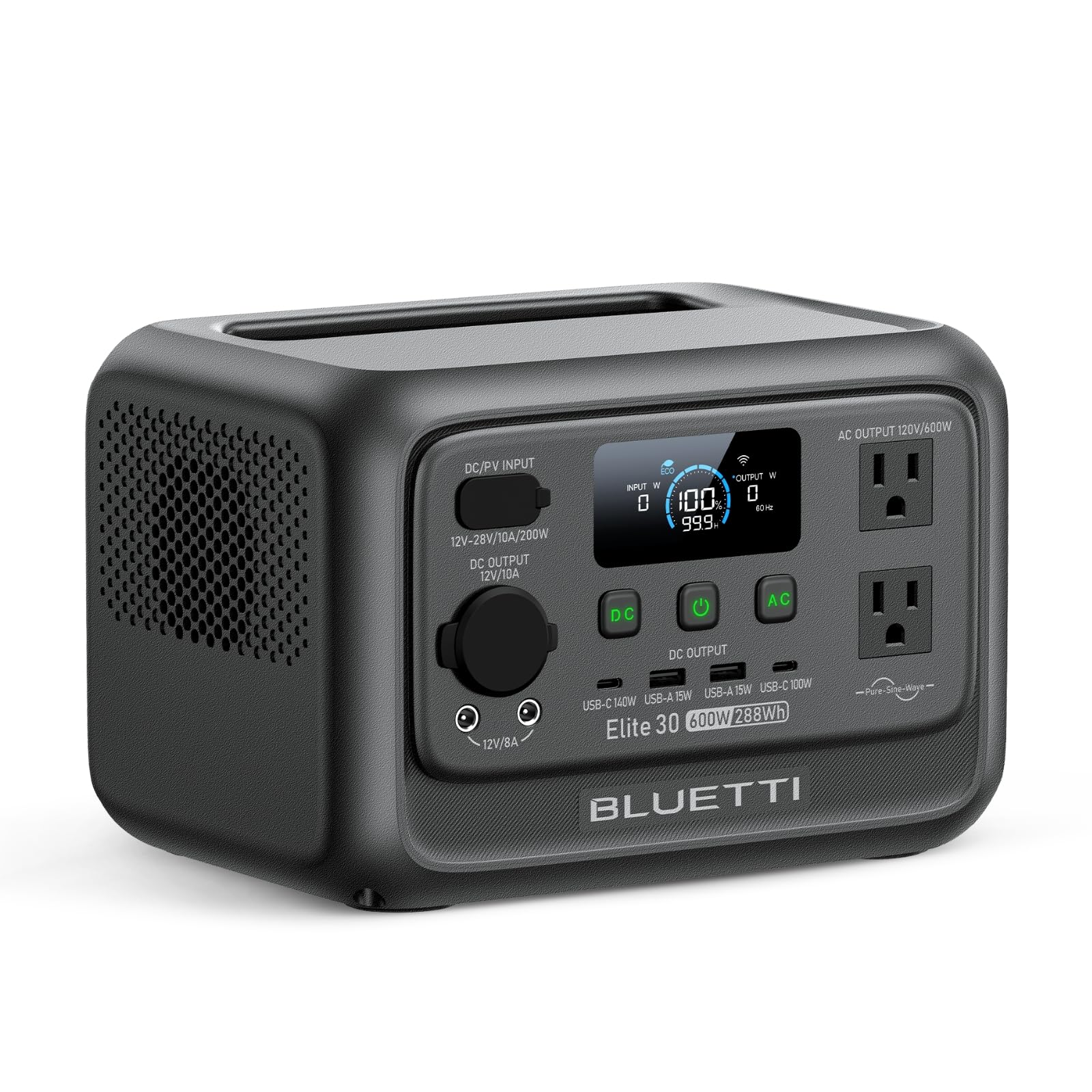
BLUETTI Elite 30 V2
Key Features
- Weight: 9.5 lb
- Capacity: 288Wh
- AC output: 600W
- Solar panel: Not included
- Price: Midrange
600W from a 9.5-pound box is the headline here, and it is the reason the Elite 30 V2 is our small high-output pick. Most 300Wh-class stations here top out at 300W, which rules out a small induction burner, a larger fan, or a tool-battery charger. The Elite 30 V2 handles those short bursts and still fits in a backpack.
The 288Wh capacity is the limiting factor. It is plenty for phones, lights, a laptop, and a camera, and a CPAP can run overnight on DC if your machine is efficient. Run a high-draw appliance and the battery drains quickly; the 1,500W Power Lifting mode is for startup surges and short jobs, not for a heater or a long cook session. We treat this as a weekend station for one or two people, not a base-camp power supply.
We are impressed by the recharge speed: 0 to 80% in about 45 minutes and 0 to 100% in roughly 70 minutes on AC, according to BLUETTI. The 10ms UPS is more useful for a mobile office than a tent, but it is a nice buffer if you work from camp. The missing solar panel is the main omission; add a compatible panel and the kit gets more expensive and more capable. The LiFePO4 chemistry is a point in its favor for long-term ownership, even though capacity remains the real limit.
Pros
- 600W continuous output in a 9.5 lb body
- 0-80% in about 45 minutes on AC
- 10ms UPS protects sensitive gear
- Compact enough for a backpack
Cons
- Solar panel not included
- 288Wh drains fast under high draw
The Elite 30 V2 is the small station we choose when a campsite has one high-draw device: 600W output, 288Wh, and a 9.5-pound body.
Best for Budget Solar Kit
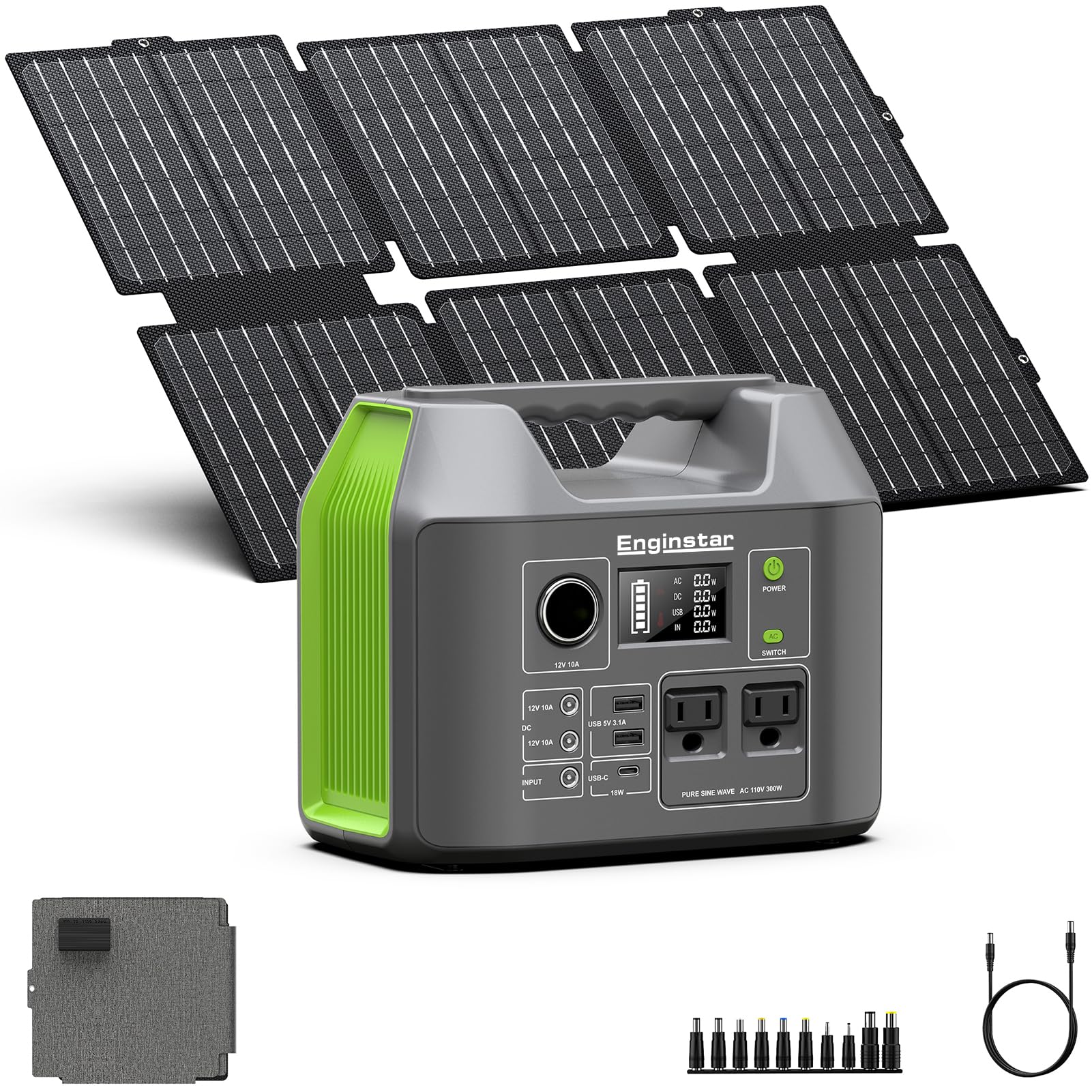
EnginStar R300
Key Features
- Weight: 6.5 lb
- Capacity: 296Wh
- AC output: 300W
- Solar panel: 60W included
- Price: Budget
The included 60W panel is the reason to look at this kit. It folds, packs with the station, and gives you a way to top up without buying a separate panel. What it does not do is refill 296Wh quickly: 60W is a small panel, and under anything less than strong direct sun it is a maintenance charge rather than a full recharge. We treat the AC adapter as the main charging method and the panel as a backup.
At 6.5 pounds, the R300 is easy to carry and light enough for a daypack. The 296Wh battery and 300W output cover phones, lights, a laptop, a fan, and a small cooler, but not a full-size fridge or a coffee maker. We like the two AC outlets and the mix of USB ports; it is enough for a couple of people to charge overnight without a strip. The pure sine wave output is the right choice for laptops and CPAP machines.
The caveat is the charging system. Charging speed and battery life are the mixed parts of this model’s story, and the weak spot is a unit that takes a charge slowly or stops accepting one. Test the wall and solar inputs as soon as the kit arrives, and keep the receipt. Compared with the Jackery Explorer 300, you get a panel and more capacity for less money, but the Jackery has the stronger reliability record here.
Pros
- 60W solar panel included
- 296Wh and 300W in a 6.5 lb body
- Pure sine wave AC and multiple USB ports
Cons
- Charging speed and battery life are inconsistent
- Included 60W panel is a top-up
We recommend the EnginStar R300 as the panel-included budget kit: 60W solar, 296Wh, and 6.5 pounds, with the understanding that it is for small devices.
Best for Mid-Size Value
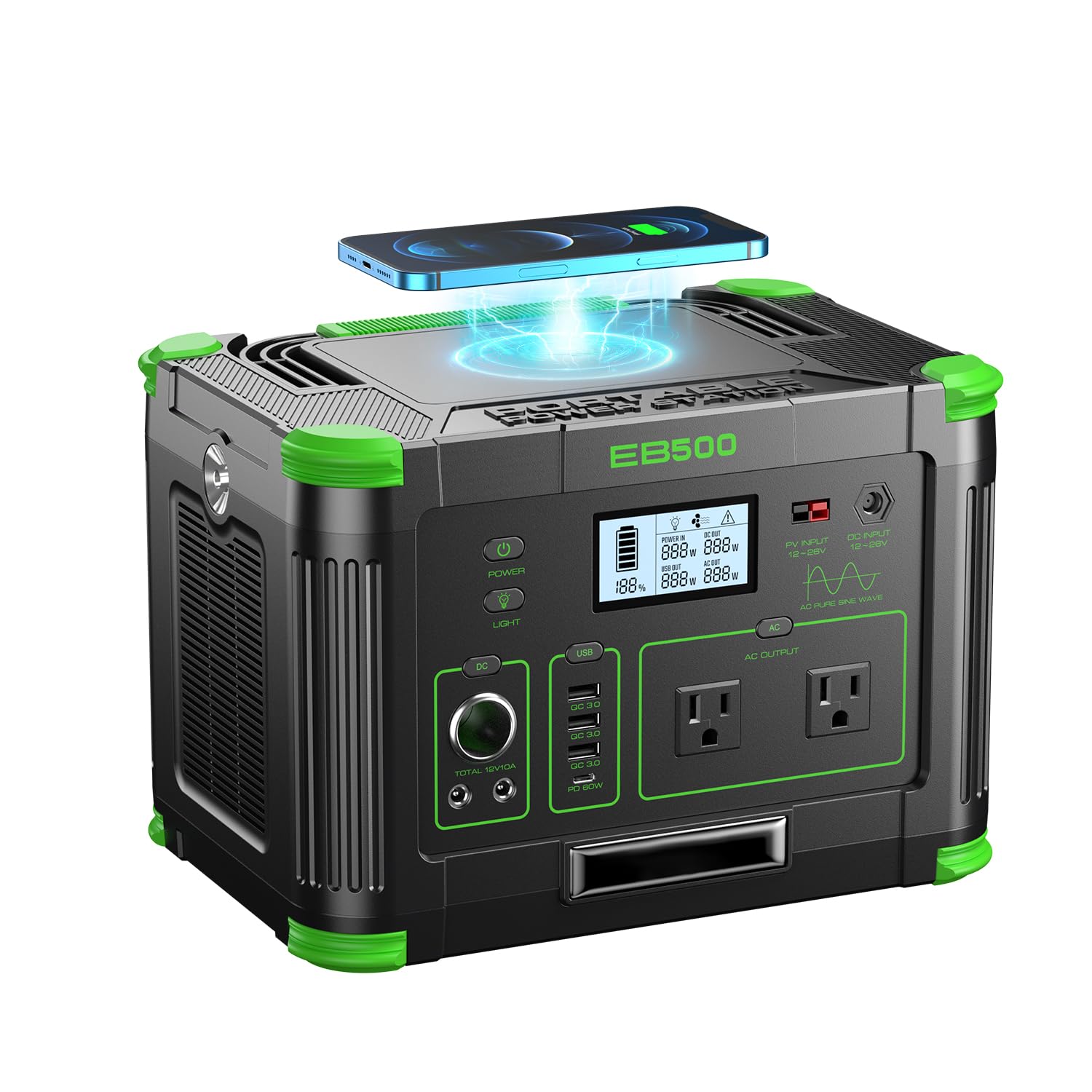
GRECELL EB500
Key Features
- Weight: 18 lb
- Capacity: 519.48Wh
- AC output: 500W
- Solar panel: Not included
- Price: Budget
About 519Wh is the useful middle ground in this group: roughly twice the capacity of the small 300Wh stations without the 23-pound carry of the 1kWh models. The EB500 weighs 18 pounds, which is still a two-hand lift for some people, but it fits a car-camping kit and runs a 12V cooler, lights, and a laptop through a weekend. We see it as the value option for a couple or a small family.
The 500W continuous output and 1,000W surge are enough for small appliances and electronics, though not for a full-size fridge, microwave, or kettle. We appreciate the 10 outlets, including a 60W USB-C PD port that can charge a laptop at a useful speed. The pure sine wave output and built-in BMS are the right baseline for sensitive gear. For the money, the feature set is sensible rather than flashy.
The two compromises are solar and charging speed. No panel is included, and the unit is compatible with 100W or 200W panels, so you need to budget for one if off-grid charging is the point. Charging speed is the other weak spot; the EB500 is not a fast-charge station, and solar is slower still. We treat it as a station to top up before you leave rather than one to refill quickly at camp. That is fine for a weekend base camp, less so for a long off-grid trip.
Pros
- 519Wh at a value price
- 500W output with 1,000W surge
- 10 outlets including 60W USB-C
- 18 lb is manageable for car camping
Cons
- No solar panel included
- Charging speed is slower than the top picks
The GRECELL EB500 is our value pick for a mid-size camp setup: 519Wh and 500W for less money than the name-brand stations, with no panel in the box.
Best for Built-In Panel
BROWEY S1600

Key Features
- Weight: 26 lb
- Capacity: 1,024Wh
- AC output: 1,600W
- Solar panel: Built-in 40W
- Price: Premium
The built-in 40W panel is the whole idea here: you unfold it from the station, point it at the sun, and skip a separate panel and cable. We like that for a base camp where the station stays put. What we do not like is the math. A 40W panel is a trickle for a 1,024Wh battery, so it is a maintenance charge, not a way to run a fridge off the sun. The 26-pound body reinforces that this is a car-camping station, not a backpacking one.
The rest is a familiar 1,024Wh, 1,600W package with a 3,200W peak and a LiFePO4 battery rated for 3,000-plus cycles. The 3,200W peak matters for a fridge or a tool with a startup surge, while the 1,600W continuous rating sets the real limit. That is enough for a fridge, CPAP, lights, and laptops at base camp, and the eight outlets cover a family’s gear. The solar charging speed is the trade you accept for the built-in convenience; the panel is always with the station, but it will not keep up with heavy use. For a weekend cabin or a car-camping base, that is a reasonable compromise. For serious off-grid use, a separate 100W-plus panel is the better answer. The three-year warranty is a plus.
Pros
- Built-in 40W panel needs no separate carry
- 1,024Wh and 1,600W for base camp
- LiFePO4 battery rated for 3,000-plus cycles
- Eight outlets and a 3,200W peak
Cons
- 26 lb is a car-camping commitment
- 40W panel charges slowly
We like the BROWEY S1600 for the camper who wants the panel built in: 1,024Wh and 1,600W with a folding 40W panel, though its 26-pound body is car-camping only.
Best for Cheap Panel Kit
ZeroKor R200

Key Features
- Weight: 5.1 lb
- Capacity: 280Wh
- AC output: 300W
- Solar panel: 60W included
- Price: Budget
Five pounds is the number that makes the ZeroKor R200 worth a look. It is the lightest panel-included station here, and the 60W panel folds into the kit, so you can carry both in one trip from the car. That convenience is real for a day hike or a small tent setup where every item has to justify its place.
The 280Wh battery and 300W output put it in the small-device lane: phones, lights, a tablet, a camera, and a small fan. We do not ask it to run a coffee maker or a full-size fridge; the inverter is not built for that. For a couple of nights of lights and charging, the capacity is adequate. The 60W panel is a top-up, not a fast recharge, and the wall adapter is the practical way to fill it before a trip.
The weak spots are the AC outlet and the charging speed. A unit that will not hold a load or takes a charge slowly is the failure pattern to test for, so plug in a small appliance and run the panel on arrival. If it works, it is a lot of kit for the money. If not, the return window is your friend.
We treat the R200 as the budget panel kit, not the default. The EnginStar R300 is the better small panel-included choice if you can stretch to it; the ZeroKor wins only when the 5.1-pound weight and the lowest panel-included cost are the priorities. That is a narrow brief, but it is a real one for a solo camper who wants a panel in the bag.
Pros
- 5.1 lb with a 60W panel included
- A budget-friendly panel-included kit
- Enough for phones, lights, and small fans
Cons
- AC outlet and charging speed are weak points
- 280Wh limits bigger appliances
We treat the ZeroKor R200 as the budget panel kit: 5.1 pounds, 280Wh, and a 60W panel included, with the charging and outlet caveats that come at this end of the market.
How We Chose and Tested Camping Solar Generators
We started by pulling together camping solar generators from brands we’ve used before and a few newer names with strong review patterns, then filtered by realistic camping power capacity, weight, panel compatibility, and price. That left seven units, which we tested over eight months.
Each unit lived through the same rough circuit: weekend car-camping trips, a no-hookup cabin stay, and backyard outage drills where I ran a 12V cooler, laptops, phones, LED lights, and a small fan. I weighed every generator on a luggage scale and carried it from the trunk to the campsite—sometimes a hundred yards—to see whether the handles, wheels, or shoulder straps actually helped. For power capacity, I noted which devices ran at once and how long the battery lasted before shutting down. For charging speed, I timed wall and solar recharges, including a partly cloudy afternoon, and checked whether the app-reported input watts matched reality.
Battery life got a less polite test: repeated charge-and-drain cycles, with notes on whether capacity estimates drifted and whether the unit shut down cleanly or threw errors. I paired each app and checked how far I could walk before Bluetooth dropped, whether input and output readings updated, and whether firmware updates went through without a fuss. Value came down to what came in the box—panels, cables, ports—and whether the build felt worth the spend compared with the rest of the fleet. The units that made the list were the ones that kept their numbers honest when the weather and the loads weren’t.
How to Choose a Camping Solar Generator
Start with the loads you actually run, then work backward to capacity and weight; the panel is a charging accessory, not a substitute for enough battery.
Match capacity to your camp loads
Watt-hours tell you how much energy the battery holds; watts tell you what it can run at once. A 300Wh station is fine for phones, lights, a laptop, and a short CPAP night, while a 500Wh unit gives more margin and a 1,000Wh station can run a small fridge or a longer CPAP schedule. We start by listing the devices and their runtimes, then add 20 percent for inverter losses and cold. The Jackery Explorer 1000 v2 is the pick here with real fridge headroom; the 300Wh stations are for lighter loads.
Decide how much weight you will carry
Capacity and weight rise together, and the carry from the car to the site is where that matters. A 5- to 10-pound station fits a daypack or a tote; an 18- to 25-pound unit is a two-hand car-camping box. We prioritize weight when the campsite changes or the walk is long, and capacity when the station stays at one base. The 7.1-pound Jackery Explorer 300 is the easy carry; the 1kWh picks are for the trunk-to-table trip.
Look past the included-panel headline
A panel in the box is convenient, but the wattage matters more than the word included. A 40W or 60W panel is a top-up for a small battery and a slow trickle for a 1kWh one; a 100W or larger panel is the better match if solar is your main charging plan. Check the station’s solar input limit before buying a bigger panel. We treat included panels as a backup, not a promise of off-grid independence.
Check output, outlets, and surge
Continuous watts set what runs reliably; surge watts cover motor startup for a fridge or a fan. A 300W station handles electronics and small fans, 500W to 600W opens up small appliances, and 1,500W or more is for fridges and tools. Add up the devices you run at once and leave headroom. We also look for pure sine wave AC, at least one USB-C PD port, and enough outlets that you do not need a power strip at camp.
Battery life, recharge speed, and the parts that fail
LiFePO4 is the chemistry we prefer for a long-term camping station because it is rated for more cycles than the older lithium-ion cells, though the listed cycle counts vary by model. Fast AC recharge is more useful than fast solar for most weekend trips; the Jackery Explorer 1000 v2 can reach full in about an hour in its app mode. Test every input and outlet when the unit arrives, and pay attention to the handle and port covers, which see the most abuse.
Frequently Asked Questions
Can a camping solar generator run a CPAP machine?
Many can, especially on DC. Add up your machine’s watts and the hours you sleep, then leave the humidifier off if you want to stretch a small battery. A 300Wh station is a reasonable one-night starting point for a basic CPAP; a 500Wh unit gives more margin for a heated humidifier or a second night.
Do I need to charge a new power station before a trip?
Yes. Charge it fully at home, then test each outlet with the devices you plan to bring. Recharge it every few months in storage, and keep it out of a hot car for long periods. A station that has sat unused for a year may need a full charge before it behaves normally.
Can I leave a solar panel connected while I’m away from camp?
Disconnect it if you are leaving for hours, especially when wind or rain is possible. Use a stake or tie-down, keep the connector dry, and check the panel when you return. A panel that has blown over can damage the connector or the station’s input.
Final Verdict
The Jackery Explorer 1000 v2 is the camping solar generator we recommend for most buyers. It has the capacity and output to run a small fridge, CPAP, lights, and laptops, and its fast AC recharge makes it practical before a trip. If you carry your gear to the site, the 7.1-pound Explorer 300 is the better answer; if you want a panel in the box, the EnginStar R300 is the budget kit, with slower charging and a smaller battery.