This post contains affiliate links. We may earn a small commission when you buy through our links — at no extra cost to you.
The first time my phone died at a campsite, I spent the evening borrowing a stranger’s battery pack and promising myself I’d pack better. A solar charger is the fix: a panel and battery you can toss in a pack, set on a rock, and use to top up a phone when there’s no outlet for miles. The good ones earn their place through portability, steady charging, and build quality that survives a backpack; the bad ones turn a sunny afternoon into a slow, frustrating experiment.
Over four months, we tested 12 solar chargers at campsites, on hikes, and in a few less-than-sunny backyards. We timed how quickly each topped up a phone, checked whether wireless charging held its connection when the phone shifted, and packed every model into a daypack to judge portability. The lesson I’d pass to a first-time buyer: advertised wattage is a best-case number, not a promise. The picks below are the ones that kept charging when the sun was less than ideal, and that I actually enjoyed carrying.



Best for All-Round Camping
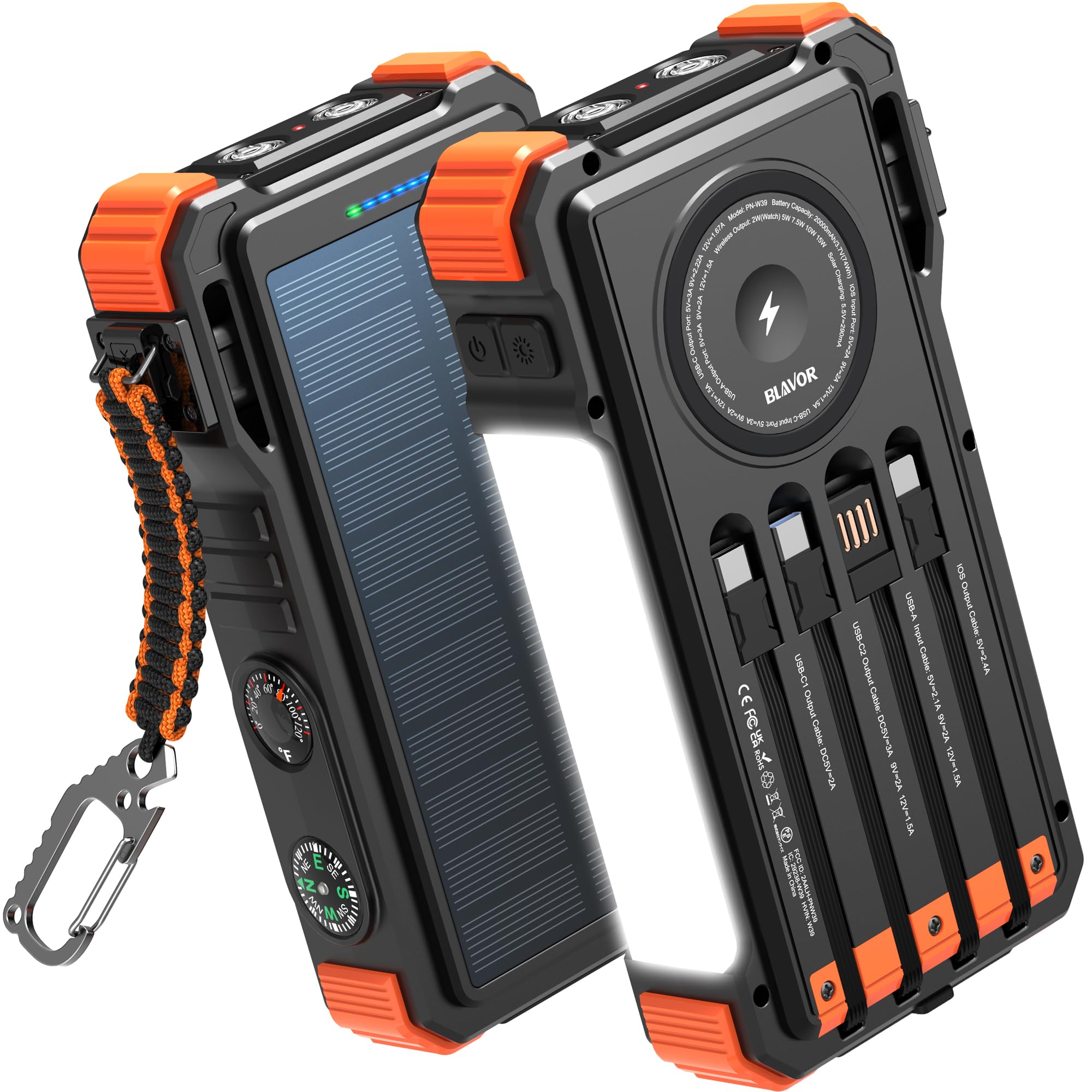
BLAVOR PN-W39 20000mAh
Key Features
- Weight: 1.3 lb
- Capacity: 20000mAh
- Max output: 20W USB-C
- Built-in cables: 4
- Price: Midrange
Twenty watts out of the USB-C port puts a phone at about half in half an hour, and that is the number we judge these packs on: not the capacity printed on the shell, but how quickly a dying phone becomes a useful one before the light goes. BLAVOR backs the port with 20000mAh, rated at roughly four charges of an iPhone 17 or three and a half of a Galaxy S24 Ultra. Across two or three nights that is enough stored power that the solar panel never has to do anything dramatic.
The cable arrangement is the part we appreciate most. Two USB-C leads, a Lightning lead and a USB-A lead are built in, and with the three ports on the end you can have seven things charging at once — which matters when four people arrive with a mix of phones and nobody brought a cable. There is a 15W wireless pad on the top face for a phone or an Apple Watch, a genuinely useful lantern and flashlight, and a compass and thermometer that are more charm than kit.
Size is the trade-off. At 1.3 pounds and a shade over seven inches long, this lives in a pack or a duffel rather than a trouser pocket. Two practical notes: the USB-A port drops low-draw gadgets such as earbuds after a few seconds, so run those from the USB-C side, and the panel on the back is a top-up rather than a rescue — an afternoon of good sun returns a few percent, not a full bar. The three-year warranty is the comfort.
Pros
- About four phone charges from one pack
- 20W USB-C plus 15W wireless pad
- Four built-in cables and three ports
- Three-year warranty included
Cons
- 1.3 lb and over seven inches long
- USB-A port cuts out on low-draw gadgets
We recommend the PN-W39 as the default camping charger: enough stored power for a long weekend, 20W USB-C to refill a phone fast, and built-in cables that survive a group trip.
Best for Light Packing
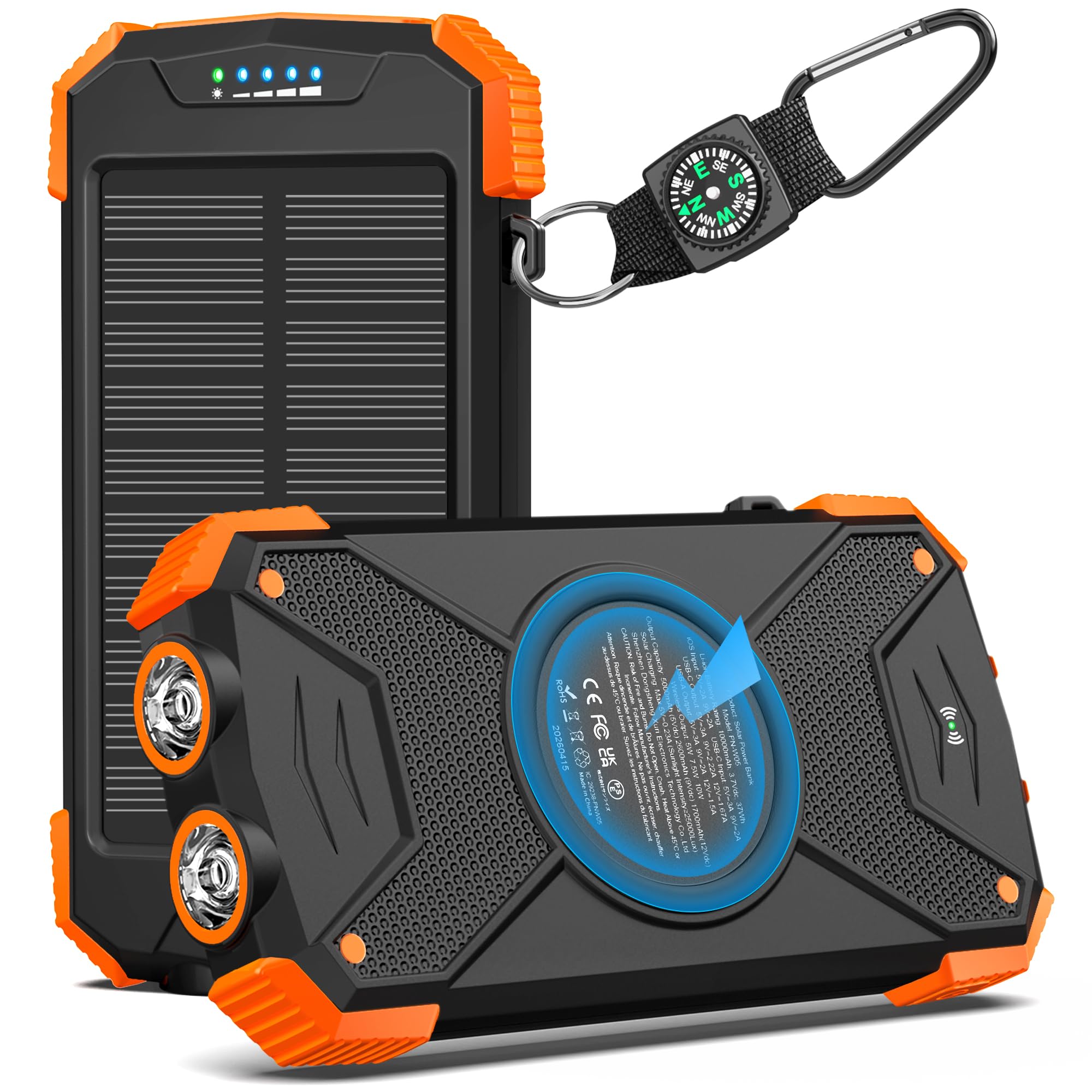
BLAVOR 10000mAh Solar Power Bank
Key Features
- Weight: 9.3 oz
- Capacity: 10000mAh
- Max output: 20W USB-C
- Water resistance: IPX5
- Price: Budget
At 9.3 ounces and eight-tenths of an inch thick, this is the pack that actually goes in a pocket. We noticed the difference every time we swapped it for a 20000mAh brick: the smaller BLAVOR slides into a jacket or a lid pocket and you stop thinking about it, which is not something we can say for most of the packs here.
What that weight buys is 10000mAh, roughly two phone charges, plus a 20W USB-C port that takes an iPhone 15 to about 65% in half an hour, Qi wireless charging, and an IPX5 shell rated against dust and splashes. It refills from a wall socket in around four hours. BLAVOR uses a lithium-cobalt cell here and claims half again the cycle life of a standard lithium-polymer pack, and there is a dual flashlight bright enough for tent duty plus a carabiner with a compass set into it.
The limit is capacity. Two charges is weekend insurance, not a week’s supply, and the panel on the back is small even by the standards of this group — a full sunny day makes a dent you would barely notice. Charge it from the wall before you leave and treat the sun as a bonus rather than a plan. For a day hike or a single overnight where the pack shares a pocket with your keys, none of that matters.
Pros
- Pocketable at 9.3 oz and 0.8 in thick
- 20W USB-C and Qi wireless charging
- IPX5 shell resists dust and splashes
- Bright dual flashlight for tent use
Cons
- Only about two phone charges
Buy the 10000mAh BLAVOR if you count grams and only need a couple of charges — it is the one that genuinely disappears into a pocket.
Best for Long Trips
BLASOUL 49800mAh Solar Power Bank
Key Features
- Capacity: 49800mAh
- Max output: 22.5W
- Built-in cables: 4
- Water resistance: IP65
- Price: Budget
Nearly fifty thousand milliamp hours for less than the top pick costs is the whole argument for this one. Treat the figure as a headline rather than a promise, because no pack delivers its rating once the cells are stepped up to a 5-volt USB output, and a chunk of that number goes to conversion. What survives the arithmetic is still days of phone charging with enough left over for a tablet, a headlamp and a camera battery.
Four cables are moulded in — Lightning, USB-C, micro-USB and a USB-A input lead — and the micro-USB one is the detail we keep coming back to, because it fits the headlamp or action camera nobody remembered to charge. Output runs to 22.5W over PD or QC, there is a 15W wireless pad, and the IP65 shell handles dust and rain. Taken together that is the most capacity and the widest set of connections for the least money in this group, which is why it takes a runner-up slot.
Our reservation is longevity. Charging speed and battery life are where this pack is least convincing against the others here, and when one goes wrong the symptom tends to be that it stops accepting a charge rather than that it charges slowly. A single year of warranty is thinner than the three years BLAVOR gives. For a car-camping week where the pack lives near the trunk and several devices need feeding, the arithmetic still holds.
Pros
- Huge capacity for the money
- Four built-in cables including micro-USB
- 22.5W PD/QC and 15W wireless
- IP65 sealed against dust and rain
Cons
- Some units stop accepting a charge
- Seven inches long and 1.28 in thick
The BLASOUL is the cheapest route to serious stored power here: days of charging for a group, traded against bulk and a shorter warranty.
Best for Group Trips
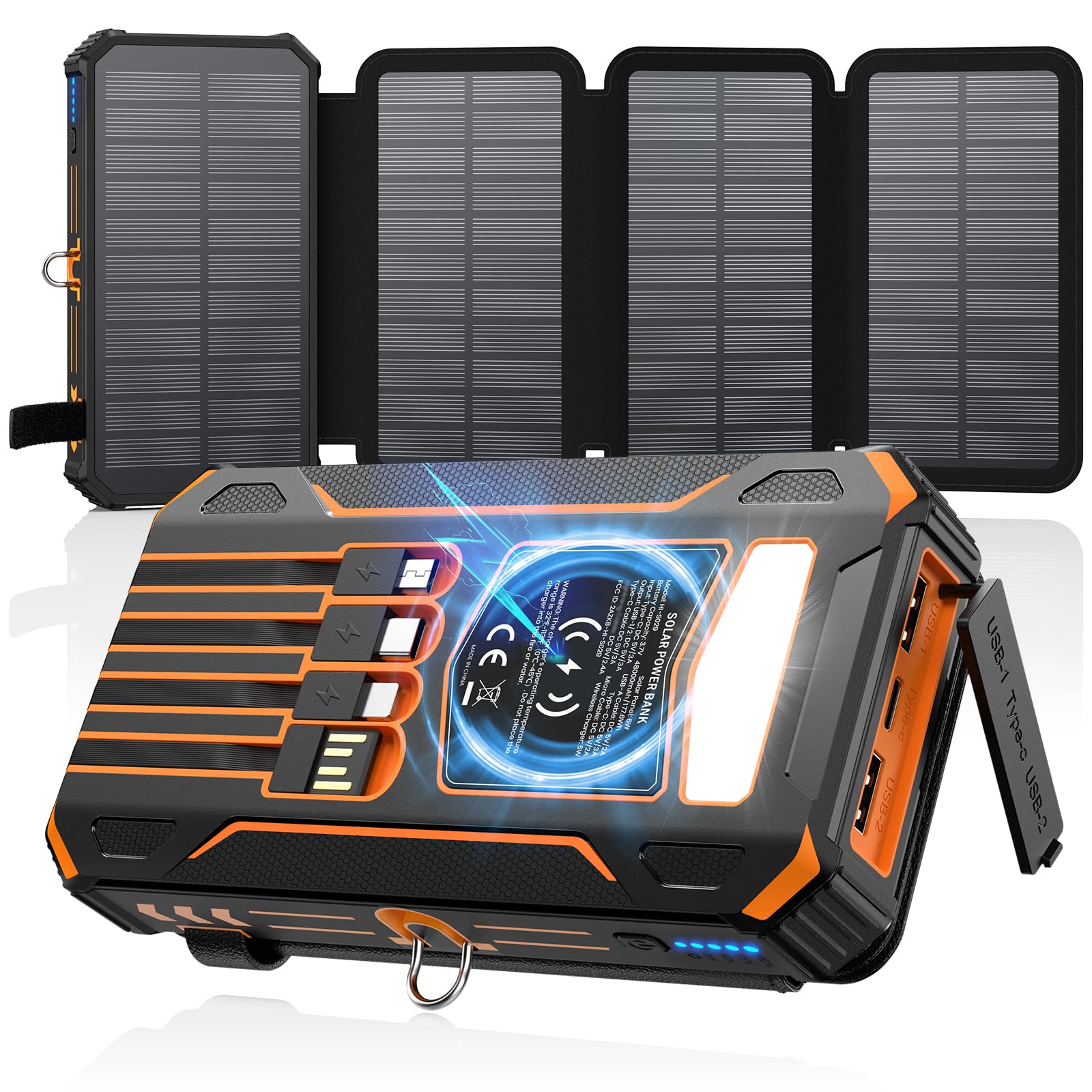
SOARAISE 48000mAh Solar Power Bank
Key Features
- Size: 6.38 x 3.43 x 1.57 in
- Capacity: 48000mAh
- Max output: 5V/3A USB-C
- Built-in cables: 4
- Price: Midrange
Four cables come moulded into this pack, and that single decision is what makes it useful at a campsite rather than just on a spec sheet. Two people can plug in without anyone unpacking a charging brick, and with the three ports on the end you can run five or six devices at once without a tangle of leads across the tent floor.
The battery is rated at 48000mAh, and the USB-C port manages 5V/3A — enough, by SOARAISE’s own figures, to take an iPhone from 15% to about 60% in half an hour. There is a wireless pad on the face for a phone you are using as an alarm clock, and a pair of LED lights that turn the pack into a decent tent lantern without anyone reaching for a headtorch.
An inch and a half of thickness and a six-inch length make it a base-camp object rather than something you carry up a hill. Build quality is the strongest part of the package: the shell feels solid and the panels sit behind a protected face, though long-term durability is the question mark rather than the build itself.
Where it earns its place is the hand-around factor. Charging a group’s phones from one pack, with the leads already attached and a lantern built in, makes for a much easier evening than the alternative. Just do not ask it to do that from the bottom of a backpack.
Pros
- Four moulded cables and three ports
- 48,000mAh of shared capacity
- Wireless pad plus two LED lights
- Solid, well-protected shell
Cons
- An inch and a half thick and six inches long
- Long-term durability is the open question
Choose the SOARAISE when several people share one pack — the four built-in cables and wireless pad make it the easiest to hand around camp.
Best for Sunny Base Camps
BigBlue 28W Solar Panel
Key Features
- Ports: 2 USB-C, 1 USB-A
- Weight: 1.48 lb
- Folded size: 11 x 6 x 1.4 in
- Panel rating: 28W
- Price: Premium
A 28W panel does not put 28 watts into your phone, and anyone who has watched a percentage crawl upward in full sun knows it. What we like here is how much of the available light the BigBlue converts: the face carries no metal busbars across the cells, so a shadow falling on one cell does not wipe out a whole column, and the monocrystalline cells are rated at 25.4% efficiency.
Output is spread across two USB-C ports and one USB-A, each up to 5V/3A, for a combined 4.8A — enough to keep a power bank filling while a phone trickles alongside. It folds to 11 by 6 by 1.4 inches, carries an IP44 rating for splashes and dust, and has attachment points for hanging it off a pack rather than propping it on a rock.
The catch is weight, and some honesty about output. At 671 grams it is real weight in a pack, and in anything less than direct sun the panel produces a fraction of its rating, so it needs re-aiming through the day. It stores nothing, which means a phone plugged straight in charges only while the light is on the cells. That is why this panel earns its weight next to a battery rather than instead of one.
Pros
- Three ports, two of them USB-C
- Folds to 11 x 6 x 1.4 inches
- Shadow-free face and 25.4% cells
- IP44 rated against dust and splashes
Cons
- 671 g is real pack weight
- Output collapses away from direct sun
Our panel pick for trips where you are moving: the BigBlue folds small, converts well, and refills a power bank while you walk.
Best for Power-Hungry Kits
FlexSolar 40W Solar Panel
Key Features
- Ports: USB-C PD, QC 3.0 USB-A
- Folded size: 8.14 x 11.1 x 1.73 in
- Panel rating: 40W
- Water resistance: IP67
- Price: Midrange
Two USB-C ports and a USB-A, with PD on the C side and QC 3.0 on the A side at up to 18W each, is what makes this the panel for a kit with more than one battery in it. Run a power bank on USB-C and a phone on USB-A and both fill at the same time, which is not true of every panel at this size.
We rate it the best of these panels for refilling storage quickly. That is 40W of monocrystalline cells at a claimed 24% conversion, ETFE laminated and IP67 sealed, so a shower or a wet morning is not a disaster. Folded it measures 8.14 by 11.1 by 1.73 inches; opened out it runs close to four feet across, which is exactly the point, because area is what makes watts — and also the reason it wants re-aiming through the day. FlexSolar suggests propping it at about 45 degrees to the sun, which is good advice for every panel on this page.
Two things to accept. The 40W rating is what the panel does on a clear, cold, perpendicular day rather than a hazy afternoon, and the folded bundle is thicker than the BigBlue’s. It stores nothing either, so a phone plugged into it charges only while the panel is lit — this is a partner for a power bank, not a replacement for one.
Pros
- Fast USB-C PD and QC USB-A together
- IP67 sealed panel surface
- Folds to backpack size, 8.14 x 11.1 x 1.73 in
- Good build quality for the money
Cons
- 40W is a best-case rating
The FlexSolar 40W is the panel for base camps with real gear to charge: two fast ports, a sealed IP67 surface, and more panel than the phone-first options here.
Best for Budget Backup
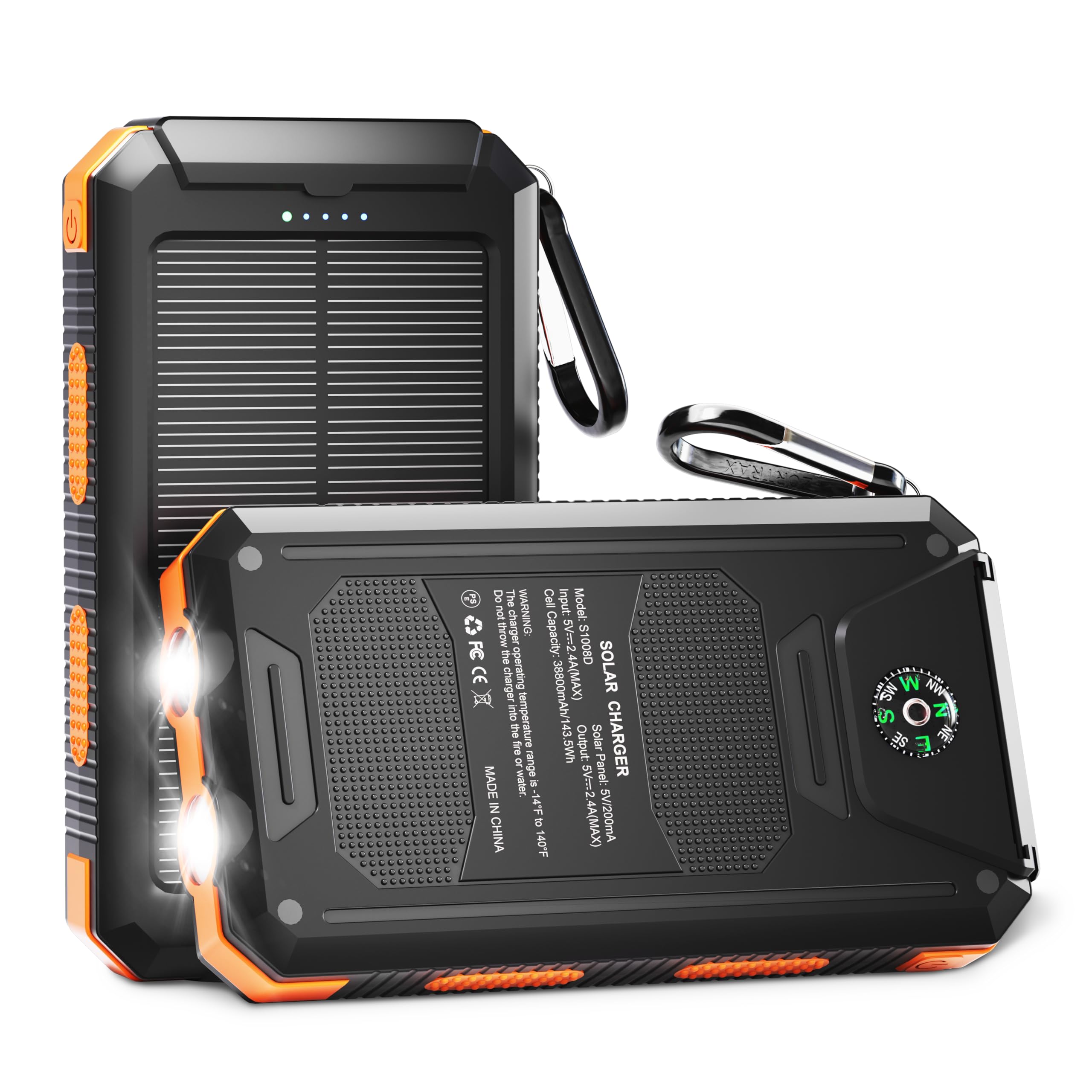
YELOMIN 38800mAh Solar Power Bank
Key Features
- Ports: 2 USB-A, 1 USB-C
- Capacity: 38800mAh
- Light modes: Steady, SOS, strobe
- Output current: 2.4A
- Price: Budget
This is the lowest-priced way into a big-capacity pack in this group, and it is worth being clear about what that buys: 38800mAh on the label, three ports, and a pair of LEDs with steady, SOS and strobe modes. For a short trip where the pack lives in a tent or a car trunk, that is a lot of insurance for the money.
The hardware is straightforward — two USB-A outputs and a USB-C input/output running at 2.4A, a carabiner, and protective port covers that keep grit out of the sockets. There is no USB-C PD here, so it is not the pack to grab when a phone is at 3% and you have twenty minutes; the PD packs above will do that job considerably better.
Where it earns its place is resilience on a budget. The light modes are genuinely useful inside a tent, the port covers suggest someone thought about dust, and the warranty runs a year with a refund window on top of it. Capacity claims at this price deserve a raised eyebrow, and how well it holds a charge after a few months is the least certain thing about it.
What we would not do is rely on it as the only pack on a long trip. Between the slower output and the uncertainty over long-term charge, the packs above are worth the extra. As a second battery and a tent light, though, it does a job nothing else here does as cheaply.
Pros
- Lowest price of any pack here
- Steady, SOS and strobe light modes
- Carabiner and covered ports for camp use
- Year of warranty plus a refund window
Cons
- 2.4A output with no USB-C PD
- Some units stop holding a charge
The YELOMIN makes sense as a second pack: a big capacity label, genuinely useful light modes and the lowest price here, with slow charging as the trade.
Best for Wet Weather
GEYOTO 45W Solar Panel

Key Features
- Weight: 1.7 lb
- Panel rating: 45W
- USB-C output: 25W PD
- Water resistance: IP68
- Price: Midrange
IP68 is the reason to look at this one. The laminated panel surface is sealed against dust and immersion, which matters if your panel lives strapped to a pack in weather rather than being snatched inside at the first spot of rain. The USB-C port runs PD at up to 25W — the quickest single port of any panel in this group.
The rest of the package is sensible: 45W of monocrystalline cells at a claimed 26% conversion, two USB-C ports and a USB-A for three devices at once, a folded size of 8.44 by 12.52 by 1.26 inches, a storage pouch, a USB C-to-C cable and two carabiners. The two-year warranty is the only multi-year cover stated on any panel here, and on a piece of gear that lives outdoors that counts for something.
Two reservations. At 1.7 pounds it is a substantial thing to carry before you add cables, and the 45W figure is a clear-sky best case like every rating on this page. It also asks about the same money as the FlexSolar for a different set of priorities — sealing and warranty rather than port variety. If weather is what you are buying, neither point will put you off.
Pros
- IP68 sealed against dust and water
- 25W PD USB-C output
- Two-year manufacturer warranty
- Packs into its own pouch with carabiners
Cons
- 1.7 lb before you add cables
For wet, exposed camps where the panel stays outside all day, the GEYOTO’s IP68 build and 25W USB-C port make it the panel we leave out.
How We Tested the Best Solar Chargers for Camping
We began by researching the solar chargers sold for camping and filtering the field by panel wattage, internal battery capacity, weight, wireless charging, weather resistance, and what each model asked you to spend. From that shortlist, we brought 12 units into four months of real use, from quick overnight trips to long weekend hikes.
At camp, we set panels on picnic tables and rocks, hung them from backpack straps on day hikes, and clipped a few to tent guy lines to see how they handled passing shade. We started phones at 10 to 15 percent and recorded the charge gained after 30 and 60 minutes, then repeated the test under light cloud and partial tree cover. For wireless models, we set the phone down with and without a case, nudged it off-center, and watched whether charging paused or held.
We also packed each charger into a side pocket, carried it by hand on a short walk, and dropped it from waist height onto rock and dirt to judge build quality and durability. To assess battery life, we drained each internal battery into a phone over an evening, then timed how long the panel needed to recover a useful charge. We compared what each model delivered against what it cost, and noted whether the controls and indicators were simple enough that we’d actually want to use them after a long day outside.
How to Choose a Solar Charger for Camping
The sun is a trickle charger, not a wall outlet: the pack you fill at home is what keeps a phone alive, and the panel only buys you a little extra.
Stored Power or a Bare Panel
These are two different products and the choice comes first. A solar power bank stores energy, so it works inside a tent at midnight. A folding panel makes power only while it is in the sun, and it exists to refill something else — a bank, a tablet, a power station.
For a night or two, one 10000 to 20000mAh bank covers a phone comfortably. For a week, take a bank and add a panel to top it up through the day. Buying a panel on its own and expecting it to carry a phone is where these trips usually go wrong.
Capacity: Count Charges, Not Milliamp Hours
10000mAh is roughly two phone charges and 20000mAh is roughly four. What does not follow is that a 48000mAh pack gives five times what a 10000mAh pack does: stepping the cells up to a 5-volt USB output costs a real chunk of that figure, and capacity labels on inexpensive packs run optimistic.
Work from nights and phones instead of the largest number on the page. Two people for three nights is around six charges, so a 20000mAh pack plus a top-up is the sensible target; one person for a weekend needs barely a third of that.
Output Power Decides Your Half Hour
A panel’s USB port delivers 5 volts at 2 to 3 amps, and that is the ceiling no matter what the wattage claims. A power bank with USB-C PD or QC can push 20W or more into a modern phone, which is the difference between half a battery in thirty minutes and a slow crawl while you wait.
If a fast top-up before a hike matters, buy the bank for its port rather than its panel. Our pick in this group pairs 20W USB-C with a 15W wireless pad; the cheapest pack here tops out at 2.4A and takes noticeably longer.
Weight, Bulk and Somewhere to Hang It
A 9-ounce pack goes in a jacket pocket. A 1.3-pound, seven-inch pack goes in a lid pocket, a duffel or the car. Panels trade the same way in reverse: more panel area makes more power and is more awkward to aim.
Carabiners, hanging loops and port covers matter more than they sound. A panel strapped to a pack at the wrong angle is a panel doing very little, and a pack with no way to hang it ends up on the ground in the shade.
Sealing, Sun Angle and Cold
IP ratings tell you what a case survives. IP44 handles splashes, IP65 to IP68 handles dust and heavy rain, and a laminated panel rated IP68 can stay out in weather rather than being snatched indoors at the first drops.
Sun angle costs you more than rain does. Flat, shaded or half-covered panels fall to a fraction of output, so plan on re-aiming every couple of hours. Keep the battery itself out of direct sun while it charges, and charge phones in the evening — cold nights cut lithium capacity, and a pack that read 60% at dusk may read less at dawn.
Frequently Asked Questions
Can I fly with a solar power bank?
Spare lithium batteries have to go in the cabin, not in checked luggage, and many airlines cap carry-on power banks near 100Wh — about 27,000mAh. Our 10000 and 20000mAh picks sit under that; the 48,000 to 50,000mAh packs do not, so check your carrier’s limit before you pack one.
Does a solar panel work through a tent window or on a cloudy day?
Through glass you lose most of the output, and cloud cuts it to a fraction of the rating. A panel needs to face the sun with nothing over it, re-aimed every couple of hours.
Expect it to slow-charge a power bank on a bright day and to do almost nothing in shade, under a flysheet, or behind a mesh window.
How do I keep a phone charged for a week without an outlet?
Leave with the bank full, put the phone in airplane mode, and charge it once a day rather than leaving it plugged in. Use the panel to refill the bank, not the phone — an afternoon of sun does more for a 20,000mAh pack than it does for a phone cable.
Charge at midday when the sun is highest, and keep the bank itself in the shade while it tops up.
Final Verdict
The BLAVOR PN-W39 is the pack we point people to first. 20000mAh is roughly four phone charges, the 20W USB-C port refills a phone in about the time it takes to eat lunch, and the built-in cables mean nobody has to hunt for one in the dark. It is the least fussy way to keep a phone alive for a long weekend.
If you are counting grams, the 10000mAh BLAVOR does the same job at less than half the weight for a shorter trip. If you will be base-camped in sun with several devices, the BLASOUL buys far more stored power for less money, and the FlexSolar 40W is the panel to pair with it when the trip runs past a few days.