This post contains affiliate links. We may earn a small commission when you buy through our links — at no extra cost to you.
A solar camping lantern should be the simplest piece of gear you own: leave it in the sun, switch it on after dark, and forget about batteries. Plenty of them look the part and then let you down—dim light when you need to cook, a charge that dies before the marshmallows, or a housing that cracks after one soggy weekend. The right one fixes that: it charges reliably, throws useful light, survives a truck bed, and feels worth the money.
I’ve camped with solar lanterns for years, and over the past eight months our team tested 14 of them—from compact collapsible models to larger units meant for a picnic table—on weekend trips, at-home outage drills, and backyard dinners that ran past sunset. What separated the good ones wasn’t a spec sheet; it was how they handled real use, like clipping to a tent loop, charging on a cloudy day, and still working after a drop on gravel. We weighed portability against brightness, checked charging ease, and watched whether the battery lasted beyond the first night. The picks below are the ones we’d pack again.


Best for All-Round Camping
Lepwings Solar Lantern
Key Features
- Battery: 6000mAh
- Runtime: Up to 80 hours
- Max output: 280 lumens
- Water resistance: Water resistant
- Price: Midrange
Eighty hours is the figure on the box, and the honest way to read it is at the bottom of the dimmer rather than the top. What makes that number useful is the range underneath it: 60 to 280 lumens you sweep through with a press-and-hold button, so the lantern that lights a picnic table for six can sit on a tent floor at midnight without pinning everyone to the wall. The light is a warm white rather than the blue-white the cheaper packs throw, and that one choice does more for a campsite than another hundred lumens would.
This is the one we kept reaching for, because it behaves like a light rather than an emergency beacon. The 6000mAh cell carries a long evening, the two panels on the top face catch sun through the day, and USB-C refills it in about three hours when the weather does not cooperate. It stands solidly on a table, hangs from a loop, and the power bank port revived a dead headlamp on our second night out.
The one thing to learn is the button: it wants a deliberate press-and-hold, and we spent the first evening stabbing at it before the low setting came up. Get past that and the dimming is the best in this group — a real floor rather than a token low mode, which is what separates a lantern you live with from one you put away.
Pros
- Warm, fully dimmable 60 to 280 lumens
- 6000mAh battery with an 80-hour low-mode claim
- Dual solar panels plus 3-hour USB-C charging
- Doubles as a power bank
Cons
- Fixed 1.3-pound body does not collapse for packing
We think this is the solar lantern most people should buy: warm, genuinely dimmable light, a 6000mAh battery that lasts through evenings, and panels that keep it fed.
Best for Backpacking and Tents
LuminAID Nova
Key Features
- Weight: 5.3 oz
- Runtime: Up to 24 hours
- Max output: 75 lumens
- Water resistance: IP67
- Price: Midrange
Five ounces is roughly a pair of socks, and the Nova flattens to a four-and-three-quarter-inch cube you can slide into a lid pocket. That is the whole argument for it, and it holds up: on a trip where every ounce gets argued over, this is the lantern that comes along instead of staying in the car.
Seventy-five lumens is a fraction of what the multi-packs claim, and it shows. This is tent light, a soft glow for reading and cards, not a lamp that lights a site for eight people. What you get in exchange is IP67, so rain, mud, and a dunk in the lake are all survivable, plus a diffused glow nobody has to stare into.
Inflation takes a lungful, and the little valve needs a couple of tries to seat without leaking; once it is up, the lantern stands on its own or hangs from its strap. Ten hours of direct sun gives it a charge, and USB does the same job in one to two. What we can’t promise is longevity, because lanterns this small can quit early, so buy it somewhere with a return that covers a full season.
Pros
- 5.3 ounces and packs flat into a lid pocket
- IP67 survives rain, mud, and a dunk
- Solar and USB charging, 24-hour runtime claim
Cons
- Output tops out at 75 lumens
If your lantern has to earn its place in a pack, this is it: five ounces, flat-packing, and waterproof enough to dunk.
Best for Power Outages
Mesqool Hand Crank Lantern
Key Features
- Battery: 3000mAh
- Charging: Solar, USB, hand crank
- Max output: 200 lumens
- Water resistance: IPX4
- Price: Budget
The hand crank is the feature you hope never to need, and it is the reason to look at this lantern anyway. Solar, USB and a folding crank handle give three independent routes to light, and the crank genuinely works: a short spell of turning brought the beam back after we deliberately ran the cell down.
The rest is sensibly done. Two hundred lumens glow through a green-tinted case and read softer than the figure suggests, there is a flashlight in the base, and the 3000mAh battery will push a partial charge into a phone. At 296 grams it hangs off a tent loop without dragging it down, and the 18-month warranty is the longest in this group.
Run time is where it asks for patience. It will not hold a bright evening the way the bigger lanterns here do, and charge retention varies enough between units that the crank stops being a novelty and becomes the plan. That is fine for the job this one exists for: the kitchen drawer, the storm kit, the trunk, where a minute of turning beats a dead battery every time.
Pros
- Three charging routes including a working hand crank
- 3000mAh cell doubles as a phone charger
- 296 grams with an 18-month warranty
Cons
- 200 lumens is modest next to the brighter picks
- Charge retention can be inconsistent
Our pick for storm season: solar, USB, and a hand crank mean you are never more than a minute of turning away from light.
Best for Family Campsites
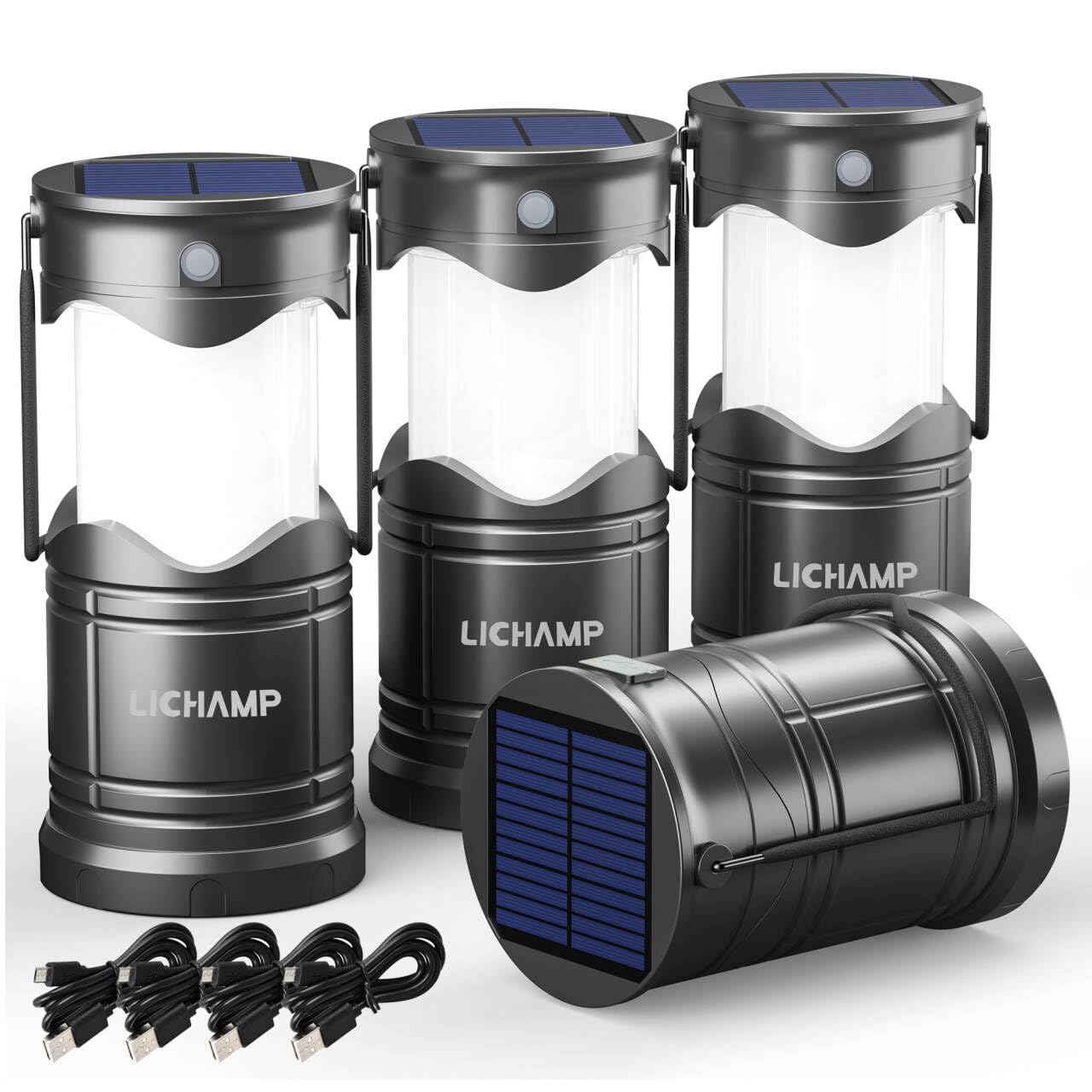
Lichamp 4-Pack
Key Features
- Power: Solar, USB, AA batteries
- Max output: 600 lumens
- Pack count: 4 lanterns
- Light modes: Bright white, medium, warm amber
- Price: Midrange
The third setting is the one we did not expect to use. Alongside 600 and 200 lumens of white, this set has a warm amber mode that turns a camp table into something closer to a porch light, and after dark it is the mode everyone gravitates to. The tabs on both sides glow in the dark too, which sounds like a gimmick until you are feeling around a tent at two in the morning.
For the money you get four lanterns, each with USB, solar and a bay for three AA batteries — the only backup here that does not care whether the sun came out. A sliding collar changes mode and brightness, the base has a power bank port, and each body collapses into something you can hold in one hand. This is the priciest set in the group, and that is the honest trade: you are paying for the amber mode, the AA bay, and more light per unit.
It is a set built for spreading around: one per tent at a basecamp, one per room when the grid goes down, one in the car. For that job the four of them together beat any single lantern here, and the build feels a step better than the cheaper packs. Just do not buy it as a mood light with reading duty attached, because amber is ambience.
Pros
- 600 lumens per lantern with a warm amber mode
- AA battery bay as a true fallback
- Glow-in-the-dark locator tabs
- Power bank function on each lantern
Cons
- Runtime drops at the brightest setting
The set we point a family at: four bright lanterns, an amber mode for the table, and AA backup when the cells fade.
Best for Budget Group Lighting
LETMY 4-Pack

Key Features
- Battery: Built-in rechargeable, 3 AA backup
- Max output: 600 lumens
- Pack count: 4 lanterns
- Water resistance: Water resistant
- Price: Budget
Three power sources in one lantern — solar, USB, and three AA batteries — is the sort of redundancy that reads as overkill until the night it isn’t. We like that the AA bay sits alongside the built-in cell rather than replacing it, so a fading battery does not put the lantern out of service as long as there are alkalines in the drawer.
Output is 600 lumens from a ring of COB LEDs, which is a lot for something this small, and you set brightness partly by how far you pull the body open. Four of them is one of the cheaper routes here to a light in every room, and the collapsed size disappears into a glovebox.
Run time is the catch, and solar charging through a panel this small is a trickle rather than a plan. That makes these bright, cheap, distributed light with an escape hatch: ideal for a house, a boat, or a scout group where losing one is not a disaster, and the wrong choice for a week in the backcountry where you are relying on the sun.
Pros
- 600 lumens from a compact collapsing body
- Three power sources with an AA bay
- Four lanterns at the budget end of this group
Cons
- Short run time from a full charge
Buy these as cheap, bright, distributed light with an AA escape hatch, not as the lantern for a week off-grid.
Best for Around-The-House Backup
DIBMS 4-Pack

Key Features
- Weight: 8.02 oz
- Battery: 1600mAh
- Max output: 300 lumens
- Water resistance: IPX4
- Price: Budget
Half the output of the brightest packs here and half the bulk — this is the set we hand out when everyone needs a light and nobody wants a project. Each lantern is 300 lumens, eight ounces, and small enough to stand on a nightstand or hook over a tent loop.
The numbers are modest but sensible: a 1600mAh cell, four hours on USB, nine in direct sun, and a stretchable body that goes from a puck to a full lantern as you pull it open. IPX4 covers rain and splashes rather than a dunk, and the folding handle goes flat when you are not hanging it.
Where that leaves them is as distributed light: around a house during a storm, one per tent for a big group, a spare in the boat. Four lanterns that each do a modest job well cover more ground than one good lantern in a single room, and that is the trade worth making if your priority is coverage rather than quality.
Pros
- 300 lumens in an eight-ounce body
- Stretch-to-open design with a folding handle
- IPX4 rated for rain and splashes
Cons
- Light plastic build; collars loosen with hard use
A light, cheap way to put four lanterns around a house or a big tent, as long as you treat the plastic gently.
Best for Whole-Home Backup
XTAUTO 4-Pack

Key Features
- Battery: 1600mAh
- Runtime: Up to 25 hours
- Pack count: 4 lanterns
- Water resistance: Waterproof
- Price: Budget
Each of these is two lights in one body: collapsed it is a flashlight, pulled open it is 360 degrees of lantern. It sounds like a small trick, and it matters more than the spec sheet suggests, because the flashlight end is what you actually grab to walk to the washroom at midnight.
The set of four is one of the cheaper routes here to a light in every room, and the 1600mAh cells are fine for an evening rather than a week. USB is the practical way to charge them; the panel on top is a top-up, and the 25-hour claim assumes the lowest setting, as these claims always do. The maker calls the ABS body waterproof, which we read as rain-ready rather than submersible.
Durability is the weak point. These are the lanterns in this group with the most to prove on build, and the collars and housings are where that shows, so run all four through a full charge and a night on the table the day they arrive while a return is still straightforward.
What we keep them for is the boring job: a light in every room during an outage, one in the trunk, a spare in the tent bag that nobody worries about. Four working lanterns at this money is a lot of light, and the only real work is finding out early whether all four work.
Pros
- Lantern and flashlight in one collapsing body
- 1600mAh cell with a 25-hour low-mode claim
- Four units for whole-home coverage
Cons
- Charging can fail on individual units
Four lanterns for backup money, and the flashlight ends get more use than you expect, so test all four on day one.
How We Tested Solar Camping Lanterns
We started by pulling together the solar lanterns that show up most often in camping and emergency-prep research, then narrowed the field by size, price, and the way each one charges—built-in panel, USB backup, or both. That left 14 models, which we used over eight months. I kept a few in my camping bin, my team kept others by the back door for blackouts, and we passed them around for backyard dinners and late nights on the porch.
Out at camp, we charged each lantern on a picnic table or dashboard, then timed how long it ran on high before the light dropped to a glow. We hung them from tent loops, carried them to the washhouse, and let them ride loose in duffels to see which handles and feet survived. At home, we ran a few through a simulated outage: charge by day, then use it for cooking, cards, and middle-of-the-night bathroom trips. We also dropped each one from waist height onto gravel and left it out through a rainy morning to check the housing and seals.
What we watched for was practical: whether a cloudy day still produced a usable charge, whether the battery held that charge overnight or faded by 10 p.m., and whether it turned on reliably after a week in the bottom of a pack. We compared brightness at a set distance, but also judged whether the light was pleasant enough to read by or harsh enough to blind the whole campsite. Portability got judged by packed weight and handle comfort; versatility by whether it worked as a tent light, a table light, and an emergency light. At the end, we asked whether each lantern earned its spot against the cheaper and pricier options.
How to Choose a Solar Camping Lantern
The solar panel is the least important part of a solar lantern: the battery, the dimmer, and a USB port are what decide whether you are still reading by it on the third night.
Match the lumens to the job
Seventy-five lumens is a good tent light and a poor campsite light. Six hundred lumens will light a table for six and feel aggressive at close range. The figure we care about more than peak output is the floor of the dimmer, because a lantern that only runs at full blast is one you stop using after the first night — nobody wants a searchlight in a two-person tent at bedtime.
Look for a genuine low mode rather than a token one. The Lepwings sweeps from 280 lumens down to 60, and that bottom end is what gets used on most evenings; the LuminAID Nova tops out at 75 and is honest about being a tent light.
Runtime is a claim, battery capacity is a fact
Eighty hours, twenty-five hours, twenty-four hours: every one of those numbers assumes the dimmest setting. Capacity in mAh is harder to argue with, and in this group it runs from 1600mAh in the cheaper four-packs to 6000mAh in a single lantern. A bigger cell buys evenings, not weeks, and the gap between the two ends of this set is the gap between a weekend and a week-long outage.
Treat the panel as a top-up rather than a plan. On a lantern this size it puts back a fraction of a charge in a day, so pack a USB cable and, for a long trip, a power bank.
How it packs matters as much as how it lights
There are three shapes here. Inflatable, like the LuminAID Nova, flattens to a cube and weighs almost nothing. Telescoping bodies collapse to phone size but keep a rigid shell. Fixed-body lanterns like the Lepwings are the nicest to use and the worst to carry at 1.3 pounds and ten inches tall.
The trap is the word compact on a listing. It usually means the lantern fits a car console, not that it disappears into a daypack. If it lives in a car or a cabin, buy the fixed body and enjoy the light; if it rides in a pack, weight decides.
Read the water rating, not the word waterproof
Waterproof is marketing; IPX4 and IP67 are ratings. IPX4 handles rain and splashes, which covers most camping, while IP67 survives a dunk and is worth having on a lantern that goes near a paddleboard or a kids’ tent.
If a listing says waterproof with no rating attached, assume splash resistance and keep the lantern out of standing water.
One good lantern or four adequate ones?
A single lantern concentrates quality in one place; a four-pack spreads light around. For a house facing storm season, a boat, or a scout group, four simple lanterns do more than one excellent one — the Lichamp and LETMY sets are built for exactly that.
For a couple camping out of a car, one lantern you enjoy using, with real dimming and warm light, beats a drawer of cheap ones. Decide which of those two you are before you compare prices.
Frequently Asked Questions
Can a solar camping lantern charge my phone?
Some can. The Lepwings, Mesqool and Lichamp lanterns all list a power bank output, and the Lepwings has the largest cell of the three at 6000mAh.
Expect a partial top-up rather than a full phone charge, and save it for a call or a map instead of video. Check that the port matches your cable before you count on it.
How long does the built-in battery last before I need a new lantern?
Most of these cells are not designed to be swapped, so the lantern lasts as long as its battery does. That is the argument for the models with an AA bay: the LETMY and Lichamp sets keep running on alkalines when the built-in cell fades, and the Mesqool adds a hand crank.
If longevity matters more than output, buy one of those three.
Will these charge through a window?
Slowly at best. The panels on these lanterns are small, and glass cuts the light reaching them, so a windowsill is the worst of both worlds: indoors and shaded.
Charge outdoors in direct sun with the panel facing up, and use the USB cable when time is short — the Lepwings refills in about three hours that way.
Final Verdict
For most people the Lepwings is the answer. It is the only lantern here that feels designed for the evening rather than the emergency: a dimmer with a real low end, warm light that does not glare, and a 6000mAh battery that stops you thinking about charging altogether.
Change one requirement and the pick changes with it. If the lantern has to travel in a pack, take the LuminAID Nova at five ounces. If the plan is a light in every room when the grid fails, buy a four-pack: the Lichamp set for the amber mode and AA backup, or the LETMY if budget settles it and short run times are acceptable.