This post contains affiliate links. We may earn a small commission when you buy through our links — at no extra cost to you.
Camping lanterns have one job, and it gets harder the better they do it: light up a tent, a picnic table, or a whole site without eating through batteries by midnight. Push the brightness up and the runtime drops; shrink the lantern so it disappears into a pack and the light turns thin and harsh. That trade-off is the whole game, and it’s why two lanterns that look identical on the shelf can feel completely different at 10 p.m. in the woods.
I’ve been the person squinting at a dead lantern with a phone flashlight in my teeth, so I care about more than raw lumens — how the light spreads across a card game, whether the thing survives a tumble off a picnic table, how easy it is to dim one-handed. My team and I have spent the past six months living with 14 of them on camping weekends, in the backyard, and through a two-day power outage. The ones worth carrying all make the same few smart decisions about light and battery.



Best for All-Round Camping
EZORKAS 2-Pack Lantern
Key Features
- Power: USB rechargeable, built-in battery
- Backup: 3 AA batteries
- Mounting: Magnetic base and hook
- In the box: 2 lanterns
- Price: Budget
Two ways to power a lantern is the reason this one leads the list: a built-in battery you top up over USB, and a compartment that takes AA cells when the battery is flat and there is no outlet for a mile. That backup is what separates a rechargeable lantern you can rely on from one that becomes dead weight on day three. The rest of the package is unusually well sorted — a magnetic base, a hanging hook, four lighting modes, and a red strobe for emergencies.
The light comes from COB bulbs spread around the body rather than focused into a beam, so it fills a tent or a picnic table instead of punching one bright hole in the dark. Push the handle down and it becomes a flashlight for the walk to the washroom, which is the mode that got the most use after dark on our trips. The pair divides naturally between tent and table, and at 1.5 pounds for both they vanish into a duffel. Three magnets sit in each base — the detail that surprised us most. One lantern rides on a truck hood while dinner gets made; the other sticks to a steel cooler.
If your campsite is a big open field and you want the whole thing lit, this is not the lantern for that; the AYL and the Lepro put out several times the light. For the tent, the table, the tailgate and the fuse box, this is the shape of lantern we want in the bag.
Pros
- Charges by USB and takes AA backup
- Magnets, hook, and flashlight mode
- Red strobe and SOS for emergencies
Cons
- No published lumen rating to compare
The one we recommend first: it charges over USB, falls back on AA cells when the battery dies, and hangs or sticks wherever you need it.
Best for Family Camps
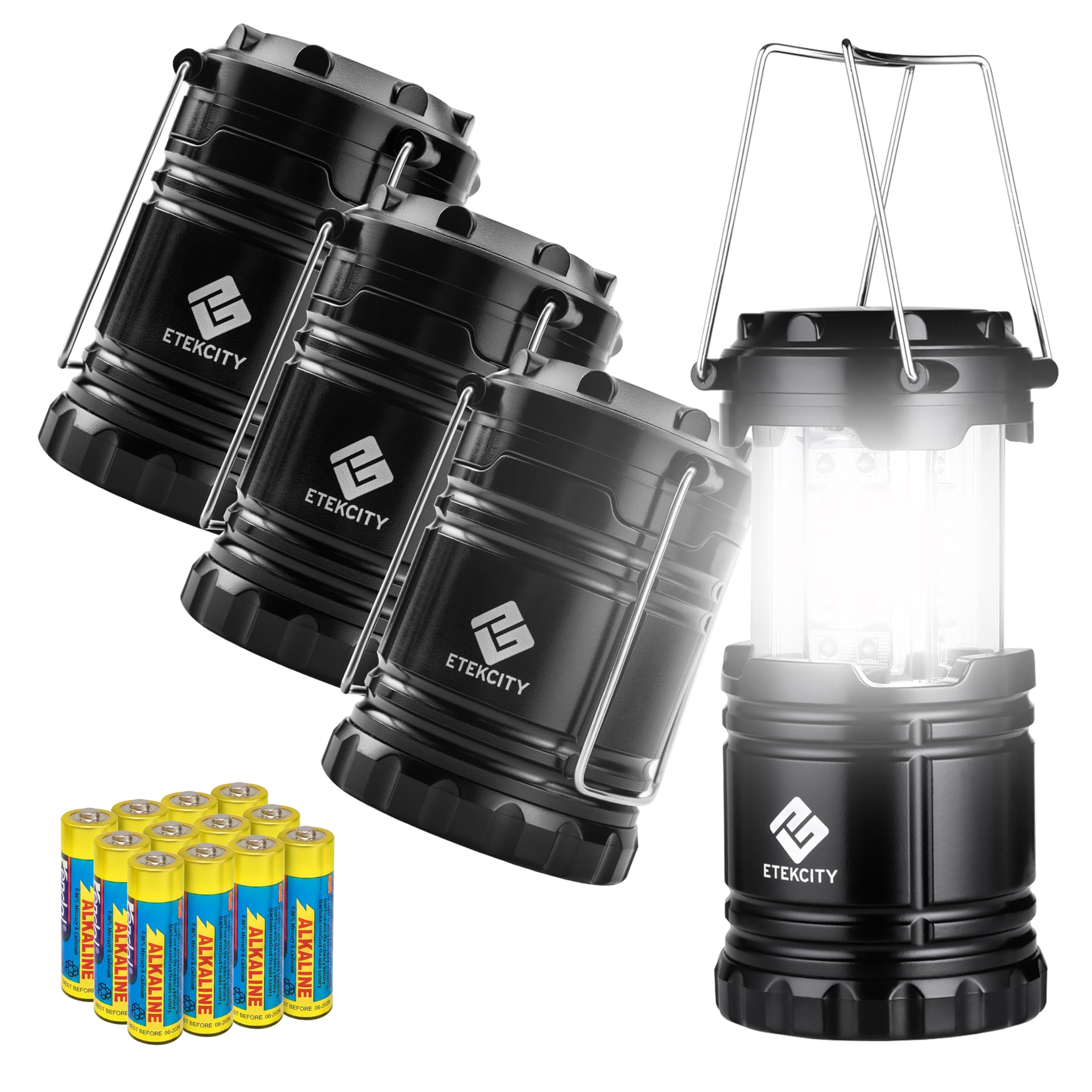
Etekcity 4-Pack Lanterns
Key Features
- Runtime: Up to 50 hours
- Batteries: 3 AA per lantern, 12 included
- Pack size: 4 lanterns
- Light output: 154 lumens
- Price: Midrange
Fifty hours is the number that makes this four-pack make sense: three AA cells per lantern, batteries in the box, and enough runtime that a long weekend barely dents a set. Each lantern puts out 154 lumens through 30 LEDs in a 360-degree spread, and the whole thing collapses to 4.86 inches tall and 3.46 inches across — about the size of a chunky phone. If you want more punch from AA cells, the Lichamp pack is the one to look at.
What we appreciate most is that there is no switch to hunt for. Pull the lantern open and it lights; push it down and it goes out. That sounds trivial until you are zipping into a tent at two in the morning with one hand full, and it is the reason this is the pack we hand to families: four lanterns mean one per tent, one for the table, and one to lose in the car.
Storage is the other thing this pack gets right. The batteries ship in the box but outside the lanterns, so nothing corrodes while the set waits a year in a closet, and you load the cells when you actually need them. The collapsed body shields the LEDs too, which matters in a duffel full of tent poles.
Pros
- Up to 50 hours on three AA cells
- Opens and closes to switch, no button
- Batteries included but stored outside
Cons
- 154 lumens is tent light, not site light
- AA cells are a recurring cost
Four lanterns, batteries in the box, and 50 hours a set: the simplest way to light a family camp, as long as you do not need floodlight brightness.
Best for Group Campsites
Lichamp 4-Pack Lantern
Key Features
- Runtime: 30 hours
- Batteries: 3 AA per lantern, not included
- Pack size: 4 lanterns
- Light output: 350 lumens
- Price: Midrange
Of the AA-powered four-packs here, this is the bright one: 350 lumens against the Etekcity’s 154, spread through 360 degrees, with a 30-hour rating on three AA cells. On a group site where you want the table, the stove and the walk to the tent lit at once, that extra output is the difference between a glow and actual light.
The mechanism is the familiar pull-up design — lift the handles to switch it on, adjust the height to dial the brightness — and the light is a cool white rather than a warm glow. Good for cooking, reading and finding the matches; less cozy at the end of the evening. Battery changes need a moment of patience, since the base cap has to line up exactly before it screws back on.
The 30-hour figure comes with the usual asterisk: that is not full brightness for 30 hours. Run these flat out and the cells go quickly, so we plan on a set per lantern per long weekend and treat anything beyond that as a bonus. Fiddly cap aside, this is the brightest AA lantern here, and the one to take when the campsite, not the tent, is what needs illuminating.
Pros
- 350 lumens from an AA lantern
- 30-hour rating on three AA cells
- Four lanterns cover a whole site
Cons
- Full brightness drains cells quickly
- Cool white light only, no warm mode
The brightest of the AA four-packs: 350 lumens and a 30-hour rating, with a fiddly battery cap and a real appetite for cells at full power.
Best for Lit Camp Kitchen
Lepro 1000LM Rechargeable
Key Features
- Battery: 4400mAh with power bank
- Runtime: Up to 12 hours at 300 lumens warm white
- Light output: 1000 lumens
- Water resistance: IPX4
- Price: Midrange
A thousand lumens is the number on the box, and there is enough of it to light a camp kitchen — but the reason this lantern stays in our kit is the 4,400mAh battery inside, which doubles as a power bank. On a trip where the phone is also the map, the camera and the only way to call home, that is worth more than another few hundred lumens.
Two hooks, one on top and one on the base, let it hang upside down from a tent loop so the light bounces off the ceiling instead of shining in your eyes. It is a small design choice that makes a small tent much more livable. There are four modes — cool white around 6000K, warm white around 3100K, both combined, and a flash setting — and a long press dims whichever one you are in. IPX4 covers rain, not a dunking.
Runtime is the part that needs planning. The 12-hour figure belongs to a 300-lumen warm-white setting; at full output you get a fraction of that, and filling the battery again takes a few hours off a USB adapter. The shell is light plastic rather than armor, so give it a hook rather than a rock.
We still recommend it, for a specific job: a rechargeable area light with a power bank inside is exactly what you want hanging in a tent or a cabin, and the warm mode means you are not reading under a headlamp. If you need guaranteed all-night light, carry a lantern you can feed fresh cells — that is the trade.
Pros
- 1,000 lumens with warm and cool modes
- 4,400mAh battery doubles as a power bank
- Hangs upside down from a base hook
Cons
- Sealed battery can stop taking a charge
A bright rechargeable that doubles as a power bank, with two hooks and warm or cool light — just plan a top-up before a long night.
Best for Big Sites
AYL 1800LM 2-Pack
Key Features
- Battery: 4400mAh with power bank
- Pack size: 2 lanterns
- Light output: 1800 lumens
- Water resistance: IP44
- Price: Premium
Eighteen hundred lumens is the highest output here by a wide margin, and it changes what the lantern is for. This is not a light you set on a picnic table at eye level — it is the one you hang high over a group site, or stand in the middle of a room when the power is out and you want to stop tripping over furniture.
The body is a 5.25-inch metal cube at about 2.5 pounds, with 46 LEDs behind the lens, a slip-proof handle and rubber feet that keep it from sliding off a tailgate. Two in the pack means one for the site and one for the house.
We rate it for that job and not for every job. At about 2.5 pounds it is a basecamp and blackout lantern, not something you carry up a hill, and its brightness is wasted in a small tent where a 190-lumen lantern does the job more comfortably. But hung over a group site or stood in a dark living room, 1,800 dimmable lumens with warm, cool and combined modes is genuinely reassuring, and the power bank is a bonus rather than the point.
Pros
- 1,800 lumens, the highest output here
- Power bank for phones and small devices
- Rubber feet and slip-proof handle
Cons
- Battery can stop accepting a charge
Eighteen hundred lumens for a big site or a blackout, in a metal body that is happy on a table and too heavy to carry far.
Best for Power Outages
Eveready 360 PRO 3-Pack
Key Features
- Runtime: 16 hours
- Batteries: 3 AA per lantern, included
- Area output: 350 lumens
- Flashlight mode: 60 lumens, 100m beam
- Price: Midrange
Red flashing and SOS modes are why this one earns a place. Three lanterns, each with a 350-lumen area mode, a 60-lumen directional beam rated to 100 meters, and the red signals you hope never to use. It is the pack that lives in the hall closet and the trunk, not just the camping bin.
The hardware suits that role. Magnets in the base hold it on a fridge or a tailgate, a hook underneath lets it hang, and the handles pull up to switch it on — the same collapse-to-light logic as the Etekcity, with more modes and roughly double the area output. Three lanterns also mean you can leave one at home, one in the car and one at the cabin.
We keep coming back to this as the emergency pick, and the reasons are unglamorous: it is affordable enough to buy three, the magnets mean it stays where you put it, and the red modes cover the one situation where plain light is not enough. One thing to sort out before the storm is water — the product page cannot agree with itself, with the title claiming IPX4 and the spec table saying not water resistant, so treat these as dry-weather and indoor lanterns.
Pros
- Red flashing and SOS emergency modes
- Magnets, hook, and hanging handles
- Batteries included across three lanterns
Cons
- Nine AA cells across the pack
Buy the three-pack for outages and car kits: red SOS modes, magnets, and enough area light to run a room, with batteries included.
Best for Spare Tent Lights
Lepro Collapsible 2-Pack

Key Features
- Runtime: Up to 14 hours
- Batteries: 3 AA per lantern, not included
- Light output: 190 lumens
- Water resistance: IPX4
- Price: Budget
Two 190-lumen lanterns that fold down to phone size, at the bottom of this group’s price range. No charging port, no power bank, no red strobe — just three AA cells per lantern, a pull-up switch and 360 degrees of light rated for 14 hours. That is the whole pitch, and for a lot of trips it is enough.
What we like is how little they ask of you: no charging schedule, no mode to cycle through, no instructions to lose. Pull it open and it is on. The IPX4 body handles rain, and 190 lumens is right for a small tent or a vestibule, which is exactly where a 1,000-lumen lantern starts to feel aggressive. The catch is cells — six AA across the pair and none in the box, so buy a pack before you leave and keep a spare set with the lanterns.
Pros
- Folds to phone size for packing
- 190 lumens for up to 14 hours
- IPX4 body for light rain
Cons
- Battery-only, with no recharge option
The cheapest light here: two collapsible 190-lumen lanterns that ask for AA cells and nothing else.
Best for Trunk and Toolbox
GearLight Magnetic 2-Pack

Key Features
- Mounting: Magnetic base and hook
- Batteries: 3 AA per lantern, included
- Pack size: 2 lanterns
- Light output: 600 lumens
- Price: Midrange
Magnets are the whole idea here. Three of them sit in the base, enough to hold a lantern on a truck hood, a fridge door or the side of a tool cabinet while you work with both hands. It is a work light that happens to camp, rather than the other way around.
Six hundred lumens from a body 5.25 inches tall is a lot of light in a small package, and each lantern runs on three AA cells that come in the box. A hook on the base lets it hang, and the folding handle gives you something to carry it by.
The number that gives us pause is the battery figure: two hours, per the spec table. That is far shorter than anything else here, and it turns the GearLight into a task light — a burst of light while you change a tire or find the shutoff valve — rather than something you leave burning through an evening.
So we rate it as the toolbox lantern, not the tent lantern. For a whole night around a campsite, one of the AA four-packs or a rechargeable serves you better; for the trunk, the shed and the fuse box, strong magnets and included cells are worth more than runtime, and this pair delivers both.
Pros
- Three magnets in the base
- 600 lumens with batteries included
- Hangs from a hook on the base
Cons
- Two-hour listed battery life
A magnetic work light that camps: 600 lumens, batteries in the box, and a listed two-hour runtime to plan around.
How We Tested Camping Lanterns
We started by combing spec sheets and owner reviews for roughly 60 lanterns, then narrowed to 14 that covered the real spread: palm-sized USB-rechargeable pucks, collapsible models, battery-powered classics, and a couple of bigger two-panel lights. We ruled out anything with a sealed battery you can’t replace and anything that needed an app to switch on.
Every lantern came camping with us at least twice over six months — car camping weekends, a wet three-day trip, and one memorable blackout at home. In camp we hung each one from a tent loop, set it on a picnic table for dinner, and read by it after the fire died. Sitting three feet away, we watched how the light fell across a card game: some threw a hard hot spot that left half the table in shadow, others were even and warm enough to actually eat by.
Battery life got timed, not estimated. We ran each lantern on high until output visibly dropped, then repeated on low, and noted whether it could run while charging — the difference between a dead light and a dim one at 2 a.m. For compact size and ease of use, every lantern went into the same 40-liter pack beside a sleeping bag and stove, and we logged which ones vanished into a side pocket. Then we handed them to people who’d never touched them, including a seven-year-old, and watched whether they could find the button in the dark and dim it without landing on strobe.
Durability meant drops off a picnic table onto gravel, a night in the rain, and a week bouncing in a truck bed, plus a check on latches and lens seals afterward. A couple developed rattles; one stopped latching. The picks below are the ones that came back working.
How to Choose a Camping Lantern
The lantern decision comes down to two questions — where the light has to go, and how you will refill it — and almost everything else follows from those.
Rechargeable, disposable, or both
The rechargeable-versus-batteries argument is really about day three of a trip. A USB lantern is cheaper to run and never sends you hunting for cells at a gas station, but it needs an outlet, a power bank, or a car charger, and a sealed battery that fails ends the lantern. An AA lantern costs more over a season, but it takes a refill from any shop and keeps working when the grid does not. We prefer a hybrid where you can get one, because a built-in battery with an AA compartment survives both a forgotten charger and a week-long outage.
Watch for solar as a headline feature: a small panel on a lantern is a trickle, and three grey days will leave you flat. Treat solar as a backup to USB charging, not a replacement for it.
How much light, and where it lands
Lumens measure output, not usefulness. Around 150 is plenty for a two-person tent, and the same lantern on a picnic table at a group site will feel dim beside a 350-lumen pack. Past 500 lumens you are lighting an area rather than a space, and the lantern becomes something to hang high instead of setting down beside you.
The trap is buying output and ending up with a bare emitter at eye level — a 1,000-lumen lantern on a camp table is genuinely unpleasant to sit next to. Hang it, dim it, or bounce it off the ceiling. Also check the spread: a 360-degree body fills a tent, while a directional beam is for walking to the washroom, not for eating dinner.
Runtime is a number with a mode attached
Every runtime claim belongs to a mode. Fifty hours on three AA cells is a dim setting; run the same lantern at full brightness and the figure falls hard. Read the claim against the brightness you would actually use at dinner and again at two in the morning, then plan for the worst of the two.
Our rule is one spare set of cells per lantern for a weekend, or a charged power bank for a rechargeable. Big D cells buy longer runtime but cost more per set and add weight, which is a fair trade only for a lantern that lives on a table and never goes in a pack.
Hanging, mounting, and weather
Where a lantern ends up matters as much as what it emits. A top hook lets it hang from a tent loop; a second hook on the base lets it hang upside down and bounce light off the ceiling, which is the most comfortable way to light a tent. Magnets are the underrated one — a few strong ones turn a lantern into a hands-free work light on a truck hood or a fuse box.
On weather: IPX4 means splashes, not immersion. A lantern rated that way is fine in rain and wrong in a puddle, and it should be dried before it goes back in the crate. If you are carrying rather than driving, weight settles everything — a pound in a daypack feels like three by the second evening.
Frequently Asked Questions
Do camping lanterns come with batteries?
Some do and some do not, and the box is the only reliable answer. Among these, the Etekcity pack ships with 12 AA cells, the GearLight and Eveready lanterns include theirs, and the Lepro collapsible pair ships empty. Rechargeable models have a built-in battery but often take AA cells as a backup.
Before a trip, open the box, check, and pack one spare set per lantern. It is a five-minute job that decides whether the first night works.
Can I use a camping lantern indoors during a power outage?
Yes. LED lanterns are safe indoors and give off no fumes, which makes them the right choice for a blackout. Keep the brightest ones low and bounce the light off the ceiling rather than pointing it at the wall you are trying to read against — 150 to 350 lumens is enough for a room once your eyes adjust.
The rule that matters: never bring a propane, white-gas, or kerosene lantern inside, no matter how cold or dark it gets.
How do I stop a lantern switching on inside my pack?
Collapsible lanterns switch on when the handle is pulled up, and a strap or a stuff sack will happily do that for you. Take the cells out for travel, or reverse one cell so the contact is broken, and carry the batteries in a small bag.
Push-button rechargeables are less prone to it, but check that the button is not pressed against a hard object like a stove or a water bottle.
Will a rechargeable lantern hold its charge between trips?
Not indefinitely. Lithium packs lose charge while they sit, and a lantern that was full in June may be flat in October. Top it up the night before you leave and again every few months in storage, and keep a USB cable in the car so a top-up is possible on the road.
If a built-in pack stops accepting a charge altogether, the lantern is finished — there is no cell to swap, which is the argument for keeping one AA lantern as a backup.
Final Verdict
Buy the EZORKAS two-pack if you want one answer. It charges over USB, falls back on AA cells, and its magnets and hooks let it work on a table, in a tent, or under a hood — the only lantern here that covers all three without a compromise.
Choose the Etekcity four-pack instead if you want to hand out a lantern to everyone and stop thinking about charging, and go to the AYL when the site rather than the tent is what needs lighting.