This post contains affiliate links. We may earn a small commission when you buy through our links — at no extra cost to you.
The last time my power went out, I ate dinner with a phone flashlight clamped between my teeth. A camping lantern is the fix for exactly that: light that stands on its own, hangs from a tent loop, or grabs onto something metal while you dig through a drawer. The trouble is that the number printed on the box tells you almost nothing — a lantern advertised at 1,000 lumens can fade to a dim blue puddle long before morning, and the battery claims are usually measured on the lowest setting nobody actually uses.
After a few years of car camping and blackout nights, I’ve learned that the lanterns worth owning are rarely the brightest ones. My team and I gathered 14 lanterns and lived with them for four months — backyard dinners, a couple of camping trips, and two deliberately unplugged evenings at home — and the ones I kept reaching for were the ones that were easy to grab off a shelf, easy to hang or stick to a car hood, and honest about how long they’d run. The picks below are sorted on exactly that.


Best for Rugged Camping
Streamlight Siege 44931
Key Features
- Power: 3 D alkaline
- Runtime: 295 hours on low
- Max output: 540 lumens
- Water resistance: IPX7, floats
Weather is what this lantern is built for. The Siege is sealed to IPX7, floats, and takes a knock without feeling precious, which matters more on a wet camping trip than another hundred lumens. At 540 lumens it lights a tent or picnic table evenly, and the 360-degree globe keeps the light from punching one bright hole in the dark.
The hanging hardware is better than most: a D-ring on top and another on the bottom let it sit upright or hang inverted, and the removable globe widens the spread when you need more area light. The red mode and SOS are the sort of thing you hope stays unused, but they belong on a lantern that lives in an emergency kit.
Power comes from three D cells, and the low mode runs for up to 295 hours. That is the number that makes it a serious outage light rather than a weekend toy. It is also a lantern you pack deliberately, not one that disappears into a pocket.
Pros
- Sealed IPX7 body that floats
- 540 lumens with 360-degree light
- 295-hour low runtime
- Red and SOS emergency modes
Cons
- Not rechargeable; needs three D cells
Our default for wet-weather camping and outages: a sealed, floating, 540-lumen lantern whose 295-hour low mode makes it the dependable one in this set.
Best for Rechargeable Tent Light
EZORKAS 2-Pack Lantern
Key Features
- Power: Rechargeable; 3 AA backup
- Mounting: Magnetic base
- Pack size: 2 lanterns
- Light modes: 4 modes incl. SOS
- Price: Budget
Two lanterns in one box is the practical pitch, but the better reason to pick this pair is the power setup: a built-in rechargeable battery with a three-AA backup slot. That combination is rare enough to matter when a USB cable goes missing and the weather has other plans.
We found the light easy to live with in a tent. The push-pull handle turns it on and off, the four modes cover bright white and a red warning, and the magnetic base sticks to a steel table or the inside of a car. It is a tent, table, or stairwell light rather than a whole-campsite floodlight.
We kept one in the car and one in the tent bag, which is the point of a two-pack. The AA backup means a dead internal battery does not end the trip, and the handle gives you a hook for hanging. For a rechargeable pair at the affordable end of this group, those are the right priorities.
Pros
- Rechargeable with AA battery backup
- Two lanterns in one pack
- Magnetic base and hanging handle
- Four modes including red warning
Cons
- Magnets grip only steel surfaces
- Water-resistant rather than dunk-proof
A rechargeable two-pack with an AA fallback, magnetic base, and red warning mode; an easy pick for family tents and car kits.
Best for Bright Battery Light
Lepro 1000LM Lantern
Key Features
- Power: 3 D alkaline (not included)
- Runtime: 12 hours at max
- Max output: 1000 lumens
- Water resistance: IPX4
- Price: Midrange
A thousand lumens is the reason to look at this Lepro. We pointed it at a picnic table after dusk and got a clean, wide pool of light rather than a hotspot, and the dimming control lets you pull it back for a tent or a book. It is the brightest lantern here that runs on ordinary disposable batteries.
The four modes are more useful than the count suggests: daylight white for cooking and sorting gear, warm white for a less clinical tent glow, both together for maximum output, and a flash mode for emergencies. A long press dims smoothly, and the metal handle and bottom hook give you two ways to hang it.
Power comes from three D cells, and the runtime is rated at twelve hours even at full output. That is generous for a light this bright, and it means you can leave the charger at home. The lantern is a base-camp tool rather than a pocket light.
Pros
- 1000 lumens from D cells
- Warm, cool, combined, and flash modes
- Dimmable with a long press
- 12 hours at full output
Cons
- Three D cells not included
- Battery cover is fiddly to refit
The brightest battery-powered lantern here: 1000 lumens, warm and cool modes, and a 12-hour full-output rating for base camp.
Best for Maximum Campsite Brightness
AYL 1800LM 2-Pack
Key Features
- Battery: 4400 mAh rechargeable
- Runtime: Up to 12 hours
- Max output: 1800 lumens
- Water resistance: IP44
- Price: Premium
At 1800 lumens, the AYL is playing a different game from the collapsible pocket lanterns. The 46 LEDs throw a wide, powerful light that will illuminate a campsite or a room during an outage, and the two-pack means you can keep one at home and one in the camping box.
We found the four modes and dimming genuinely useful: daylight for tasks, warm light for a tent, both together for maximum output, and a flash setting for emergencies. The built-in 4400mAh battery also charges a phone, which is the kind of backup that earns its space on a stormy weekend.
This is a car-camping and power-outage light rather than a backpacking item. The output and phone charging are worth the bulk, and the slip-proof handle makes it easy to carry between the tent and the car.
Pros
- 1800-lumen maximum output
- Two lanterns per pack
- 4400mAh battery doubles as power bank
- Four dimmable modes
Cons
- Charging can become inconsistent after storage
Maximum output in this set, with a 4400mAh power bank and a two-pack, for car campers who want a lot of light.
Best for Family Camping
Lichamp 4-Pack Lanterns
Key Features
- Power: 3 AA per lantern
- Runtime: 30 hours
- Pack size: 4 lanterns
- Max output: 350 lumens
- Price: Midrange
A four-pack changes the way you use a lantern. Instead of shepherding one light from tent to table to washbag, you put one in each place and stop thinking about it. The Lichamp set is built for that kind of family camping: 350 lumens per lantern, a 360-degree globe, and a collapsible body that packs down small.
We hung one from a tent loop and set another on the table; the pull-up handle does both jobs and turns the light on as it opens. The 30-hour runtime is the figure that matters here, and three AA cells per lantern are easy to replace from a gas-station pack.
Output is the trade-off. At 350 lumens this is a tent and table light, not a beam that lights a whole campsite. Four lanterns for the money is the reason to choose it; we think most families will value the spread of light over one brighter unit.
Pros
- Four lanterns in one box
- 350 lumens per lantern
- 30-hour runtime
- Collapsible with foldaway handles
Cons
- No warm-light mode
A sensible family set: four collapsible 350-lumen lanterns with a 30-hour runtime, though they suit tent and table duty more than wide campsite lighting.
Best for Warm Tent Light
Lepro 1000LM Rechargeable
Key Features
- Battery: 4400 mAh rechargeable
- Runtime: 12 hours warm white
- Max output: 1000 lumens
- Water resistance: IPX4
- Price: Midrange
Warm light is the feature that makes this Lepro feel different. The 3100K setting is closer to a campfire glow than the clinical white of most work lights, and it is the mode we reach for when the tent needs to feel like somewhere to unwind rather than a staging area.
It is also a 1000-lumen lantern, a 4400mAh power bank, and a four-mode light with cool white, warm white, a combined setting, and flash. The two hooks, top and base, let you hang it upright or upside down, which is useful when you want light bounced off a table rather than aimed at your eyes.
The 12-hour runtime belongs to the 300-lumen warm-white mode, not the full 1000-lumen blast. That is not unusual for a rechargeable lantern, but it is the number to plan around if you need all-night light. A Type-C cable is included, and the power-bank function is a sensible bonus rather than the main event.
We like the combination for tent camping: it covers a small group, gives you a phone top-up, and does not force you into disposable batteries. The built-in cell makes it a light to recharge before every trip, not one to leave in a pack for years.
Pros
- Warm 3100K lighting mode
- 1000 lumens with dimming
- 4400mAh power bank
- Hooks on top and base
Cons
- Heavier than collapsible lanterns
A warm, rechargeable 1000-lumen lantern with a 4400mAh power bank and two hanging points; the cozier choice for tent camping.
Best for Car and Garage
GearLight 2-Pack Lantern

Key Features
- Power: 3 AA per lantern (included)
- Mounting: Magnetic base and hook
- Pack size: 2 lanterns
- Max output: 600 lumens
- Price: Midrange
A magnetic base turns a lantern into a tool. Stick it to a car hood, a steel shelf, or the side of a toolbox and you get light exactly where your hands are working, with no third hand needed.
The rest is a compact two-pack: 600 lumens, a push-pull body, a foldable hook, and batteries included. We found the light broad enough for a small room or a tent, and the included cells mean it works on arrival. The hook and handle give you hanging and carrying options beyond the magnet.
This is a task light for the car, the garage, or a quick camp setup rather than a primary tent lantern. As a two-pack for those jobs, the convenience is real: one stays by the tool cabinet and one rides in the trunk.
Pros
- Magnetic base for hands-free work
- 600 lumens per lantern
- Batteries included
- Two-pack with foldable hooks
Cons
- Two-hour rated runtime
A handy magnetic two-pack for the car and garage, with 600 lumens and batteries included, better used as a task light than a primary camp lantern.
Best for Compact Backup Lights
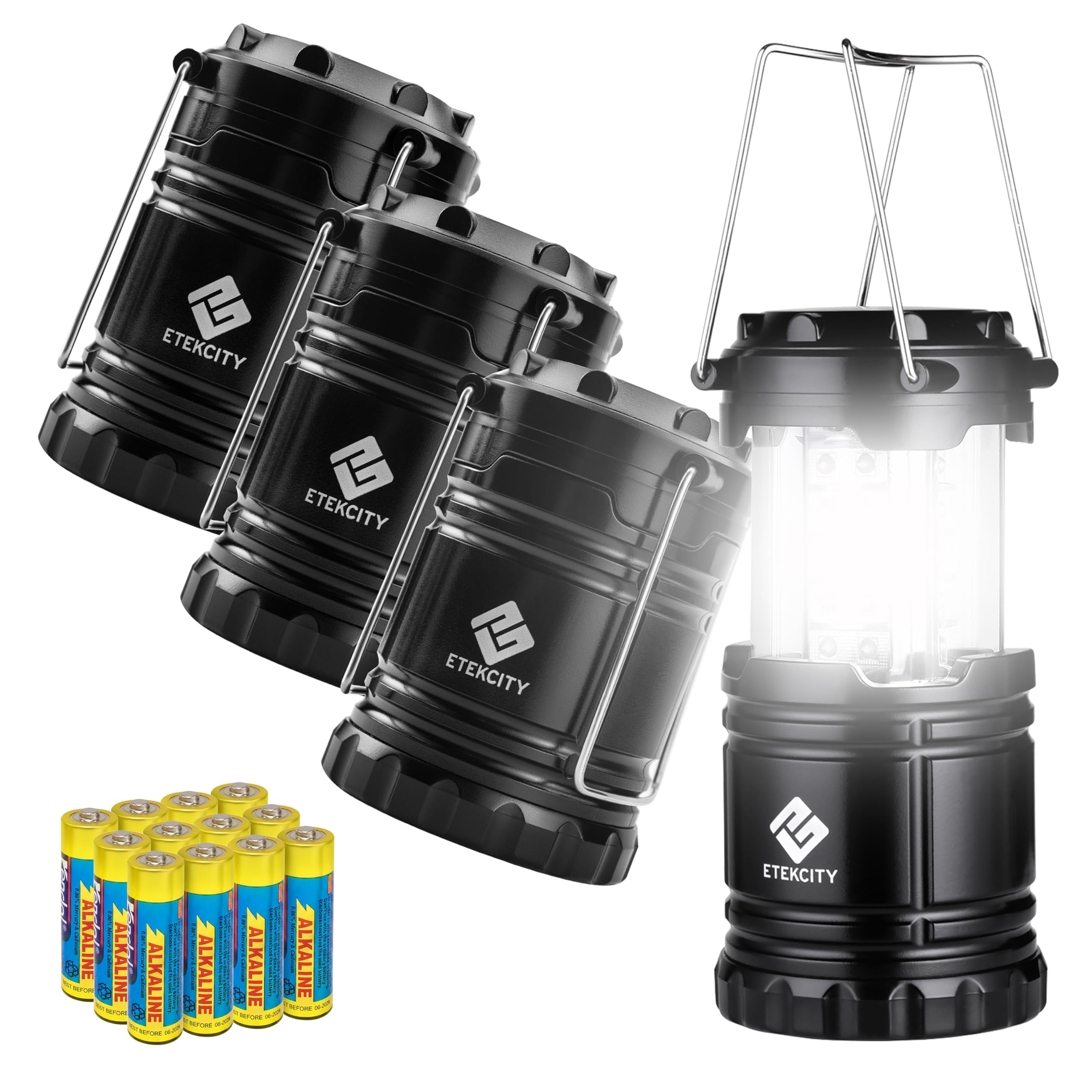
Etekcity 4-Pack Lanterns
Key Features
- Power: 3 AA (included)
- Runtime: 50 hours
- Pack size: 4 lanterns
- Max output: 154 lumens
- Price: Midrange
Four lanterns that collapse this small are easy to justify. The Etekcity set takes up less space than a single full-size lantern when packed, which is the point: keep one in the glovebox, one in the tent bag, and two in the house for the next power outage.
The 360-degree output is even and glare-free enough to hang overhead, and the pull-up body controls brightness without a switch hunt. Four of them let you place light where you need it instead of carrying one bright unit around the camp.
The 50-hour runtime is the standout number, and it comes from three AA cells per lantern. Batteries are included, which is a small but welcome convenience when you are buying a set for an emergency kit.
We keep coming back to this set for its footprint rather than its output. This is the one we reach for when pack space matters more than horsepower, and the one we hand to a family member who needs a light for the stairs.
Pros
- Four compact lanterns
- 50-hour runtime
- Batteries included
- Water-resistant ABS body
Cons
- 154 lumens is low for primary campsite lighting
A compact four-pack of backup lights with a 50-hour runtime and batteries included; ideal for packs, cars, and power outages.
How We Tested 14 Lanterns Over Four Months
We started with roughly 50 lanterns sold at major retailers and cut the list down to 14 based on specs, price, and packed size. Anything with a sealed non-rechargeable battery was out, as was anything over about two pounds, anything that wouldn’t fit in a jacket pocket or a stuff sack side pocket, and anything whose brightness claim was the only interesting thing about it. Each surviving lantern then went into rotation in real places: on a picnic table after sunset, hung from a tent loop during a rainy weekend, on a garage floor during an oil change, and in a hallway during two planned hours with the breaker off.
For brightness, I walked each lantern to the far end of a 20-foot yard and looked back to see whether the light fell in an even pool or a hot spot with dark edges, and whether I could read a paper map at that distance. Battery life got timed rather than trusted: every lantern ran on its highest setting until it dimmed or died, with hours logged, then ran again on low overnight to see what was left by morning. We also noted whether it charged over USB-C or needed loose AAs from a drawer.
Ease of use got tested in the dark, with cold hands and gloves on, switching modes without looking. A 9-year-old and a grandparent each got handed every lantern to turn on and hang up. For quality, each one was dropped from counter height onto concrete, left out in the rain, and checked for water inside. The magnetic base — the thing shoppers ask about most — was stuck to a car hood, a metal shelf, and a tent pole, then tilted to see whether it slid or held.
How to Choose a Camping Lantern
Start with the job the lantern has to do, not the biggest lumen number on the box: a tent light, a family campsite, and an outage kit pull the choice in different directions.
Match output to the space
Output is about the space you need to fill, not bragging rights. A 150-lumen lantern is enough hung inside a small tent; 350 to 600 lumens is comfortable on a table or in a family tent; 1000 lumens and up is campsite or room lighting. Dimming matters as much as the peak because a bright lantern turned low lasts longer and is kinder overhead. We treat the Etekcity set as personal lighting and the Lepro 1000LM or AYL 1800LM as group or room light.
Pick a power habit
Disposable cells are simple, replaceable, and ready after months in a pack. Rechargeable lanterns save on batteries and often double as power banks, but they need a cable and a charging habit. Our preference is a rechargeable lantern with an AA fallback, like the EZORKAS pair, for family camping. For a kit that may sit untouched, the Streamlight’s D-cell power and 295-hour low mode are easier to trust. Recharge before every trip, and keep a spare set of the right cells.
Read runtime the right way
Headline runtime usually belongs to the lowest or warmest mode. The Streamlight’s 295 hours is a low setting; the Lepro rechargeable’s 12 hours is a 300-lumen warm-white mode; the AYL’s 12 hours is its own maximum claim. Think about whether you need an all-night glow or short bursts of high light. A dimmable lantern with a warm mode and a red night mode gives you more useful range than one with a single bright setting.
Check weather sealing and hanging
IPX4 handles splashes; IPX7 can survive a temporary dunking. None of these lanterns is a dive light, so check the rating rather than the phrase water resistant. Hanging hardware matters just as much: a D-ring or hook lets you place light above eye level, while a magnetic base needs clean steel. The Streamlight is the wet-weather pick here; the GearLight is the magnetic task light. Look at your tent loops and car surfaces before choosing.
Choose one lantern or a pack
One good lantern is lighter and simpler; a pack gives you placement, redundancy, and a light for every camper. A four-pack makes sense for a family tent, a cabin, or an outage kit, where 154 to 350 lumens per unit is enough spread around. A solo backpacker is better served by one brighter, weather-sealed lantern. Check the collapsed size and the per-lantern battery count, because four lanterns also mean twelve AA cells in some sets.
Frequently Asked Questions
Do I really need a lantern if I already have a headlamp?
A headlamp is for hands-free tasks and walking; a lantern is for area light. In a tent, a headlamp casts shadows and glares into other people’s eyes, while a hanging lantern lights the space. Keep both: a headlamp for the trail and a lantern for camp. If you are packing only one light for a solo trip, a small collapsible lantern plus a phone flashlight can cover a night.
Can I leave a camping lantern in a tent overnight?
Yes, with care. LEDs run cooler than fuel lanterns, but keep the lantern off fabric and away from sleeping bags, and hang it from a dedicated loop rather than a seam. Use a low or warm setting, and do not leave a rechargeable light charging unattended in a tent. A battery-powered light with a recessed switch is the better choice around packed gear.
How should I store a battery-powered lantern between trips?
Take the alkaline cells out if the lantern will sit for months; that is the simplest way to avoid corrosion and a dead light when you need it. Store the lantern dry, with the battery door closed but not cranked down hard. For a rechargeable lantern, top it up every few months rather than leaving it fully drained. Keep a spare set of the right cells with the lantern.
Final Verdict
Buy the Streamlight Siege if you want one lantern that can handle rain, a drop, and a long outage without fuss. Its sealed body, 295-hour low mode, and even 540-lumen light make it the most dependable all-rounder in this set. For a rechargeable setup, the EZORKAS two-pack is the easier choice; for a family camp or maximum brightness, the Lichamp four-pack and AYL 1800LM make more sense.