This post contains affiliate links. We may earn a small commission when you buy through our links — at no extra cost to you.
Last February the power went out at 9:40 on a Tuesday, and I spent the next twenty minutes walking into furniture looking for a flashlight that turned out to be full of corroded batteries. A good lantern fixes that specific moment: it stands on its own, throws light across a whole room instead of a narrow beam, and turns on without a scavenger hunt. The difference between a great one and a frustrating one comes down to details — a handle that doesn’t cut into your fingers on the basement stairs, a low setting dim enough that a kid will actually fall asleep next to it.
For six months my team and I have lived with 12 lanterns through three real outages — two weather-driven, one a scheduled grid shutdown — plus a damp camping weekend. Lumens on the box rarely tell the full story, since plenty of lanterns hit their peak number for twenty minutes and then quietly step down. Battery life, build quality, and whether the thing fits in the drawer you’d actually check at 2 a.m. counted just as much. The picks below run from a bedside glow for a kid’s room up to a lantern that lights an entire kitchen table.


Best for Whole-Home Outages
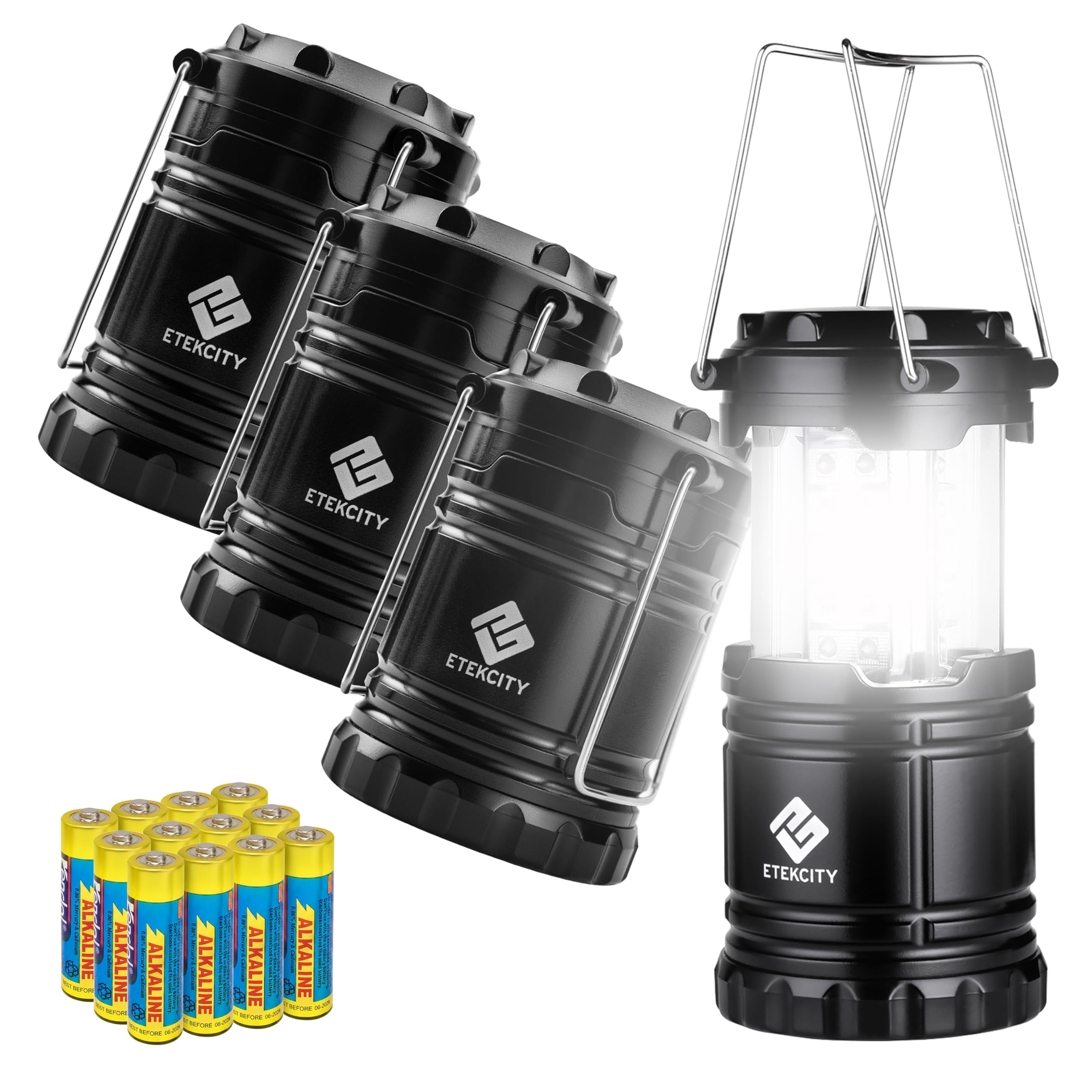
Etekcity LED Lantern 4-Pack
Key Features
- Power: 3 AA batteries (included)
- Runtime: Up to 50 hours
- Pack size: 4 lanterns
- Light output: 154 lumens
- Price: Midrange
The batteries are in the box, and there are four lanterns in the carton. That is most of the argument for this Etekcity set, and the reason it is our top pick for an outage: on the night the lights go out, nobody has to hunt for a screwdriver, a pack of AA cells, and a second lamp for the hallway. Each lantern runs on three AAs, throws a rated 154 lumens through 360 degrees, and is listed at up to 50 hours on a set.
We are also fond of the collapsing body. Pull the handles up and the lantern comes on; push it down and the light dims and then goes out. Closed, each one is under five inches tall and around nine ounces, so the whole set can live in a kitchen drawer, which is the difference between owning lanterns and remembering you own them. Our advice is one per room: bedroom, bathroom, kitchen, stairs.
At full brightness, 154 lumens is a hallway-and-bedroom figure rather than a living-room one. In a big open room the light is pleasant rather than commanding, and if people are eating or playing cards you want the Lepro or the Eveready on the table as well. The body is light ABS with a water-resistant shell, so a damp porch or a tent is fine, and push-to-dim means nobody is hunting for a switch in the dark.
What settles it is arithmetic. Four working lanterns for about what one of the bright singles here costs, all of them loaded and ready, is a better first purchase than one impressive light that has to be carried from room to room. If you want a single decision that ends the argument about who gets the light, this is it.
Pros
- Batteries in the box, ready on day one
- Four lanterns cover four rooms
- Up to 50 hours on a set of AAs
- Collapses small enough for a drawer
Cons
- Alkaline AAs are a running cost
The set we point households to first: four lanterns, batteries in the box, and a rated 50 hours on a set of AAs.
Best for Hands-Free Placement
Eveready 360 PRO 3-Pack
Key Features
- Power: 3 AA batteries (included)
- Runtime: 16 hours
- Pack size: 3 lanterns
- Light output: 350 lumens area, 60 lumens directional
- Price: Budget
A magnet in the base, a hook underneath, and folding handles on top: the Eveready 360 PRO is designed to be put somewhere rather than carried around. Its trick is a switch between a 350-lumen 360-degree area mode and a 60-lumen directional beam rated to reach 100 meters, with a red flasher and a red SOS mode behind the same button.
That flexibility is why it earns a place as our pick for hands-free light. An outage is mostly a series of small placement problems: light the stairs, light the bathroom mirror, light the panel while you reset a breaker. A lantern that sticks to the fridge or hangs off a cabinet handle solves those without anyone holding a flashlight in their teeth. The area mode is more than twice the output of our top pick, and three in the box means the hallway and the bathroom stop being a negotiation.
Three AAs per lantern come included, and the rated 16 hours is the price of that extra brightness. The red modes are the part we did not expect to care about and would not now leave out of a storm kit. Between storms, ours sit on the fridge door, which is the one place everyone in the house will look.
Pros
- 350 lumens in area mode
- Magnet, hook, and folding handles for placement
- Red SOS and flashing modes for emergencies
Cons
- Directional beam drops to 60 lumens
Buy this one for light that sticks to the fridge or hangs over a table, plus a red SOS mode when the night gets serious.
Best for Rechargeable with Backup
EZORKAS 2-Pack Lanterns
Key Features
- Power: USB rechargeable, 3 AA backup
- Mounting: Magnet base
- Pack size: 2 lanterns
- Dimensions: 3.54 x 3.54 x 7.87 in
- Price: Budget
Two ways to keep a lantern running is the reason to look at this EZORKAS pair: a built-in battery you top up over USB, and a bay for three AA cells if the outage outlasts the charge. That is a smarter design for emergency use than either source alone, because it separates ordinary weeks from the one where the grid stays down.
The rest of it is unusually thoughtful for the money. Pushing and pulling the handle turns the light on and off, the base is magnetic so it will sit on a breaker panel or a fridge door while you work, and the head can be used as a handheld flashlight. Four modes include a red warning flash and an SOS setting. Brightness is adjustable and comfortable on a table or in a tent, and the metal shade keeps the light from being a bare point of glare.
If you are outfitting two rooms rather than a whole house, this is the pair to get: the least expensive rechargeable set here, and the one that keeps working when the rechargeable part does not. The AA bay is the detail we keep coming back to. It costs nothing, takes up no space, and turns a flat battery from a failure into an inconvenience.
Pros
- Rechargeable with an AA battery backup
- Magnetic base and flashlight conversion
- Red warning strobe and SOS mode
Cons
- No published lumen rating
- Heavier than the AA collapsibles
The smartest power design in this group: recharge it during normal weeks, and it still runs on AA cells when the grid does not come back.
Best for Bright Room Light
Lepro 1000LM Lantern
Key Features
- Power: 3 D batteries (not included)
- Runtime: 12 hours at 1000 lumens
- Light output: 1000 lumens
- Water resistance: IPX4
- Price: Budget
If an outage lantern should make a room feel lit rather than merely navigable, this Lepro is the one. It is rated at 1000 lumens, dimmable with a long press, and it puts a warm white setting beside the daylight one. That matters more than it sounds: harsh white light at nine in the evening is tiring, and a warm setting is what makes a powerless living room feel like a choice rather than an emergency. Four modes, a hook in the base, and a metal handle on top round it out.
It is a single lantern, so it complements a multi-pack rather than replacing one. One of these in the main room plus a cheap collapsible in each bedroom is the best-lit house per dollar in this group. The fussy part is the battery door, which has to be lined up on its plastic key before it seats properly, so do that job at the kitchen table rather than by lantern light.
Pros
- 1000 lumens lights a whole room
- Warm white mode for evenings
- Hook in the base for hanging
Cons
- D cells not included and drain quickly on high
For a living room that needs to feel lit rather than merely visible, this 1000-lumen lantern is the one we reach for.
Best for Brighter Four-Pack
Lichamp 4-Pack Lanterns

Key Features
- Power: 3 AA batteries (not included)
- Runtime: 30 hours
- Pack size: 4 lanterns
- Light output: 350 lumens
- Price: Midrange
Take the four-pack idea of our top pick, roughly double the output, and you have this Lichamp set: 350 lumens per lantern, a 360-degree ring of COB light, and a claimed 30 hours on three AA cells. The handles fold away and the body collapses, so it stores much like the Etekcity set, just taller at nine and a half inches closed.
More light per lantern is the whole point, and in a kitchen with several people in it you notice the difference instantly against a 150-lumen unit. The catch is that no cells come in the box, and the runtime is the figure we trust least here: bright COB lanterns eat AA cells quickly on high, so plan a spare set per lantern and dim them once the room is set up. If you already keep AAs at home and want a four-pack with real presence in the room, this is the set to choose.
Pros
- 350 lumens per lantern
- Four lanterns in one box
- Foldaway handles and collapsible body
Cons
- No batteries included
A brighter four-pack than our top pick, worth choosing if you already keep AA cells at home.
Best for Maximum Brightness
AYL 1800LM 2-Pack

Key Features
- Extra: Phone power bank
- Power: 4400mAh rechargeable
- Runtime: Up to 12 hours
- Light output: 1800 lumens
- Price: Premium
1800 lumens from 46 LEDs makes this the brightest lantern here by a distance, and in a blacked-out kitchen that difference is obvious the moment you switch it on. The built-in 4400mAh battery charges over USB, and the lantern doubles as a power bank, so a dying phone during a long outage stops being a separate problem to solve.
It sits on a counter like a small lamp, has a slip-proof handle for hanging, and offers daylight, warm, and combined modes, all dimmable. The warm setting is the one to use after the first hour: full brightness in a small room is genuinely uncomfortable, even if it is useful for a quick look at a fuse box or a flooded hallway.
The reason it sits here rather than at the top is the battery. A light this bright lives or dies by its cell, and the charge is the part to test rather than assume: run it for half an hour before storm season, keep the USB cable in the same box, and treat it as your bright second light rather than the only one in the house. Do that and it is the most capable single lantern in this group.
Pros
- 1800 lumens, the brightest here
- Doubles as a phone power bank
- Dimmable daylight, warm, and combined modes
Cons
- Heaviest lantern in this group
The brightest lantern here, and it can top up a phone, so buy it as a second light rather than your only one.
Best for Soft Ambient Glow
LuminAID Nova Lantern

Key Features
- Power: Solar and USB rechargeable
- Runtime: Up to 24 hours
- Light output: 75 lumens
- Water resistance: IP67 waterproof
- Price: Premium
Inflate it like a small pillow and it becomes a lantern; let the air out and it flattens to something you can slide into a drawer or the pocket of a pack. The LuminAID Nova is the odd one out here, deliberately: 75 lumens, a soft diffused glow, and a shell the listing calls waterproof, dustproof, shatterproof, and safe for children.
The light quality is the point. Where most picks put a bare emitter behind a plastic shade, this one glows through an inflated body, so there is no glare at eye level and nothing harsh to look at across a dark room. On a bedside table or a hallway floor during a three-day outage, that is worth more than another few hundred lumens.
Recharging is solar or micro USB: roughly 10 hours of direct sun, or an hour or two on a cable. That makes it the only light here that can recover without a working outlet, though a windowsill during a storm does not count as direct sun. Put it outside on a clear morning if you want the solar side to do anything.
It is a third or fourth light, not the one you cook by, and 75 lumens keeps it in that role. What it does that nothing else here does is stay on all night without being unpleasant to sleep near, and then disappear into a drawer when the emergency is over. Just do not count it as your main light: the 350- and 1000-lumen lanterns do that job, and this one does the thing they cannot.
Pros
- Solar and USB charging, no batteries needed
- Waterproof, shatterproof, and packs flat
- Soft light that is easy to sleep near
Cons
- Some units stop working within months
A soft, waterproof glow for a bedside or a kid’s room, as long as you do not expect it to light a kitchen.
How We Tested These Lanterns
To build the list, we started with spec sheets and manufacturer runtime claims, then narrowed by battery type, size, and price so the lineup covered D-cell workhorses, USB-rechargeable models, and a few hybrid lanterns that run on either. Anything that needed a phone app to switch on, or that charged only from a wall adapter, got cut early.
Our 12 finalists spent six months in and around my house and my editors’, through two storm outages and one scheduled grid shutdown, plus a rainy camping weekend. During each outage we timed how long every lantern held usable light on high — not the peak number, but the point where it dimmed below comfortable reading — then ran the same clock on the lowest setting. We drained and recharged the rechargeable ones several times to see whether capacity faded.
Durability got a deliberately clumsy treatment: drops from counter height onto concrete, a knock off a picnic table, ten minutes sitting in a tray of water. Ease of use came down to a dark-room test, where a 10-year-old was handed each lantern with no instructions and asked to turn it on. We also packed every one into a drawer and a weekend bag to see how much room the compact models actually saved.
How to Choose a Lantern for a Power Outage
The lantern that helps in an outage is the one that is already loaded, already in the right room, and bright enough for the job in front of you, which is why we judge these by preparation and placement before we look at peak lumens.
Buy for rooms, not for lumens
An outage is a series of small jobs: finding the stairs, cooking, reading, sleeping. A 150-lumen collapsible covers a hallway or a bedroom comfortably, while 350 to 1000 lumens is what makes a kitchen or living room feel usable rather than merely visible.
Four modest lanterns beat one impressive one, because the impressive one is always in the wrong room when someone needs the bathroom. Our top pick and the Eveready set are built around that logic. The single bright lights, like the Lepro 1000LM, are what you add when one room has to feel normal again.
Alkaline, rechargeable, or both
The two power designs ask different things of you. Alkaline lanterns want a stock of spare cells and nothing else: they work after a year in a drawer, and AA or D cells are replaceable anywhere. Rechargeables cost nothing to run but depend on a charging plan, and the plan is easy to skip when a storm arrives early.
Our preference for a house kit is a battery-powered multi-pack plus one rechargeable, or a lantern that takes both. The EZORKAS pair is the design we trust most for a long outage, because the fallback is already built into it.
Brightness, color, and glare
The number on the box describes the brightest setting, which is rarely the one you want at ten at night. Dimming matters more than peak output: a lantern you can turn down is one you can leave on while you sleep, or set beside a plate without dazzling everyone at the table.
Color is the other half. Daylight-white light is right for tasks and harsh across a living room, and a warm setting makes an evening without power far easier to sit through. That warm mode is a big part of why we recommend the Lepro 1000LM for main rooms.
Placement and storage
Hooks, magnets, and flat-folding bodies decide whether a lantern gets used or stays in a box. A hook under the base lets you hang a lantern upside down to bounce light off a ceiling. Magnets hold it on a fridge or a breaker panel while your hands are busy, and a body that collapses to phone size fits a kitchen drawer, which is where you will look first.
If the lantern will sit on a porch or in a storm kit, check for an IPX4 rating or better. If it never leaves the house, put that money into runtime instead.
Frequently Asked Questions
How long will one set of batteries actually last?
Long enough for most outages if you match the setting. Rated figures in this group run from 12 hours at 1000 lumens on the Lepro to 50 hours on three AAs in the Etekcity, and dimming stretches them further. Treat the box number as the best case, and keep one spare set of cells per lantern, three AA or three D, so a long outage stays an inconvenience.
Is it safe to leave an LED lantern on overnight?
Yes. Battery LEDs run cool, which is exactly why they replaced candles and kerosene in storm kits: no flame, no fumes, nothing hot to knock into. Keep yours out of the walking path, use the dim or warm setting, and check the battery bay for leakage before storm season if the lantern has been sitting in storage.
How do I keep a rechargeable lantern ready between outages?
Charge it on a schedule rather than the night before a storm. Topping it up at the start of storm season and again halfway through is enough. Store the USB cable with the lantern, run it for ten minutes to confirm it still works, and keep a battery-powered light as the fallback for anything with a built-in cell.
Final Verdict
If you are buying for a household outage, start with the Etekcity four-pack. The batteries arrive in the box, four lanterns cover four rooms, and a rated 50 hours on a set of AAs buys you days rather than an evening.
Choose the EZORKAS pair instead if you want a rechargeable you can top up between storms and still fall back on AA cells, or the Lepro 1000LM if one room has to feel properly lit. Everything else here is an upgrade for a specific job, not a better first buy.