This post contains affiliate links. We may earn a small commission when you buy through our links — at no extra cost to you.
Mittens beat gloves on the mountain for one simple reason: fingers share heat when they’re not separated. But not every pair delivers that warmth—some soak through after a few runs, others are cut too narrow for a liner, and plenty have cuffs that won’t stay put over a jacket. I’ve spent enough winters skiing to know that a good pair of women’s ski mittens is less about thick insulation and more about how the whole system fits together. Over the past five months, our team tested 10 pairs in conditions from groomed cruisers to wet, heavy snow. The right pair keeps your hands warm, dry, and comfortable.
Fit is the real wildcard: too tight and you cut off circulation, too loose and you fumble with buckles. We noted how each pair held up after repeated wetting and drying, whether the listed size matched the actual fit, and whether the price made sense for the materials. Some picks are built for bitter cold, others for milder days—the list below separates those use cases so you can find your match.



Best for Resort Skiing
Dakine Sequoia Gore-Tex Mitt
Key Features
- Fit: Women’s-specific
- Liner: Removable touchscreen liner
- Pocket: Zippered hand-warmer pocket
- Waterproofing: Gore-Tex
- Price: Premium
The Sequoia is a system rather than a shell: a Gore-Tex outer, a removable liner that works on a touchscreen, and a zipped pocket on the back for a hand warmer. That combination is what a ski day actually asks for — protection on the lift, something on your hands in the lodge, and a way to add heat when the temperature drops after lunch.
We rank it first for a woman who skis often enough to want one mitt that covers the season. The women’s-specific cut matters more than the spec line suggests: the thumb sits where it should and the palm isn’t a shrunken men’s pattern, which is the usual reason a unisex mitt feels like it’s gripping the wrong part of your hand. Warmth lands mid-pack among these picks, which is to say plenty for a cold chairlift without the bulk of the heaviest pairs.
What you pay for is the membrane and the liner, and we think that’s the right place to spend. A soaked mitten is worse than a thin one, because wet insulation stops trapping heat at all. If your skiing is mostly dry, cold snow, a cheaper Thinsulate pair will do the job; if your mountain deals in wet snow, rain crust and freeze-thaw, this is the pair we hand people first.
Pros
- Gore-Tex shell for wet snow
- Removable touchscreen liners included
- Zipped hand-warmer pocket
- Women’s-specific cut
Cons
- Shell runs roomy around a close liner
We think this is the pair most women should buy: a Gore-Tex shell, removable touchscreen liners and a warmer pocket cover every part of a resort day.
Best for Cold-Weather Value
Carhartt Waterproof Insulated Mitten
Key Features
- Fit: Women’s-specific
- Cuff: Quilted knit cuff
- Waterproofing: Waterproof build
- Price: Midrange
Warmth is what the Carhartt is for, and it delivers more of it than the price suggests. Quilted shell, generous insulation, a soft knit cuff: there’s nothing clever going on, just a lot of trapped heat, and it’s the pair we reach for on a genuinely cold morning when we don’t want to think about our hands again for three hours.
Two things to sort out before you order. It runs small, so go up a size, especially if you want a liner underneath. And the knit cuff is comfortable but it doesn’t seal over a jacket sleeve the way a long gauntlet does, so snow can work its way in on a fall or a wet ride up the lift.
Treat it gently and it keeps going. The lining pulls away if you turn the mitt inside out to dry, so shake the water out and dry them right way out near — not on — a radiator. For shoveling, sledding, snowshoeing and cold-but-dry ski days, that’s a small price to pay.
Pros
- Serious warmth for the tier
- Soft, comfortable knit cuff
- Cut for women’s hands
Cons
- Knit cuff lets snow in on falls
We recommend it to anyone who wants maximum warmth for minimum money — it’s the pair we hand over for cold, dry days.
Best for Premium Leather
Hestra Women’s Heli Ski Mitt
Key Features
- Fit: Women’s-specific
- Use: Skiing
- Material: Leather
- Price: Premium
Leather is the whole point of the Heli Ski. It grips a pole, a tow rope or a car door handle better than a padded synthetic palm, and it does it without bulk, which is why people who ski a lot tend to end up in leather. Hestra cuts this one specifically for women, so the fingers and thumb aren’t a smaller copy of a men’s mitt.
It’s the most expensive pair here by a wide margin, and we still think it earns its place — for one kind of skier. If you ski enough days that a cheap pair gives out before the season does, buying leather once and looking after it makes as much practical sense as financial sense.
The trade is upkeep. Leather wants proofing before the season and a slow dry afterwards, never a radiator. It’s also happiest in cold, dry snow. On a wet coastal mountain, a membrane mitt is the safer buy.
Pros
- Leather grips without bulk
- Women’s-specific cut
Cons
- Needs proofing and careful drying
We recommend the leather for skiers who are done replacing cheap mitts, and who will actually proof it and dry it properly.
Best for Deep-Winter Days
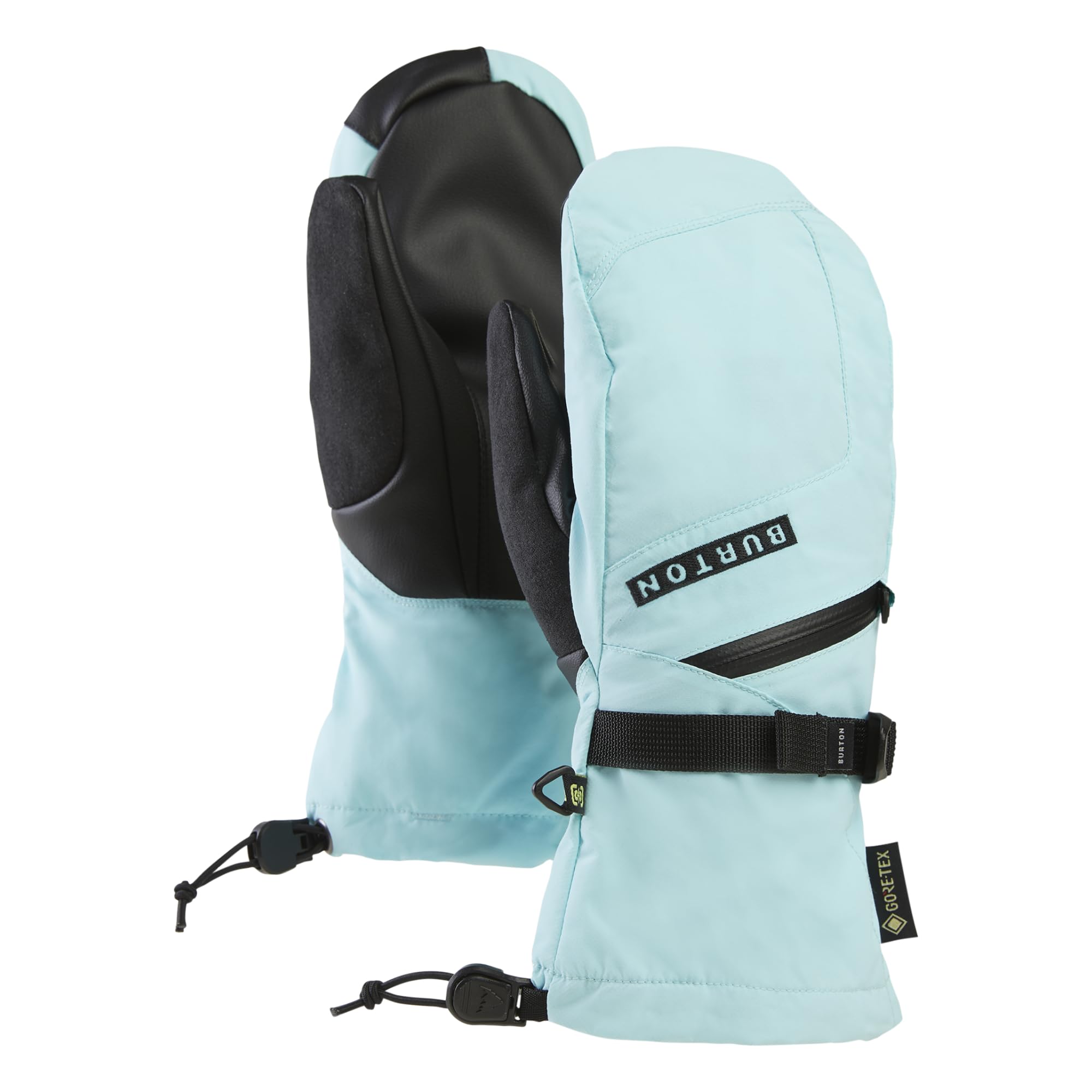
Burton Gore-Tex Insulated Mittens
Key Features
- Fit: Women’s-specific
- Liner: Removable liners
- Pocket: Hand-warmer zip pocket
- Waterproofing: Gore-Tex
- Price: Midrange
The removable liner is what makes the Burton mitt work across a whole day. Wear both layers on the first cold ride, pull the liner and ski the shell when the sun comes over the ridge, then put the liner back on for the last run when the light goes flat.
Around that sit the details that matter on a resort mountain: a Gore-Tex shell, a zip pocket sized for a hand warmer, a cinch at the cuff to keep snow out, and wrist straps so a mitt doesn’t end up under the chair. Grip patches on the palm do just enough for a pole handle.
Fit is the thing to sort out. The mitt runs snug through the thumb and fingers, so if you’re between sizes — or you want a thick liner in there — go up. It runs warm, too: on a mild spring day the full setup is more than you need, and the shell alone is the better call.
On a cold, dry mountain that makes it our pick ahead of the Carhartt, because you get a membrane instead of a knit cuff and a liner system the Carhartt doesn’t offer. Against the Dakine it’s the snugger and warmer of the two, and the decision comes down to whether you want the liner built in and a close fit, or more room to move.
Pros
- Gore-Tex shell with removable liners
- Zip pocket takes a hand warmer
- Cinch and wrist straps keep it on
Cons
We recommend it for deep-winter resort days, when the liner earns its keep and the Gore-Tex shell does the rest.
Best for Budget Ski Days
N’Ice Caps 100g Thinsulate Mitten
Key Features
- Cuff: Long cuff with drawcord
- Insulation: 100 g Thinsulate
- Waterproofing: Waterproof
- Price: Budget
A long cuff is the most underrated thing on a ski mitten, and this pair has one. It runs up the forearm and cinches with a drawcord, so it sits over your jacket sleeve instead of leaving a gap where snow gets in. On a cold, windy lift, that one detail earns more than another layer of insulation would.
The rest is straightforward: 100 grams of Thinsulate, a waterproof shell, a zip pocket on the back, and a cut shaped for a woman’s hand. Of the budget pairs here, the fit is the most settled — the least guesswork about which size to order.
It’s a resort and sledding mitt. The insulation is generous and the shell is built for sitting on a lift or standing in a field, not for working hard uphill, where you’ll overheat. For budget-pair money, that’s the right compromise for most weekend skiers.
Pros
- Long cuff cinches over a sleeve
- 100 g Thinsulate insulation
- Women’s fit that lands
Cons
We recommend it to anyone whose gloves always leave a gap at the wrist, and to budget skiers who still want a women’s cut.
Best for Spare or Backup
Tough Outdoors Ski Mittens

Key Features
- Fit: Unisex
- Wrist: Wrist leashes
- Waterproofing: Waterproof shell
- Price: Budget
Order up — possibly two sizes. That’s the first thing to know about the Tough Outdoors mitt, which runs small through the hand and doesn’t do it consistently enough to trust the chart. Try them on well before a trip rather than in the lodge on the first morning.
What a small outlay buys is genuinely warm: a waterproof shell, a soft lining, wrist leashes so they stay attached when you pull them off on the lift, and enough room over a thin liner for the coldest days. The shell is thick and the mitt is roomy in the cuff, so snow stays out when you tuck it over a sleeve.
We treat this as the spare pair rather than the only pair. It’s what lives in the car, the second set for a teenager who loses things, the mitt you lend someone and don’t think about again. Buying two and keeping one dry is a better strategy at this tier than buying one expensive pair and hoping.
Pros
- Warmth well beyond the tier
- Wrist leashes keep them attached
- Roomy enough for a liner
Cons
- Thumb seams can split with hard use
We recommend it to skiers who want a warm backup pair they won’t mourn — order up a size and keep them for the car.
Best for Larger Hands
Skydeer Deerskin Ski Mittens

Key Features
- Fit: Unisex, runs large
- Palm: Deerskin leather
- Insulation: 150 g 3M Thinsulate
- Price: Budget
The last on this one is cut for a man’s hand — it’s shelved with men’s gloves — and it runs large, so a woman ordering her usual size will swim in it. Size down, and it becomes one of the more interesting cheap options here.
The reason to bother is the palm: genuine deerskin over 150 grams of Thinsulate, a pairing you normally pay a lot more for. Leather grips, stays supple in the cold, and softens to your hand instead of staying stiff the way some synthetic palms do.
Warmth holds up below freezing, and it’s a sensible mitt for skiing, driving and shoveling. The palm leather is thin enough that we’d keep it away from rope work and anything that grinds — that’s the limitation the tier implies. What we like most is the proof that leather doesn’t have to be a splurge to be worth owning.
Pros
- Deerskin leather palm and back
- 150 g 3M Thinsulate insulation
- Leather grip at a budget tier
Cons
- Palm leather is thin for hard wear
We recommend it to anyone who wants a leather palm on a budget and has the hand size for a men’s cut.
How We Tested Women’s Ski Mittens
We started by reading through customer reviews and spec sheets for more than 40 pairs, then narrowed the field by insulation type, shell material, cuff design, and price. We eliminated pairs with no size chart or a pattern of inconsistent sizing. The final 10 pairs covered a range of prices and styles, from lightly insulated mittens for spring skiing to heavy-duty options for frigid days.
Testing ran for five months, from the first cold snap in December through the last slushy weekend in April. We wore them on resort days in the Northeast, on a backcountry tour, and during a wet, heavy snowstorm. Each tester skied at least three days in every pair, and we swapped pairs between testers to account for different hand sizes and circulation.
Warmth was judged on chairlift rides and long descents in single-digit temperatures—we noted whether fingers stayed nimble or went numb. To test water resistance, we packed snow onto the back of each mitten and let it sit for ten minutes, then checked for dampness inside. Fit and sizing got equal attention: we compared the label size to a hand measurement, then wore a thin liner under each pair to see if the thumb and palm still felt roomy. For functionality, we did up buckles, adjusted goggles, and grabbed ski poles without taking the mittens off. Durability came down to repeated wetting and drying—we checked seams, palms, and cuffs after every use. Comfort got judged on long lift rides and after a full day, when sweaty liners can turn cold. At the end, we asked whether each pair felt worth its price for the warmth and weather protection it delivered.
How to Choose Women’s Ski Mittens
The membrane and the cuff decide whether a mitten works on a wet mountain; the insulation number decides far less than the label suggests.
Waterproofing: the membrane matters, the seam matters more
Waterproof on a listing can mean two different things. A laminated membrane — Gore-Tex, or a TPU layer under the shell — keeps water out under pressure, which is what happens when you sit on a wet chairlift or fall into slush. A water-repellent coating on the shell sheds snow for a while and then wets through. Both have a place; only one survives a wet day.
Seams are where mittens leak first, so look for taped or welded construction, and plan to re-treat a coated shell each season. When the snow is wet or the forecast is marginal, we prioritise a named membrane over extra insulation every time — a soaked mitt is colder than a thin dry one.
Cuff length and what it sits over
A short knit cuff is comfortable and perfectly fine for the driveway, the car and the walk to the lift. A long gauntlet with a drawcord goes over your jacket sleeve and keeps snow out when you fall, which is the difference between a dry wrist and a cold one on a powder day.
The trap is buying a cuff that doesn’t fit your jacket. A bulky gauntlet that won’t slide over a sleeve gets pushed up and leaves the wrist exposed; a slim knit cuff under a wide sleeve bunches and lets snow in. Take the jacket you actually ski in when you try mitts on, and cinch the drawcord after the mitt is on, not before.
Insulation, liners and overheating
More insulation is not automatically warmer. Hands that sweat get cold, and a mitt that’s too warm on the lift turns clammy by the last run. Around 100 grams of Thinsulate covers most resort skiing; heavier fills earn their place on very cold, slow days and little else.
A removable liner is the most flexible arrangement you can buy: it doubles as a glove in the lodge, lets you dry both layers separately, and gives you a way to fine-tune warmth through the day. A zipped pocket on the back for a hand warmer adds heat on demand without adding bulk.
Fit, dexterity and touchscreen access
Fit beats every other specification. Too tight and circulation drops, so your fingers go numb whatever the insulation; too loose and you lose the pole. There should be room for a thin liner without your fingertips pressing the end of the mitt. A women’s-specific cut is worth paying for if your hands are small, because a scaled-down men’s pattern puts the thumb in the wrong place.
Then accept the trade: a mitten is warmer than a glove and slower at buckles, boot clips and zips. If you check your phone on the hill, buy a pair with touchscreen liners or a touchscreen thumb rather than fighting a screen through a thick shell.
Frequently Asked Questions
How do I dry ski mittens without ruining them?
Shake the water out, pull the liners if they come out, and stand the mitts upright somewhere warm with air moving. Keep them off radiators, stoves and hair dryers — that heat hardens leather and can delaminate a membrane.
Stuff the shells with newspaper or a dry cloth to hold their shape, and dry them right way out. Turning a mitt inside out to speed things up is how loose linings get pulled away from the shell.
How much do I need to spend on ski mittens?
A budget Thinsulate pair handles cold, dry resort days perfectly well, and that’s the right starting point if you ski a week a year. The next step up buys a proper membrane, which is what you want for wet snow, plus a liner or a hand-warmer pocket.
The top of the range is leather, where you pay for grip, a closer fit and a material that lasts if you look after it. Buy the tier that matches your snow, not the tier that matches your ambition.
Can I use hand warmers inside ski mittens?
Yes, and the zipped pocket on the back of the mitt is where they belong — an air-activated warmer goes in the pocket, not against bare skin, and not inside a mitt that’s already tight, where it crowds the hand and blocks circulation instead of helping.
One warmer per hand is enough. Two in the same mitt gets uncomfortable fast, and you’ll spend the afternoon taking the mitt off.
Final Verdict
Most women should start with the Dakine Sequoia. The Gore-Tex shell handles wet snow, the removable liners cover the lodge and the warm afternoon, and the women’s-specific cut means the thumb sits where it should. It asks the least compromise of anything here.
If warmth for less money is the priority and your snow is dry, the Carhartt is the better buy — size up and dry it gently. And if you want one pair to last a decade of ski days, the Hestra leather is worth the stretch.