This post contains affiliate links. We may earn a small commission when you buy through our links — at no extra cost to you.
Cold hands end a snowboarding day faster than ice or a bad snowpack. You can dress for the temperature, but once your fingers go numb, buckling a binding turns into a fumbling contest and the next chair ride feels like punishment. The right glove fixes that: warmth on the lift, dry hands after a slushy run, and enough feel to adjust a strap without pulling anything off.
I’ve tried the liner-under-mitten trick, the disposable hand warmer stuffed at the wrist, and the thin pipe glove that only works in spring. When we went looking for the best snowboarding gloves, my team and I rode in 12 pairs from November through March, and the biggest myth we busted is that thicker means warmer. A glove that fits too tight cuts off circulation and your fingers go cold anyway; a waterproof membrane, a lining that moves sweat away, and a little room at the fingertips do far more. The picks below are the ones that earned a second season.


Best for All-Around Riding
Tough Outdoors Ski Gloves
Key Features
- Use: Skiing and snowboarding
- Type: Glove
- Sizing: Men’s and women’s
- Price: Budget
Snowboarding asks more of a glove than standing in a cold parking lot does. You need enough feeling in your fingers to knock snow off a binding and pull a strap tight, and you need them still working on the last run. The Tough Outdoors gloves get that balance right, which is why they are our default recommendation: warm down into the teens, dry through a day of melting snow, and thin enough that you are not peeling them off every time you bend over.
Sizing is where to slow down. The palm runs snug and the thumb is the tightest spot, so a rider who lands between sizes is better off going up — and up again if a liner is part of the plan. The wrist strap is a small thing we came to rely on: you can pull a glove off with it and let it dangle instead of clamping it under an arm on the lift.
Where the design runs out of room is real cold. In single digits these become a second-best choice next to a mitten, and if your hands go numb on the lift, no amount of insulation in a glove will fix that. For everything from a slushy spring afternoon to a properly cold January day, it is a trade most riders can live with.
Pros
- Warm down into teens temperatures
- Stays dry through melting snow
- Fingers free for bindings and zips
- Wrist strap keeps them off the snow
Cons
- Seams can let go near the thumb
We recommend the Tough Outdoors gloves as the default for most snowboarders: warm in teens temperatures, dry through wet snow, and dexterous enough for bindings at a price that makes them easy to replace.
Best for Touchscreen Use
Hikenture Ski Gloves
Key Features
- Extras: Touchscreen, zip pocket
- Weight: 6.72 oz
- Insulation: 3M Thinsulate with fleece
- Waterproofing: TPU membrane
- Price: Budget
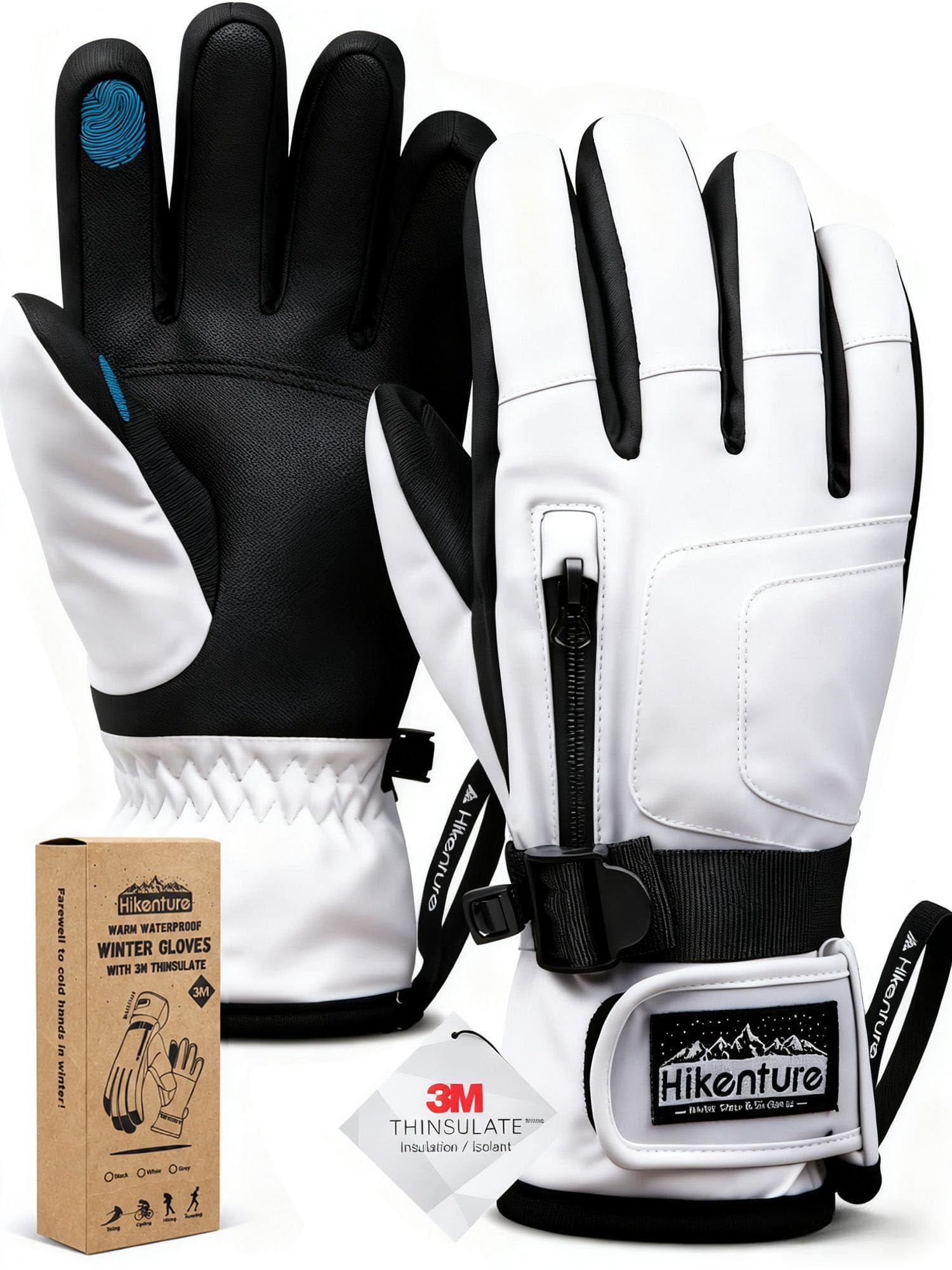
The little zipped pocket on the back of the Hikenture gloves is the detail that sells them: sealed, easy to reach with the glove on, and sized for a key or a card. Add touchscreen fingertips on the index finger and thumb, and you have a glove built partly for the standing-around parts of a snowboard day — the lift line, the phone check, the hunt for a snack.
Among the value picks, this is the one we point at riders who keep a phone in a chest pocket. The build backs it up: a TPU membrane under 3M Thinsulate and fleece, a reinforced anti-slip palm, and 6.72 ounces a pair, light enough to live in a jacket as a spare. It is a genuine waterproof membrane rather than a sprayed-on coating, and that is the difference that matters when snow melts on the back of your hand.
Sizing is the catch. These come up small, so riders between sizes go up, and anyone planning a liner goes up again. The fit is narrow across the palm, which suits a smaller hand and pinches a wide one at the knuckles. Measure your palm before ordering rather than trusting your usual glove size.
Pros
- Touchscreen fingertips on index and thumb
- Sealed zip pocket on the back of the hand
- TPU membrane under 3M insulation
- Light at 6.72 ounces a pair
Cons
- Shell wets out in steady rain
- Lining cannot be turned out to dry
Buy the Hikenture gloves if your phone comes out on the lift: touchscreen fingertips, a zipped pocket, and a real membrane for about what the top pick costs.
Best for Bitter Cold
Tough Outdoors Ski Mittens
Key Features
- Type: Mitten
- Sizing: Women’s and men’s
- Waterproofing: Waterproof shell
- Price: Budget
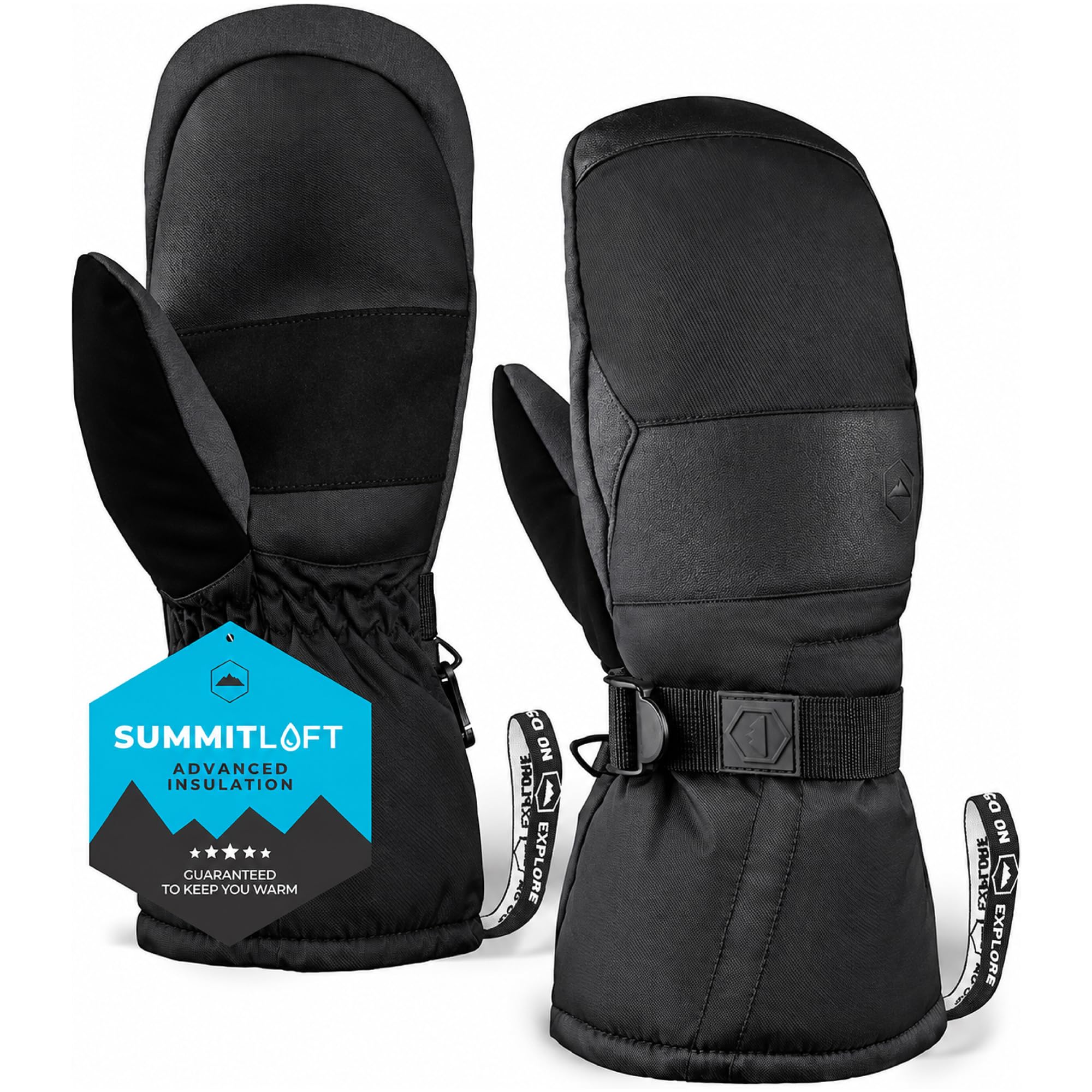
A mitten keeps your fingers together, and that shared heat is the entire argument for wearing one. On a long cold lift it is the difference between riding down and riding down with hands you cannot feel, and at the same thickness a mitten beats a glove every time. This is the simplest route to warmer hands in this group.
The cut is generous enough for a thin merino liner underneath, which is how we wear them once the temperature drops — liner plus shell handles cold that turns a glove into a liability. Wrist leashes keep them attached when you pull one off, and the opening is wide enough to get a hand back in with the other mitten still on.
Water is where they give ground. The shell holds off snow perfectly well, but a wet, heavy day eventually soaks the outside, and once that happens the insulation stops working; a liner buys time rather than a fix. That is why these live in the bag as the cold, dry-day pair rather than the only pair — and on an inland hill in January, that is most days.
Pros
- Warmer than a glove at the same thickness
- Roomy enough to fit a liner
- Wrist leashes keep them attached
Cons
- Sizing runs small; order up
- Thumb seams can tear early
The Tough Outdoors mittens are our coldest-day pick: warmer than gloves by design, roomy enough for a liner, and leashed so you do not lose one over the side of the lift.
Best for Frozen Fingers
SAVIOR HEAT Heated Gloves
Key Features
- Battery: 7.4V 2200mAh, up to 11 hrs
- Membrane: Hipora waterproof
- Warranty: 2 years
- Heat settings: 3 modes, 104–149°F
- Price: Premium
Heated gloves solve a different problem than insulation does. Insulation slows heat loss; an element puts heat back into fingers that have already gone cold. That is the case the SAVIOR HEAT pair makes, and it is the only argument that holds for a rider whose hands hurt by the second run no matter what they are wearing.
Three settings run from a gentle 104–113°F up to 122–149°F, and the lower ones are subtle enough that you forget the heat is on until you take a glove off. Underneath the electrics there is a Hipora waterproof membrane, 3M Thinsulate, and a leather palm that grips a binding strap better than the nylon gloves here. The published eleven-hour runtime belongs to the lowest setting, so treat it as a best case. We think the premium is worth it for that specific rider and hard to justify for anyone else.
A two-year warranty covers the electrics, and the gloves are hand wash only, so the care routine is simple but unforgiving of a machine wash. If your hands are merely cold rather than painful, an insulated mitten does the job with none of the charging, which is the honest dividing line for this pair.
Pros
- Three heat settings up to 149°F
- Hipora membrane with 3M Thinsulate
- Leather palm grips binding straps
Cons
- Battery packs make the wrists bulky
- Little finger can stay cold even when heated
For riders whose fingers go numb whatever they wear, the SAVIOR HEAT gloves are the one pair here that gives heat back rather than just slowing its loss.
Best for Grip and Wind
TRENDOUX Winter Ski Gloves

Key Features
- Extras: Touchscreen, thumb scraper
- Weight: 3.88 oz
- Insulation: 7 layers, 3M Thinsulate
- Waterproofing: Waterproof and windproof
- Price: Midrange
There is a small rubber blade on the back of the thumb of these TRENDOUX gloves, meant for clearing snow and rain off a goggle lens. It costs almost nothing to add and gets used on every lift ride — the kind of detail we noticed in the first hour and kept reaching for after that.
The rest of the build is aimed at wind. Seven layers of insulation with imported 3M Thinsulate, a windproof back of hand, silicone grip strips on the palm, and a cuff that cinches at the wrist and closes with a hook-and-loop strap over the jacket. At 110 grams they are light enough that heavier gloves feel clumsy when you swap back.
These sit just behind our top picks, and the care label has a lot to do with it: dry clean only is an odd instruction for something that spends its day in melting snow, and it rules out the quick wash and air dry that every other glove here will take. If that does not bother you, they are a genuinely good mid-price glove for a rider who hates bulk and rides somewhere windy.
Pros
- Thumb scraper clears a fogged lens
- Windproof with silicone palm grip
- Light at 110 grams
Cons
- Dry clean only, so no quick wash
Wind is where the TRENDOUX gloves earn their place: light, grippy, and quick to cinch down over a jacket cuff.
Best for Smaller Hands
Pnosnesy Ski Gloves

Key Features
- Extras: Touchscreen, PU palm
- Insulation: 3M Thinsulate
- Cold rating: -22°F to -4°F
- Palm sizing: 10.04 in (25.5 cm) for M
- Price: Budget
The medium in this range is cut for a 10.04-inch palm, and the listing says plainly what that means: youth sizes 12 to 15, and women with small hands. That honesty is why we kept it in the guide. It is a proper small-hands snow glove — 3M Thinsulate, a TPU insert, a PU palm — and it sits at the bottom of the price range here.
The -22°F to -4°F rating is a claim rather than a promise. What matters more is that the insulation is doubled with fleece and the shell is splashproof rather than fully sealed, which is right for cold dry snow and wrong for a rainy slush day. Sizing wanders up and down the chart, so measure your palm and match the number rather than ordering your usual size. Touchscreen fingertips, a zipped pocket, and a one-year warranty round out the package.
Pros
- Cut for small hands, clearly stated
- 3M Thinsulate with PU palm grip
- Lowest price tier of the picks
Cons
- Thumb seams can split early
The Pnosnesy medium is a small-hands snow glove done properly: 3M insulation, a waterproof insert, and a PU palm for less than the rest of the field.
How We Chose and Tested Snowboarding Gloves
We started with every glove and mitten that kept surfacing in reader reviews and in our own gear bags, then cut anything without a waterproof membrane or a cuff long enough to tuck under a jacket. From that shortlist we bought 12 pairs outright, ranging from budget workhorses to heated models, and rode them from November through March, rotating them through the same days so the conditions stayed comparable.
Each pair saw park laps, powder mornings, wet spring slush, and a few bitter days when the chair ride is the entire test. We noted how quickly hands warmed up after the first run, whether the liner stayed put when we peeled a wet hand out, and how much fumbling it took to buckle in, cinch a wrist strap, or answer a phone. Sizing got checked against each brand’s chart on bare hands and over thin liners, since a glove that runs small is a glove that runs cold.
Water resistance we measured rather than guessed: each cuff went into a bucket for five minutes while we checked whether the liner stayed dry, and we weighed gloves before and after full days to see how much moisture they took on and how they felt the next morning. Heated pairs ran on high until the battery died so we could time it. Durability came down to palm wear and thumb seams after a season of grabbing edges, and value was cost spread across however many seasons those seams looked likely to survive.
How to Choose Snowboarding Gloves
The glove that works on a snowboard is the one you can still use with cold hands: warm enough to keep your fingers working, dry enough to survive a day of melting snow, and thin enough to pull a binding strap without taking it off.
Mittens, gloves, and where a liner fits
Gloves give you fingers, and fingers are what clear snow off a binding and work a zipper. Mittens keep those fingers together so they share heat, which is why they feel warmer at the same thickness. The practical answer for a lot of riders is a thin merino liner under a mitten: the liner manages moisture, the shell handles cold, and a mitten with room for one — the Tough Outdoors pair is cut that way — covers the coldest days here without batteries.
What waterproof actually means
Waterproof and water-resistant get used interchangeably on glove listings, and they are not the same thing. A membrane — TPU in the Hikenture, Hipora in the SAVIOR HEAT — is a sheet that blocks liquid water while letting vapor escape; a coating or a treated leather shell resists water until it wets out, then soaks through. Snow melting on a warm glove is the real enemy, so look for a membrane plus a treated outer.
Then check where the cuff ends. A gauntlet that sits over your jacket sleeve stops snow travelling up your arm when you fall, and a cinch at the wrist keeps it from working in from above.
Measure your palm, not your usual size
Glove sizing is the least reliable number on a product page. Measure around the widest part of your palm, just below the knuckles, and compare that to the maker’s chart rather than to the size you wear in anything else — the Pnosnesy medium is listed at 10.04 inches, which is youth and small-hand territory. Then read which way the model runs: the Hikenture gloves and the Tough Outdoors mittens both come up small, so ordering up is the safer mistake.
Cuffs, leashes, and keeping snow out
Two pieces of hardware separate a glove you keep from one you lose. A wrist leash stays on your wrist when the glove comes off, so you can pull one off on the lift without watching it drop into the trees; the Tough Outdoors mittens have them, and the Tough Outdoors gloves have a strap you can pull them off by. The other is cuff length and closure — over the jacket sleeve on deep days, cinched at the wrist so snow cannot travel up.
When heated gloves earn their price
Electric gloves are for the rider whose hands hurt regardless of insulation: poor circulation, or long cold lift lines that no mitten fixes. The SAVIOR HEAT pair runs three settings up to 149°F over a Hipora membrane, and the batteries are the real limit — the maker’s eleven-hour figure is a low-setting number, so plan on a charger at lunch or a spare set of packs. If your hands are merely cold, a mitten covers it for a fraction of the money.
Frequently Asked Questions
Can you snowboard in ski gloves?
Yes. The gap between ski and snowboard gloves is mostly marketing — both need waterproofing, insulation, and a cuff that covers your jacket. What changes is wear: a snowboarder drags a hand on the snow and grabs edges and bindings, so the palm is what wears out first. Look for a leather or PU palm and a reinforced thumb before you worry about the label on the box.
How do you dry snowboarding gloves overnight?
Stuff them with newspaper or hang them cuffs down in a warm room, not on a radiator — direct heat bakes a membrane and cracks leather. Turn the lining back through if it pulls out, and follow the care label: hand washing and air drying covers most gloves, and a tumble dryer will finish the membrane off for good.
Are touchscreen gloves actually usable on a mountain?
They work, but only where the conductive material sits — usually the index finger and thumb — and only if the fit is close, since a loose fingertip will not register. Cold, damp hands make it worse, so treat touchscreen as a convenience for checking a lift line or a message rather than something to type on. If phone use matters, buy a pair that names a touchscreen fingertip in the listing.
Final Verdict
We point most snowboarders at the Tough Outdoors gloves. They keep hands warm and dry without taking your fingers away, and the price of a first pair means a blown seam is an annoyance rather than an expense.
Ride somewhere genuinely cold, or have hands that go numb on the lift, and the Tough Outdoors mittens or the SAVIOR HEAT heated pair are the better buy. Want your phone on the lift? That is the Hikenture gloves.