This post contains affiliate links. We may earn a small commission when you buy through our links — at no extra cost to you.
Camping pillows ask you to choose between two disappointments: an inflatable that packs to the size of a lime but crinkles and slides out from under your head by 2 a.m., or a foam pillow that feels like home and takes up half your pack. I’ve spent six months sleeping on 14 of them—on weekend car-camping trips, in a tent during a rainy stretch, and on a friend’s floor—and the gap between well-made and flimsy comes down to whether the pillow holds its shape and air until morning. The right one buys a decent night’s sleep without making you resent the space it takes up.
Softness gets the headlines, but support matters more: a plush pillow can go flat by midnight, while a firmer one keeps your head in place. We inflated and deflated each pillow repeatedly, stuffed them into their sacks, and slept on them for full nights—not five-minute couch tests. The picks below earned their place in my pack and their price, whether you’re car camping with room to spare or counting every ounce.




Best for Camping and Backpacking
Klymit Luxe Travel Pillow
Key Features
- Care: Machine washable
- Fill: Air and polyester hybrid
- Weight: 7 oz
- Firmness: Plush
- Price: Midrange
Inflatable pillows have one obvious flaw: they feel like a balloon under your ear. Klymit’s fix is a layer of polyester fill over the air chamber, so what touches your cheek is soft fabric with a little give rather than taut plastic that crinkles every time you roll over.
That hybrid construction is why this is the pillow we point most campers toward. It weighs 7 ounces, takes up a space you won’t begrudge in a 40-liter pack, and sleeps like a small bed pillow rather than a beach toy. For a couple of nights in a tent, that’s the whole job done.
The valve is where our enthusiasm cools slightly. There’s no one-way seal, so a breath or two escapes while you’re threading the cap back on, and we learned to inflate it a shade firmer than we wanted and let it settle. It’s a few seconds of inconvenience rather than a reason to look elsewhere, and the fabric surface stays comfortable whether you run it firm or soft.
It’s also the pillow here that kept getting used after the trips ended. Ours lives behind a couch cushion now and comes out for long car rides, which is a decent sign for a piece of gear that usually gets stuffed in a bin until July.
Pros
- Hybrid fill feels like fabric, not a balloon
- 7 oz and small enough for backpacking
- Machine washable
Cons
- Valve has no one-way seal
- Costs more than the budget inflatables
Our pick for most campers: a hybrid fill gives it a pillow’s softness at 7 ounces, and it packs small enough to earn a place in a backpack.
Best for Ultralight Backpacking
Trekology Aluft 2.0
Key Features
- Weight: 3.84 oz
- Thickness: 4 in
- Packed size: 5 x 2 in
- Inflated size: 16 x 12 in
- Price: Budget
Five by two inches is the number that matters. Rolled up, the Aluft 2.0 is smaller than a soda can and weighs 3.84 ounces, which puts it in the category of things you pack without debating.
For backpacking, that’s the argument that decides it. This is the pillow we reach for when the pack is already heavy: there’s no question about whether it earns its place, and the strap loops around a sleeping pad so the pillow stays where you put it instead of migrating to the tent floor by three in the morning. The grip dots on the back help as well.
The trade is loft and surface area. At 16 by 12 inches it’s a pillow you sleep on deliberately rather than one you sprawl across, and four inches of height suits back and side sleepers better than stomach sleepers. It’s also the pillow here with the most to prove on durability: the air chamber is what eventually gives out on this style of pillow, and with no removable cover, cleaning means hand washing the whole thing.
None of that changes the math for a weekend backpacker. At this weight and this footprint in a pack, it’s the easiest yes in the group, and the price band makes replacing one an annoyance rather than a decision.
Pros
- Packs to 5 x 2 inches
- 3.84 oz barely registers in a pack
- Strap and grip dots hold it on the pad
Cons
- No removable cover, hand wash only
- Air chamber is the long-term weak point
The ultralight default: 3.84 ounces, smaller than a soda can rolled up, and a strap that keeps it on your pad all night.
Best for Car Camping Comfort
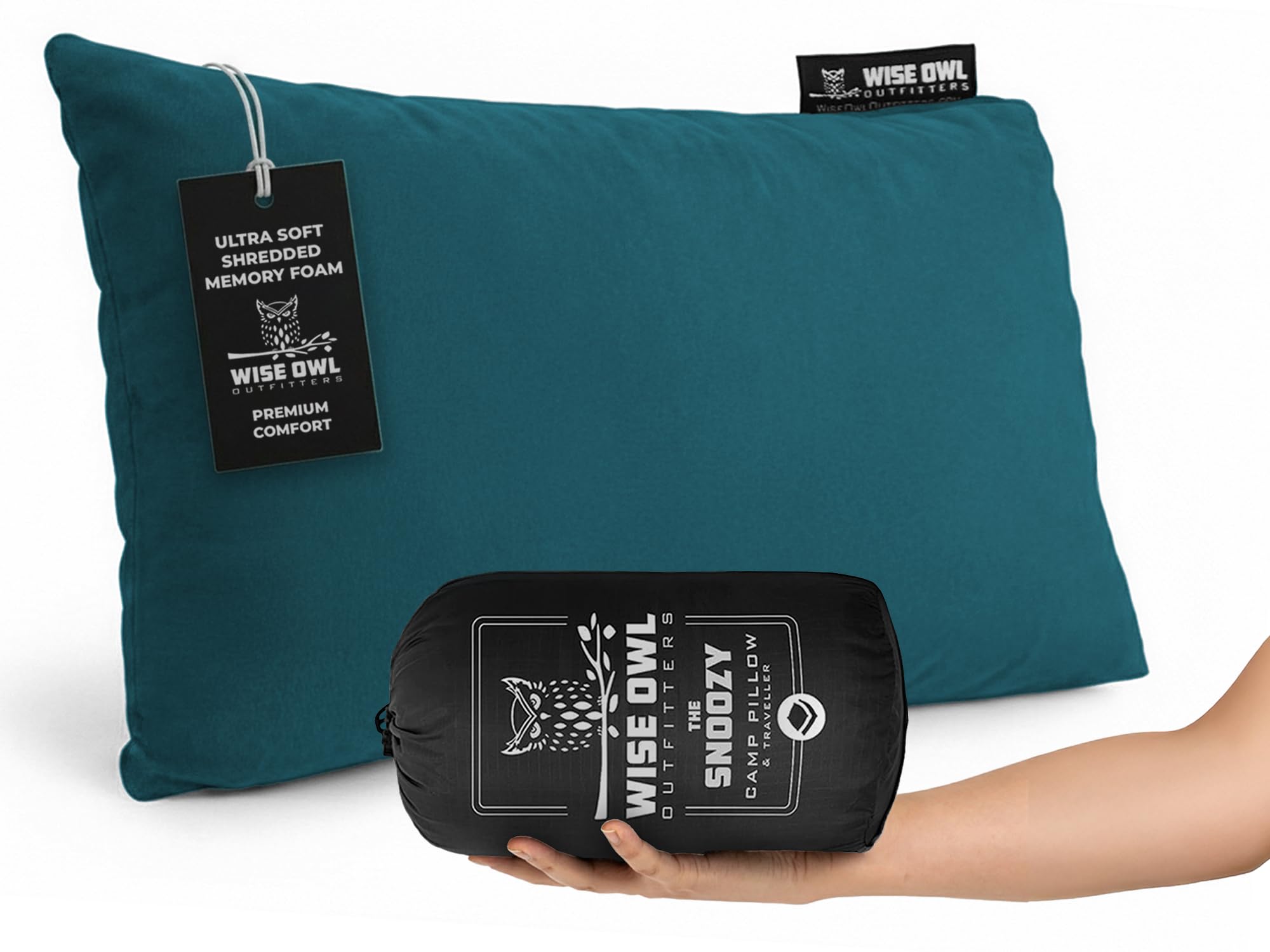
Wise Owl Memory Foam Pillow
Key Features
- Fill: Shredded memory foam
- Size: 14 x 18 in
- Cover: Removable microsuede
- Weight: 11 oz
- Price: Midrange
If you drive to your campsite, skip the inflatables entirely. The Wise Owl is a real pillow, shredded memory foam in a microsuede case, and it’s the one we hand to people who insist they can’t sleep on air.
It weighs 11 ounces and compresses into its own waterproof stuff sack, which is the right way to read that number: light enough for a short backpacking trip, bulky enough that you won’t take it on a long one. On a cot or in a big tent, that bulk stops mattering about thirty seconds after you lie down.
The foam is firm. It’s shredded, so you can push it around and punch it into shape, but it doesn’t sink the way down does and it can feel lumpy before it settles. The 14-by-18-inch footprint is generous for a camping pillow, and the microsuede cover unzips and goes in the washing machine, which after a smoky weekend is the detail we appreciate most.
Pros
- Real pillow feel from shredded foam
- Removable, machine-washable microsuede cover
- Waterproof stuff sack included
Cons
- 11 oz and bulky for backpacking
- Firm, sometimes lumpy fill
For car campers who want a pillow that feels like home: firm shredded foam, a washable microsuede cover, and enough support to head off the morning ache.
Best for Minimal Pack Weight
Sea to Summit Aeros Premium
Key Features
- Valve: Multi-function mini valve
- Weight: 2.8 oz
- Packed size: 3.3 x 2.8 in
- Inflated size: 13.4 x 9.4 x 4.3 in
- Price: Premium
At 2.8 ounces the Aeros Premium weighs less than half of our top pick and packs to 3.3 by 2.8 inches. If you count grams, the conversation starts and finishes with those two figures.
The details are what make the weight tolerable. The surface is brushed knit polyester rather than slick nylon, the curved shape cradles your head instead of letting it roll off the edge, and the multi-function valve is the best in this group: press the button and you bleed a little air out for a softer pillow without dumping the whole fill and starting again. That matters more than it sounds when you’re adjusting by feel at two in the morning.
It’s a specialist’s pillow, and it makes sense only on a certain kind of trip. The 13.4-by-9.4-inch surface is the smallest here, so if you move around in your sleep you’ll spend the night chasing it back under your head. And the extra money buys you the weight saving rather than more comfort; a cheaper inflatable is a warmer pillow for the same night’s sleep.
One compatibility note worth checking before you order: the PillowLock patches that pin it to a sleeping mat exist only on Sea to Summit mats. On anything else you’re relying on friction and a bit of luck.
Pros
- 2.8 oz, the lightest pillow here
- Micro-adjustable valve holds fine settings
- Brushed knit surface instead of slick nylon
Cons
- Smallest sleeping surface in this group
- Premium tier for an air pillow
The choice for committed ultralight packs: 2.8 ounces, a valve you can tune in the dark, and just enough surface to sleep on.
Best for Luxury Car Camping
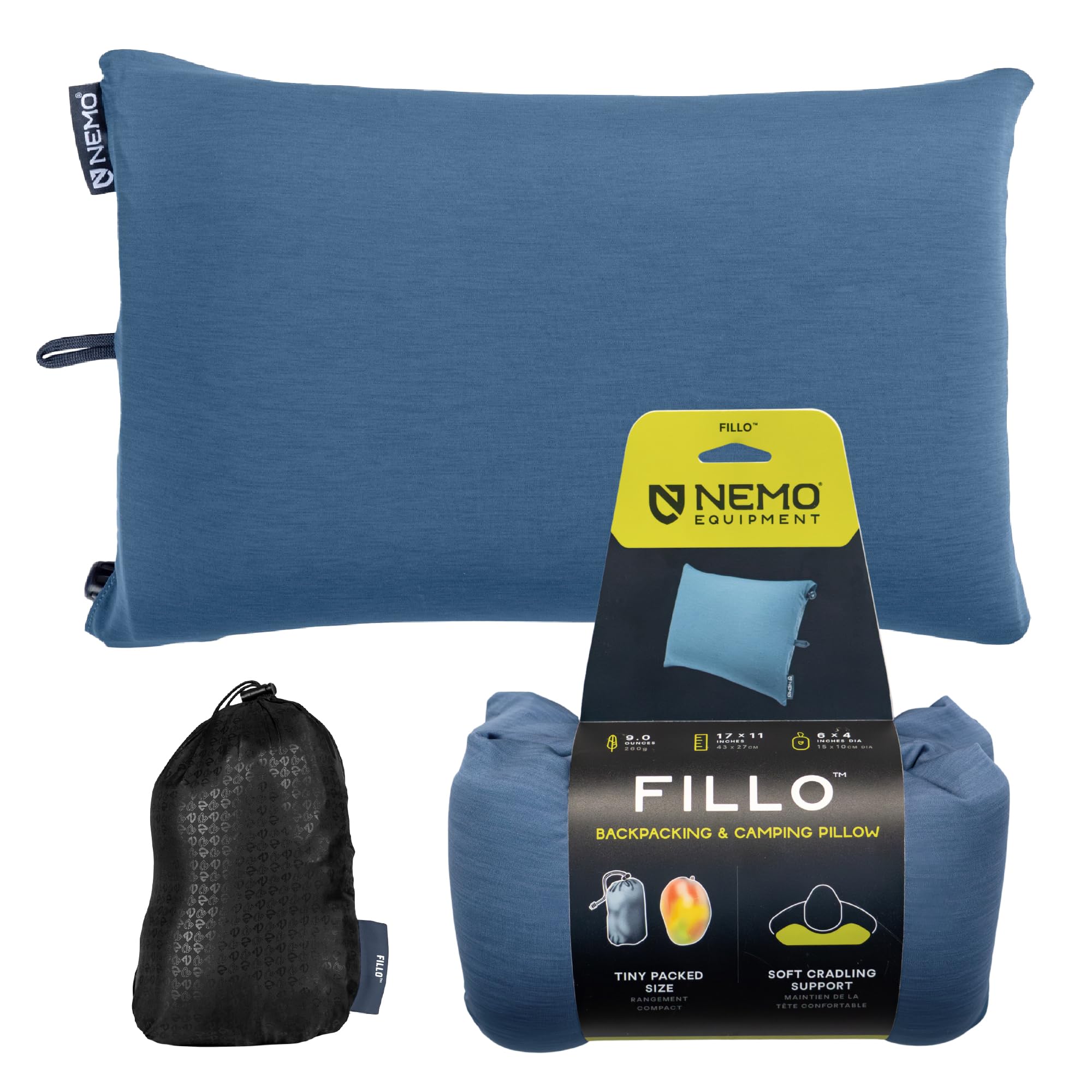
NEMO Fillo
Key Features
- Fill: Foam over air cell
- Cover: Removable, machine washable
- Weight: 9.2 oz
- Thickness: 4 in
- Price: Premium
A 3-inch I-beam air cell sits under a layer of foam, and that structure is why the Fillo doesn’t dome up like a balloon. Inflate it and the baffles hold a flattish sleeping surface; the foam on top gives it the soft, slightly yielding feel of memory foam rather than the tautness of air.
NEMO’s details are the sort you notice on the second night. The stuff sack is sewn into the pillow so it can’t go missing, the valve micro-adjusts so you can let it down a notch without losing the fill, and the recycled microfiber cover unzips and goes in the machine. At about 9 ounces it’s fine on your back for a weekend.
This is the pillow we take when the tent is the destination, car camping or a paddle-in site, rather than when we’re counting every ounce. It takes up more pack volume than any inflatable here, and on a long backpacking trip that’s the difference between a luxury and a nuisance.
What makes it worth the money is the adjustment: side sleepers can firm it up, back sleepers can let it soften, and nobody has to guess before the trip which one they are. Add a washable cover and a lifetime warranty, and the premium is easier to justify than the price tag suggests.
Pros
- Foam layer over air kills the balloon feel
- Micro-adjustable valve through the night
- Removable, machine-washable cover
- Lifetime warranty
Cons
- Bulkiest of the picks in a pack
- Most expensive pillow here
Worth the premium if you want to set your own height rather than accept it: foam over air, adjustable through the night, and a cover that washes.
Best for Budget First Pillow
Teton Sports Camp Pillow
Key Features
- Care: Machine washable
- Size: 18 x 12 in
- Weight: 9.6 oz
- Thickness: 6.9 in
- Price: Budget
There’s no valve here, nothing to inflate, and nothing to leak. The Teton Camp Pillow is a fiber-filled rectangle with a washable polyester case and its own stuff sack, and we think that ordinariness is the point: it’s the pillow you hand a kid or a first-time camper and then forget about.
It measures 18 by 12 inches and nearly 7 inches thick, which is more loft than any inflatable in this group and about what a bed pillow gives you. That suits back and side sleepers who want their head up off the ground rather than cradled in a hollow.
The cost of that loft is bulk. It weighs 9.6 ounces and never compresses to anything like the inflatables do, so it belongs in a car or a canoe rather than on a long hike, and the loft is fixed: you can’t let it down a notch on a warm night if it’s sitting too high.
What it has beyond the price is upkeep. The whole pillow goes in the machine, Teton’s lifetime warranty covers defects, and it’s the least fussy thing in this guide at a campsite where everything else wants inflating, wiping, or drying.
Pros
- Nothing to inflate and nothing to leak
- Nearly 7 inches of loft
- Machine washable with a lifetime warranty
Cons
- Bulky and 9.6 oz to carry
- Fixed loft, no firmness adjustment
The simplest, cheapest way into a real pillow at camp: fixed loft, no valve to fail, and a case you can throw in the wash.
Best for Washable Inflatable
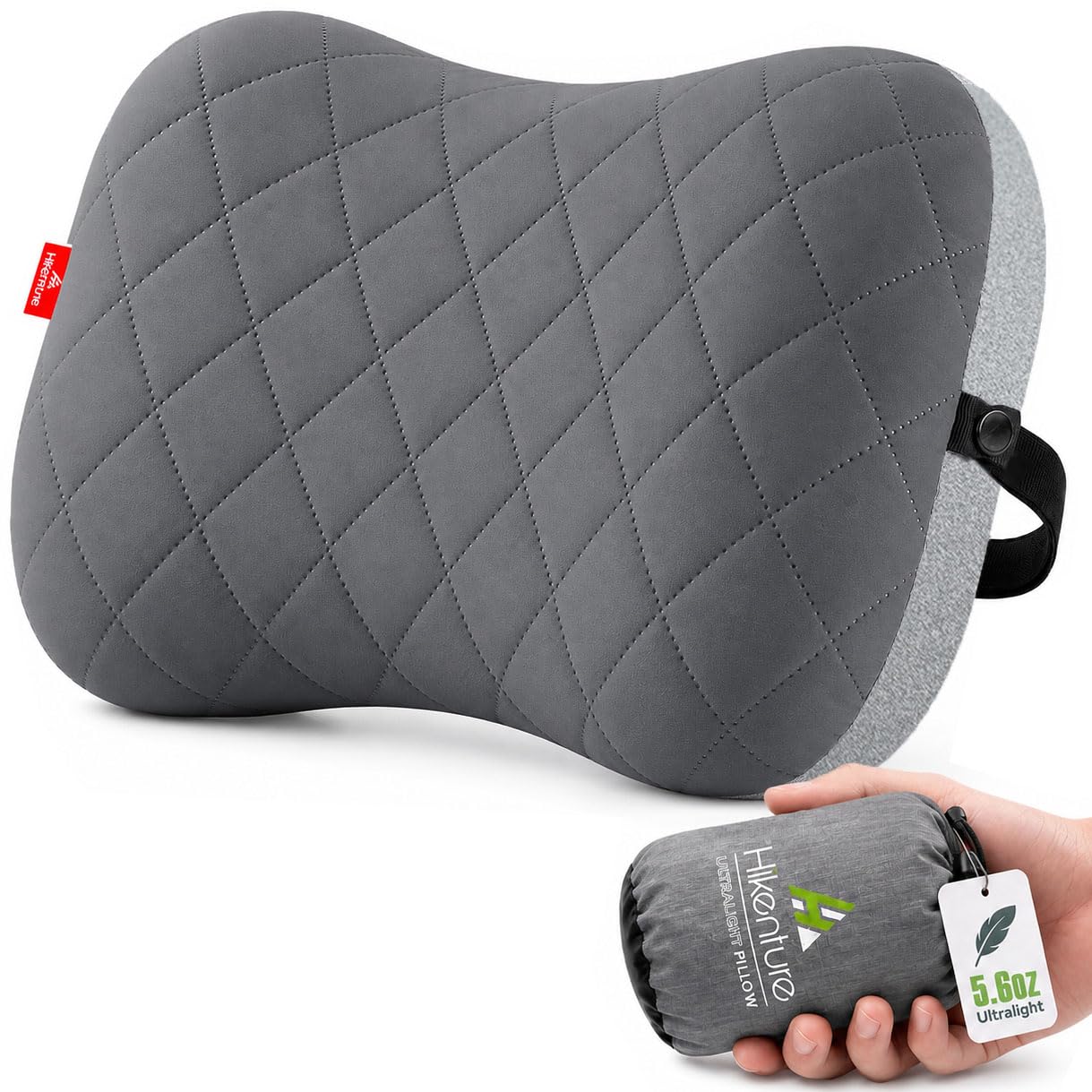
Hikenture Camping Pillow
Key Features
- Cover: Removable
- Weight: 5.6 oz
- Thickness: 4.7 in
- Inflated size: 17.3 x 12.2 in
- Price: Budget
It’s the only inflatable here with a cover that zips off and goes in the wash, and that single detail is why it earns a place. The cover is the part that touches your face, so it’s the part that should be washable, and on most air pillows it isn’t.
The rest is solid. It weighs 5.6 ounces, inflates in a few breaths through a one-click valve, and gives you 17.3 by 12.2 inches of surface at 4.7 inches thick, which is noticeably roomier than the lightest pillows in this group.
The bladder is what you’re gambling on. Seams and valves are what fail on inflatables, and the valve seat is where a slow leak would show up first. Inflate it fully at home and leave it overnight before you trust it on a trip; it’s a small check that saves a bad night at camp.
Against the Trekology it trades roughly two ounces for a roomier surface and a cover you can launder; against the foam pillows it trades comfort for pack space. For weekend trips where a clean pillow matters more than a light pack, this is the one we pack.
Pros
- Zip-off, washable cover
- 5.6 oz with a roomy surface
- One-click valve inflates fast
Cons
- Bladder and valve are the long-term risk
The best-value inflatable here for anyone who cares about a clean pillow: the cover zips off, it inflates in a few breaths, and it’s roomy for 5.6 ounces.
Best for Adjustable Foam Loft
Therm-a-Rest Compressible Cinch

Key Features
- Fill: Upcycled urethane foam
- Loft: Adjustable cinch cord
- Size: 14 x 18 in
- Thickness: 6 in
- Price: Premium
A cinch cord across the back is the whole idea. Pull it and the foam compresses; loosen it and the pillow lofts back up. It’s the only pillow here you adjust by strap rather than by breath, and after a night of fiddling with a valve, that’s a pleasant change.
The fill is upcycled urethane foam under a stretch-knit recycled polyester cover, and at 14 by 18 inches with 6 inches of loft it sleeps like a small bed pillow. The knit surface is the part we noticed first; it feels like bedding rather than gear, which is not something you can say about many things in a tent.
It’s still foam, so it never packs to nothing. Cinched down it’s a lump in a pack rather than a flat fold, and after a few nights compressed it can feel uneven until you shake it out and let it breathe. For car camping none of that matters; for backpacking it’s exactly why inflatables exist. If ounces matter, weigh it yourself before a long trip.
What sells it for us is the adjustment plus the upkeep: the cord lets a side sleeper crank it firm and a stomach sleeper let it out, the cover comes off and washes, and the three-year warranty covers the seams. It’s the foam pillow we reach for when we want to sleep well without hauling a bed pillow.
Pros
- Cinch cord adjusts loft and firmness
- 6 inches of loft under a soft knit cover
- Removable cover, three-year warranty
Cons
- Never packs small like an inflatable
- Fill can shift and feel uneven
For foam-pillow sleepers who want to tune the loft: a cinch cord, 6 inches of fill, and a soft knit cover, as long as you’re not carrying it far.
How We Tested Camping Pillows
We built the shortlist by comparing packed dimensions, weight, inflation method, shell fabric, and price against what a weekend camper or backpacker actually needs, then ruled out pillows whose specs looked good but whose valves or seams drew repeated complaints. That left 14 pillows, which we used over six months in conditions a tent pillow really sees: weekend car-camping trips, two wet nights, a backpacking overnight, and a few floor sleeps at home.
At camp, we inflated each one by mouth or pump, timed how long it took, and watched whether the valve spat air back out while we closed it. We left every pillow inflated overnight, then pressed a palm into the center in the morning to see how much loft and support remained. During the night, we noted whether it slid off the pad, flattened under a side sleeper’s head, or stayed put through a turn.
Back home, we stuffed each pillow into its sack five times and compared the packed bundle to a one-liter water bottle, since pack space is the whole point. We weighed them on a kitchen scale and checked seams, fabric, and valves after every trip for abrasion or leaks. At the end, we matched price against how each one held up, because a cheap pillow that goes flat is no bargain.
How to Choose a Camping Pillow
Almost every decision here comes down to one trade: how much weight and pack space you’ll spend for a surface that feels like a pillow instead of a balloon.
Air, Foam, or Hybrid
Air pillows are the lightest thing you can bring, and the air chamber is exactly what you feel under your head. Foam pillows feel like the pillow at home, weigh roughly twice as much, and never compress below a certain lump. Hybrids put foam or fiber over an air cell, which is why our top pick sleeps the way it does. Pick air for distance, foam when the car is the campsite, and hybrid if you’ve had bad nights on inflatables before.
Packed Size and Weight
Compact in a listing describes the pillow, not your pack. A six-inch foam pillow called compact is still a bulky lump; a three-ounce inflatable called compact vanishes into a hipbelt pocket. Compare packed weight and packed dimensions together and ignore the adjectives. In this group the air pillows run from just under three ounces to seven, and the foam ones from about nine to eleven. Hiking more than a few miles, aim low; driving in, take the comfort.
Loft and Surface Area
Thickness matters more than length. Four inches is the working minimum for a side sleeper, and the Teton’s 6.9 inches is more loft than any inflatable here offers. Surface area is the other half of the equation: the smallest pillow in this group gives you 13.4 by 9.4 inches, and if you move around at night you’ll spend it retrieving the pillow. Back and stomach sleepers can go thinner and smaller.
Air Retention and Noise
An inflatable that’s firm at 10 p.m. can be half flat by four. TPU softens as it cools, and a valve that isn’t seated properly will bleed all night. Before any trip, inflate it fully at home, close the valve, and leave it overnight; if it’s softer in the morning, return it. Crinkling is the other air-pillow complaint, and it’s a fabric question: a brushed or knit cover muffles it, thin nylon does not.
Covers, Cleaning, and What Lasts
Foam lasts; bladders eventually don’t. The seam at the valve is usually where an inflatable gives up, which is why a zip-off cover is worth more than the gram it costs. On a foam pillow the cover is what wears out first, so a removable washable one adds years of use. Camp a few times a year and a wash plus a spot clean is plenty; go most weekends and plan to replace the inflatable eventually.
Frequently Asked Questions
Is a camping pillow worth bringing?
If you wake up because your head has slid off a stuff sack, yes. A jacket wrapped in a fleece works for one night, but clothes compact as you sleep and shift every time you turn over. Test it before you buy: roll a fleece into your sleeping bag’s hood, sleep on it, and see how you feel at six in the morning. Most people who sleep badly outdoors are short of loft, not short of gear.
How do I keep a camping pillow from sliding off my sleeping pad?
Attach it to something. The Trekology has a strap that loops around a pad plus grip dots on the back, and Sea to Summit’s PillowLock patches only work on their own mats, so check before you count on them. With a smooth pad, tuck the pillow inside your sleeping bag’s hood or under a pad strap. A pillow merely jammed against the tent wall will be on the floor by morning.
How do I clean a camping pillow?
Unzip the cover, machine wash it cold, and air dry it. Never put an inflatable bladder in a dryer; heat turns a slow seam leak into a burst one. If the cover doesn’t come off, hand wash the whole pillow with mild soap, rinse thoroughly, and dry it fully inflated with the valve open before it goes back in the pack. Foam pillows often survive a gentle cycle, but check the tag first.
What’s the difference between a camping pillow and a travel pillow?
A travel pillow is usually a U-shaped collar built to hold your head upright in a seat. A camping pillow is a flat sleeping surface for lying down, and it’s judged on loft, packed size, and how it behaves overnight. Napping in a car or a plane seat, buy the collar. Sleeping flat in a tent, buy the flat pillow, and check its packed dimensions against the space you’ve actually got.
Final Verdict
Start with the Klymit Luxe. It solves the problem most campers actually have, a surface that feels like a pillow but still disappears into a pack, and at 7 ounces it works for a weekend backpack and a drive-in campsite alike.
Counting grams, the Sea to Summit Aeros Premium saves you a shade over four ounces if you can live with a smaller surface. Sleeping in a tent you drive to, the Wise Owl’s shredded foam beats both on comfort, and the bulk stops mattering the moment the car is parked.