This post contains affiliate links. We may earn a small commission when you buy through our links — at no extra cost to you.
Backpacking pillows make a simple promise and often break it: the smaller one packs, the less it feels like a pillow, and the plusher it feels at home, the more of your pack it eats. I’ve slept on a rolled-up fleece, a stuff sack stuffed with tomorrow’s jacket, and an inflatable that went flat by 2 a.m., so I understand the temptation to leave the thing behind entirely. But a bad night doesn’t stay in the tent — it shows up in your pace and your knees on the descent. A pillow light enough to earn its place is the cheapest upgrade there is to how the next day feels.
Over seven months we took 14 backpacking pillows on overnight trips, and the differences had surprisingly little to do with how they look online. The real surprise was firmness: most inflatables soften overnight, so a pillow that feels perfect at 9 p.m. can be a pancake by 3. One you can top up in the dark without waking the tent beats one with nicer fabric every time. The ones worth carrying are below.




Best for Ultralight Backpacking
Sea to Summit Aeros Premium
Key Features
- Fill: Air
- Weight: 2.8 oz
- Packed size: 3.3 x 2.8 in
- Inflated size: 13.4 x 9.4 x 4.3 in
- Price: Premium
2.8 ounces, packed to 3.3 by 2.8 inches. The Aeros Premium takes less room in a pack than a spare pair of socks and less weight than a bar of chocolate, and it settles our recommendation before comfort even enters the argument. If you count grams, this is the pillow.
The brushed knit face is what separates it from the field. Most inflatables press a taut film against your cheek and rustle when you turn over; this one has a soft, faintly textured surface and a contoured shape that holds your head instead of letting it roll off the edge. The multi-function valve does the rest of the work — the large port fills it in a couple of breaths, and the small button bleeds air a puff at a time so you can find the pressure you actually want rather than the one you inflated to in the dark.
The Regular measures 13.4 by 9.4 inches inflated with 4.3 inches of height, which is plenty under a head but not a broad sleeping surface; broad shoulders and a lot of rolling over argue for more width. If you sleep on a Sea to Summit mat, the PillowLock patches hold it where you put it. On any other pad it behaves like every other inflatable and can wander during the night.
Price is the honest objection. This is the most expensive inflatable here, and a pillow is an easy thing to economize on at the start of a season. What the money buys is a night where the pillow never crosses your mind, which is the whole reason to carry one up a hill.
Pros
- 2.8 oz and packs to fist size
- Brushed knit face feels like fabric, not plastic
- Micro valve lets you fine-tune firmness
- PillowLock holds it on Sea to Summit mats
Cons
- Hand wash and air dry only
- Premium price for a small pillow
It is the pillow we recommend to anyone counting ounces: 2.8 ounces, fist-sized packed, and soft enough that we stopped noticing it by the second night.
Best for Budget Backpacking
Trekology Aluft 2.0
Key Features
- Fill: Air
- Weight: 3.84 oz
- Packed size: 5 x 2 in
- Inflated size: 16 x 12 x 4 in
- Price: Budget
The Aluft 2.0 is the pillow we send first-time buyers toward, and not because it is the best pillow here. It is not. It is the one that costs almost nothing in weight or pack space — 3.84 ounces, rolled to 5 by 2 inches — and then does the two jobs an inflatable has to do: it fills in a couple of breaths and it stays where you put it.
Staying put is what surprised us. The back is covered in rubber anti-slip dots and there is an elastic strap that wraps around a sleeping pad, so the pillow is still under your head at 2 a.m. rather than wedged against the tent wall. Inflated to 16 by 12 inches with 4 inches of height, it is firm — properly firm — which suits back sleepers and anyone who dislikes the sinking feel of an underfilled air pillow.
The shell is the part to go in with your eyes open. It is thin TPU, and thin TPU fails at a pinhole or a seam rather than wearing out gracefully. Ours came through our trips intact, but we treat this pillow as a consumable that may last two or three seasons, which is a much easier thing to accept at the bottom of the price range than at the top.
Pros
- Anti-slip dots and strap keep it on the pad
- 3.84 oz with a 5 x 2 inch pack size
- Firm 4-inch loft suits back sleepers
Cons
- Thin shell can puncture or split early
- Firm feel will not suit soft-pillow sleepers
We keep pointing first-timers here because it stays on the pad, packs to nothing, and asks very little of your budget — just do not expect years of service.
Best for Comfort-First Camping
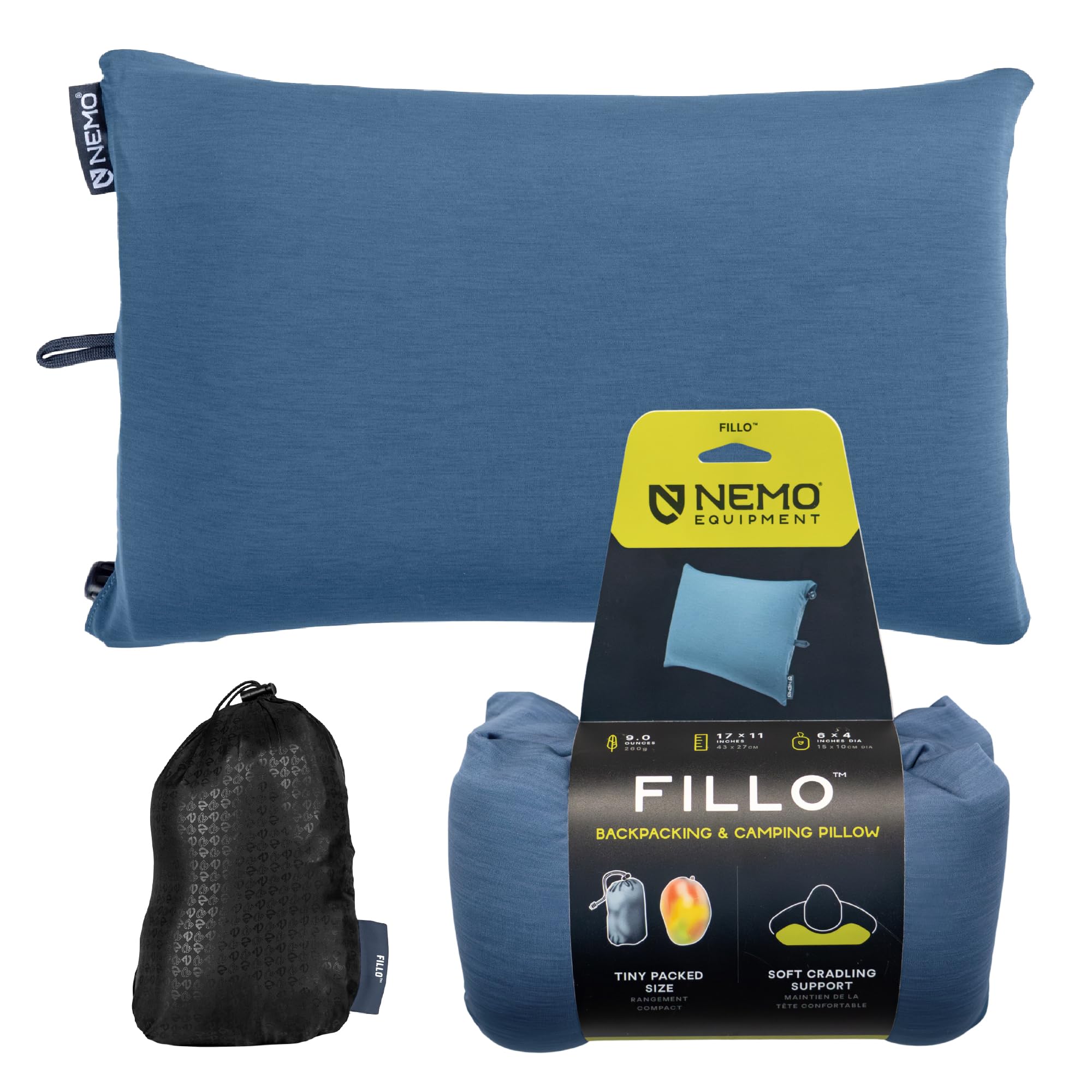
NEMO Fillo
Key Features
- Fill: Foam and air cell
- Cover: Removable, washable
- Packed: Integrated stuff sack
- Weight: 9.2 oz
- Price: Premium
9.2 ounces is real weight. The Fillo is more than three times as heavy as our top pick and packs to roughly the size of a grapefruit, so a pack built around a ten-pound base weight has no room for it. It is also the pillow we reach for when the trip is about sleeping well rather than covering miles.
The construction explains the weight. A 3-inch I-beam baffled air cell gives the pillow structure, so there is no balloon dome under your head, and a layer of foam on top supplies the give that makes a pillow feel like a pillow rather than an inflated bag. Blow it up firm for side sleeping, or let air out until it is soft and let the foam take over.
The details are handled: a removable, machine-washable recycled fabric cover that is soft enough to sleep on directly, an integrated stuff sack that cannot get lost in the tent, and a micro-adjustable valve you can tune in the dark without waking anyone. Nothing about it feels improvised.
What the foam costs you is bulk and money, and neither is a problem if most of your nights are in a car or a base camp. For a long thru-hike it is a luxury item, and a very good one — we just would not build a lightweight kit around it.
Pros
- Foam layer over an air cell feels like a real pillow
- Removable, machine-washable recycled cover
- Integrated stuff sack cannot be lost
Cons
- Heavy and bulky next to an inflatable
- Premium price
Our pick when sleeping well outranks shaving grams: the foam-topped air cell is the closest thing here to a real pillow at 9.2 ounces.
Best for Side Sleeping
Klymit Luxe Travel Pillow
Key Features
- Care: Machine wash, tumble dry low
- Fill: Polyester and air
- Size: X-Large
- Weight: 7 oz
- Price: Premium
Side sleepers get the worst of a flat air pillow. Your head drops, your shoulder carries the load, and by morning your ear has spent six hours against a taut membrane. The Luxe answers that with an air cell for height and a polyester fill layer on top, so there is actual loft under your cheek instead of a drum skin.
It is a 7-ounce pillow listed as X-Large, and Klymit quotes ten to fifteen breaths to fill it. The outer fabric is a soft-touch polyester with a plush hand that does not announce itself as plastic, and unusually for this group the whole pillow can go in a washing machine and be tumble-dried on low, with no separate cover to keep track of.
Of everything here, this is the pillow with the least to complain about: soft, tall, quiet, and washable without fuss. Our reservation is size. The XL is a lot of pillow inside a small tent and a lot of packed volume inside a small pack, and at 7 ounces it is not what you take on a fast-and-light trip.
Pros
- Polyester fill over air gives real loft
- Whole pillow is machine washable
- Soft-touch fabric, not a plastic membrane
Cons
- Simple screw valve, no one-way inflation
- XL size is bulky in a small pack
If you sleep on your side and want genuine height under your ear, this hybrid earns its 7 ounces and then some.
Best for Foam on Trail
Nappler Shredded Foam
Key Features
- Fill: Shredded memory foam
- Size: 19 x 13 in
- Cover: Removable, washable
- Weight: 8 oz
- Price: Midrange
An 8-ounce shredded-foam pillow is an oddity. The Wise Owl weighs 11 ounces, the TETON 9.6, and both take up noticeably more room; Nappler squeezes a 19-by-13-inch foam pillow into a pouch that clips to the outside of a pack. For anyone who has given up on air pillows after one leak too many, that is the interesting part.
The fill is loose shredded memory foam behind a zip, so you can pull out handfuls until the height suits you — a genuine fix if you have bought a camp pillow that turned out two inches too tall. It is medium firm, holds its shape through the night, and the cover unzips for machine washing, which matters on a trip long enough to notice.
Give it time to come back to life. Compressed foam arrives flat and needs several hours to loft, so unpack it when you pitch rather than when you are ready to sleep. Once it has, this is the foam pillow we pack when the trip is three nights and comfort outranks grams.
Pros
- 8 oz for a shredded-foam pillow
- Removable fill lets you set the height
- Removable cover is machine washable
Cons
- Packs larger than any inflatable here
- Only the cover can be washed
For backpackers who want foam rather than air, this is the one that still fits in a pack: 8 ounces, adjustable fill, and a real pillow’s surface.
Best for Car Camping
Wise Owl Memory Foam
Key Features
- Fill: Memory foam
- Size: 12 x 16 in
- Packed: Waterproof stuff sack
- Weight: 11 oz
- Price: Midrange
11 ounces, and a stuff sack that takes both hands and a knee. This is not a backpacking pillow in any serious sense — it is the pillow for the car, the base camp, the festival, the cabin weekend, the overnight where your pack travels twenty feet from the trunk.
What the weight buys is a 12-by-16-inch shredded memory foam pillow with a microsuede cover that feels like bedding rather than gear, 4 inches of loft, and a cover that unzips and goes in the machine. The fill is loose, so you can push it around and build height where your head actually is, and the stuff sack is waterproof, which is more useful than it sounds in a damp tent.
For the way most people camp — a car, a tent, a cooler — this is the foam pillow we hand over first. Sleep on it a night or two at home before the trip so the fill settles where it needs to; it arrives packed tight and takes a little persuading.
Pros
- Microsuede cover feels like real bedding
- Removable cover for machine washing
- Waterproof stuff sack included
Cons
- Too heavy and bulky for a backpack
- Shredded fill can feel lumpy
A genuinely comfortable foam pillow for car camping and base camp, as long as you are not the one carrying it up a mountain.
Best for Washable Cover
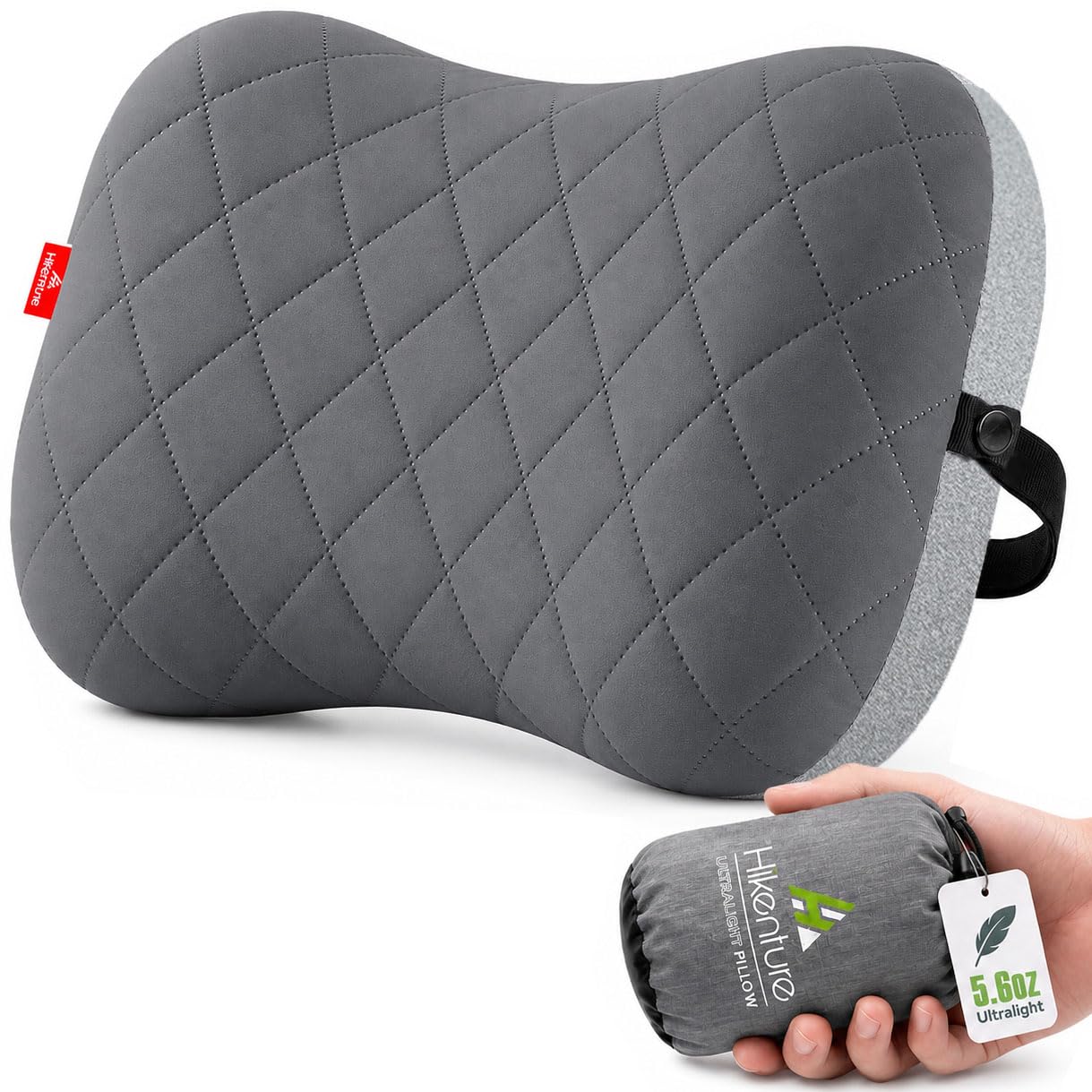
Hikenture Camping Pillow
Key Features
- Cover: Removable, washable
- Valve: One-click
- Weight: 5.6 oz
- Inflated size: 12.2 x 17.3 x 4.7 in
- Price: Budget
Almost every inflatable here is hand-wash only, which after four nights in the same sleeping bag is a grimmer prospect than it sounds. The Hikenture solves that the obvious way: a breathable fabric cover that peels off the bladder and goes into the machine, so the part your face touches is clean even when the rest of your kit is not.
The rest is a well-sorted inflatable. At 12.2 by 17.3 inches and 4.7 inches thick, it has the biggest sleeping surface of any air pillow here, and the one-click valve fills it in a few breaths. The curve is shaped for back and side sleepers, and the cover is soft against a face rather than slick.
The bladder is where the risk sits. It is a thin TPU film with welded seams and a plastic valve, and failures happen: a slow leak, a split at the valve, a pillow that is flat by midnight. Ours held through our trips, but the pillow’s life is the bladder’s life, and no cover changes that.
So if a washable cover and a bigger sleeping surface are worth three ounces to you, this is the pick, and it is the one we hand to anyone who finds inflatables clammy. If you want the pillow most likely to still be in your pack three seasons from now, spend more on the Sea to Summit.
Pros
- Removable cover goes in the washing machine
- Biggest inflated surface of the air pillows here
- One-click valve fills in a few breaths
Cons
- Bladder or valve can fail
- Heavier than other inflatables here
Buy it if a washable cover matters more to you than the last few ounces, and treat the bladder as the part that will eventually let you down.
Best for No-Inflation Camping
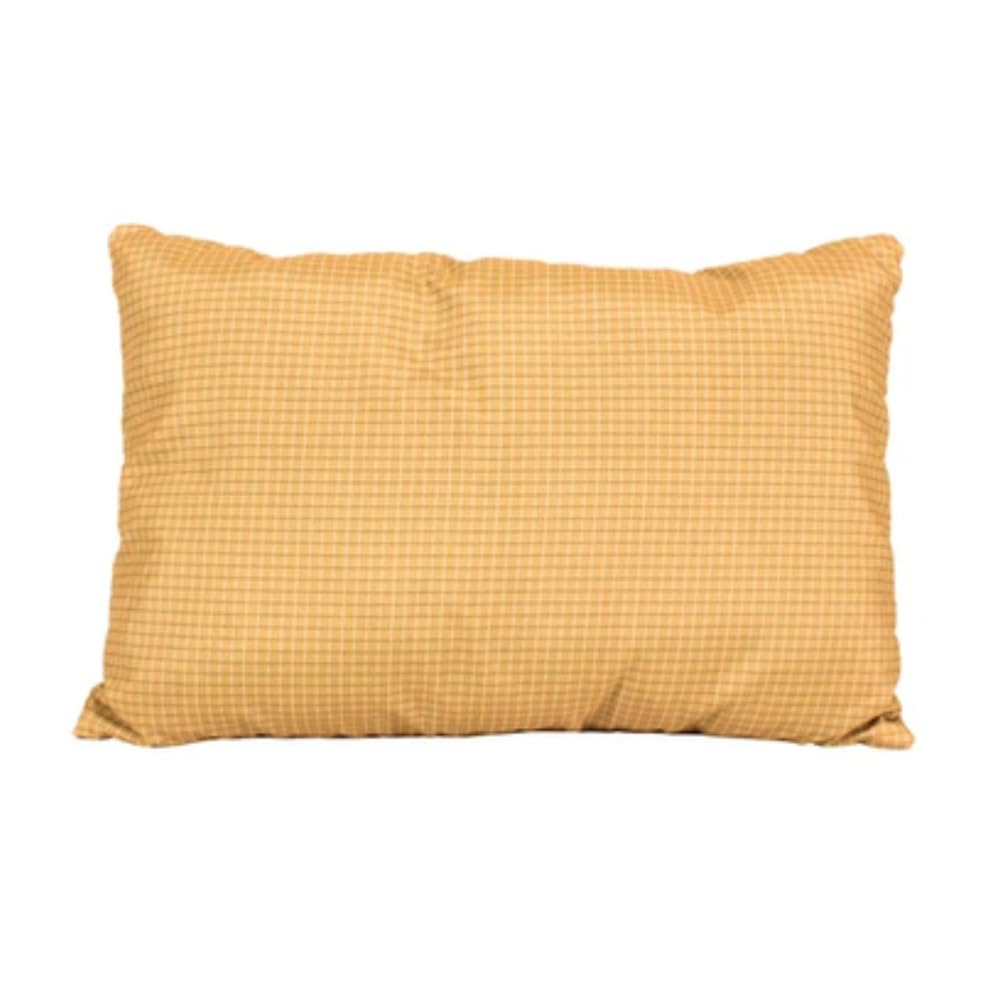
TETON Sports Camp Pillow
Key Features
- Fill: Fiber fill
- Size: 18 x 12 x 6.9 in
- Packed: Compression sack
- Weight: 9.6 oz
- Price: Budget
There is a small, specific pleasure in arriving at camp, unrolling a pillow, and not blowing into anything.
The TETON lofts on its own — fiber fill inside a polyester flannel cover, 18 by 12 inches and 6.9 inches thick, which is more loft than any inflatable here. It is machine washable as a unit, arrives with a pillowcase and a compression sack, and carries a limited lifetime warranty. It weighs 9.6 ounces.
Sizing is the thing to get right. It is a camp pillow, not a bed pillow: 18 by 12 inches reads generous next to a 3-ounce inflatable and small next to what is on your bed, and the gap between those expectations is where disappointment lives. Fold it in half if you want a neck roll.
For car camping, scout trips, and huts, it is the simplest thing in this guide — quiet, valve-free, nothing to puncture, and it smells like a pillow instead of a tent. At 9.6 ounces with a compression sack’s worth of bulk, it is also more than a backpacker wants to carry.
Pros
- Nothing to inflate or puncture
- Pillow and case are machine washable
- 6.9 inches of loft, the most here
Cons
- Heavy and bulky for backpacking
- No way to adjust firmness
The no-fuss option for car camping and scout trips: it lofts itself, washes in a machine, and never needs a valve.
How We Chose and Tested Backpacking Pillows
We started with a shortlist of roughly 40 pillows — brands we’ve used on trail plus a few well-reviewed newcomers — and cut it down before anyone slept on anything. We logged weight and packed size first and dropped anything over about half a pound or bulkier than a large grapefruit, since a pillow that eats pack space you’d rather give to food doesn’t come on a second trip. We deliberately kept budget options in alongside the spendier ones to see whether the extra money bought real comfort. That left 14.
Testing ran for seven months, from spring overnighters through a few cold nights in the fall, and covered two multi-night trips, a handful of car-camping weekends, and more backyard tent nights than I’d like to admit. Our testers sleep in every position, so each pillow went to a side sleeper, a back sleeper, and a stomach sleeper, and we noted where it ended up by morning — under a shoulder, wedged against the tent wall, or exactly where it started. We also watched how each one sat inside a sleeping bag hood versus loose on top of a pad.
At camp, we counted breaths to inflate each pillow and timed how long it took to deflate and wrestle back into its stuff sack, usually by headlamp. For air retention, we left each one inflated for 48 hours, then squeezed it and compared it to the day it was filled, and we noted which ones felt half-flat at 3 a.m. on a cold night. Durability came from repetition — 20 rounds of inflating, stuffing, and unpacking per pillow, then a close look at seams and valves. We checked packed size against a one-liter bottle, and whether a pillow slid off the pad or stayed put through a night of turning.
How to Choose a Backpacking Pillow
The right pillow is the one you stop thinking about at 2 a.m., and almost every decision comes down to how much weight and pack space you will trade for that.
Weigh the pillow against the sleep you get
An inflatable adds 3 to 6 ounces and packs to the size of a fist. A shredded-foam pillow runs 8 to 11 ounces and takes several times the volume. We think the trade only works in one direction: buy the lightest pillow you can actually sleep on, not the lightest one on the page.
Back sleepers on two-night trips do fine with an inflatable. Anyone who wakes with a stiff neck every morning should spend the extra five ounces. A pillow you resent carrying is still better than a pillow that keeps you awake.
Inflatable, foam, or hybrid
Inflatables are lightest and let you dial firmness, but a plain air cell can feel like a balloon and a puncture ends it. Foam feels like home and never deflates at 3 a.m., at the cost of bulk and weight. Hybrids put a fill layer over an air cell — the NEMO Fillo and Klymit Luxe here — and land around 7 to 9 ounces.
Choose a hybrid if one pillow has to cover both car camping and the occasional backpacking trip. Choose air if you hike light or fly with it. Choose foam if the pillow never walks far from the car.
Height, surface, and staying on the pad
Side sleepers need height under the ear — 4 inches or more — while back sleepers do fine with less. The other number that matters is the inflated surface: 12 by 16 inches is about the minimum for an adult head, and anything smaller ends up on the tent floor.
Then look for a way to anchor it: an elastic strap, rubber dots on the back, or a patch system that mates with your sleeping mat. A pillow that slides off at 2 a.m. is worse than no pillow, because you wake up hunting for it in the dark.
Valves and seams decide how long it lasts
Every inflatable here fails the same way: a seam, a weld, or the valve. A valve with a fine-adjust button is easier to top up in the dark and keeps you from overinflating a plain screw cap to compensate.
Before a trip, inflate the pillow at home and leave it for an hour. A slow leak shows up as a soft pillow rather than a flat one, which is the difference between fixing it at home and sleeping on a folded jacket. Foam pillows fail at the cover zip instead, so check that it runs freely before you pack.
Frequently Asked Questions
Can I just use a stuff sack filled with clothes instead of a pillow?
You can, and on a two-night trip in mild weather it is a reasonable trade — a dry bag with a fleece in it works. The problem is consistency: a clothes bag compresses through the night and ends up half the height by morning.
Buy a pillow once you are sleeping out three or more nights in a row, or when you wake with a sore neck on every trip. Test the stuff sack at home first and see how it feels after six hours.
How do I wash a camping pillow?
For an inflatable, wipe the bladder with mild soap, rinse, and let it air dry completely before it goes back in its sack — trapped moisture is what makes a pillow smell. If the cover comes off, machine wash that separately.
For foam, wash the cover only and never put the core through a machine; spot-clean and air it in the shade. Check the care label first, since the Sea to Summit Aeros is hand-wash only while the Klymit Luxe can go in a machine.
Can I use a backpacking pillow on a plane or in a car?
Yes. Every pillow here fits in a carry-on, and nothing about a TPU bladder or a foam fill is restricted at security. Deflate an inflatable for the flight and top it up once you are seated, since 4 inches of loft is too tall for an airline seatback.
The foam picks work as a car pillow between trips — the Nappler and the Wise Owl both squash into a door pocket or a suitcase corner without complaint.
Final Verdict
The Sea to Summit Aeros Premium is where we point first: 2.8 ounces, packed smaller than a coffee mug, with a brushed cover and a fine-adjust valve that make it sleepable rather than merely tolerable. It is the pillow that costs you the least in a pack and still gets you through the night.
If the budget is tight, the Trekology Aluft 2.0 stays on the pad for a fraction of the money. And if you want a real pillow more than a light one, the NEMO Fillo is what we carry when the trip is about sleeping well.