This post contains affiliate links. We may earn a small commission when you buy through our links — at no extra cost to you.
A packable pillow and a comfortable pillow are usually two different pillows, and that’s the whole problem with shopping this category. Go small enough to vanish into a pack and you’re resting your head on a deflated balloon; go plush enough to actually sleep on and you’ve surrendered a stuff sack’s worth of space. I’ve folded more fleece jackets under my head than I’d like to admit. A good camping pillow buys you a real night’s sleep with almost no weight and no morning wrestling match.
Over four months we slept on 14 of them — in tents, in a hammock, on a cabin floor, and once in the back of a hatchback at a trailhead — looking for the ones that get the balance right. Here’s something first-time buyers don’t know: inflated dimensions are measured rock hard, so a pillow you can barely compress is usually an inch shorter once you let air out to actually sleep on it. The picks below are the ones I’d pack again without a second thought.
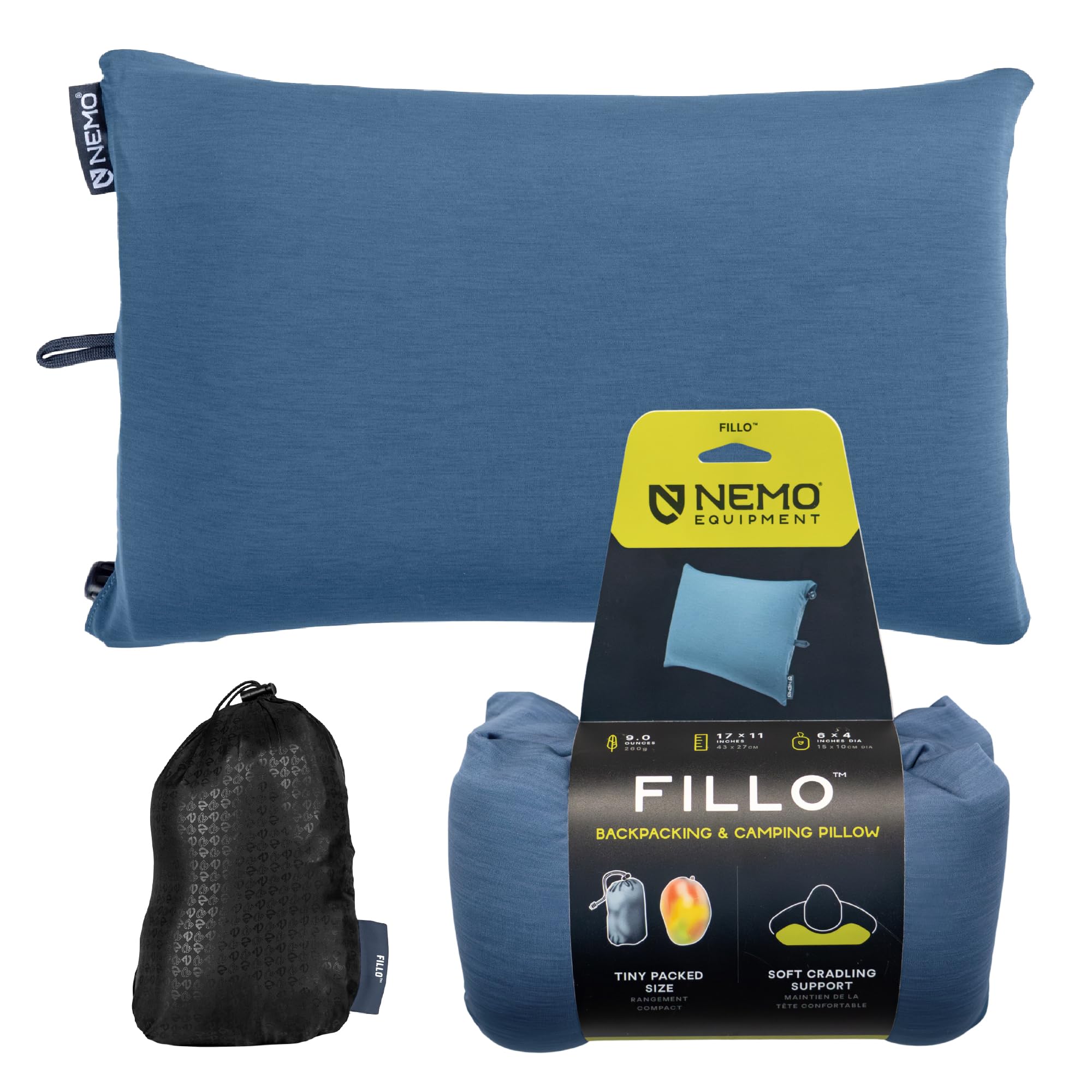




Best for All-Round Camping
NEMO Fillo
Key Features
- Fill: Foam over air cell
- Cover: Removable, machine washable
- Weight: 0.26 kg (9.2 oz)
- Thickness: 4 in
- Price: Premium
Every inflatable pillow runs into the same problem: you lie down, your head perches on a balloon, and the smallest shift sends a wobble through your neck. NEMO’s answer is a 3-inch I-beam baffled air cell under a slab of foam, so the surface gives where your head lands instead of bouncing it back. A micro-adjustable valve lets you tune firmness in small steps rather than choosing between brick and blob.
That combination is what makes the Fillo our top pick. It is the best balance of sleep comfort and packed size in this set: 4 inches of loft, under ten ounces, and a stuff sack sewn into the pillow so it cannot wander off inside a tent. The recycled microfiber cover unzips and goes in the washing machine, which matters more on something that spends the night against your face than it does on a bed pillow.
The trade-off is weight. At 0.26 kilograms the Fillo is roughly three times what the Aeros weighs, and a committed ultralight hiker will feel every gram of it. We think that is the right trade for side sleepers who want a pillow that behaves like a pillow. If you count every ounce, buy the Sea to Summit below; if you do not, this is the pillow that ends the search.
Pros
- Foam over a baffled air cell kills the balloon feel
- Cover unzips and machine washes
- Stuff sack is sewn in, so it never goes missing
- Micro-adjustable valve fine-tunes firmness
Cons
- Premium price tier
We recommend the Fillo to anyone who wants their camping pillow to sleep like bedding: foam over air, a washable cover, and a stuff sack that stays attached to the pillow.
Best for Ultralight Backpacking
Sea to Summit Aeros Premium
Key Features
- Weight: 2.8 oz
- Face Fabric: Brushed knit polyester
- Packed Size: 3.3 x 2.8 in
- Inflated Size: 13.4 x 9.4 x 4.3 in
- Price: Midrange
Packed, the Aeros Premium measures 3.3 by 2.8 inches and weighs 2.8 ounces, about the size of a clenched fist. That number is the reason it exists, and nothing else in this set gets close to it.
The brushed knit face is the detail that separates it from cheap inflatables. It does not have the cold, tacky feel of a bare bladder against your cheek, and the fabric muffles the crinkle you hear on cheaper pillows when you turn over. The multi-function valve does three jobs: it inflates, it dumps air fast, and a button bleeds pressure in small increments so you can go from firm to right without starting over.
For backpacking, this is the pillow we take. Inflated, it is 13.4 by 9.4 inches with 4.3 inches of height, a small surface, and a broad-shouldered side sleeper may want to look at the wider foam pillows here. The D-shaped profile does give your head a defined place to sit, and on a mummy pad that shape matters more than raw width. One thing to know before you rely on it: the PillowLock patches that hold it to a sleeping mat are on Sea to Summit mats only, so the anti-slip feature is a system, not a universal.
Pros
- Packs to fist size at 2.8 ounces
- Brushed knit face feels like fabric, not plastic
- Multi-function valve adjusts pressure precisely
Cons
- Hand wash and air dry only
- Small sleeping surface
We take this one when we are counting ounces: at 2.8 ounces it disappears into a pack and still gives your head a real surface to sleep on.
Best for Side Sleepers
Klymit Luxe
Key Features
- Care: Machine washable, tumble dry low
- Fill: Air and polyester hybrid
- Weight: 7 oz
- Inflation: 10 to 15 breaths
- Price: Midrange
Part air, part polyester fill, wrapped in a soft-touch fabric that does not feel like a pool toy, the Luxe is the inflatable for people who have sworn off inflatables. We think it is the most comfortable air pillow in this group, and it hides its bladder better than any of the others.
Ten to fifteen breaths gets it up, and the fill does the rest: polyester loft on top, air underneath, so your head cradles instead of rebounding. The cover is machine washable, which is unusual on a hybrid. The valve is a plain screw cap rather than a one-way inflator, so you lose a little air while you are closing it. Inflate it slightly firmer than you want and it settles about right.
Where it gives ground is weight: at 7 ounces it is well behind the 2.8-ounce Aeros, so it is not the pillow for anyone counting grams on a thru-hike. For weekend tents, campervans and hammocks, the comfort is worth the extra ounces, and it still packs smaller than any foam pillow here.
Pros
- Hybrid fill feels plush, not balloon-like
- Inflates in 10 to 15 breaths
- Machine-washable cover
Cons
- Heavier than the ultralight inflatables here
Our pick for inflatable skeptics: the hybrid fill and soft cover make it feel like a pillow rather than a balloon, and it still packs down to seven ounces.
Best for Car Camping
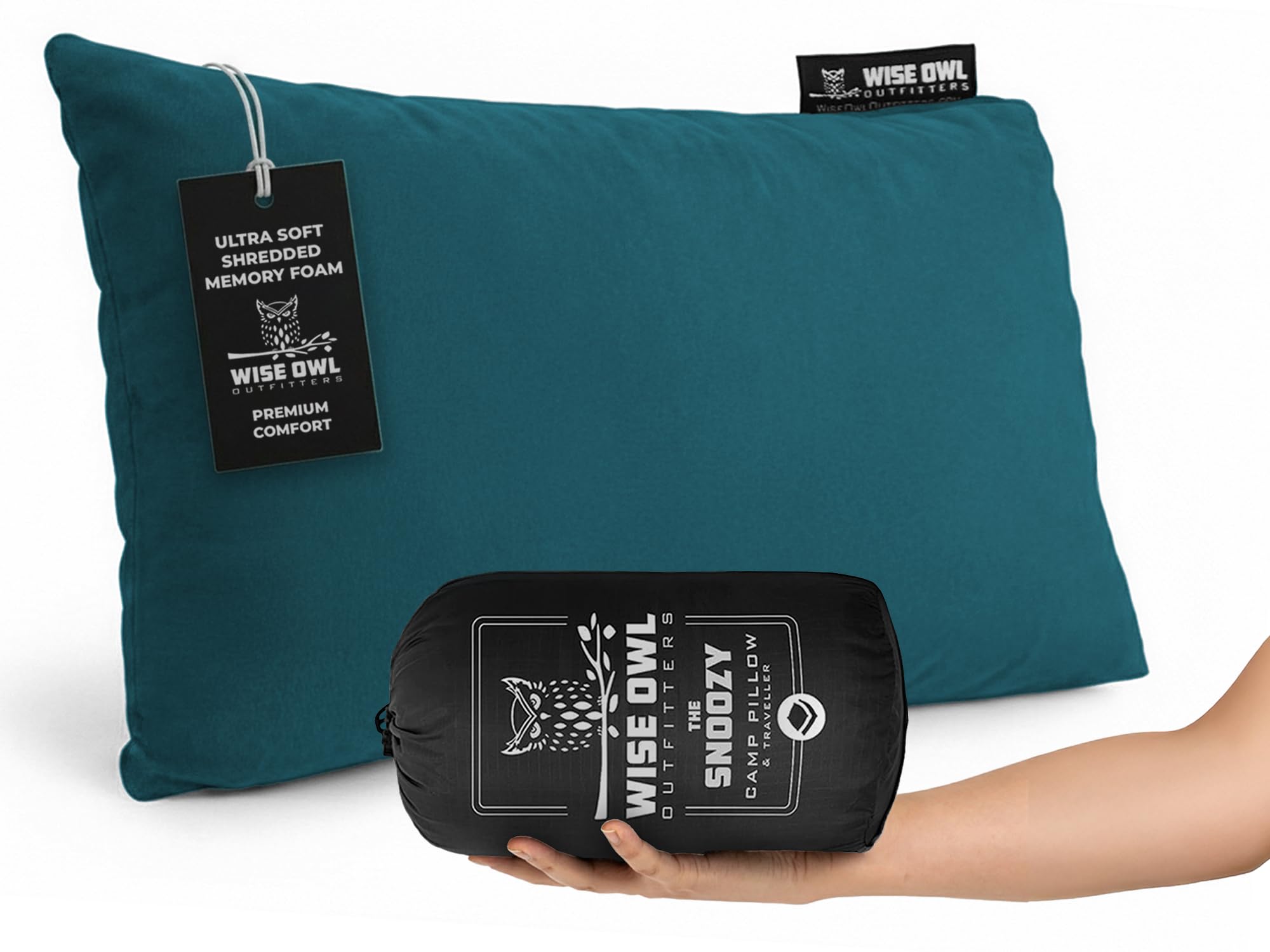
Wise Owl Camping Pillow
Key Features
- Fill: Shredded memory foam
- Size: 14 x 18 x 4 in
- Cover: Removable, machine washable
- Weight: 11 oz
- Price: Midrange
The Wise Owl is a bed pillow that learned to travel: a microsuede cover, shredded memory foam inside, and 4 inches of loft, closer to what is on your bed than anything else in this guide.
That is exactly why we like it for car camping, canoe trips, and short approaches. The shredded foam conforms instead of propping you up on air, and the loft is enough for a side sleeper to keep their neck in line. The cover is the nicest fabric on any pillow here, and it unzips for the washing machine, the detail that keeps a camp pillow from getting grim by the end of a hot summer.
The fill runs firm, and it can feel lumpy under your cheek until you break it in with your hands; if you want a pillow you sink into, this is not that pillow. The waterproof stuff sack really is waterproof, but it is a tight fit, so pack it first while you still have patience. Neither quibble is enough to swap it out on a weekend trip.
Pros
- Shredded foam conforms like a bed pillow
- Removable microsuede cover machine washes
- Waterproof stuff sack included
Cons
- Heavy and bulky for backpacking
We like the Wise Owl for car camping and short hauls: the shredded foam sleeps like bedding, and the weight only hurts on long walks.
Best for Adjustable Loft
Coop Home Goods Travel Pillow
Key Features
- Fill: Adjustable memory foam
- Size: 19 x 13 x 4 in
- Cover: Removable, machine washable
- Weight: 16 oz
- Price: Premium
Unzip the Coop and you can take foam out by the handful. That is the idea: a travel pillow you tune until your neck stops complaining, rather than one that arrives at a loft someone else chose. It is 19 by 13 inches and 4 inches thick, filled with shredded memory foam rather than a molded slab.
The cover is Coop’s Lulltra fabric, a polyester-rayon blend that feels closer to bedding than to outdoor gear, and it is machine washable. The foam carries CertiPUR-US and Greenguard Gold certification, which is worth knowing if you are sensitive to what is pressed against your face for eight hours.
Two practical notes. The foam can arrive with a noticeable odor, so unzip it and let it air out before you pack it for a trip; that usually clears it. And the whole thing weighs a pound, which is fine in a canoe or a car trunk and not fine on a long climb.
For side sleepers who need real loft and can spare the weight, we think it is the best sleep in this guide, because adjustable fill means you are not stuck with someone else’s idea of medium. Backpackers should look at the inflatables above; everyone else gets bedding-grade comfort with a packing penalty they will never notice.
Pros
- Add or remove foam to set your loft
- CertiPUR-US and Greenguard Gold certified
- Washable Lulltra cover
Cons
- A full pound is heavy on the trail
We point side sleepers here first: you can dial in your own loft, as long as a pound of pillow is acceptable in the pack.
Best for Budget Backpacking
TREKOLOGY Aluft 2.0
Key Features
- Cover: Polyester, hand wash only
- Weight: 3.84 oz
- Packed Size: 5 x 2 in
- Inflated Size: 16 x 12 x 4 in
- Price: Budget
The Aluft is among the least expensive pillows here and the smallest packed: 5 by 2 inches, smaller than a soda can, at 3.84 ounces. If you have been sleeping on a balled-up fleece, this is the upgrade that costs the least and takes up the least room.
The details are better than the price suggests. Rubber dots on the back keep it from skating off a sleeping pad, an elastic strap wraps around the pad if you want it fixed in place, and the TPU fabric is water-resistant. It is hand wash only, so there is no removable cover to launder, and that is the compromise at this end of the range.
As a first backpacking pillow or a spare that lives in the car, we think it is the easy call. What you are accepting is the air cell: valves and seams are where pillows like this give out, and a slow leak turns it back into a stuff sack. Inflate it at home, leave it an hour, and check that it has not softened. That test is the difference between a bargain and a nuisance at two in the morning.
Pros
- Packs to 5 x 2 inches at 3.84 ounces
- Rubber dots and strap keep it on the pad
- Water-resistant TPU fabric
- One of the cheapest pillows in this set
Cons
- Hand wash only, no removable cover
We think it is the best first backpacking pillow: tiny, light, and inexpensive enough to keep as a spare, provided you accept the leak risk of a thin air cell.
Best for No-Inflate Camping
TETON Sports Camp Pillow
Key Features
- Fill: Fiber fill
- Size: 18 x 12 x 6.9 in
- Weight: 9.6 oz
- Warranty: Lifetime
- Price: Budget
No valve, no breath count, no deflating at two in the morning. The TETON lofts up on its own and stays that way, and we recommend it to anyone who has given up on inflatables and wants a pillow that behaves like a pillow the moment it comes out of the sack.
It is fiber-filled, 18 by 12 inches and 6.9 inches thick, so there is a lot of pillow here for 9.6 ounces. The pillow and its case both go in the washing machine, and TETON backs it with a lifetime warranty, an unusual promise on the least expensive pillow in this guide.
The catch is bulk: nearly seven inches of loft and a stuff sack that ends up bigger than you expect, so it takes real space in a pack. For a scout trip, a car-camping weekend, or a base camp where the bag stays in the trunk, it is the least fussy pillow here, with nothing to inflate and nothing to lose.
Pros
- Lofts on its own with no inflating
- Pillow and case are machine washable
- Lifetime warranty
- Least expensive pillow in this guide
Cons
- Soft loft with no firmness adjustment
Our recommendation for inflatable refugees: it lofts on its own, washes in the machine, and costs less than almost anything else here.
Best for Base Camp Comfort
Klymit Drift

Key Features
- Fill: Shredded memory foam
- Size: 23 x 16 x 6.5 in
- Weight: 1.7 lb
- Warranty: 2 years
- Price: Premium
At 23 by 16 inches and 6.5 inches thick, the Drift is a bed pillow that folds. Set it down in a tent next to a 2.8-ounce inflatable and it looks absurd, right up until you lie on it.
Inside is shredded memory foam, and you can pull some out through the zip to change the loft. The outer shell is water-resistant and reversible, with a jersey face on one side and a canvas print on the other, and the cover comes off for machine washing. A compression strap is included for travel.
None of that helps you carry it. The strap shrinks the bundle without turning it into anything worth hauling up a mountain, and this is squarely a pillow for the tent you drive to.
For base camp, a van, or a family tent, we rate it the most comfortable pillow here. It is the one that makes sleeping outdoors feel like sleeping at home, and the removable fill means you can push it soft or firm. Be honest about how far you are carrying it, and it is an easy recommendation.
Pros
- Shredded foam you can remove to adjust
- Reversible, machine-washable outer cover
- Water-resistant shell for damp tents
Cons
- 1.7 pounds rules out backpacking
- Compression strap adds little
We rate it the most comfortable pillow here for base camp and van life, and the least suitable for anyone carrying their gear uphill.
What Four Months of Sleeping on the Ground Taught Us
We built the shortlist by collecting every camping pillow with a meaningful run of user reviews and a listed packed weight under about a pound, then narrowing to 14 across the three styles that dominate the category: inflatable air pillows, self-inflating foam, and compressible stuffed ones. Testing ran four months, from a cold, damp April trip through a string of summer weekends, and each pillow got at least three nights.
Every pillow went through the same routine. I counted breaths and timed inflation, then deflated and repacked it the next morning to see whether it slid back into its stuff sack without a fight — a few never did. Fully inflated, I measured each one against a sleeping bag hood and a standard camp pad width, then let air out in stages to check how it behaved at the softness most people actually sleep at. Packed weight and packed volume went on a kitchen scale, since the listed numbers were optimistic on roughly half of them.
The nights were the real test: back, side, and stomach sleepers in my family each took a turn, noting whether the pillow slid off the pad by 2 a.m., whether the fabric felt slick or grippy against a sleeping bag, and whether an ear went numb. Durability got checked at the seams and valves after every trip, and one pillow that rode loose in a pack for a week told us plenty. Each was smelled straight out of the package and again after a night, because new TPU and foam can carry a chemical odor that either fades fast or doesn’t. At the end, we weighed price against how many nights we’d genuinely trust each one for.
How to Choose a Camping Pillow
The decision that shapes everything else is fill, because air, foam, and hybrid each set how small the pillow packs, how it sleeps, and what it weighs.
Start with fill, because it decides the rest
The only way to get under four ounces is air, and the better inflatables now hide the bladder behind a knit or microfiber face, so the old balloon problem is mostly a cheap-pillow problem. Foam and fiber sleep closer to bedding but cost you pack space: the lightest foam pillow here is 11 ounces, the largest is 1.7 pounds. Hybrids split the difference with a foam or polyester layer over an air cell, which is the design our top pick uses. Side sleepers who want one pillow for everything should start with a hybrid; long-distance hikers should start with air.
Judge packed size, not inflated size
Listings give two sets of numbers, and the one that matters in a 40-liter pack is the packed figure. Inflated dimensions tell you how much pillow your head gets, which is worth knowing, but they say nothing about the space it takes at the bottom of your bag. The Aeros packs to 3.3 by 2.8 inches; the Aluft to 5 by 2. A foam pillow that only publishes inflated size is telling you something too, since it compresses to whatever your stuff sack allows, and that is rarely small. Short trips can absorb it. Long ones cannot.
Match loft to how you sleep
Side sleepers need height, around four inches or more, to fill the gap between shoulder and ear; that is why the four-inch hybrid and foam pillows here suit them and a thin air pillow often does not. Back sleepers can go lower. Stomach sleepers want the least loft of all, which makes a nearly seven-inch fiber pillow the wrong shape for them. Adjustable fill is the escape hatch: the Coop and the Drift both let you pull foam out until the height is right, and the Fillo’s valve lets you bleed an air cell down to your own setting.
Valves decide whether an air pillow survives the night
Inflating is easy; staying inflated is the job. A one-way inflator with a separate dump valve is quicker and loses less air on closing than a plain screw cap, and a fine-adjust button lets you tune pressure without starting over. Whatever you buy, inflate it at home, leave it an hour, and check that it has not softened. A slow leak is the failure that turns a pillow back into a stuff sack, and it is better found in your living room than at two in the morning. Inflate slightly firm, then bleed down.
Buy a cover you can wash
A pillow spends eight hours against your face, so a removable, machine-washable cover is worth more than it sounds. Foam cores cannot be washed and bladders should not be, which leaves the cover as the part that actually gets clean. The Fillo, Wise Owl, Coop and Drift covers all come off; the Teton goes in whole; the Aeros and the Aluft are hand-wash only. On a multi-night trip that difference shows up fast.
Frequently Asked Questions
Do I really need a camping pillow, or does a stuff sack of clothes work?
For one night, a tightly packed stuff sack tucked inside a fleece is fine. The problem is that clothes compact as you sleep, so you wake up on a flat bag and rebuild it in the dark. A dedicated pillow holds its loft, and the lightest ones here add under four ounces. If you are on the fence, buy a cheap inflatable first and see whether you notice the difference.
How do I keep my camping pillow from sliding off my sleeping pad?
Three fixes, in order of effort. Tuck the pillow inside the hood of your sleeping bag so the bag holds it. Choose one with a grippy back: the Aluft has rubber dots and an elastic strap that wraps around a pad. Or use a lock system, though Sea to Summit’s PillowLock patches only work on their own mats. A smooth inflatable on a smooth pad will find the floor by morning.
Are inflatable camping pillows noisy?
The bladder makes the noise, not the pillow: bare TPU crinkles against a pad and against your ear. A brushed knit or microfiber face muffles most of it, which is a real reason to pay more for the Aeros or the Luxe than for a bare inflatable, and a cloth cover over the whole pillow does the rest. If you share a tent with a light sleeper, that cover earns its few grams.
How long should a camping pillow last?
Foam and fiber pillows generally outlast inflatables, because there is no air cell to puncture and the wear shows up in the cover instead. Warranties reflect the difference: Nemo, Sea to Summit and Teton all back theirs for life, while Klymit’s Drift carries two years. Store any inflatable deflated with the valve open, and treat the closure gently on the ones that use a screw cap.
Final Verdict
If you want one pillow for every kind of trip, the NEMO Fillo is the one we recommend. The foam-over-air design sleeps like bedding rather than a balloon, the cover goes in the washing machine, and it packs small enough to live in a daypack without a negotiation.
Backpackers counting ounces should take the Sea to Summit Aeros instead, because at 2.8 ounces it is in a different weight class. And if your tent has a car parked next to it, skip both and take the Wise Owl.