This post contains affiliate links. We may earn a small commission when you buy through our links — at no extra cost to you.
Dusk at camp is the easy part. It’s 11 p.m., the fire has burned down, someone is reading in a tent, and the lantern that looked so bright at sunset has faded to a dim orange smudge. Almost every solar light fails the same way — a panel that needs direct sun, a battery that holds barely one evening, a plastic housing that cracks the first time it rides in a gear bin — and a good one fixes all three at once, so you stop thinking about light and just use it.
I’ve carried cheap solar lanterns on trips for years as a backup to a headlamp, and I’ve stopped treating them as toys. Over the past four months, my team and I have lived with 14 of them — collapsible lanterns, stake lights, clip-on pucks, and a couple of string sets — on camping trips, in the backyard, and through one long outage at home. Here’s what nobody tells a first-time buyer: the lumen number on the box is measured on a fresh full charge, so what actually matters is what’s left after a gray afternoon. The picks below all had usable light when it counted.


Best for All-Round Camping
Lepwings Solar Lantern
Key Features
- Battery: 6000mAh
- Charging: Solar and USB-C
- Max runtime: 80 hours
- Max brightness: 280 lumens
- Price: Midrange
Eighty hours is the kind of figure that invites suspicion, so here’s what it means in practice: that’s the dimmest setting, around 60 lumens, where the Lepwings runs for days on its 6000mAh cell. Push it to the 280-lumen maximum and you’ll be reaching for the cable a lot sooner. The useful part is everything in between — a warm 3000K light you can dial down to a tent glow or up enough to see a stove, on a touch control you can find by feel.
We keep coming back to it because it quietly removes the two things that make solar lights disappointing. Charging is the first: two panels on top are joined by a USB-C port that fills the battery in about three hours, so a grey day costs you runtime rather than the light itself. Output is the second. At 280 lumens it’s the brightest single lantern here, and the light is warm instead of the blue-white wash the cheaper four-packs give you. It also works as a power bank, which on a trip where your phone is the map is a genuinely reassuring extra.
What you trade for that is size. At 1.3 pounds and about ten inches tall it’s a basecamp light, not something for a fastpacking bag — the LuminAID covers that job at a fraction of the weight. Water resistance is stated as ‘water resistant’ rather than an IP number, so we treat it as a light for rain and not for a night left out in a downpour. Neither bothers us for car camping, a van build, or a tent you drive to.
Pros
- Up to 80 hours on the low setting
- Warm, dimmable 60-280 lumen output
- Solar plus a three-hour USB-C charge
- Doubles as a power bank
Cons
- Too heavy and tall for a backpack
- No stated IP water-resistance rating
For a fixed camp, this is the light we recommend first: warm dimmable output, a battery measured in nights, and USB-C backup when the sun doesn’t show.
Best for Backpacking and Tents
LuminAID Nova Lantern
Key Features
- Weight: 5.3 oz
- Max runtime: 24 hours
- Max brightness: 75 lumens
- Water resistance: IP67
- Price: Midrange
Five and a third ounces, packed flat enough to slide down the side of a daypack: the Nova is the light here you stop noticing until you need it. Inflated it’s a soft cube that glows rather than beams, and we found it fills a two-person tent better than its 75 lumens suggests — enough to read by, sort a first-aid kit, or find your boots at 5 a.m. without waking anyone.
IP67 is the part that matters for real camping. It’s dustproof and survives a dunking, and with no glass and no exposed lens there’s nothing to crack when it rolls off a picnic table. Charging is either about ten hours of decent sun or one to two hours on micro-USB, and the 24-hour runtime belongs to the low setting, as it does on everything in this category.
The valve is the part to look after. It seals well enough to hold air overnight, but a body that lives folded in a pack is the likeliest thing to fail first, so store it part-inflated rather than crushed at the bottom of a duffel. The other small note is micro-USB in a USB-C world — pack the right cable or you’ll be borrowing one at the trailhead.
Pros
- Five ounces and packs flat
- IP67 waterproof, dustproof and shatterproof
- Up to 24 hours of light per charge
Cons
- 75 lumens is tent light, not camp light
- Priced like a four-pack for one light
The backpacking answer: five ounces, IP67, and a diffused glow that fills a tent. Pick it when weight decides the trip and you’re lighting people, not a site.
Best for Family Campsites
XTAUTO 4-Pack Lanterns
Key Features
- Battery: 1600mAh
- Charging: Solar and USB
- Pack size: 4 lanterns
- Max runtime: 25 hours
- Price: Budget
Four lanterns for roughly what one of our other picks costs is the entire pitch, and for a family site it’s a good one: one hanging in the tent, one on the table, one in the glovebox, one in the blackout drawer at home. The body pulls up to switch on and to set brightness, then collapses to something phone-sized, with a folding handle that hangs off a tent loop or a branch.
As lights, they’re better than the price suggests. Six plus one LEDs give a genuine 360-degree spread, the flashlight mode throws a usable beam for the walk to the water tap, and the 1600mAh cell is rated for 25 hours at the lower settings. Solar and USB both work, and the USB path is the one to trust. Two of ours live in the car trunk and get used far more often than we expected.
Two things to plan around. The colour is cool white at 6000K, which is bright and slightly clinical inside a tent at night — fine over a table, less restful at bedtime. And the failure that turns up is a unit that never takes a charge, so open all four, plug each one in and watch for the charging light before a trip that matters. We treat the set as a kit: check it once on arrival, then stop worrying about it.
Pros
- Four lanterns, one modest outlay
- Lantern and flashlight in one body
- Two charging routes, solar and USB
Cons
- Cool white light is clinical in a tent
- Weakest durability in this set
A cheap way to light a whole campsite at once, with flashlight modes for the walk to the taps. Buy the four-pack for family camping and blackout duty, not for a pack.
Best for Trips without Power
LETMY 4-Pack Lanterns
Key Features
- Pack size: 4 lanterns
- Power options: Solar, USB, AA batteries
- Max brightness: 600 lumens
- Water resistance: Water resistant
- Price: Budget
The AA bay is what separates these from every other four-pack here. When the built-in cell is flat and there’s no sun in the forecast, you drop in three AA batteries and keep going — and on a week somewhere without hookups, that’s the difference between a lantern you keep using and one that spends the last three nights in the tent bag.
The rest of the package is competitive. A claimed 600 lumens, the highest figure in this group, comes from a COB LED arranged for a 360-degree spread; the body collapses small and hangs from a tent loop; and there are four of them in the box. Push the top setting and the light is genuinely bright enough to cook by, and the pull-up collar means you can adjust brightness one-handed in the dark.
The catch is the power. The built-in battery is rated for a short run at full output, and the solar panel contributes little more than a trickle, so we treat USB as the real charger and the panel as something that buys an hour at dusk. That’s easy to live with if you carry a power bank and a cable. If you’re counting on sunshine alone, it isn’t.
Pros
- Three power sources, including AA batteries
- 600 lumens, the highest claim here
- Four lanterns and four cables in the box
Cons
- Short runtime at full brightness
- Solar panel barely charges the battery
The set for trips with no power: 600 lumens, four lanterns, and an AA bay as your last resort. Plan on USB charging and treat the sun as a bonus.
Best for Tent Ambience
Goal Zero Crush Light Chroma
Key Features
- Charging: Solar and USB
- Light modes: Six colors, four modes
- Max brightness: 60 lumens
- Water resistance: IPX4
- Price: Midrange
Red is the setting we didn’t expect to use as much as we do. It’s enough light to sort a pack at 2 a.m. without trashing your night vision or lighting up the whole tent, which is the same reason headlamps have carried red modes for years. The six colours and the fade cycle are the fun part, and there’s no shame in that — a lantern that turns a wet evening under a tarp into something a kid remembers is doing real work.
Sixty lumens doesn’t sound like much and isn’t: this is a light for a tent, a hammock or a small van, not for cooking a meal for six. What it does, it does nicely. The 3000K white is warm enough to read by, the body collapses flat enough to slide into a jacket pocket or clip to a pack with a carabiner, and it charges from a small panel on the back or from USB.
Two limits worth knowing. IPX4 means rain and splashes, not a dunking, so it’s a tent and fair-weather light rather than one to leave out through a storm. And the body is built light — ours lives on a loop or in a pocket, never at the bottom of a toolbox. As a second light that makes an evening better, we’re happy with it; as the only light on a family camp, it isn’t enough.
Pros
- Red and colored modes that save night vision
- Warm 3000K white for reading
- Folds flat for a pocket or pack
Cons
- Sixty lumens is ambience, not area light
- IPX4 covers splashes only
Buy it for the mood: red and colored modes, a warm reading light, and a body that folds flat. It’s a tent light, not the light you cook by.
Best for Basecamp and Blackouts
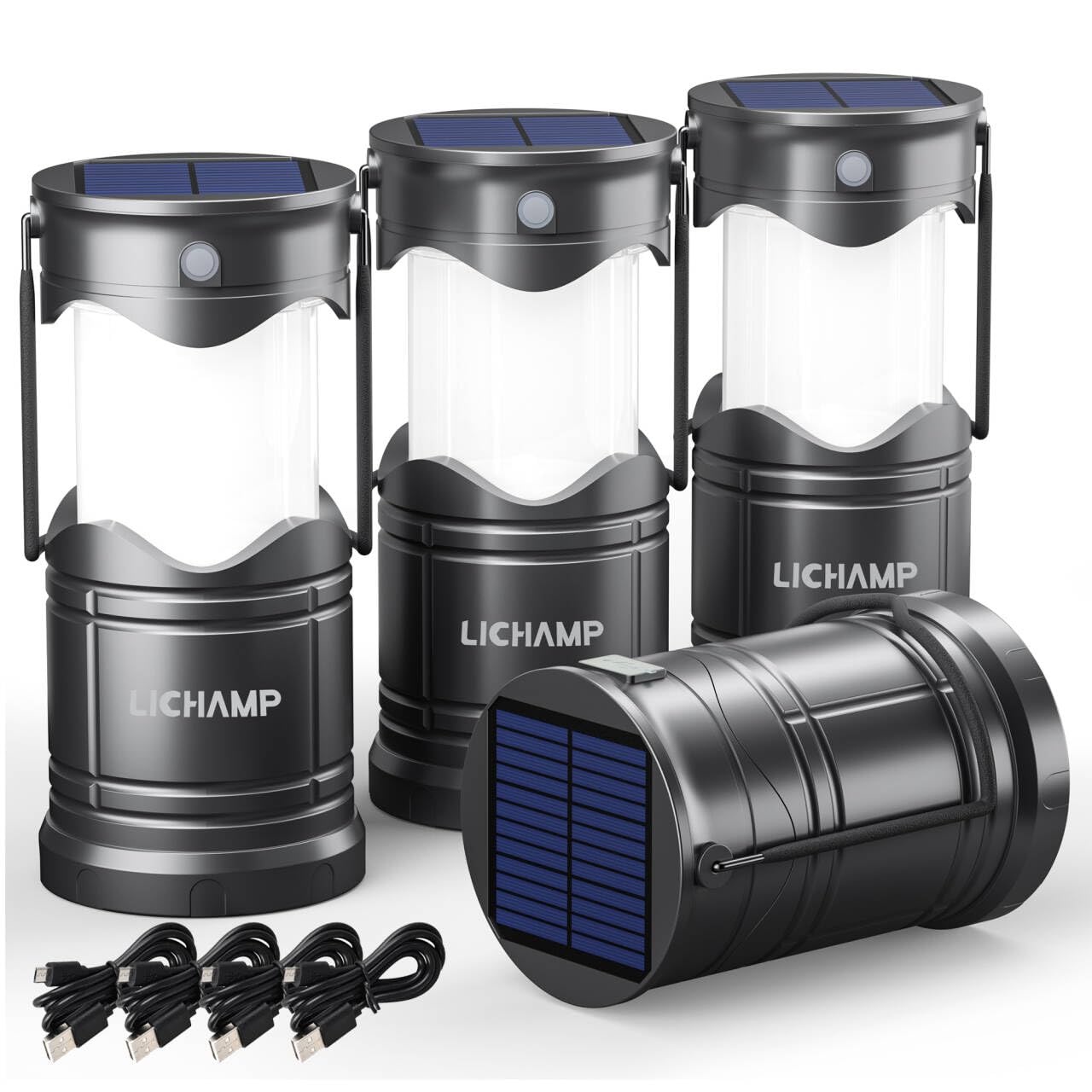
Lichamp 4-Pack Lanterns
Key Features
- Pack size: 4 lanterns
- Light modes: Three, including warm amber
- Power options: USB, solar, AA batteries
- Max brightness: 600 lumens
- Price: Premium
Three settings, and it’s the third that earns these a place. Six hundred lumens of white handles a cooking table, 200 is about right hanging in a tent, and the warm amber mode is far kinder at eye level after dark than the cool-white four-packs — it’s the setting we reach for once the plates are cleared. Brightness also shifts with how far you pull the body open, which is the sort of control that works with cold hands.
Everything else is well thought out. The body collapses to roughly phone size, the big folding handle hangs from a ridge line, and small glow-in-the-dark tabs on the sides make the thing findable in a dark tent. There’s a power bank function and an AA bay as a fallback, plus four USB cables in the box. Battery life is where these are least convincing — a set that’s flat after a few months is the failure to plan for, and the AA bay is the insurance.
Pros
- 600 lumens with a warm amber mode
- Charges by USB, solar or AA batteries
- Doubles as a power bank
Cons
- Priciest of the four-packs here
The best-equipped four-pack here: 600 lumens, an amber mode, a power bank and AA backup. Worth the extra if your kit has to keep working.
Best for Budget Backup Kit
DIBMS 4-Pack Lanterns

Key Features
- Battery: 1600mAh
- Max runtime: 6 hours
- Max brightness: 300 lumens
- Water resistance: IPX4
- Price: Budget
Three hundred lumens puts these a step below the other four-packs, and in a body this small you feel it: they light a table, a tent or the back of a car, not an entire site. What they do instead is stretch — a 1600mAh cell the listing rates for six hours, USB charging in about four, and a solar panel that wants most of a day in direct sun before it has done anything useful.
For the job most people actually buy these for — a tent, a hatchback, a drawer of blackout supplies — that’s enough, and the 2-in-1 head is the useful bit: pull the lantern open for a room, close it down and you have a flashlight for the walk to the taps. At eight ounces with an IPX4 shell, they’re the ones we hand to a kid or leave in the car without a second thought. The trade is output, not convenience.
Pros
- Lantern and flashlight in one head
- Eight ounces, easy to hang or carry
- IPX4 shell for rain and splashes
Cons
- Dim next to the 600-lumen four-packs
A sensible four-pack that lights a tent and a trail without fuss. Buy it as a cheap kit for the car and the blackout drawer, not as your main camp light.
Best for Tent and Tarp
MPOWERD Luci String Lights

Key Features
- Length: 18 feet
- Battery: 2000mAh
- Charging: Solar and USB
- Brightness: 100 lumens
- Price: Midrange
Eighteen feet of warm LEDs on a cord that winds back into its own base: string these along a tarp ridge line or around the awning of a van and the camp stops looking like a bivvy and starts looking like somewhere you want to sit. The base is a 2000mAh power bank too, which is nice insurance on a trip where your phone is also your camera and your map.
What it isn’t is a working light. A hundred lumens spread across 18 feet is ambience and a bit of path-finding; nobody is cooking by this. Solar charging through the small panel on the base is slow, and in shade it’s slower still, so the USB port is the practical way to top it up. A strand that lives outdoors in the rain can also fail at the charging circuit after a handful of trips, so hang it under cover rather than leaving it out all season.
As a second light, it’s the one that changes an evening. Three brightness levels take it from party to path marker, and we hang ours under a tarp rather than out in the open. If your camp already has a good lantern, this is the upgrade that makes people want to stay up for one more round.
Pros
- Warm light that transforms a tarp or van
- Cord winds into the base for packing
- 2000mAh base works as a power bank
Cons
- Ambience only, 100 lumens over 18 feet
- A single strand costs more than a four-pack
The light that makes a camp worth sitting in after dark. It’s ambience rather than illumination, so pair it with a lantern and hang it under cover.
How We Tested the Best Solar Lights for Camping
The shortlist came out of a few weeks of reading spec sheets and customer reviews, then filtering hard. We dropped anything with a panel too small to recharge in a single day, anything that only turned on by cycling through five modes in sequence, and anything with no USB fallback for a rainy stretch. That narrowed the field to 14 lights covering lanterns, stakes, clip-on pucks, and string sets across the affordable end of the market.
Testing ran four months, from late spring into early fall, and most of it happened where these lights actually live: three weekend camping trips, a run of backyard overnights, and one week with the power deliberately shut off at the breaker. We drained every light to zero first, then set it out in full sun and timed how long it ran before output dropped below reading level, repeating the same run on overcast days to see what a gray afternoon cost. In camp we hung them in tents, walked trails with the stake lights, and noted how easy each switch was to find by feel in the dark.
Portability got the gear-bin treatment: we weighed each light, packed it against cookware and a stove, and dropped it onto gravel from table height. A few spent a night out in the rain, and two came back with water inside. We kept a running log of failures, too — lights that quit charging after a month, dimmed to nothing by hour three, or needed two hands to open — because reliability is the entire point of leaving batteries at home. What we ranked on in the end was usable light per night against what you pay, and the lights that scored well were the unglamorous ones that charged without fuss every single day.
How to Choose a Solar Camping Light
The two numbers that decide a camping light, lumens and runtime, are also the two that get quoted at their most flattering, so work out how much light you actually need before you compare claims.
Start with the light you actually need
Lumens in a lantern spread through 360 degrees, so 300 lumens in a collapsible body looks far dimmer than 300 lumens in a flashlight aimed at a tree. For a two-person tent, 60 to 100 lumens of diffused light is plenty. For a cooking table or a group of six, look at 280 and up.
For a family camp we’d suggest one bright lantern over the table plus a small light per person. That’s why a four-pack makes sense beside a single good lantern rather than instead of one.
Read the runtime, then read it again
Every long runtime in this guide belongs to the dimmest setting. The 80 hours on our top pick is a 60-lumen glow; at 280 lumens the same lantern runs for a fraction of that. That’s not a trick, it’s how battery capacity works, but it makes the middle setting the number that matters.
Ask what the low mode looks like and whether you’d actually use it, because that’s where the headline figure lives. Then plan a USB top-up at some point on any trip longer than a weekend rather than treating one charge as a whole holiday.
Treat solar as a top-up, not a plan
A panel the size of a coaster, lying flat on top of a lantern, collects a fraction of what a folding solar panel does, and shade, cloud and a tent fly cut it further. That’s fine: the panel earns its keep at a sunny basecamp where the light sits out all day, and it’s nearly useless on a wooded site.
Charge everything by USB before you leave and let the sun add runtime rather than provide it. The two-panel top of the Lepwings is the most useful version of this idea here, and it still isn’t a substitute for a cable.
Weigh packed size against output
Be honest about how the light travels. Five ounces and a flat pack disappears into a daypack; 1.3 pounds is a basecamp light you carry from the car. If the light lives in a pack, weight wins over lumens every time, because the brightest lantern in the world is no use left at home.
At camp, a folding handle or hanging loop earns its place in a tent, and a flat base matters more than you’d think for a light that sits on a table. A light you can stand up and aim is more useful than one you can only hang.
Understand the water-resistance ratings
IPX4 handles rain and splashes; IP67 survives a drop in a puddle, dust and all. A ‘waterproof’ claim with no IP number is a marketing word until something proves otherwise, and it usually isn’t the thing you want to test at 2 a.m.
Match the rating to exposure. A light that hangs inside a tent or under a tarp only needs splash protection; one that lives outside the tent for a whole season should carry a proper IP rating, because the port covers and seams are where water gets in.
Frequently Asked Questions
Are solar camping lights worth it compared with an ordinary battery lantern?
Buy a rechargeable lantern that also has a solar panel, not a panel-only light. Every pick here charges from USB, and that’s the feature doing the real work on a cloudy trip; the panel just adds hours at a sunny camp. For a weekend with a power bank, a plain USB lantern is fine and cheaper.
Can a solar camping light charge my phone?
Some can, and it’s worth knowing which. The Lepwings with its 6000mAh cell, the Lichamp set and the Luci String base all work as a power bank; the 1600mAh four-packs will barely move a modern phone.
Compare the light’s capacity with your phone’s and expect to lose some in the transfer. Treat it as emergency reserve, not your main charging plan.
How long do these lights last before they need replacing?
The LEDs aren’t the limit — one lantern here is rated for tens of thousands of hours. The battery, the switch and the charging port decide, so a light used hard outdoors is a few-season purchase rather than a decade one.
That’s the practical case for a four-pack or for a design with an AA bay: when one unit gives up, the camp still has light.
Final Verdict
Start with the Lepwings. It makes the fewest compromises for a camping trip: warm 3000K light you can dim from a tent glow to a cooking level, a 6000mAh battery that outlasts most trips, and USB-C charging that rescues the cloudy ones. It’s a basecamp light rather than a pack light, and that’s fine by us.
If you’re carrying your kit instead of driving it, the LuminAID Nova is the one — five ounces matters more than 280 lumens when the light has to live in a pack. And if you’re lighting a family site on a budget, the XTAUTO four-pack puts light in four places at once; just check that every unit takes a charge before you leave.