This post contains affiliate links. We may earn a small commission when you buy through our links — at no extra cost to you.
A solar panel the size of a paperback isn’t charging your phone in an hour. That’s the tradeoff baked into every solar power bank: the panel is a trickle top-up for a weekend off-grid, not a stand-in for a wall outlet. What separates a good one from a shelf ornament is everything around the panel — how much battery it really holds, how fast it pushes power into a phone, whether the wireless pad lines up without peeling your case off, and how it handles a drop onto a rock. Get those right and the solar side stops feeling like a gimmick.
My team and I have spent the past six months draining and refilling 12 of them on camping trips, in the backyard, and on weekday commutes, and the honest ones shared a trait: a watt-hour rating that matched what actually came out. The milliamp figure on the box is measured at the cells’ internal voltage, so what reaches your phone is closer to two-thirds of it. The picks below are the ones that came closest to their claims.


Best for Multi-Day Trips
BLAVOR PN-W12-Pro
Key Features
- Size: 7 x 3.5 x 1.6 in
- Solar array: 4 foldable panels, 1.2A max
- USB-C output: 18W PD
- Battery capacity: 20,000 mAh
- Price: Premium
Four foldable panels rated at 1.2A in strong sun is the most specific solar claim in this group, and it’s a large part of why we made this one the default. Run the numbers and it’s roughly six watts — enough to move the gauge during a sunny lunch stop, nowhere near enough to refill 20,000mAh in a day. Buy a solar bank expecting the sun to be the fuel and you’ll be disappointed by every product on this page. Buy one expecting a slow top-up between wall charges and this is the pack built for you.
The rest of the hardware is grown-up about power. USB-C delivers 18W Power Delivery, which charges a phone about as fast as its own wall charger and will run a PD-capable laptop slowly; the two USB-A ports cover headlamps, watches and cameras. A 20,000mAh cell is a few phone charges in practice rather than the arithmetic on the box, since conversion losses take their cut. UL2056 certification and IPX5 sealing round it out.
The camping light is what we kept reaching for. There’s a three-level panel built into the case plus a flashlight with normal, SOS and strobe modes, and on its low setting it’s enough to read by or light the inside of a tent. A light you don’t have to hunt for in the dark earns its place faster than another port does.
What it isn’t is small or inexpensive. At 7 by 3.5 by 1.6 inches it belongs in a daypack rather than a pocket, and you pay a premium for the capacity. What that buys is protection from the failure that actually ends trips: given that a pack quietly dying is the thing worth avoiding, spending more for output and certification is a trade we’ll make every time. Charge it from the wall the night before you leave.
Pros
- Four-panel array with a stated 1.2A output
- 18W USB-C PD charges phones fast, laptops slowly
- UL2056 cells and IPX5 sealing for outdoor use
- Camping light bright enough to read by
Cons
- Slow to come back up from the wall or sun
- Premium price for 20,000mAh
We recommend it as the do-everything pack for multi-day trips: real 18W PD output, four panels that actually add charge, and the steadiest reliability in this group.
Best for Ultralight Day Hikes
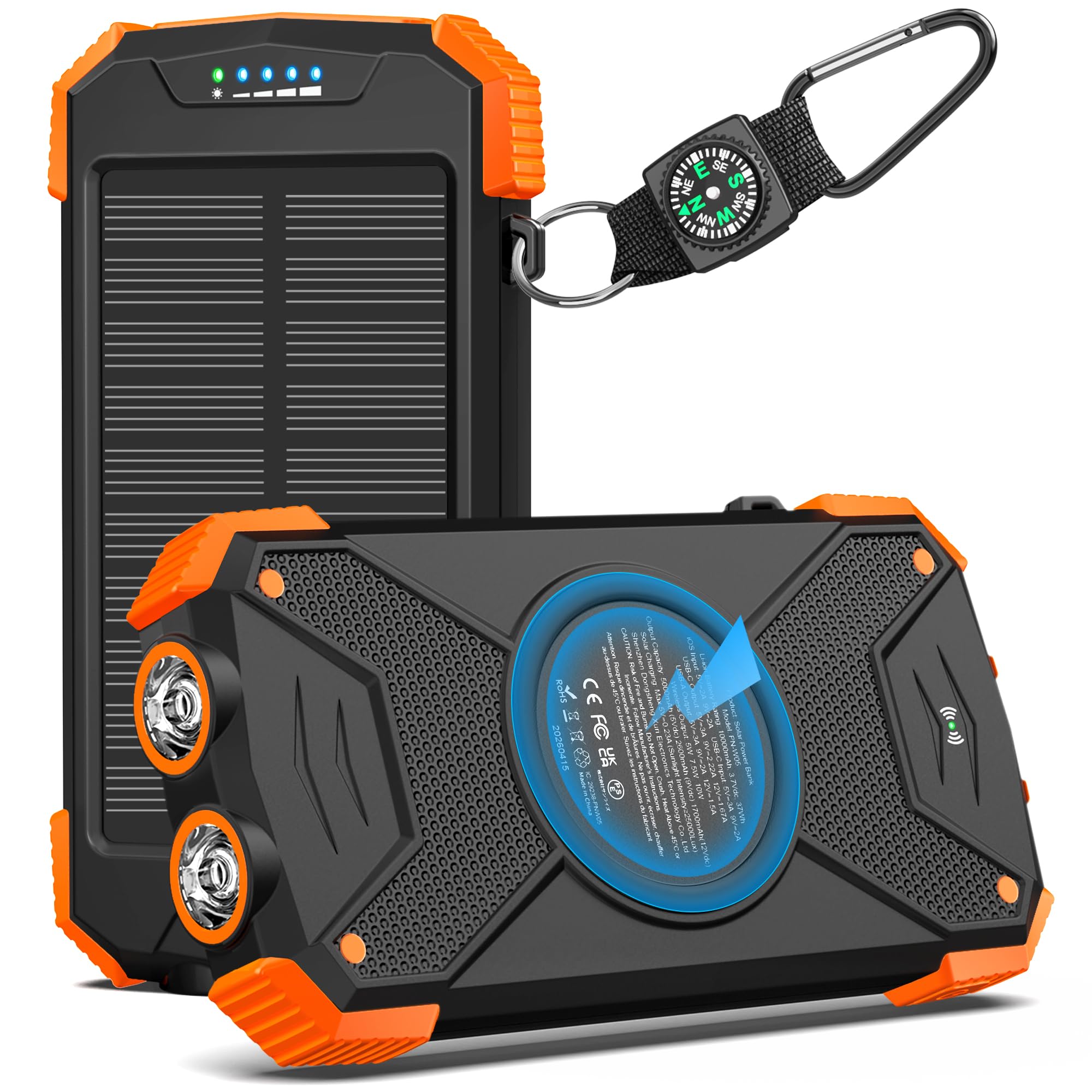
BLAVOR PN-W05
Key Features
- Weight: 9.3 oz
- USB-C output: 20W
- Battery capacity: 10,000 mAh
- Water resistance: IPX5
- Price: Budget
At 9.3 ounces and under an inch thick, this is the pack that stays in the bag because you forget it’s there. The 10,000mAh cell is honest for the size — a couple of phone charges, or one phone plus a headlamp across a weekend — and the Qi pad on top means you can drop a phone onto it at camp and skip the cable hunt entirely.
Cable-free is the whole argument, and it holds up. The 20W USB-C port is rated to take an iPhone 15 to 65% in half an hour, which is wall-charger territory, and the wireless pad handles the lazy overnight top-up. Add IPX5 sealing, a genuinely bright flashlight with SOS, and a three-year warranty, and this is the one we hand to someone who wants to stop thinking about power.
The limits are size and sun. 10,000mAh won’t carry two people through a long weekend, and the solar panel is a trickle — a day in the sun buys a fraction of a charge, not a fresh battery. For a day hike, a festival or a commute bag, neither of those matters, and nothing else here is easier to carry.
Pros
- 9.3 ounces and pocket-sized
- 20W USB-C fast charging
- Qi wireless pad for cable-free top-ups
- IPX5 sealed with a bright flashlight
Cons
- 10,000mAh is roughly two phone charges
- Solar panel adds very little charge
Our pick when weight decides: 9.3 ounces, 10,000mAh, and a Qi pad that lets you charge a phone without hunting for a cable.
Best for Basecamp and Festivals
BLASOUL 49800mAh
Key Features
- USB-C output: 22.5W
- Built-in cables: 4 (3 output, 1 input)
- Battery capacity: 49,800 mAh
- Water resistance: IP65
- Price: Midrange
Four cables live in the case — Lightning, USB-C, micro-USB and a USB-A input — so the cable you forgot is the one already attached. That sounds like a small thing until you’ve watched a group of four people pass one Lightning cable around a picnic table. No pouch, no untangling, no discovering that your friend’s phone is the one connector nobody brought.
Under all that sits a 49,800mAh cell with 22.5W USB-C PD and a 15W wireless pad, in a body rated IP65 — dust-tight and resistant to water jets, the most sealed pack in this group. The built-in cables plus its USB-C and USB-A ports mean it can genuinely charge several devices at once, and the wireless pad takes the cable out of the bedtime routine.
Bulk is the trade, and it’s one we’re happy to make for a pack that lives in a car or a tent. Seven inches long and better suited to a daypack than a jacket pocket, this is a basecamp, festival or glovebox companion rather than something you carry up a mountain. Give it that role and the size stops being a compromise: close to 50,000mAh, a genuinely fast port, and cables you can’t leave behind.
Pros
- Four built-in cables cover every common phone
- 22.5W PD and 15W wireless charging
- IP65 is the strongest sealing in this set
- 49,800mAh at a midrange price
Cons
- Too big to pocket at 7 inches long
We point to it when one pack has to cover a group: just under 50,000mAh, four built-in cables and the best water-and-dust sealing here.
Best for High-Capacity Value
SOARAISE 48000mAh
Key Features
- Solar array: 4 panels
- USB-C output: 5V/3A
- Built-in cables: 4
- Battery capacity: 48,000 mAh
- Price: Midrange
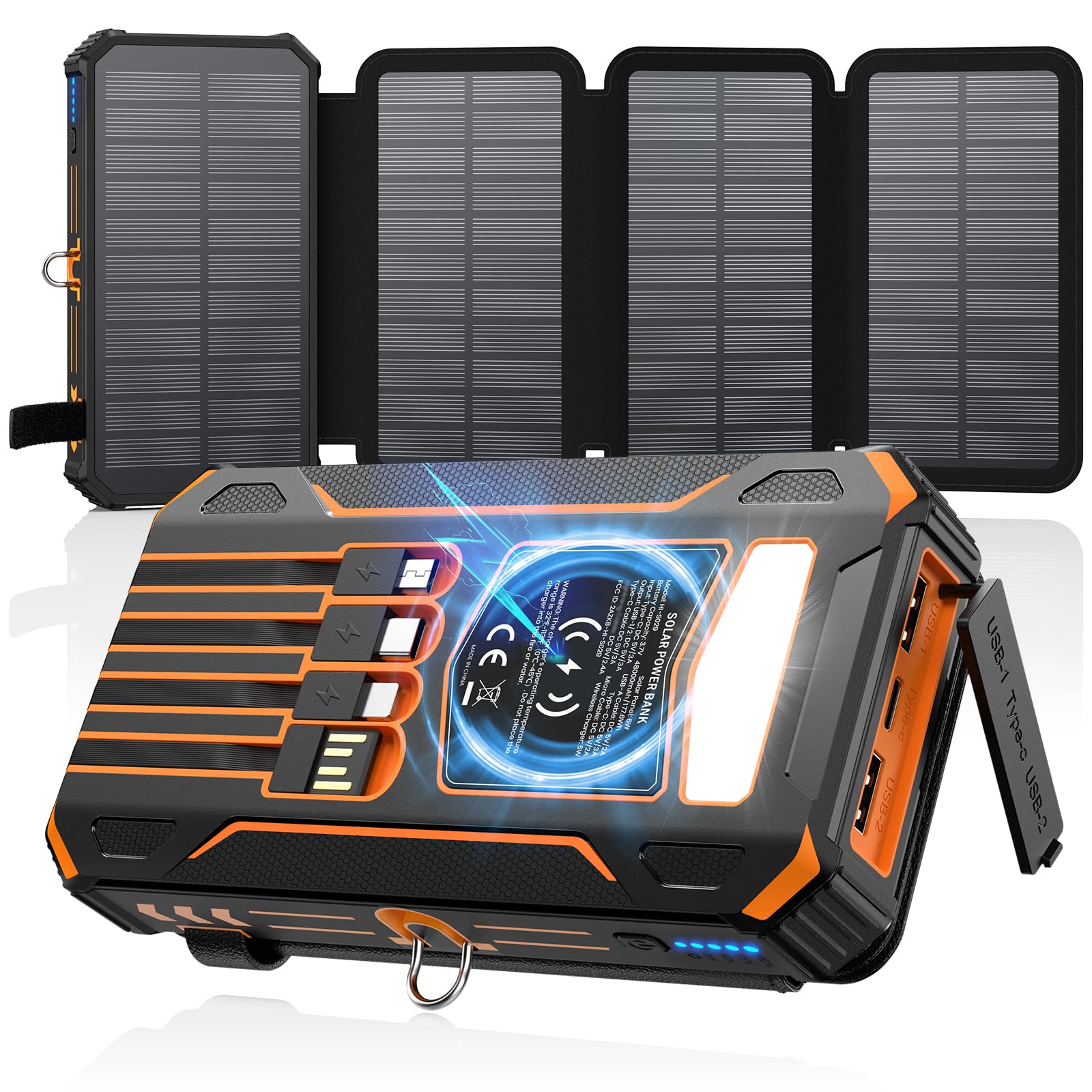
Where the BLAVOR puts its money into certification and output, the SOARAISE spends it on capacity and hardware: 48,000mAh, four folding solar panels and four built-in cables. On paper that’s a lot of pack for midrange money, and the case supports the claim — solid, heavy-duty, with folding panels and port covers that seat properly.
We like it most as the cheap way into a genuinely large battery. Four panels spread the solar input over more area than the singles do, the built-in cables cover Lightning, USB-C, micro-USB and USB-A, and a wireless pad on top handles a phone you can’t be bothered to plug in. For a car kit or a family basecamp, it covers the jobs without asking you to think.
Two compromises come with it. The first is weight: at this capacity it’s a pack you notice on a climb, and one that belongs in a boot rather than on your back all day. The second is speed — the 5V/3A USB-C port is steady rather than quick, so a modern phone won’t fast-charge from it. Neither costs you anything at basecamp.
Pros
- 48,000mAh for midrange money
- Four folding panels and four built-in cables
- Solid, heavy-duty build
Cons
- Heavy enough that it lives in the car
- 5V/3A output is steady, not fast
We see it as the value route into a big battery: 48,000mAh, four panels and four cables at a midrange price, for people who leave the pack in the car.
Best for Budget Backup
YELOMIN 38800mAh
Key Features
- Ports: 3 (2 USB-A, 1 USB-C)
- Weight: 9.9 oz
- Flashlight: Dual LED, 3 modes
- Battery capacity: 38,800 mAh
- Price: Budget
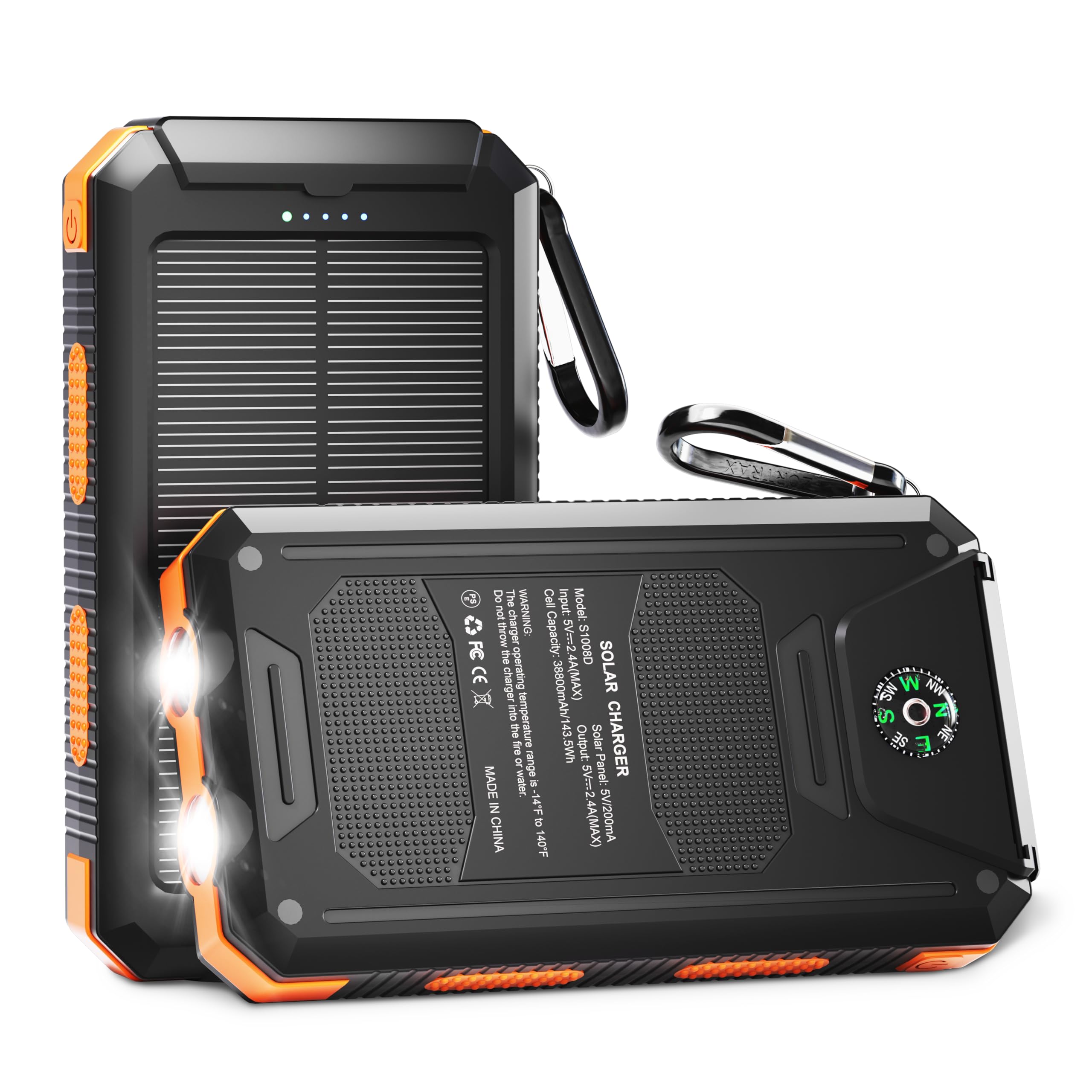
Plenty of listings here describe a solar panel as though it will run your week. This one says the panel slowly adds small amounts of power in direct sun and that a full solar recharge may take days — which is the truth about every pack on this page. That honesty is the most useful thing in the listing, and we trust the rest of the spec sheet more because of it.
What you get at the budget end of this group is 38,800mAh in 9.9 ounces, the best capacity-to-weight ratio here, with three ports (two USB-A and a USB-C that takes a charge in and out), dual LEDs with steady, SOS and strobe modes, a carabiner and a 12-month warranty. It disappears into a daypack in a way the 50,000mAh bricks don’t.
The catch is consistency. This is the budget pack in the group, and budget packs are where you notice the difference in things like how firmly the ports hold a cable and how long the cell keeps its capacity. The sensible move is to run it hard in the first month — three full charge cycles, an afternoon in the sun, a week rattling around a pack — while a return is still simple.
Pros
- 38,800mAh in just 9.9 ounces
- Three ports plus a carabiner
- Listing is honest about solar limits
Cons
- Slow output next to the midrange packs
- Smallest capacity of the big-battery group
Our budget pick: 38,800mAh in 9.9 ounces, and a listing honest enough to tell you the solar panel won’t refill it.
Best for Blackout Kit
FEELLE 50000mAh
Key Features
- Extras: Hand crank and compass
- Weight: 1.1 lb
- Solar array: 4 panels
- Battery capacity: 50,000 mAh
- Price: Premium
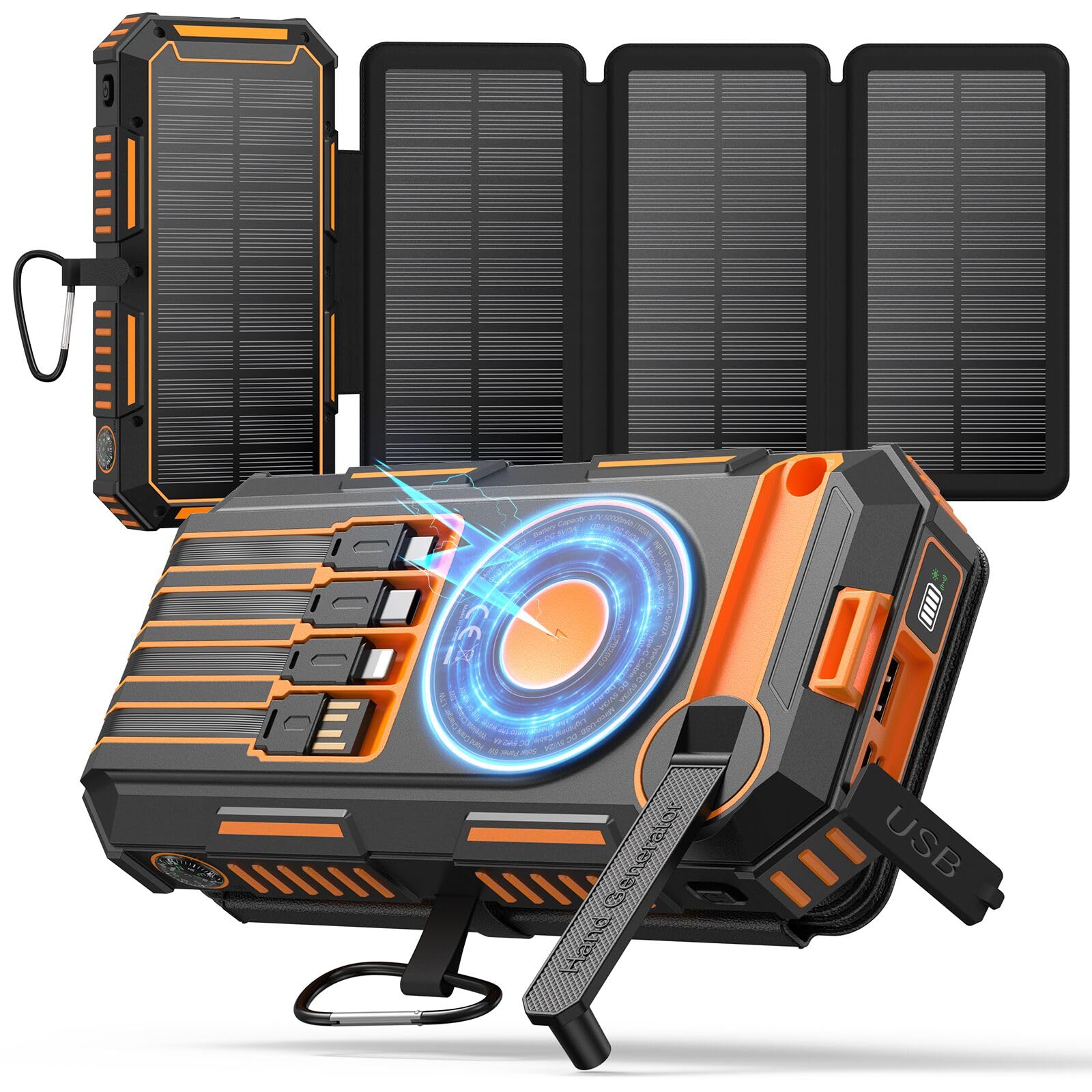
The hand crank is the reason to open this listing and the reason to be suspicious of it. Cranking a generator by hand produces a trickle of current for real effort, and nobody is winding their way back to 50,000mAh. As a last-resort one-more-call feature it’s a genuine comfort; as a plan for a week off-grid, it isn’t one.
The rest is a lot of hardware: 50,000mAh, four solar panels, a 15W magnetic pad that snaps a phone into place, four built-in cables, three ports, a compass and a three-year warranty. Charging six devices at once is realistic here in a way it never is on a 10,000mAh pack.
Our reservation is the shape of it. At 0.5 kg and nearly two inches thick it’s a glovebox or basecamp pack, and a battery this size comes back up slowly whether the power arrives from the wall, the panels or the wireless pad. As a blackout kit that lives in the car next to the jump leads, it makes sense to us — crank, light and compass included. In a hiking pack it’s dead weight.
Pros
- Hand crank as a genuine last resort
- Magnetic 15W wireless mount
- Four panels and four built-in cables
Cons
- Nearly two inches thick and about a pound
- Slow to refill at 50,000mAh
We rate it for the blackout kit rather than the backpack: 50,000mAh, a crank worth having once everything else is flat, and a magnetic wireless pad.
Best for Car Camping
Uukto 20000mAh

Key Features
- Ports: 6
- Weight: 1.11 lb
- Lighting: Camping light plus 2 flashlights
- Battery capacity: 20,000 mAh
- Price: Budget
The lighting is what separates this one. There’s a large camping light built into the case alongside two multi-mode flashlights, and the tent-light setting alone justifies it on a trip where you’re cooking after dark. Most packs here give you a keyring flashlight; this one lights the table you’re eating at.
Six ports and three built-in cables mean a family’s worth of phones, a watch and a headlamp can all be topped up from one brick, and the USB-C port takes a charge in and out. 20,000mAh is the sensible middle of this category: enough for several days of phone use without a battery that needs its own luggage.
It isn’t light. At 503.8 g you’re carrying the light and the port count as much as the capacity, and there are 20,000mAh packs in this group that weigh less. Whether that matters depends entirely on whether you’re walking or parking.
We see it as the car-camping pack: it sits on a table, lights the tent and charges whatever gets plugged into it, and the carabiner keeps it off the ground. For a hiker counting grams it’s the wrong shape. For a family basecamp it does more jobs than anything else here.
Pros
- Camping light plus two flashlights
- Six ports and three built-in cables
Cons
- Half a kilogram for 20,000mAh
Our car-camping pick: 20,000mAh, six ports and a tent light you can read by, in a pack that’s happiest near the vehicle.
Best for Second Pack
Luvknit 20000mAh

Key Features
- Warranty: Lifetime replacement
- USB-C output: 22.5W
- Built-in cables: 3
- Battery capacity: 20,000 mAh
- Price: Budget
A lifetime replacement promise on a budget pack is either the best thing about it or a marketing line, and the difference only shows up when something breaks. The terms are at least unusually clear: direct replacement or refund for failures that aren’t damage you caused, with no return shipping required.
The hardware is straightforward and sensible: 20,000mAh, a 22.5W USB-C PD output the listing rates at 70% in half an hour, three built-in cables covering Lightning, USB-C and micro-USB, a USB-A port and a dual LED flashlight. Nothing exotic, and everything you’d actually use on a trip.
The built-in cables are the practical win. Three of the connectors you’re likely to need are attached to the pack, so a weekend bag doesn’t need a cable pouch at all, and the USB-C port handles input as well as output. It’s the simplest pack here to hand to someone who always forgets a charger.
We think the warranty is the reason to pick it over the other budget packs. If it dies inside a year, cover is what saves you, and the terms here are better than anything else in this group. Buy it as a second pack for the glovebox or the daypack, with the expectation that it might not be your last one.
Pros
- Lifetime replacement warranty
- Three built-in cables plus USB-C in/out
- 22.5W PD at a budget price
Cons
- Lifetime cover depends on the seller honoring it
We like the lifetime replacement cover and the three built-in cables; it’s a low-risk second pack rather than a buy-once choice.
How We Tested the Best Solar Power Banks
We built a shortlist of about 30 solar power banks from brands we’d already bought from and a few we hadn’t, cross-checking listed watt-hours against panel wattage, port types, and price so we weren’t comparing a pocket charger to a brick. Twelve made the cut. We’ve used them for six months — camping weekends, the backyard, car dashboards, ordinary weekday commutes — and re-ran every measurement at the end to see how much capacity the cells had given up.
Battery life was the first thing we checked and the last. We charged a phone from dead to full, over and over, until the bank quit, then compared that count to the watt-hour rating on the box. We timed 0 to 50 percent on a mid-size phone with a USB-C meter in line to see whether a bank delivered its advertised output or quietly fell back to a trickle. For the solar side, each unit sat in direct sun on a dashboard or balcony for two hours while we logged how much the battery gained and whether the panel got hot enough to throttle.
Portability came down to pocket time — we weighed each one and tried it in a jacket pocket, a hip-belt pouch, and a tote. Wireless charging got its own fussing: phone on the pad with the case on and off, shaken, checked for whether the coil lined up on its own or needed nudging. Durability meant waist-high drops onto concrete, dust, splashes, and watching port covers and panel hinges for wear. Functionality got judged the way you’d actually use it — whether the readout shows a real percentage or blinks four dots, and whether the solar gain is visible enough to be satisfying. Value was usable watt-hours and ports per dollar, not the sticker.
How to Choose a Solar Power Bank
The solar panel on these packs is a top-up rather than a fuel tank, so the real decision is how much battery you’ll carry and how quickly it gives that battery back.
Capacity Versus Weight Is the Whole Decision
Everything else in this category is secondary to how much battery you’ll actually carry. A 10,000mAh pack is a phone and a headlamp over a weekend and weighs well under a pound; 20,000mAh roughly doubles both numbers; the 48,000 to 50,000mAh models are around a pound or more and the size of a thick paperback. The trap is buying the biggest number and then leaving it at home because it pulls on your shoulder.
Count nights, not devices. Two nights with one phone is a 20,000mAh pack; a week off-grid is a big one that lives in a basecamp bag or the car rather than on your back all day.
What the Solar Panel Can Actually Do
Four panels producing 1.2A is about six watts in strong, direct sun, and that’s the best case before clouds, angle and shade take their cut. Six watts will nudge a 20,000mAh pack over a long sunny day; it will not refill it, and it will barely register on a 50,000mAh one. Charge from the wall before you leave and treat every hour of sun as a small deposit.
So buy for the trickle, not for the fuel: solar earns its keep on a long trip where the wall is days away, or as a slow rescue when everything else is flat. A listing that promises the sun will keep you running is telling you something about the listing.
Output, Cables and the Wireless Trade-Off
The port you’ll use most is USB-C, and the number that matters is its PD wattage. An 18W or 22.5W port charges a phone about as fast as its own wall charger; a 5V/3A pack is steady rather than quick. If you carry a tablet, check for PD before anything else.
Built-in cables are the quiet luxury of this group. The BLASOUL and the SOARAISE carry four, the FEELLE four, the Luvknit three, and the cable you forget is the one that ends the trip. Wireless charging is a convenience, not a speed feature: it runs warmer and slower than a cable, so use it overnight rather than when you’re in a hurry.
Sealing, Lights and Warranty
An IPX5 pack shrugs off rain and splashes; IP65 adds dust sealing, which matters if the pack lives in a pocket full of sand. Port covers are the part that fails first, so check they seat properly before a trip rather than after.
A built-in light is worth more than an extra port when you’re setting up after dark, and the best here double as tent lights. Warranty length is the other quiet spec: three years from BLAVOR and FEELLE, two from Uukto, lifetime replacement from Luvknit. On a device whose battery ages, that’s real value.
Frequently Asked Questions
Can I take a solar power bank on a plane?
In carry-on, usually. Most airlines cap spare lithium batteries at 100Wh, which is roughly 27,000mAh at 3.7 volts — so the 10,000mAh and 20,000mAh packs here sit comfortably inside the limit, while the 38,800 to 50,000mAh models work out to somewhere around 145 to 185Wh and need the airline’s approval.
Check your carrier’s rule before you fly, and never put one in checked luggage.
Will a solar power bank charge a laptop or a tablet?
A tablet, yes, and slowly. A laptop only if the pack’s USB-C port does Power Delivery at 18W or more, which here means the BLAVOR PN-W12-Pro — and even then, expect to hold a charge on a working machine rather than gain one.
Phones, headlamps, watches, cameras and e-readers are what every pack in this group is built to handle.
Can I leave a solar power bank in a hot car or in the sun all day?
The panel needs sun; the battery doesn’t like heat. Leave it in direct sun while it’s charging, but don’t store it on a dashboard or in a hot car, and bring it inside once it’s topped up.
If the case starts to swell, or the pack gets hot to the touch while charging, retire it. A damaged lithium cell isn’t worth the risk.
Final Verdict
The BLAVOR PN-W12-Pro earns our recommendation because it does the two things that matter most here: it gives power back quickly through a genuine 18W USB-C port, and it keeps working. The solar array is a bonus, not the plan — charge it from the wall the night before you leave and let the panels cover the afternoons in between.
If you’re counting grams, the 9.3-ounce BLAVOR PN-W05 is the one that disappears into a hip belt. If capacity is the whole point, the SOARAISE 48,000mAh gets you the biggest battery here for midrange money, at a weight you’ll feel on the first climb.